belt DODGE DURANGO 2009 2.G Owner's Guide
[x] Cancel search | Manufacturer: DODGE, Model Year: 2009, Model line: DURANGO, Model: DODGE DURANGO 2009 2.GPages: 498, PDF Size: 8.3 MB
Page 73 of 498
3. Attach the tether strap hook of the child restraint to
the tether anchor located on the seatback and remove the
slack in the tether strap according to the manufacturer ’s
instructions.
WARNING!
An incorrectly anchored tether strap could lead to
seat failure and injury to the child. In a collision, the
seat could come loose and allow the child to crash
into the inside of the vehicle or other passengers, or
even be thrown from the vehicle. Use only the anchor
positions directly behind the child seat to secure a
child restraint top tether strap. For instructions, refer
to “Child Restraint Tether Anchor” in this section.
See your authorized dealer for help if necessary.
Transporting Pets
Airbags deploying in the front seat could harm your pet.
An unrestrained pet will be thrown about and possiblyinjured, or injure a passenger during panic braking or in
a collision. Pets should be restrained in the rear seat in
pet harnesses or pet carriers that are secured by seat belts.
ENGINE BREAK-IN RECOMMENDATIONS
A long break-in period is not required for the engine in
your vehicle.
Drive moderately during the first 300 miles (500 km).
After the initial 60 miles (100 km), speeds up to 50 or
55 mph (80 or 90 km/h) are desirable.
While cruising, brief full-throttle acceleration within the
limits of local traffic laws, contributes to a good break-in.
Wide-open throttle acceleration in low gear can be detri-
mental and should be avoided.
The engine oil installed in the engine at the factory is a
high-quality energy conserving type lubricant. Oil
changes should be consistent with anticipated climate
conditions under which vehicle operations will occur.
THINGS TO KNOW BEFORE STARTING YOUR VEHICLE 71
2
Page 74 of 498
The recommended viscosity and quality grades are
shown under “Engine Oil”, under “Maintenance Proce-
dures” in section 7 of this manual. NON-DETERGENT
OR STRAIGHT MINERAL OILS MUST NEVER BE
USED.
A new engine may consume some oil during its first few
thousand miles (kilometers) of operation. This should be
considered as a normal part of the break-in and not
interpreted as an indication of difficulty.
SAFETY TIPS
Transporting Passengers
NEVER TRANSPORT PASSENGERS IN THE CARGO
AREA.
WARNING!
•It is extremely dangerous to ride in a cargo area,
inside or outside of a vehicle. In a collision, people
riding in these areas are more likely to be seri-
ously injured or killed.
•Do not allow people to ride in any area of your
vehicle that is not equipped with seats and seat
belts.
•Be sure everyone in your vehicle is in a seat and
using a seat belt properly.
72 THINGS TO KNOW BEFORE STARTING YOUR VEHICLE
Page 76 of 498
Safety Checks You Should Make Inside The
Vehicle
Seat Belts
Inspect the belt system periodically, checking for cuts,
frays, and loose parts. Damaged parts must be replaced
immediately. Do not disassemble or modify the system.
Front seat belt assemblies must be replaced after a
collision. Rear seat belt assemblies must be replaced after
a collision if they have been damaged (i.e., bent retractor,
torn webbing, etc.). If there is any question regarding belt
or retractor condition, replace the belt.
Airbag Warning Light
The light should come on and remain on for six to eight
seconds as a bulb check when the ignition switch is first
turned ON. If the light is not lit during starting, see your
authorized dealer. If the light stays on, flickers, or comes
on while driving, have the system checked by an autho-
rized dealer.
Defroster
Check operation by selecting the defrost mode and place
the blower control on high speed. You should be able to
feel the air directed against the windshield. See your
authorized dealer for service if your defroster is
inoperable.
Periodic Safety Checks You Should Make Outside
The Vehicle
Tires
Examine tires for excessive tread wear and uneven wear
patterns. Check for stones, nails, glass, or other objects
lodged in the tread. Inspect the tread and sidewall for
cuts and cracks. Check the wheel nuts for tightness.
Check the tires (including spare) for proper pressure.
Lights
Have someone observe the operation of exterior lights
while you work the controls. Check turn signal and high
beam indicator lights on the instrument panel.
74 THINGS TO KNOW BEFORE STARTING YOUR VEHICLE
Page 123 of 498
Using body pressure, move forward and rearward on the
seat to be sure the seat adjusters have latched.
WARNING!
Adjusting a seat while the vehicle is moving is
dangerous. The sudden movement of the seat could
cause you to lose control. The seat belt might not be
properly adjusted and you could be injured. Adjust
any seat only while the vehicle is parked.
Manual Front Seat Recliners
The bucket seats are equipped with recliners. The reclin-
ing mechanism is operated by a lever located on the right
side of the passenger’s seat and the left side of thedriver’s seat. To recline, lean forward slightly before
lifting the lever, then push back to the desired position
and release the lever. Lean forward and lift the lever to
return the seatback to its normal position. Using body
pressure, lean forward and rearward on the seat to be
sure the seatback is locked.
WARNING!
Do not ride with the seatback reclined so that the
shoulder belt is no longer resting against your chest.
In a collision you could slide under the seat belt and
be seriously or even fatally injured. Use the recliner
only when the vehicle is parked.
UNDERSTANDING THE FEATURES OF YOUR VEHICLE 121
3
Page 132 of 498
WARNING!
The 20% seatback contains the center shoulder belt.
A 20% seatback that is not fully latched in the
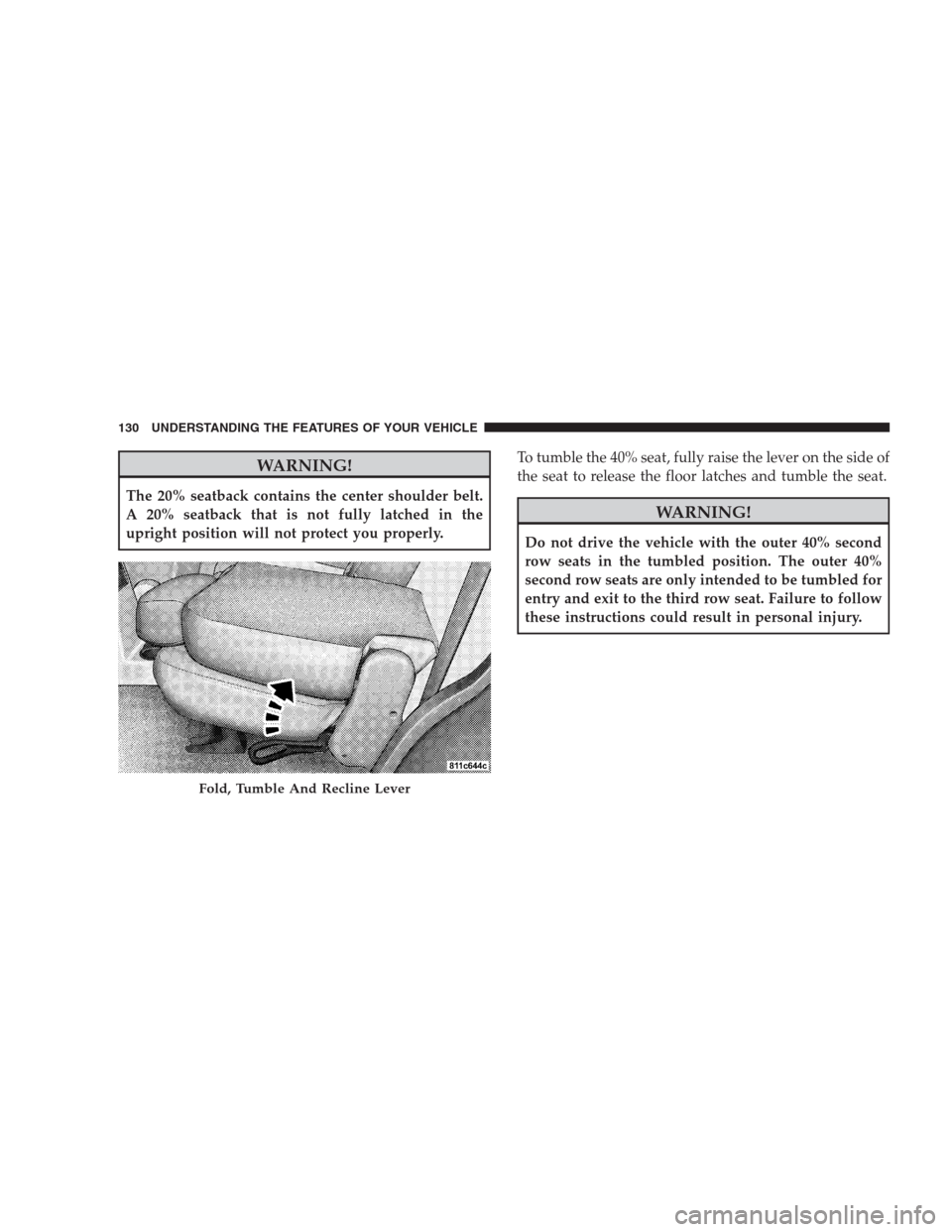
upright position will not protect you properly.To tumble the 40% seat, fully raise the lever on the side of
the seat to release the floor latches and tumble the seat.
WARNING!
Do not drive the vehicle with the outer 40% second
row seats in the tumbled position. The outer 40%
second row seats are only intended to be tumbled for
entry and exit to the third row seat. Failure to follow
these instructions could result in personal injury.
Fold, Tumble And Recline Lever
130 UNDERSTANDING THE FEATURES OF YOUR VEHICLE
Page 136 of 498

NOTE:The seat belt buckles are hinged to fold with the
seatback.
WARNING!
•Do not sit in the third row seat unless the cushion
and back are properly engaged. Proper engage-
ment can be verified by pushing/pulling on the
upright seatback. The seatback will not move
unless properly engaged.
•Do not sit in the third row seat with the second
row seatback(s) folded or tumbled. In a collision,
you could slide under the seat belt and be seri-
ously or even fatally injured.
Third Row 60/40 Folding — If Equipped
The third row can be equipped with a 60/40 folding seat.
Either side of the third row seat can be folded to extend
the cargo area.The seatback release lever and a seatback return strap
located on both sides of the rear seating sections.
Third Row Seat
134 UNDERSTANDING THE FEATURES OF YOUR VEHICLE
Page 140 of 498
4. Turn on the radio and set the radio station presets (up
to 10 AM and 10 FM stations can be set).
5. Adjust the Automatic Temperature Control (ATC)
while the ATC is in Auto mode.
6. Press and release the SET button located on the
driver’s door.
7. Within five seconds, press and release memory button
1 or 2 on the driver’s door. The next steps must be
performed within 10 seconds if you desire to also use a
RKE transmitter to recall memory positions.
8. Turn the vehicle off and remove the key.
9. Press and release the LOCK button on one of the RKE
transmitters.
10. Insert the ignition key and turn the ignition switch to
the ON position.11. Repeat the above steps to set the next memory
position using the other numbered memory button or to
link another RKE transmitter to memory.
NOTE:A chime sound may be heard if Setting Memory
was inhibited for any reason.
Memory Position Recall
NOTE:
•The driver’s seat belt must be unbuckled to recall
memory positions.
•The vehicle must be in PARK to recall memory posi-
tions.
•Not all motors may be moved at one time. Please refer
to the eight-way power seat description in this section.
138 UNDERSTANDING THE FEATURES OF YOUR VEHICLE
Page 156 of 498
WARNING!
Tilting the steering column while the vehicle is
moving is dangerous. Without a stable steering col-
umn, you could lose control of the vehicle and have
an accident. Adjust the column only while the ve-
hicle is stopped. Be sure it is locked before driving.
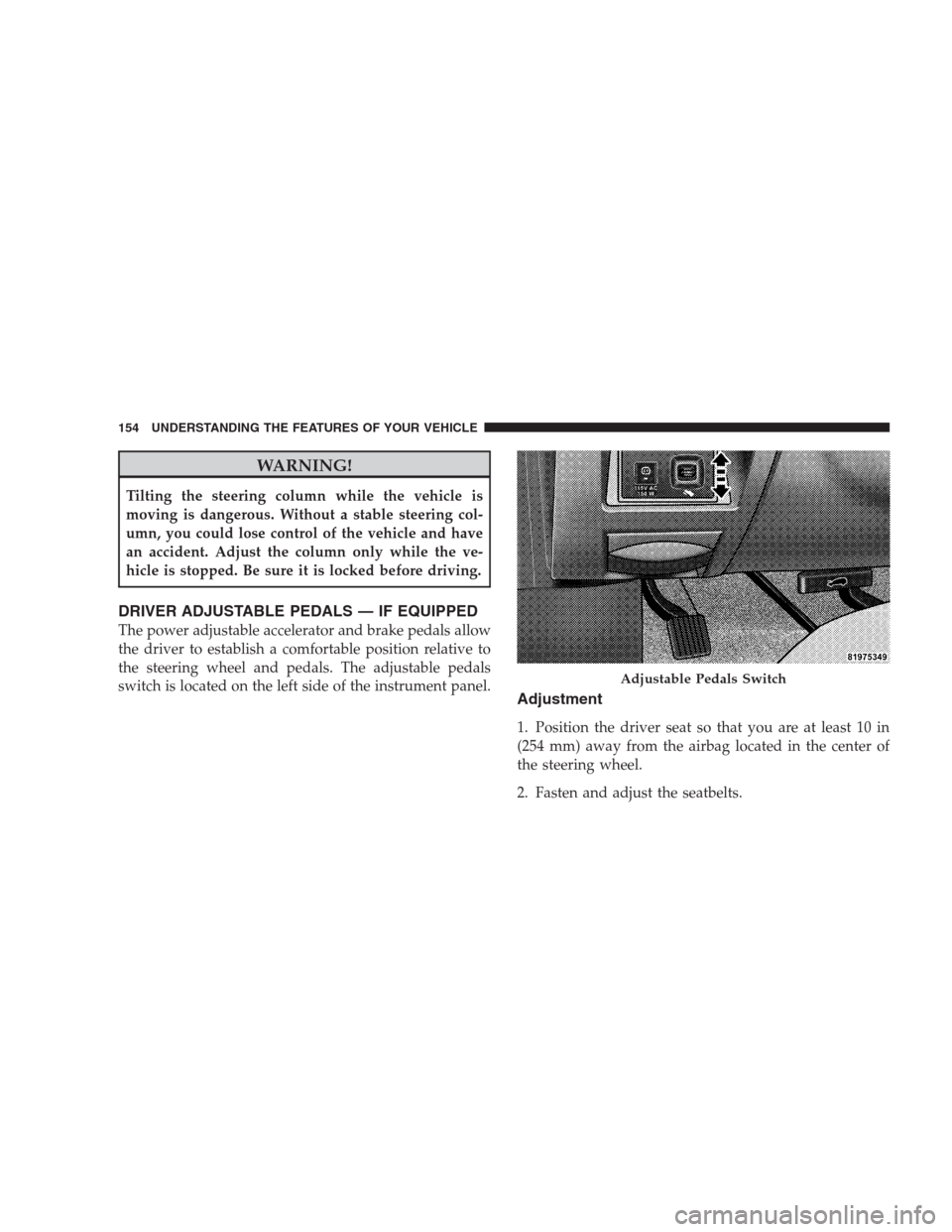
DRIVER ADJUSTABLE PEDALS — IF EQUIPPED
The power adjustable accelerator and brake pedals allow
the driver to establish a comfortable position relative to
the steering wheel and pedals. The adjustable pedals
switch is located on the left side of the instrument panel.
Adjustment
1. Position the driver seat so that you are at least 10 in
(254 mm) away from the airbag located in the center of
the steering wheel.
2. Fasten and adjust the seatbelts.
Adjustable Pedals Switch
154 UNDERSTANDING THE FEATURES OF YOUR VEHICLE
Page 185 of 498
movement and the sunroof will remain in a partial open
condition until the switch is pushed forward again. To
close fully, hold the switch in the forward position until
the glass movement has stopped.
The sunshade can be opened manually. It will also open
as the sunroof opens. The sunshade cannot be closed if
the sunroof is open.
WARNING!
•Never leave children alone in a vehicle. Leaving
unattended children in a vehicle is dangerous for a
number of reasons. A child or others could be
seriously or fatally injured. Don’t leave the key in
the ignition. A child could operate power win-
dows, other controls, or move the vehicle.
(Continued)
WARNING! (Continued)
•In an accident, there is a greater risk of being
thrown from a vehicle with an open sunroof. You
could also be seriously injured or killed. Always
fasten your seat belt properly and make sure all
passengers are properly secured too.
•Do not allow small children to operate the sun-
roof. Never allow fingers or other body parts, or
any object to project through the sunroof opening.
Injury may result.
Wind Buffeting
Wind buffeting can be described as the perception of
pressure on the ears or a helicopter-type sound in the
ears. Your vehicle may exhibit wind buffeting with the
windows down, or the sunroof (if equipped) in certain
open or partially open positions. This is a normal occur-
rence and can be minimized. If the buffeting occurs with
the rear windows open, open the front and rear windows
UNDERSTANDING THE FEATURES OF YOUR VEHICLE 183
3
Page 206 of 498
5. High Beam Indicator
Indicates that headlights are on high beam.
6. Seat Belt Reminder Light
This light comes on for several seconds after the
ignition is turned ON as a reminder to “buckle
up.” This light will remain on as long as the seat
belt remains unbuckled. If this light flashes, it indicates a
fault in the seat belt system. Have the system checked by
an authorized dealer.
7. Engine Temperature Warning Light
This light warns of an overheated engine condi-
tion. As temperatures rise and the gauge ap-
proachesH(Hot), this indicator will illuminate
and a single chime will sound after reaching a set
threshold. Further overheating will cause the tempera-
ture gauge to passH(Hot), the indicator will continu-
ously flash and a continuous chime will occur until the
engine is allowed to cool.CAUTION!
Driving with a hot engine cooling system could
damage your vehicle. If the temperature light is on,
safely pull over and stop the vehicle. Idle the vehicle
in neutral with the air conditioner turned off until
the light turns off. If the light remains on, turn the
engine off immediately, and call for service.
WARNING!
A hot engine cooling system is dangerous. You or
others could be badly burned by steam or boiling
coolant. You may want to call a service center if your
vehicle overheats. If you decide to look under the
hood yourself, see Section 7 of this manual. Follow
the warnings under the Cooling System Pressure Cap
paragraph.
204 UNDERSTANDING YOUR INSTRUMENT PANEL