wheel DODGE DURANGO 2021 Vehicle Warranty
[x] Cancel search | Manufacturer: DODGE, Model Year: 2021, Model line: DURANGO, Model: DODGE DURANGO 2021Pages: 262, PDF Size: 10.42 MB
Page 235 of 262

TOYO TIRES® – LIMITED WARRANTY
234
• When two new tires have been installed onto the rear axle positions,
they are to be kept on the rear but rotated from side to side. This is
recommended after installing two new tires to the rear position, or
if you discover significant tread depth differences between the front
and rear positions during rotation intervals.
REPLACING ONE TIRE
• Replacing a single tire on a vehicle can have an adverse effect on
s
uspension systems, gear ratios, transmission, and tire treadwear.
• If single tire replacement is unavoidable, it is recommended that the
s
ingle new tire be paired with the tire that has the deepest tread and
both be placed on the rear axle. Placing greater traction on the rear
axle on wet surfaces is necessary to prevent a possible oversteer
condition and loss of vehicle stability.
WHEEL ALIGNMENT AND BALANCING
• Proper wheel alignment and balance are very important consider -
a
tions for safety and getting the maximum mileage from your tires.
Yo
u need to check how your tires are wearing at least once a month.
• Your vehicle may be out of alignment if your tires are wearing
u
nevenly, such as when the inside shoulder of the tire is wearing
faster than the rest of the tread. This condition not only shortens the
life of your tires, it adversely affects the handling characteristics of
your vehicle, which could be dangerous. If your tires show irregular
wear, have your vehicle’s alignment checked immediately.
Page 237 of 262

TOYO TIRES® – LIMITED WARRANTY
236
If you experience a blowout or a sudden tire failure, the following
information should be helpful:
• When the tire failure occurs, you may hear a loud noise, or feel a
v
ibration, and/or the vehicle may pull toward the side of the failed
tire. Do not abruptly brake or turn.
• Maintain steady pressure on the accelerator pedal.
•
Hold the steering wheel firmly and steer to maintain your lane posi -
t
ion.
• Find a safe place to pull off the road and allow the vehicle to gradu -
a
lly decelerate. Apply light braking as required to stop safely.
• Gradually pull over to the shoulder and come to a stop. Look for a
d
amaged tire on your vehicle.
• Seek roadside assistance or change the damaged tire with your
s
pare tire.
• Have all of your tires and the vehicle thoroughly inspected by a tire
p
rofessional.
TIRE ROTATION
The purpose for rotating tires is to achieve more uniform wear for all
ti
res on a vehicle. Your tires should be thoroughly examined on a lift
by a tire dealer for any abnormalities. If tires show uneven treadwear,
ask the service person to check and/or correct any vehicle wheel
alignment or other mechanical problem before rotation.
The following rotation patterns are acceptable. Please refer to your
ve
hicle Owner’s Manual for rotation advice.
Page 239 of 262

TOYO TIRES® – LIMITED WARRANTY
238
More frequent rotation or a thorough vehicle inspection may be
necessary if, upon inspection, irregular or erratic treadwear is
beginning to appear.
It is important to remember the following:
• These tire rotation recommendations do not take into account
d
ifferent tire and construction types mixed on the vehicle.
• Some tires cannot be rotated in the manner described. Such tires
i
nclude unidirectional tires. Unidirectional tread patterns must be
rotated front-to-rear only so that the direction of revolution does not
change.
• Some vehicles are designed with different tire sizes on the front and
r
ear axles. Normally, such combinations will not allow rotation.
Prior to rotating, consult the vehicle Owner’s Manual.
• For vehicles with dual rear wheels, see the vehicle Owner’s Manual
f
or the vehicle manufacturer’s procedures. If your vehicle Owner’s
Manual is not available, please contact the vehicle manufacturer.
• Some vehicles are equipped with wheels that limit the choice of
r
otation pattern. Consult the vehicle Owner’s Manual.
• Do not include temporary spare tires in the rotation pattern.
H
owever, if your spare tire is the same size and type as a road tire
(for LT tires of the same size, type, and load rating), it should be
included in the tire rotation process. The proper procedure is to use
the vehicle manufacturer’s recommended tire rotation procedures,
or if not available, to use the appropriate rotation pattern shown,
inserting the spare in the right rear position. Place the tire that
would have gone to the right rear in the spare tire storage position
as the new spare.
• Important! After rotation, adjust the pressure of the individual tires
t
o the vehicle manufacturer’s recommendation or the inflation pres-
sure recommended by Toyo Tires for an optional fitment according
to
the tire’s new location on the vehicle.
• Do not mix speed-rated tires on the same axle. Higher speed-rated
t
ires must remain on the rear axle. Consult an authorized Toyo Tires
dealer.
Page 243 of 262
TOYO TIRES® – LIMITED WARRANTY
242
TIRE SPINNING
TOWING OR USE OF SLIDE-IN TRUCK CAMPERS
If you are towing a trailer or using a slide-in truck camper, refer to
y o
ur vehicle Owner’s Manual.
WINTER (SNOW) TIRES Winter driving presents special challenges for vehicle
handling. The use of winter tires, studs, and chains,
wh
ile improving traction performance in snow and ice,
requires additional caution and care with regard to
braking, cornering, and speed. It is important to drive
with care not only on snow and ice, but on dry and wet
roads as well.
• T raction is considerably reduced as snow tires approach 50% tread
w
ear, and replacement should be considered in order to maintain
effectiveness in heavy snow conditions.
• Tire speed rating – When lower-speed-rated winter tires replace
h
igher-speed-rated touring and high performance all-season radial
tires, do not exceed the lower-rated speed.
WARNING!
Spinning a tire to remove a vehicle stuck in mud, snow, or wet
gr
ass can be dangerous. This could cause serious personal injury
or death to a bystander or passenger and extensive vehicle
damage. A tire spinning at a speedometer reading above 35 miles
pe
r hour (55 km/h) can reach a speed capable of disintegrating a
ti
re with explosive force within a matter of seconds. Under some
conditions, a tire may be spinning at twice the speed shown on
the speedometer. Never spin a tire above a speedometer reading
of 35 mph (55 km/h). Never allow anyone to stand near or directly
be
hind the spinning tire. Do not spin if a drive wheel is off the
ground.
WARNING!
Studded tires may require longer braking distances on dry or wet
pa
ved surfaces. Failure to allow for adequate braking distance
could result in serious personal injury or death.
Page 246 of 262
TOYO TIRES® – LIMITED WARRANTY
245
TIRE STORAGE
Tires should be stored indoors in a cool dry place where water cannot
co
llect inside the tires. The tires should be placed away from harmful
ozone-producing electric generators and motors and sources of heat
such as hot pipes. Storage surfaces should be clean and free of grease,
gasoline, or other substances, which can deteriorate the rubber.
WARNING!
• Check inflation pressure before using your spare tire. Failure to
h
ave proper inflation pressure when using your spare tire may
cause loss of vehicle control, which could result in serious
personal injury or death. Maintain spare tire inflation pressures
based on the vehicle Owner’s Manual or the Tire Information
Placard.
• “T” Type high-pressure temporary spare tires should not be
u
sed with any other wheel, nor should standard tires, snow tires,
wheel covers, or trim rings be used on the high-pressure spare
tire wheel. If you fail to follow this warning, your vehicle’s
handling characteristics can be seriously affected. You could
have an accident resulting in serious personal injury or death.
Consult your vehicle Owner’s Manual for the proper use of your
“temporary use” spare tire.
• Do not operate your vehicle with more than one temporary spare
i
n use (this does not apply to a full size spare), and only operate
it at limited speeds and distances as indicated on the sidewall of
the tire.
• The “T” Type temporary spare tire may lower ground clearance
w
hen used. Avoid driving over large obstacles and other road
hazards. Check your vehicle Owner’s Manual for other special
clearance precautions when using the “T” Type temporary spare
tire provided in your vehicle.
Page 248 of 262
TOYO TIRES® – LIMITED WARRANTY
247
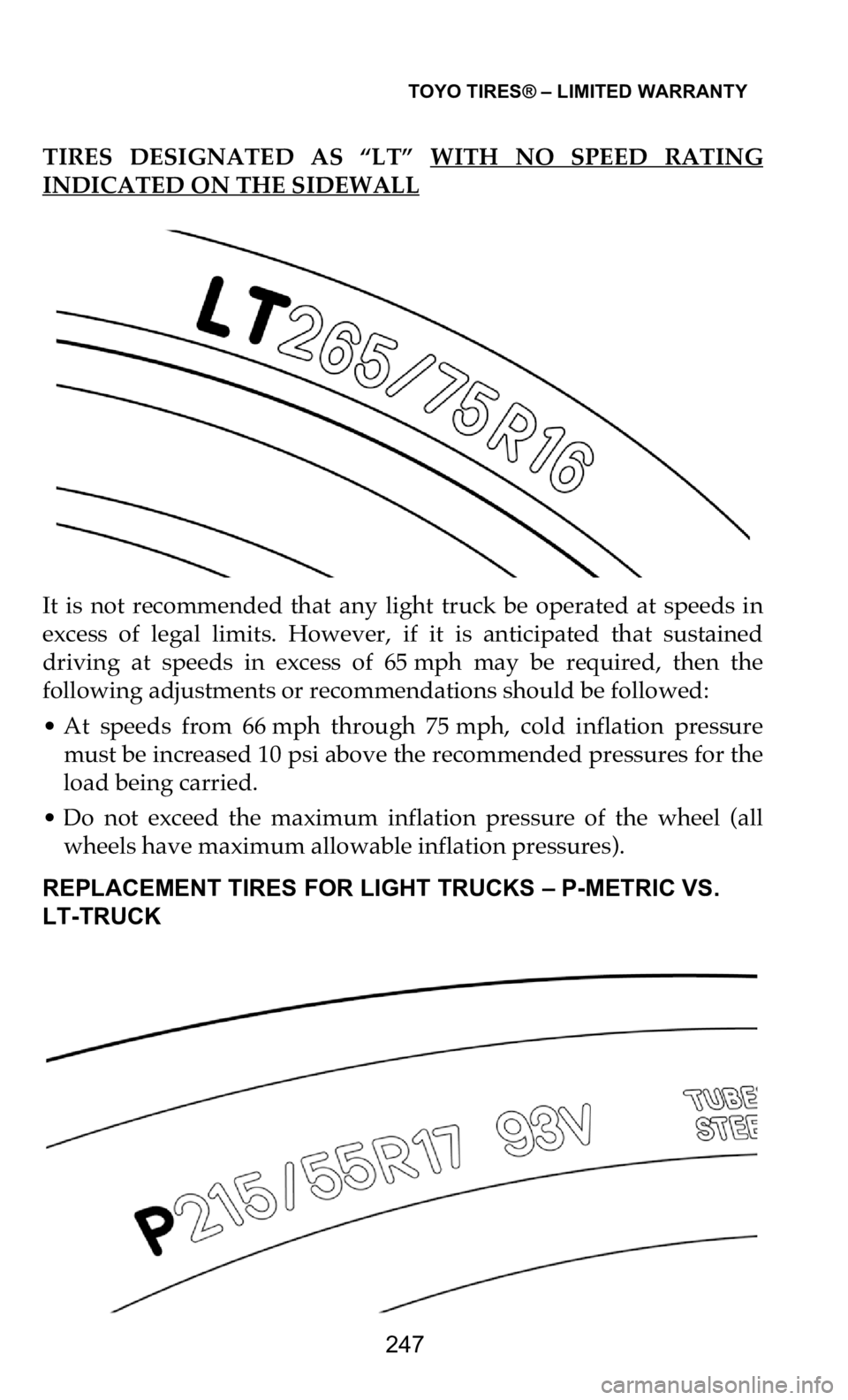
TIRES DESIGNATED AS “LT” WITH NO SPEED RATING
INDICATED ON THE SIDEWALL
It is not recommended that any light truck be operated at speeds in
excess of legal limits. However, if it is anticipated that sustained
driving at speeds in excess of 65 mph may be required, then the
fo
llowing adjustments or recommendations should be followed:
• At speeds from 66
mph through 75 mph, cold inflation pressure
mu
st be increased 10 psi above the recommended pressures for the
load being carried.
• Do not exceed the maximum inflation pressure of the wheel (all
w
heels have maximum allowable inflation pressures).
REPLACEMENT TIRES FOR LIGHT TRUCKS – P-METRIC VS.
LT
-TRUCK
Page 253 of 262
TOYO TIRES® – LIMITED WARRANTY
252
tions of their use and may vary due to driving habits, service prac-
tices, differences in road characteristics, and climate.
• Traction - The traction grades from highest to lowest are AA, A, B,
a
nd C, and they represent the tire’s ability to stop on wet pavement
as measured under controlled conditions on specified government
test surfaces of asphalt and concrete.
• Temperature - The temperature grades are A (the highest), B, and C,
r
epresenting the tire’s resistance to the generation of heat and its
ability to dissipate heat when tested under controlled conditions on
a specified indoor laboratory test wheel. Sustained high tempera -
tures can cause the materials of the tire to degenerate and reduce tire
li
fe, and excessive temperature can lead to sudden tire failure. The
grade C corresponds to a level of performance that all passenger car
tires must meet under the Federal Motor Vehicle Safety Standard
No. 139. Grades B and A represent higher levels of performance on
the laboratory test wheel than the minimum required by law.
• D OT Quality Grades - All passenger car tires must conform to
f
ederal requirements in addition to these grades. CAUTION!
The traction grade assigned to tires is based on locked braking
( s
traight ahead) traction tests and does not include cornering
(turning) traction.
WARNING!
The temperature grade is established for a tire that is properly
in
flated and not overloaded. Excessive speed, underinflation, or
excessive loading either separately or in combination can cause
heat buildup and possible tire failure. This can cause an accident,
which could lead to serious personal injury or death.
Page 257 of 262

YOKOHAMA TIRES — LIMITED WARRANTY
256
2. WHAT IS NOT WARRANTED
Tires that have become unserviceable for the following reasons:
• Road hazard injuries or damages, caused to the tire by obstacles and
d
ebris such as cuts, punctures (whether repairable or not), snags,
bruises, tears, or impact breaks.
• Improper repairs or repairs that have failed.
•
Improper inflation or other maintenance abuses.
•
Incorrect mounting of the tire, or tire/wheel imbalance.
•
Mechanical irregularities in the vehicle such as wheel misalignment,
w
orn, or faulty parts.
• Accident, corrosion, vandalism, fire, or damage caused by nature.
•
Tires used on vehicles in racing or special applications.
•
Non-speed-rated temporary spare tires used over 50
mph
(80 km/h).
• Tires worn out [2/32
inch (1.6 mm) or less of tread remaining] .
• Tires that have been retreaded.
•
Tires transferred from the vehicle on which they were originally
i
nstalled.
• Improper storage
3
. WHAT IS WARRANTED
Tires that have become unserviceable for reasons other than stated
ab
ove will be replaced in accordance with this warranty.
If a warrantable condition is found, tires will be replaced as follows:
A) Passenger Car and Light Truck Tires (Other than Temporary
Sp
are Tires)
When a tire becomes unserviceable during the first 2/32 inch (1.6 mm)
of
original usable tread depth or 12 months from date of vehicle
pu
rchase, whichever comes first, it will be replaced with a comparable
new YOKOHAMA tire free of charge. During this period, tires will be
mounted and balanced without charge. Other service charges such as
tire rotation, alignment or applicable taxes are payable by the
customer.
When a tire has worn past the above specified period for free
re
placement, the customer must pay for the cost of a new comparable
YOKOHAMA passenger car or light truck tire on a pro-rated basis.
The dealer shall determine this cost by multiplying the percentage of
Page 260 of 262

YOKOHAMA TIRES — LIMITED WARRANTY
259
6. Do not use snow chains on your YOKOHAMA high pressure
spare. This could cause damage to your vehicle.
7. When the tread wear indicator appears on the tire, replace it only
w
ith the same type spare tire.
8. Check the tire’s cold inflation pressure monthly and maintain at 60
p
si (4.2 kg/cm2) even when not in use. Do not inflate over 60 psi.
9. The YOKOHAMA high pressure spare tire should not be used with
a
ny other rim nor should standard tires, wheel covers, or trim rings
be used on the YOKOHAMA high pressure spare tire rim on which
the YOKOHAMA high pressure spare tire was originally installed.
IMPORTANT SAFETY INFORMATION
All tires require owner maintenance regardless of how well a tire is
co
nstructed. Operational damages such as punctures, impact
damage, cuts, incorrect inflation, etc., may cause tire failure and
subsequent personal injury and/or property damage. Simple
operational and maintenance practices, as listed below, will reduce
the chances of tire problems.
Tire Inspection
Visually inspect your tires frequently for any tire damage such as
sc
rapes, bulges, cuts, nails, irregular wear, etc. resulting from
operation. This must be done immediately after any known or
suspected contact with an object in the road, a pothole, road
irregularity or after severe braking. Refer these conditions to a
reputable tire service center for repair or replacement. Never drive on
a tire if such conditions appear.
Tire Loading
Never exceed the maximum vehicle load limit listed on the vehicle
pl
acard, tire information label or in the Owners Manual. Be aware of
the load carrying limits molded into the tire’s sidewall and do not
exceed those limits. Maximum load can only be carried at the
maximum cold inflation pressure indicated on the tire’s sidewall.
Speed Limits
Regardless of the speed capability of your tires, never exceed lawful
sp
eeds or speeds dictated by driving conditions.