wheel DODGE DURANGO 2021 Vehicle Warranty
[x] Cancel search | Manufacturer: DODGE, Model Year: 2021, Model line: DURANGO, Model: DODGE DURANGO 2021Pages: 262, PDF Size: 10.42 MB
Page 214 of 262
TOYO TIRES® – LIMITED WARRANTY
213
WHAT IS NOT COVERED?
This Limited Warranty does not cover the following categories of
cl
aims:
Rapid Treadwear: Original equipment tires are not guaranteed to last
a
specified number of miles.
Damage from road hazards (not limited to cuts, snags, bruises, impact
br
eaks, bulges, punctures, stone drills, chips, and scales), fire, theft, or
collision.
Conditions arising from improper tire/vehicle maintenance or use,
no
t limited to:
• Irregular or excessive treadwear due to: Incorrect inflation; over -
l
oading; vehicle misalignment; failure to rotate tires; and poor or
de
fective mechanical condition of brakes, shocks, and wheels; or
other factors attributable to the vehicle or wheel.
• Any tire which has been run with low air pressure or while flat.
•
Damage due to abuse; vandalism; tire alteration; tire spinning;
r
acing; or other competitive activities.
• Damage, corrosion, or deterioration from using oil-based chemicals,
w
ater-based sealers, balancing substances, or flammable gases.
• Damage from improper use of tire chains.
T
ires with the DOT identification number removed or rendered
il
legible.
Improper mounting, balancing or repair, not limited to:
• Improper tire mounting, or tire/wheel assembly imbalance.
•
Damage from incorrect mounting or dismounting of the tire, incor -
r
ect wheel size, water or other material trapped inside the tire
du
ring mounting, or failure to keep the tires balanced.
• Damage resulting from improper repair materials or procedures.
F
ailure to meet conditions of this Limited Warranty, not limited to:
• Any tire that is not an Eligible Tire.
•
Any tire for which mileage and tire rotation records are not avail -
a
ble or verifiable.
• Any tire not presented and available for Toyo Tires’ inspection.
•
Any tire worn beyond the treadwear indicators (less than 2/32” of
r
emaining tread).
• Uniformity issues after the first 25% of treadwear.
Page 224 of 262
TOYO TIRES® – LIMITED WARRANTY
223
RECOMMENDATIONS FOR SAFE TIRE INFLATION
• If you must inflate your tires when they are hot, add four pounds
p
er square inch (4 psi) (28 kPa) above the recommended inflation
pressure specification. Recheck the inflation pressure when the tires
are cold and adjust to the recommended inflation pressure shown
on the vehicle’s Tire Information Placard.
• Never release air or nitrogen from a hot tire in order to reach the
r
ecommended cold tire pressure. Normal driving causes tires to run
hotter and inflation pressure to increase. If you release pressure
when your tires are hot, you may dangerously underinflate your
tires. If your tires lose more than one pound per square inch (1 psi)
per month, the tire, the valve, or the wheel may be damaged.
Consult an authorized Toyo Tires dealer for an inspection.
• Over-inflation can cause the tire to be more susceptible to impact
d
amage.
• Over-inflation or underinflation may adversely affect vehicle
h
andling.
• Remember to check your spare tire. Consult your vehicle Owner’s
M
anual for the correct inflation pressure and use of a “temporary
use” spare tire. The inflation pressure specified for a spare tire is
typically different from that specified for your regular tires.
• Use valve caps to keep valve cores clean and clear of debris and to
h
elp guard against air leakage.
WARNING!
Never inflate a tire unless it is secured to the vehicle or a tire
mo
unting machine. Inflating an unsecured tire is dangerous. If
the tire bursts, it could be propelled into the air with explosive
force and cause serious personal injury or death.
Page 225 of 262
TOYO TIRES® – LIMITED WARRANTY
224
VEHICLES EQUIPPED WITH TIRE PRESSURE MONITORING
SYSTEMS (TPMS)Even if your vehicle is equipped with a tire pressure
monitoring system, you should check your tire pressure
at
least once per month when the tires are cold for
example, after being parked overnight. Tire pressure
warning systems are not a substitute for regular tire
pressure maintenance.
IDENTIFYING DAMAGED TIRES
• I f your tire strikes a road hazard at any speed, internal tire damage
c
ould result, which may lead to sudden tire failure and loss of
vehicle control. Tire failure may even occur miles after the initial
impact. Impact damage from such hazards may not be visible on the
outside of the tire. Have your Toyo Tires® dealer dismount the tire
and inspect it for damage. A tire may not have visible signs of
damage on the tire surface or the interior.
• If the impact was sufficient to bend the wheel flange, internal tire
d
amage may have occurred, compromising the safety and integrity
of the tire. Such impact damage may result in a sudden tire failure
many weeks or months later. Tire replacement is highly recom -
mended as a safety precaution.
• Indications of impact damage include, but are not limited to, a
b
ubble or a blister on the outside of the tire.
• Have your dealer inspect your tires if you see anything unusual or
i
f cuts, cracks, splitting, or bruises in the tread and sidewall areas are
visible. Bumps or bulges may indicate a serious and dangerous
separation within the tire body. Have your tire inspected by a qual -
ified tire service person. It may be necessary to have the tire
re
moved from the wheel for a complete inspection.
WARNING!
If your vehicle is equipped with TPMS, read the vehicle Owner’s
Ma
nual regarding its operation. Some TPMS systems do not alert
you until the tires are significantly underinflated, which could
result in permanent tire damage and possible sudden tire failure.
In the event that your TPMS malfunction indicator lamp is
displayed, you should immediately pull over to a safe parking
area and check your tires.
Page 226 of 262
TOYO TIRES® – LIMITED WARRANTY
225
• Inspect your tires for adequate tread depth. When the tire is worn to
the built-in indicators at 2/32” (1.6 mm) or less tread groove depth,
th
e tire is worn out and must be replaced. Never drive on tires to the
point that the tire cord or the fabric is exposed.
• Inspect your tires for uneven wear. Wear on one side of the tread or
f
lat spots in the tread may indicate alignment or other problems
with the tires or the vehicle. Consult an authorized Toyo Tires®
dealer.
IDENTIFYING DAMAGED WHEELS
Periodically check to see if any of the following symptoms exist, in
w h
ich case the wheel must be replaced:
• If the flange is bent.
•
If welds or rivets are leaking.
•
If the stud holes are elongated and not round. (Improper lug nut
t
ightening could cause this.)
• If there are cracks in the wheel.
W
ORN OUT TIRES
Tires must be replaced when tread is worn to 2/32” (1.6 mm).
Tr
eadwear indicators on Toyo Tires® treads show the 2/32” depth
(1.6 mm). Most states require that tires be replaced when the tread
de
pth is worn to 2/32” (1.6 mm). Tires may lose sufficient wet and
sn
ow traction before reaching 2/32” (1.6 mm) of wear. Many wet
we
ather accidents result from skidding on worn out tires.
Excessively worn tires are more susceptible to penetrations. Consider
re
placing your tires earlier if you drive in snow or wet conditions.
WARNING!
Never drive on a tire if there is any evidence of damage. Driving
on
a damaged tire is dangerous. A damaged tire could suddenly
fail, which may result in loss of vehicle control and lead to serious
personal injury or death. Do not attempt to dismount, mount, or
repair a tire yourself. See your Toyo Tires dealer immediately if
you detect damage.
Page 228 of 262
TOYO TIRES® – LIMITED WARRANTY
227
• Do not use a rope type plug for repair. A tire must be removed from
the wheel and inspected for interior damage. Any tire repair done
without removing the tire from the wheel is improper and unsafe.
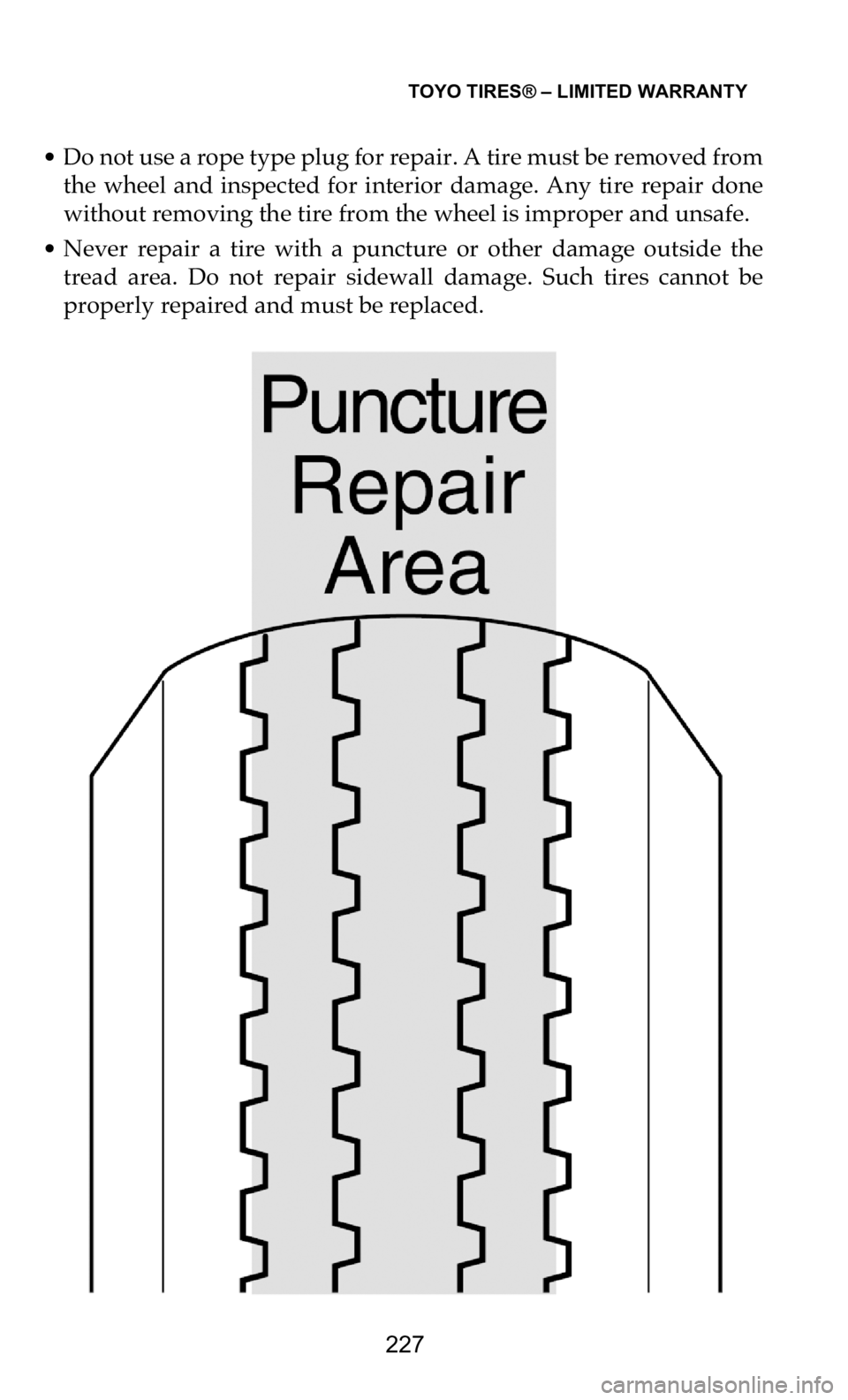
• Never repair a tire with a puncture or other damage outside the
t
read area. Do not repair sidewall damage. Such tires cannot be
properly repaired and must be replaced.
Page 230 of 262
TOYO TIRES® – LIMITED WARRANTY
229
The following procedures concerning replacement tires must be
followed:
• Confirm that the load-carrying capacity is greater than or equal to
t
he loadcarying capacity of the OE tire size at the pressure indicated
on the vehicle Tire Information Placard.
• Carefully note any differences between recommendations for front
a
nd rear axle positions regarding the tire size and/or inflation pres-
sure.
• The speed rating must be equal to or greater than what is specified
b
y the vehicle manufacturer if the speed capability of the vehicle is
to be maintained.
• Tires should be mounted on approved wheel widths. If changing
t
ire sizes, check to make sure the wheel has adequate load and infla -
tion pressure capacity.
• Body and chassis clearance must be checked on the vehicle’s front
a
nd rear axles.
In addition to the above, light truck tire replacements should take into
co
nsideration the following:
• Proper spacing between dual tires is necessary for optimum tire
p
erformance. If chains are used, particular care must be taken to
assure adequate clearance between loaded tires to avoid damage
from the chains. The allowable outside diameter difference between
a tire and its dual mate is 1/4 inch (6.4 mm) for light truck tires.
WARNING!
• Failure to install tires with adequate load capacity will result in
t
ire fatigue and sudden tire failure. This could lead to loss of
vehicle control, possibly resulting in personal injury or death.
• Certain vehicle performance parameters, including ride comfort
a
nd handling, may be affected by substitute tire sizes. In some
cases, particularly for SUVs and light trucks, a failure to follow
the vehicle manufacturer’s recommendations for tire replace -
ment could adversely affect the safe handling of the vehicle,
po
ssibly resulting in a loss of vehicle control leading to personal
injury or death.
Page 231 of 262
TOYO TIRES® – LIMITED WARRANTY
230
(Continued)
CONSIDERATIONS IN PLUS SIZING
Always refer to and follow the vehicle manufacturer’s replacement
ti
re recommendations. In some cases, a vehicle manufacturer may
specifically advise against the application of replacement tires that are
not of the original size or type.
TIRE AND WHEEL MATCHING AND MOUNTING
WARNING!
Any attempt to mount a tire on a wheel with a different diameter
wi
ll result in an explosion of the tire/wheel assembly that could
cause severe personal injury or death.
Prior to mounting any tire, always check the wheel identification
st
amp to verify the correct wheel diameter. Always check the tire
size molded onto the sidewall.
Never exceed 40 psi when seating the tire beads onto the wheel.
Always stand well clear of any tire mounting operation. This is
es
pecially important when the service operator inflates the tire. If
the tire has been improperly mounted, it could burst with
explosive force causing serious personal injury or death.
A new valve stem must be installed on the wheel each time a
wo
rn out passenger or light truck tire is replaced.
Removing and replacing tires on wheels can be dangerous.
Attempting to mount tires with improper tools or procedures
co
uld result in a tire explosion, causing serious personal injury or
death. This is a job for your authorized Toyo Tires dealer or other
qualified tire service location only.
Serious personal injury or death can result from:
• Failure to select the proper tire and wheel. The tire must match
t
he width and diameter requirements of the wheel. When
mounting truck type radial tires use only wheels approved for
radial tires.
• Failure to inspect both the tire and wheel. The wheel must be
f
ree of cracks, dents, chips, and rust. The tire must be free of bead
damage, cuts, and punctures.
Page 232 of 262
TOYO TIRES® – LIMITED WARRANTY
231
TIRE MIXING
• Toyo Tires® recommends that all four tires be of the same size,
s
peed rating, and construction (radial or non-radial). In some cases
the vehicle manufacturer may require different sized tires for the
front or rear axles. Never mix P-metric or European Metric
passenger tires with LT-metric tires on the same vehicle.
• Match tire size designations in pairs on an axle, except during the
t
emporary use of a spare tire.
• If two radial tires and two non-radial tires are used on a vehicle, put
t
he radials on the rear axle. If radial and non-radial tires are used on
a vehicle equipped with dual rear tires, the radial tires may be used
on either axle.
SPEED-RATED TIRE
• If the vehicle Tire Information Placard and/or the vehicle Owner’s
M
anual specifies speed-rated tires, the replacement tires must have
the same or higher speed rating to maintain vehicle speed capa -
bility.
• F
ailure to follow proper procedures. For proper mounting proce -
d
ures, consult the Rubber Manufacturers Association’s publica -
tion “Care and Service of Automobile and Light Truck Tires”
(r
ef.: www.ustires.org ).
•
Exceeding the maximum bead seating pressure of 40 psi. Be
a
bsolutely certain beads are fully seated before adjusting the
inflation pressure to the level recommended for vehicle opera -
tion.
Never put flammable substances in the tire/wheel assemblies at
an
y time. Never put any flammable substance into a tire/wheel
assembly and attempt to ignite it in order to seat the beads.
CAUTION!
Driving your vehicle with an improper mix of tire sizes,
co
nstructions, and speed ratings can be dangerous. Your car’s
handling characteristics can be adversely affected. You could have
an accident resulting in serious personal injury or death. Consult
your vehicle Owner’s Manual or an authorized Toyo Tires dealer
for proper tire replacement.
WARNING! (Continued)
Page 233 of 262
TOYO TIRES® – LIMITED WARRANTY
232
• If a replacement tire has a lower speed capability than that specified
by the vehicle manufacturer, the vehicle’s speed must be restricted
to that of the replacement tire. Vehicle handling could also be
affected. Consult the vehicle Owner’s Manual or tire manufacturer
for recommendations.
• If tires with different speed ratings are used, it is recommended that
t
he lower speed- rated tires always be placed on the front axle. This
is to prevent a potential oversteer condition.
FOUR-WHEEL DRIVE (4WD) AND ALL-WHEEL DRIVE (AWD)
VE
HICLES
If no instructions for tire mixing appear in the vehicle Owner’s
Ma
nual, follow these guidelines:
• Do not mix tire sizes. All four tires must be marked with the same
t
ire size, unless otherwise specified by the vehicle manufacturer.
This also applies to winter/snow tires.
• Do not mix tread pattern types such as all-terrain and all- season.
S
TUDLESS WINTER/SNOW TIRES
• It is always preferable to apply winter/snow tires to all wheel posi -
t
ions, including dual tires, to maintain vehicle mobility and control.
• If winter/snow tires are applied to the f
ront axle of any vehicle,
winter/snow tires must also be installed on the
rear axle. DO NOT
apply winter/snow tires only to the front axle. This applies to all
passenger and light truck vehicles, including front-wheel- drive,
4WD, and AWD vehicles.
• If winter/snow tires are installed on the rear axle of any vehicle, it is
recommended (but not required) that they also be installed on the
front axle.
WARNING!
Unless winter/snow tires on the rear axle have comparable
tr
action qualities to the tires on the front axle, the vehicle may
experience adverse handling characteristics. This may result in
loss of vehicle control, which can lead to serious personal injury
or death.
Page 234 of 262
TOYO TIRES® – LIMITED WARRANTY
233
STUDDED WINTER/SNOW TIRES
• Studded winter/snow tires have higher traction qualities under
m
ost winter weather conditions.
• If studded winter/snow tires are installed on the f
ront axle of any
vehicle, studded winter/snow tires must also be installed on the
rear axle. DO NOT apply studded winter/snow tires only to the
front axle.
• If studded winter/snow tires are installed on the rear axle of any
vehicle, it is strongly recommended that they should also be
installed on the
front axle. Only if studded winter/snow tires are
installed on all wheel positions of a vehicle will optimum handling
characteristics be achieved.
REPLACING TWO TIRES
• When a pair of replacement tires is selected in the same size and
c
onstruction as those on the vehicle, the two newer tires must be
installed on the rear axle and must be of equal or higher speed rating
than the front tires. Generally, new tires with deeper tread will
provide better grip and evacuate water more effectively, which is
important as a driver approaches hydroplaning situations. Placing
greater traction on the rear axle on wet surfaces is necessary to
prevent a possible oversteer condition and loss of vehicle stability.
WARNING!
Installing only two studded winter/snow tires on the front axle of
an
y vehicle (including front-wheel-drive vehicles) without
studded winter/snow tires on the rear axle can cause adverse
vehicle handling characteristics. This can result in a loss of
vehicle control, which could cause serious personal injury or
death.
CAUTION!
In some cases, the vehicle manufacturer may specifically advise
ag
ainst replacing fewer than all four tires. Always check and
follow the recommendations in the vehicle Owner’s Manual. For
4WD and AWD vehicles, even small differences in outside
diameter may cause drivetrain damage or mechanical
malfunction.