wheel DODGE DURANGO 2021 Vehicle Warranty
[x] Cancel search | Manufacturer: DODGE, Model Year: 2021, Model line: DURANGO, Model: DODGE DURANGO 2021Pages: 262, PDF Size: 10.42 MB
Page 159 of 262

MICHELIN®
158
has complied with the terms and conditions of the warranty,
Michelin® will replace the tires as described under “How
Replacement Charges are calculated”.
Temporary Spares
Michelin® temporary spare tires are covered by this warranty for six
ye
ars from the date of purchase or until the first 2/32 nds of an inch
(1.6 mm) of the original tread is worn off. Date of purchase is
do
cumented by new vehicle registration or tire sales invoice. If no
proof of purchase is available, coverage will be based on date of
manufacture. At that time, all warranties, express or implied, expire.
WHAT IS NOT COVERED
Tires which become unserviceable due to:
• Road hazard injury (e.g., a cut, snag, bruise, impact damage or
p
uncture)
• Incorrect mounting of the tire, tire/wheel imbalance or improper
r
epair
• Misapplication, improper maintenance, racing, underinflation,
o
verinflation or other abuse
• Uneven or rapid wear which is caused by mechanical irregularity in
t
he vehicle such as wheel misalignment, (a measured tread differ -
ence of 2/32 nds of an inch (1.6 mm) or more across the tread on the
sa
me tire)
• Accident, fire, chemical corrosion, tire alteration, or vandalism
•
Use in commercial applications for tread wear; by this warranty for
s
ix years
• Flat spotting caused by improper storage or brake lock
•
The addition of liquid, solid or gaseous materials other than air,
n
itrogen or carbon dioxide (for example, waterbase sealers or
balancing substances)
• Cosmetic ozone or weather cracking
•
Use of Michelin® Self-Supporting Zero Pressure (ZP) tires without
a
properly operating low air pressure warning system
Page 164 of 262

MICHELIN®
163
in the Michelin® Owner’s Manual, vehicle Owner’s Manual, tire
placard information, and tire sidewall information regarding safety
warnings, proper tire use and maintenance.
CONTROLLABILITY
Controlling a vehicle when a tire failure occurs
If a tire failure occurs, you may hear a loud noise, feel a vibration,
an
d/or the vehicle may pull toward the side of the failed tire. If
possible, step on the accelerator momentarily to maintain forward
momentum and ensure vehicle control. It is most important that you
DO NOT BRAKE OR ABRUPTLY TURN THE STEERING WHEEL.
Slowly remove your foot from the accelerator and hold the steering
wheel firmly while steering to remain in your lane. Once the vehicle
has slowed and is fully under control, apply the brakes gently; safely
pull over to the shoulder and come to a stop. Inspect the tires. If one
or more looks flat or low, shows detachment or other damage, remove
tire assembly and replace it with a properly inflated spare. Bumps or
bulges may indicate detachment within the tire body and require
inspection by a qualified tire technician.
DRIVING ON ANY TIRE THAT DOES NOT HAVE THE CORRECT
I N
FLATION PRESSURE IS DANGEROUS
Any underinflated tire builds up excessive heat that may result in
su
dden tire destruction. If tires are supplied as original equipment,
refer to the tire decal on the vehicle (check vehicle and/or vehicle
Owner’s Manual for decal location) for the recommended operating
pressures. For replacement tires, the correct inflation pressure will be
provided by your tire retailer; if not, refer to the vehicle decal.
These inflation pressures must be maintained as a minimum.
Ho
wever, do not exceed the maximum pressure rating indicated on
the tire sidewall.
SELF-SUPPORTING TIRES. ZERO PRESSURE (ZP) TIRES, AND
PA
X® SYSTEM TIRES, AT LOW OR ZERO AIR PRESSURE
The handling characteristics of a vehicle with a deflated PAX® System
ti
re or Self- Supporting Zero Pressure (ZP) tire (whether front or rear)
are not the same as those of a vehicle with normally inflated tires.
Avoid high speeds and hard cornering whenever a low pressure
warning is activated.
Page 165 of 262

MICHELIN®
164
Even a MICHELIN® PAX® System Tire or Self-Supporting Zero
Pressure (ZP) tire can build up excessive heat when run underinflated
for an extended period of time. The length of time and distance a
PAX® System Tire/Self-Supporting Zero Pressure (ZP) tire will
perform at low or zero air pressure will depend upon the severity of
the event causing air loss, ambient temperature, speed at which the
tire is operated, and the conditions under which the tire is operated
(i.e. hard braking, cornering and other sharp maneuvers will greatly
reduce the length of time the tire can perform at low or zero air
pressure.) Continuous use of an underinflated tire may lead to sudden
tire destruction. If a tire at low or zero pressure begins to vibrate or
cause difficulty in vehicle handling, remove the tire immediately and
replace with the temporary spare. If Michelin® PAX® System Tire/
Self-Supporting Zero Pressure (ZP) tires are supplied as original
equipment, refer to the vehicle owner’s manual for complete details
on the low tire pressure warning system designed to alert you in the
event of a low pressure condition.
NOTE:
MICHELIN® SELF-SUPPORTING ZERO PRESSURE (ZP) TIRES
AR
E TO BE USED ONLY IN CONJUNCTION WITH AN OPERA -
TIONAL, MICHELIN® APPROVED, LOW TIRE PRESSURE
WA
RNING SYSTEM. Otherwise, all provisions of the limited
warranty are void. For a list of approved systems, see your partici -
pating Michelin® tire retailer, or call toll free:1-
800-847-3435
NOTE:
Some MICHELIN® Self-Supporting Zero Pressure (ZP) tires can only
be
mounted on special SH-M (Symmetric Hump - Modified) wheels.
These tires bear the special SH-M designation, molded into the side -
wall of the tire, next to the ZP designation. DO NOT MOUNT A TIRE
WI
TH THE SH-M DESIGNATION ON THE SIDEWALL ON A
STANDARD WHEEL. DOING SO VOIDS THIS LIMITED
WARRANTY AND COULD CAUSE THE TIRE TO BECOME
UNSERVICEABLE AT LOW OR ZERO PRESSURE, RESULTING IN
SERIOUS PERSONAL INJURY OR DEATH.
NOTE:
MICHELIN® PAX® SYSTEM TIRES ARE TO BE USED ONLY IN
CO
NJUNCTION WITH AN OPERATIONAL, TIRE PRESSURE
MONITORING SYSTEM (TPMS), APPROVED BY THE VEHICLE
MANUFACTURER FOR USE WITH THE PAX SYSTEM. Otherwise,
Page 168 of 262

MICHELIN®
167
instructions for checking pressures when tires are hot. When tires
have cooled, check air pressure again. If any tire has lost more than
5 PSI from the previous pressure check, have the tire inspected at
once by an authorized PAX® System Retailer for PAX® tires or a
participating Michelin® tire retailer or representative of your
vehicle manufacturer if your vehicle Owner’s Manual so advises.
Failure to do so may cause irreparable damage to the tire and result
in sudden tire destruction and personal injury.
TIRE PRESSURE MONITORING SYSTEMS (TPMS):
Your vehicle may be equipped with a Tire Pressure Monitoring
Sy
stem (TPMS) that is designed to monitor the pressure of tires
mounted on your vehicle and sends a signal to the driver if a tire
pressure falls below a predetermined level. A TPMS should not
replace monthly manual pressure checks for all four tires and the
spare. We recommend that you manually monitor and check tire
pressure inflation with a pressure gauge. Your tires should have the
recommended pressure listed by your vehicle’s manufacturer. This
information can be found in the vehicle Owner’s Manual and often on
a placard located in the vehicle’s door jamb, inside the fuel hatch, or
on the glove compartment door. If you have a plus size fitment that
requires a higher inflation pressure, your tire pressure monitoring
system will require re-calibration to new inflation pressure. Refer to
your tire dealer/installer of plus size tires for proper inflation
pressure.
We recommend checking air pressure once each month, and before a
l o
ng trip. Whether you have a full-sized or mini-spare, make sure that
it is properly inflated as well. If the TPMS generates improper
monitoring or signals we recommend that you consult your Owner’s
Manual provided with your vehicle and follow-up with your vehicle’s
manufacturer.
TIRE SPINNING
Do not spin wheels in excess of 35 mph (55 km/h) as indicated on the
sp
eedometer. Excessive speed in a free-running, unloaded tire can
cause it to “explode” from centrifugal force. The energy released by
such an explosion is sufficient to cause serious physical injury or
death. Never allow anyone to stand near or behind the spinning tire.
When in mud, sand, snow, ice or other slippery conditions, do not
en
gage in excessive wheel spin. Accelerating the motor excessively,
particularly with automatic transmission vehicles, may cause a drive
Page 169 of 262

MICHELIN®
168
tire that has lost traction to spin beyond its speed capability. This is
also true when balancing a drive tire/wheel assembly on the vehicle
using the vehicle engine to spin the tire/wheel assembly.
HIGH SPEED DRIVING CAN BE DANGEROUS
Correct inflation pressure is especially important. H
owever, at high
speeds, even with the correct inflation pressure, a road hazard, for
example is more difficult to avoid and if contact is made, has a greater
chance of causing tire damage than at a lower speed. Moreover,
driving at high speed reduces the reaction time available to avoid
accidents and bring your vehicle to a safe stop. If you see any damage
to a tire or wheel, replace it with the spare at once and visit a
participating Michelin® tire retailer.
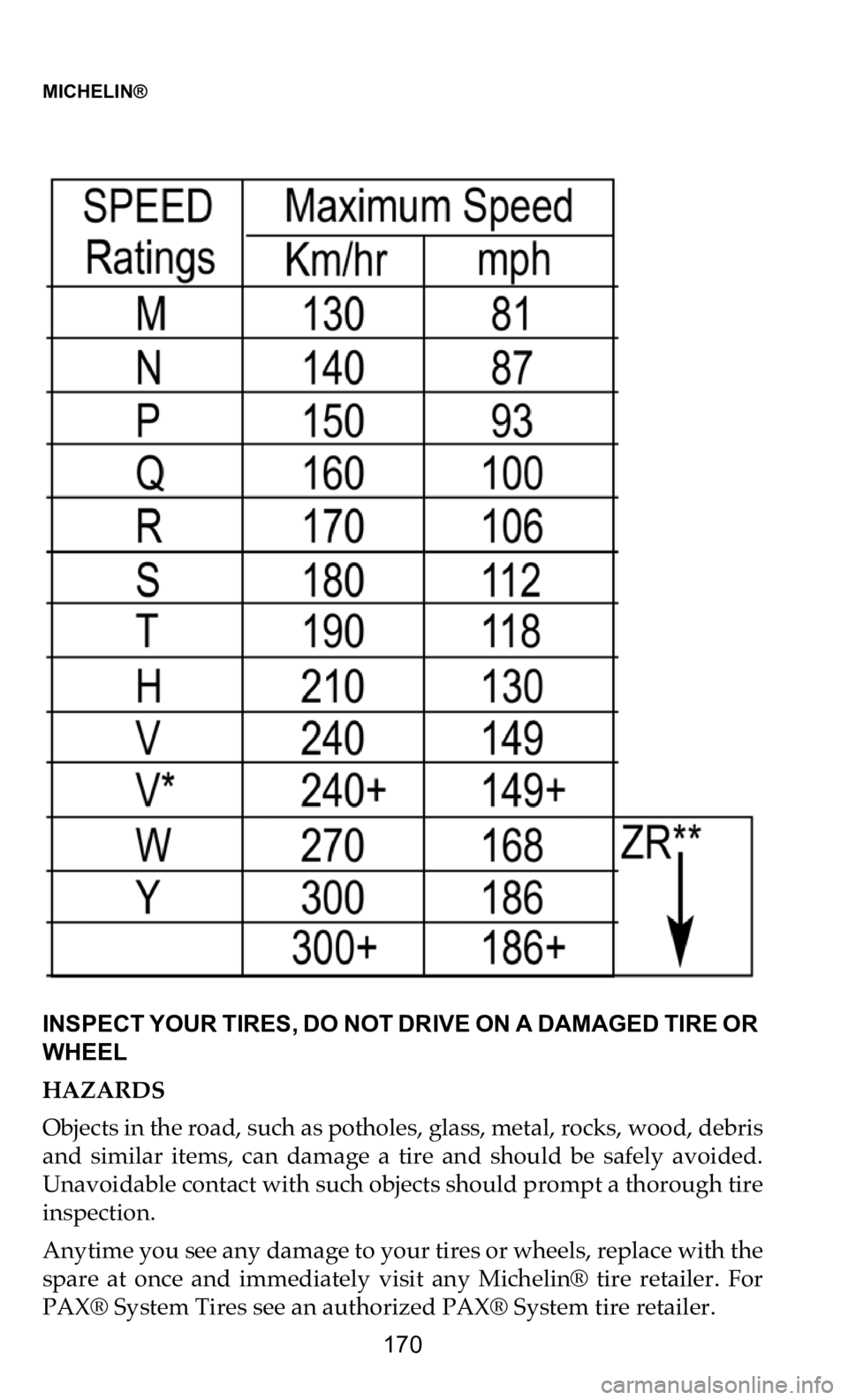
Exceeding the maximum speeds shown on the following page for each
ty
pe of Michelin® tire will cause the tire to build up excessive heat
which can cause tire damage that could result in sudden tire
destruction and rapid air loss. Failure to control a vehicle when one or
more tires experience a sudden air loss can lead to an accident.
In any case, you should not exceed reasonable speeds as indicated
by
the legal limits and driving conditions.
SPEED RATINGS
Speed Symbols are shown on the sidewall of some Michelin® tires.
Th
e following table shows the maximum speed corresponding to the
symbol.
*Some V (or VR) rated tires may have a speed capacity greater than
14
9 mph (240 km/h). Consult your participating Michelin® tire
re
tailer for maximum speed rating if your vehicle capability exceeds
this speed.
**Z (or ZR) rated tires are designed to use on cars with maximum
sp
eed capabilities in excess of 149 mph (240 km/h).
(W and Y speed ratings are subcategories of Z).
Consult your Michelin® tire retailer for maximum speed capabilities.
Fo
r PAX® System Tires consult an authorized PAX® System Tire
Retailer. Although a tire may be speed-rated, we do not endorse the
operation of any vehicle in an unsafe or unlawful manner. Speed
ratings are based on laboratory tests which relate to performance on
the road, but are not applicable if tires are underinflated, overloaded,
worn out, damaged, altered, improperly repaired or retreaded.
Page 171 of 262
MICHELIN®
170
INSPECT YOUR TIRES, DO NOT DRIVE ON A DAMAGED TIRE OR
WHEEL
HAZARDS
Objects in the road, such as potholes, glass, metal, rocks, wood, debris
an
d similar items, can damage a tire and should be safely avoided.
Unavoidable contact with such objects should prompt a thorough tire
inspection.
Anytime you see any damage to your tires or wheels, replace with the
sp
are at once and immediately visit any Michelin® tire retailer. For
PAX® System Tires see an authorized PAX® System tire retailer.
Page 172 of 262

MICHELIN®
171
IMPACT DAMAGE
A tire impacted by a road hazard (curb, pothole, debris) may be
da
maged but not have visible signs of damage on its surface. A tire
damaged by an impact may sustain a sudden failure a day, week, or
even months later. You may not recall hitting an object that damaged
or injured your tires. Air loss, unusual tire wear, localized wear or
vibrations can also be signs of internal tire damage.
If you suspect any damage to your tire or wheel from an impact with
a
curb, pothole or debris on the road or any other road hazard, or if
you feel or hear any unusual vibration, replace with a properly
inflated spare at once and immediately visit any qualified tire
technician.
INSPECTION
When inspecting your tires, including the spare, check the air
pr
essures. If the pressure check indicates that one of your tires has lost
pressure of two pounds or more, look for signs of penetration, valve
leakage or wheel damage that may account for the air loss.
Always look for bulges, cracks, cuts, penetrations, and abnormal
ti
re wear, particularly on the edges of the tire tread, which may be
caused by misalignment or underinflation. If any such damage is
found, the tire must be inspected by any Michelin® tire retailer at
once. Use of a damaged tire could result in tire destruction.
All tires will wear out faster when subjected to high speeds as well as
ha
rd cornering, rapid starts, sudden stops, frequent driving on roads
which are in poor condition, and off road use. Roads with holes and
rocks or other objects can damage tires and cause misalignment of
your vehicle. When driving on such roads, drive carefully and slowly,
and before driving again at normal or highway speeds, examine your
tires for any damage, such as cuts, bulges, penetrations, unusual wear
patterns, etc.
WEAR-BARS
Michelin® tires contain “Wear-Bars” in the grooves of the tire tread
wh
ich show up when only 2/32nds of an inch (1.6 mm) of tread is
re
maining. At this stage, your tires must be replaced. Tires worn
beyond this stage are extremely dangerous.
Page 173 of 262

MICHELIN®
172
DO NOT OVERLOAD - DRIVING ON ANY OVERLOADED TIRE IS
DANGEROUS
The maximum load rating of your tires is molded on the tire sidewall.
Do
not exceed this rating. Follow the loading instructions of FCA US
LLC for your vehicle and this will ensure that your tires are not
overloaded. Tires which are loaded beyond their maximum allowable
loads for the particular application will build up excessive heat that
may result in sudden tire destruction.
Do not exceed the gross axle weight rating for any axle on your
ve
hicle.
TRAILER TOWING
If you anticipate towing a trailer, you should visit any Michelin® tire
re
tailer for advice concerning the correct size tire and pressures. Tire
size and pressures will depend upon the type and size of trailer and
hitch utilized, but in no case must the maximum cold inflation
pressure or tire load rating be exceeded. Check the tire decal and the
owner’s manual supplied by FCA US LLC for your vehicle for further
recommendations on trailer towing.
MICHELIN® PAX® System Tires/Self-Supporting Zero Pressure
(Z
P) Tires and Trailer Towing
Operation of Pax® or ZP tires at low or zero air pressure with a trailer
in
tow, is dangerous and is not recommended. If the low pressure
warning indicator is activated when a trailer is in tow, stop, disconnect
the trailer, and do not continue to tow the trailer until the tire has been
repaired and re-inflated to the proper air pressure. If the tire cannot be
repaired, it must be replaced with a new full size, PAX®/ZP tire, and
inflated to the proper air pressure, before the trailer can be safely
towed again.
WHEEL ALIGNMENT AND BALANCING ARE IMPORTANT
FO
R SAFETY AND MAXIMUM MILEAGE FROM YOUR TIRES.
CHECK HOW YOUR TIRES ARE WEARING AT LEAST ONCE
EA
CH MONTH
If your tires are wearing unevenly, such as the inside shoulder of the
ti
re wearing faster than the rest of the tread, or if you detect excessive
vibration, your vehicle may be out of alignment or balance. These
conditions not only shorten the life of your tires but adversely affect
the handling characteristics of your vehicle, which could be
dangerous. If you detect irregular wear or vibration, have your
Page 174 of 262
MICHELIN®
173
alignment and balance checked immediately. Tires which have been
ran underinflated will show more wear on the shoulders than in the
center of the tread.
TIRE MIXING
Michelin® tires are radial tires and for best performance it is
re
commended that the same size and type of tire be used on all four
wheel positions. Before mixing tires of different types in any
configuration on any vehicle, be sure to check the vehicle
manufacturer’s owner‘s manual for its recommendations.
It is especially important to check the vehicle manufacturer’s Owner’s
Ma
nual when mixing, matching, or replacing tires on 4-wheel drive
vehicles, as this may require special precautions.
MICHELIN® DOES NOT RECOMMEND MIXING PAX® SYSTEM
TI
RES WITH NON-PAX TIRES/SELF-SUPPORTING ZERO
PRESSURE (ZP) TIRES WITH NON-ZP TIRES OTHER THAN THE
TEMPORARY USE OF THE SPARE IF THE VEHICLE IS SO
EQUIPPED.
WINTER DRIVING
Tires which meet the US Tire Manufacturers Association (USMTA)
de
finition of snow tires are marked M/S, or M&S. On such tires, this
designation is molded into the sidewall. Tires without this notation
are not recommended or Winter driving.
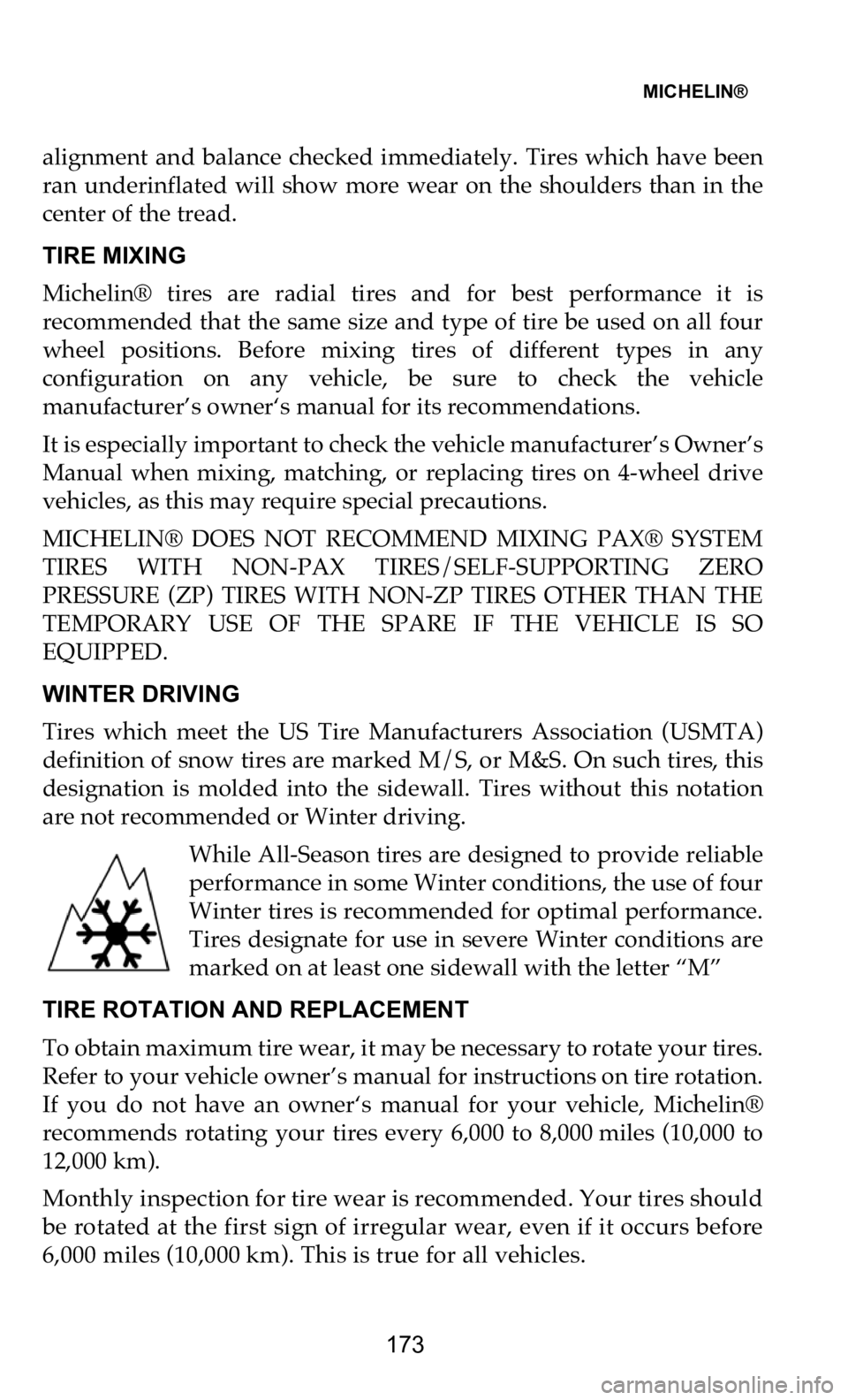
While All-Season tires are designed to provide reliable
performance in some Winter conditions, the use of four
Wi
nter tires is recommended for optimal performance.
Tires designate for use in severe Winter conditions are
marked on at least one sidewall with the letter “M”
TIRE ROTATION AND REPLACEMENT
To obtain maximum tire wear, it may be necessary to rotate your tires.
Re
fer to your vehicle owner’s manual for instructions on tire rotation.
If you do not have an owner‘s manual for your vehicle, Michelin®
recommends rotating your tires every 6,000 to 8,000 miles (10,000 to
12
,000 km).
Monthly inspection for tire wear is recommended. Your tires should
be
rotated at the first sign of irregular wear, even if it occurs before
6,000 miles (10,000 km). This is true for all vehicles.
Page 175 of 262

MICHELIN®
174
When rotating tires with a directional tread pattern, observe the
arrows molded on the sidewall which show the direction the tire
should turn. Care must be taken to maintain the proper turning
direction.
Some Tire Pressure Monitoring Systems (TPMS) may not recognize
th
at a tire has been moved to a different position on your vehicle.
Make certain that your TPMS system is reset, if necessary, so as to
correctly identify the location of each tire on your vehicle. Refer to
your vehicle owner’s manual or your vehicle dealer.
Determine whether rotated tires require tire inflation adjustment as
fr
ont and rear position tire pressure may vary according to the vehicle
manufacturer’s specification due to the actual load on that wheel
position. Some vehicles may have different sized tires mounted on the
front and rear axles, and these different sized tires have rotation
restrictions. Always check the vehicle owner’s manual for the proper
rotation recommendations.
Full-size Spare
Full-size spare tires (not temporary spares) of the same size and
co
nstruction should be used in a five tire rotation. Always check the
inflation pressure of the full-size spare immediately before
incorporating it into rotation. Follow the vehicle manufacturer’s
recommended pattern for rotation, or if not available, see a qualified
tire technician.
Replacement of Two Tires
It is recommended that all four tires are replaced at the same time.
Ho
wever, when only two tires are replaced, the new tires should be
put on the rear. The new tires, with deeper tread, may provide better
grip and water evacuation in wet driving conditions.
CUSTOMIZATION OF TIRES, WHEELS, OR SUSPENSION ON
SU
VS AND LIGHT TRUCKS
Due to their size, weight and higher center of gravity, vehicles such as
SU
Vs and light trucks do not have the same handling characteristics
as automobiles. Because of these differing characteristics, failure to
operate your SUV/truck in a proper and safe manner can increase the
likelihood of vehicle rollover. Modifications to your SUV/truck tire
size, tire type, wheels or suspension can change its handling
characteristics and further increase the likelihood of vehicle rollover.
Whether your SUV/truck has the original equipment configuration
for tires, wheels and suspension or whether any of these items have