air condition DODGE DURANGO 2021 Vehicle Warranty
[x] Cancel search | Manufacturer: DODGE, Model Year: 2021, Model line: DURANGO, Model: DODGE DURANGO 2021Pages: 262, PDF Size: 10.42 MB
Page 61 of 262
BRIDGESTONE® - FIRESTONE®
60
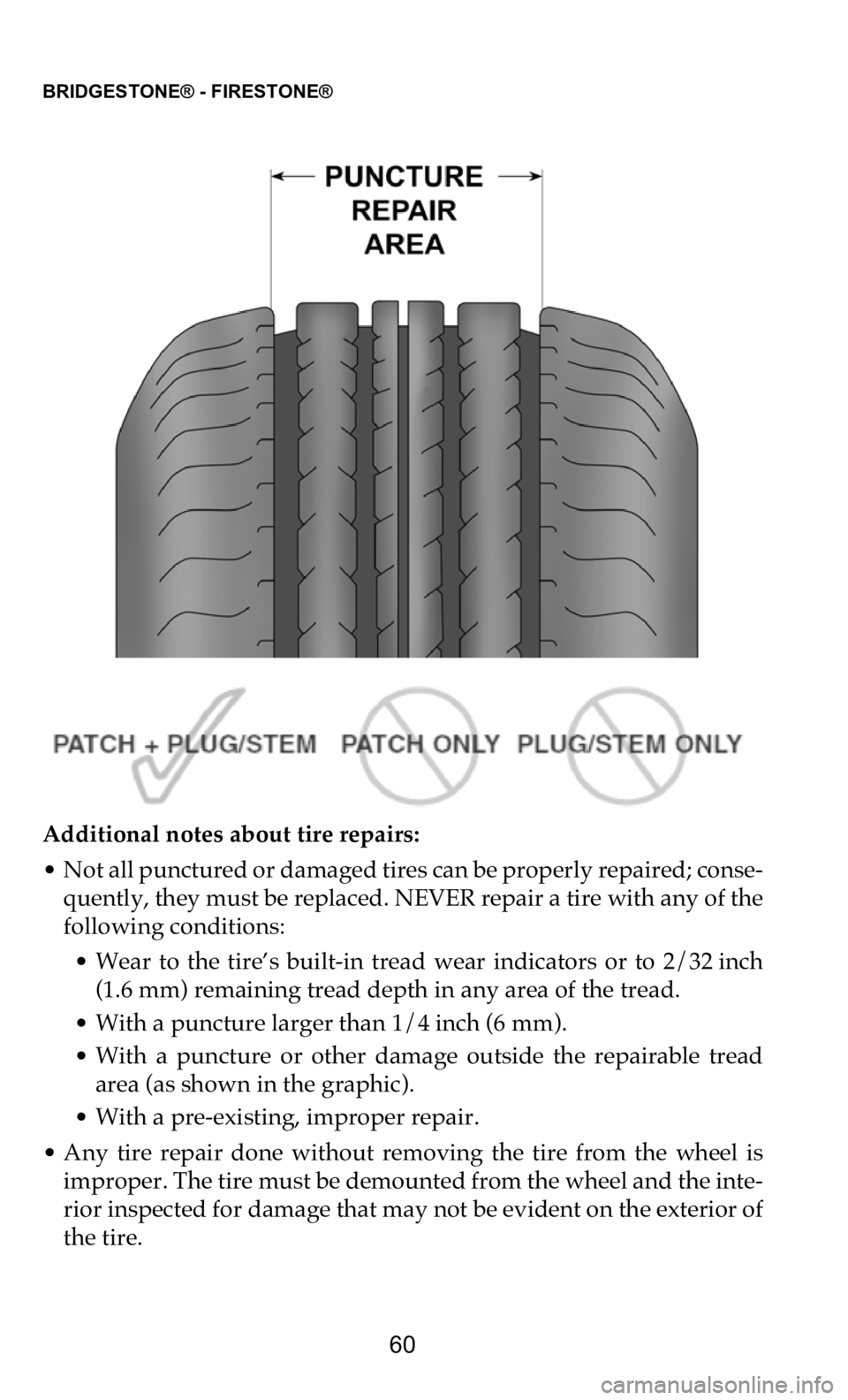
Additional notes about tire repairs:
• Not all punctured or damaged tires can be properly repaired; conse -
q
uently, they must be replaced. NEVER repair a tire with any of the
fo
llowing conditions:
• Wear to the tire’s built-in tread wear indicators or to 2/32 inch
(1
.6 mm) remaining tread depth in any area of the tread.
• With a puncture larger than 1/4
inch (6 mm).
• With a puncture or other damage outside the repairable tread
a
rea (as shown in the graphic).
• With a pre-existing, improper repair.
•
Any tire repair done without removing the tire from the wheel is
i
mproper. The tire must be demounted from the wheel and the inte -
rior inspected for damage that may not be evident on the exterior of
th
e tire.
Page 62 of 262

BRIDGESTONE® - FIRESTONE®
61
• Using only a plug/stem, or using only a patch, is not a safe or proper
repair. A patch must be applied to the interior of the tire and the
puncture hole must be filled with a suitable plug/stem filler to
prevent inflation pressure loss and contamination of the steel belts
and other plies.
• NEVER substitute a tube for a proper repair or to remedy an
i
mproper repair.
• Tubes, like tires, should only be repaired by a qualified tire service
p
rofessional.
• Some vehicle manufacturers do not recommend using repaired
t
ires. Consult your vehicle Owner’s Manual or contact the vehicle
manufacturer before operating a repaired tire on your vehicle.
ASK how your tire will be repaired. ALWAYS insist on a proper tire
re
pair.
Emergency/Temporary Sealant or Filler Repairs: A
n emergency/
temporary sealant or filler injected into the tire, such as by aerosol can
or injection/squeeze-tube, is not a proper repair and voids the tire
Limited Warranty. A tire injected with such sealant/filler must be
replaced by a qualified tire service professional as soon as possible.
Speed Rating: T
he tire’s speed rating is void if the tire is repaired,
retreaded, damaged, abused, or otherwise altered from its original
condition. Thereafter, it should be treated as a non-speed rated tire.
See “Tire Speed Ratings” in this manual.
Improper repair voids the tire Limited Warranty. S
ee “Limited
Warranty” in this manual.
RFT (Run-Flat Technology) Tires: I
n addition to the above, there are
recommendations specific to the repair of RFT tires; see “RFT Tires
with Run-Flat Technology” in this manual.
WARNING!
Tell the tire service professional if you have used an aerosol fixer
to
inflate/seal the tire. Aerosol fixers could contain a highly
volatile gas. Always remove the valve core outdoors, away from
sources of excessive heat, flame, or sparks and completely deflate
the tire before removing it from the wheel.
Page 66 of 262

BRIDGESTONE® - FIRESTONE®
65
• High-speed driving should be left to trained professionals operating
under controlled conditions.
• No tire, regardless of its design or speed rating, has unlimited
c
apacity for speed, and a sudden tire failure can occur if its limits are
exceeded. See “Tire Speed Ratings,” the next section in this manual.
Refer to your vehicle Owner’s Manual for any tire pressure
re
commendations for high speed driving.
TIRE SPEED RATINGS
A tire bearing a letter “speed rating” designation indicates the tire’s
sp
eed capability according to standardized laboratory tests. This
speed rating system is intended to permit comparison of the speed
capabilities of different tires. When replacing your tires, consult your
vehicle Owner’s Manual and tire information placard for
recommendations, if any, concerning the use of speed rated tires.
• To avoid reducing the speed capability of the vehicle, replace a
s
peed rated tire only with another tire having at least the same
speed rating. It is the “top speed” of the “slowest” tire on the vehicle
which limits the vehicle’s top speed without tire failure.
• The tire’s speed rating is void if the tire is repaired, retreaded,
d
amaged, abused, or otherwise altered from its original condition.
Thereafter, it should be treated as a non-speed rated tire.
• Non-speed rated tires are usually for ordinary passenger car or light
t
ruck service and not for high speed driving.
• For winter tires used in cold weather conditions, it is generally
a
cceptable to apply a tire with a lower speed rating than your orig -
inal tires; however, speed should be reduced accordingly. All winter
ti
res should be the same speed rating. Some vehicles have specific
recommendations regarding winter tire use; consult your vehicle
Owner’s Manual and tire information placard. See “Winter Tires” in
this manual.
These speed ratings are based on standardized laboratory tests under
sp
ecific, controlled conditions. While these tests may relate to
performance on the road, real-world driving is rarely identical to any
test conditions. Your tire’s actual speed capability may be less than its
rated speed since it is affected by factors such as inflation pressure,
load, tire condition (including damage), wear, vehicle condition
Page 72 of 262
BRIDGESTONE® - FIRESTONE®
71
RFT TIRES WITH RUN-FLAT TECHNOLOGY
If your vehicle is equipped with
Bridgestone® or Firestone® brand
RF
T tires, this chapter presents
specific maintenance and safety issues
associated with these tires that are in addition to those covered
elsewhere in this manual.
What is RFT? Run-Flat Technology tires are extraordinary tires that
ut
ilize specially designed components to temporarily support your
vehicle in the event of inflation pressure loss, such as from a
puncture. This gives you the ability to drive to a convenient and safe
location to change your tire (if equipped with a spare) or have it
inspected for possible repair or replacement.
Naturally, certain run-flat and low pressure operating limitations
ap
ply, which varies according to the specific self-supporting tire
design. Like all tires, during normal operation, they must be properly
inflated and maintained. Regardless of the design or quality, no tire is
indestructible.
RFT — How to Identify: B
ridgestone® and Firestone® brand tires are
marked on the sidewalls, near the wheel, with the RFT logo (shown
above).
RFT INFLATION PRESSURE
Like other tires, RFT tires need proper inflation pressure maintenance
fo
r safe operation and to achieve the maximum tire life and
performance. Check inflation pressures monthly and before long trips
or carrying extra weight. Use an accurate tire gauge and check
pressures when the tires are cold. Follow the vehicle manufacturer’s
recommendation for inflation pressure settings as indicated on the
vehicle tire information placard and/or in the vehicle Owner’s
Manual. Do not forget the spare, if applicable. See “Tire Inflation
Pressure” in this manual.
TIRE PRESSURE MONITORING SYSTEM (TPMS)
A functioning Tire Pressure Monitoring System (TPMS) must be used
wi
th your Run Flat tires. These tires ride so well even without inflation
pressure, the TPMS may be necessary to alert you of an inflation
pressure loss condition. When alerted, follow the instructions in your
vehicle Owner’s Manual and see “Run-Flat or Low Tire Pressure
Operation,” the following section in this manual.
Page 75 of 262

BRIDGESTONE® - FIRESTONE®
74
SPECIAL SERVICE AND REPAIR ISSUES
Run-Flat Certified Retailers
Because of the advanced technology and design of Run-Flat tires and
th
e required Tire Pressure Monitoring Systems (TPMS), Bridgestone®
Firestone® Run-Flat Certified Retailers are specially trained to sell and
service RFT tires.
Run-Flat Certified Retailers have the necessary equipment and are
sp
ecially trained to properly mount and demount RFT tires and to
handle TPMS devices. Conventional mounting equipment may
irreparably damage RFT tires and an improper repair is unsafe and
will void the Limited Warranty. Accordingly, it is important to go to
a Bridgestone® Firestone® Run-Flat Certified Retailer for tire
maintenance and replacement.
Call toll-free 1-877-BFS-4RFT or, 87
7-237-4738 or visit
www.bridgestonetire.com
to locate the nearest Bridgestone®
Firestone® Run-Flat Certified Retailer.
Inspection after Run-Flat or Low Pressure Operation
Following run-flat or low tire pressure operation, or in the event of
an
y other tire damage or unusual condition, it is very important to
obtain a proper and complete tire evaluation as soon as possible.
Rotation
Follow the vehicle manufacturer’s recommendations, or rotate every
5,
000 miles per the recommendations in this manual (see “Radial Tire
Ro
tation”). In some cases, TPMS devices require reprogramming with
each tire rotation.
RFT Tire Replacement
Do not replace or mix RFT tires with conventional tires, unless on an
em
ergency/temporary basis. Conventional tires do not have run-flat
capability and the handling characteristics of the vehicle with these
tires may be different. If a conventional tire is used on an emergency/
temporary basis, verify that its size, load capacity, inflation pressure,
and speed rating specifications meet the requirements of the vehicle.
Replace any conventional tire with the proper RFT tire as soon as
possible.
Page 76 of 262

BRIDGESTONE® - FIRESTONE®
75
RFT Tire Damage and Repair
No tire, regardless of its design or quality is indestructible. RFT tires
ca
n be ultimately rendered unusable due to a puncture or other road
hazard as well as from improper run-flat or low tire pressure
operation. Some punctures may be repaired under certain restrictions
and prescribed procedures.
When driven flat or with low pressure, factors affecting reparability
in
clude vehicle speed, load, and maneuvering; the amount of inflation
pressure loss; and ambient temperature. In any situation, the extent
and location of direct damage from a puncturing object or other road
hazard are also critical factors.
RFT tires are not repairable in any of the following situations:
• If the tire was operated with inflation pressure less than 15 psi (100 kPa).
•
Abrasion or other damage is present on the exterior tread, sidewall
o
r bead areas.
• Abrasion, wrinkling, or separation is present on the tire interior.
•
Any condition or damage is present that disqualifies repair of a
c
onventional tire.
Run-Flat Certified Retailers will fully inspect your tire, inside and out,
to
determine if the tire can be repaired. Tire damage is not always
visible from the outside and the tire must be removed from the wheel
for a complete inspection. For more information, see the section “Tire
Repairs” in this manual.
NOTE:
Some vehicle manufacturers do not recommend using repaired tires.
Co
nsult your vehicle Owner’s Manual or contact the vehicle manufac -
turer before operating a repaired tire on your vehicle.
Page 82 of 262

BRIDGESTONE® - FIRESTONE®
81
•Improper use or operation, including, without limitation:
Improper inflation pressure, overloading, tire/wheel spinning,
use of an improper wheel, tire chain damage, misuse, misappli -
cation, negligence, tire alteration, or for racing or competition
pu
rposes.
• Insufficient or improper maintenance,
including, without
limitation: Failure to rotate tires as recommended in this manual,
wheel misalignment, worn suspension components, improper
tire mounting or demounting, tire/wheel assembly imbalance,
or other vehicle conditions, defects, or characteristics.
• Contamination or degradation
by petroleum products or other
chemicals, fire or other externally generated heat, or water or
other material trapped inside the tire during mounting or infla -
tion.
• Improper repair.
Improper repair voids this Limited Warranty
• For RFT tires only, improper run-flat or low tire pressure oper -
a
tion, including, without limitation: Exceeding speed, distance,
o
r other run-flat/lowpressure operation limitations.
2. Rapid tread wear or wear-out. Original equipment tires have no
m
ileage warranty.
3. Weather/ozone cracking after 4 years from date of tire manufac -
t
ure.
4. Ride disturbance or vibration after 1/32 inch (0.8mm) of tread
we
ar use.
5. Tires with sealant, balance, or other filler material that was not
o
riginally applied or inserted by the tire manufacturer.
6. Tires used in commercial service.
7
. Tires purchased and normally used outside the United States and
C
anada.
8. The cost of applicable federal, state, and local taxes.
9
. Failure to follow any of the safety and maintenance recommenda -
t
ions or warnings contained in this manual.
This Limited Warranty is in addition to and/or may be limited by any
ot
her applicable written warranty you may have received concerning
special tires or situations.
Page 88 of 262

CONTINENTAL TIRE
87
TEMPORARY SPARE: If a temporary spare tire becomes unser -
viceable from a condition other than those listed in Section 3,
du
ring the first 1/32nd (0.8 mm) of tread wear, then it will be re -
placed with a **comparable new Continental brand TS tire FREE
OF
CHARGE, including mounting and balancing. The owner pays
all applicable taxes. After this "Free Replacement Period" for your
temporary spare tire expires, no warranty claim will be accepted.
After the Free Replacement Period: T
he tire (except temporary
spare tire) may still be eligible for a pro rata replacement up to
72 months from date of original purchase until the tread is worn
do
wn to the tread wear indicators (2/32nds of an inch or 1.6 mm of
tr
ead remaining.) If an eligible tire becomes unserviceable under
the stipulations of this Limited Warranty and Adjustment policy it
will be replaced with a **comparable new Continental brand tire,
charging the owner a pro-rated amount. Owner pays all applicable
taxes (including F.E.T.), mounting and balancing charges.
The replacement tire price will be determined by multiplying the
pe
rcentage of the usable tread worn by the Dealers Selling Price
(excluding all applicable taxes) at the time of the adjustment. The
usable tread is the original tread down to the tread wear indicators
(2/32nds of an inch or 1.6 mm of tread remaining.)
** A "comparable" new Continental brand tire may be of either the
sa
me tire line or the same basic construction but with a different
sidewall or tread configuration. If a higher priced tire is selected,
the consumer will pay the difference in price.
3. WHAT IS NOT COVERED BY THIS WARRANTY
T
HE FOLLOWING ARE NOT COVERED:
• Road Hazard:
Any tire with road hazard damage, which
includes,but is not limited to: cuts, snags, punctures, bruises, and
impact breaks.
• Ride/Vibration:
Any ride/vibration complaint after the first 2/32nds
(1.6 mm) of an inch of treadwear or 12 months of service, which -
ever comes first.
• Repairs:
If a tire is returned under complaint and the reason for
the tire’s disablement is in any way associated with a repair, or
with the situation that led to the repair, the manufacturer’s
warranty is invalidated.
• Mileage: Mileage is not covered under this policy.
Page 91 of 262

CONTINENTAL TIRE
90
Owner must present new vehicle registration form or new vehicle
sales invoice indicating the date of purchase. Owner will be re -
quired to sign the CTA Limited Warranty Claim Form or dealer re -
placement sales receipt.
Owner is responsible for paying all applicable taxes charged by the
se
rvicing dealer and is also responsible for paying shipping, local
tire-disposal fees and parts or service regardless of mileage or
months of service. This includes payment for tire rotation, align -
ment, towing, road service, valve stems and tire repairs.
Owner is responsible for maintaining proper tire air pressure and
fo
r proper maintenance of the tire.
6. SAFETY WARNING:
I
gnoring any of the safety and information contained in this war -
ranty may result in tire failure, causing serious injury or death.
• Tire failure due to under inflation/overloading. Follow vehicle
o
wner’s manual or tire placard in vehicle for proper inflation and
loading.
• Explosion of tire/rim assembly due to improper tire mounting.
T
ire mounting / demounting can be dangerous. It should be
performed only by a trained tire specialist using proper tools and
procedures. Prior to tire mounting/demounting, the Rubber
Manufacturers Association (RMA) wall charts and manuals
should be read to obtain the proper procedures. The failure to
follow these procedures may result in faulty positioning of the
tire and/or rim, which may cause the assembly to burst with
force sufficient to cause injury or death.
• Tire failure due to damage.
Inspect your tires frequently for
scrapes, bulges, separations, cuts, snags and other damage from
road hazards. Damage from impact can occur to the inner
portions of your tire without being visible to the outside. If you
suspect a tire has been damaged from striking anything unusual
in the road, you must have the tire removed from the rim and
inspected both inside and out by a trained tire specialist. Air loss
or unusual tire wear can also be warning signs that a tire may
have internal damage. If you notice these conditions, have your
tire inspected by a trained individual.
• Tire failure due to excessive tire spinning.
Avoid tire spinning.
The centrifugal force generated by a free-spinning tire/rim
assembly may cause a sudden tire explosion resulting in vehicle
Page 92 of 262
CONTINENTAL TIRE
91
damage and/or serious injury or death. Never exceed 35 mph
(5
5km/h) as indicated on your speedometer when your vehicle
is stuck in snow, mud, or sand and your tire(s) is/are spinning.
Use a gentle backward and forward rocking motion to free your
vehicle for continued driving. Never stand or permit anyone else
to stand near or behind a tire spinning while attempting to push
a vehicle that is stuck.
SELF SUPPORTING RUNFLAT (SSR) TIRE OWNERS
Continental Tire the Americas, LLC (CTA) does not recommend any
re
pair to or reuse of punctured Continental SSR tires.
Even a trained tire specialist may be unable to recognize internal
st
ructural damage to a Self Supporting Run-flat (SSR) tire resulting
from having been driven in an under inflated or zero inflation
pressure condition. Such damage may not be visible on the surface of
the inner liner or sidewall making it impossible to determine the tire
suitability for repair or reuse. CTA does not recommend any repair to
or reuse of Continental SSR tires. You may visit
www.continentaltire.com
or
www.continentaltire.ca
and select
Customer Care FAQs to obtain additional SSR information.
TEMPORARY SPARE TIRE OWNERS
CTA does not recommend any repair to or reuse of punctured
T e
mporary Spare Tires.
CONTISEAL™ TIRE OWNERS A ContiSeal™ tire differs from a
non-ContiSeal™ tire in that it has
a
sticky, viscous layer from
shoulder to shoulder along the
inner liner. This layer is an integral part of the ContiSeal™ tires. It is
not designed or intended to act as a permanent puncture repair (See
information below). If an object up to 3/16ths (5 mm) diameter
pe
netrates the tread of the ContiSeal™ tire, this sticky, viscous layer is
designed to surround and adhere to the puncturing object and prevent
air loss from the tire by providing a near instantaneous seal. If the
puncturing object becomes dislodged from the tire, the material is
designed to seal most holes made by objects up to 3/16” (5 mm)
di
ameter. While ContiSeal™ tires significanty reduce the incidence of
flats they are not designed to be driven under inflated or in a flat
condition. In all other aspects, ContiSeal™ tires perform exactly like