service DODGE DURANGO 2021 Vehicle Warranty
[x] Cancel search | Manufacturer: DODGE, Model Year: 2021, Model line: DURANGO, Model: DODGE DURANGO 2021Pages: 262, PDF Size: 10.42 MB
Page 41 of 262

BFGOODRICH® TIRES
40
road. If a tire is mounted by error on the wrong-sized rim, do not
remount it on the proper rim — scrap it. It may have been damaged
internally (which is not externally visible) by having been
dangerously stretched and could fail on the highway.
Old valves may leak. When new tubeless tires are mounted, have
ne
w valves of the correct type installed. Tubeless tires must only be
mounted on wheels designed for tubeless tires i.e., wheels which
have safety humps or ledges.
It is recommended that you have your tires and wheels balanced. Tires
an
d wheels which are not balanced may cause steering difficulties, a
bumpy ride, and irregular tire wear.
Be sure that all your valves have suitable valve caps. The valve cap
is
the primary seal against air loss.
SERVICE LIFE FOR PASSENGER CAR AND LIGHT TRUCK TIRES
IN
CLUDING SPARE TIRES
The following recommendation applies to passenger car and light
tr
uck tires. Tires are composed of various types of material and rubber
compounds, having performance properties essential to the proper
functioning of the tire itself. These component properties evolve over
time. For each tire, this evolution depends upon many factors such as
weather, storage conditions, and conditions of use including load,
speed, inflation pressure, maintenance etc. to which the tire is
subjected throughout its life. This service-related evolution varies
widely so that accurately predicting the serviceable life of any specific
tire in advance is not possible.
In addition to regular inspections and inflation pressure maintenance
by
consumers, it is recommended to have passenger car and light
truck tires, including spare tires, inspected regularly by a qualified tire
specialist, such as a tire dealer, who will assess the tire’s suitability for
continued service. Tires which have been in use for five years or more
should continue to be inspected by a specialist at least annually.
Consumers are strongly encouraged to be aware not only of their tires’
vi
sual condition and inflation pressure but also of any change in
dynamic performance such as increased air loss, noise or vibration,
which could be an indication that the tires need to be removed from
service to prevent tire failure.
Page 42 of 262

BFGOODRICH® TIRES
41
It is impossible to predict when tires should be replaced based on their
calendar age alone. However the older a tire the greater the chance
that it will need to be replaced due to the service-related evolution or
other conditions found upon inspection or detected during use.
While most tires will need replacement before they achieve 10 years,
it
is recommended that any tires in service 10 years or more from the
date of manufacture, including spare tires, be replaced with new tires
as a simple precaution even if such tires appear serviceable and even
if they have not reached the legal wear limit.
For tires that were on an original equipment vehicle i.e., acquired by
th
e consumer on a new vehicle, follow the vehicle manufacturer’s
tire replacement recommendations, when specified (but not to
exceed 10 years).
The date when a tire was manufactured is located on the sidewall of
ea
ch tire. Consumers should locate the Department of Transportation
(DOT) code on the tire which begins with DOT and ends with the
week and year of manufacture. For example, a DOT code ending with
"2204" indicates a tire made in the 22nd week (May) of 2004.
REMEMBER TO AVOID DAMAGE TO YOUR TIRES AND
PO
SSIBLE ACCIDENT
• INSPECT TIRES AT LEAST MONTHLY, AND IMMEDIATELY
A
FTER STRIKING ANY ROAD HAZARD.
• CHECK TIRE PRESSURE AT LEAST ONCE EACH MONTH
W
HEN TIRES ARE COLD AND BEFORE EVERY LONG TRIP.
• NEVER UNDERINFLATE OR OVERINFLATE A TIRE.
•
NEVER OVERLOAD YOUR VEHICLE AND TIRES.
•
ALWAYS OBEY LEGAL SPEED LIMITS AND DRIVE AT A SPEED
T
HAT IS REASONABLE UNDER THE ROAD AND WEATHER
CONDITIONS.
• AVOID DRIVING OVER POTHOLES, OBSTACLES, CURBS OR
E
DGES OF PAVEMENT.
• AVOID EXCESSIVE WHEEL SPINNING.
•
IF YOU SEE ANY DAMAGE TO A TIRE, REPLACE THE TIRE
W
ITH A PROPERLY INFLATED SPARE AND VISIT A QUALI -
FIED TIRE PROFESSIONAL AT ONCE.
• KEEP TIRES AND WHEELS PROPERLY ALIGNED, BALANCED,
A
ND ROTATED.
Page 45 of 262

BRIDGESTONE® - FIRESTONE®
44
BRIDGESTONE® - FIRESTONE®
TIRE MAINTENANCE, SAFETY and WARRANTY MANUAL
ORIGINAL EQUIPMENT PASSENGER and LIGHT TRUCK
TIRES Including RFT Tires with Run-Flat Technology
Congratulations!
Your new vehicle comes equipped with quality BRIDGESTONE®
or
FIRESTONE® brand tires.
To ensure optimum tire performance and reduce the risk of a tire
fa
ilure, Bridgestone® Firestone® North American Tire, LLC strongly
recommends you read and follow all maintenance and safety
information contained in this manual. In addition, we recommend
periodic inspection and maintenance, if necessary, by a qualified tire
service professional.
Inflate.
Check your tire pressure monthly.
Rotate.
Rotate your tires as recommended by the vehicle manufacturer or
ev
ery 5,000 miles.
Evaluate.
Routinely look for signs of tread wear or damage.
TIRE CARE BASICS
Quick Reference Guide to Maintenance for All Tires, Including the
Sp
are.
Page 52 of 262
BRIDGESTONE® - FIRESTONE®
51
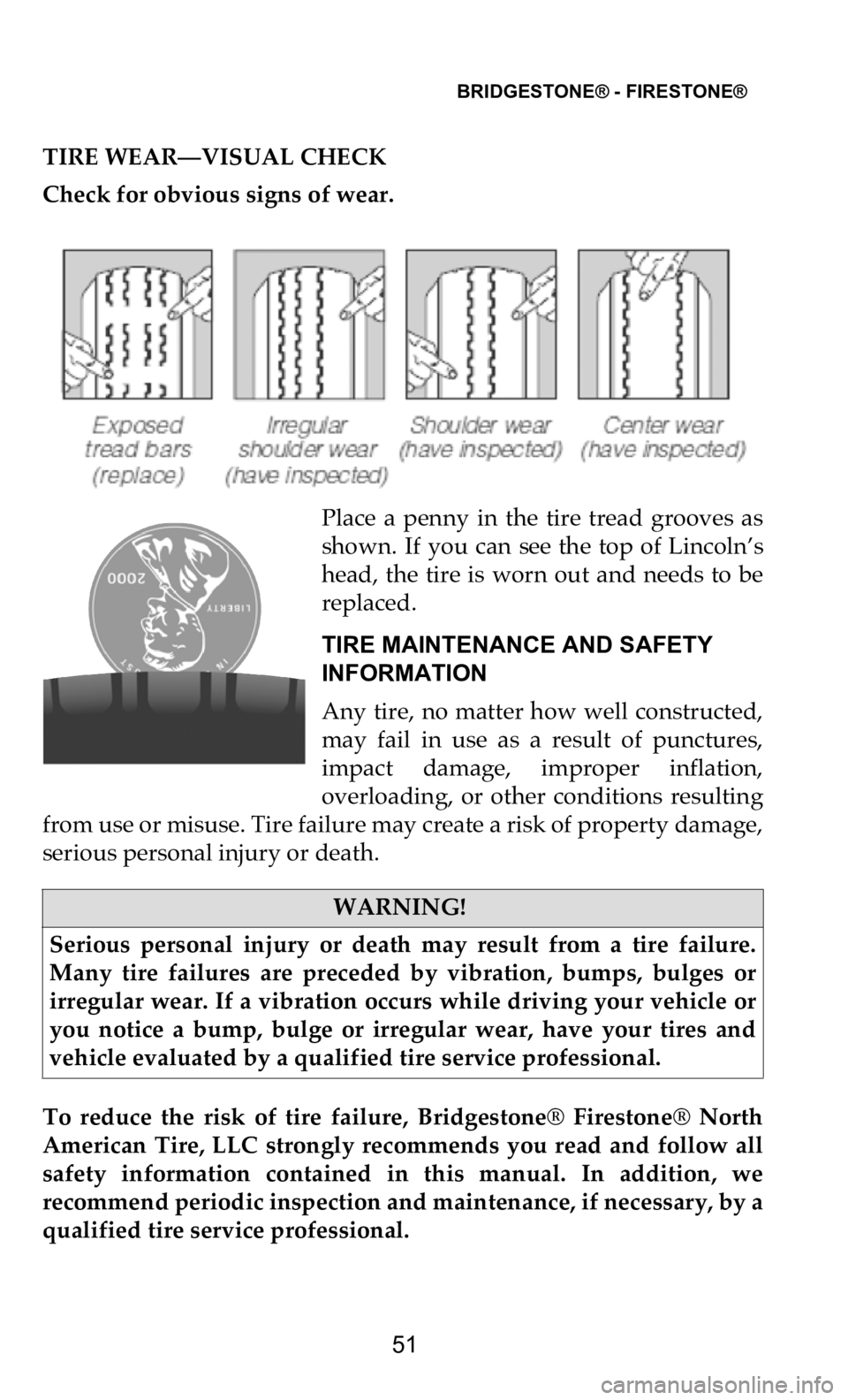
TIRE WEAR—VISUAL CHECK
Check for obvious signs of wear.
Place a penny in the tire tread grooves as
shown. If you can see the top of Lincoln’s
h
ead, the tire is worn out and needs to be
replaced.
TIRE MAINTENANCE AND SAFETY
IN
FORMATION
Any tire, no matter how well constructed,
ma
y fail in use as a result of punctures,
impact damage, improper inflation,
overloading, or other conditions resulting
from use or misuse. Tire failure may create a risk of property damage,
serious personal injury or death.
To reduce the risk of tire failure, Bridgestone® Firestone® North
A m
erican Tire, LLC strongly recommends you read and follow all
safety information contained in this manual. In addition, we
recommend periodic inspection and maintenance, if necessary, by a
qualified tire service professional.
WARNING!
Serious personal injury or death may result from a tire failure.
Ma
ny tire failures are preceded by vibration, bumps, bulges or
irregular wear. If a vibration occurs while driving your vehicle or
you notice a bump, bulge or irregular wear, have your tires and
vehicle evaluated by a qualified tire service professional.
Page 54 of 262
BRIDGESTONE® - FIRESTONE®
53
These situations can cause a tire failure, even at a later date, which
could lead to serious personal injury or death. Consult the vehicle tire
information placard and/or Owner’s Manual for the recommended
inflation pressures. In addition to tire damage, improper inflation
pressure may also:
• Adversely affect vehicle ride and handling.
•
Reduce tire tread wear.
•
Affect fuel economy.
T
herefore, follow these important recommendations for tire and
ve
hicle safety, mileage, and economy:
• Always keep the vehicle manufacturer’s recommended inflation p
ressure in all your tires, including the spare.
• Check their pressure monthly and before long trips or carrying e
xtra weight.
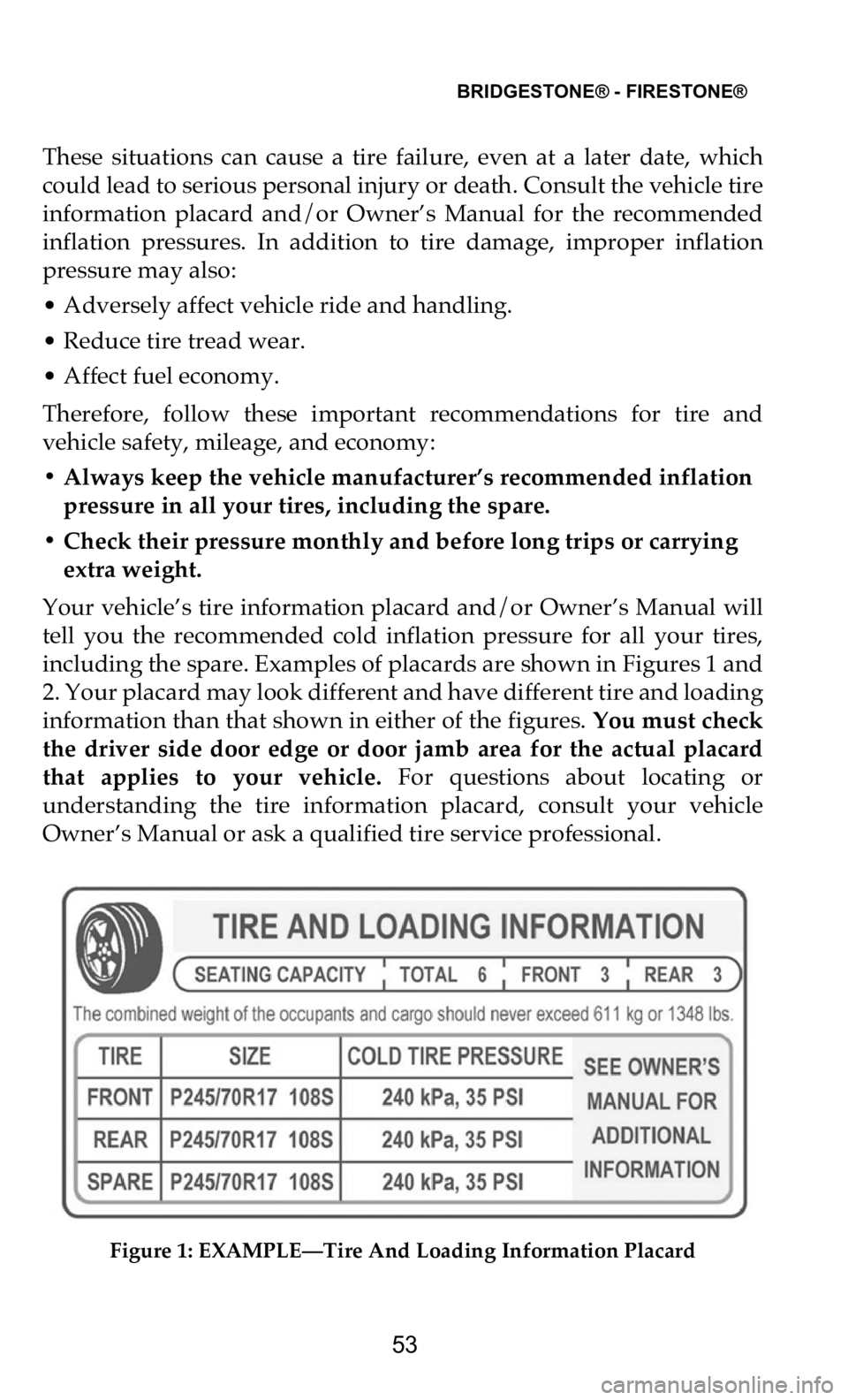
Your vehicle’s tire information placard and/or Owner’s Manual will
te
ll you the recommended cold inflation pressure for all your tires,
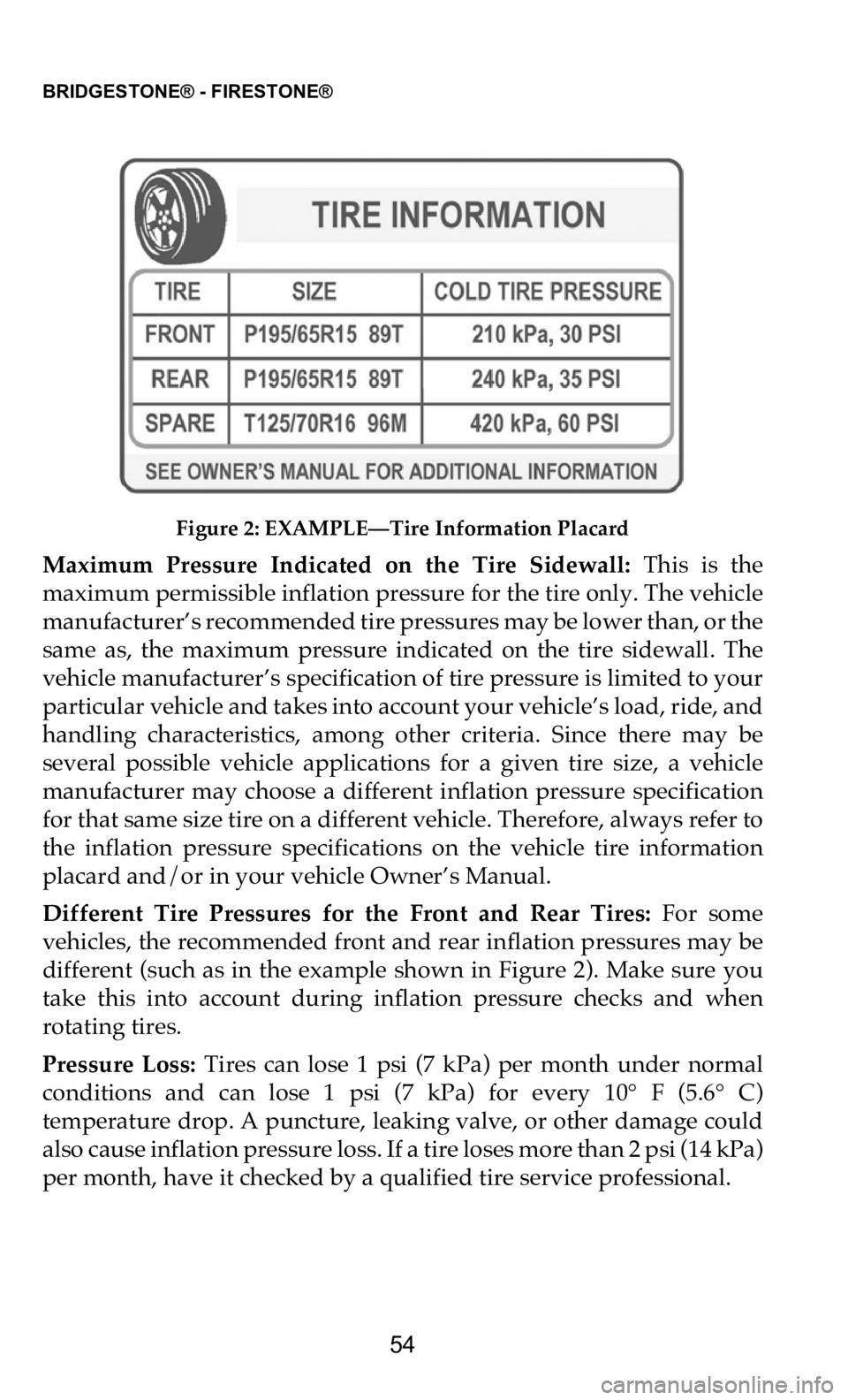
including the spare. Examples of placards are shown in Figures 1 and
2. Your placard may look different and have different tire and loading
information than that shown in either of the figures. You must check
the driver side door edge or door jamb area for the actual placard
that applies to your vehicle. For questions about locating or
understanding the tire information placard, consult your vehicle
Owner’s Manual or ask a qualified tire service professional.
Figure 1: EXAMPLE—Tire And Loading Information Placard
Page 55 of 262
BRIDGESTONE® - FIRESTONE®
54
Figure 2: EXAMPLE—Tire Information Placard
Maximum Pressure Indicated on the Tire Sidewall: This is the
maximum permissible inflation pressure for the tire only. The vehicle
manufacturer’s recommended tire pressures may be lower than, or the
same as, the maximum pressure indicated on the tire sidewall. The
vehicle manufacturer’s specification of tire pressure is limited to your
particular vehicle and takes into account your vehicle’s load, ride, and
handling characteristics, among other criteria. Since there may be
several possible vehicle applications for a given tire size, a vehicle
manufacturer may choose a different inflation pressure specification
for that same size tire on a different vehicle. Therefore, always refer to
the inflation pressure specifications on the vehicle tire information
placard and/or in your vehicle Owner’s Manual.
Different Tire Pressures for the Front and Rear Tires: F
or some
vehicles, the recommended front and rear inflation pressures may be
different (such as in the example shown in Figure 2). Make sure you
take this into account during inflation pressure checks and when
rotating tires.
Pressure Loss: T
ires can lose 1 psi (7 kPa) per month under normal
conditions and can lose 1 psi (7 kPa) for every 10° F (5.6° C)
temperature drop. A puncture, leaking valve, or other damage could
also cause inflation pressure loss. If a tire loses more than 2 psi (14 kPa)
per month, have it checked by a qualified tire service professional.
Page 56 of 262

BRIDGESTONE® - FIRESTONE®
55
TIPS FOR SAFE TIRE INFLATION
• Check your tire pressures, including your spare tire, monthly and
b
efore long trips or carrying extra weight. Be sure to use an accurate
pressure gauge.
• Check inflation pressure when the tires are “cold.” Tires are consid -
e
red “cold” when the vehicle has been parked for three hours or
mo
re, or if the vehicle has been driven less than a mile at moderate
speed.
• Never release pressure from a hot tire in order to reach the recom -
m
ended cold tire pressure. Normal driving causes tires to run hotter
an
d inflation pressure to increase. If you reduce inflation pressure
when your tires are hot, you may dangerously underinflate your
tires.
• If it is necessary to adjust inflation pressure when your tires are
“
hot”, set their pressure to 4 psi (28 kPa) above the recommended
cold inflation pressure. Recheck the inflation pressure when the tires
are cold.
• If your tires lose more than 2 psi (14 kPa) per month, the tire, the
v
alve, or wheel may be damaged. Consult a qualified tire service
professional for an inspection.
• Use valve caps to keep the valves clear of debris and to help guard
a
gainst inflation pressure loss.
WARNING!
Inflating an unsecured tire is dangerous. If it bursts, it could be
hu
rled into the air with explosive force resulting in serious
personal injury or death. Never inflate a tire unless it is secured to
the vehicle or a tire mounting machine.
Page 57 of 262
BRIDGESTONE® - FIRESTONE®
56
TIPS FOR SAFE LOADING
• Always keep the vehicle manufacturer’s recommended inflation
p
ressure in all your tires, including the spare. Check their pressure
monthly and before long trips or carrying extra weight.
• Never exceed the maximum load rating stamped on the sidewall of
y
our tire.
• Never exceed the Gross Vehicle Weight Rating (GVWR) or front/ r
ear Gross Axle Weight Rating (GAWR) of your vehicle.
• Consult your vehicle Owner’s Manual for load recommendations
a
nd special instructions such as for trailer/towing and snow plow
installations.
TIRE DAMAGE, INSPECTION AND SERVICE LIFE
Evaluation and maintenance of your tires is important to their
pe
rformance and the service they provide to you. Over time and/or
through use, the condition of a tire can change from exposure to
everyday road conditions, the environment, damaging events such as
punctures, and other external factors.
WARNING!
Driving your vehicle in an overloaded condition is dangerous.
Ov
erloading causes excessive tire heat build-up and internal
structural damage. This can cause a tire failure, even at a later
date, which could lead to serious personal injury or death.
Consult the vehicle tire information placard, certification label,
and owner’s manual for the recommended vehicle load limits and
loading recommendations.
WARNING!
Driving on damaged tires is dangerous. A damaged tire can
su
ddenly fail causing serious personal injury or death. Have your
tires regularly inspected by a qualified tire service professional.
Page 58 of 262

BRIDGESTONE® - FIRESTONE®
57
You should visually inspect your tires on a regular basis throughout
their life, and you should have your tires periodically evaluated by a
qualified tire service professional when your vehicle is serviced such
as routine maintenance intervals, oil changes, and tire rotations. In
particular, note the following tips for spotting tire damage:
• After striking anything unusual in the roadway, have a qualified tire
s
ervice professional demount the tire and inspect it for damage. A
tire may not have visible signs of damage on the tire surface. Yet, the
tire may suddenly fail without warning, a day, a week, or even
months later.
• Inspect your tires for cuts, cracks, splits or bruises in the tread and
s
idewall areas. Bumps or bulges may indicate a separation within
the tire body. Have your tire inspected by a qualified tire service
professional. It may be necessary to have it removed from the wheel
for a complete inspection.
• Inspect your tires for adequate tread depth. When the tire is worn to
t
he built-in indicators at 2/32 inch (1.6 mm) or less tread groove
de
pth, or the tire cord or fabric is exposed, the tire is dangerously
worn and must be replaced immediately.
• Inspect your tires for uneven wear. Wear on one side of the tread or
f
lat spots in the tread may indicate a problem with the tire or vehicle.
Consult a qualified tire service professional.
• Inspect your wheels also. If you have a bent or cracked wheel, it
m
ust be replaced.
• Don’t forget to check the spare tire.
M
ake sure your tires, including the spare tire, continue to be regularly
in
spected after 5 years of service to determine if they can continue in
service. Even when your tires appear to be usable from their external
appearance or the tread depth may have not reached the minimum
wear out depth, it is recommended that all tires (including spare tires
and “temporary use” spares) more than 10 years old be replaced with
new tires.
The 10 year period after the date of production is not an indicator of
ac
tual service life for any individual tire. Some tires will need to be
replaced before 10 years due to conditions such as punctures, impact
damage, improper inflation, overloading, tread wear or other
conditions involving use or misuse of the tire. If a tire is worn out or
otherwise unserviceable from damage or conditions of use, it should
be replaced regardless of when it was produced or placed in service.
Page 59 of 262
BRIDGESTONE® - FIRESTONE®
58
The vehicle manufacturer may consider vehicle performance
characteristics when making tire replacement recommendations.
Consult your vehicle Owner’s Manual for any information regarding
tire service life and replacement and follow the recommendations
applicable to your vehicle.
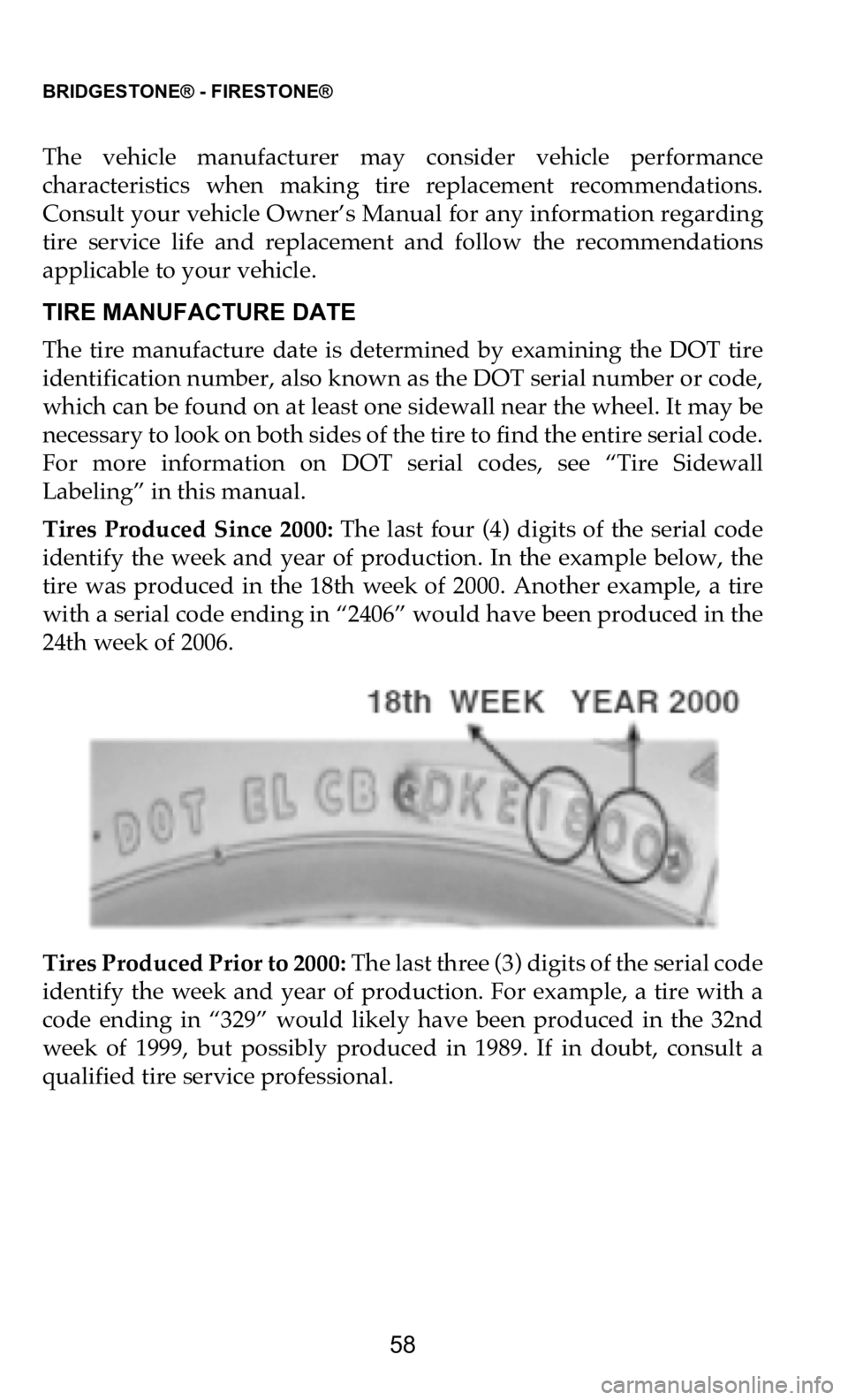
TIRE MANUFACTURE DATE
The tire manufacture date is determined by examining the DOT tire
id
entification number, also known as the DOT serial number or code,
which can be found on at least one sidewall near the wheel. It may be
necessary to look on both sides of the tire to find the entire serial code.
For more information on DOT serial codes, see “Tire Sidewall
Labeling” in this manual.
Tires Produced Since 2000: T
he last four (4) digits of the serial code
identify the week and year of production. In the example below, the
tire was produced in the 18th week of 2000. Another example, a tire
with a serial code ending in “2406” would have been produced in the
24th week of 2006.
Tires Produced Prior to 2000: T
he last three (3) digits of the serial code
identify the week and year of production. For example, a tire with a
code ending in “329” would likely have been produced in the 32nd
week of 1999, but possibly produced in 1989. If in doubt, consult a
qualified tire service professional.