lock DODGE DURANGO 2023 Owners Manual
[x] Cancel search | Manufacturer: DODGE, Model Year: 2023, Model line: DURANGO, Model: DODGE DURANGO 2023Pages: 328, PDF Size: 13.82 MB
Page 241 of 328
IN CASE OF EMERGENCY239
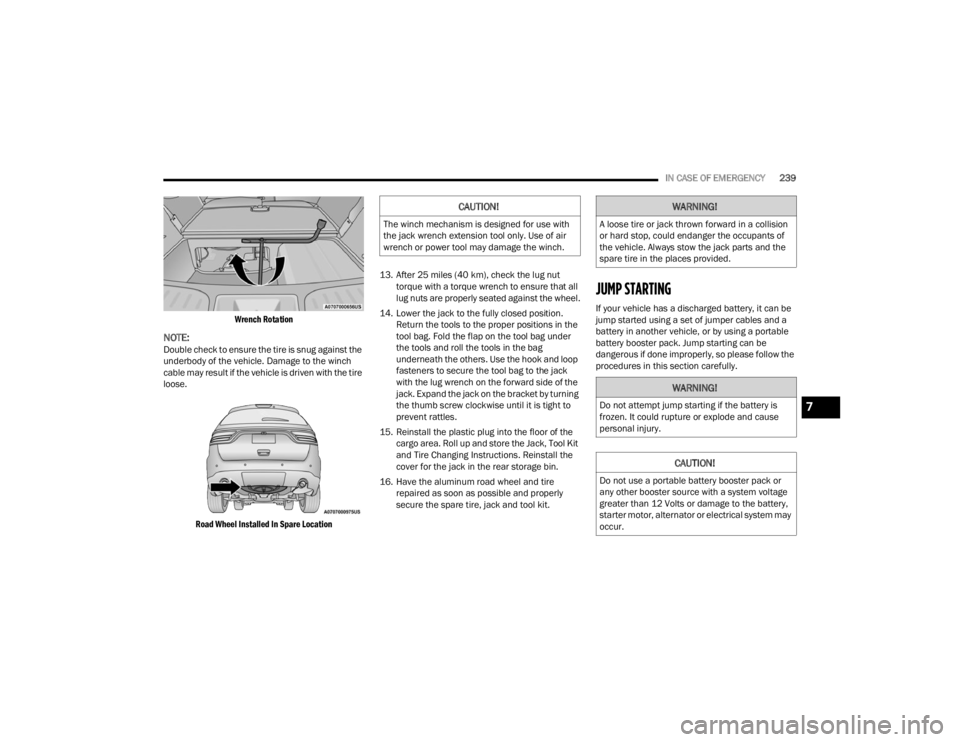
Wrench Rotation
NOTE:Double check to ensure the tire is snug against the
underbody of the vehicle. Damage to the winch
cable may result if the vehicle is driven with the tire
loose.
Road Wheel Installed In Spare Location
13. After 25 miles (40 km), check the lug nut
torque with a torque wrench to ensure that all
lug nuts are properly seated against the wheel.
14. Lower the jack to the fully closed position. Return the tools to the proper positions in the
tool bag. Fold the flap on the tool bag under
the tools and roll the tools in the bag
underneath the others. Use the hook and loop
fasteners to secure the tool bag to the jack
with the lug wrench on the forward side of the
jack. Expand the jack on the bracket by turning
the thumb screw clockwise until it is tight to
prevent rattles.
15. Reinstall the plastic plug into the floor of the cargo area. Roll up and store the Jack, Tool Kit
and Tire Changing Instructions. Reinstall the
cover for the jack in the rear storage bin.
16. Have the aluminum road wheel and tire repaired as soon as possible and properly
secure the spare tire, jack and tool kit.
JUMP STARTING
If your vehicle has a discharged battery, it can be
jump started using a set of jumper cables and a
battery in another vehicle, or by using a portable
battery booster pack. Jump starting can be
dangerous if done improperly, so please follow the
procedures in this section carefully.
CAUTION!
The winch mechanism is designed for use with
the jack wrench extension tool only. Use of air
wrench or power tool may damage the winch.
WARNING!
A loose tire or jack thrown forward in a collision
or hard stop, could endanger the occupants of
the vehicle. Always stow the jack parts and the
spare tire in the places provided.
WARNING!
Do not attempt jump starting if the battery is
frozen. It could rupture or explode and cause
personal injury.
CAUTION!
Do not use a portable battery booster pack or
any other booster source with a system voltage
greater than 12 Volts or damage to the battery,
starter motor, alternator or electrical system may
occur.
7
23_WD_OM_EN_USC_t.book Page 239
Page 246 of 328
244IN CASE OF EMERGENCY
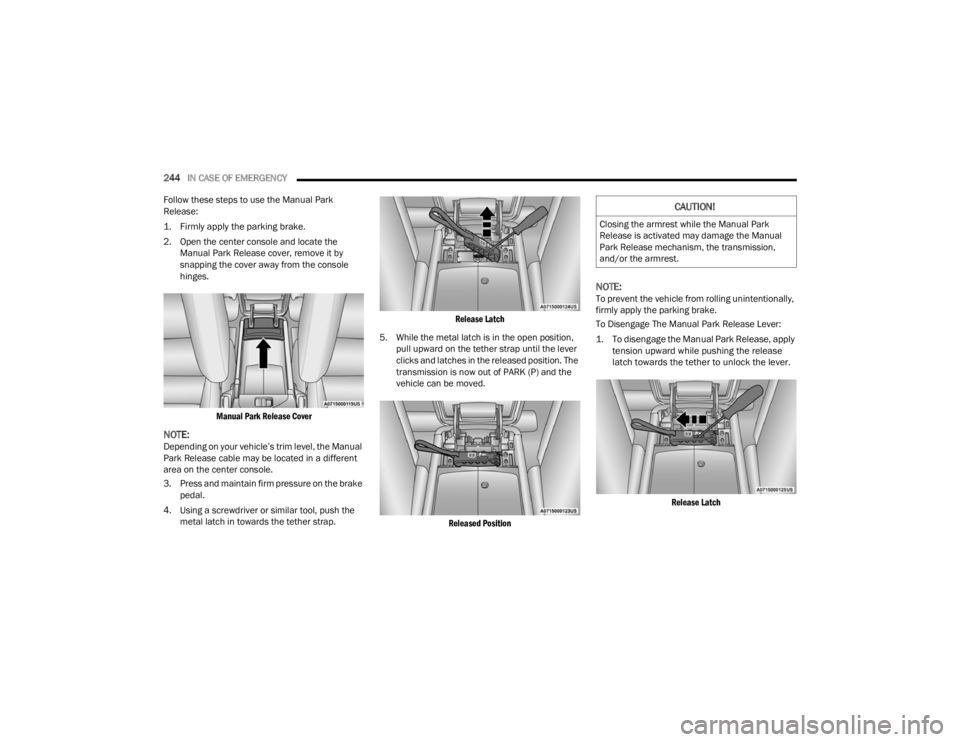
Follow these steps to use the Manual Park
Release:
1. Firmly apply the parking brake.
2. Open the center console and locate the Manual Park Release cover, remove it by
snapping the cover away from the console
hinges.
Manual Park Release Cover
NOTE:Depending on your vehicle’s trim level, the Manual
Park Release cable may be located in a different
area on the center console.
3. Press and maintain firm pressure on the brake pedal.
4. Using a screwdriver or similar tool, push the metal latch in towards the tether strap.
Release Latch
5. While the metal latch is in the open position, pull upward on the tether strap until the lever
clicks and latches in the released position. The
transmission is now out of PARK (P) and the
vehicle can be moved.
Released Position
NOTE:To prevent the vehicle from rolling unintentionally,
firmly apply the parking brake.
To Disengage The Manual Park Release Lever:
1. To disengage the Manual Park Release, apply tension upward while pushing the release
latch towards the tether to unlock the lever.
Release Latch
CAUTION!
Closing the armrest while the Manual Park
Release is activated may damage the Manual
Park Release mechanism, the transmission,
and/or the armrest.
23_WD_OM_EN_USC_t.book Page 244
Page 247 of 328
IN CASE OF EMERGENCY245
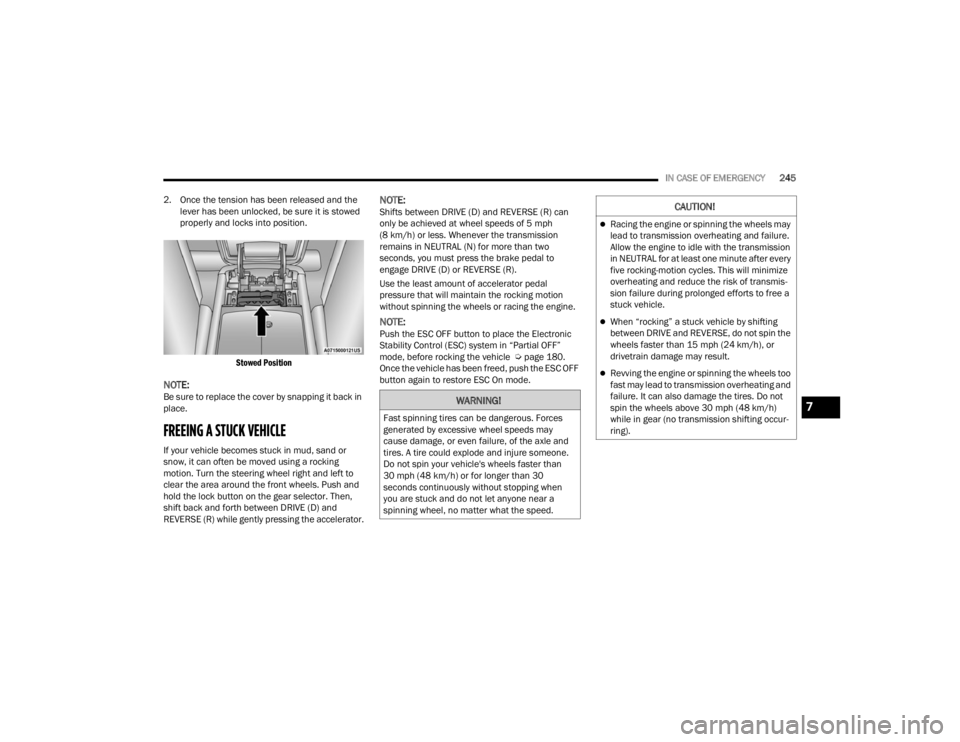
2. Once the tension has been released and the lever has been unlocked, be sure it is stowed
properly and locks into position.
Stowed Position
NOTE:Be sure to replace the cover by snapping it back in
place.
FREEING A STUCK VEHICLE
If your vehicle becomes stuck in mud, sand or
snow, it can often be moved using a rocking
motion. Turn the steering wheel right and left to
clear the area around the front wheels. Push and
hold the lock button on the gear selector. Then,
shift back and forth between DRIVE (D) and
REVERSE (R) while gently pressing the accelerator.
NOTE:Shifts between DRIVE (D) and REVERSE (R) can
only be achieved at wheel speeds of 5 mph
(8 km/h) or less. Whenever the transmission
remains in NEUTRAL (N) for more than two
seconds, you must press the brake pedal to
engage DRIVE (D) or REVERSE (R).
Use the least amount of accelerator pedal
pressure that will maintain the rocking motion
without spinning the wheels or racing the engine.
NOTE:Push the ESC OFF button to place the Electronic
Stability Control (ESC) system in “Partial OFF”
mode, before rocking the vehicle Ú page 180.
Once the vehicle has been freed, push the ESC OFF
button again to restore ESC On mode.
WARNING!
Fast spinning tires can be dangerous. Forces
generated by excessive wheel speeds may
cause damage, or even failure, of the axle and
tires. A tire could explode and injure someone.
Do not spin your vehicle's wheels faster than
30 mph (48 km/h) or for longer than 30
seconds continuously without stopping when
you are stuck and do not let anyone near a
spinning wheel, no matter what the speed.
CAUTION!
Racing the engine or spinning the wheels may
lead to transmission overheating and failure.
Allow the engine to idle with the transmission
in NEUTRAL for at least one minute after every
five rocking-motion cycles. This will minimize
overheating and reduce the risk of transmis -
sion failure during prolonged efforts to free a
stuck vehicle.
When “rocking” a stuck vehicle by shifting
between DRIVE and REVERSE, do not spin the
wheels faster than 15 mph (24 km/h), or
drivetrain damage may result.
Revving the engine or spinning the wheels too
fast may lead to transmission overheating and
failure. It can also damage the tires. Do not
spin the wheels above 30 mph (48 km/h)
while in gear (no transmission shifting occur -
ring).
7
23_WD_OM_EN_USC_t.book Page 245
Page 260 of 328
258SERVICING AND MAINTENANCE
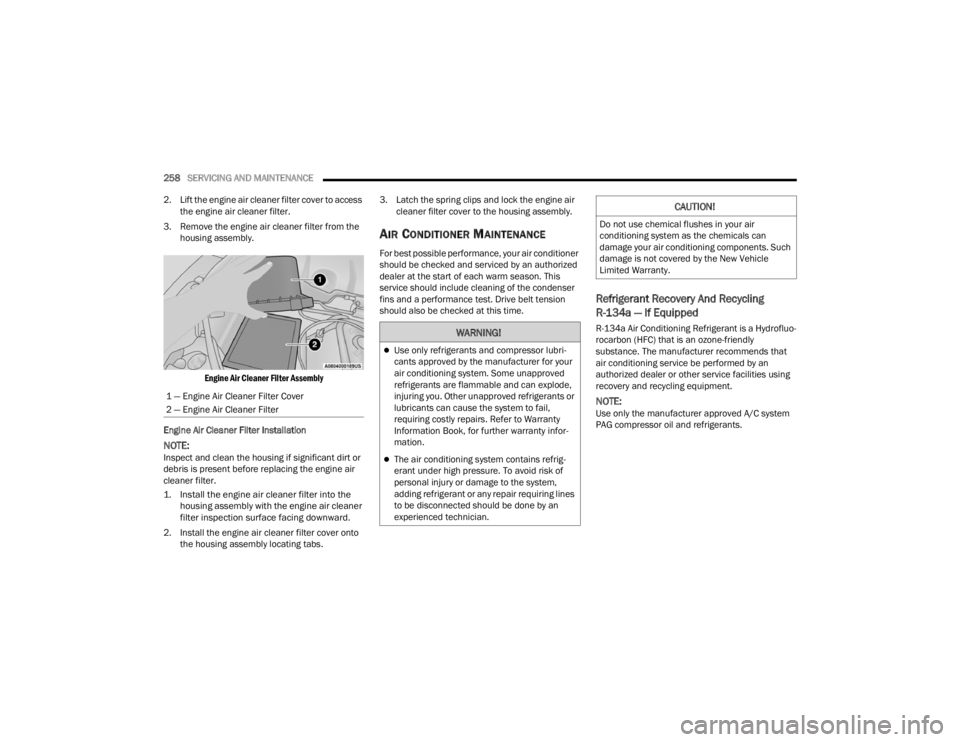
2. Lift the engine air cleaner filter cover to access the engine air cleaner filter.
3. Remove the engine air cleaner filter from the housing assembly.
Engine Air Cleaner Filter Assembly
Engine Air Cleaner Filter Installation
NOTE:Inspect and clean the housing if significant dirt or
debris is present before replacing the engine air
cleaner filter.
1. Install the engine air cleaner filter into the housing assembly with the engine air cleaner
filter inspection surface facing downward.
2. Install the engine air cleaner filter cover onto the housing assembly locating tabs. 3. Latch the spring clips and lock the engine air
cleaner filter cover to the housing assembly.
AIR CONDITIONER MAINTENANCE
For best possible performance, your air conditioner
should be checked and serviced by an authorized
dealer at the start of each warm season. This
service should include cleaning of the condenser
fins and a performance test. Drive belt tension
should also be checked at this time.
Refrigerant Recovery And Recycling
R-134a — If Equipped
R-134a Air Conditioning Refrigerant is a Hydrofluo -
rocarbon (HFC) that is an ozone-friendly
substance. The manufacturer recommends that
air conditioning service be performed by an
authorized dealer or other service facilities using
recovery and recycling equipment.
NOTE:Use only the manufacturer approved A/C system
PAG compressor oil and refrigerants.
1 — Engine Air Cleaner Filter Cover
2 — Engine Air Cleaner Filter
WARNING!
Use only refrigerants and compressor lubri
-
cants approved by the manufacturer for your
air conditioning system. Some unapproved
refrigerants are flammable and can explode,
injuring you. Other unapproved refrigerants or
lubricants can cause the system to fail,
requiring costly repairs. Refer to Warranty
Information Book, for further warranty infor -
mation.
The air conditioning system contains refrig -
erant under high pressure. To avoid risk of
personal injury or damage to the system,
adding refrigerant or any repair requiring lines
to be disconnected should be done by an
experienced technician.
CAUTION!
Do not use chemical flushes in your air
conditioning system as the chemicals can
damage your air conditioning components. Such
damage is not covered by the New Vehicle
Limited Warranty.
23_WD_OM_EN_USC_t.book Page 258
Page 263 of 328

SERVICING AND MAINTENANCE261
Conditions that would require replacement:
Rib chunking (one or more ribs has separated
from belt body)
Rib or belt wear
Longitudinal belt cracking (cracks between two
ribs)
Belt slips
Groove jumping (belt does not maintain correct
position on pulley)
Belt broken (identify and correct problem before
new belt is installed)
Noise (objectionable squeal, squeak, or rumble
is heard or felt while drive belt is in operation)
Some conditions can be caused by a faulty
component such as a belt pulley. Belt pulleys
should be carefully inspected for damage and
proper alignment.
Belt replacement on some models requires the
use of special tools. We recommend having your
vehicle serviced at an authorized dealer.
BODY LUBRICATION
Locks and all body pivot points, including such
items as seat tracks, door hinge pivot points and
rollers, liftgate, tailgate, decklid, sliding doors and
hood hinges, should be lubricated periodically. Use
a lithium-based grease, such as Mopar® Spray
White Lube to ensure quiet, easy operation and to protect against rust and wear. Prior to the
application of any lubricant, the parts concerned
should be wiped clean to remove dust and grit;
after lubricating excess oil and grease should be
removed. Particular attention should also be given
to hood latching components to ensure proper
function. When performing other underhood
services, the hood latch, release mechanism and
safety catch should be cleaned and lubricated.
The external lock cylinders should be lubricated
twice a year, preferably in the Autumn and Spring.
Apply a small amount of a high quality lubricant,
such as Mopar® Lock Cylinder Lubricant directly
into the lock cylinder.
WINDSHIELD WIPER BLADES
Clean the rubber edges of the wiper blades and the
windshield periodically with a sponge or soft cloth
and a mild nonabrasive cleaner. This will remove
accumulations of salt or road film.
Operation of the wipers on dry glass for long
periods may cause deterioration of the wiper
blades. Always use washer fluid when using the
wipers to remove salt or dirt from a dry windshield.
Avoid using the wiper blades to remove frost or ice
from the windshield. Keep the blade rubber out of
contact with petroleum products such as engine
oil, gasoline, etc.
NOTE:Life expectancy of wiper blades varies depending
on geographical area and frequency of use. If chat
-
tering, marks, water lines or wet spots are present,
clean the wiper blades or replace as necessary.
The wiper blades and wiper arms should be
inspected periodically, not just when wiper
performance problems are experienced. This
inspection should include the following points:
Wear or uneven edges
Foreign material
Hardening or cracking
Deformation or fatigue
If a wiper blade or wiper arm is damaged, replace
the affected wiper arm or blade with a new unit. Do
not attempt to repair a wiper arm or blade that is
damaged.
Front Wiper Blade Removal/Installation
CAUTION!
Do not allow the wiper arm to spring back
against the glass without the wiper blade in
place or the glass may be damaged.
8
23_WD_OM_EN_USC_t.book Page 261
Page 264 of 328
262SERVICING AND MAINTENANCE
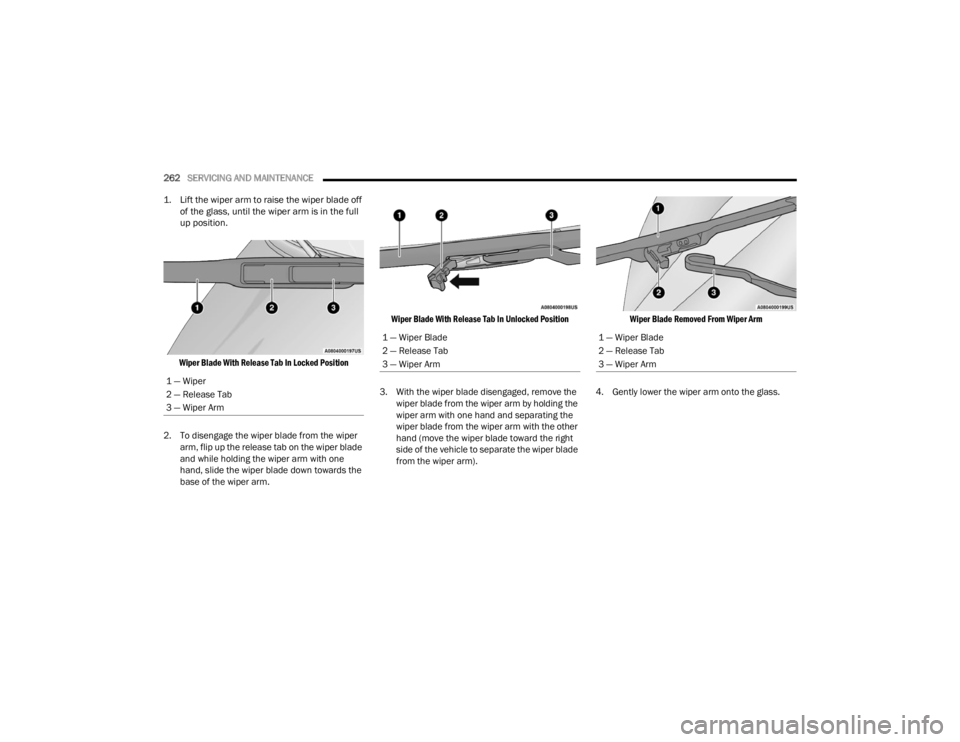
1. Lift the wiper arm to raise the wiper blade off of the glass, until the wiper arm is in the full
up position.
Wiper Blade With Release Tab In Locked Position
2. To disengage the wiper blade from the wiper arm, flip up the release tab on the wiper blade
and while holding the wiper arm with one
hand, slide the wiper blade down towards the
base of the wiper arm.
Wiper Blade With Release Tab In Unlocked Position
3. With the wiper blade disengaged, remove the wiper blade from the wiper arm by holding the
wiper arm with one hand and separating the
wiper blade from the wiper arm with the other
hand (move the wiper blade toward the right
side of the vehicle to separate the wiper blade
from the wiper arm).
Wiper Blade Removed From Wiper Arm
4. Gently lower the wiper arm onto the glass.
1 — Wiper
2 — Release Tab
3 — Wiper Arm
1 — Wiper Blade
2 — Release Tab
3 — Wiper Arm1 — Wiper Blade
2 — Release Tab
3 — Wiper Arm
23_WD_OM_EN_USC_t.book Page 262
Page 265 of 328
SERVICING AND MAINTENANCE263
Installing The Front Wipers
1. Lift the wiper arm off of the glass, until the wiper arm is in the full up position.
2. Position the wiper blade near the hook on the tip of the wiper arm with the wiper release tab
open and the blade side of the wiper facing up
and away from the windshield.
3. Insert the hook on the tip of the arm through the opening in the wiper blade under the
release tab.
4. Slide the wiper blade up into the hook on the wiper arm and rotate the wiper blade until it is
flush against the wiper arm. Fold down the
latch release tab and snap it into its locked
position. Latch engagement will be
accompanied by an audible click.
5. Gently lower the wiper blade onto the glass.
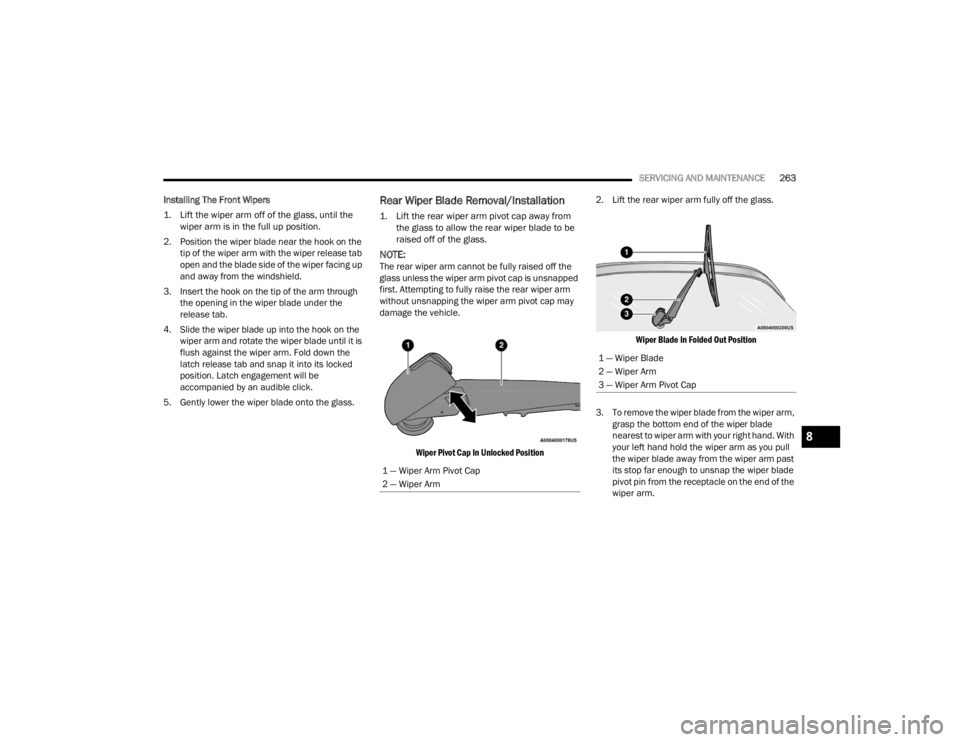
Rear Wiper Blade Removal/Installation
1. Lift the rear wiper arm pivot cap away from the glass to allow the rear wiper blade to be
raised off of the glass.
NOTE:The rear wiper arm cannot be fully raised off the
glass unless the wiper arm pivot cap is unsnapped
first. Attempting to fully raise the rear wiper arm
without unsnapping the wiper arm pivot cap may
damage the vehicle.
Wiper Pivot Cap In Unlocked Position
2. Lift the rear wiper arm fully off the glass.
Wiper Blade In Folded Out Position
3. To remove the wiper blade from the wiper arm, grasp the bottom end of the wiper blade
nearest to wiper arm with your right hand. With
your left hand hold the wiper arm as you pull
the wiper blade away from the wiper arm past
its stop far enough to unsnap the wiper blade
pivot pin from the receptacle on the end of the
wiper arm.
1 — Wiper Arm Pivot Cap
2 — Wiper Arm
1 — Wiper Blade
2 — Wiper Arm
3 — Wiper Arm Pivot Cap
8
23_WD_OM_EN_USC_t.book Page 263
Page 275 of 328

SERVICING AND MAINTENANCE273
F05 ––Air Suspension Comp *
F06 40 Amp Green –ABS Pump SRT
F07 30 Amp Pink –Starter Solenoid
F08 ––Spare
F09 30 Amp Pink –Diesel Fuel Htr * / VAC PUMP *
F10 40 Amp Green –CBC #2 / EXT Light
F11 30 Amp Pink –Trlr Tow Brake *
F12 40 Amp Green –CBC #3 / Pwr Locks
F13 40 Amp Green –HVAC BLWR MTR
F14 40 Amp Green –CBC #4 / Ext Light
F15 40 Amp Green –LTR Engine Cooling *
F16 ––Spare
F17 ––HDLP Washers *
F18 ––Spare
F19 20 Amp Blue –Solenoid Headrest *
F20 30 Amp Pink –Pass Door Mod
F21 ––Spare
F22 20 Amp Blue –ECM * / PCM *
F23 30 Amp Pink –CBC #1 / Int Light
F24 30 Amp Pink –Driver Door Mod
Cavity Cartridge Fuse Micro FuseDescription
* If Equipped
8
23_WD_OM_EN_USC_t.book Page 273
Page 282 of 328
280SERVICING AND MAINTENANCE
Bulb Replacement
NOTE:Lens fogging can occur under certain atmospheric
conditions. This will usually clear as atmospheric
conditions change to allow the condensation to
change back into a vapor. Turning the lamps on will
usually accelerate the clearing process.
FRONT TURN SIGNAL
See the following steps to replace:
1. Open the hood.
2. Rotate the turn signal bulb a quarter turn
counterclockwise to remove from housing.
3. Disconnect the electrical connector and replace the bulb.
FRONT FOG LAMPS
The front fog lamps are LEDs. See an authorized
dealer for service.
REAR TAIL, STOP AND TURN SIGNAL LAMPS
The rear tail, stop, and turn signal lamps are LED.
See an authorized dealer for replacement.
REAR LIFTGATE MOUNTED BACK-UP LAMPS
See the following steps to replace:
1. Raise the liftgate.
2. Use a fiber stick or flat blade screw driver to pry the lower trim from the liftgate.
3. Back-up lamps are now visible. Rotate socket(s) counterclockwise.
4. Remove/replace bulb(s).
5. Reinstall the socket(s).
6. Reverse process to reinstall the liftgate trim.
CENTER HIGH MOUNTED STOP LAMP (CHMSL)
The Center High Mounted Stop Lamp is an LED
assembly. See an authorized dealer for
replacement.
REAR LICENSE LAMP
The rear license lamps are LEDs. See an
authorized dealer for service.
CAUTION!
Do not touch the new bulb with your fingers. Oil
contamination will severely shorten bulb life. If
the bulb comes in contact with an oily surface,
clean the bulb with rubbing alcohol.
23_WD_OM_EN_USC_t.book Page 280
Page 311 of 328
CUSTOMER ASSISTANCE309
Who is Covered
You are covered by Roadside Assistance services if
you are a purchaser for use of the vehicle.
Roadside Assistance services last for five years or
60,000 miles on the odometer, whichever occurs
first, calculated from the start date of the Basic
Limited Warranty, as set forth in your Warranty
Information book.
1
1. Towing services provided through Cross Country Motor Club,
Inc. Medford, MA 02155, except in AK,CA, HI, OR, WI, and WY,
where services are provided by Cross Country Motor Club of
California, Inc., Thousand Oaks, CA 91360.
What to Do
If your vehicle requires jump start assistance, out
of gas/fuel delivery, tire service, lockout service or
towing as a result of a mechanical breakdown, dial
toll-free: USA: 1-800-521-2779/Canada:
800-363-4869. Provide your name, Vehicle
Identification Number (VIN) required for covered
services, license plate number, and your location,
including the telephone number from which you
are calling. Briefly describe the nature of the
problem and answer a few simple questions. You
will be given the name of the service provider and
an estimated time of arrival. If you feel you are in
an unsafe situation, please let us know. With your
consent, we will contact local police or safety
authorities. If Unable to Contact Roadside Assistance
If you are unable to contact Roadside Assistance or
unable to provide a valid Vehicle Identification
Number (VIN), and you obtain towing services on
your own, you may submit your original receipts
from the licensed towing or service facility, for
services rendered within30 days of the
occurrence. Be sure to include your VIN, odometer
mileage at the time of service, and current mailing
address. We will process the claim based on
vehicle and service eligibility. If eligible, we will
reimburse you for the reasonable amount actually
paid, based on the usual and customary charges
for that service in the area where they were
provided. FCA US LLC’s determination relating to
reimbursement is final. Correspondence should be
mailed to:
FCA US LLC Customer Assistance
P.O. Box 9145
Medford, MA 02155
Attention Claims Department
FCA US LLC reserves the right to modify the terms
or discontinue the Roadside Assistance Program
at any time. The Roadside Assistance program is
subject to restrictions and conditions of use, which
are determined solely by FCA US LLC.
Flat Tire Service
If you are inconvenienced by a flat tire, we will
dispatch a service provider to use your vehicle’s
temporary spare tire (if equipped) as
recommended in your Owner’s Manual. This is not
a permanent flat tire repair.
Out of Gas/Fuel Delivery
Drivers cannot always count on a gas station being
nearby, especially when traveling away from home.
We will dispatch a service provider to deliver a
small amount of fuel (maximum two gallons) to get
you to a nearby station. This service is limited to
two occurrences in a 12-month period.
Battery Jump Assistance
No time is a good time for a depleted battery. With
Roadside Assistance, you do not have to worry
about being stranded. We will dispatch a service
provider to provide you with a battery jump
anytime, day or night.
Lockout Service
Whether the keys are locked in your vehicle or
frozen locks are keeping you from getting on your
way, help is just a phone call away. This service is
limited to providing access to the vehicle’s seating
area. It does not cover the cost of replacement
keys.
10
23_WD_OM_EN_USC_t.book Page 309