ignition DODGE GRAND CARAVAN 2009 5.G Owners Manual
[x] Cancel search | Manufacturer: DODGE, Model Year: 2009, Model line: GRAND CARAVAN, Model: DODGE GRAND CARAVAN 2009 5.GPages: 535, PDF Size: 18.61 MB
Page 345 of 535
apparent, and/or the system is not functioning as antici-
pated. Coordinate inspection efforts through an autho-
rized dealer.CAUTION!
Do not use chemical flushes in your power steering
system as the chemicals can damage your power
steering components. Such damage is not covered by
the New Vehicle Limited Warranty.
WARNING!
Fluid level should be checked on a level surface and
with the engine off to prevent injury from moving
parts and to ensure accurate fluid level reading. Do
not overfill. Use only manufacturer’s recommended
power steering fluid.
If necessary, add fluid to restore to the proper indicated
level. With a clean cloth, wipe any spilled fluid from all
surfaces. Refer to “Fluids, Lubricants, and Genuine
Parts” in Section 7 for the correct fluid type.
PARKING BRAKE
When the parking brake is applied with the ignition
switch ON, the “Brake Warning Light” in the instrument
cluster will turn on.
NOTE:
This light only shows that the parking brake is
applied. It does not show the degree of brake application.
STARTING AND OPERATING 343 5
Page 347 of 535
WARNING! (Continued)
Never leave children alone in a vehicle. Leaving
unattended children in a vehicle is dangerous for a
number of reasons. A child or others could be
seriously or fatally injured. Do not leave the key in
the ignition. A child could operate power win-
dows, other controls, or move the vehicle
When parking on a hill, turn the front wheels toward the
curb on a downhill grade, and away from the curb on an
uphill grade.
The parking brake should always be applied whenever
the driver is not in the vehicle.
ANTI-LOCK BRAKE SYSTEM (ABS)
The Anti-Lock Brake System (ABS) provides increased
vehicle stability and brake performance under most
braking conditions. The system operates with a separate computer to modulate hydraulic pressure to prevent
wheel lock-up and help avoid skidding on slippery
surfaces.
ABS is activated during braking under certain road or
stopping conditions. ABS-inducing conditions can in-
clude ice, snow, gravel, bumps, railroad tracks, loose
debris, or panic stops.
You may experience the following when the brake system
goes into anti-lock:
The ABS motor running (it may continue to run for a
short time after the stop)
A clicking sound of solenoid valves
Brake pedal pulsations
A slight drop or fall away of the brake pedal at the end
of the stop
STARTING AND OPERATING 345 5
Page 349 of 535
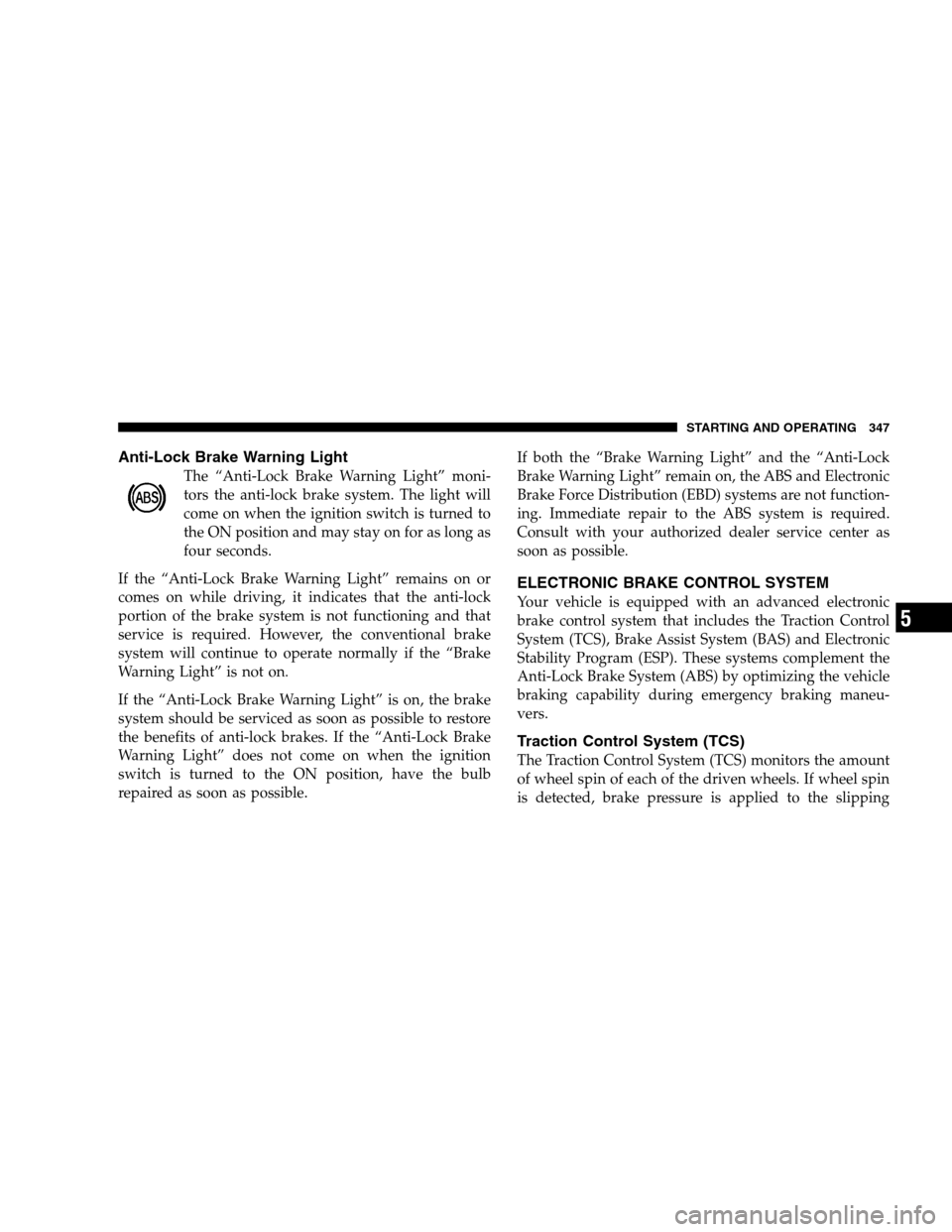
Anti-Lock Brake Warning LightThe “Anti-Lock Brake Warning Light” moni-
tors the anti-lock brake system. The light will
come on when the ignition switch is turned to
the ON position and may stay on for as long as
four seconds.
If the “Anti-Lock Brake Warning Light” remains on or
comes on while driving, it indicates that the anti-lock
portion of the brake system is not functioning and that
service is required. However, the conventional brake
system will continue to operate normally if the “Brake
Warning Light” is not on.
If the “Anti-Lock Brake Warning Light” is on, the brake
system should be serviced as soon as possible to restore
the benefits of anti-lock brakes. If the “Anti-Lock Brake
Warning Light” does not come on when the ignition
switch is turned to the ON position, have the bulb
repaired as soon as possible. If both the “Brake Warning Light” and the “Anti-Lock
Brake Warning Light” remain on, the ABS and Electronic
Brake Force Distribution (EBD) systems are not function-
ing. Immediate repair to the ABS system is required.
Consult with your authorized dealer service center as
soon as possible.
ELECTRONIC BRAKE CONTROL SYSTEM
Your vehicle is equipped with an advanced electronic
brake control system that includes the Traction Control
System (TCS), Brake Assist System (BAS) and Electronic
Stability Program (ESP). These systems complement the
Anti-Lock Brake System (ABS) by optimizing the vehicle
braking capability during emergency braking maneu-
vers.
Traction Control System (TCS)
The Traction Control System (TCS) monitors the amount
of wheel spin of each of the driven wheels. If wheel spin
is detected, brake pressure is applied to the slipping STARTING AND OPERATING 347
5
Page 353 of 535
NOTE:To improve the vehicle’s traction when driving
with snow chains, or starting off in deep snow, sand or
gravel, it may be desirable to switch to the “Partial Off”
mode by pressing the “ESP OFF” switch. Once the
situation requiring ESP to be switched to the “Partial Off”
mode is overcome, turn ESP back on by momentarily
pressing the “ESP OFF” switch. This may be done while
the vehicle is in motion.
ESP/BAS Warning Light
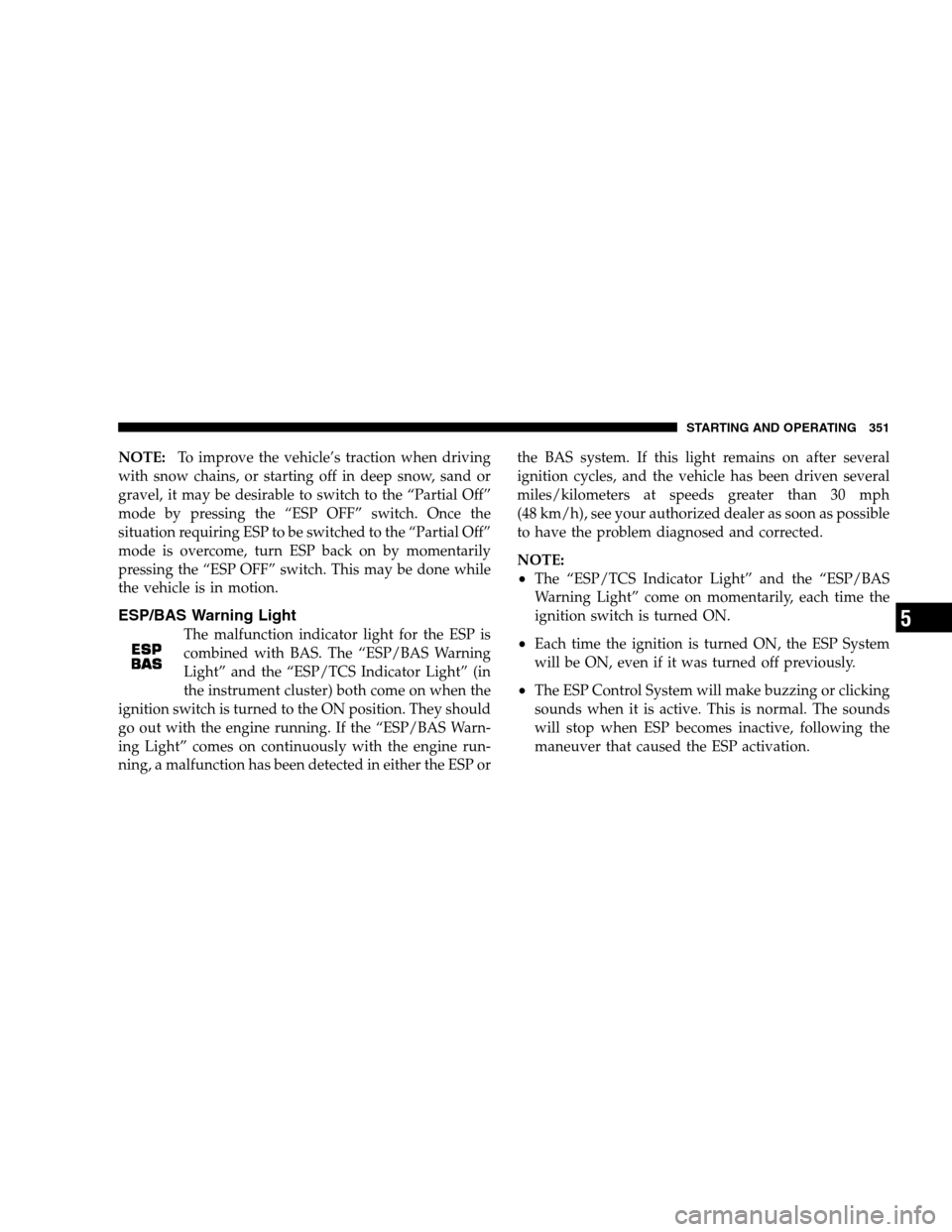
The malfunction indicator light for the ESP is
combined with BAS. The “ESP/BAS Warning
Light” and the “ESP/TCS Indicator Light” (in
the instrument cluster) both come on when the
ignition switch is turned to the ON position. They should
go out with the engine running. If the “ESP/BAS Warn-
ing Light” comes on continuously with the engine run-
ning, a malfunction has been detected in either the ESP or the BAS system. If this light remains on after several
ignition cycles, and the vehicle has been driven several
miles/kilometers at speeds greater than 30 mph
(48 km/h), see your authorized dealer as soon as possible
to have the problem diagnosed and corrected.
NOTE:
The “ESP/TCS Indicator Light” and the “ESP/BAS
Warning Light” come on momentarily, each time the
ignition switch is turned ON.
Each time the ignition is turned ON, the ESP System
will be ON, even if it was turned off previously.
The ESP Control System will make buzzing or clicking
sounds when it is active. This is normal. The sounds
will stop when ESP becomes inactive, following the
maneuver that caused the ESP activation. STARTING AND OPERATING 351
5
Page 375 of 535
The Basic TPMS consists of the following components:
Receiver Module
Four Tire Pressure Monitoring Sensors
TPMS Telltale Warning Light
Tire Pressure Monitoring Low Tire Pressure
Warnings
The “TPMS Telltale Warning Light” will illu-
minate in the instrument cluster, and an au-
dible chime will be activated when one or more
of the four active road tire pressures are low.
Should this occur, you should stop as soon as possible,
check the inflation pressure of each tire on your vehicle,
and inflate each tire to the vehicle’s recommended cold
tire pressure value (located on the placard on the
driver’s-side B-Pillar). The system will automatically
update and the “TPMS Warning Lamp” will extinguish
once the updated tire pressures have been received. NOTE:
The vehicle may need to be driven for up to
20 minutes above 15 mph (25 km/h) to receive this
information.
The “TPMS Warning Lamp” will flash on and off for
75 seconds, and remain on solid when a system fault is
detected. The system fault will also sound a chime. If the
ignition key is cycled, this sequence will repeat, provid-
ing the system fault still exists. The “TPMS Warning
Lamp” will turn off when the fault condition no longer
exists. A system fault can occur with any of the following
scenarios:
1. Jamming due to electronic devices or driving next to
facilities emitting the same radio frequencies as the TPMS
sensors.
2. Installing some form of aftermarket window tinting
that affects radio wave signals. STARTING AND OPERATING 373
5
Page 376 of 535
3. Accumulation of excessive snow and/or ice around
the wheels or wheel housings.
4. Using tire chains on the vehicle.
5. Using wheels/tires not equipped with TPMS sensors.
Vehicles with Compact Spare
1. The compact spare tire (if equipped) does not have a
TPMS sensor. Therefore the TPMS will not monitor the
pressure in the compact spare tire.
2. If you install the compact spare tire in place of a road
tire that has a pressure below the low-pressure warning
limit, upon the next ignition key cycle, a chime will
sound and the “TPMS Telltale Warning Light” will turn
on.
3. After driving for up to 20 minutes above 15 mph
(25 km/h), the “TPMS Telltale Warning Light” will flash
on and off for 75 seconds and then remain on solid.4. For each subsequent ignition key cycle, a chime will
sound and the “TPMS Telltale Warning Light” will re-
main on solid.
5. Once you repair or replace the original road tire and
reinstall it on the vehicle in place of the compact spare
tire, the TPMS will automatically update, and the “TPMS
Telltale Warning Light” will turn off as long as no tire
pressure is below the low-pressure warning limit in any
of the four active road tires. The vehicle may need to be
driven for up to 20 minutes above 15 mph (25 km/h) for
the TPMS to receive this information.
Premium System — If Equipped
The TPMS uses wireless technology with wheel rim-
mounted electronic sensors to monitor tire pressure lev-
els. Sensors mounted to each wheel as part of the valve
stem transmit tire pressure readings to the Receiver
Module.
374 STARTING AND OPERATING
Page 378 of 535
Should a low tire condition occur on any of the four
active road tire(s), you should stop as soon as possible,
and inflate the low tire(s) that is flashing on the graphic
display to the vehicle’s recommended cold tire pressure
value. The system will automatically update, the graphic
display of the pressure value(s) will stop flashing, and
the “TPMS Telltale Warning Light” will extinguish once
the updated tire pressure(s) have been received. The
vehicle may need to be driven for up to 20 minutes above
15 mph (25 km/h) to receive this information.
Check TPMS Message
The “TPMS Telltale Warning Light” will flash on and off
for 75 seconds, and remain on solid when a system fault
is detected. The system fault will also sound a chime. The
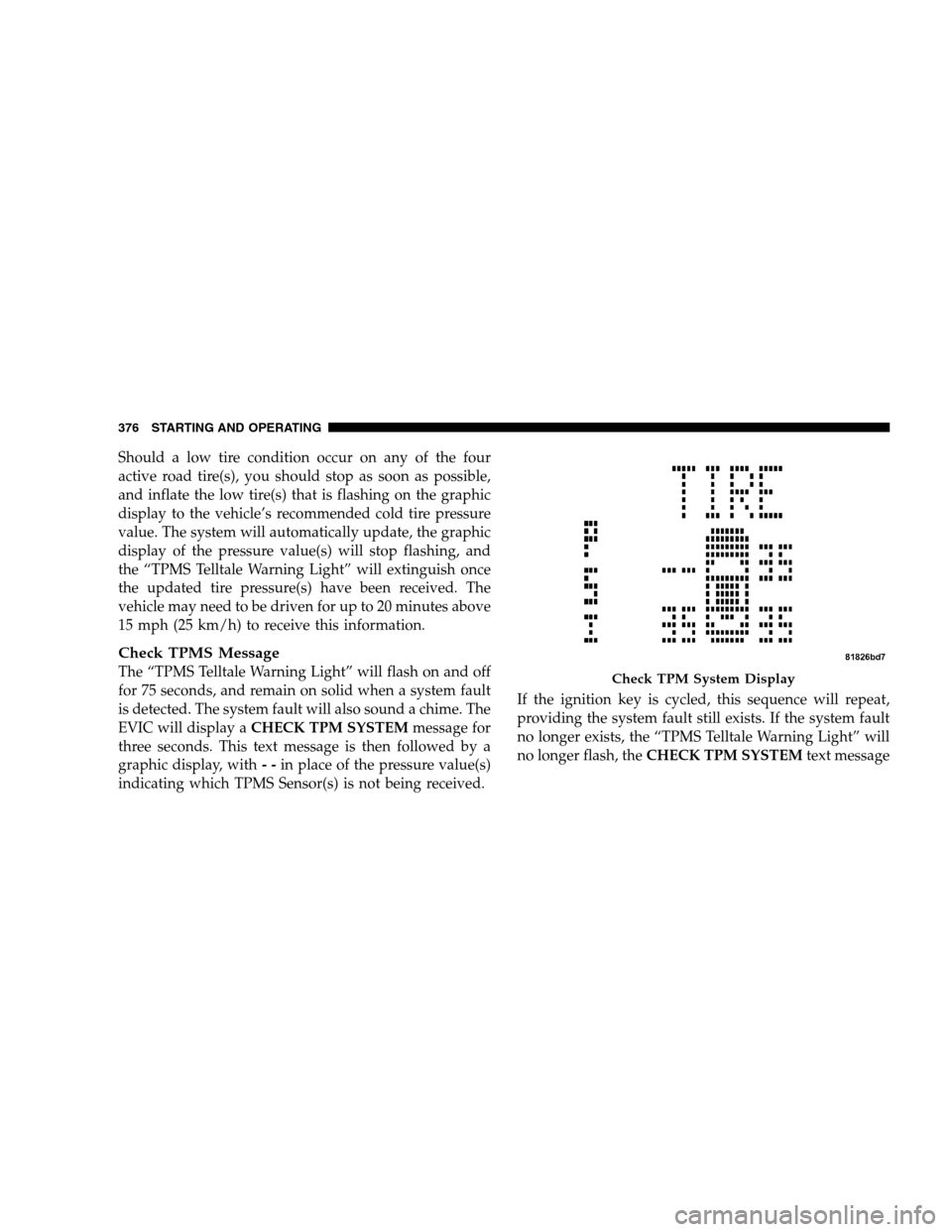
EVIC will display aCHECK TPM SYSTEM message for
three seconds. This text message is then followed by a
graphic display, with - -in place of the pressure value(s)
indicating which TPMS Sensor(s) is not being received. If the ignition key is cycled, this sequence will repeat,
providing the system fault still exists. If the system fault
no longer exists, the “TPMS Telltale Warning Light” will
no longer flash, the
CHECK TPM SYSTEM text message Check TPM System Display
376 ST
ARTING AND OPERATING
Page 379 of 535
will not be present, and a pressure value will be dis-
played instead of dashes. A system fault can occur by any
of the following scenarios:
1. Jamming due to electronic devices or driving next to
facilities emitting the same radio frequencies as the TPMS
sensors.
2. Installing some form of aftermarket window tinting
that affects radio wave signals.
3. Accumulation of excessive snow and/or ice around
the wheels or wheel housings.
4. Using tire chains on the vehicle.
5. Using wheels/tires not equipped with TPMS sensors.
Vehicles with Compact Spare
1. The compact spare tire (if equipped) does not have a
TPMS. Therefore, the TPMS will not monitor the pressure
in the compact spare tire.2. If you install the compact spare tire in place of a road
tire that has a pressure below the low-pressure warning
limit, upon the next ignition key cycle, the “TPMS Telltale
Warning Light” will remain on, a chime will sound, and
the EVIC will still display a flashing pressure value in the
graphic display.
3. After driving the vehicle for up to 20 minutes above
15 mph (25 km/h), the “TPMS Telltale Warning Light”
will flash on and off for 75 seconds and then remain on
solid. In addition, the EVIC will display a CHECK TPM
SYSTEM message for three seconds and then display
dashes (- -) in place of the pressure value.
4. For each subsequent ignition key cycle, a chime will
sound, the “TPMS Telltale Warning Light” will flash on
and off for 75 seconds and then remain on solid, and the
EVIC will display a CHECK TPM SYSTEM message for
three seconds and then display dashes (- -) in place of the
pressure value.
STARTING AND OPERATING 377 5
Page 384 of 535
An out-of-tune engine, or certain fuel or ignition
malfunctions, can cause the catalytic converter to
overheat. If you notice a pungent burning odor or
some light smoke, your engine may be out of tune or
malfunctioning and may require immediate service.
Contact your authorized dealer for service assistance.
The use of fuel additives which are now being sold as
octane enhancers is not recommended. Most of these
products contain high concentrations of methanol.
Fuel system damage or vehicle performance problems
resulting from the use of such fuels or additives is not
the responsibility of the manufacturer.
NOTE: Intentional tampering with emissions control
systems can result in civil penalties being assessed
against you.
Carbon Monoxide Warnings WARNING!
Carbon monoxide (CO) in exhaust gases is deadly.
To prevent carbon monoxide poisoning DO NOT
inhale exhaust gases. They contain carbon monox-
ide, a colorless and odorless gas which can kill.
NEVER run the engine in a closed area, such as a
garage, and NEVER sit in a parked vehicle with
the engine running for an extended period. If the
vehicle is stopped in an open area with the engine
running for more than a short period, adjust the
ventilation system to force fresh, outside air into
the vehicle.
(Continued)
382 STARTING AND OPERATING
Page 411 of 535
WHAT TO DO IN EMERGENCIESCONTENTS
m
Hazard Warning Flasher . . . . . . . . . . . . . . . 410
m If Your Engine Overheats . . . . . . . . . . . . . . . 410
m Jacking And Tire Changing . . . . . . . . . . . . . . 411
▫ Jack Location . . . . . . . . . . . . . . . . . . . . . . 412 m
Jump-Starting Procedure . . . . . . . . . . . . . . . 424
m Freeing A Stuck Vehicle . . . . . . . . . . . . . . . . 427
m Towing A Disabled Vehicle . . . . . . . . . . . . . . 427
▫ Towing With The Ignition Key . . . . . . . . . . 427 6