ignition DODGE GRAND CARAVAN 2009 5.G Owners Manual
[x] Cancel search | Manufacturer: DODGE, Model Year: 2009, Model line: GRAND CARAVAN, Model: DODGE GRAND CARAVAN 2009 5.GPages: 535, PDF Size: 18.61 MB
Page 412 of 535
HAZARD WARNING FLASHERThe Hazard Warning flasher switch is located in the
center of the instrument panel above the radio.
Press the switch to turn on the Hazard Warning
flasher. When the switch is activated, all directional
turn signals will flash on and off to warn oncoming
traffic of an emergency. Press the switch a second time to
turn off the Hazard Warning flasher.
This is an emergency warning system and should not be
used when the vehicle is in motion. Use it when your
vehicle is disabled and is creating a safety hazard for
other motorists.
When you must leave the vehicle to seek assistance, the
Hazard Warning flasher will continue to operate even
though the ignition switch is OFF.
NOTE: With extended use, the Hazard Warning flasher
may wear down your battery.
IF YOUR ENGINE OVERHEATS
In any of the following situations, you can reduce the
potential for overheating by taking the appropriate action.
On the highways — Slow down.
In city traffic — While stopped, shift the transmission
shift lever into NEUTRAL, but do not increase engine
idle speed.
NOTE: There are steps that you can take to slow down
an impending overheat condition:
If your air conditioner (A/C) is on, turn it off. The A/C
system adds heat to the engine cooling system and
turning the A/C can help remove this heat.
You can also turn the Temperature Control to maxi-
mum heat, the Mode Control to floor and the Fan
Control to high. This allows the heater core to act as a
supplement to the radiator and aids in removing heat
from the engine cooling system. 410 WHAT TO DO IN EMERGENCIES
Page 416 of 535
Preparations For Jacking1. Park the vehicle on a firm, level surface. Avoid ice or
slippery areas.
WARNING!
Do not attempt to change a tire on the side of the
vehicle close to moving traffic. Pull far enough off
the road to avoid being hit when operating the jack
or changing the wheel.
2. Set the parking brake.
3. Place the shift lever into PARK. 4. Turn OFF the ignition.
5. Turn on the Hazard Warning flasher.
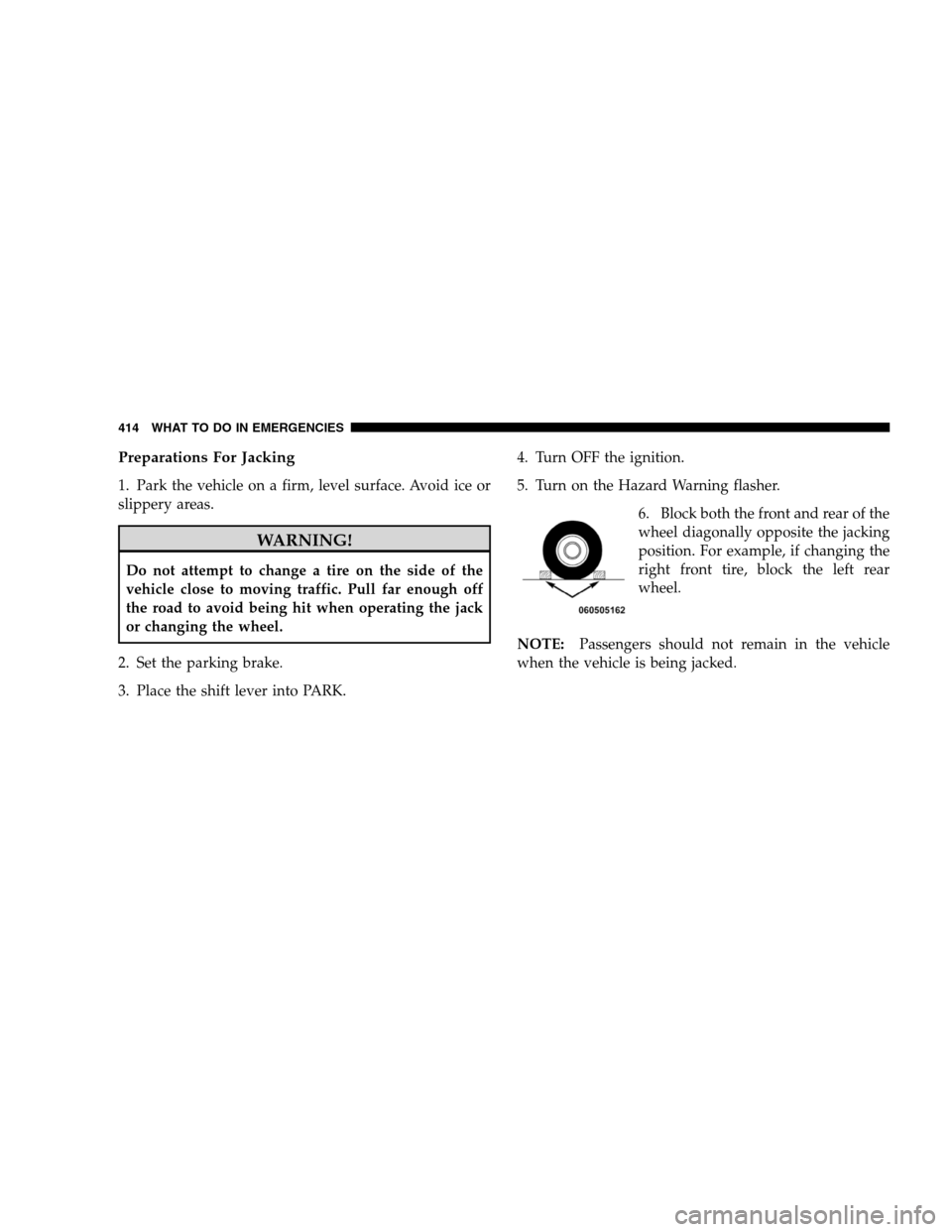
6. Block both the front and rear of the
wheel diagonally opposite the jacking
position. For example, if changing the
right front tire, block the left rear
wheel.
NOTE: Passengers should not remain in the vehicle
when the vehicle is being jacked. 414 WHAT TO DO IN EMERGENCIES
Page 427 of 535
WARNING! (Continued)
Take special care to avoid the radiator cooling fan
whenever the hood is raised. The cooling fan is
electrically operated and can start anytime the
ignition switch is ON. You can be hurt by the fan.
During cold weather when temperatures are be-
low the freezing point, electrolyte in a discharged
battery may freeze. Do not attempt jump-starting
because the battery could rupture or explode. The
battery temperature must be brought up above the
freezing point before attempting a jump-start. When jump-starting, proceed as follows:
1. Wear eye protection and remove any metal jewelry,
such as watch bands or bracelets, that might make an
inadvertent electrical contact.
2. When a boost is provided by a battery in another
vehicle, park that vehicle within booster cable reach and
do not let the vehicles touch. Set the parking brake, place
the automatic transmission shift lever into PARK and
turn the ignition switch to the OFF position for both
vehicles.
3. Turn off the heater, radio and all unnecessary electrical
loads.
4. Connect one end of a jumper cable to the positive
terminal of the discharged battery. Connect the other end
of the same cable to the positive terminal of the booster
battery.
WHAT TO DO IN EMERGENCIES 425 6
Page 429 of 535
FREEING A STUCK VEHICLEIf your vehicle becomes stuck in mud, sand or snow, it
can often be moved by a rocking motion. Turn your
steering wheel right and left to clear the area around the
front wheels. Then move the shift lever back and forth
between REVERSE and DRIVE. Using minimal accelera-
tor pedal pressure to maintain the rocking motion, with-
out spinning the wheels, is most effective.
WARNING!
Fast spinning tires can be dangerous. Forces gener-
ated by excessive wheel speeds may cause tire dam-
age or failure. A tire could explode and injure some-
one. Do not spin your vehicle’s wheels faster than
35 mph (55 km/h) when you are stuck. Do not let
anyone near a spinning wheel, no matter what the
speed. CAUTION!
Revving the engine or spinning the wheels too fast
may lead to transmission overheating and failure. It
can also damage the tires. Do not spin the wheels
above 35 mph (55 km/h).
TOWING A DISABLED VEHICLE
Towing With The Ignition Key
Your vehicle may be towed under the following condi-
tions:
The shift lever must be in NEUTRAL.
The distance to be traveled must not exceed 100 miles
(160 km).
The towing speed must not exceed 44 mph (72 km/h).
WHAT TO DO IN EMERGENCIES 427
6
Page 430 of 535
CAUTION!Exceeding these towing limits may cause a transmis-
sion gear failure.
If the transmission is inoperative, or if the vehicle is to be
towed more than 100 miles (160 km), the vehicle must be
towed with the front wheels off the ground. CAUTION!
Do not attempt to tow this vehicle from the front
with sling-type towing equipment. Damage to the
front fascia will result.
(Continued) CAUTION! (Continued)
Always use wheel lift equipment when towing
from the front. The only other approved method of
towing is with a flatbed truck.
Do not tow the vehicle from the rear. Damage to
the rear sheet metal, liftgate and fascia will occur.
Do not push or tow this vehicle with another
vehicle as damage to the bumper fascia and trans-
mission may result.
If the vehicle being towed requires steering, the
ignition switch must be in the OFF position, not in
the LOCK or ACC positions.
428 WHAT TO DO IN EMERGENCIES
Page 431 of 535
If it is necessary to use the accessories while being towed
(wipers, defrosters, etc.), the key must be in the ON
position, not the ACC position. Make certain the trans-
mission remains in NEUTRAL.
Towing Without The Ignition Key
Special care must be taken when the vehicle is towed
with the ignition in the OFF position. The only approved
method of towing without the ignition key is with a
flatbed truck. Proper towing equipment is necessary to
prevent damage to the vehicle.
Towing This Vehicle Behind Another Vehicle (Flat
Towing With All Four Wheels On The Ground)
Flat towing of vehicles equipped with an automatic
transmission, is only permitted within the limitations
described in this section.
Towing This Vehicle Behind Another Vehicle With
A Tow Dolly
The manufacturerdoes not recommend that you tow a
front wheel drive vehicle on a tow dolly. Vehicle damage
may occur.
WHAT TO DO IN EMERGENCIES 429 6
Page 438 of 535
filler cap message will be displayed in the instrument
cluster. Tighten the gas cap until a9clicking9sound is
heard. This is an indication that the gas cap is properly
tightened. Press the odometer reset button to turn the
message off. If the problem persists, the message will
appear the next time the vehicle is started. If the problem
is detected twice in a row, the system will turn on the
Malfunction Indicator Light (MIL). Resolving the prob-
lem will turn the MIL light off. Take your vehicle in to an
authorized dealer.
EMISSIONS INSPECTION AND MAINTENANCE
PROGRAMS
In some localities, it may be a legal requirement to pass
an inspection of your vehicle’s emissions control system.
Failure to pass could prevent vehicle registration.
For states that require an Inspection and Mainte-
nance (I/M), this check verifies the “Malfunction Indicator Light (MIL)” is functioning and is not on when
the engine is running, and that the OBD II system is
ready for testing.
Normally, the OBD II system will be ready. The OBD II
system may
notbe ready if your vehicle was recently
serviced, recently had a dead battery or a battery replace-
ment. If the OBD II system should be determined not
ready for the I/M test, your vehicle may fail the test.
Your vehicle has a simple ignition key-actuated test,
which you can use prior to going to the test station. To
check if your vehicle’s OBD II system is ready, you must
do the following:
1. Insert your ignition key into the ignition switch.
2. Turn the ignition to the ON position, but do not crank
or start the engine.
3. If you crank or start the engine, you will have to start
this test over. 436 MAINTAINING YOUR VEHICLE
Page 439 of 535
4. As soon as you turn your key to the ON position, you
will see the MIL symbol come on as part of a normal bulb
check.
5. Approximately 15 seconds later, one of two things will
happen:a. The MIL will flash for about 10 seconds and then
return to being fully illuminated until you turn OFF
the ignition or start the engine. This means that your
vehicle’s OBD II system is not readyand you should
not proceed to the I/M station.
b. The MIL will not flash at all and will remain fully
illuminated until you turn OFF the ignition or start the
engine. This means that your vehicle’s OBD II system
is ready and you can proceed to the I/M station.
If your OBD II system is not ready,you should see your
authorized dealer or repair facility. If your vehicle was
recently serviced or had a battery failure or replacement, you may need to do nothing more than drive your
vehicle as you normally would in order for your OBD II
system to update. A recheck with the above test routine
may then indicate that the system is now ready.
Regardless of whether your vehicle’s OBD II system is
ready or not, if the MIL is illuminated during normal
vehicle operation you should have your vehicle serviced
before going to the I/M station. The I/M station can fail
your vehicle because the MIL is on with the engine
running.
REPLACEMENT PARTS
Use of genuine MOPARt
parts for normal/scheduled
maintenance and repairs is highly recommended to en-
sure the designed performance. Damage or failures
caused by the use of non-MOPARt parts for maintenance
and repairs will not be covered by the manufacturer’s
warranty.
MAINTAINING YOUR VEHICLE 437 7
Page 447 of 535
To minimize the possibility of catalyst damage:
Do not shut OFF the engine or interrupt the ignition
when the transaxle is in gear and the vehicle is in
motion.
Do not try to start the engine by pushing or towing the
vehicle.
Do not idle the engine with any spark plug wires
disconnected or removed, such as when diagnostic
testing, or for prolonged periods during very rough
idling or malfunctioning operating conditions.
Maintenance-Free Battery
The top of the maintenance-free battery is permanently
sealed. You will never have to add water, nor is periodic
maintenance required.WARNING!
Battery fluid is a corrosive acid solution and can
burn or even blind you. Do not allow battery fluid
to contact your eyes, skin or clothing. Do not lean
over a battery when attaching clamps. If acid
splashes in eyes or on skin, flush the area imme-
diately with large amounts of water.
Battery gas is flammable and explosive. Keep
flame or sparks away from the battery. Do not use
a booster battery or any other booster source with
an output greater than 12 volts. Do not allow cable
clamps to touch each other.
Battery posts, terminals and related accessories
contain lead and lead compounds. Wash hands
after handling.
MAINTAINING YOUR VEHICLE 445 7
Page 453 of 535
Cooling System
WARNING!
When working near the radiator cooling fan, dis-
connect the fan motor lead or turn the ignition
switch to the OFF position. The fan is temperature
controlled and can start at anytime the ignition
switch is in the ON position.
You or others can be badly burned by hot engine
coolant (antifreeze) or steam from your radiator. If
you see or hear steam coming from under the
hood, do not open the hood until the radiator has
had time to cool. Never try to open a cooling
system pressure cap when the radiator is hot.
Coolant Checks
Check the engine coolant (antifreeze) protection every
12 months (before the onset of freezing weather, where
applicable). If the engine coolant (antifreeze) is dirty or rusty in appearance, the system should be drained,
flushed and refilled with fresh coolant. Check the front of
the A/C condenser for any accumulation of bugs, leaves,
etc. If dirty, clean by gently spraying water from a garden
hose vertically down the face of the condenser.
Check the coolant recovery bottle tubing for brittle rub-
ber, cracking, tears, cuts and tightness of the connection
at the bottle and radiator. Inspect the entire system for
leaks.
With the engine at normal operating temperature (but
not running), check the cooling system pressure cap for
proper vacuum sealing by draining a small amount of
engine coolant (antifreeze) from the radiator drain cock.
If the cap is sealing properly, the engine coolant (anti-
freeze) will begin to drain from the coolant recovery
bottle. DO NOT REMOVE THE COOLANT PRESSURE
CAP WHEN THE COOLING SYSTEM IS HOT.
MAINTAINING YOUR VEHICLE 451 7