light DODGE GRAND CARAVAN 2009 5.G Owners Manual
[x] Cancel search | Manufacturer: DODGE, Model Year: 2009, Model line: GRAND CARAVAN, Model: DODGE GRAND CARAVAN 2009 5.GPages: 535, PDF Size: 18.61 MB
Page 407 of 535
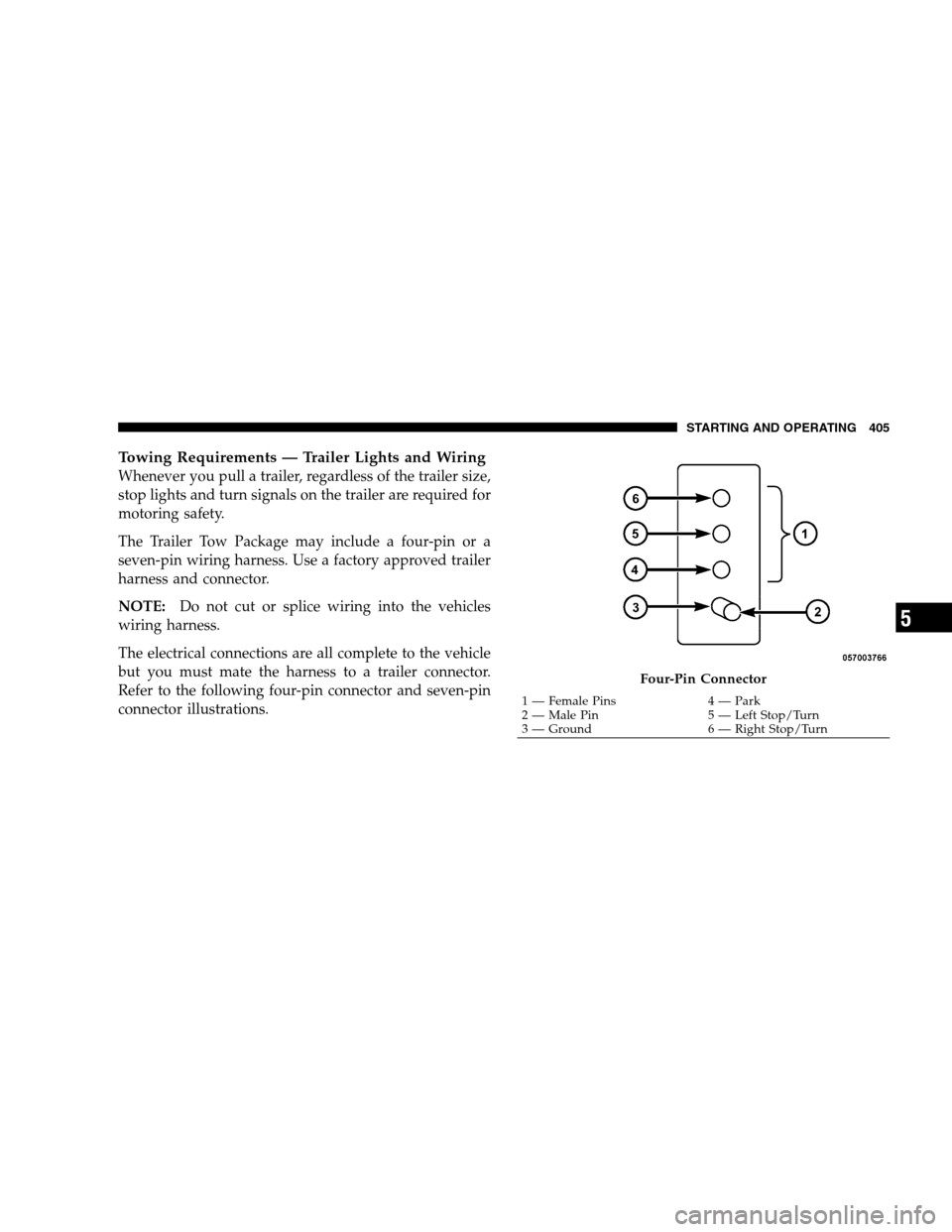
Towing Requirements — Trailer Lights and WiringWhenever you pull a trailer, regardless of the trailer size,
stop lights and turn signals on the trailer are required for
motoring safety.
The Trailer Tow Package may include a four-pin or a
seven-pin wiring harness. Use a factory approved trailer
harness and connector.
NOTE:
Do not cut or splice wiring into the vehicles
wiring harness.
The electrical connections are all complete to the vehicle
but you must mate the harness to a trailer connector.
Refer to the following four-pin connector and seven-pin
connector illustrations. Four-Pin Connector
1 — Female Pins
4 — Park
2 —
Male Pin 5 — Left Stop/Turn
3 — Ground 6 — Right Stop/Turn
STARTING AND OPERATING 405 5
Page 409 of 535
The automatic transaxle fluid and filter should be
changed if you REGULARLY tow a trailer for more than
45 minutes of continuous operation. Refer to the “Main-
tenance Schedule” in Section 8 of this manual for the
proper maintenance intervals.
NOTE:
Check the automatic transaxle fluid level before tow-
ing.
The six-speed automatic transaxle is sealed and re-
quires an authorized dealer to check the transaxle
fluid.
Electronic Speed Control — If Equipped
Do not use in hilly terrain or with heavy loads.
When using the speed control, if you experience speed
drops greater than 10 mph (16 km/h), disengage until
you can get back to cruising speed.
Use speed control in flat terrain and with light loads to
maximize fuel efficiency.
STARTING AND OPERATING 4075
Page 422 of 535
CAUTION!Do not attempt to raise the vehicle by jacking on
locations other than those indicated in Step 5.
6. Place the wrench on the jack screw and turn to the
right until the jack head is properly engaged in the
described location. Do not raise the vehicle until you are
sure the jack is securely engaged.
7. Raise the vehicle by turning the jack screw to the right,
using the swivel wrench. Raise the vehicle only until the
tire just clears the surface and enough clearance is
obtained to install the spare tire. Minimum tire lift
provides maximum stability. WARNING!Raising the vehicle higher than necessary can make
the vehicle less stable. It could slip off the jack and
hurt someone near it. Raise the vehicle only enough
to remove the tire.
8. Remove the wheel lug nuts, for vehicles with wheel
covers, remove the cover from the wheel by hand. Do not
pry the wheel cover off. Then pull the wheel off the hub.
9. Install the compact spare tire. Lightly tighten the lug
nuts. To avoid the risk of forcing the vehicle off the jack,
do not tighten the lug nuts fully until the vehicle has been
lowered.
NOTE:
Do not install the wheel cover on the compact spare.
Do not use a hammer or force to install the wheel
covers.
420 WHAT TO DO IN EMERGENCIES
Page 434 of 535
▫Cooling System . . . . . . . . . . . . . . . . . . . . 451
▫ Brakes . . . . . . . . . . . . . . . . . . . . . . . . . . . 456
▫ Automatic Transaxle . . . . . . . . . . . . . . . . . 458
▫ Appearance Care And Protection From
Corrosion . . . . . . . . . . . . . . . . . . . . . . . . . . 461
▫ Cleaning The Instrument Panel
Cupholders . . . . . . . . . . . . . . . . . . . . . . . . 466
m Fuses . . . . . . . . . . . . . . . . . . . . . . . . . . . . . 467
▫ Totally Integrated Power Module (TIPM) . . 467
m Vehicle Storage . . . . . . . . . . . . . . . . . . . . . . 475
m Replacement Light Bulbs . . . . . . . . . . . . . . . 475
m Bulb Replacement . . . . . . . . . . . . . . . . . . . . 476
▫ Headlamps . . . . . . . . . . . . . . . . . . . . . . . 476 ▫
Front Park/Turn Signal Lamps . . . . . . . . . 477
▫ Fog Lamps . . . . . . . . . . . . . . . . . . . . . . . . 477
▫ Rear Tail, Stop, Turn Signal, Side Marker
And Backup Lamps . . . . . . . . . . . . . . . . . . . 478
▫ Center High-Mounted Stop Lamp
(CHMSL) . . . . . . . . . . . . . . . . . . . . . . . . . . 479
▫ License Lamp . . . . . . . . . . . . . . . . . . . . . . 479
m Fluids And Capacities . . . . . . . . . . . . . . . . . 480
m Fluids, Lubricants And Genuine Parts . . . . . . 481
▫ Engine . . . . . . . . . . . . . . . . . . . . . . . . . . . 481
▫ Chassis . . . . . . . . . . . . . . . . . . . . . . . . . . 482
432 MAINTAINING YOUR VEHICLE
Page 437 of 535

ONBOARD DIAGNOSTIC SYSTEM — OBD IIYour vehicle is equipped with a sophisticated onboard
diagnostic system called OBD II. This system monitors
the performance of the emissions, engine, and automatic
transmission control systems. When these systems are
operating properly, your vehicle will provide excellent
performance and fuel economy, as well as engine emis-
sions well within current government regulations.
If any of these systems require service, the OBD II system
will turn on the “Malfunction Indicator Light.” It will
also store diagnostic codes and other information to
assist your service technician in making repairs. Al-
though your vehicle will usually be drivable and not
need towing, see your authorized dealer for service as
soon as possible.
CAUTION!
Prolonged driving with the “Malfunction Indica-
tor Light” on could cause further damage to the
emission control system. It could also affect fuel
economy and driveability. The vehicle must be
serviced before any emissions tests can be per-
formed.
If the “Malfunction Indicator Light” is flashing
while the engine is running, severe catalytic con-
verter damage and power loss will soon occur.
Immediate service is required.
Loose Fuel Filler Cap Message — gASCAP
Should the “Loose Fuel Filler Cap” or “gASCAP” mes-
sage appear, there may be a problem in the evaporative
system. Before taking the vehicle into an authorized
dealer, check first to see if the fuel filler cap is possibly
loose, improperly installed, or damaged. A loose fuel
MAINTAINING YOUR VEHICLE 435 7
Page 438 of 535
filler cap message will be displayed in the instrument
cluster. Tighten the gas cap until a9clicking9sound is
heard. This is an indication that the gas cap is properly
tightened. Press the odometer reset button to turn the
message off. If the problem persists, the message will
appear the next time the vehicle is started. If the problem
is detected twice in a row, the system will turn on the
Malfunction Indicator Light (MIL). Resolving the prob-
lem will turn the MIL light off. Take your vehicle in to an
authorized dealer.
EMISSIONS INSPECTION AND MAINTENANCE
PROGRAMS
In some localities, it may be a legal requirement to pass
an inspection of your vehicle’s emissions control system.
Failure to pass could prevent vehicle registration.
For states that require an Inspection and Mainte-
nance (I/M), this check verifies the “Malfunction Indicator Light (MIL)” is functioning and is not on when
the engine is running, and that the OBD II system is
ready for testing.
Normally, the OBD II system will be ready. The OBD II
system may
notbe ready if your vehicle was recently
serviced, recently had a dead battery or a battery replace-
ment. If the OBD II system should be determined not
ready for the I/M test, your vehicle may fail the test.
Your vehicle has a simple ignition key-actuated test,
which you can use prior to going to the test station. To
check if your vehicle’s OBD II system is ready, you must
do the following:
1. Insert your ignition key into the ignition switch.
2. Turn the ignition to the ON position, but do not crank
or start the engine.
3. If you crank or start the engine, you will have to start
this test over. 436 MAINTAINING YOUR VEHICLE
Page 452 of 535
Avoid using the wiper blades to remove frost or ice from
the windshield. Keep the blade rubber out of contact with
petroleum products such as engine oil, gasoline, etc.
NOTE:Life expectancy of wiper blades varies depend-
ing on geographical area and frequency of use. Poor
performance of blades may be present with chattering,
marks, water lines or wet spots. If any condition is
present please proceed to clean wiper blades with humid
cloth removing any debris that may be affecting its
function. If performance is not of your entire satisfaction
please visit dealer to have your wiper blades replaced.
Adding Washer Fluid
The fluid reservoir for the windshield washers and the
rear window washer is shared. It is located in the engine
compartment and should be checked at regular intervals.
Fill the reservoir with windshield washer solvent (not
radiator antifreeze) and operate the system for a few
seconds to flush out any residual water. The washer fluid reservoir will hold a full gallon of fluid
when the Low Washer Fluid Light illuminates. WARNING!
Commercially available windshield washer solvents
are flammable. They could ignite and burn you. Care
must be exercised when filling or working around
the washer solution.
After the engine has warmed, operate the defroster for a
few minutes to reduce the possibility of smearing or
freezing the fluid on the cold windshield. MOPARt All
Weather Windshield Washer Solution, used with water as
directed on the container, aids cleaning action, reduces
the freezing point to avoid line clogging, and is not
harmful to paint or trim.
450 MAINTAINING YOUR VEHICLE
Page 459 of 535
Master Cylinder — Brake Fluid Level CheckThe fluid level in the master cylinder should be checked
when performing underhood services, or immediately if
the “Brake System Warning Light” indicates system
failure.
Clean the top of the master cylinder area before removing
the cap. Add fluid to bring the level up to the top of the
“FULL” mark on the side of the master cylinder reservoir.
Overfilling of fluid is not recommended because it may
cause leaking in the system.
Add enough fluid to bring the level up to the require-
ments described on the brake fluid reservoir. With disc
brakes, fluid level can be expected to fall as the brake
pads wear. However, low fluid level may be caused by a
leak and a checkup may be needed.
Use only manufacturer’s recommended brake fluid. Re-
fer to “Fluids, Lubricants, and Genuine Parts” in this
section for the correct fluid type. WARNING!
Overfilling the brake fluid reservoir can result in
spilling brake fluid on hot engine parts and the
brake fluid catching fire.
Use of a brake fluid that has a lower initial boiling
point than the recommended MOPARt DOT 3
product or a brake fluid that is unidentified as to
FMVSS specification may result in sudden brake
failure during hard prolonged braking. You could
have an accident.
Use only brake fluid that has been in a tightly closed
container to avoid contamination from foreign matter or
moisture.
MAINTAINING YOUR VEHICLE 457 7
Page 467 of 535
WARNING!Do not use volatile solvents for cleaning purposes.
Many are potentially flammable, and if used in
closed areas they may cause respiratory harm.
Cleaning High Gloss Front Door and Pillar
Appliques
When cleaning the front door B-Pillar appliques, care
must be taken to avoid scratching the plastic.
1. Remove all dirt with a wet soft rag. A mild soap
solution may be used. Do not use high alcohol content or
abrasive cleaners. Glass cleaners are not recommended. If
soap is used, wipe clean with a clean damp rag.
2. To maintain the high gloss shine, apply a scratch and
swirl remover onto a damp cloth and apply to the door
applique. Rub the applique with firm pressure then buff
lightly with a clean cotton cloth until a high gloss shine is
achieved.
Cleaning Headlights
Your vehicle has plastic headlights that are lightweight
and less susceptible to stone breakage than glass head-
lights.
Plastic is not as scratch resistant as glass and therefore
different lens cleaning procedures must be followed.
To minimize the possibility of scratching the lenses and
reducing light output, avoid wiping with a dry cloth. To
remove road dirt, wash with a mild soap solution fol-
lowed by rinsing.
Do not use abrasive cleaning components, solvents, steel
wool or other aggressive material to clean the lenses.
Glass Surfaces
All glass surfaces should be cleaned on a regular basis
with MOPARt
Glass Cleaner or any commercial
household-type glass cleaner. Never use an abrasive type
MAINTAINING YOUR VEHICLE 465 7
Page 471 of 535
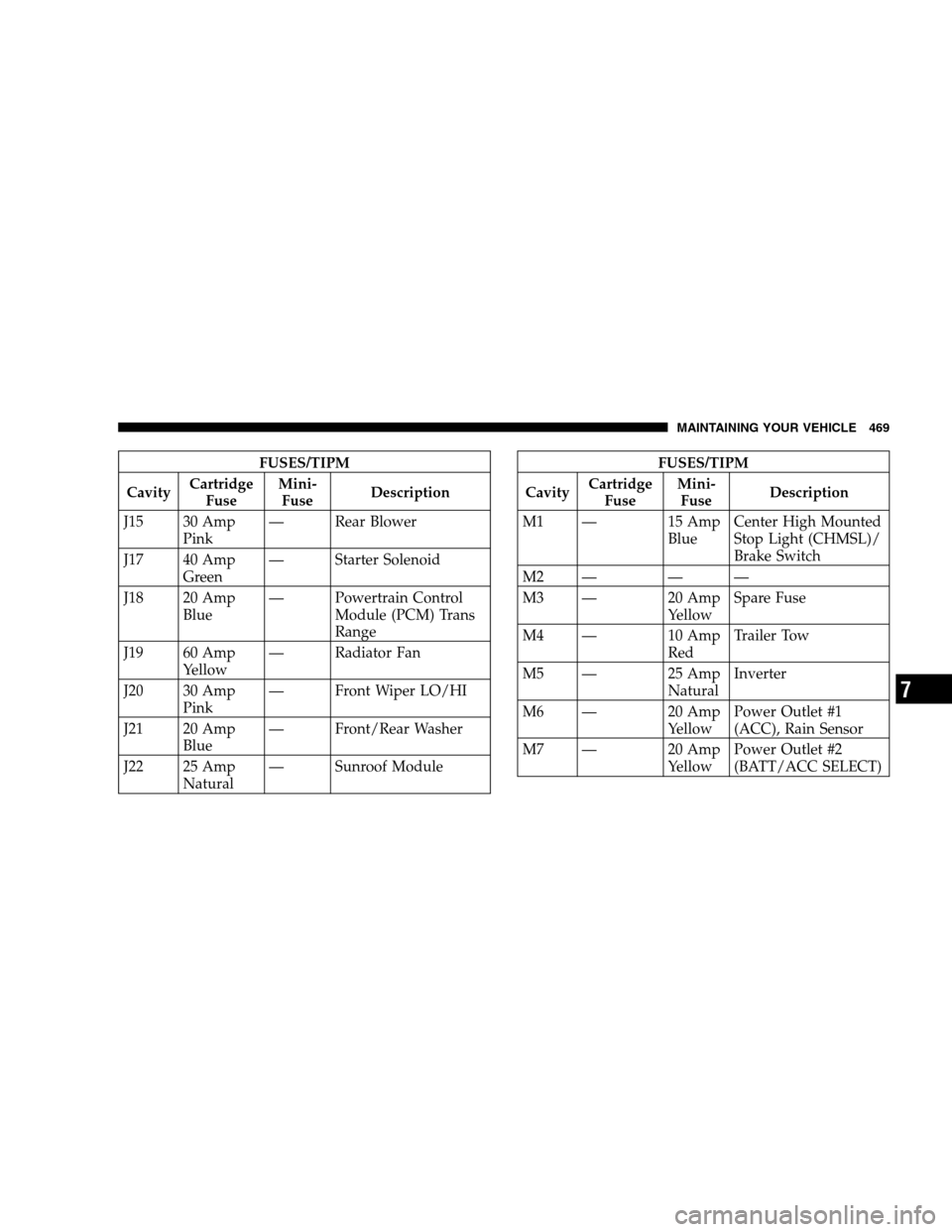
FUSES/TIPM
Cavity Cartridge
Fuse Mini-
Fuse Description
J15 30 Amp Pink — Rear Blower
J17 40 Amp Green — Starter Solenoid
J18 20 Amp Blue — Powertrain Control
Module (PCM) Trans
Range
J19 60 Amp Yellow — Radiator Fan
J20 30 Amp Pink — Front Wiper LO/HI
J21 20 Amp Blue — Front/Rear Washer
J22 25 Amp Natural — Sunroof ModuleFUSES/TIPM
Cavity Cartridge
Fuse Mini-
Fuse Description
M1 — 15 Amp BlueCenter High Mounted
Stop Light (CHMSL)/
Brake Switch
M2 — — —
M3 — 20 Amp YellowSpare Fuse
M4 — 10 Amp RedTrailer Tow
M5 — 25 Amp NaturalInverter
M6 — 20 Amp YellowPower Outlet #1
(ACC), Rain Sensor
M7 — 20 Amp YellowPower Outlet #2
(BATT/ACC SELECT)
MAINTAINING YOUR VEHICLE 469 7