display DODGE GRAND CARAVAN 2009 5.G Repair Manual
[x] Cancel search | Manufacturer: DODGE, Model Year: 2009, Model line: GRAND CARAVAN, Model: DODGE GRAND CARAVAN 2009 5.GPages: 535, PDF Size: 18.61 MB
Page 320 of 535
Floor ModeAir comes from the floor outlets. A slight amount of
air is directed through the defrost and side window
demister outlets.
Mix Mode Air comes from the floor, defrost and side window
demist outlets. This mode works best in cold or
snowy conditions. It allows you to stay comfort-
able, while keeping the windshield clear.
Defrost Mode Air comes from the windshield and side window
demist outlets. Use DEFROST mode with maxi-
mum blower and temperature settings for best wind-
shield and side window defrosting.
NOTE: While operating in the other modes, the system
will not automatically sense the presence of fog, mist or
ice on the windshield. DEFROST mode must be manually
selected to clear the windshield and side glass. The SNOWFLAKE mode, or A/C button, allows
the operator to manually activate or deactivate the
air conditioning system. When in SNOWFLAKE
mode, and the ATC display is on cool, dehumidified air
flows through the air outlets. If ECONOMY mode is
desired, press the SNOWFLAKE button to turn off the
SNOWFLAKE mode in the ATC display, and deactivate
the A/C system.
NOTE:
If the system is in Mix or Defrost Mode, the SNOW-
FLAKE can be turned off, but the A/C system shall
remain active to prevent fogging of the windows.
If fog or mist appears on the windshield or side glass,
select DEFROST mode and increase blower speed. 318 UNDERSTANDING YOUR INSTRUMENT PANEL
Page 321 of 535
Recirculation ControlWhen outside air contains smoke, odors, or
high humidity, or if rapid cooling is desired,
you may wish to recirculate interior air by
pressing the RECIRCULATION mode control
button. RECIRCULATION mode should only be used
temporarily. The recirculation symbol will illuminate in
the display when this button is selected. Push the button
a second time to turn off the RECIRCULATION mode
LED and allow outside air into the vehicle.
NOTE: In cold weather, use of the RECIRCULATION
mode may lead to excessive window fogging. The RE-
CIRCULATION mode is not allowed in the FLOOR, MIX
and DEFROST modes to improve window clearing op-
eration. Recirculation will be disabled automatically if
these modes are selected.
Rear Automatic Temperature Control (ATC) — If
Equipped
The Rear ATC System has floor air outlets at the rear of
the right side sliding door, and overhead outlets at each
outboard rear seating position. The system provides
heated air through the floor outlets or cool, dehumidified
air through the headliner outlets.
The REAR SYSTEM control for the Rear ATC System is
on the front lower ATC panel located on the instrument
panel.
Pressing the REAR LOCK button for the Rear ATC
System from the front lower ATC panel, illuminates a
LOCK symbol in the rear display. The rear temperature
and air source are controlled from the front lower ATC
panel.
Rear second row occupants can only adjust the rear ATC
control when the REAR LOCK button is turned off. UNDERSTANDING YOUR INSTRUMENT PANEL 319
4
Page 322 of 535
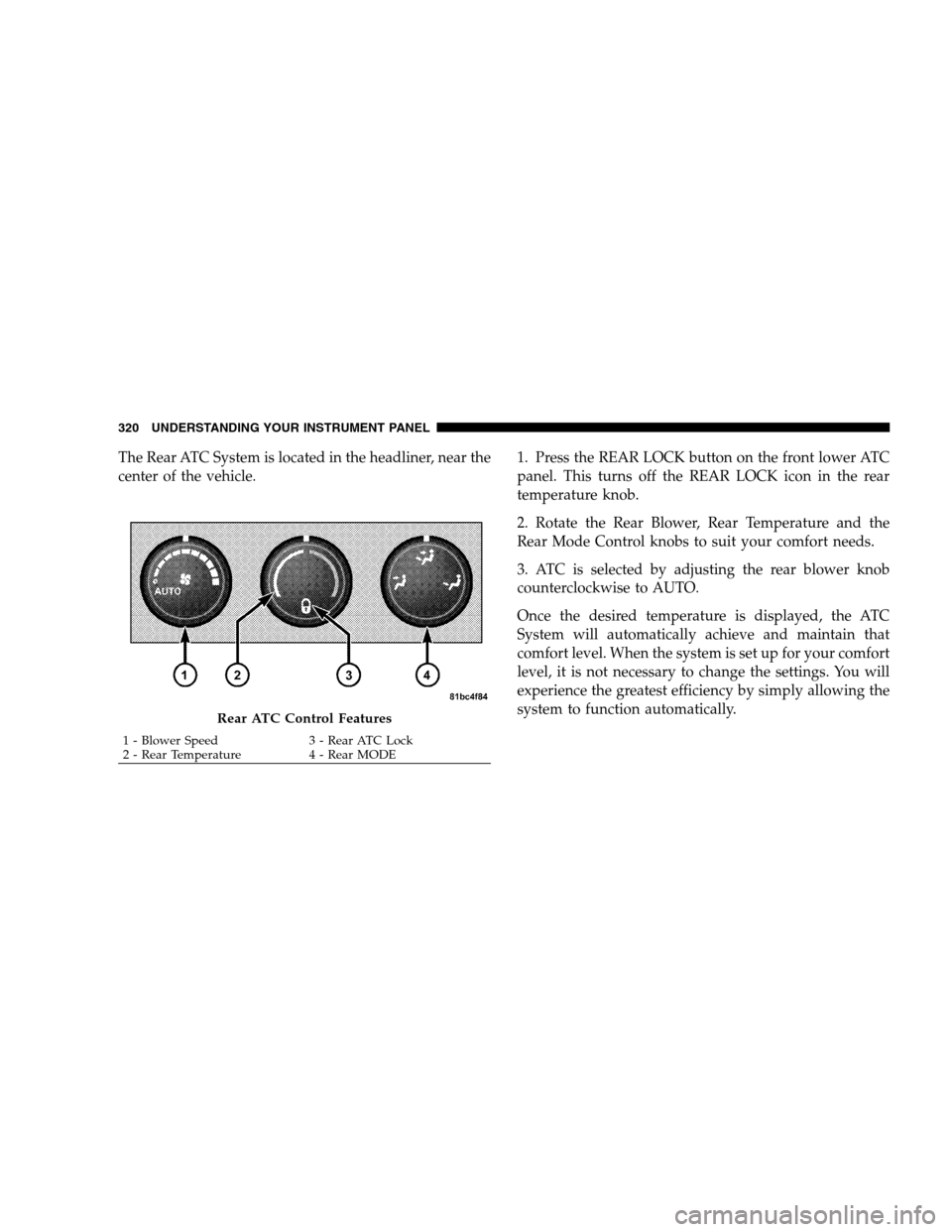
The Rear ATC System is located in the headliner, near the
center of the vehicle.1. Press the REAR LOCK button on the front lower ATC
panel. This turns off the REAR LOCK icon in the rear
temperature knob.
2. Rotate the Rear Blower, Rear Temperature and the
Rear Mode Control knobs to suit your comfort needs.
3. ATC is selected by adjusting the rear blower knob
counterclockwise to AUTO.
Once the desired temperature is displayed, the ATC
System will automatically achieve and maintain that
comfort level. When the system is set up for your comfort
level, it is not necessary to change the settings. You will
experience the greatest efficiency by simply allowing the
system to function automatically.Rear ATC Control Features
1 - Blower Speed
3 - Rear ATC Lock
2 -
Rear Temperature 4 - Rear MODE
320 UNDERSTANDING YOUR INSTRUMENT PANEL
Page 323 of 535
NOTE:
It is not necessary to move the temperature settings for
cold or hot vehicles. The system automatically adjusts
the temperature, mode and fan speed to provide
comfort as quickly as possible.
The temperature can be displayed in English or Metric
units by selecting the “Display Units of Measure in”
customer-programmable feature. Refer to the “Elec-
tronic Vehicle Information Center (EVIC) — Customer-
Programmable Features” in this Section.
Rear Blower Control
The rear blower control knob can be manually set to off,
or any fixed blower speed, by rotating the knob from low
to high. This allows the rear seat occupants to control the
volume of air circulated in the rear of the vehicle.CAUTION!
Interior air enters the Rear Automatic Temperature
Control System through an intake grille, located in
the passenger side trim panel behind the third row
seats. The heater outlets are located in the passenger
side trim panel, just behind the sliding door. Do not
block or place objects directly in front of the inlet
grille or heater outlets. The electrical system could
overload causing damage to the blower motor.
Rear Temperature Control
To change the temperature in the rear of the vehicle,
rotate the temperature knob counterclockwise to lower
the temperature, and clockwise to increase the tempera-
ture. The REAR temperature settings are displayed in the
front upper ATC panel.
UNDERSTANDING YOUR INSTRUMENT PANEL 321
4
Page 335 of 535
Automatic Transaxle Ignition Interlock SystemFor electrical system malfunctions, there is an override
for the interlock system. In order to override this system,
remove the cover located to the top right of the shift lever
in the instrument panel. The override can be activated by
pressing the white-colored tab, which can be accessed
through the hole in the instrument panel. While the
override is pressed, the shift lever can be moved out of
the PARK position without pressing the brake pedal.
After operation, return the cover to its original position.
This system prevents the key from being removed unless
the shift lever is in PARK. It also prevents moving the
shift lever out of PARK, unless the key is in the ACC/ON
position, and the brake pedal is pressed.
NOTE:
If a malfunction occurs, the system will trap the
key in the ignition cylinder to warn you that this safety
feature is inoperable. The engine can be started and
stopped but the key cannot be removed until you obtain
service.
Four-Speed or Six-Speed Automatic Transaxle
NOTE: Under extreme cold temperatures (-6°F (-21°C)
and when in DRIVE, transmission operation may be
briefly limited to only second gear operation. Normal
operation will resume once the transmission temperature
has risen to a suitable level (four–speed models only).
The electronically-controlled transaxle provides a precise
shift schedule. The transaxle electronics are self-
calibrating; therefore, the first few shifts on a new vehicle
may be somewhat abrupt. This is a normal condition, and
precision shifts will develop within a few hundred miles
(kilometers).
The transaxle has only PRND shift positions. Downshifts
are carried out by an Electronic Range Select (ERS) by
moving the lever—/ + while in the DRIVE position, the
instrument cluster will display transaxle gear selection as
6, 5, 4, 3, 2, 1 for six-speed, and 4, 3, 2, 1 for four-speed
transaxles.
STARTING AND OPERATING 333 5
Page 339 of 535
the transaxle into third gear, the transaxle will never shift
above third gear, but can shift down to second or first
gear automatically, when needed.
Switching from ERS to DRIVE can be done at any vehicle
speed. To shift from DRIVE mode to ERS mode, move the
shift lever to the left (-) once. The current gear will be
maintained as the top gear. To disable ERS, simply press
and hold the shift lever to the right (+) until “D” is
displayed in the instrument cluster odometer.WARNING!
Do not downshift for additional engine braking on a
slippery surface. The drive wheels could lose their
grip and the vehicle could skid, causing an accident
or personal injury.
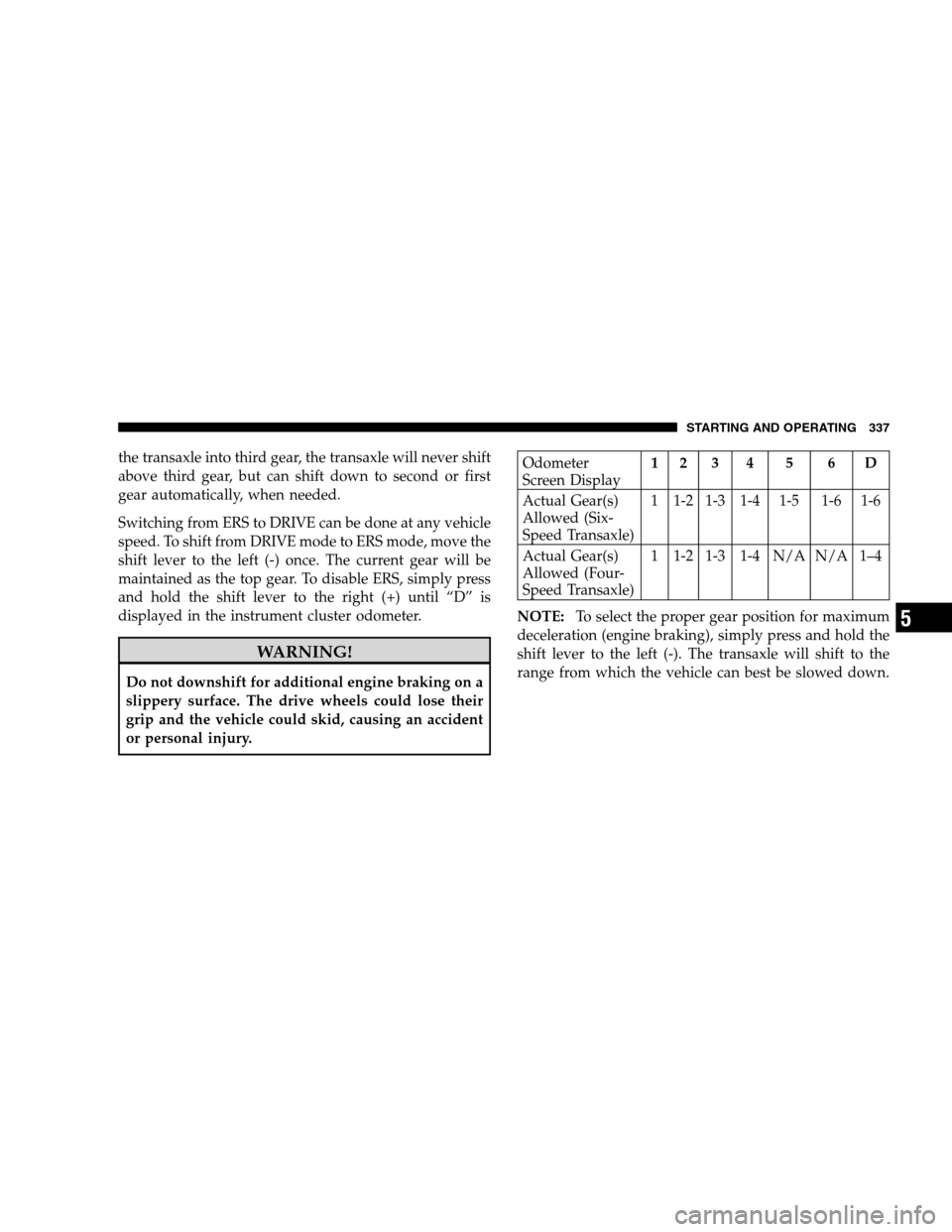
Odometer
Screen Display
1 2 3 4 5 6 D
Actual Gear(s)
Allowed (Six-
Speed Transaxle) 1 1-2 1-3 1-4 1-5 1-6 1-6
Actual Gear(s)
Allowed (Four-
Speed Transaxle) 1 1-2 1-3 1-4 N/A N/A 1–4
NOTE: To select the proper gear position for maximum
deceleration (engine braking), simply press and hold the
shift lever to the left (-). The transaxle will shift to the
range from which the vehicle can best be slowed down.
STARTING AND OPERATING 337 5
Page 377 of 535
NOTE:It is particularly important to regularly check
and maintain proper tire pressure in all the tires.
The Premium TPMS consists of the following compo-
nents:
Receiver Module
Four TPMS Sensors
Three Trigger Modules (mounted in three of the four
wheel wells)
Various TPMS messages, which display in the Elec-
tronic Vehicle Information Center (EVIC), and graph-
ics displaying tire pressures
Yellow TPMS Telltale Warning Light
TPMS Low Pressure Warnings
The “TPMS Telltale Warning Light” will illuminate in the
instrument cluster, and an audible chime will be acti-
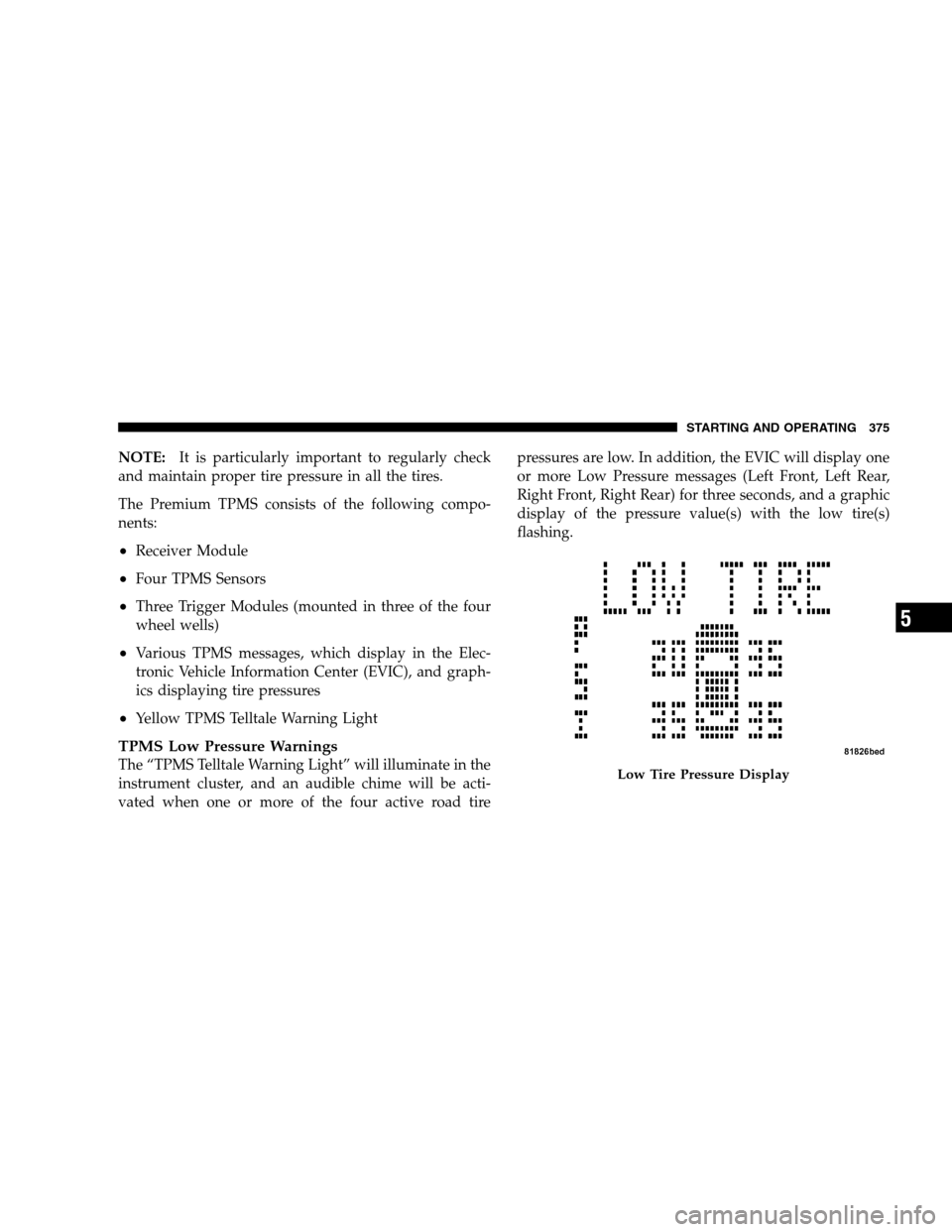
vated when one or more of the four active road tire pressures are low. In addition, the EVIC will display one
or more Low Pressure messages (Left Front, Left Rear,
Right Front, Right Rear) for three seconds, and a graphic
display of the pressure value(s) with the low tire(s)
flashing. Low Tire Pressure Display
STARTING AND OPERATING 375 5
Page 378 of 535
Should a low tire condition occur on any of the four
active road tire(s), you should stop as soon as possible,
and inflate the low tire(s) that is flashing on the graphic
display to the vehicle’s recommended cold tire pressure
value. The system will automatically update, the graphic
display of the pressure value(s) will stop flashing, and
the “TPMS Telltale Warning Light” will extinguish once
the updated tire pressure(s) have been received. The
vehicle may need to be driven for up to 20 minutes above
15 mph (25 km/h) to receive this information.
Check TPMS Message
The “TPMS Telltale Warning Light” will flash on and off
for 75 seconds, and remain on solid when a system fault
is detected. The system fault will also sound a chime. The
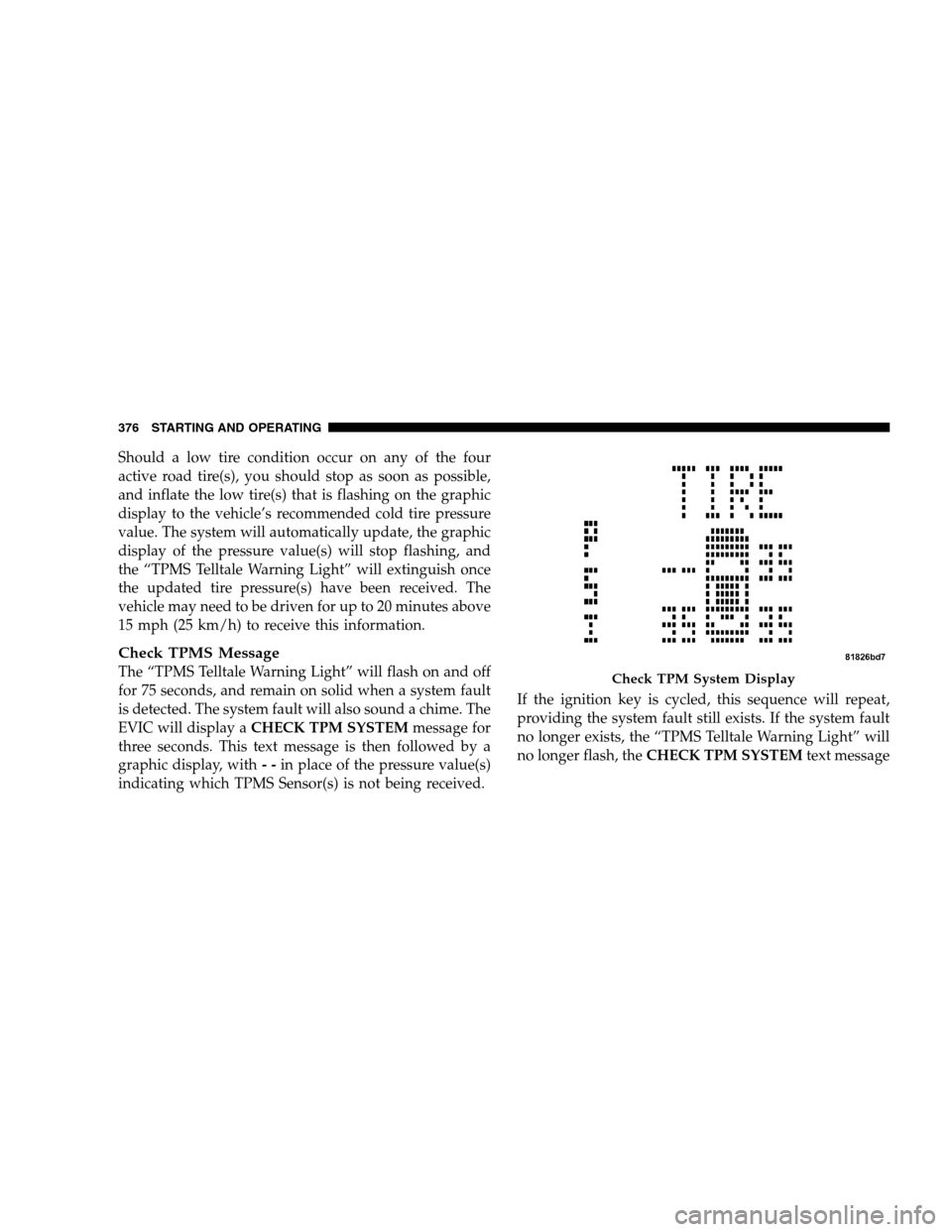
EVIC will display aCHECK TPM SYSTEM message for
three seconds. This text message is then followed by a
graphic display, with - -in place of the pressure value(s)
indicating which TPMS Sensor(s) is not being received. If the ignition key is cycled, this sequence will repeat,
providing the system fault still exists. If the system fault
no longer exists, the “TPMS Telltale Warning Light” will
no longer flash, the
CHECK TPM SYSTEM text message Check TPM System Display
376 ST
ARTING AND OPERATING
Page 379 of 535
will not be present, and a pressure value will be dis-
played instead of dashes. A system fault can occur by any
of the following scenarios:
1. Jamming due to electronic devices or driving next to
facilities emitting the same radio frequencies as the TPMS
sensors.
2. Installing some form of aftermarket window tinting
that affects radio wave signals.
3. Accumulation of excessive snow and/or ice around
the wheels or wheel housings.
4. Using tire chains on the vehicle.
5. Using wheels/tires not equipped with TPMS sensors.
Vehicles with Compact Spare
1. The compact spare tire (if equipped) does not have a
TPMS. Therefore, the TPMS will not monitor the pressure
in the compact spare tire.2. If you install the compact spare tire in place of a road
tire that has a pressure below the low-pressure warning
limit, upon the next ignition key cycle, the “TPMS Telltale
Warning Light” will remain on, a chime will sound, and
the EVIC will still display a flashing pressure value in the
graphic display.
3. After driving the vehicle for up to 20 minutes above
15 mph (25 km/h), the “TPMS Telltale Warning Light”
will flash on and off for 75 seconds and then remain on
solid. In addition, the EVIC will display a CHECK TPM
SYSTEM message for three seconds and then display
dashes (- -) in place of the pressure value.
4. For each subsequent ignition key cycle, a chime will
sound, the “TPMS Telltale Warning Light” will flash on
and off for 75 seconds and then remain on solid, and the
EVIC will display a CHECK TPM SYSTEM message for
three seconds and then display dashes (- -) in place of the
pressure value.
STARTING AND OPERATING 377 5
Page 380 of 535
5. Once you repair or replace the original road tire, and
reinstall it on the vehicle in place of the compact spare,
the TPMS will update automatically. In addition, the
“TPMS Telltale Warning Light” will turn off and the
graphic in the EVIC will display a new pressure value
instead of dashes (- -), as long no tire pressure is below
the low pressure warning limit in any of the four active
road tires.
NOTE:The vehicle may need to be driven for up to
20 minutes above 15 mph (25 km/h) in order for the
TPMS to receive this information.
General Information
This device complies with Part 15 of the FCC rules and
RSS 210 of Industry Canada. Operation is subject to the
following conditions:
This device may not cause harmful interference.
This device must accept any interference received,
including interference that may cause undesired
operation.
The tire pressure sensors are regulated under one of the
following licenses:
United States . . . . . . . . . . . . . . . . . . . . . KR5S120123
Canada . . . . . . . . . . . . . . . . . . . . . . . . 2671-S120123
FUEL REQUIREMENTS
3.3L/3.8L Gasoline Engine
These engines are designed to meet all
emissions regulations and provide excel-
lent fuel economy and performance when
using high-quality unleaded “regular”
gasoline having an octane rating of 87. The
use of premium gasoline is not recom-
mended, as it will not provide any benefit over regular
gasoline in these engines. 378 STARTING AND OPERATING