win DODGE GRAND CARAVAN 2013 5.G Owners Manual
[x] Cancel search | Manufacturer: DODGE, Model Year: 2013, Model line: GRAND CARAVAN, Model: DODGE GRAND CARAVAN 2013 5.GPages: 683, PDF Size: 5.5 MB
Page 615 of 683
Disposal Of Used Engine Coolant
Used ethylene glycol-based engine coolant (antifreeze) is
a regulated substance requiring proper disposal. Check
with your local authorities to determine the disposal
rules for your community. To prevent ingestion by ani-
mals or children, do not store ethylene glycol-based
engine coolant in open containers or allow it to remain in
puddles on the ground. If ingested by a child or pet, seek
emergency assistance immediately. Clean up any ground
spills immediately.
Coolant Level
The coolant bottle provides a quick visual method for
determining that the coolant level is adequate. With the
engine OFF and cold, the level of the engine coolant
(antifreeze) in the bottle should be between the ranges
indicated on the bottle.The radiator normally remains completely full, so there is
no need to remove the radiator cap unless checking for
engine coolant (antifreeze) freeze point or replacing cool-
ant. Advise your service attendant of this. As long as the
engine operating temperature is satisfactory, the coolant
bottle need only be checked once a month.
When additional engine coolant (antifreeze) is needed to
maintain the proper level, only OAT coolant that meets the
requirements of Chrysler Material Standard MS-12106
should be added to the coolant bottle. Do not overfill.
Points To Remember
NOTE:When the vehicle is stopped after a few miles/
kilometers of operation, you may observe vapor coming
from the front of the engine compartment. This is nor-
mally a result of moisture from rain, snow, or high
humidity accumulating on the radiator and being vapor-
ized when the thermostat opens, allowing hot engine
coolant (antifreeze) to enter the radiator.7
MAINTAINING YOUR VEHICLE 613
Page 616 of 683
If an examination of your engine compartment shows no
evidence of radiator or hose leaks, the vehicle may be
safely driven. The vapor will soon dissipate.
•Do not overfill the coolant expansion bottle.
•
Check the coolant freeze point in the radiator and in the
coolant expansion bottle. If engine coolant (antifreeze)
needs to be added, the contents of the coolant expansion
bottle must also be protected against freezing.
•If frequent engine coolant (antifreeze) additions are
required, the cooling system should be pressure tested
for leaks.
•
Maintain engine coolant (antifreeze) concentration at a
minimum of 50% OAT coolant (conforming to MS-12106)
and distilled water for proper corrosion protection of
your engine which contains aluminum components.
•Make sure that the coolant expansion bottle overflow
hoses are not kinked or obstructed.
•Keep the front of the radiator clean. If your vehicle is
equipped with air conditioning, keep the front of the
condenser clean.
•
Do not change the thermostat for Summer or Winter
operation. If replacement is ever necessary, install ONLY
the correct type thermostat. Other designs may result in
unsatisfactory engine coolant (antifreeze) performance,
poor gas mileage, and increased emissions.
614 MAINTAINING YOUR VEHICLE
Page 621 of 683
Appearance Care And Protection From Corrosion
Protection Of Body And Paint From Corrosion
Vehicle body care requirements vary according to geo-
graphic locations and usage. Chemicals that make roads
passable in snow and ice and those that are sprayed on
trees and road surfaces during other seasons are highly
corrosive to the metal in your vehicle. Outside parking,
which exposes your vehicle to airborne contaminants,
road surfaces on which the vehicle is operated, extreme
hot or cold weather and other extreme conditions will
have an adverse effect on paint, metal trim, and under-
body protection.
The following maintenance recommendations will enable
you to obtain maximum benefit from the corrosion
resistance built into your vehicle.
What Causes Corrosion?
Corrosion is the result of deterioration or removal of
paint and protective coatings from your vehicle.
The most common causes are:
•Road salt, dirt and moisture accumulation.
•Stone and gravel impact.
•Insects, tree sap and tar.
•Salt in the air near seacoast localities.
•Atmospheric fallout/industrial pollutants.
Washing
•Wash your vehicle regularly. Always wash your ve-
hicle in the shade using MOPAR® Car Wash, or a mild
car wash soap, and rinse the panels completely with
clear water.7
MAINTAINING YOUR VEHICLE 619
Page 624 of 683
Stain Repel Fabric Cleaning Procedure – If Equipped
Stain Repel seats may be cleaned in the following manner:
•Remove as much of the stain as possible by blotting
with a clean, dry towel.
•Blot any remaining stain with a clean, damp towel.
•For tough stains, apply MOPAR® Total Clean, or a
mild soap solution to a clean, damp cloth and remove
stain. Use a fresh, damp towel to remove soap residue.
•For grease stains, apply MOPAR® Multi-Purpose
Cleaner to a clean, damp cloth and remove stain. Use
a fresh, damp towel to remove soap residue.
•Do not use any harsh solvents or any other form of
protectants on Stain Repel products.
Interior Care
Instrument Panel Surfaces
The instrument panel cover has a low glare surface,
which minimizes reflections in the windshield. Do not
use protectants or other products which may cause
undesirable reflections. Use soap and warm water to
restore the low glare surface.
Cleaning Interior Trim
Interior trim should be cleaned starting with a damp
cloth, a damp cloth with MOPAR® Total Clean or equiva-
lent, then MOPAR® Spot & Stain Remover or equivalent
if absolutely necessary. Do not use harsh cleaners or
Armor All®. Use MOPAR® Total Clean or equivalent to
clean vinyl upholstery
622 MAINTAINING YOUR VEHICLE
Page 626 of 683
To minimize the possibility of scratching the lenses and
reducing light output, avoid wiping with a dry cloth. To
remove road dirt, wash with a mild soap solution fol-
lowed by rinsing.
Do not use abrasive cleaning components, solvents, steel
wool or other aggressive material to clean the lenses.
Glass Surfaces
All glass surfaces should be cleaned on a regular basis
with MOPAR® Glass Cleaner, or any commercial
household-type glass cleaner. Never use an abrasive type
cleaner. Use caution when cleaning the inside rear win-
dow equipped with electric defrosters or the right rear
quarter window equipped with the radio antenna. Do
not use scrapers or other sharp instrument that may
scratch the elements.When cleaning the rear view mirror, spray cleaner on the
towel or rag that you are using. Do not spray cleaner
directly on the mirror.
Cleaning Plastic Instrument Cluster Lenses
The lenses in front of the instruments in this vehicle are
molded in clear plastic. When cleaning the lenses, care
must be taken to avoid scratching the plastic.
1. Clean with a wet soft rag. A mild soap solution may be
used, but do not use high alcohol content or abrasive
cleaners. If soap is used, wipe clean with a clean damp
rag.
2. Dry with a soft cloth.
624 MAINTAINING YOUR VEHICLE
Page 629 of 683
CAUTION!
•When installing the Totally Integrated Power Mod-
ule cover, it is important to ensure the cover is
properly positioned and fully latched. Failure to do
so may allow water to get into the Integrated Power
Module, and possibly result in a electrical system
failure.
•When replacing a blown fuse, it is important to use
only a fuse having the correct amperage rating. The
use of a fuse with a rating other than indicated may
result in a dangerous electrical system overload. If
a properly rated fuse continues to blow, it indicates
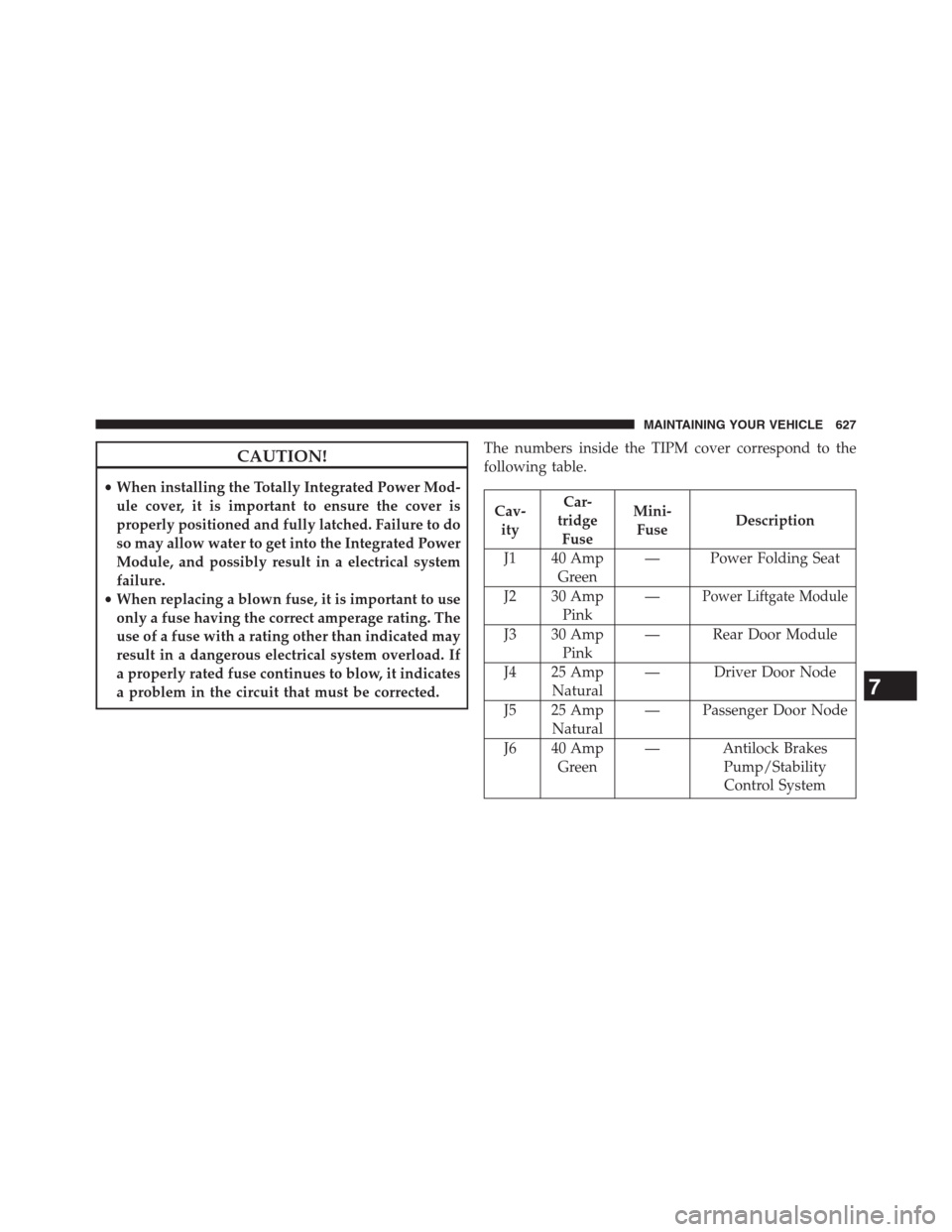
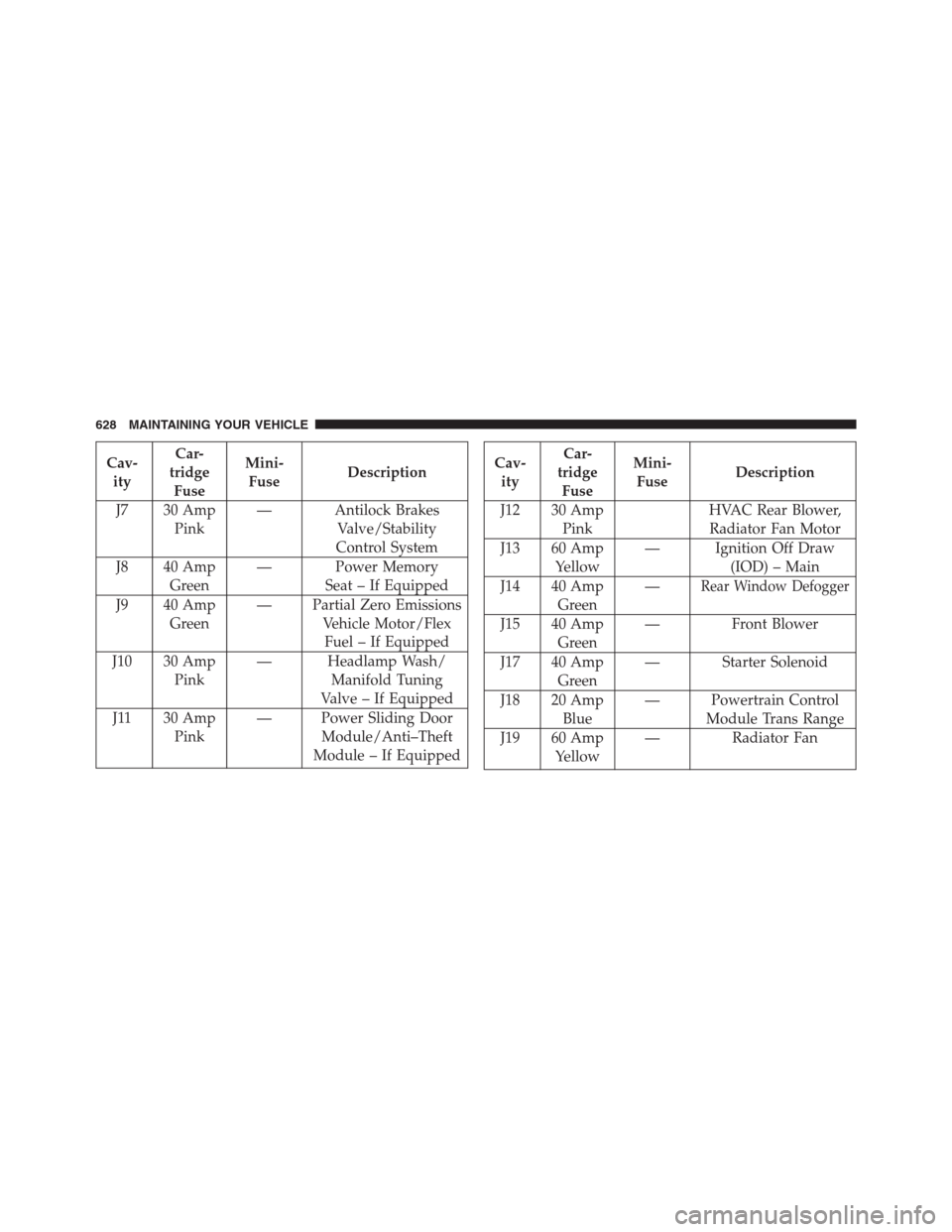
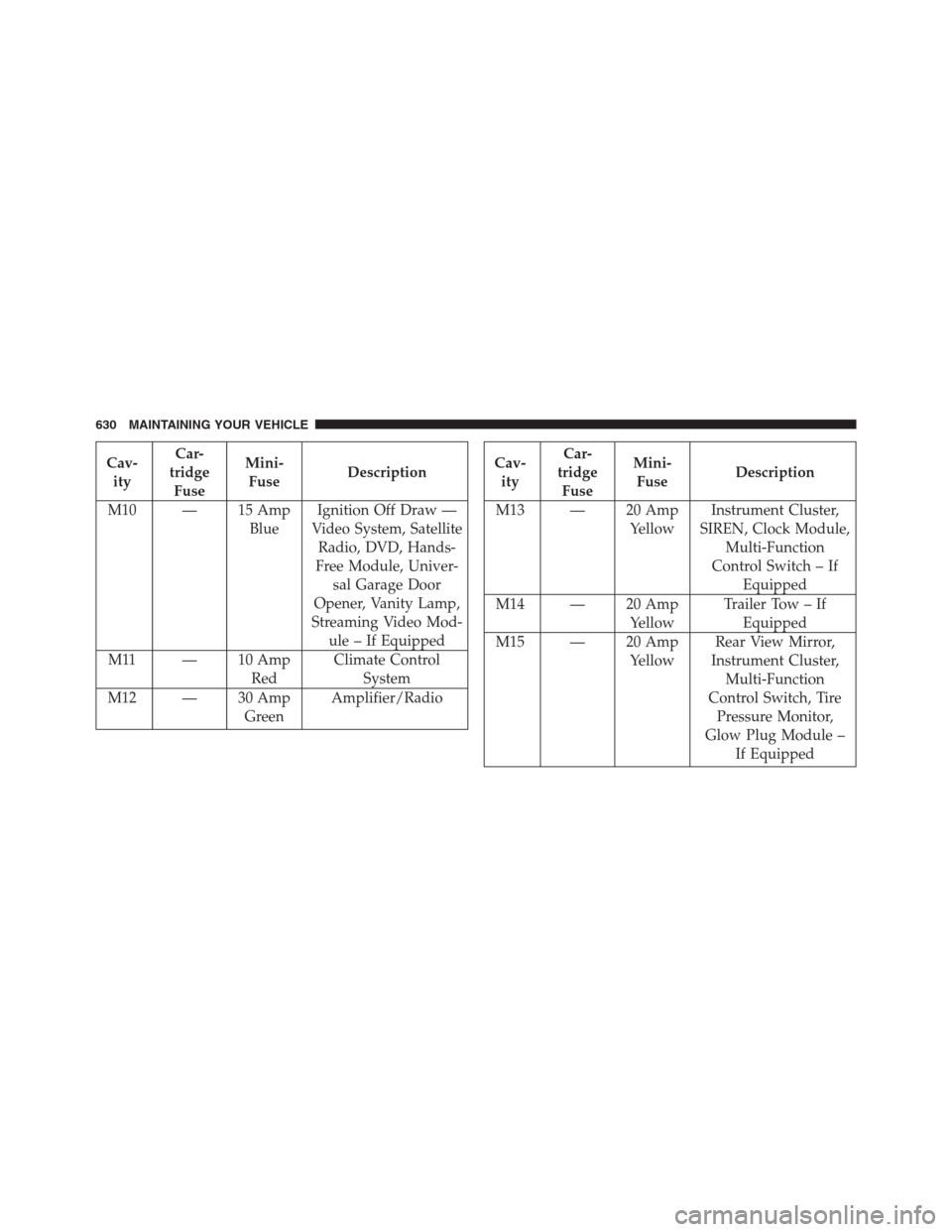
a problem in the circuit that must be corrected.The numbers inside the TIPM cover correspond to the
following table.
Cav-
ityCar-
tridge
FuseMini-
FuseDescription
J1 40 Amp
Green— Power Folding Seat
J2 30 Amp
Pink—
Power Liftgate Module
J3 30 Amp
Pink— Rear Door Module
J4 25 Amp
Natural— Driver Door Node
J5 25 Amp
Natural— Passenger Door Node
J6 40 Amp
Green— Antilock Brakes
Pump/Stability
Control System
7
MAINTAINING YOUR VEHICLE 627
Page 630 of 683
Cav-
ityCar-
tridge
FuseMini-
FuseDescription
J7 30 Amp
Pink— Antilock Brakes
Valve/Stability
Control System
J8 40 Amp
Green— Power Memory
Seat – If Equipped
J9 40 Amp
Green— Partial Zero Emissions
Vehicle Motor/Flex
Fuel – If Equipped
J10 30 Amp
Pink— Headlamp Wash/
Manifold Tuning
Valve – If Equipped
J11 30 Amp
Pink— Power Sliding Door
Module/Anti–Theft
Module – If EquippedCav-
ityCar-
tridge
FuseMini-
FuseDescription
J12 30 Amp
PinkHVAC Rear Blower,
Radiator Fan Motor
J13 60 Amp
Yellow— Ignition Off Draw
(IOD) – Main
J14 40 Amp
Green—
Rear Window Defogger
J15 40 Amp
Green— Front Blower
J17 40 Amp
Green— Starter Solenoid
J18 20 Amp
Blue— Powertrain Control
Module Trans Range
J19 60 Amp
Yellow— Radiator Fan
628 MAINTAINING YOUR VEHICLE
Page 632 of 683
Cav-
ityCar-
tridge
FuseMini-
FuseDescription
M10 — 15 Amp
BlueIgnition Off Draw —
Video System, Satellite
Radio, DVD, Hands-
Free Module, Univer-
sal Garage Door
Opener, Vanity Lamp,
Streaming Video Mod-
ule – If Equipped
M11 — 10 Amp
RedClimate Control
System
M12 — 30 Amp
GreenAmplifier/RadioCav-
ityCar-
tridge
FuseMini-
FuseDescription
M13 — 20 Amp
YellowInstrument Cluster,
SIREN, Clock Module,
Multi-Function
Control Switch – If
Equipped
M14 — 20 Amp
YellowTrailer Tow – If
Equipped
M15 — 20 Amp
YellowRear View Mirror,
Instrument Cluster,
Multi-Function
Control Switch, Tire
Pressure Monitor,
Glow Plug Module –
If Equipped
630 MAINTAINING YOUR VEHICLE
Page 633 of 683
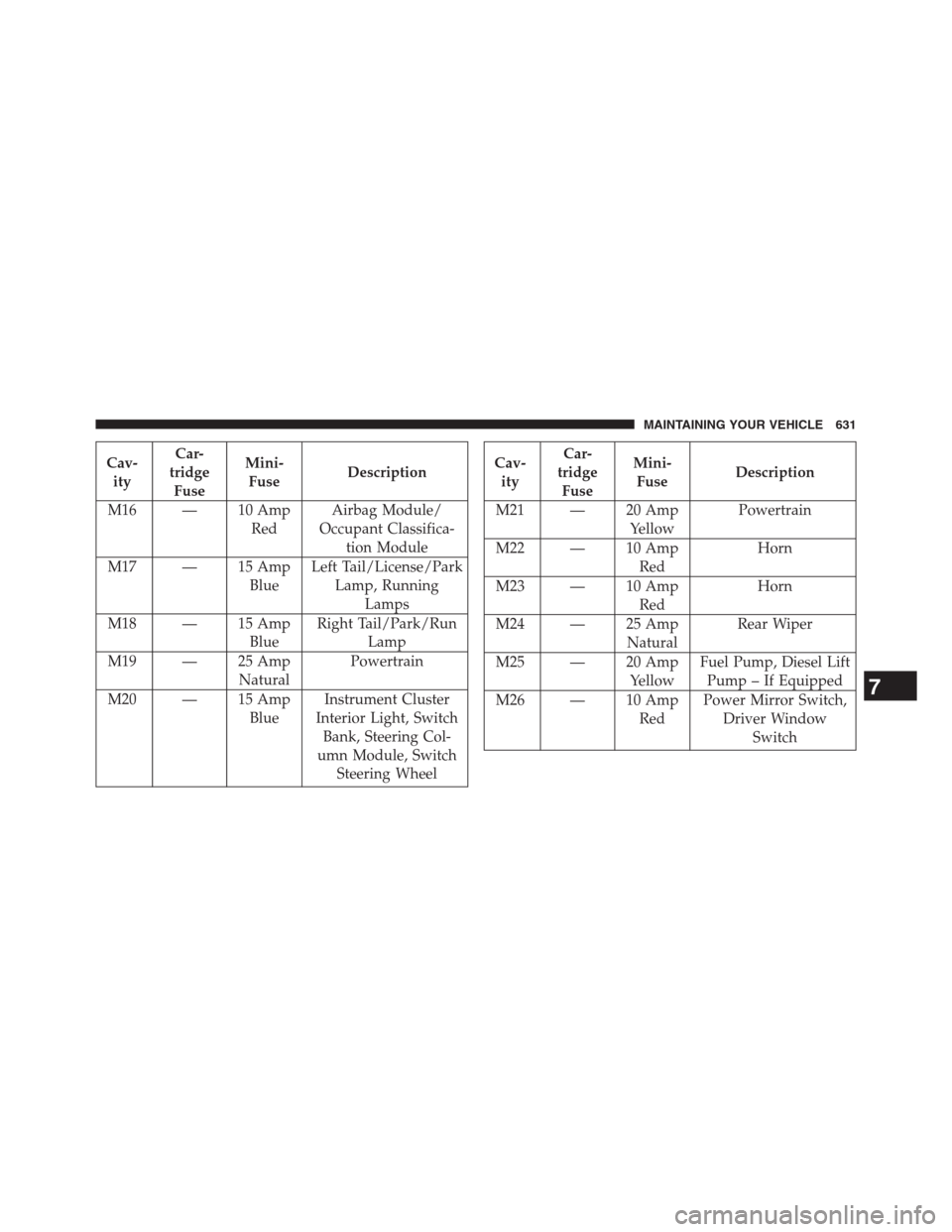
Cav-
ityCar-
tridge
FuseMini-
FuseDescription
M16 — 10 Amp
RedAirbag Module/
Occupant Classifica-
tion Module
M17 — 15 Amp
BlueLeft Tail/License/Park
Lamp, Running
Lamps
M18 — 15 Amp
BlueRight Tail/Park/Run
Lamp
M19 — 25 Amp
NaturalPowertrain
M20 — 15 Amp
BlueInstrument Cluster
Interior Light, Switch
Bank, Steering Col-
umn Module, Switch
Steering WheelCav-
ityCar-
tridge
FuseMini-
FuseDescription
M21 — 20 Amp
YellowPowertrain
M22 — 10 Amp
RedHorn
M23 — 10 Amp
RedHorn
M24 — 25 Amp
NaturalRear Wiper
M25 — 20 Amp
YellowFuel Pump, Diesel Lift
Pump – If Equipped
M26 — 10 Amp
RedPower Mirror Switch,
Driver Window
Switch
7
MAINTAINING YOUR VEHICLE 631
Page 635 of 683
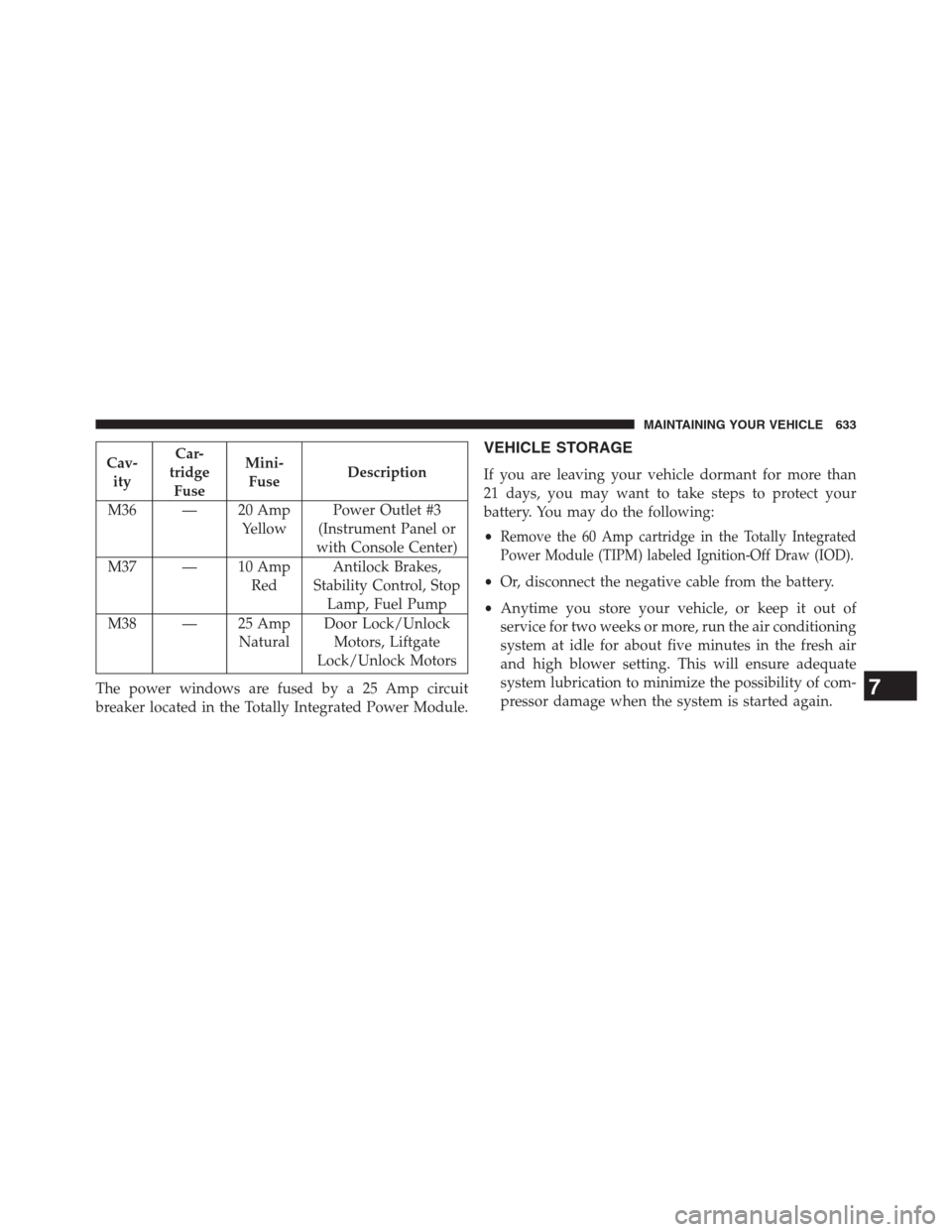
Cav-
ityCar-
tridge
FuseMini-
FuseDescription
M36 — 20 Amp
YellowPower Outlet #3
(Instrument Panel or
with Console Center)
M37 — 10 Amp
RedAntilock Brakes,
Stability Control, Stop
Lamp, Fuel Pump
M38 — 25 Amp
NaturalDoor Lock/Unlock
Motors, Liftgate
Lock/Unlock Motors
The power windows are fused by a 25 Amp circuit
breaker located in the Totally Integrated Power Module.VEHICLE STORAGE
If you are leaving your vehicle dormant for more than
21 days, you may want to take steps to protect your
battery. You may do the following:
•
Remove the 60 Amp cartridge in the Totally Integrated
Power Module (TIPM) labeled Ignition-Off Draw (IOD).
•Or, disconnect the negative cable from the battery.
•Anytime you store your vehicle, or keep it out of
service for two weeks or more, run the air conditioning
system at idle for about five minutes in the fresh air
and high blower setting. This will ensure adequate
system lubrication to minimize the possibility of com-
pressor damage when the system is started again.
7
MAINTAINING YOUR VEHICLE 633