tow DODGE JOURNEY 2009 1.G Workshop Manual
[x] Cancel search | Manufacturer: DODGE, Model Year: 2009, Model line: JOURNEY, Model: DODGE JOURNEY 2009 1.GPages: 523
Page 398 of 523
JACKING AND TIRE CHANGING
WARNING!
•Do not attempt to change a tire on the side of the vehicle
close to moving traffic. Pull far enough off the road to
avoid the danger of being hit when operating the jack or
changing the wheel.
• Getting under a jacked-up vehicle is dangerous. The
vehicle could slip off the jack and fall on you. You could
be crushed. Never get any part of your body under a
vehicle that is on a jack. Never start or run the engine
while the vehicle is on a jack. If you need to get under a
raised vehicle, take it to a service center where it can be
raised on a lift.
• The jack is designed to use as a tool for changing tires
only. The jack should not be used to lift the vehicle for
service purposes. The vehicle should be jacked on a firm
level surface only. Avoid ice or slippery areas.
• A loose tire or jack thrown forward in a collision or hard
stop could endanger the occupants of the vehicle. Always
stow the jack parts and the spare tire in the places
provided.
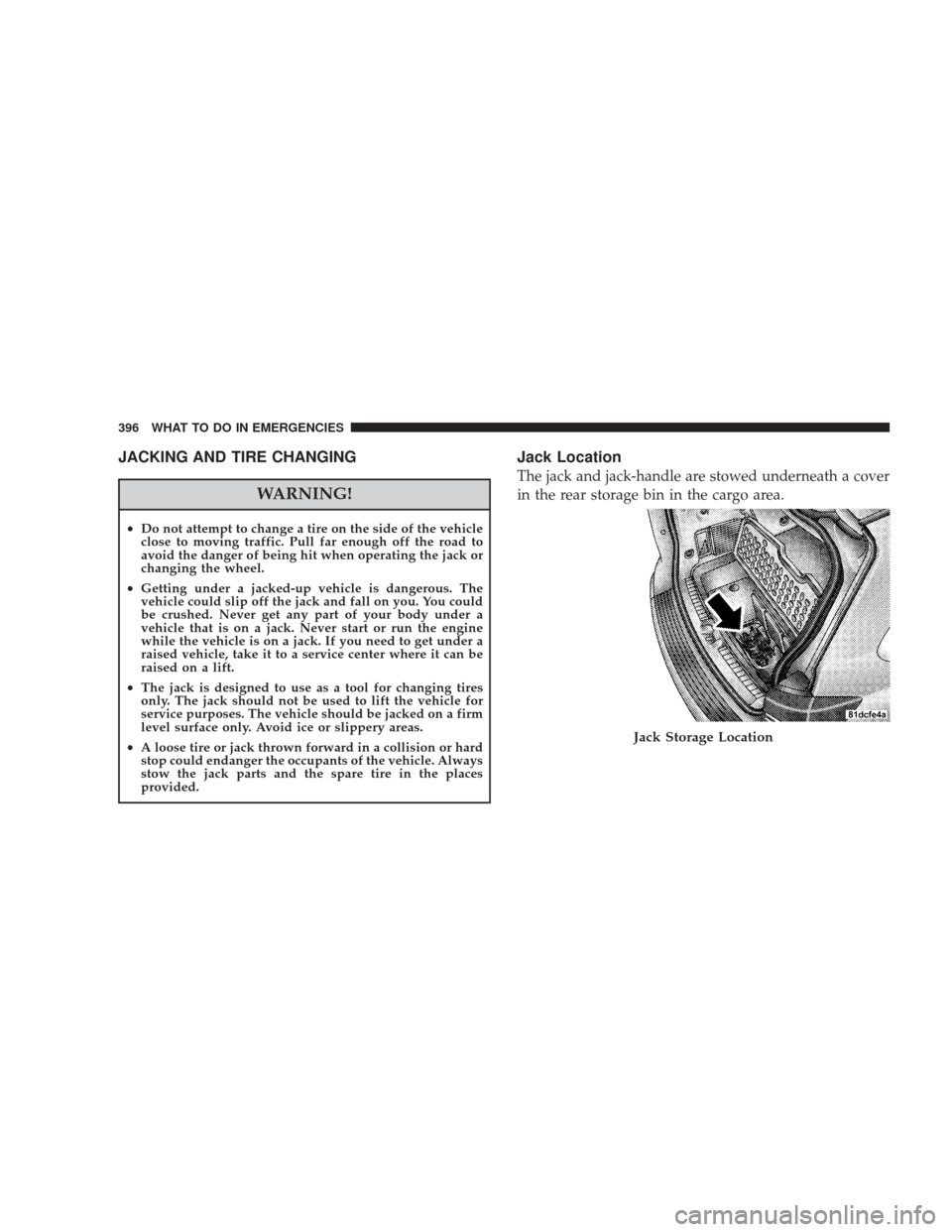
Jack Location
The jack and jack-handle are stowed underneath a cover
in the rear storage bin in the cargo area.
Jack Storage Location
396 WHAT TO DO IN EMERGENCIES
Page 399 of 523
Spare Tire Location
The spare tire is stowed underneath the rear of the
vehicle and is held in place by means of a cable winch
mechanism.
Preparations For Jacking
1. Park the vehicle on a firm level surface as far from the
edge of the roadway as possible. Avoid icy or slippery
areas.
2.Set the parking brake and place the shift lever in
PARK.
3. Turn OFF the ignition.
4. Turn ON the hazard warning flashers.
5. Passengers should not remain in the vehicle when the
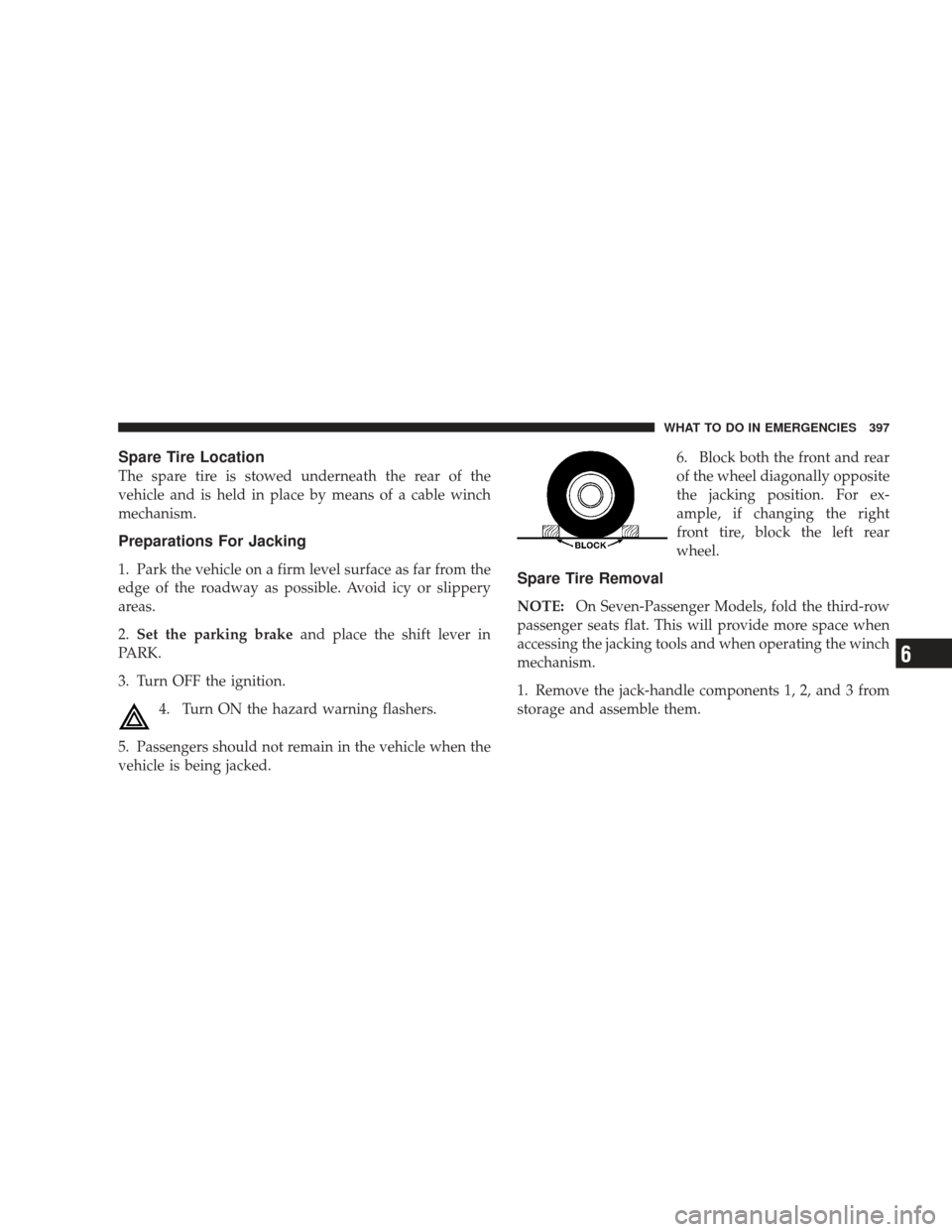
vehicle is being jacked. 6. Block both the front and rear
of the wheel diagonally opposite
the jacking position. For ex-
ample, if changing the right
front tire, block the left rear
wheel.Spare Tire Removal
NOTE:
On Seven-Passenger Models, fold the third-row
passenger seats flat. This will provide more space when
accessing the jacking tools and when operating the winch
mechanism.
1. Remove the jack-handle components 1, 2, and 3 from
storage and assemble them.
WHAT TO DO IN EMERGENCIES 397
6
Page 401 of 523
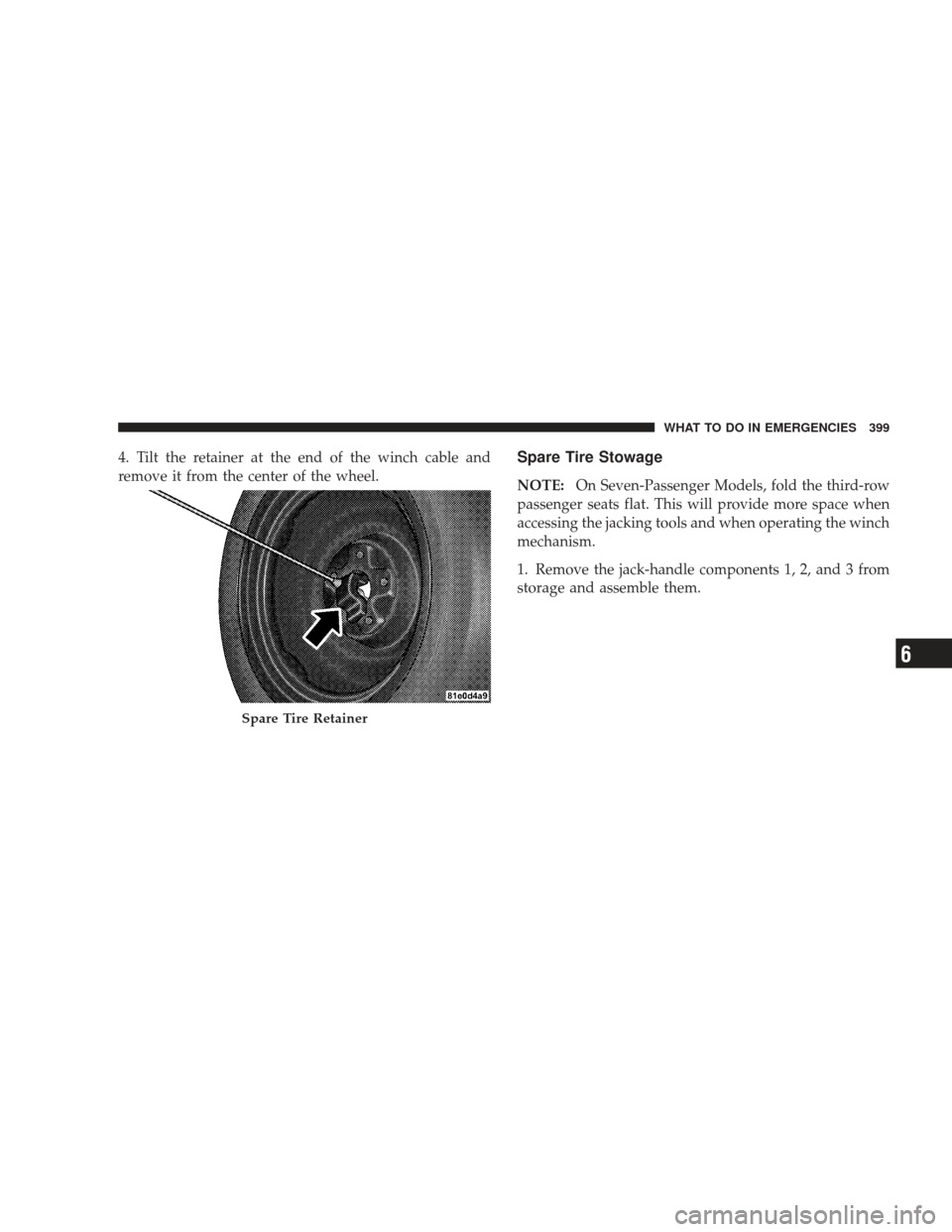
4. Tilt the retainer at the end of the winch cable and
remove it from the center of the wheel.Spare Tire Stowage
NOTE:On Seven-Passenger Models, fold the third-row
passenger seats flat. This will provide more space when
accessing the jacking tools and when operating the winch
mechanism.
1. Remove the jack-handle components 1, 2, and 3 from
storage and assemble them.
Spare Tire Retainer
WHAT TO DO IN EMERGENCIES 399
6
Page 404 of 523
WARNING!
Carefully follow these tire changing warnings to help prevent
personal injury or damage to your vehicle:
•Always park on a firm, level surface as far from the edge of
the roadway as possible before raising the vehicle.
• Block the wheel diagonally opposite the wheel to be raised.
• Set the parking brake firmly and set an automatic transaxle
in PARK; a manual transaxle in REVERSE.
• Never start or run the engine with the vehicle on a jack.
• Do not let anyone sit in the vehicle when it is on a jack.
• Do not get under the vehicle when it is on a jack.
• Only use the jack in the positions indicated and for lifting
this vehicle during a tire change.
• If working on or near a roadway, be extremely careful of
motor traffic.
• To assure that spare tires, flat or inflated are securely stowed,
spares must be stowed with the valve stem facing the
ground.
• Turn on the Hazard warning flasher.
1. Remove the spare tire, jack, and jack-handle from
stowage.
2. Loosen, but do not remove, the wheel nuts on the
wheel with the flat tire. Turn the wheel nuts counter-
clockwise one turn while the wheel is still on the ground.
3. Place the jack underneath the lift area that is closest to
the flat tire. Turn the jack screw clockwise to firmly
engage the jack saddle with the lift area of the sill flange.
402 WHAT TO DO IN EMERGENCIES
Page 407 of 523
•Refer to “Compact Spare Tire” and to “Limited-Use
Spare” under “Tires — General Information” in Sec-
tion 5 for additional warnings, cautions, and informa-
tion about the spare tire, its use, and operation.
7. Install the wheel nuts with the cone shaped end of the
nut toward the wheel. Lightly tighten the wheel nuts.
WARNING!
To avoid the risk of forcing the vehicle off the jack,
do not tighten the wheel nuts fully until the vehicle
has been lowered. Failure to follow this warning may
result in personal injury or death.
8. Lower the vehicle by turning the jack screw counter-
clockwise with the jack handle. 9. Finish tightening the wheel nuts. Push down on the
wrench while tightening for increased leverage. Alternate
wheel nuts until each nut has been tightened twice.
Correct wheel nut tightness is 95 ft lbs (130 N·m). If in
doubt about the correct tightness, have them checked
with a torque wrench by your authorized dealer or at a
service station.
10. Lower the jack to its fully closed position.WARNING!
A loose tire or jack, thrown forward in a collision or
hard stop could endanger the occupants of the ve-
hicle. Always stow the jack parts and the spare tire in
the places provided. Have the deflated (flat) tire
repaired or replaced immediately.
WHAT TO DO IN EMERGENCIES 405
6
Page 408 of 523
11. Place the deflated (flat) tire in the cargo area.Do not
stow the deflated tire in the spare tire stowage location.
Have the deflated (flat) tire repaired or replaced as soon
as possible.
12. To stow the winch cable and retainer, fit the as-
sembled jack-handle over the winch drive nut. Rotate the
jack-handle assembly clockwise until you hear the winch
mechanism click three times. It cannot be over tightened.
13. Stow the jack-handle and jack.
14. Check the tire pressure as soon as possible. Adjust the
tire pressure as required.Wheel Nuts
Tighten all wheel nuts occasionally to eliminate the
possibility of wheel studs being sheared or the bolt holes
in the wheels becoming elongated. This is especially
important during the first few hundred miles (kilome-
ters) of operation and after changing a tire. This allows
the wheel nuts to seat properly. All wheel nuts should
first be firmly seated against the wheel. The wheel nuts
should then be tightened to recommended torque.
Tighten the wheel nuts to the final torque in increments.
Progress around the bolt circle, tightening the nut oppo-
site of the one you previously tightened until the final
torque is achieved. Recommended torque is 95 ft lbs (130
N·m).
406 WHAT TO DO IN EMERGENCIES
Page 409 of 523
JUMP-STARTING PROCEDURES
WARNING!
•Take care to avoid the radiator cooling fan when-
ever the hood is raised. It can start anytime the
ignition switch is ON. You can be hurt by the fan.
•Do not attempt to push or tow your vehicle to get
it started. Vehicles equipped with an automatic
transaxle cannot be started this way. Unburned
fuel could enter the catalytic converter and once
the engine has started, ignite and damage the
converter and vehicle. If the vehicle has a dis-
charged battery, booster cables may be used to
obtain a start from another vehicle. This type of
start can be dangerous if done improperly, so
follow this procedure carefully.
•Do not use a booster battery or any other booster
source with an output that exceeds 12 Volts.
WARNING!
•Battery fluid is a corrosive acid solution; do not
allow battery fluid to contact eyes, skin, or cloth-
ing. Don’t lean over battery when attaching
clamps or allow the clamps to touch each other. If
acid splashes in eyes or on skin, flush contami-
nated area immediately with large quantities of
water.
•A battery generates hydrogen gas, which is flam-
mable and explosive. Keep flame or spark away
from the vent holes.
The battery is stored in a compartment that is located
behind the left front fender and is accessible through the
wheel well. Remote jump-start terminals are located in
the engine compartment.
WHAT TO DO IN EMERGENCIES 407
6
Page 414 of 523
TOWING A DISABLED VEHICLE
Without The Ignition Key
Front Wheel Drive (FWD)
Special care must be taken when the vehicle is towed
with the ignition in the LOCK position. Flat bed towing
is the preferred towing method. However, if a flat bed
towing vehicle is not available, a wheel lift towing
vehicle may be used. Furthermore, rear towing is not
recommended with the front wheels on the ground, as
transaxle damage can result. If rear towing is the only
alternative, a front end dolly must be used. Proper
towing equipment is necessary to prevent damage to the
vehicle.
All Wheel Drive (AWD)
Your vehicle must be transported on a flat bed truck.
Towing This Vehicle Behind Another Vehicle (Flat
Towing With The Key In The Ignition And All Four
Wheels On The Ground)
CAUTION!
•If the vehicle being towed requires steering, the
ignition switch must be in the ON position, not in
the LOCK or ACC position.
•Do not attempt to tow this vehicle from the front
with sling type towing equipment. Damage to the
front fascia will result.
•Do not push or tow this vehicle with another
vehicle as damage to the bumper fascia and trans-
axle may result.
412 WHAT TO DO IN EMERGENCIES
Page 415 of 523
If you must use the accessories (wipers, defrosters, etc.)
while being towed, the key must be in the ON position,
not the ACC position. Make certain the transaxle remains
in NEUTRAL.
Front Wheel Drive (FWD)
Your vehicle may be towed under the following condi-
tions: The shift lever must be in NEUTRAL, the distance
to be traveled must not exceed 15 mi (25 km), and the
towing speed must not exceed 25 mph (40 km/h).
Exceeding these towing limits may cause a transaxle
failure. If the transaxle is not operative, or if the vehicle is
to be towed more than 15 mi (25 km), the vehicle must be
transported either with a flat bed truck or with the front
wheels off the ground.
All Wheel Drive (AWD)
Your vehicle may be towed under the following condi-
tions: The shift lever must be in NEUTRAL, the distance
to be traveled must not exceed 15 mi (25 km), the towingspeed must not exceed 25 mph (40 km/h), and both front
and rear wheels must be on the ground. Exceeding these
towing limits may cause a transaxle failure. If the trans-
axle is not operative, or if the vehicle is to be towed more
than 15 mi (25 km), the vehicle must be transported on a
flat bed truck.
Towing This Vehicle Behind Another Vehicle With
A Tow Dolly
Front Wheel Drive (FWD)
Rear towing is not recommended
with the front wheels
on the ground, as transaxle damage can result. If rear
towing is the only alternative, a front end dolly must be
used. Proper towing equipment is necessary to prevent
damage to the vehicle.
WHAT TO DO IN EMERGENCIES 413
6
Page 416 of 523
All Wheel Drive (AWD)
CAUTION!
The manufacturer does not recommend towing an
All-Wheel Drive (AWD) on a tow dolly. Vehicle
damage may occur.
414 WHAT TO DO IN EMERGENCIES