ESP DODGE JOURNEY 2015 1.G Workshop Manual
[x] Cancel search | Manufacturer: DODGE, Model Year: 2015, Model line: JOURNEY, Model: DODGE JOURNEY 2015 1.GPages: 648
Page 489 of 648
When you do switch fuel types it is recommended that:
•You do not add less than 5 gallons (19 Liters) when
refueling.
•You drive the vehicle immediately after refueling for at
least 5 miles (8 km).
Observing these precautions will avoid possible hard
starting and/or significant deterioration in driveability
during warm up.
NOTE:
•Use seasonally adjusted E-85 fuel (ASTM D5798). With
non-seasonally adjusted E-85 fuel, you may experience
hard starting and rough idle following start up even if
the above recommendations are followed, especially
when the ambient temperature is below 32°F (0°C).
•Some additives used in regular gasoline are not fully
compatible with E-85 and may form deposits in your
engine. To eliminate driveability issues that may be
caused by these deposits, a supplemental gasoline
additive, such as MOPAR® Injector Cleanup or
Techron may be used.
Selection Of Engine Oil For Flexible Fuel Vehicles
(E-85) And Gasoline Vehicles
FFV vehicles operated on E-85 require specially formu-
lated engine oils. These special requirements are included
in MOPAR® engine oils, and in equivalent oils meeting
Chrysler Specification MS-6395. The manufacturer only
recommends engine oils that are API Certified and meet
the requirements of Material Standard MS-6395. MS-6395
contains additional requirements, developed during ex-
tensive fleet testing, to provide additional protection to
Chrysler Group LLC engines. Use MOPAR® or an
equivalent oil meeting the specification MS-6395.
5
STARTING AND OPERATING 487
Page 566 of 648
you use the same engine coolant (OAT coolant conform-
ing to MS-12106) throughout the life of your vehicle.
Please review these recommendations for using Organic
Additive Technology (OAT) engine coolant (antifreeze)
that meets the requirements of Chrysler Material Stan-
dard MS-12106. When adding engine coolant (antifreeze):
•We recommend using MOPAR® Antifreeze/Coolant
10 Year/150,000 Mile Formula OAT (Organic Additive
Technology) that meets the requirements of Chrysler
Material Standard MS-12106.
•Mix a minimum solution of 50% OAT engine coolant
that meets the requirements of Chrysler Material Stan-
dard MS-12106 and distilled water. Use higher concen-
trations (not to exceed 70%) if temperatures below
−34° F (−37° C) are anticipated.
•Use only high purity water such as distilled or deion-
ized water when mixing the water/engine coolant
(antifreeze) solution. The use of lower quality water
will reduce the amount of corrosion protection in the
engine cooling system.
Please note that it is the owner’s responsibility to main-
tain the proper level of protection against freezing ac-
cording to the temperatures occurring in the area where
the vehicle is operated.
NOTE:
•Some vehicles require special tools to add coolant
properly. Failure to fill these systems properly could
lead to severe internal engine damage. If any coolant is
needed to be added to the system please contact your
local authorized dealer.
•Mixing engine coolant (antifreeze) types is not recom-
mended and can result in cooling system damage. If
HOAT and OAT coolant are mixed in an emergency,
564 MAINTAINING YOUR VEHICLE
Page 579 of 648
•If you detect any stone chips or scratches in the paint,
touch them up immediately. The cost of such repairs is
considered the responsibility of the owner.
•If your vehicle is damaged due to a collision or similar
cause that destroys the paint and protective coating,
have your vehicle repaired as soon as possible. The
cost of such repairs is considered the responsibility of
the owner.
•If you carry special cargo such as chemicals, fertilizers,
de-icer salt, etc., be sure that such materials are well
packaged and sealed.
•If a lot of driving is done on gravel roads, consider
mud or stone shields behind each wheel.
•Use MOPAR® Touch Up Paint on scratches as soon as
possible. Your authorized dealer has touch up paint to
match the color of your vehicle.
Wheel And Wheel Trim Care
•All wheels and wheel trim, especially aluminum and
chrome plated wheels, should be cleaned regularly
with a mild soap and water to prevent corrosion.
•To remove heavy soil and/or excessive brake dust, use
MOPAR® Wheel Cleaner.
NOTE:If your vehicle is equipped with Dark Vapor or
Black Satin Chrome wheels DO NOT USE wheel cleaners,
abrasives or polishing compounds. They will perma-
nently damage this finish and such damage is not cov-
ered by the New Vehicle Limited Warranty. USE ONLY
MILD SOAP AND WATER WITH A SOFT CLOTH. Used
on a regular basis this is all that is required to maintain
this finish.
7
MAINTAINING YOUR VEHICLE 577
Page 581 of 648
Cleaning Interior Trim
Interior Trim should be cleaned starting with a damp
cloth, a damp cloth with MOPAR® Total Clean or equiva-
lent, then MOPAR® Spot & Stain Remover or equivalent
if absolutely necessary. Do not use harsh cleaners or
Armor All®. Use MOPAR® Total Clean or equivalent to
clean vinyl upholstery.
Cleaning Leather Upholstery
MOPAR® Total Clean or equivalent is specifically recom-
mended for leather upholstery.
Your leather upholstery can be best preserved by regular
cleaning with a damp soft cloth. Small particles of dirt
can act as an abrasive and damage the leather upholstery
and should be removed promptly with a damp cloth.
Stubborn soils can be removed easily with a soft cloth
and MOPAR® Total Clean or equivalent. Care should be
taken to avoid soaking your leather upholstery with any
liquid. Please do not use polishes, oils, cleaning fluids,
solvents, detergents, or ammonia-based cleaners to clean
your leather upholstery. Application of a leather condi-
tioner is not required to maintain the original condition.
WARNING!
Do not use volatile solvents for cleaning purposes.
Many are potentially flammable, and if used in
closed areas they may cause respiratory harm.
Cleaning Headlights
Your vehicle is equipped with plastic headlights and fog
lights that are lighter and less susceptible to stone break-
age than glass headlights.
Plastic is not as scratch resistant as glass and therefore
different lens cleaning procedures must be followed.
7
MAINTAINING YOUR VEHICLE 579
Page 618 of 648
The manufacturer will not stand behind any service
contract that is not the manufacturer’s service contract. It
is not responsible for any service contract other than the
manufacturer’s service contract. If you purchased a ser-
vice contract that is not a manufacturer’s service contract,
and you require service after the manufacturer’s New
Vehicle Limited Warranty expires, please refer to the
contract documents, and contact the person listed in
those documents.
We appreciate that you have made a major investment
when you purchased the vehicle. An authorized dealer
has also made a major investment in facilities, tools, and
training to assure that you are absolutely delighted with
the ownership experience. You will be pleased with their
sincere efforts to resolve any warranty issues or related
concerns.
WARNING!
Engine exhaust (internal combustion engines only),
some of its constituents, and certain vehicle compo-
nents contain, or emit, chemicals known to the State
of California to cause cancer and birth defects, or
other reproductive harm. In addition, certain fluids
contained in vehicles and certain products of compo-
nent wear contain, or emit, chemicals known to the
State of California to cause cancer and birth defects,
or other reproductive harm.
WARRANTY INFORMATION
See the Warranty Information Booklet, located on the
DVD, for the terms and provisions of Chrysler Group
LLC warranties applicable to this vehicle and market.
616 IF YOU NEED CONSUMER ASSISTANCE
Page 622 of 648
concrete. A tire marked C may have poor traction perfor-
mance.
WARNING!
The traction grade assigned to this tire is based on
straight-ahead braking traction tests, and does not
include acceleration, cornering, hydroplaning, or
peak traction characteristics.
Temperature Grades
The temperature grades are A (the highest), B, and C,
representing the tire’s resistance to the generation of heat
and its ability to dissipate heat, when tested under
controlled conditions on a specified indoor laboratory
test wheel. Sustained high temperature can cause the
material of the tire to degenerate and reduce tire life, and
excessive temperature can lead to sudden tire failure. The
grade C corresponds to a level of performance, which all
passenger car tires must meet under the Federal Motor
Vehicle Safety Standard No. 109. Grades B and A repre-
sent higher levels of performance on the laboratory test
wheel, than the minimum required by law.
WARNING!
The temperature grade for this tire is established for
a tire that is properly inflated and not overloaded.
Excessive speed, under-inflation, or excessive load-
ing, either separately or in combination, can cause
heat buildup and possible tire failure.
620 IF YOU NEED CONSUMER ASSISTANCE
Page 624 of 648
About Your Brakes........................431
ABS (Anti-Lock Brake System)................434
Adding Engine Coolant (Antifreeze)............563
Adding Fuel.............................489
Adding Washer Fluid......................558
Additives, Fuel...........................483
Air bag . . . . . . . . . . . . . . . . . . . . . . . . . . . . . . . . .61
Air Bag
Advance Front Air Bag....................62
Air Bag Components.....................61
Air bag Operation.......................64
Air Bag Warning Light....................73
Enhanced Accident Response................72
Event Data Recorder (EDR).................75
Front Air Bag . . . . . . . . . . . . . . . . . . . . . . . . . . .61
If A Deployment Occurs...................71
Knee Impact Bolsters.....................65
Maintaining Your Air Bag System............75
Side Air Bags...........................66
Transporting Pets.......................102
Air bag Deployment........................61
Air bag Light.............................73
Air bag Maintenance........................75
Air Cleaner, Engine (Engine Air Cleaner Filter) . . . .550
Air Conditioner Maintenance.................552
Air Conditioning Filter.....................401
Air Conditioning, Operating Tips..............400
Air Conditioning, Rear Zone.................381
Air Conditioning Refrigerant.................552
Air Conditioning System....................552
Air Pressure, Tires.........................458
Alarm Light.............................305
Alarm, Panic.............................22
Alarm (Security Alarm)......................17
Alarm System (Security Alarm)................17
All Wheel Drive (AWD).....................425
Alterations/Modifications, Vehicle...............7
Antifreeze (Engine Coolant)..................562
622 INDEX
Page 630 of 648
Exhaust Gas Caution.....................44
Fails to Start...........................411
Flooded, Starting........................411
Fuel Requirements......................480
Jump Starting..........................528
Oil . . . . . . . . . . . . . . . . . . . . . . . . . . . . . . . . ..547
Oil Change Interval......................315
Oil Filler Cap..........................541
Oil Selection...........................548
Oil Synthetic..........................549
Operation.............................102
Overheating...........................511
Starting..............................408
Temperature Gauge......................305
Engine Oil Viscosity.......................549
Engine Oil Viscosity Chart...................549
Enhanced Accident Response Feature............72
Entry System, Illuminated....................19
Ethanol................................481
Event Data Recorder........................75
Exhaust Gas Caution........................44
Exhaust System...........................104
Exterior Folding Mirrors....................119
Exterior Lighting..........................222
Exterior Lights...........................107
Fabric Care..............................578
Filler Location Fuel........................305
Filters
Air Cleaner...........................550
Air Conditioning.......................401
Engine Oil............................550
Engine Oil Disposal.....................550
Flashers
Hazard Warning........................511
Turn Signal...........................107
628 INDEX
Page 635 of 648
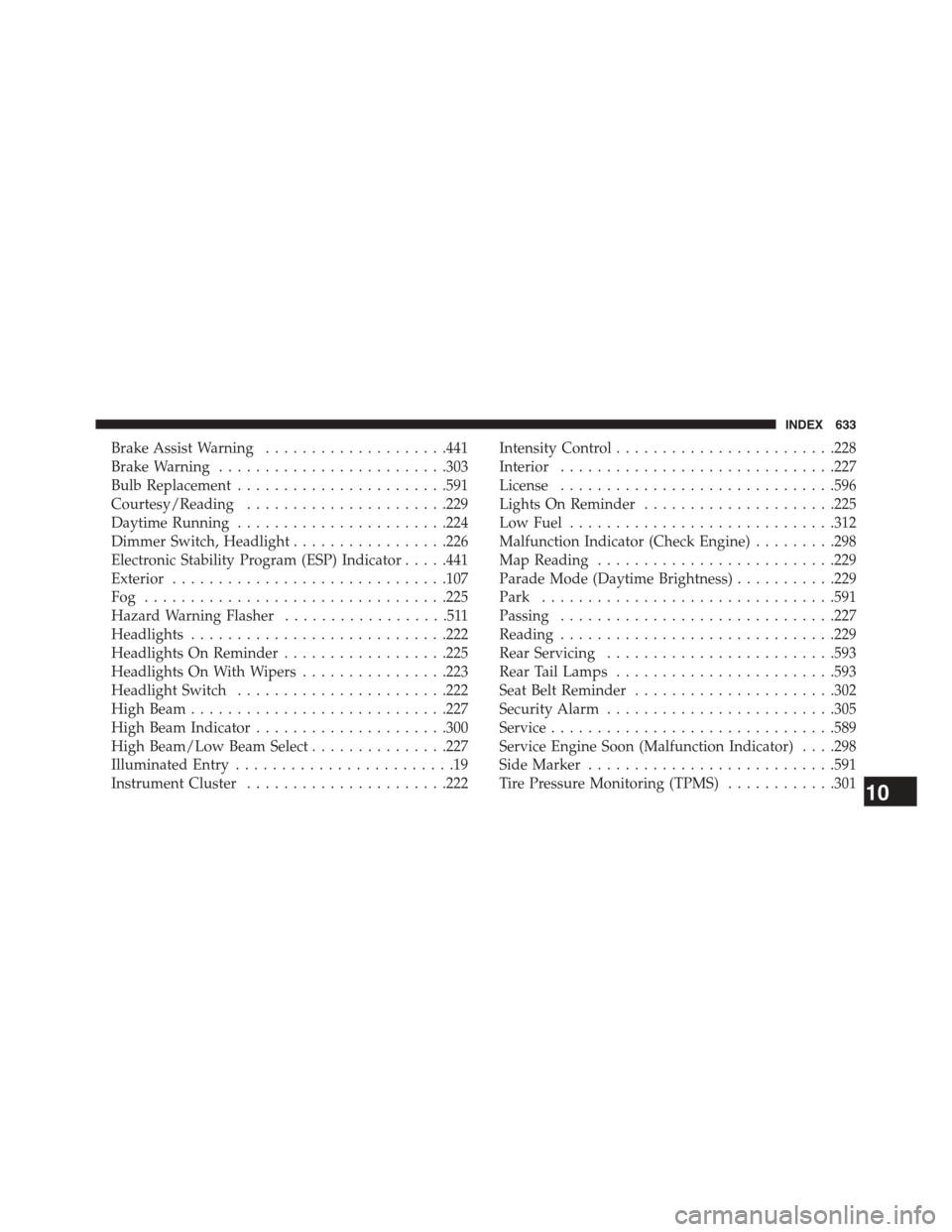
Brake Assist Warning....................441
Brake Warning.........................303
Bulb Replacement.......................591
Courtesy/Reading......................229
Daytime Running.......................224
Dimmer Switch, Headlight.................226
Electronic Stability Program (ESP) Indicator.....441
Exterior..............................107
Fog . . . . . . . . . . . . . . . . . . . . . . . . . . . . . . . ..225
Hazard Warning Flasher..................511
Headlights............................222
Headlights On Reminder..................225
Headlights On With Wipers................223
Headlight Switch.......................222
High Beam............................227
High Beam Indicator.....................300
High Beam/Low Beam Select...............227
Illuminated Entry........................19
Instrument Cluster......................222
Intensity Control........................228
Interior..............................227
License..............................596
Lights On Reminder.....................225
Low Fuel.............................312
Malfunction Indicator (Check Engine).........298
Map Reading..........................229
Parade Mode (Daytime Brightness)...........229
Park................................591
Passing..............................227
Reading..............................229
Rear Servicing.........................593
Rear Tail Lamps........................593
Seat Belt Reminder......................302
Security Alarm.........................305
Service...............................589
ServiceEngine Soon (Malfunction Indicator) . . . .298
Side Marker...........................591
Tire Pressure Monitoring (TPMS)............30110
INDEX 633