liftgate DODGE JOURNEY 2019 User Guide
[x] Cancel search | Manufacturer: DODGE, Model Year: 2019, Model line: JOURNEY, Model: DODGE JOURNEY 2019Pages: 524, PDF Size: 5.29 MB
Page 37 of 524
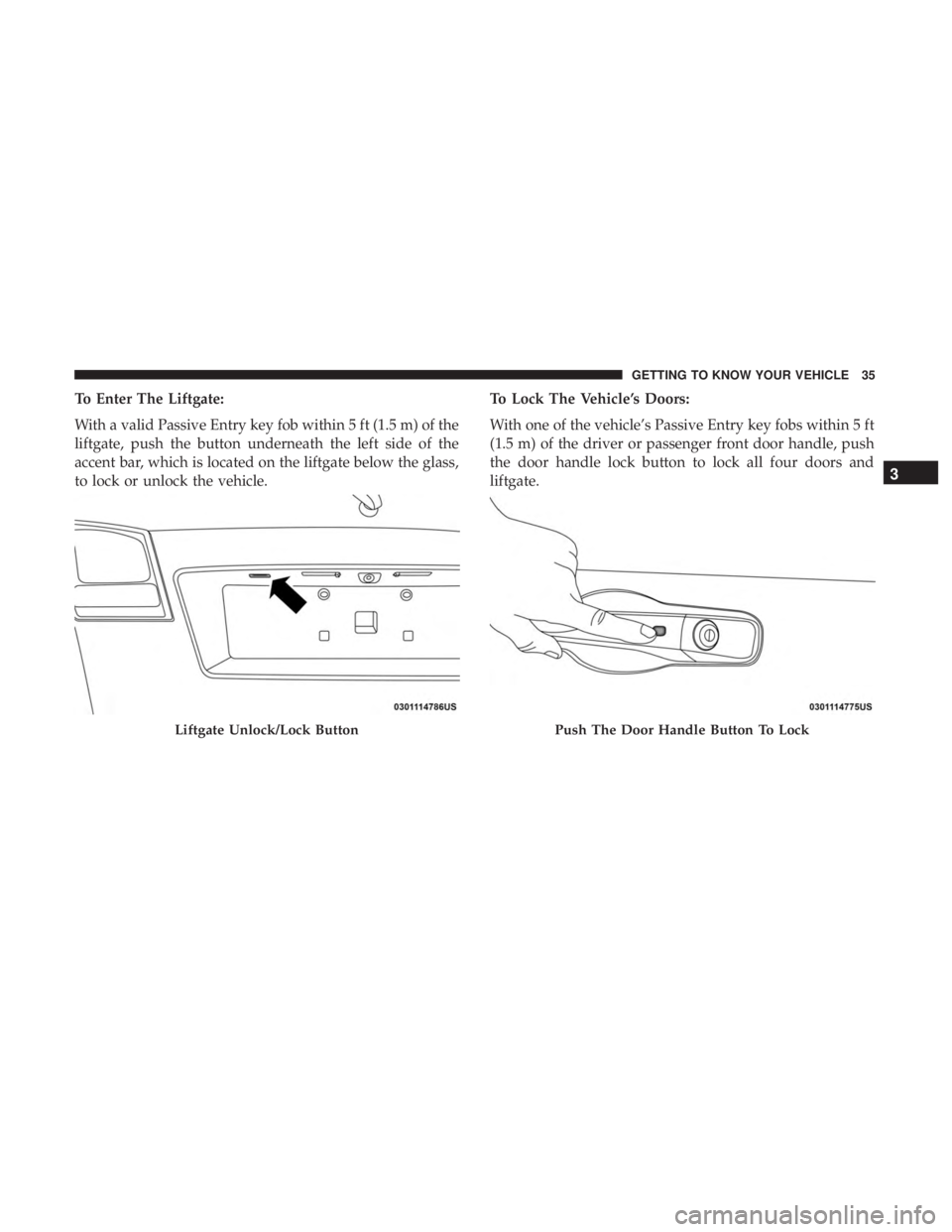
To Enter The Liftgate:
With a valid Passive Entry key fob within 5 ft (1.5 m) of the
liftgate, push the button underneath the left side of the
accent bar, which is located on the liftgate below the glass,
to lock or unlock the vehicle.To Lock The Vehicle’s Doors:
With one of the vehicle’s Passive Entry key fobs within 5 ft
(1.5 m) of the driver or passenger front door handle, push
the door handle lock button to lock all four doors and
liftgate.
Liftgate Unlock/Lock ButtonPush The Door Handle Button To Lock
3
GETTING TO KNOW YOUR VEHICLE 35
Page 69 of 524
INTERIOR LIGHTS
Courtesy/Interior Lighting
The interior lights come on when a door is opened.
To protect the battery, the interior lights will turn off
automatically 10 minutes after the ignition is placed in the
OFF position. This will occur if the interior lights were
switched on manually or are on because a door is open.
The Battery Protection also includes the glove compart-
ment light. To restore interior light operation after auto-
matic battery protection is enabled (Lights off), either place
the ignition in the ON/RUN position or cycle the light
switch.
Front Lights
The overhead console has two courtesy lights. The lights
turn on when a front door, a rear door or the liftgate is
opened. If your vehicle is equipped with Remote Keyless
Entry the lights will also turn on when the unlock button
on the key fob is pushed. The courtesy lights also function
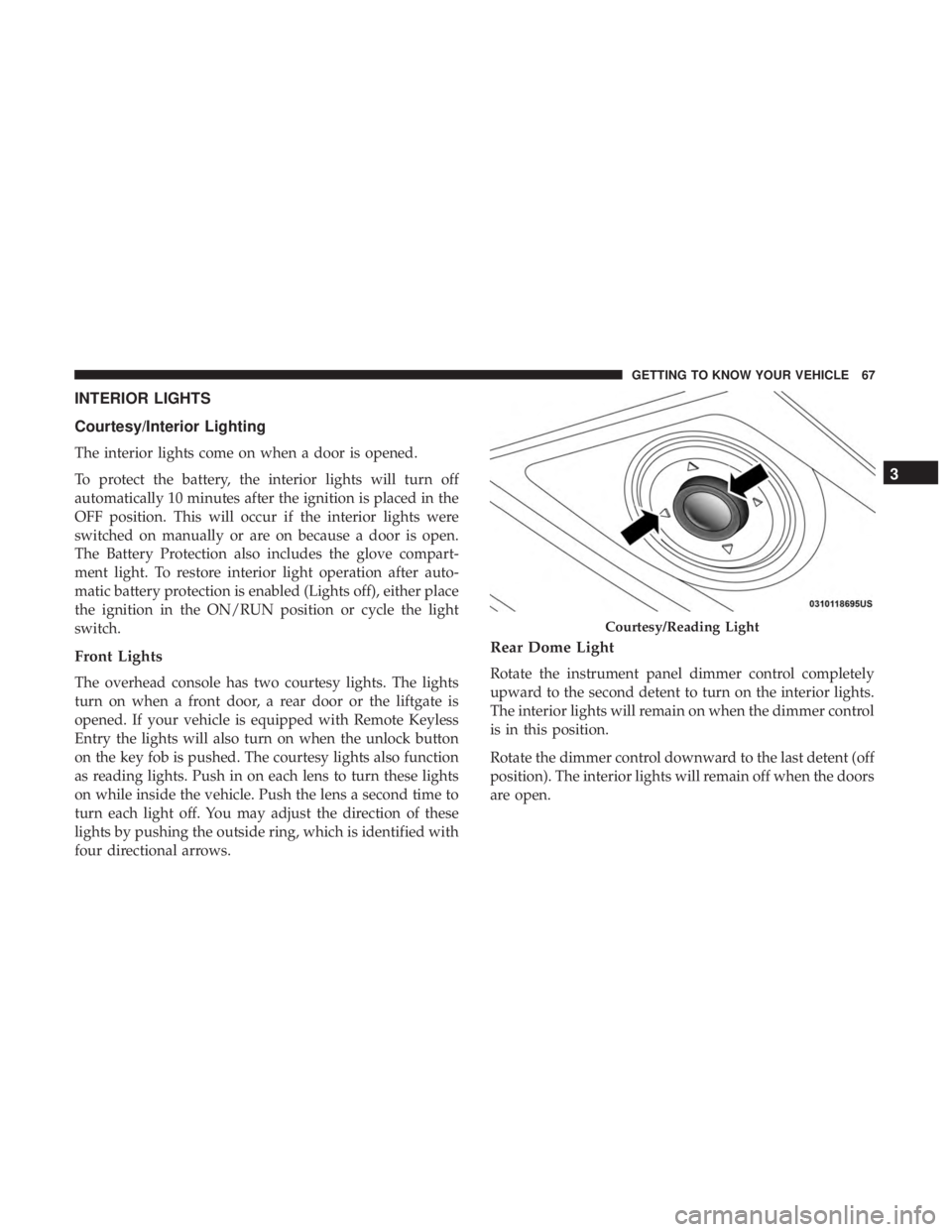
as reading lights. Push in on each lens to turn these lights
on while inside the vehicle. Push the lens a second time to
turn each light off. You may adjust the direction of these
lights by pushing the outside ring, which is identified with
four directional arrows.
Rear Dome Light
Rotate the instrument panel dimmer control completely
upward to the second detent to turn on the interior lights.
The interior lights will remain on when the dimmer control
is in this position.
Rotate the dimmer control downward to the last detent (off
position). The interior lights will remain off when the doors
are open.
Courtesy/Reading Light
3
GETTING TO KNOW YOUR VEHICLE 67
Page 111 of 524
CAUTION!
To prevent possible damage:
•Before closing hood, make sure the hood prop rod is
fully seated into its storage retaining clips.
• Do not slam the hood to close it. Use a firm down-
ward push at the center front edge of the hood to
ensure that both latches engage. Never drive your
vehicle unless the hood is fully closed, with both
latches engaged.
LIFTGATE
Opening
The liftgate can be unlocked or locked pushing the unlock
or lock button on the Remote Keyless Entry key fob, the
Keyless Enter-N-Go (Passive Entry) lock/unlock button
underneath the left side of the accent bar, which is located
on the liftgate below the glass or by activating the power
door lock switch located on either front door trim panel.
Refer to “Keyless Enter-N-Go” in “Getting To Know Your
Vehicle” for further information on Keyless Enter-N-Go
(Passive Entry). NOTE:
The liftgate cannot be unlocked or locked with the
manual door lock plungers on the door trim panels or the
door lock cylinder on the driver’s door.
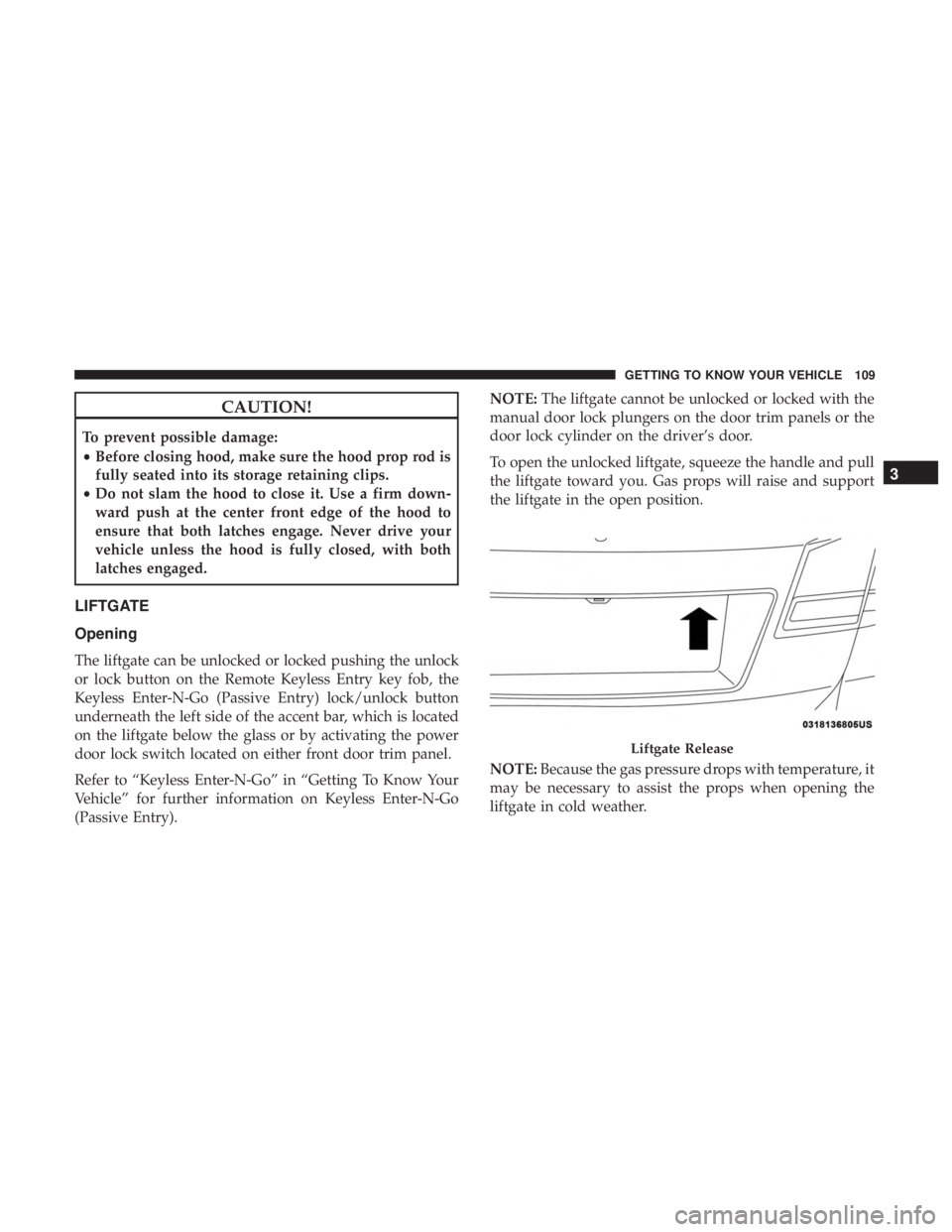
To open the unlocked liftgate, squeeze the handle and pull
the liftgate toward you. Gas props will raise and support
the liftgate in the open position.
NOTE: Because the gas pressure drops with temperature, it
may be necessary to assist the props when opening the
liftgate in cold weather.
Liftgate Release
3
GETTING TO KNOW YOUR VEHICLE 109
Page 112 of 524
WARNING!
•Driving with the liftgate open can allow poisonous
exhaust gases into your vehicle. You and your pas-
sengers could be injured by these fumes. Keep the
liftgate closed when you are operating the vehicle.
• If you are required to drive with the liftgate open,
make sure that all windows are closed, and the
climate control blower switch is set at high speed. Do
not use the recirculation mode.
Cargo Area Features
Cargo Management System
Five Passenger System Features
• A raised load floor that sits on top of a large built-in
storage bin.
• A tri-fold door built into the load floor that allows easy
access to items in the built-in storage bin.
• 60/40 split second-row passenger seats with fold flat
feature, which allows for extended cargo space. Refer to
“Seats” in “Getting To Know Your Vehicle” for further
information. •
An optional front passenger seat with fold flat feature,
which extends cargo space even further. Refer to “Seats” in
“Getting To Know Your Vehicle” for further information.
• Cargo tie-downs.
• A retractable cargo area cover (if equipped).
Seven Passenger System Features
•
A large built-in storage bin with a hinged hardcover
located in the floor behind the third-row passenger seats.
• 60/40 split second-row passenger seats with fold flat
feature, which allows for extended cargo space. Refer to
“Seats” in “Getting To Know Your Vehicle” for further
information.
• 50/50 split third-row passenger seats with fold flat
feature, which allows for extended cargo space. Refer to
“Seats” in “Getting To Know Your Vehicle” for further
information.
•
An optional front passenger seat with fold flat feature,
which extends cargo space even further. Refer to “Seats” in
“Getting To Know Your Vehicle” for further information.
• Cargo tie-downs.
110 GETTING TO KNOW YOUR VEHICLE
Page 113 of 524
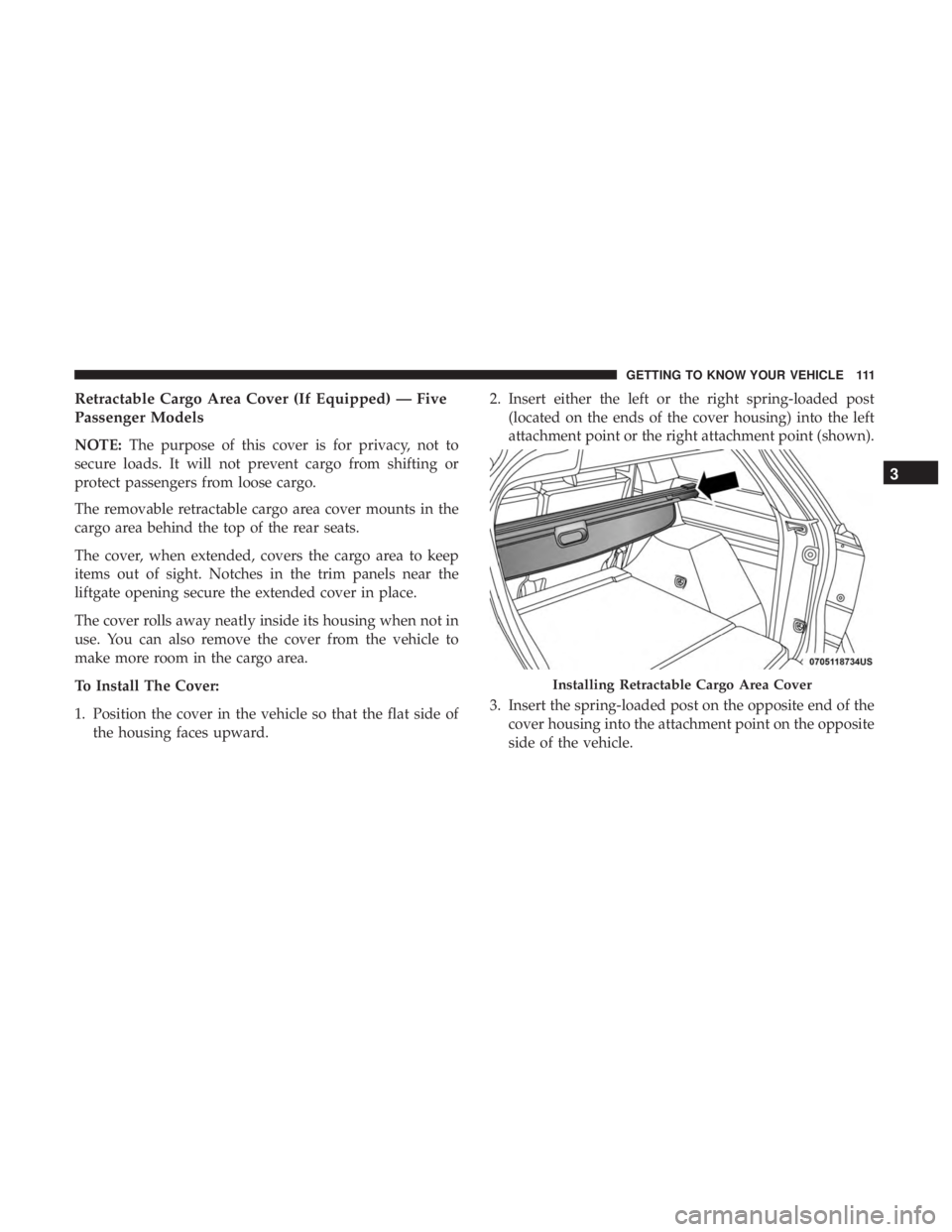
Retractable Cargo Area Cover (If Equipped) — Five
Passenger Models
NOTE:The purpose of this cover is for privacy, not to
secure loads. It will not prevent cargo from shifting or
protect passengers from loose cargo.
The removable retractable cargo area cover mounts in the
cargo area behind the top of the rear seats.
The cover, when extended, covers the cargo area to keep
items out of sight. Notches in the trim panels near the
liftgate opening secure the extended cover in place.
The cover rolls away neatly inside its housing when not in
use. You can also remove the cover from the vehicle to
make more room in the cargo area.
To Install The Cover:
1. Position the cover in the vehicle so that the flat side of the housing faces upward. 2. Insert either the left or the right spring-loaded post
(located on the ends of the cover housing) into the left
attachment point or the right attachment point (shown).
3. Insert the spring-loaded post on the opposite end of the cover housing into the attachment point on the opposite
side of the vehicle.
Installing Retractable Cargo Area Cover
3
GETTING TO KNOW YOUR VEHICLE 111
Page 114 of 524
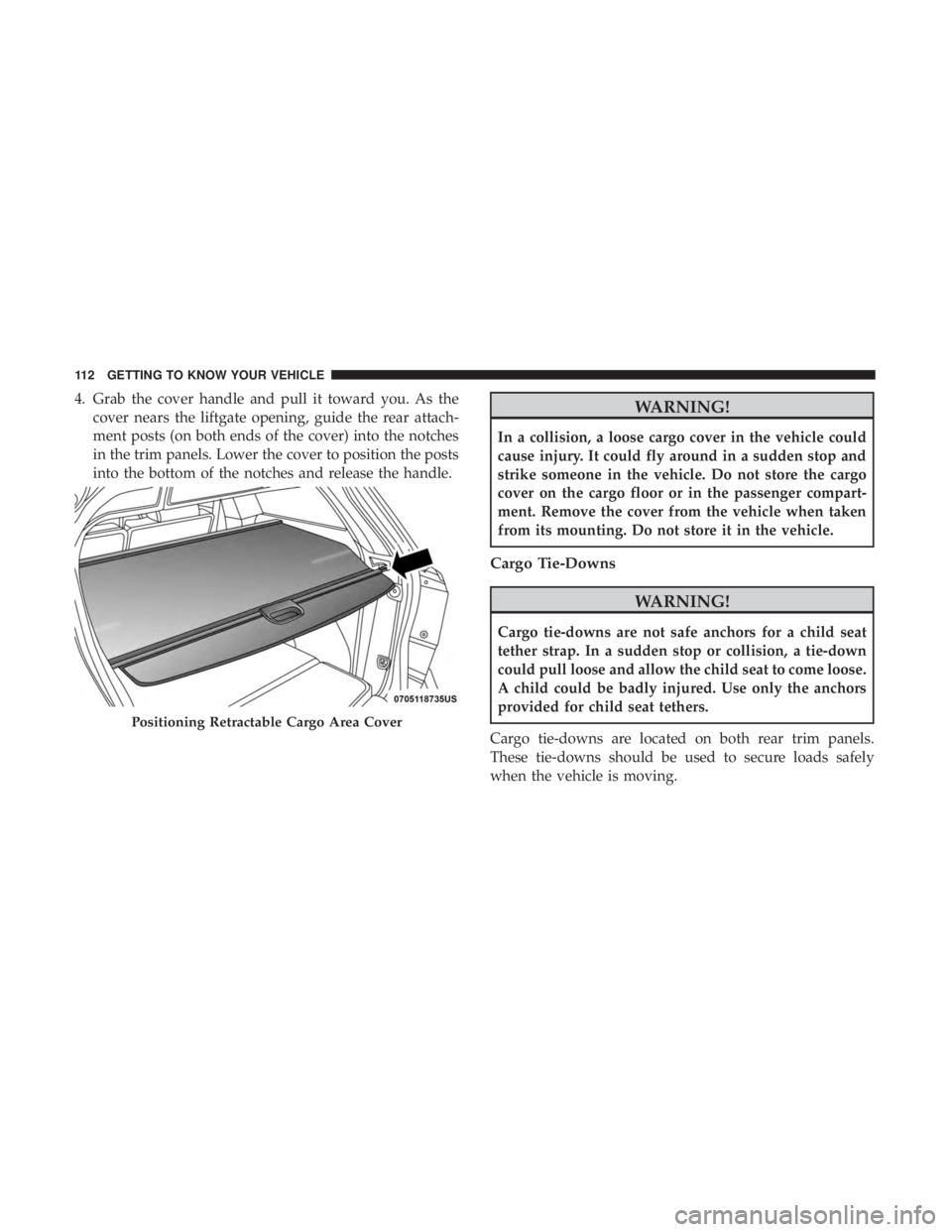
4. Grab the cover handle and pull it toward you. As thecover nears the liftgate opening, guide the rear attach-
ment posts (on both ends of the cover) into the notches
in the trim panels. Lower the cover to position the posts
into the bottom of the notches and release the handle.WARNING!
In a collision, a loose cargo cover in the vehicle could
cause injury. It could fly around in a sudden stop and
strike someone in the vehicle. Do not store the cargo
cover on the cargo floor or in the passenger compart-
ment. Remove the cover from the vehicle when taken
from its mounting. Do not store it in the vehicle.
Cargo Tie-Downs
WARNING!
Cargo tie-downs are not safe anchors for a child seat
tether strap. In a sudden stop or collision, a tie-down
could pull loose and allow the child seat to come loose.
A child could be badly injured. Use only the anchors
provided for child seat tethers.
Cargo tie-downs are located on both rear trim panels.
These tie-downs should be used to secure loads safely
when the vehicle is moving.
Positioning Retractable Cargo Area Cover
112 GETTING TO KNOW YOUR VEHICLE
Page 152 of 524
NOTE:If the vehicle is moving, there will also be a single
chime.
— Liftgate Open Warning Light
This warning light will illuminate when the liftgate is open.
NOTE: If the vehicle is moving, there will also be a single
chime.
Yellow Warning Lights
— Engine Check/Malfunction Indicator Warning
Light (MIL)
The Engine Check/Malfunction Indicator Light (MIL) is a
part of an Onboard Diagnostic System called OBD II that
monitors engine and automatic transmission control sys-
tems. This warning light will illuminate when the ignition
is in the ON/RUN position before engine start. If the bulb
does not come on when turning the ignition switch from
OFF to ON/RUN, have the condition checked promptly.
Certain conditions, such as a loose or missing gas cap, poor
quality fuel, etc., may illuminate the light after engine start.
The vehicle should be serviced if the light stays on through
several typical driving styles. In most situations, the ve-
hicle will drive normally and will not require towing. When the engine is running, the MIL may flash to alert
serious conditions that could lead to immediate loss of
power or severe catalytic converter damage. The vehicle
should be serviced by an authorized dealer as soon as
possible if this occurs.
WARNING!
A malfunctioning catalytic converter, as referenced
above, can reach higher temperatures than in normal
operating conditions. This can cause a fire if you drive
slowly or park over flammable substances such as dry
plants, wood, cardboard, etc. This could result in death
or serious injury to the driver, occupants or others.
CAUTION!
Prolonged driving with the Malfunction Indicator
Light (MIL) on could cause damage to the vehicle
control system. It also could affect fuel economy and
driveability. If the MIL is flashing, severe catalytic
converter damage and power loss will soon occur.
Immediate service is required.
150 GETTING TO KNOW YOUR INSTRUMENT PANEL
Page 225 of 524
Exhaust Gas
WARNING!
Exhaust gases can injure or kill. They contain carbon
monoxide (CO), which is colorless and odorless.
Breathing it can make you unconscious and can even-
tually poison you. To avoid breathing (CO), follow
these safety tips:
•Do not run the engine in a closed garage or in
confined areas any longer than needed to move your
vehicle in or out of the area.
• If you are required to drive with the trunk/liftgate/
rear doors open, make sure that all windows are
closed and the climate control BLOWER switch is set
at high speed. DO NOT use the recirculation mode.
• If it is necessary to sit in a parked vehicle with the
engine running, adjust your heating or cooling con-
trols to force outside air into the vehicle. Set the
blower at high speed.
The best protection against carbon monoxide entry into the
vehicle body is a properly maintained engine exhaust
system. Whenever a change is noticed in the sound of the exhaust
system, when exhaust fumes can be detected inside the
vehicle, or when the underside or rear of the vehicle is
damaged, have a competent mechanic inspect the complete
exhaust system and adjacent body areas for broken, dam-
aged, deteriorated, or mispositioned parts. Open seams or
loose connections could permit exhaust fumes to seep into
the passenger compartment. In addition, inspect the ex-
haust system each time the vehicle is raised for lubrication
or oil change. Replace as required.
Safety Checks You Should Make Inside The Vehicle
Seat Belts
Inspect the seat belt system periodically, checking for cuts,
frays, and loose parts. Damaged parts must be replaced
immediately. Do not disassemble or modify the system.
Front seat belt assemblies must be replaced after a collision.
Rear seat belt assemblies must be replaced after a collision
if they have been damaged (i.e., bent retractor, torn web-
bing, etc.). If there is any question regarding seat belt or
retractor condition, replace the seat belt.
5
SAFETY 223
Page 281 of 524
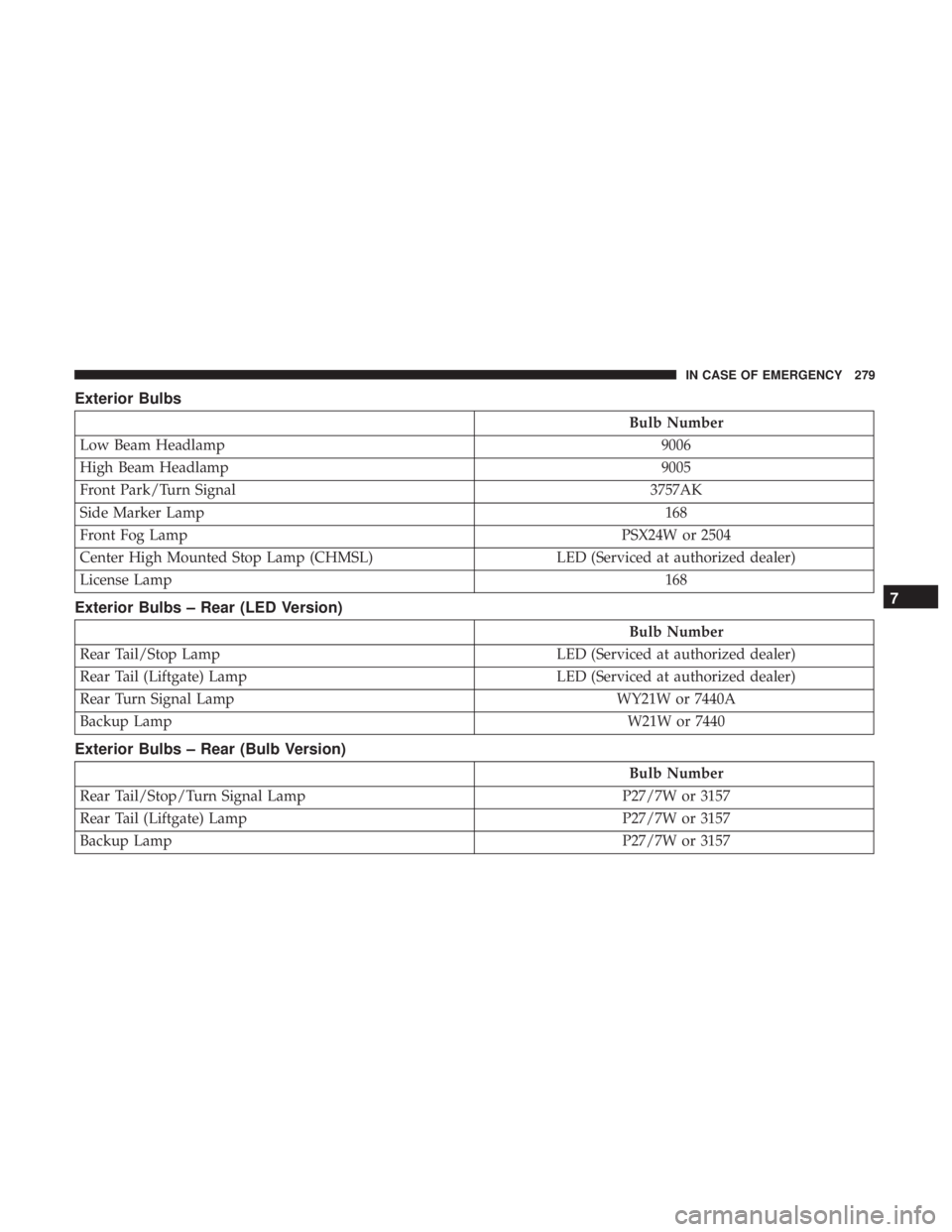
Exterior Bulbs
Bulb Number
Low Beam Headlamp 9006
High Beam Headlamp 9005
Front Park/Turn Signal 3757AK
Side Marker Lamp 168
Front Fog Lamp PSX24W or 2504
Center High Mounted Stop Lamp (CHMSL) LED (Serviced at authorized dealer)
License Lamp 168
Exterior Bulbs – Rear (LED Version)
Bulb Number
Rear Tail/Stop Lamp LED (Serviced at authorized dealer)
Rear Tail (Liftgate) Lamp LED (Serviced at authorized dealer)
Rear Turn Signal Lamp WY21W or 7440A
Backup Lamp W21W or 7440
Exterior Bulbs – Rear (Bulb Version)
Bulb Number
Rear Tail/Stop/Turn Signal Lamp P27/7W or 3157
Rear Tail (Liftgate) Lamp P27/7W or 3157
Backup Lamp P27/7W or 3157
7
IN CASE OF EMERGENCY 279
Page 284 of 524
4. Install the replacement bulb and connector assemblystraight into the fog lamp until it locks into place.
5. Reinstall the front lower wheel well access panel and fasteners.
Rear Turn Signal And Backup Lamp
The tail lamps are a two-piece design. The tail/stop/rear
turn signal lamps are located in the rear corner body
panels. The tail and backup lamps are located in the
liftgate.
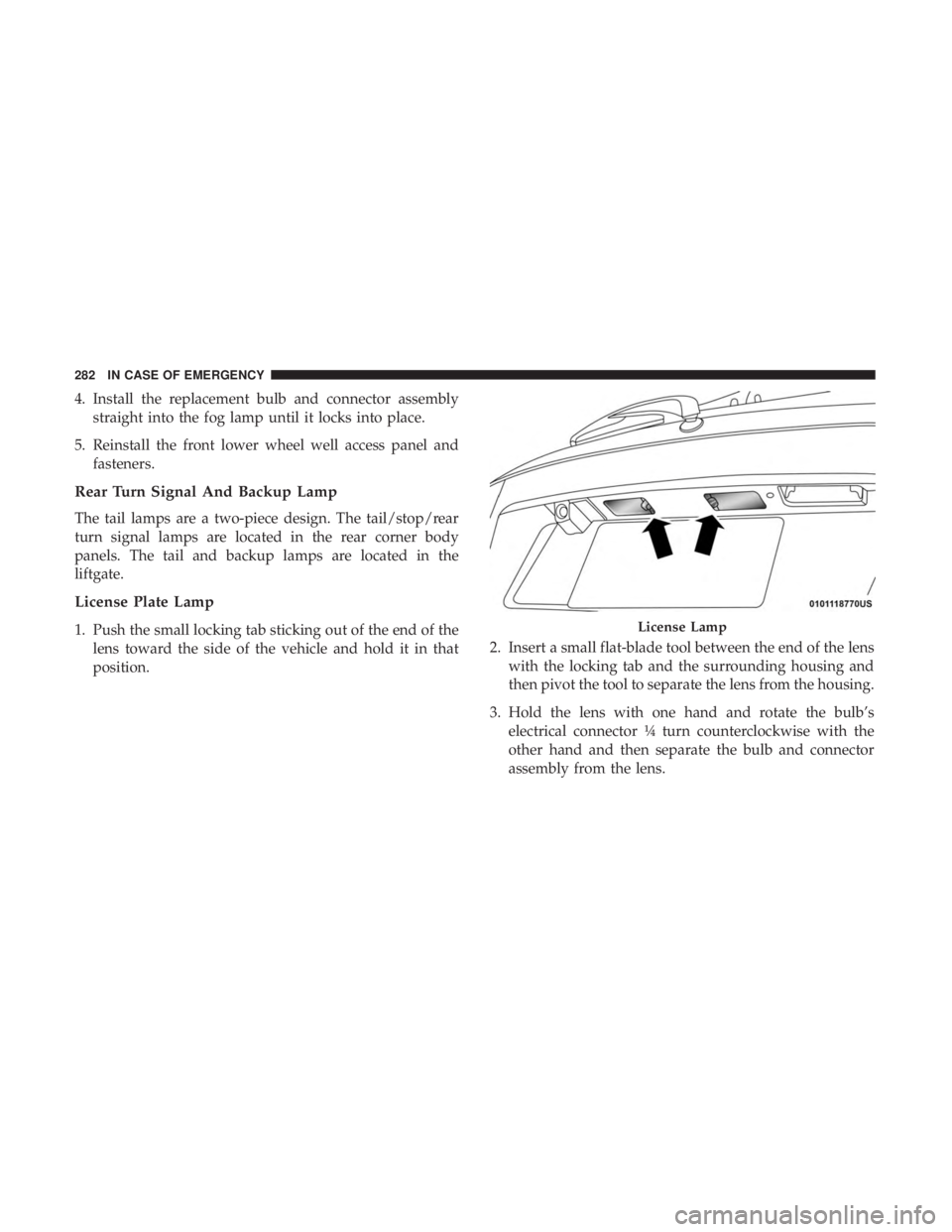
License Plate Lamp
1. Push the small locking tab sticking out of the end of thelens toward the side of the vehicle and hold it in that
position. 2. Insert a small flat-blade tool between the end of the lens
with the locking tab and the surrounding housing and
then pivot the tool to separate the lens from the housing.
3. Hold the lens with one hand and rotate the bulb’s electrical connector ¼ turn counterclockwise with the
other hand and then separate the bulb and connector
assembly from the lens.License Lamp
282 IN CASE OF EMERGENCY