heating DODGE MAGNUM SRT 2007 1.G User Guide
[x] Cancel search | Manufacturer: DODGE, Model Year: 2007, Model line: MAGNUM SRT, Model: DODGE MAGNUM SRT 2007 1.GPages: 380, PDF Size: 6.63 MB
Page 273 of 380
Towing Tips Ð Electronic Speed Control (If
Equipped)
þ
Don't use in hilly terrain or with heavy loads.
þWhen using the speed control, if you experience speed
drops greater than 10 mph (16 km/h), disengage until
you can get back to cruising speed.
þUse speed control in flat terrain and with light loads to
maximize fuel efficiency.
Towing Tips Ð Autostickt(If Equipped)
þ
For vehicles equipped with Autostick.tBy using the
Autosticktmodes, and selecting a specific gear range,
frequent shifting can be avoided. The highest gear
range should be selected that allows for adequate
performance. For example, choose ª4º if the desired
speed can be maintained. Choose ª3º or ª2º if needed
to maintain the desired speed.
þExtended driving at high RPM should be avoided to
prevent excess heat generation. A reduction in vehicle
speed may be required to avoid extended driving at
high RPM. Return to a higher gear range or vehicle
speed when road conditions and RPM level allows.
Towing Tips Ð Cooling System
To reduce potential for engine and transmission over-
heating, take the following actions:
þCity Driving
When stopped for short periods of time, put transmission
in neutral and increase engine idle speed.
þHighway Driving
Reduce speed.
þAir Conditioning
Turn off temporarily.
þRefer to ªCooling Systemº under ªMaintenance Pro-
ceduresº in Section 7 of this manual for more informa-
tion.
272 STARTING AND OPERATING
Page 277 of 380
HAZARD WARNING FLASHER
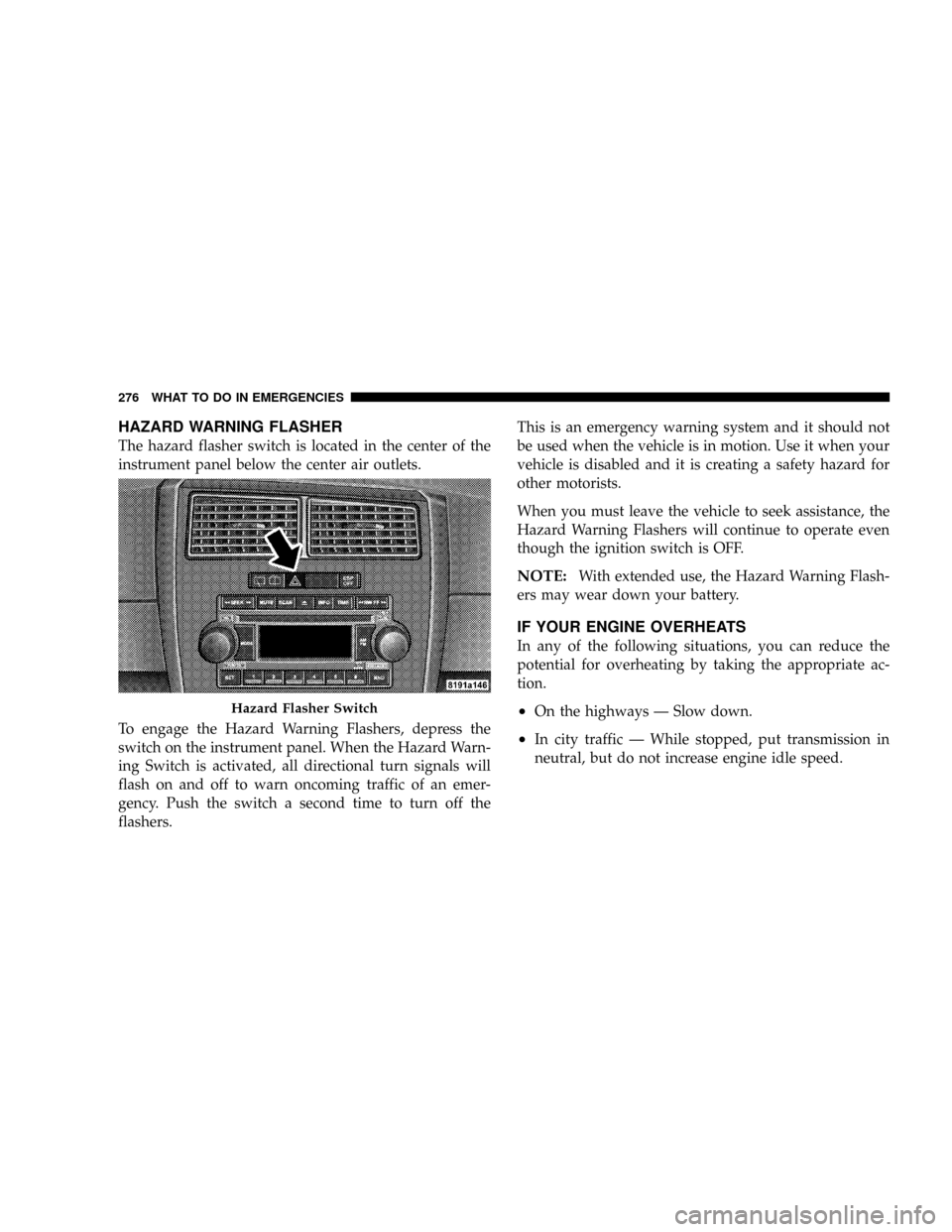
The hazard flasher switch is located in the center of the
instrument panel below the center air outlets.
To engage the Hazard Warning Flashers, depress the
switch on the instrument panel. When the Hazard Warn-
ing Switch is activated, all directional turn signals will
flash on and off to warn oncoming traffic of an emer-
gency. Push the switch a second time to turn off the
flashers.This is an emergency warning system and it should not
be used when the vehicle is in motion. Use it when your
vehicle is disabled and it is creating a safety hazard for
other motorists.
When you must leave the vehicle to seek assistance, the
Hazard Warning Flashers will continue to operate even
though the ignition switch is OFF.
NOTE:With extended use, the Hazard Warning Flash-
ers may wear down your battery.
IF YOUR ENGINE OVERHEATS
In any of the following situations, you can reduce the
potential for overheating by taking the appropriate ac-
tion.
²On the highways Ð Slow down.
²In city traffic Ð While stopped, put transmission in
neutral, but do not increase engine idle speed.
Hazard Flasher Switch
276 WHAT TO DO IN EMERGENCIES
Page 283 of 380
²Do not operate the electric air pump for more than
eight minutes to avoid overheating. The air pump may
be used again once it has cooled down.
²Replace the TIREFIT sealant bottle (5) once every four
years to assure optimum operation of the system.
²If TIREFIT is liquid, clean water and a damp cloth will
remove the material from the vehicle or tire and wheel
components. Once TIREFIT sealing material has dried,
it can easily be peeled off and properly discarded.
²Do not exceed 55 mph (90 km/h) until the tire has
been inspected.
JUMP-STARTING PROCEDURES
WARNING!
²Take care to avoid the radiator cooling fan whenever the
hood is raised. It can start anytime the ignition switch is on.
You can be hurt by the fan.
²Do not attempt to push or tow your vehicle to get it started.
Vehicles equipped with an automatic transmission cannot
be started this way. Unburned fuel could enter the catalytic
converter and once the engine has started, ignite and
damage the converter and vehicle. If the vehicle has a
discharged battery, booster cables may be used to obtain a
start from another vehicle. This type of start can be danger-
ous if done improperly, so follow this procedure carefully.
²Battery fluid is a corrosive acid solution; do not allow
battery fluid to contact eyes, skin, or clothing. Don't lean
over battery when attaching clamps or allow the clamps to
touch each other. If acid splashes in eyes or on skin, flush
contaminated area immediately with large quantities of
water.
²A battery generates hydrogen gas, which is flammable and
explosive. Keep flame or spark away from the vent holes.
²Do not use a booster battery or any other booster source
with an output that exceeds 12 volts.
²The battery in this vehicle has a vent hose that should not
be disconnected and should only be replaced with a battery
of the same type (vented).
282 WHAT TO DO IN EMERGENCIES
Page 287 of 380
CAUTION!
²When ªrockingº a stuck vehicle by moving be-
tween ªFirstº and R (Reverse), do not spin the
wheels faster than 15 mph (24 km/h), or drivetrain
damage may result.
²Racing the engine or spinning the wheels too fast
may lead to transmission overheating and failure.
It can also damage the tires. Do not spin the
wheels above 35 mph (55 km/h).
WARNING!
Fast spinning tires can be dangerous. Forces gener-
ated by excessive wheel speeds may cause tire dam-
age or failure. A tire could explode and injure
someone. Do not spin your vehicle's wheels faster
than 35 mph (55 km/h) when you are stuck, and don't
let anyone near a spinning wheel, no matter what the
speed.
TOWING A DISABLED VEHICLE
WITHOUT THE IGNITION KEY
Special care must be taken when the vehicle is towed
with the ignition in the LOCK position. The only ap-
proved method of towing without the ignition key is
with a flat bed truck. Proper towing equipment is neces-
sary to prevent damage to the vehicle.
TOWING THIS VEHICLE BEHIND ANOTHER
VEHICLE (Flat towing with all four wheels on the
ground)
Flat towing of vehicles equipped with an automatic
transmission, is only permitted within the following
limitations:
With The Ignition Key
Your vehicle may be towed under the following condi-
tions: The gear selector must be in NEUTRAL, the
distance to be traveled must not exceed 30 miles (48 km),
and the towing speed must not exceed 30 mph
(48 km/h). Exceeding these towing limits may cause a
transmission geartrain failure. If the transmission is not
286 WHAT TO DO IN EMERGENCIES
Page 301 of 380
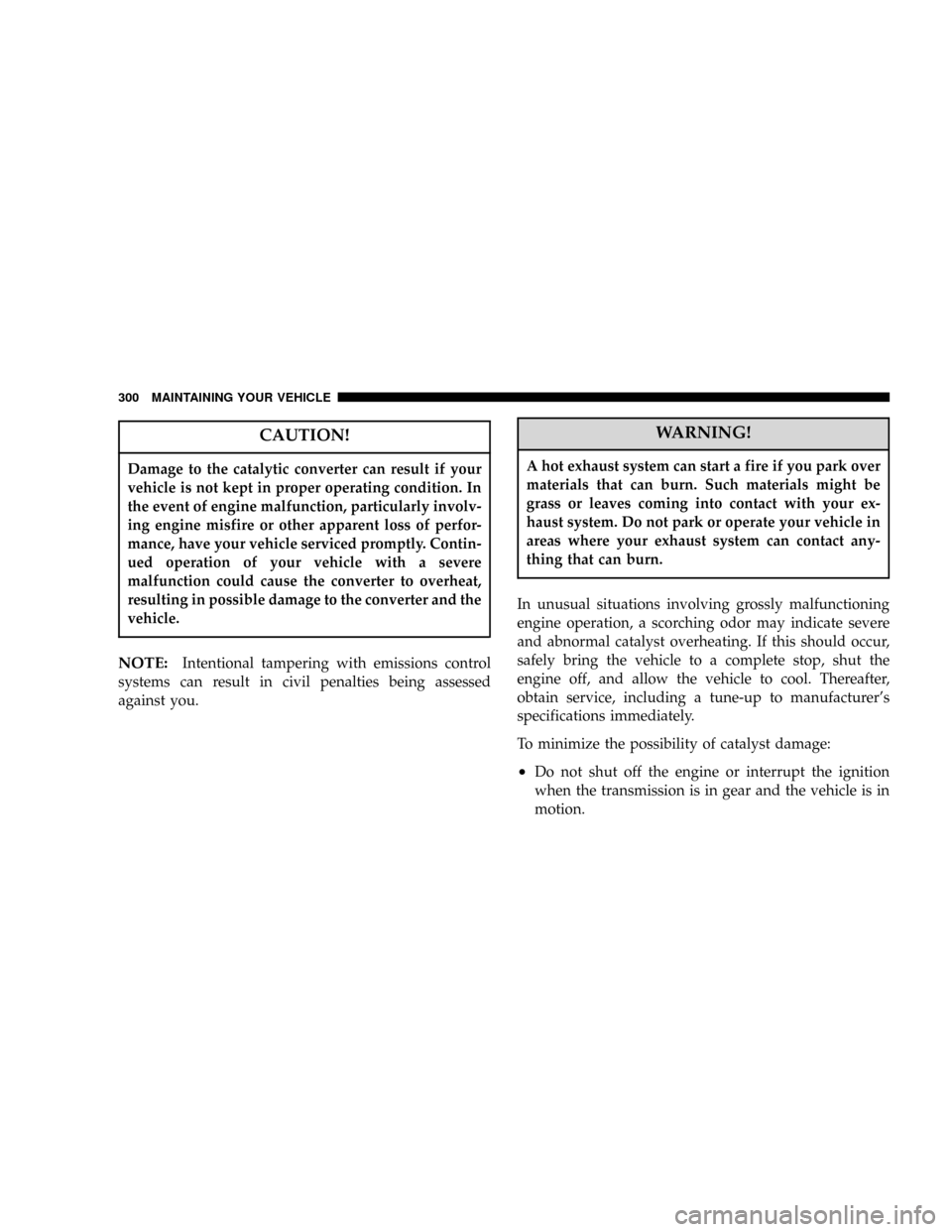
CAUTION!
Damage to the catalytic converter can result if your
vehicle is not kept in proper operating condition. In
the event of engine malfunction, particularly involv-
ing engine misfire or other apparent loss of perfor-
mance, have your vehicle serviced promptly. Contin-
ued operation of your vehicle with a severe
malfunction could cause the converter to overheat,
resulting in possible damage to the converter and the
vehicle.
NOTE:Intentional tampering with emissions control
systems can result in civil penalties being assessed
against you.
WARNING!
A hot exhaust system can start a fire if you park over
materials that can burn. Such materials might be
grass or leaves coming into contact with your ex-
haust system. Do not park or operate your vehicle in
areas where your exhaust system can contact any-
thing that can burn.
In unusual situations involving grossly malfunctioning
engine operation, a scorching odor may indicate severe
and abnormal catalyst overheating. If this should occur,
safely bring the vehicle to a complete stop, shut the
engine off, and allow the vehicle to cool. Thereafter,
obtain service, including a tune-up to manufacturer's
specifications immediately.
To minimize the possibility of catalyst damage:
²Do not shut off the engine or interrupt the ignition
when the transmission is in gear and the vehicle is in
motion.
300 MAINTAINING YOUR VEHICLE
Page 368 of 380
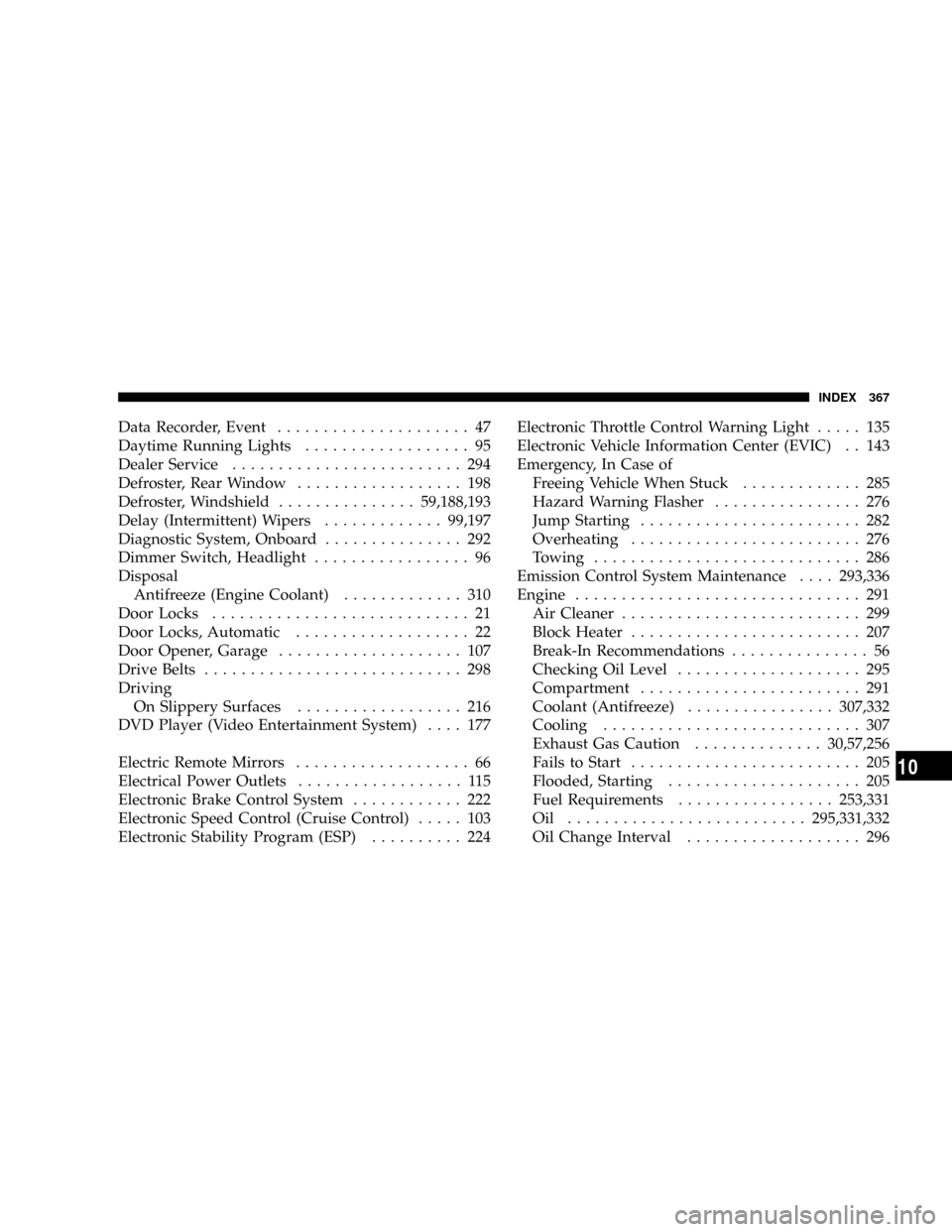
Data Recorder, Event..................... 47
Daytime Running Lights.................. 95
Dealer Service......................... 294
Defroster, Rear Window.................. 198
Defroster, Windshield...............59,188,193
Delay (Intermittent) Wipers.............99,197
Diagnostic System, Onboard............... 292
Dimmer Switch, Headlight................. 96
Disposal
Antifreeze (Engine Coolant)............. 310
Door Locks............................ 21
Door Locks, Automatic................... 22
Door Opener, Garage.................... 107
Drive Belts............................ 298
Driving
On Slippery Surfaces.................. 216
DVD Player (Video Entertainment System).... 177
Electric Remote Mirrors................... 66
Electrical Power Outlets.................. 115
Electronic Brake Control System............ 222
Electronic Speed Control (Cruise Control)..... 103
Electronic Stability Program (ESP).......... 224Electronic Throttle Control Warning Light..... 135
Electronic Vehicle Information Center (EVIC) . . 143
Emergency, In Case of
Freeing Vehicle When Stuck............. 285
Hazard Warning Flasher................ 276
Jump Starting........................ 282
Overheating......................... 276
Towing............................. 286
Emission Control System Maintenance....293,336
Engine............................... 291
Air Cleaner.......................... 299
Block Heater......................... 207
Break-In Recommendations............... 56
Checking Oil Level.................... 295
Compartment........................ 291
Coolant (Antifreeze)................307,332
Cooling............................ 307
Exhaust Gas Caution..............30,57,256
Fails to Start......................... 205
Flooded, Starting..................... 205
Fuel Requirements.................253,331
Oil ..........................295,331,332
Oil Change Interval................... 296
INDEX 367
10
Page 369 of 380
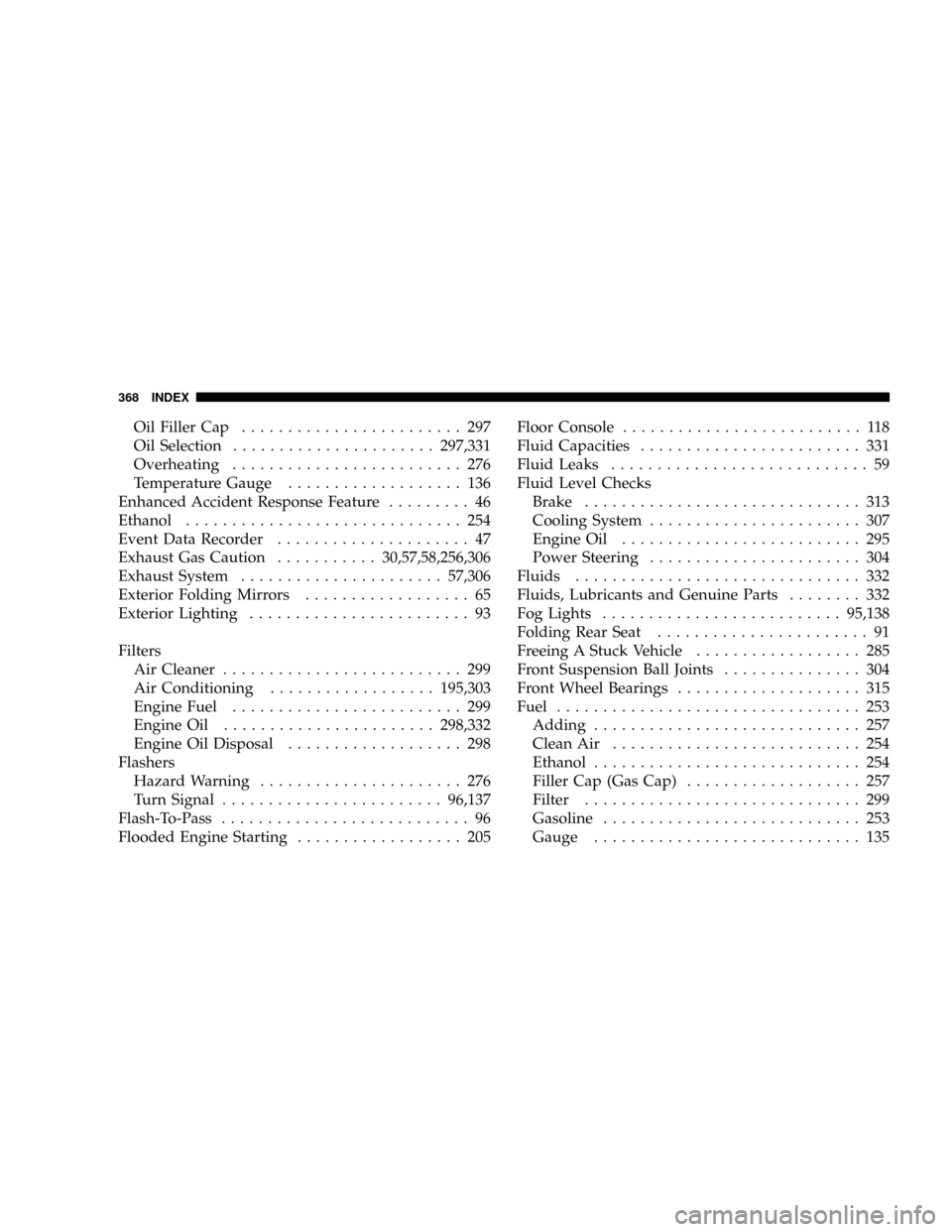
Oil Filler Cap........................ 297
Oil Selection......................297,331
Overheating......................... 276
Temperature Gauge................... 136
Enhanced Accident Response Feature......... 46
Ethanol.............................. 254
Event Data Recorder..................... 47
Exhaust Gas Caution...........30,57,58,256,306
Exhaust System......................57,306
Exterior Folding Mirrors.................. 65
Exterior Lighting........................ 93
Filters
Air Cleaner.......................... 299
Air Conditioning..................195,303
Engine Fuel......................... 299
Engine Oil.......................298,332
Engine Oil Disposal................... 298
Flashers
Hazard Warning...................... 276
Turn Signal........................96,137
Flash-To-Pass........................... 96
Flooded Engine Starting.................. 205Floor Console.......................... 118
Fluid Capacities........................ 331
Fluid Leaks............................ 59
Fluid Level Checks
Brake.............................. 313
Cooling System....................... 307
Engine Oil.......................... 295
Power Steering....................... 304
Fluids............................... 332
Fluids, Lubricants and Genuine Parts........ 332
Fog Lights..........................95,138
Folding Rear Seat....................... 91
Freeing A Stuck Vehicle.................. 285
Front Suspension Ball Joints............... 304
Front Wheel Bearings.................... 315
Fuel................................. 253
Adding............................. 257
Clean Air........................... 254
Ethanol............................. 254
Filler Cap (Gas Cap)................... 257
Filter.............................. 299
Gasoline............................ 253
Gauge............................. 135
368 INDEX
Page 374 of 380
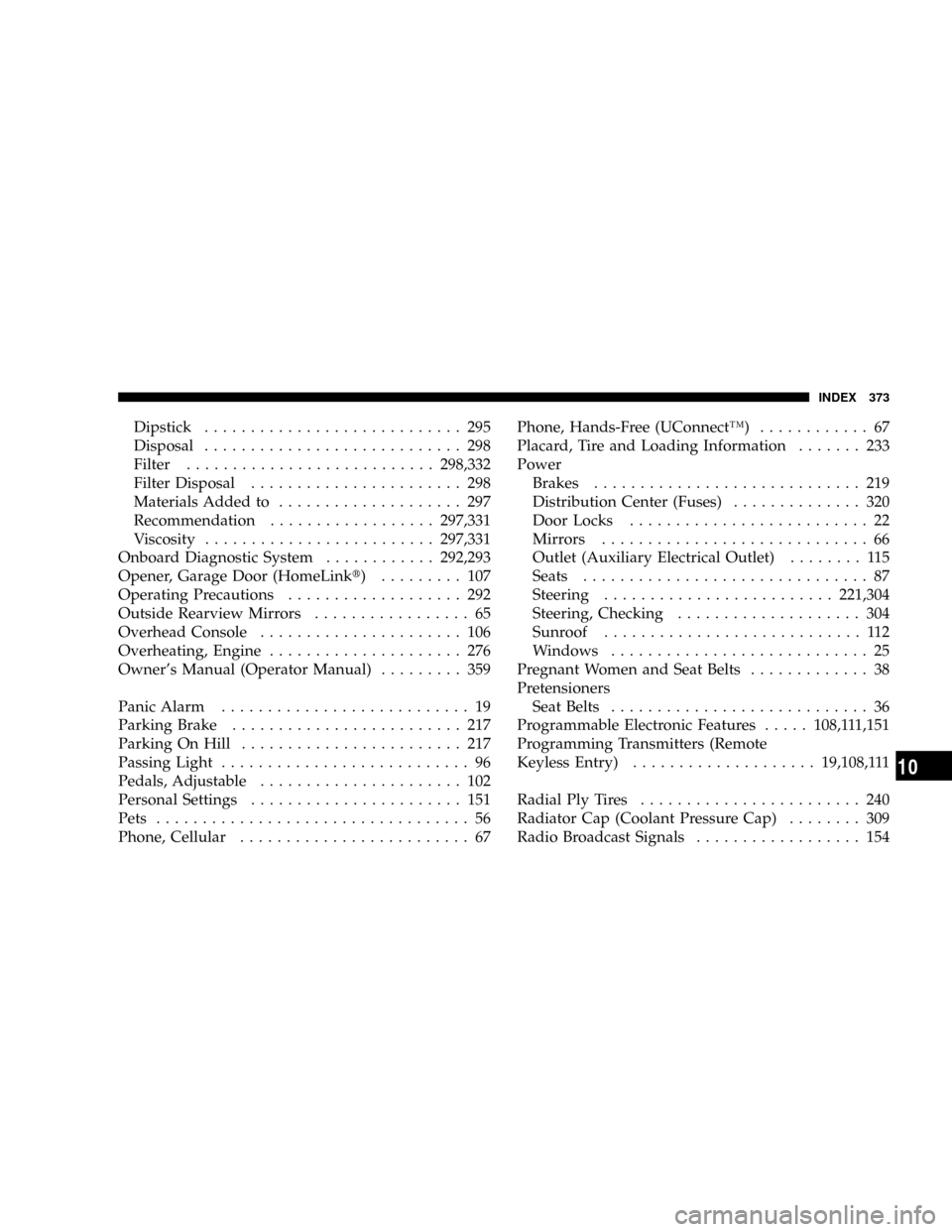
Dipstick............................ 295
Disposal............................ 298
Filter...........................298,332
Filter Disposal....................... 298
Materials Added to.................... 297
Recommendation..................297,331
Viscosity.........................297,331
Onboard Diagnostic System............292,293
Opener, Garage Door (HomeLinkt) ......... 107
Operating Precautions................... 292
Outside Rearview Mirrors................. 65
Overhead Console...................... 106
Overheating, Engine..................... 276
Owner's Manual (Operator Manual)......... 359
Panic Alarm........................... 19
Parking Brake......................... 217
Parking On Hill........................ 217
Passing Light........................... 96
Pedals, Adjustable...................... 102
Personal Settings....................... 151
Pets.................................. 56
Phone, Cellular......................... 67Phone, Hands-Free (UConnectŸ)............ 67
Placard, Tire and Loading Information....... 233
Power
Brakes............................. 219
Distribution Center (Fuses).............. 320
Door Locks.......................... 22
Mirrors............................. 66
Outlet (Auxiliary Electrical Outlet)........ 115
Seats............................... 87
Steering.........................221,304
Steering, Checking.................... 304
Sunroof............................ 112
Windows............................ 25
Pregnant Women and Seat Belts............. 38
Pretensioners
Seat Belts............................ 36
Programmable Electronic Features.....108,111,151
Programming Transmitters (Remote
Keyless Entry)....................19,108,111
Radial Ply Tires........................ 240
Radiator Cap (Coolant Pressure Cap)........ 309
Radio Broadcast Signals.................. 154
INDEX 373
10