ignition DODGE MAGNUM SRT 2007 1.G Repair Manual
[x] Cancel search | Manufacturer: DODGE, Model Year: 2007, Model line: MAGNUM SRT, Model: DODGE MAGNUM SRT 2007 1.GPages: 380, PDF Size: 6.63 MB
Page 219 of 380
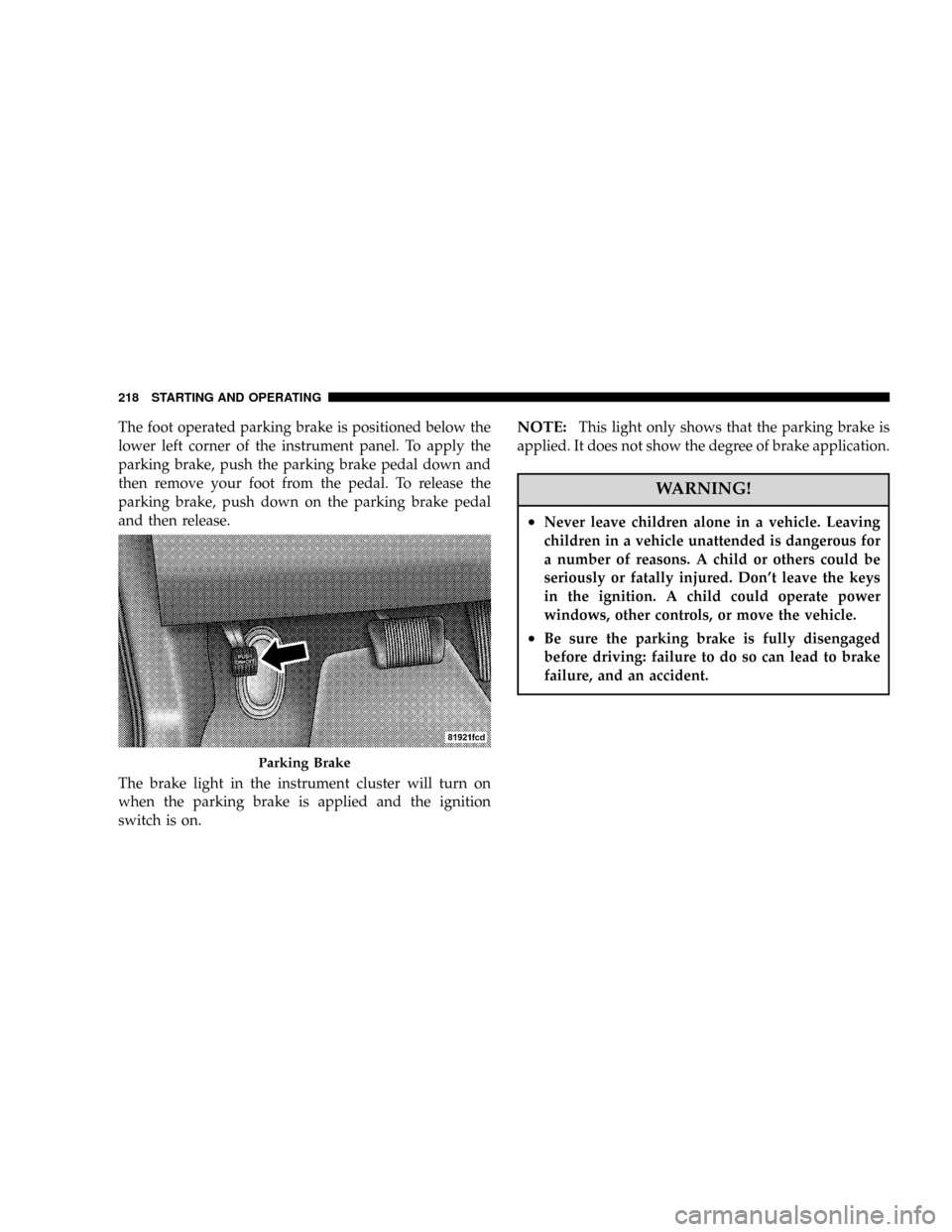
The foot operated parking brake is positioned below the
lower left corner of the instrument panel. To apply the
parking brake, push the parking brake pedal down and
then remove your foot from the pedal. To release the
parking brake, push down on the parking brake pedal
and then release.
The brake light in the instrument cluster will turn on
when the parking brake is applied and the ignition
switch is on.NOTE:This light only shows that the parking brake is
applied. It does not show the degree of brake application.
WARNING!
²Never leave children alone in a vehicle. Leaving
children in a vehicle unattended is dangerous for
a number of reasons. A child or others could be
seriously or fatally injured. Don't leave the keys
in the ignition. A child could operate power
windows, other controls, or move the vehicle.
²Be sure the parking brake is fully disengaged
before driving: failure to do so can lead to brake
failure, and an accident.
Parking Brake
218 STARTING AND OPERATING
Page 222 of 380
All vehicle wheels and tires must be the same size and
type and tires must be properly inflated to produce
accurate signals for the computer.
Anti-Lock Brake Light
The ABS light monitors the Anti-Lock Brake Sys-
tem. The light will come on when the ignition
switch is turned to the ON position and may stay on for
as long as four seconds.
If the ABS light remains on or comes on while driving, it
indicates that the Anti-Lock portion of the brake system
is not functioning and that service is required. However,
the conventional brake system will continue to operate
normally if the BRAKE warning light is not on.
If the ABS light is on, the brake system should be serviced
as soon as possible to restore the benefits of Anti-Lock
brakes. If the ABS light does not come on when the
Ignition switch is turned to the ON position, have the
bulb repaired as soon as possible.
If both the Brake Warning Light and the ABS Light
remain on, the Anti-Lock brakes (ABS) and ElectronicBrake Force Distribution (EBD) systems are not function-
ing. Immediate repair to the ABS system is required.
POWER STEERING
The standard power steering system will give you good
vehicle response and increased ease of maneuverability
in tight spaces. The system will provide mechanical
steering capability if power assist is lost.
If for some reason the power assist is interrupted, it will
still be possible to steer your vehicle. Under these condi-
tions, you will observe a substantial increase in steering
effort, especially at very low vehicle speeds and during
parking maneuvers.
NOTE:Increased noise levels at the end of the steering
wheel travel are considered normal and do not indicate
that there is a problem with the power steering system.
Upon initial start-up in cold weather, the power
steering pump may make noise for a short amount of
time. This is due to the cold, thick fluid in the steering
system. This noise should be considered normal, and
does not in any way damage the steering system.
STARTING AND OPERATING 221
5
Page 228 of 380
WARNING!
With the ESP switched off, the enhanced vehicle
stability offered by ESP is unavailable. In an emer-
gency evasive maneuver, the ESP system will not
engage to assist in maintaining stability. The ªFull
Offº ESP mode is intended for off-highway or off-
road only.
Synchronizing ESP
The malfunction indicator light for the ESP is
combined with BAS indicator. If the power
supply is interrupted (battery disconnected or
discharged), the ESP/BAS malfunction indica-
tor light may illuminate with the engine running. If this
should occur, turn the steering wheel completely to the
left and then to the right. The ESP/BAS malfunction
indicator light should go out. However, if the light
remains on, have the ESP and BAS checked at your
authorized dealer as soon as possible.
ESP/BAS Malfunction Indicator Light and
ESP/TCS Indicator Light
The malfunction indicator light for the ESP is
combined with the BAS indicator. The yellow
ªESP/BAS Malfunction Indicator Lightº and
the yellow ªESP/TCS Indicator Lightº in the
instrument cluster both come on when the ignition
switch is turned to the ªONº position. They should go
out with the engine running.
The system will turn the ªESP/BAS Malfunction Indica-
tor Lightº on continuously while the engine running if it
detects a malfunction in either the ESP or the BAS or
both. If the light remains on after several ignition cycles,
and you have driven the vehicle several miles at speeds
greater than 30 mph (48 km/h), and the ESP is synchro-
nized (refer to Synchronizing ESP), see your authorized
dealer as soon as possible to have the problem diagnosed
and corrected.
STARTING AND OPERATING 227
5
Page 229 of 380
NOTE:
²
9The9ESP/TCS Indicator Light9and the9ESP/BAS
Malfunction Indicator Light9will turn on momentarily
each time the ignition switch is turned ON.
²Each time the ignition is turned ON, the ESP System
will be ON even if it was turned off previously.
²The ESP Control System will make buzzing or clicking
sounds when it is active. This is normal; the sounds
will stop when ESP becomes inactive following the
maneuver that caused the ESP activation.
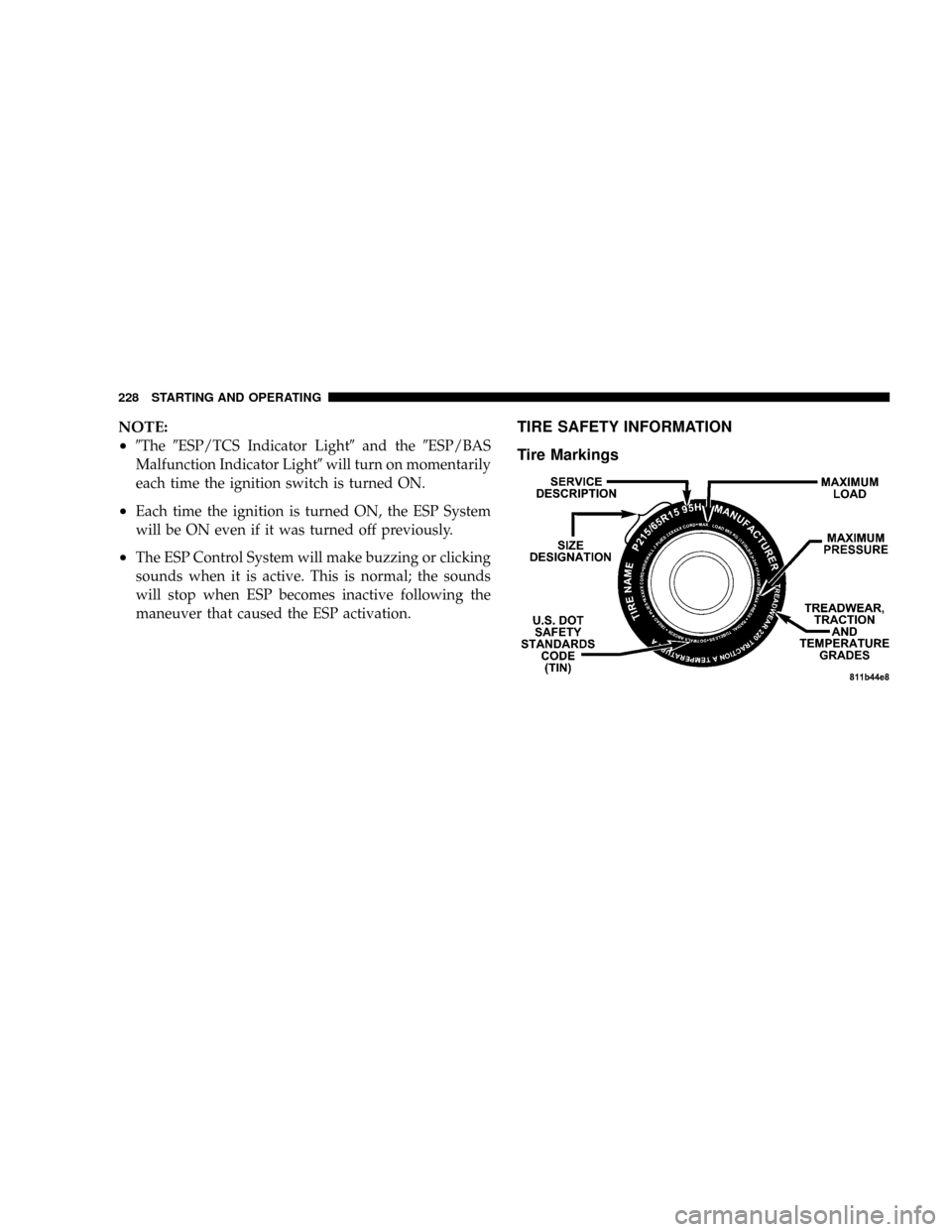
TIRE SAFETY INFORMATION
Tire Markings
228 STARTING AND OPERATING
Page 250 of 380
Base System Ð If Equipped
The Tire Pressure Monitor System (TPMS) uses wireless
technology with wheel rim mounted electronic sensors to
monitor tire pressure levels. Sensors, mounted to each
wheel as part of the valve stem, transmit tire pressure
readings to the Receiver Module.
NOTE:It is particularly important for you to check the
tire pressure in all of the tires on your vehicle regularly
and to maintain the proper pressure.
The TPMS consists of the following components:
²Receiver Module
²4 Tire Pressure Monitoring Sensors
²Tire Pressure Monitoring Telltale Light
Tire Pressure Monitoring Low Pressure Warnings
The Tire Pressure Monitoring Telltale Light will
illuminate in the instrument cluster and an audible
chime will sound when tire pressure is low in one
or more of the four active road tires. The audible chime
will sound once every ignition cycle for each condition
that it detects. Should this occur, you should stop as soonas possible, check the inflation pressure of each tire on
your vehicle, and inflate each tire to the vehicle's recom-
mended cold placard pressure value. Once the system
receives the updated tire pressures, the system will
automatically update and the Tire Pressure Monitoring
Telltale Light will turn off. The vehicle may need to be
driven for up to 10 minutes above 15 mph (25 km/h) in
order for the TPMS to receive this information. Low
pressure in the spare tire will not cause the Tire Pressure
Monitoring Telltale Light to illuminate or the chime to
sound.
NOTE:The compact spare tire (if so equipped) does not
have a tire pressure monitoring sensor. Therefore, the
TPMS will not monitor the pressure in the compact spare
tire. However, if you install the compact spare tire in
place of a road tire that has a pressure below the
low-pressure warning limit, the Tire Pressure Monitoring
Telltale Light will remain ON and a chime will still sound
each ignition key cycle. Once you repair or replace the
original road tire, and reinstall it on the vehicle in place of
the compact spare, the TPMS will update automatically
and the Tire Pressure Monitoring Telltale Light will turn
OFF, as long no tire pressure is below the low-pressure
STARTING AND OPERATING 249
5
Page 251 of 380
warning limit in any of the four active road tires. The
vehicle may need to be driven for up to 10 minutes above
15 mph (25 km/h) in order for the TPMS to receive this
information.
Check TPMS Warning
The Tire Pressure Monitoring Telltale Light will flash on
and off for 60 seconds and an audible chime will sound
when a system fault is detected. The flash cycle will
repeat every ten minutes, without an audible chime, until
the fault condition no longer exists. If the ignition key is
cycled, this sequence will repeat, providing the system
fault still exists.
Premium System Ð If Equipped
The Tire Pressure Monitor System (TPMS) uses wireless
technology with wheel rim mounted electronic sensors to
monitor tire pressure levels. Sensors, mounted to each
wheel as part of the valve stem, transmit tire pressure
readings to the Receiver Module.
NOTE:It is particularly important for you to check the
tire pressure in all of the tires on your vehicle regularly
and to maintain the proper pressure.The TPMS consists of the following components:
²Receiver Module
²4 Tire Pressure Monitoring Sensors
²3 Trigger Modules (mounted in three of the four
wheel-wells)
²Various Tire Pressure Monitoring System Messages,
which display in the Electronic Vehicle Information
Center (EVIC)
²Tire Pressure Monitoring Telltale Light
Tire Pressure Monitoring Low Pressure Warnings
The Tire Pressure Monitoring Telltale Light will
illuminate in the instrument cluster and an audible
chime will sound when tire pressure is low in one
or more of the four active road tires. The audible chime
will sound once every ignition cycle for each condition
that it detects. In addition, the Electronic Vehicle Infor-
mation Center (EVIC) will display one or more Low
Pressure messages (Left Front, Left Rear, Right Front,
Right Rear) for 3 seconds and a graphic showing the
pressure values of each tire with the low tire pressure
250 STARTING AND OPERATING
Page 253 of 380
of a road tire that has a pressure below the low-
pressure warning limit, the Tire Pressure Monitoring
Telltale Light will remain ON and a chime will still
sound each ignition key cycle. In addition, the EVIC
will still display a low-pressure message and a flash-
ing pressure value in the graphic display. Once you
repair or replace the original road tire, and reinstall it
on the vehicle in place of the compact spare, the TPMS
will update automatically. In addition, the Tire Pres-
sure Monitoring Telltale Light will turn OFF, and the
graphic in the EVIC will stop flashing and display a
new pressure value, as long no tire pressure is below
the low-pressure warning limit in any of the four
active road tires. The vehicle may need to be driven for
up to 10 minutes above 15 mph (25 km/h) in order for
the TPMS to receive this information.
Check TPMS Warning
The Tire Pressure Monitoring Telltale Light will flash on
and off for 60 seconds and an audible chime will sound
when a system fault is detected. The flash cycle will
repeat every ten minutes, without an audible chime, until
the fault condition no longer exists. In addition to the
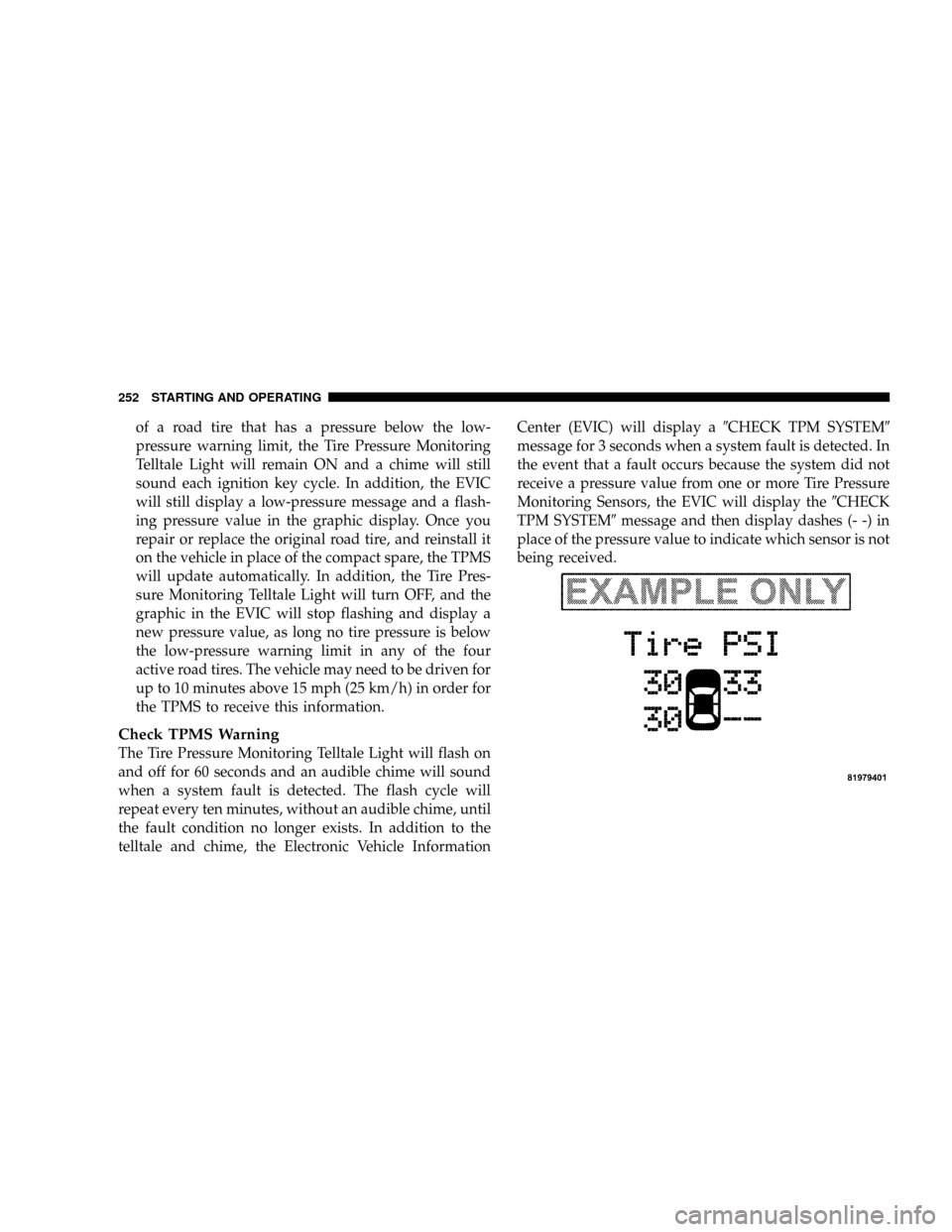
telltale and chime, the Electronic Vehicle InformationCenter (EVIC) will display a9CHECK TPM SYSTEM9
message for 3 seconds when a system fault is detected. In
the event that a fault occurs because the system did not
receive a pressure value from one or more Tire Pressure
Monitoring Sensors, the EVIC will display the9CHECK
TPM SYSTEM9message and then display dashes (- -) in
place of the pressure value to indicate which sensor is not
being received.
252 STARTING AND OPERATING
Page 254 of 380
NOTE:You can change the pressure units to display in
PSI, kPA, or BAR. Refer to ªLanguage,º under ªPersonal
Settings (Customer Programmable Features),º under
ªElectronic Vehicle Information Center (EVIC)º in Sec-
tion 4 of this manual for details.
If the ignition key is cycled, this sequence will repeat,
providing the system fault still exists. If the system fault
no longer exists, the Tire Pressure Monitoring Telltale
Light will no longer flash, and the9CHECK TPM SYS-
TEM9message will no longer display, and a pressure
value will display in place of the dashes.
General Information
This device complies with part 15 of the FCC rules and
RSS 210 of Industry Canada. Operation is subject to the
following conditions:
²This device may not cause harmful interference.
²This device must accept any interference received,
including interference that may cause undesired op-
eration.The tire pressure sensors are covered under one of the
following licenses:
United States.....................KR5S120123
Canada........................2671-S120123
FUEL REQUIREMENTS
6.1L Engine
The 6.1L engine is designed to meet all
emissions regulations and provide excel-
lent fuel economy and performance when
using high-quality premium unleaded
gasoline with an octane rating of 91 or
higher.
Light spark knock at low engine speeds is not harmful to
your engine. However, continued heavy spark knock at
high speeds can cause damage and immediate service is
required.
Poor quality gasoline can cause problems such as hard
starting, stalling, and hesitations. If you experience these
symptoms, try another brand of ªpremiumº gasoline
before considering service for the vehicle.
STARTING AND OPERATING 253
5
Page 256 of 380
MMT In Gasoline
MMT is a manganese containing metallic additive that is
blended into some gasoline to increase the octane num-
ber. Gasolines blended with MMT offer no performance
advantage beyond gasolines of the same octane number
without MMT. Gasolines blended with MMT have shown
to reduce spark plug life and reduce emission system
performance in some vehicles. The manufacturer recom-
mends using gasolines without MMT. Since the MMT
content of gasoline may not be indicated on the pump,
you should ask your gasoline retailer if his/her gasoline
contains MMT.
It is even more important to look for gasolines without
MMT in Canada, because MMT can be used at levels
higher than allowed in the United States. MMT is pro-
hibited in Federal and California reformulated gasolines.
Materials Added to Fuel
All gasoline sold in the United States is required to
contain effective detergent additives. Use of additional
detergents or other additives are not needed undernormal conditions and they would result in additional
cost. Therefore, you should not have to add anything to
the fuel.
Fuel System Cautions
CAUTION!
Follow these guidelines to maintain your vehicle's
performance:
²The use of leaded gas is prohibited by Federal law.
Using leaded gasoline can impair engine performance,
or damage the emission control system.
²An out-of-tune engine, or certain fuel or ignition
malfunctions, can cause the catalytic converter to
overheat. If you notice a pungent burning odor or
some light smoke, your engine may be out-of-tune or
malfunctioning and may require immediate service.
Contact your dealer for service assistance.
STARTING AND OPERATING 255
5
Page 276 of 380
WHAT TO DO IN EMERGENCIES
CONTENTS
mHazard Warning Flasher.................276
mIf Your Engine Overheats................276
mTIREFIT Tire Repair....................277
mJump-Starting Procedures................282
mFreeing A Stuck Vehicle.................285
mTowing A Disabled Vehicle...............286NWithout The Ignition Key...............286
NTowing This Vehicle Behind Another Vehicle
(Flat Towing With All Four Wheels On The
Ground)............................286
NTowing This Vehicle Behind Another Vehicle
With A Tow Dolly.....................287
6