torque DODGE NEON 1999 Service Repair Manual
[x] Cancel search | Manufacturer: DODGE, Model Year: 1999, Model line: NEON, Model: DODGE NEON 1999Pages: 1200, PDF Size: 35.29 MB
Page 612 of 1200
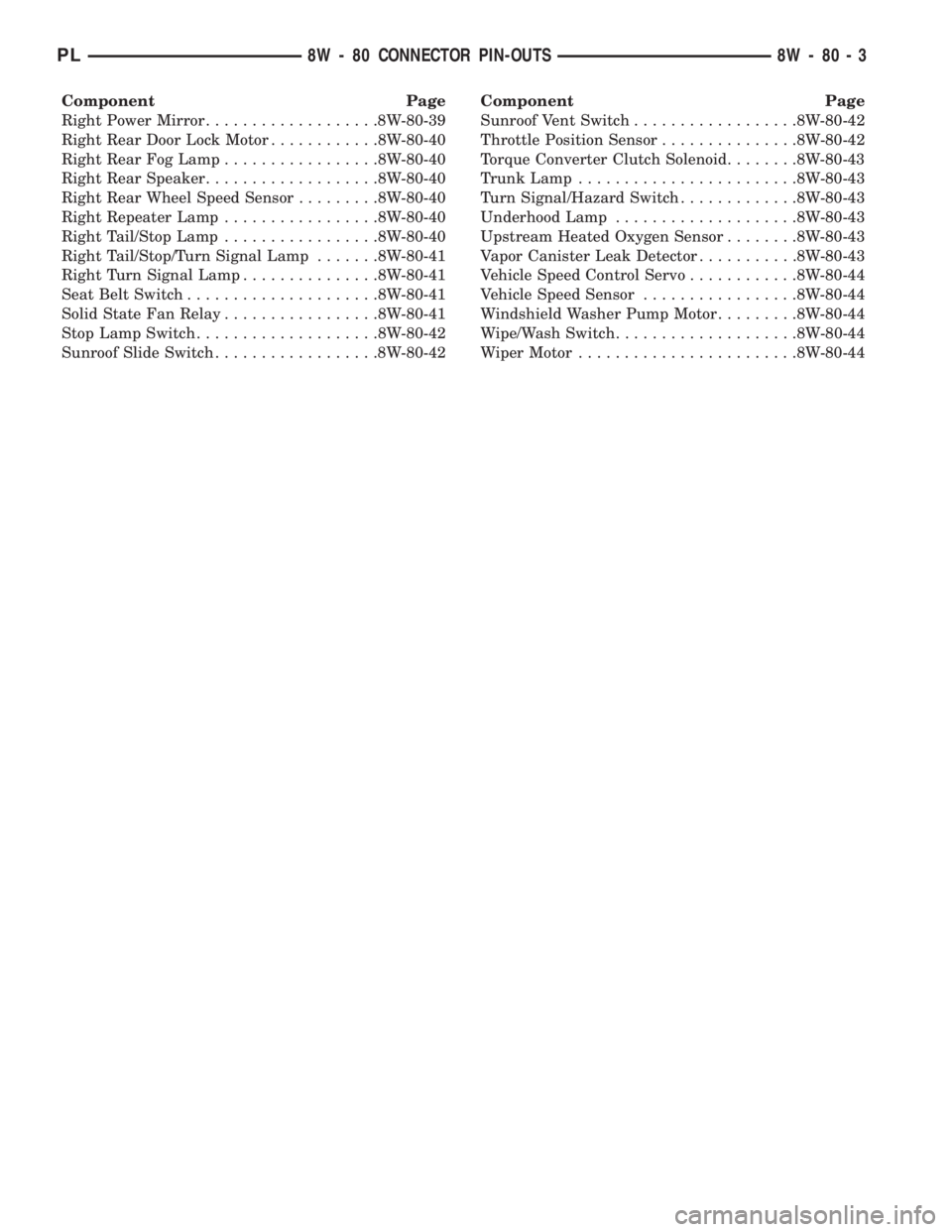
Component Page
Right Power Mirror...................8W-80-39
Right Rear Door Lock Motor............8W-80-40
Right Rear Fog Lamp.................8W-80-40
Right Rear Speaker...................8W-80-40
Right Rear Wheel Speed Sensor.........8W-80-40
Right Repeater Lamp.................8W-80-40
Right Tail/Stop Lamp.................8W-80-40
Right Tail/Stop/Turn Signal Lamp.......8W-80-41
Right Turn Signal Lamp...............8W-80-41
Seat Belt Switch.....................8W-80-41
Solid State Fan Relay.................8W-80-41
Stop Lamp Switch....................8W-80-42
Sunroof Slide Switch..................8W-80-42Component Page
Sunroof Vent Switch..................8W-80-42
Throttle Position Sensor...............8W-80-42
Torque Converter Clutch Solenoid........8W-80-43
Trunk Lamp........................8W-80-43
Turn Signal/Hazard Switch.............8W-80-43
Underhood Lamp....................8W-80-43
Upstream Heated Oxygen Sensor........8W-80-43
Vapor Canister Leak Detector...........8W-80-43
Vehicle Speed Control Servo............8W-80-44
Vehicle Speed Sensor.................8W-80-44
Windshield Washer Pump Motor.........8W-80-44
Wipe/Wash Switch....................8W-80-44
Wiper Motor........................8W-80-44
PL8W - 80 CONNECTOR PIN-OUTS 8W - 80 - 3
Page 642 of 1200

CAV CIRCUIT FUNCTION
1 Q42 18LB POWER SUNROOF CLOSE
2- -
3 Q41 18WT POWER SUNROOF OPEN
4 Q46 18OR POWER SUNROOF VENT OPEN/CLOSE LIMIT
5 Q43 18VT POWER SUNROOF VENT
6 Z8 18BK/VT GROUND
RED
3 2 14 5 6
CAV CIRCUIT FUNCTION
41 V37 20RD/LG* SPEED CONTROL SWITCH SIGNAL
42 - -
43 K4 20BK/LB SENSOR GROUND
44 K7 20OR 8 VOLT SUPPLY
45 K10 20WT POWER STEERING PRESSURE SWITCH SENSE
46 A14 18RD/WT FUSED B(+)
47 Z11 20BK/WT GROUND
48 K40 20BR/WT IDLE AIR CONTROL MOTOR NO. 3 DRIVER
49 K60 20YL/BK IDLE AIR CONTROL MOTOR NO. 2 DRIVER
50 Z12 20BK/TN GROUND
51 K141 20TN/WT DOWNSTREAM HEATED OXYGEN SENSOR SIGNAL
52 G31 18VT/LG AMBIENT TEMPERATURE SENSOR SIGNAL
53 - -
54 - -
55 - -
56 G12 20TN/BK GENERATOR LAMP DRIVER
57 K39 20GY/RD IDLE AIR CONTROL MOTOR NO. 1 DRIVER
58 K59 20VT IDLE AIR CONTROL MOTOR NO. 4 DRIVER
59 - -
60 - -
50 41
60 51
70 61
80 71BLACK
-
CONTROL SOLENOID VENT CONTROL SPEED 20LG/RD* V35 80CONTROL SOLENOID CLUTCH CONVERTOR TORQUE 20OR/BK** K54 79
- - 79
CONTROL SOLENOID VACUUM CONTROL SPEED 20TN/RD* V36 78
DRIVER SOLENOID CANISTER VAPOR 18WT/LG K106 77
SENSE SWITCH POSITION PARK/NEUTRAL 20BR/YL** T41 76
- - 76
RECEIVE SCI 20LG D20 75
CONTROL RELAY PUMP FUEL 18BR K31 74
SIGNAL TACHOMETER 20GY/LB G21 73
DRIVER SWITCH PUMP CANISTER VAPOR 18OR K107 72
- 71
- - 70
- - 69
CONTROL SOLENOID EVAP/PURGE CYCLE DUTY 20PK/BK K52 68
CONTROL RELAY DOWN SHUT AUTOMATIC 18DB/YL K51 67
SIGNAL SENSOR SPEED VEHICLE 20WT/OR G7 66
TRANSMIT SCI 20PK D21 65
CONTROL RELAY CLUTCH COMPRESSOR A/C 18DB/OR C28 64
- - 63
SENSE SWITCH LAMP STOP 20WT/PK K29 62
SUPPLY VOLT 5 20VT/WT K6 61
MODULE - C1CONTROL POWERTRAINMOTOR SUNROOFPOWER
* SPEED CONTROL
** ATX
EXCEPT BUILT-UP-EXPORT
2.0L
PL8W-80 CONNECTOR PIN-OUTS 8W - 80 - 33
PL008033J988W-1
Page 652 of 1200

CAV CIRCUIT FUNCTION
1M1 22PK FUSED B(+)M1 22PK FUSED B(+)
2 M4 22GY/BK TRUNK LAMP SWITCH OUTPUT
BLACK
CAV CIRCUIT FUNCTION
1 L60 22TN RIGHT TURN SIGNAL
2 L50 20WT/TN STOP LAMP SWITCH OUTPUT
3 L62 20BR/RD RIGHT REAR STOP/TURN SIGNAL LAMP OUTPUT
4 L32 20PK COMBINATION FLASHER OUTPUT
5 L5 20BK FUSED IGNITION SWITCH OUTPUT (RUN)
6 L9 22BK/WT FUSED B(+)
7- -
8- -
9 L63 20DG/RD LEFT REAR STOP/TURN SIGNAL LAMP OUTPUT
10 L61 22LG LEFT TURN SIGNAL
11 L55 20BK/YL COMBINATION FLASHER INPUT
BLACK
61
11 7
CAV CIRCUIT FUNCTION
1- -
2 F12 18DG/WT FUSED IGNITION SWITCH OUTPUT (ST-RUN)
3 K106 18WT/LG VAPOR CANISTER SOLENOID DRIVER
4 K107 18OR VAPOR CANISTER PUMP SWITCH DRIVER
BLACK
41
CAV CIRCUIT FUNCTION
1 A142 18DG/OR AUTOMATIC SHUT DOWN RELAY OUTPUT
2 Z1 18BK GROUND
3 K4 20BK/LB SENSOR GROUND
4 K41 20BK/DG UPSTREAM HEATED OXYGEN SENSOR SIGNAL
GRAY
2
4
1
3 1 2
CAV CIRCUIT FUNCTION
1- -
2 K54 20OR/BK TORQUE CONVERTOR CLUTCH SOLENOID CONTROL
3 F12 20DG/WT FUSED IGNITION SWITCH OUTPUT (ST-RUN)
BLACK
1
23
Z1 18BK
2 CAV
1CIRCUIT
GROUNDFUNCTION
M1 18PK FUSED B(+)
21
EXCEPT BUILT-UP-EXPORT
TORQUE CONVERTOR
CLUTCH (TCC) SOLENOID
(ATX)
TRUNK LAMP
TURN
SIGNAL/HAZARD
SWITCH
UNDERHOOD
LAMP
UPSTREAM HEATED
OXYGEN SENSOR
VAPOR CANISTER
LEAK DETECTOR
(EXCEPT BUILT-UP-EXPORT)
PL8W-80 CONNECTOR PIN-OUTS 8W - 80 - 43
PL008043J988W-1
Page 657 of 1200
Connector
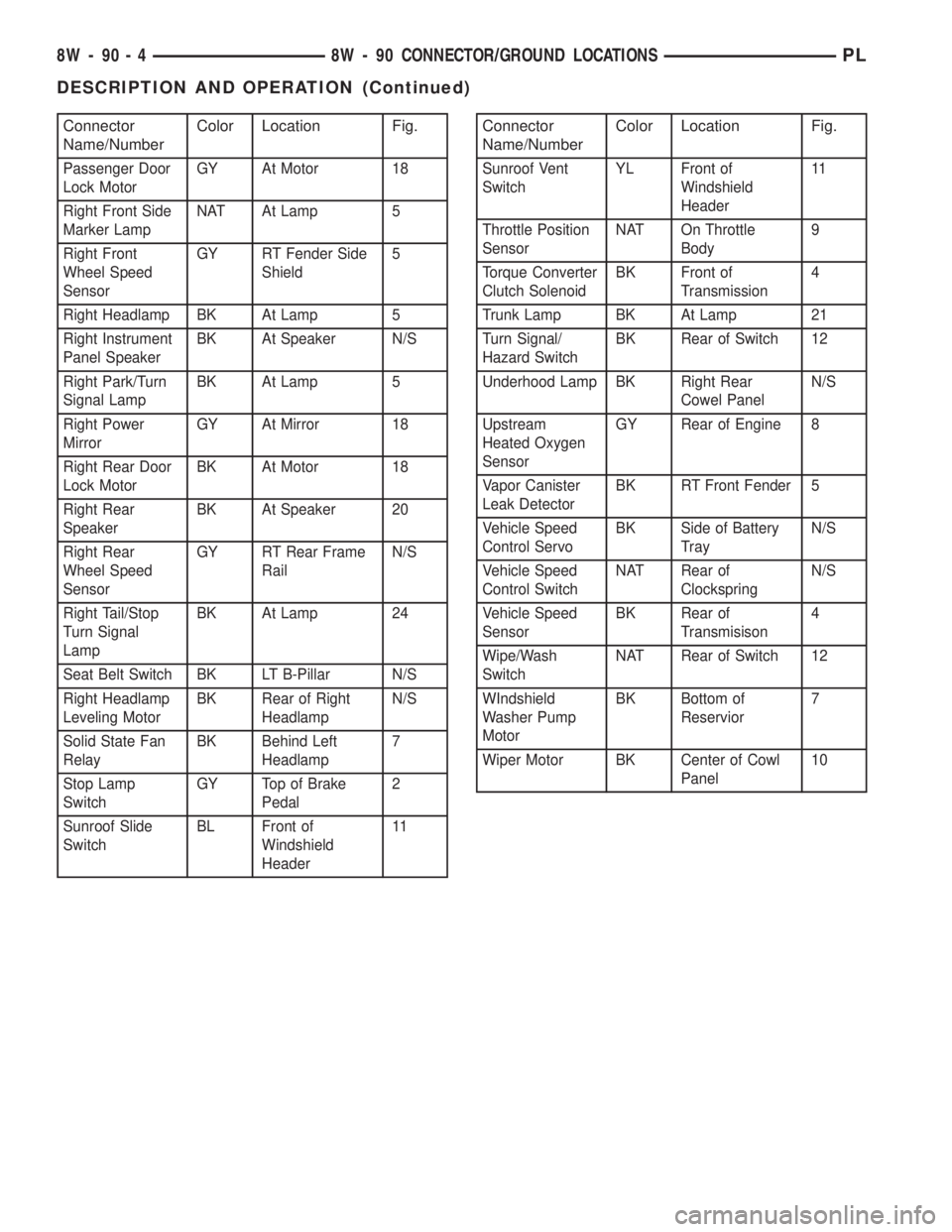
Name/NumberColor Location Fig.
Passenger Door
Lock MotorGY At Motor 18
Right Front Side
Marker LampNAT At Lamp 5
Right Front
Wheel Speed
SensorGY RT Fender Side
Shield5
Right Headlamp BK At Lamp 5
Right Instrument
Panel SpeakerBK At Speaker N/S
Right Park/Turn
Signal LampBK At Lamp 5
Right Power
MirrorGY At Mirror 18
Right Rear Door
Lock MotorBK At Motor 18
Right Rear
SpeakerBK At Speaker 20
Right Rear
Wheel Speed
SensorGY RT Rear Frame
RailN/S
Right Tail/Stop
Turn Signal
LampBK At Lamp 24
Seat Belt Switch BK LT B-Pillar N/S
Right Headlamp
Leveling MotorBK Rear of Right
HeadlampN/S
Solid State Fan
RelayBK Behind Left
Headlamp7
Stop Lamp
SwitchGY Top of Brake
Pedal2
Sunroof Slide
SwitchBL Front of
Windshield
Header11
Connector
Name/NumberColor Location Fig.
Sunroof Vent
SwitchYL Front of
Windshield
Header11
Throttle Position
SensorNAT On Throttle
Body9
Torque Converter
Clutch SolenoidBK Front of
Transmission4
Trunk Lamp BK At Lamp 21
Turn Signal/
Hazard SwitchBK Rear of Switch 12
Underhood Lamp BK Right Rear
Cowel PanelN/S
Upstream
Heated Oxygen
SensorGY Rear of Engine 8
Vapor Canister
Leak DetectorBK RT Front Fender 5
Vehicle Speed
Control ServoBK Side of Battery
TrayN/S
Vehicle Speed
Control SwitchNAT Rear of
ClockspringN/S
Vehicle Speed
SensorBK Rear of
Transmisison4
Wipe/Wash
SwitchNAT Rear of Switch 12
WIndshield
Washer Pump
MotorBK Bottom of
Reservior7
Wiper Motor BK Center of Cowl
Panel10
8W - 90 - 4 8W - 90 CONNECTOR/GROUND LOCATIONSPL
DESCRIPTION AND OPERATION (Continued)
Page 679 of 1200
Connector
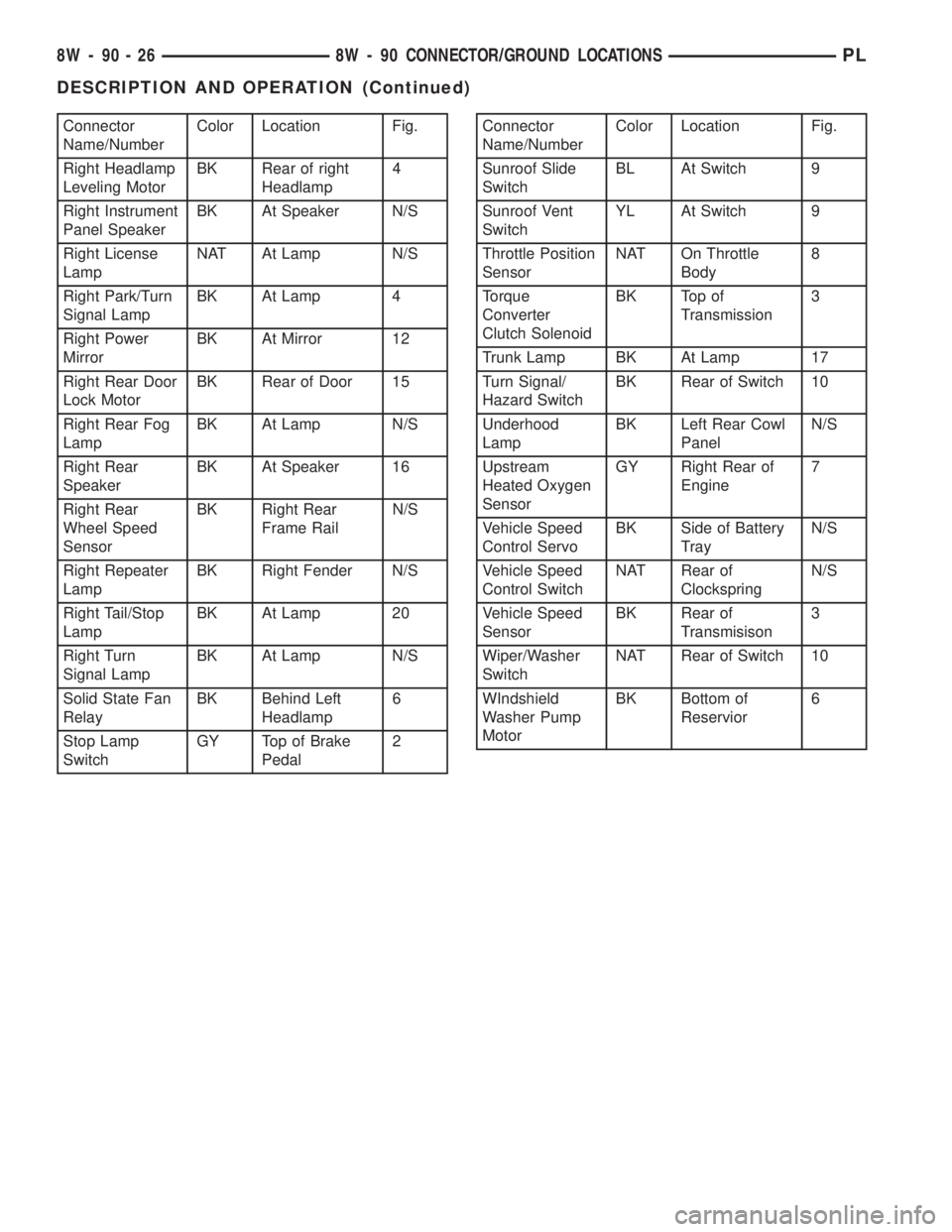
Name/NumberColor Location Fig.
Right Headlamp
Leveling MotorBK Rear of right
Headlamp4
Right Instrument
Panel SpeakerBK At Speaker N/S
Right License
LampNAT At Lamp N/S
Right Park/Turn
Signal LampBK At Lamp 4
Right Power
MirrorBK At Mirror 12
Right Rear Door
Lock MotorBK Rear of Door 15
Right Rear Fog
LampBK At Lamp N/S
Right Rear
SpeakerBK At Speaker 16
Right Rear
Wheel Speed
SensorBK Right Rear
Frame RailN/S
Right Repeater
LampBK Right Fender N/S
Right Tail/Stop
LampBK At Lamp 20
Right Turn
Signal LampBK At Lamp N/S
Solid State Fan
RelayBK Behind Left
Headlamp6
Stop Lamp
SwitchGY Top of Brake
Pedal2Connector
Name/NumberColor Location Fig.
Sunroof Slide
SwitchBL At Switch 9
Sunroof Vent
SwitchYL At Switch 9
Throttle Position
SensorNAT On Throttle
Body8
Torque
Converter
Clutch SolenoidBK Top of
Transmission3
Trunk Lamp BK At Lamp 17
Turn Signal/
Hazard SwitchBK Rear of Switch 10
Underhood
LampBK Left Rear Cowl
PanelN/S
Upstream
Heated Oxygen
SensorGY Right Rear of
Engine7
Vehicle Speed
Control ServoBK Side of Battery
TrayN/S
Vehicle Speed
Control SwitchNAT Rear of
ClockspringN/S
Vehicle Speed
SensorBK Rear of
Transmisison3
Wiper/Washer
SwitchNAT Rear of Switch 10
WIndshield
Washer Pump
MotorBK Bottom of
Reservior6
8W - 90 - 26 8W - 90 CONNECTOR/GROUND LOCATIONSPL
DESCRIPTION AND OPERATION (Continued)
Page 714 of 1200
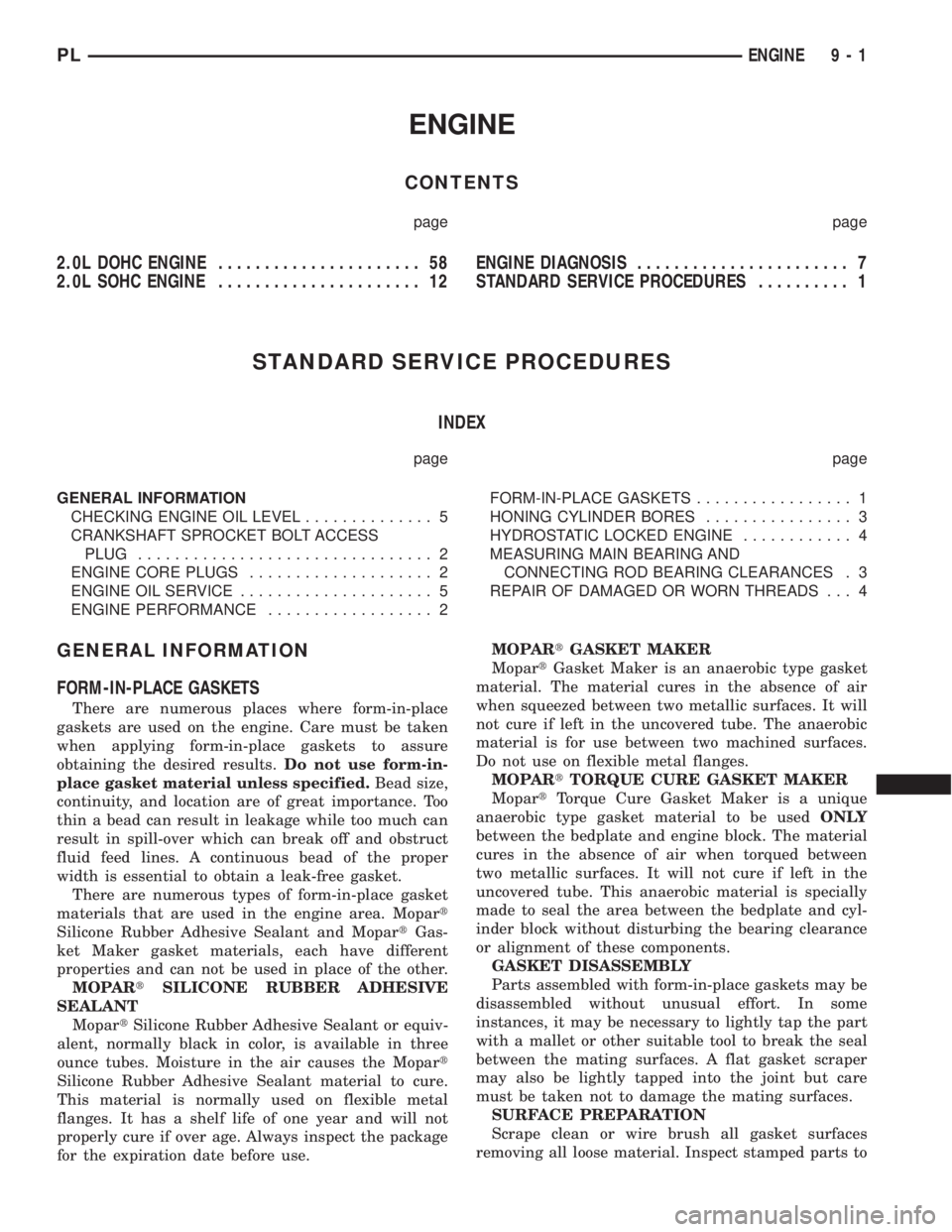
ENGINE
CONTENTS
page page
2.0L DOHC ENGINE...................... 58
2.0L SOHC ENGINE...................... 12ENGINE DIAGNOSIS....................... 7
STANDARD SERVICE PROCEDURES.......... 1
STANDARD SERVICE PROCEDURES
INDEX
page page
GENERAL INFORMATION
CHECKING ENGINE OIL LEVEL.............. 5
CRANKSHAFT SPROCKET BOLT ACCESS
PLUG................................ 2
ENGINE CORE PLUGS.................... 2
ENGINE OIL SERVICE..................... 5
ENGINE PERFORMANCE.................. 2FORM-IN-PLACE GASKETS................. 1
HONING CYLINDER BORES................ 3
HYDROSTATIC LOCKED ENGINE............ 4
MEASURING MAIN BEARING AND
CONNECTING ROD BEARING CLEARANCES . 3
REPAIR OF DAMAGED OR WORN THREADS . . . 4
GENERAL INFORMATION
FORM-IN-PLACE GASKETS
There are numerous places where form-in-place
gaskets are used on the engine. Care must be taken
when applying form-in-place gaskets to assure
obtaining the desired results.Do not use form-in-
place gasket material unless specified.Bead size,
continuity, and location are of great importance. Too
thin a bead can result in leakage while too much can
result in spill-over which can break off and obstruct
fluid feed lines. A continuous bead of the proper
width is essential to obtain a leak-free gasket.
There are numerous types of form-in-place gasket
materials that are used in the engine area. Mopart
Silicone Rubber Adhesive Sealant and MopartGas-
ket Maker gasket materials, each have different
properties and can not be used in place of the other.
MOPARtSILICONE RUBBER ADHESIVE
SEALANT
MopartSilicone Rubber Adhesive Sealant or equiv-
alent, normally black in color, is available in three
ounce tubes. Moisture in the air causes the Mopart
Silicone Rubber Adhesive Sealant material to cure.
This material is normally used on flexible metal
flanges. It has a shelf life of one year and will not
properly cure if over age. Always inspect the package
for the expiration date before use.MOPARtGASKET MAKER
MopartGasket Maker is an anaerobic type gasket
material. The material cures in the absence of air
when squeezed between two metallic surfaces. It will
not cure if left in the uncovered tube. The anaerobic
material is for use between two machined surfaces.
Do not use on flexible metal flanges.
MOPARtTORQUE CURE GASKET MAKER
MopartTorque Cure Gasket Maker is a unique
anaerobic type gasket material to be usedONLY
between the bedplate and engine block. The material
cures in the absence of air when torqued between
two metallic surfaces. It will not cure if left in the
uncovered tube. This anaerobic material is specially
made to seal the area between the bedplate and cyl-
inder block without disturbing the bearing clearance
or alignment of these components.
GASKET DISASSEMBLY
Parts assembled with form-in-place gaskets may be
disassembled without unusual effort. In some
instances, it may be necessary to lightly tap the part
with a mallet or other suitable tool to break the seal
between the mating surfaces. A flat gasket scraper
may also be lightly tapped into the joint but care
must be taken not to damage the mating surfaces.
SURFACE PREPARATION
Scrape clean or wire brush all gasket surfaces
removing all loose material. Inspect stamped parts to
PLENGINE 9 - 1
Page 715 of 1200
assure gasket rails are flat. Flatten rails with a ham-
mer on a heavy steel plate if required. Gasket sur-
faces must be free of oil and dirt. Make sure old
gasket material is removed from blind attaching
holes.
FORM-IN-PLACE GASKET APPLICATION
Assembling parts using a form-in-place gasket
requires care but it's easier then using precut gas-
kets.
MopartGasket Maker material should be applied
sparingly 1 mm (0.040 inch.) diameter or less of seal-
ant to one gasket surface. Be certain the material
surrounds each mounting hole. Excess material can
easily be wiped off. Components should be torqued in
place within 15 minutes. The use of a locating dowel
is recommended during assembly to prevent smear-
ing material off the location.
The MopartSilicone Rubber Adhesive Sealant gas-
ket material or equivalent should be applied in a con-
tinuous bead approximately 3 mm (0.120 inch) in
diameter. All mounting holes must be circled. For
corner sealing, a 3.17 or 6.35 mm (1/8 or 1/4 inch.)
drop is placed in the center of the gasket contact
area. Uncured sealant may be removed with a shop
towel. Components should be torqued in place while
the sealant is still wet to the touch (within 10 min-
utes). The usage of a locating dowel is recommended
during assembly to prevent smearing material off the
location.
CRANKSHAFT SPROCKET BOLT ACCESS PLUG
An Access plug is located in the right inner fender
shield. Remove the plug and insert the proper size
socket, extension and ratchet, when crankshaft rota-
tion is necessary.
ENGINE CORE PLUGS
REMOVAL
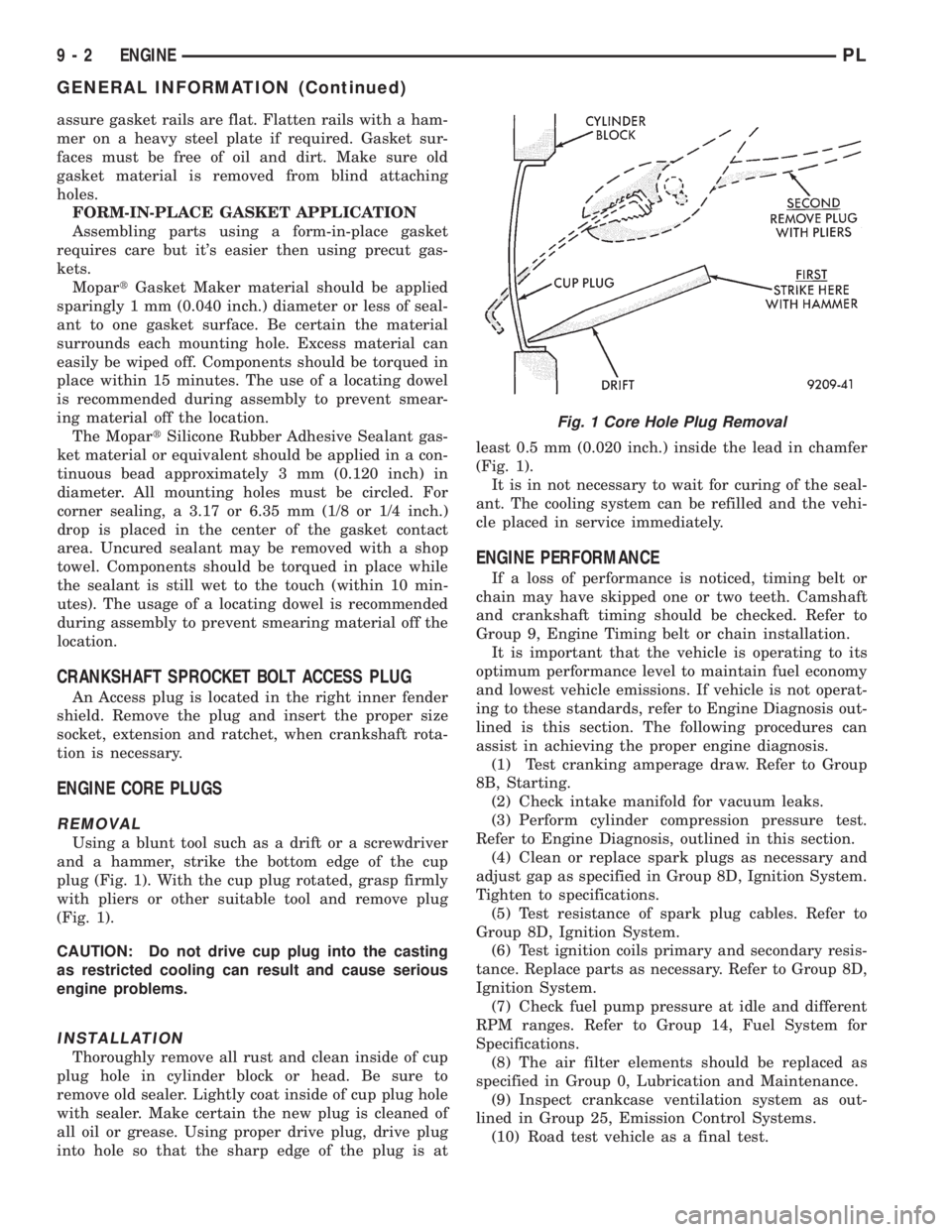
Using a blunt tool such as a drift or a screwdriver
and a hammer, strike the bottom edge of the cup
plug (Fig. 1). With the cup plug rotated, grasp firmly
with pliers or other suitable tool and remove plug
(Fig. 1).
CAUTION: Do not drive cup plug into the casting
as restricted cooling can result and cause serious
engine problems.
INSTALLATION
Thoroughly remove all rust and clean inside of cup
plug hole in cylinder block or head. Be sure to
remove old sealer. Lightly coat inside of cup plug hole
with sealer. Make certain the new plug is cleaned of
all oil or grease. Using proper drive plug, drive plug
into hole so that the sharp edge of the plug is atleast 0.5 mm (0.020 inch.) inside the lead in chamfer
(Fig. 1).
It is in not necessary to wait for curing of the seal-
ant. The cooling system can be refilled and the vehi-
cle placed in service immediately.
ENGINE PERFORMANCE
If a loss of performance is noticed, timing belt or
chain may have skipped one or two teeth. Camshaft
and crankshaft timing should be checked. Refer to
Group 9, Engine Timing belt or chain installation.
It is important that the vehicle is operating to its
optimum performance level to maintain fuel economy
and lowest vehicle emissions. If vehicle is not operat-
ing to these standards, refer to Engine Diagnosis out-
lined is this section. The following procedures can
assist in achieving the proper engine diagnosis.
(1) Test cranking amperage draw. Refer to Group
8B, Starting.
(2) Check intake manifold for vacuum leaks.
(3) Perform cylinder compression pressure test.
Refer to Engine Diagnosis, outlined in this section.
(4) Clean or replace spark plugs as necessary and
adjust gap as specified in Group 8D, Ignition System.
Tighten to specifications.
(5) Test resistance of spark plug cables. Refer to
Group 8D, Ignition System.
(6) Test ignition coils primary and secondary resis-
tance. Replace parts as necessary. Refer to Group 8D,
Ignition System.
(7) Check fuel pump pressure at idle and different
RPM ranges. Refer to Group 14, Fuel System for
Specifications.
(8) The air filter elements should be replaced as
specified in Group 0, Lubrication and Maintenance.
(9) Inspect crankcase ventilation system as out-
lined in Group 25, Emission Control Systems.
(10) Road test vehicle as a final test.
Fig. 1 Core Hole Plug Removal
9 - 2 ENGINEPL
GENERAL INFORMATION (Continued)
Page 717 of 1200
²When checking #3 main bearing shim #2 & #4
main bearing.
²When checking #4 main bearing shim #3 main
bearing.
NOTE: REMOVE ALL SHIMS BEFORE REASSEM-
BLING ENGINE
ALTERNATIVE METHOD
The weight of the crankshaft can be supported by a
jack under the counterweight adjacent to the bearing
being checked.
PLASTIGAGE PROCEDURE
(1) Remove oil film from surface to be checked.
Plastigage is soluble in oil.
(2) Place a piece of Plastigage across the entire
width of the bearing shell in the cap approximately
6.35 mm (1/4 in.) off center and away from the oil
holes (Fig. 3). (In addition, suspected areas can be
checked by placing the Plastigage in the suspected
area). Torque the bearing cap bolts of the bearing
being checked to the proper specifications.
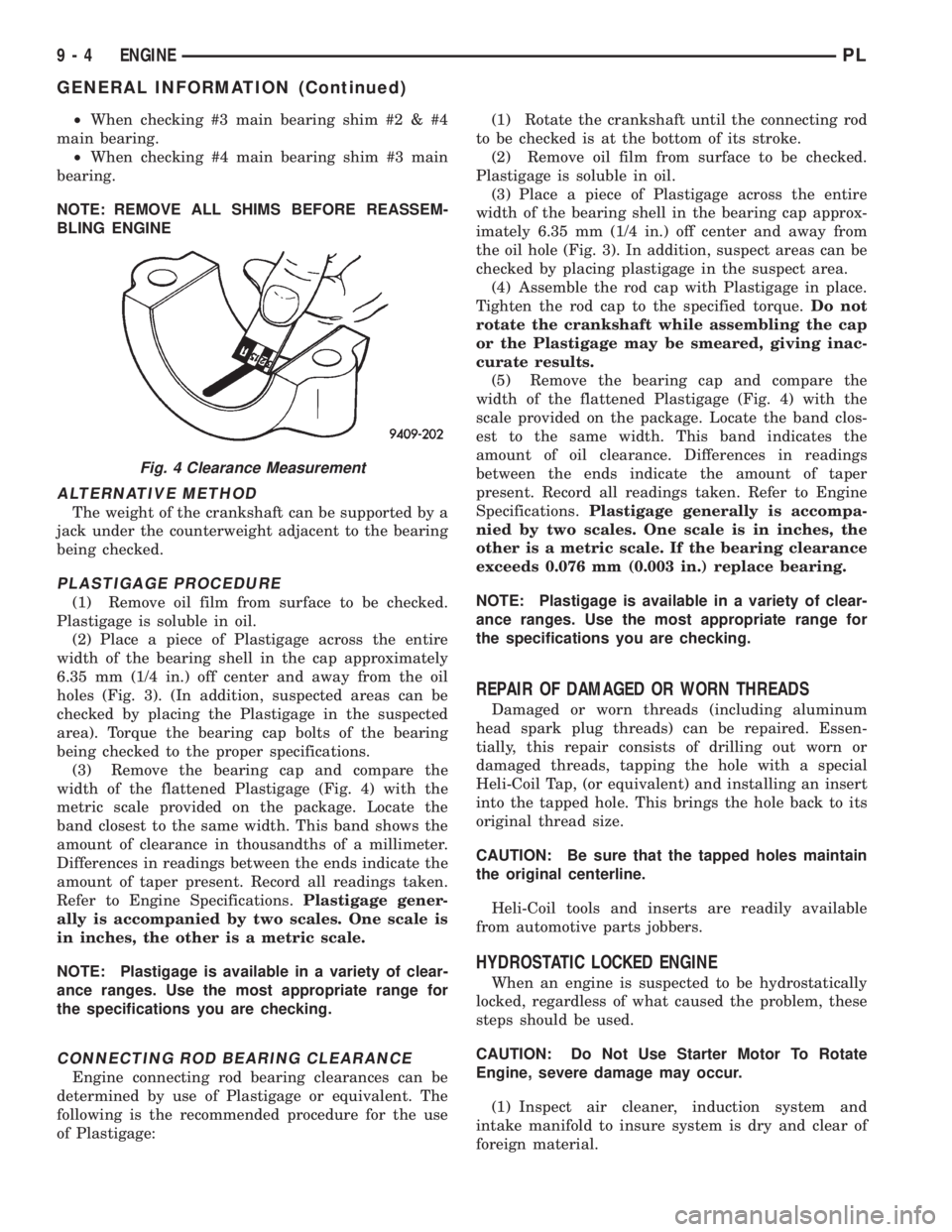
(3) Remove the bearing cap and compare the
width of the flattened Plastigage (Fig. 4) with the
metric scale provided on the package. Locate the
band closest to the same width. This band shows the
amount of clearance in thousandths of a millimeter.
Differences in readings between the ends indicate the
amount of taper present. Record all readings taken.
Refer to Engine Specifications.Plastigage gener-
ally is accompanied by two scales. One scale is
in inches, the other is a metric scale.
NOTE: Plastigage is available in a variety of clear-
ance ranges. Use the most appropriate range for
the specifications you are checking.
CONNECTING ROD BEARING CLEARANCE
Engine connecting rod bearing clearances can be
determined by use of Plastigage or equivalent. The
following is the recommended procedure for the use
of Plastigage:(1) Rotate the crankshaft until the connecting rod
to be checked is at the bottom of its stroke.
(2) Remove oil film from surface to be checked.
Plastigage is soluble in oil.
(3) Place a piece of Plastigage across the entire
width of the bearing shell in the bearing cap approx-
imately 6.35 mm (1/4 in.) off center and away from
the oil hole (Fig. 3). In addition, suspect areas can be
checked by placing plastigage in the suspect area.
(4) Assemble the rod cap with Plastigage in place.
Tighten the rod cap to the specified torque.Do not
rotate the crankshaft while assembling the cap
or the Plastigage may be smeared, giving inac-
curate results.
(5) Remove the bearing cap and compare the
width of the flattened Plastigage (Fig. 4) with the
scale provided on the package. Locate the band clos-
est to the same width. This band indicates the
amount of oil clearance. Differences in readings
between the ends indicate the amount of taper
present. Record all readings taken. Refer to Engine
Specifications.Plastigage generally is accompa-
nied by two scales. One scale is in inches, the
other is a metric scale. If the bearing clearance
exceeds 0.076 mm (0.003 in.) replace bearing.
NOTE: Plastigage is available in a variety of clear-
ance ranges. Use the most appropriate range for
the specifications you are checking.
REPAIR OF DAMAGED OR WORN THREADS
Damaged or worn threads (including aluminum
head spark plug threads) can be repaired. Essen-
tially, this repair consists of drilling out worn or
damaged threads, tapping the hole with a special
Heli-Coil Tap, (or equivalent) and installing an insert
into the tapped hole. This brings the hole back to its
original thread size.
CAUTION: Be sure that the tapped holes maintain
the original centerline.
Heli-Coil tools and inserts are readily available
from automotive parts jobbers.
HYDROSTATIC LOCKED ENGINE
When an engine is suspected to be hydrostatically
locked, regardless of what caused the problem, these
steps should be used.
CAUTION: Do Not Use Starter Motor To Rotate
Engine, severe damage may occur.
(1) Inspect air cleaner, induction system and
intake manifold to insure system is dry and clear of
foreign material.
Fig. 4 Clearance Measurement
9 - 4 ENGINEPL
GENERAL INFORMATION (Continued)
Page 722 of 1200
(3) Using a black light, inspect the entire engine
for fluorescent dye, particularly at the suspected area
of oil leak. If the oil leak is found and identified,
repair per service manual instructions.
(4) If dye is not observed, drive the vehicle at var-
ious speeds for approximately 24km (15 miles), and
repeat inspection.
(5)If the oil leak source is not positively
identified at this time, proceed with the air leak
detection test method as follows:
(6) Disconnect the fresh air hose (makeup air) at
the cylinder head cover and plug or cap the nipple on
the cover.
(7) Remove the PCV valve hose from the cylinder
head cover. Cap or plug the PCV valve nipple on the
cover.
(8) Attach an air hose with pressure gauge and
regulator to the dipstick tube.
CAUTION: Do not subject the engine assembly to
more than 20.6 kpa (3 PSI) of test pressure.
(9) Gradually apply air pressure from 1 psi to 2.5
psi maximum while applying soapy water at the sus-
pected source. Adjust the regulator to the suitable
test pressure that provide the best bubbles which
will pinpoint the leak source. If the oil leak is
detected and identified, repair per service manual
procedures.
(10) If the leakage occurs at the rear oil seal area,
refer to the section, Inspection for Rear Seal Area
Leak.
(11) If no leaks are detected, turn off the air sup-
ply and remove the air hose and all plugs and caps.
Install the PCV valve and breather cap hose. Proceed
to next step.
(12) Clean the oil off the suspect oil leak area
using a suitable solvent. Drive the vehicle at various
speeds approximately 24 km (15 miles). Inspect the
engine for signs of an oil leak by using a black light.
INSPECTION FOR REAR SEAL AREA LEAKS
Since it is sometimes difficult to determine the
source of an oil leak in the rear seal area of the
engine, a more involved inspection is necessary. Thefollowing steps should be followed to help pinpoint
the source of the leak.
If the leakage occurs at the crankshaft rear oil seal
area:
(1) Disconnect the battery.
(2) Raise the vehicle.
(3) Remove torque converter or clutch housing
cover and inspect rear of block for evidence of oil.
Use a black light to check for the oil leak. If a leak is
present in this area remove transmission for further
inspection.
(a) Circular spray pattern generally indicates
seal leakage or crankshaft damage.
(b) Where leakage tends to run straight down,
possible causes are a porous block, oil galley cup
plug, bedplate to cylinder block mating surfaces
and seal bore. See proper repair procedures for
these items.
(4) If no leaks are detected, pressurized the crank-
case as outlined in the, Inspection (Engine oil Leaks
in general)
CAUTION: Do not exceed 20.6 kPa (3 psi).
(5) If the leak is not detected, very slowly turn the
crankshaft and watch for leakage. If a leak is
detected between the crankshaft and seal while
slowly turning the crankshaft, it is possible the
crankshaft seal surface is damaged. The seal area on
the crankshaft could have minor nicks or scratches
that can be polished out with emery cloth.
CAUTION: Use extreme caution when crankshaft
polishing is necessary to remove minor nicks and
scratches. The crankshaft seal flange is especially
machined to complement the function of the rear oil
seal.
(6) For bubbles that remain steady with shaft
rotation, no further inspection can be done until dis-
assembled.
(7) After the oil leak root cause and appropriate
corrective action have been identified. Refer to Rear
Crankshaft Seals, for proper replacement procedures.
PLENGINE 9 - 9
DIAGNOSIS AND TESTING (Continued)
Page 724 of 1200
ENGINE DIAGNOSISÐMECHANICAL
CONDITION POSSIBLE CAUSES CORRECTION
NOISY VALVES 1. High or low oil level in crankcase. 1. Check for correct oil level.
2. Thin or diluted oil. 2. Change oil to correct viscosity.
3. Low oil pressure. 3. Check engine oil level.
4. Dirt in tappets/lash adjusters. 4. Replace rocker arm/hydraulic lash adjuster
assembly.
5. Worn rocker arms. 5. Inspect oil supply to rocker arms.
6. Worn tappets/lash adjusters. 6. Install new rocker arm/hydraulic lash adjuster
assembly.
7. Worn valve guides. 7. Ream and install new valves with oversize
stems.
8. Excessive runout of valve seats on valve faces. 8. Grind valve seats and valves.
9. Missing adjuster pivot. 9. Replace rocker arm/hydraulic lash adjuster
assembly.
CONNECTING ROD
NOISE1. Insuffient oil supply. 1. Check engine oil level.
2. Low oil pressure. 2. Check engine oil level. Inspect oil pump relief
valve and spring.
3. Thin or diluted oil. 3. Change oil to correct viscosity.
4. Excessive bearing clearance. 4. Measure bearings for correct clearance. Repair
as necessary.
5. Connecting rod journal out-of-round. 5. Replace crankshaft or grind surface.
6. Misaligned connecting rods. 6. Replace bent connecting rods.
MAIN BEARING NOISE 1. Insufficient oil supply. 1. Check engine oil level.
2. Low oil pressure. 2. Check engine oil level. Inspect oil pump relief
valve and spring.
3. Thin or diluted oil. 3. Change oil to correct viscosity.
4. Excessive bearing clearance. 4. Measure bearings for correct clearance. Repair
as necessary.
5. Excessive end play. 5. Check thrust bearing for wear on flanges.
6. Crankshaft journal out-of-round or worn. 6. Replace crankshaft or grind journals.
7. Loose flywheel or torque converter. 7. Tighten to correct torque.
OIL PRESSURE DROP 1. Low oil level. 1. Check engine oil level.
2. Faulty oil pressure sending unit. 2. Install new sending unit.
3. Low oil pressure. 3. Check sending unit and main bearing oil
clearance.
4. Clogged oil filter. 4. Install new oil filter.
5. Worn parts in oil pump. 5. Replace worn parts or pump.
6. Thin or diluted oil. 6. Change oil to correct viscosity.
7. Excessive bearing clearance. 7. Measure bearings for correct clearance.
8. Oil pump relief valve stuck. 8. Remove valve and inspect, clean, or replace.
9. Oil pump suction tube loose. 9. Remove oil pan and install new tube or clean, if
necessary.
10. Oil pump cover warped or cracked. 10. Install new oil pump.
OIL LEAKS 1. Misaligned or deteriorated gaskets. 1. Replace gasket(s).
2. Loose fastener, broken or porous metal part. 2. Tighten, repair or replace the part.
3. Misaligned or deteriorated cup or threaded plug. 3. Replace as necessary.
OIL CONSUMPTION
OR SPARK PLUGS
FOULED1. PCV system malfunction. 1. Check system and repair as necessary. Refer to
Group 25, Emission Control Systems.
2. Worn, scuffed or broken rings. 2. Hone cyinder bores. Install new rings.
3. Carbon in oil ring slots. 3. Install new rings.
4. Rings fitted too tightly in grooves. 4. Remove rings and check grooves. If groove is
not proper width, replace piston.
5. Worn valve guides. 5. Ream guides and replace valves with oversize
valves and seals.
6. Valve stem seal unseated or faulty. 6. Repair or replace seal.
PLENGINE 9 - 11
DIAGNOSIS AND TESTING (Continued)