torque DODGE NEON 1999 Service Repair Manual
[x] Cancel search | Manufacturer: DODGE, Model Year: 1999, Model line: NEON, Model: DODGE NEON 1999Pages: 1200, PDF Size: 35.29 MB
Page 816 of 1200
EXHAUST SYSTEM AND INTAKE MANIFOLD
CONTENTS
page page
GENERAL INFORMATION
CATALYTIC CONVERTER................... 4
EXHAUST BALL JOINT COUPLING.......... 1
EXHAUST FLEX-JOINT COUPLING (LEV)...... 2
EXHAUST GAS RECIRCULATION (EGR)
SYSTEM.............................. 3
EXHAUST SYSTEMS...................... 1
HEAT SHIELDS.......................... 3
DESCRIPTION AND OPERATION
EXHAUST MANIFOLD..................... 3
INTAKE MANIFOLD DOHC................. 3
INTAKE MANIFOLD SOHC................. 3
DIAGNOSIS AND TESTING
EXHAUST SYSTEM DIAGNOSIS CHART...... 4REMOVAL AND INSTALLATION
EXHAUST MANIFOLD.................... 11
EXHAUST PIPE AND MUFFLER............. 4
INTAKE MANIFOLDÐDOHC ENGINE......... 9
INTAKE MANIFOLDÐSOHC ENGINE......... 6
CLEANING AND INSPECTION
EXHAUST MANIFOLD.................... 12
INTAKE MANIFOLD DOHC................ 12
INTAKE MANIFOLD SOHC................ 12
SPECIFICATIONS
TORQUE CHART........................ 12
GENERAL INFORMATION
EXHAUST SYSTEMS
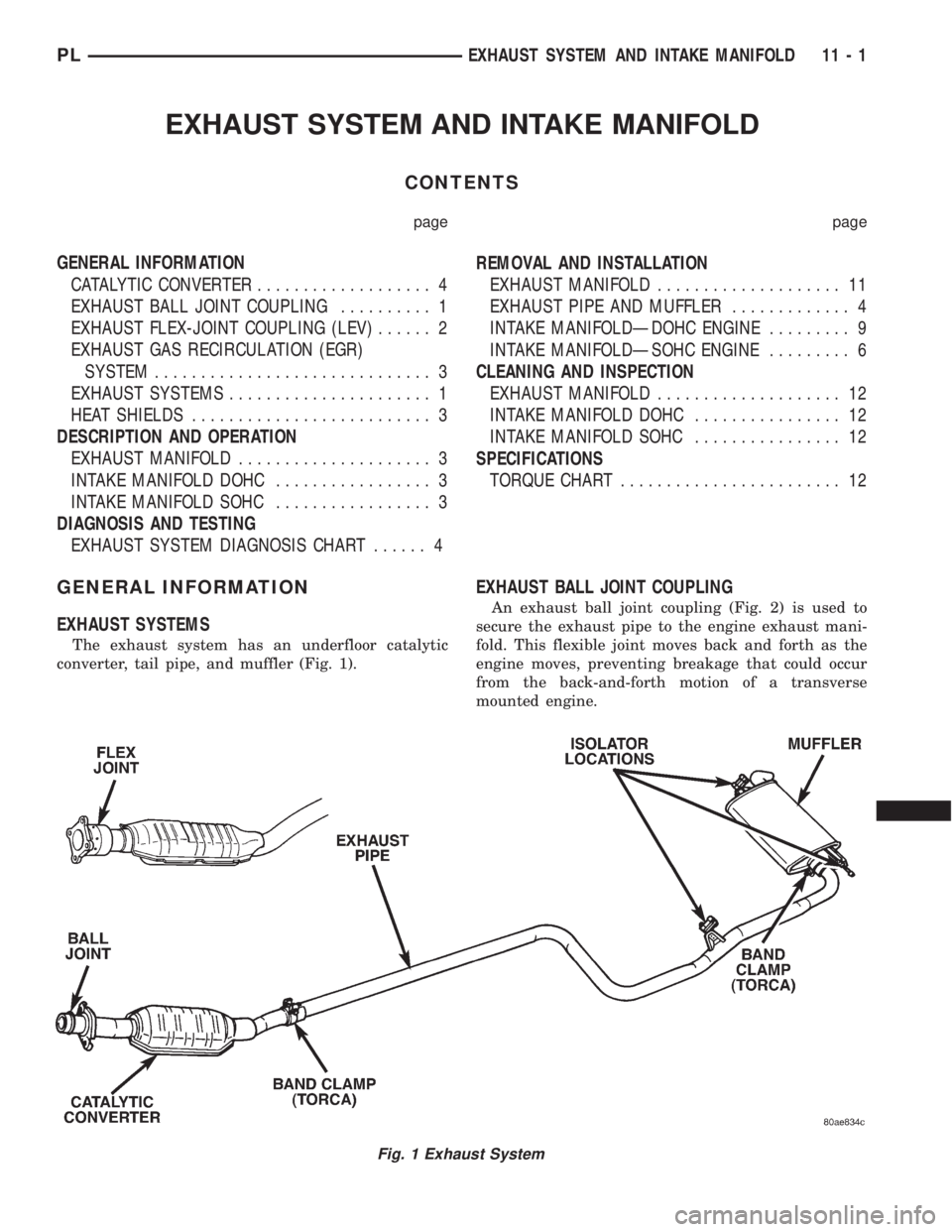
The exhaust system has an underfloor catalytic
converter, tail pipe, and muffler (Fig. 1).
EXHAUST BALL JOINT COUPLING
An exhaust ball joint coupling (Fig. 2) is used to
secure the exhaust pipe to the engine exhaust mani-
fold. This flexible joint moves back and forth as the
engine moves, preventing breakage that could occur
from the back-and-forth motion of a transverse
mounted engine.
Fig. 1 Exhaust System
PLEXHAUST SYSTEM AND INTAKE MANIFOLD 11 - 1
Page 818 of 1200
HEAT SHIELDS
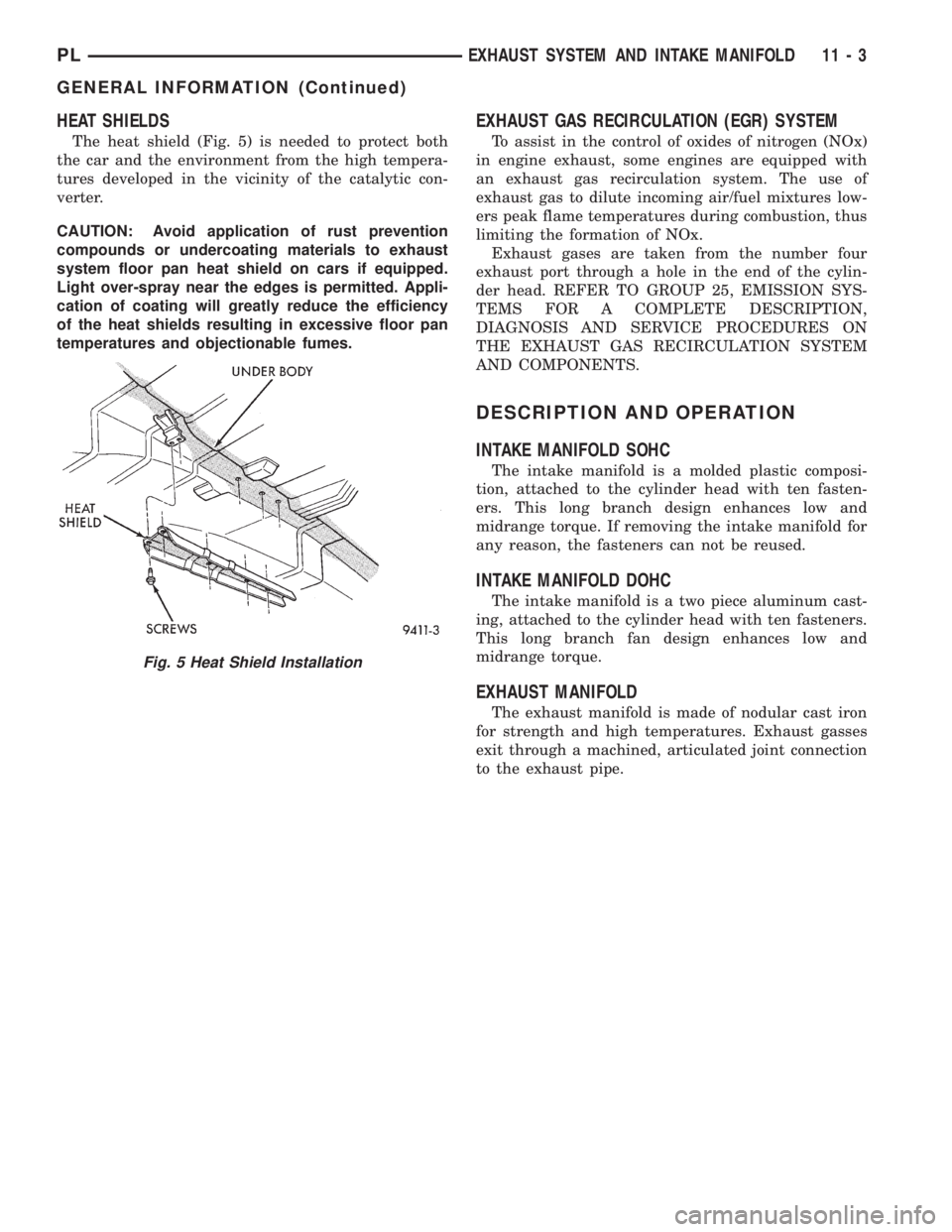
The heat shield (Fig. 5) is needed to protect both
the car and the environment from the high tempera-
tures developed in the vicinity of the catalytic con-
verter.
CAUTION: Avoid application of rust prevention
compounds or undercoating materials to exhaust
system floor pan heat shield on cars if equipped.
Light over-spray near the edges is permitted. Appli-
cation of coating will greatly reduce the efficiency
of the heat shields resulting in excessive floor pan
temperatures and objectionable fumes.
EXHAUST GAS RECIRCULATION (EGR) SYSTEM
To assist in the control of oxides of nitrogen (NOx)
in engine exhaust, some engines are equipped with
an exhaust gas recirculation system. The use of
exhaust gas to dilute incoming air/fuel mixtures low-
ers peak flame temperatures during combustion, thus
limiting the formation of NOx.
Exhaust gases are taken from the number four
exhaust port through a hole in the end of the cylin-
der head. REFER TO GROUP 25, EMISSION SYS-
TEMS FOR A COMPLETE DESCRIPTION,
DIAGNOSIS AND SERVICE PROCEDURES ON
THE EXHAUST GAS RECIRCULATION SYSTEM
AND COMPONENTS.
DESCRIPTION AND OPERATION
INTAKE MANIFOLD SOHC
The intake manifold is a molded plastic composi-
tion, attached to the cylinder head with ten fasten-
ers. This long branch design enhances low and
midrange torque. If removing the intake manifold for
any reason, the fasteners can not be reused.
INTAKE MANIFOLD DOHC
The intake manifold is a two piece aluminum cast-
ing, attached to the cylinder head with ten fasteners.
This long branch fan design enhances low and
midrange torque.
EXHAUST MANIFOLD
The exhaust manifold is made of nodular cast iron
for strength and high temperatures. Exhaust gasses
exit through a machined, articulated joint connection
to the exhaust pipe.
Fig. 5 Heat Shield Installation
PLEXHAUST SYSTEM AND INTAKE MANIFOLD 11 - 3
GENERAL INFORMATION (Continued)
Page 827 of 1200
(4) Remove exhaust pipe from manifold. Discard
manifold to flex joint gasket, if LEV equipped.
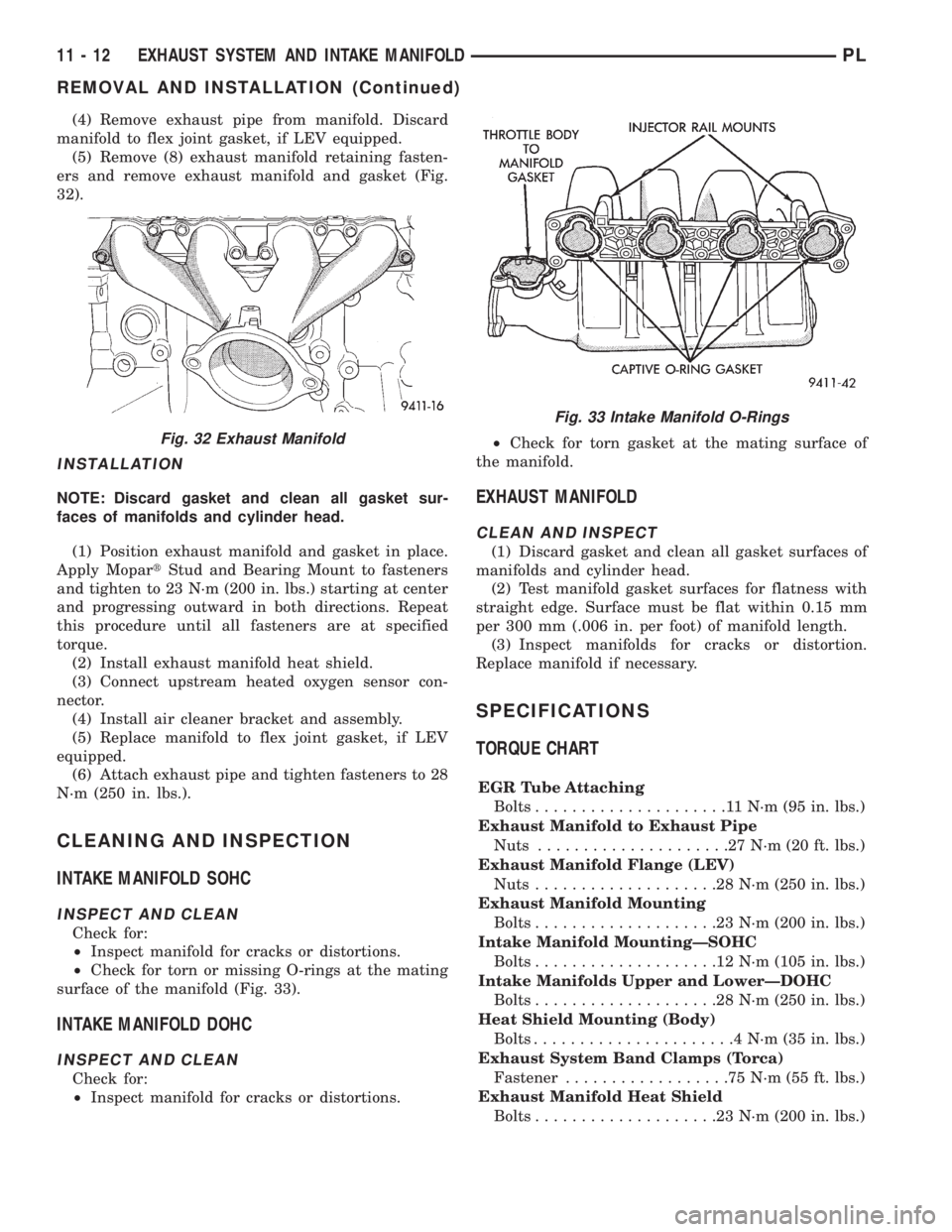
(5) Remove (8) exhaust manifold retaining fasten-
ers and remove exhaust manifold and gasket (Fig.
32).
INSTALLATION
NOTE: Discard gasket and clean all gasket sur-
faces of manifolds and cylinder head.
(1) Position exhaust manifold and gasket in place.
Apply MopartStud and Bearing Mount to fasteners
and tighten to 23 N´m (200 in. lbs.) starting at center
and progressing outward in both directions. Repeat
this procedure until all fasteners are at specified
torque.
(2) Install exhaust manifold heat shield.
(3) Connect upstream heated oxygen sensor con-
nector.
(4) Install air cleaner bracket and assembly.
(5) Replace manifold to flex joint gasket, if LEV
equipped.
(6) Attach exhaust pipe and tighten fasteners to 28
N´m (250 in. lbs.).
CLEANING AND INSPECTION
INTAKE MANIFOLD SOHC
INSPECT AND CLEAN
Check for:
²Inspect manifold for cracks or distortions.
²Check for torn or missing O-rings at the mating
surface of the manifold (Fig. 33).
INTAKE MANIFOLD DOHC
INSPECT AND CLEAN
Check for:
²Inspect manifold for cracks or distortions.²Check for torn gasket at the mating surface of
the manifold.
EXHAUST MANIFOLD
CLEAN AND INSPECT
(1) Discard gasket and clean all gasket surfaces of
manifolds and cylinder head.
(2) Test manifold gasket surfaces for flatness with
straight edge. Surface must be flat within 0.15 mm
per 300 mm (.006 in. per foot) of manifold length.
(3) Inspect manifolds for cracks or distortion.
Replace manifold if necessary.
SPECIFICATIONS
TORQUE CHART
EGR Tube Attaching
Bolts.....................11N´m(95in.lbs.)
Exhaust Manifold to Exhaust Pipe
Nuts.....................27N´m(20ft.lbs.)
Exhaust Manifold Flange (LEV)
Nuts....................28N´m(250 in. lbs.)
Exhaust Manifold Mounting
Bolts....................23N´m(200 in. lbs.)
Intake Manifold MountingÐSOHC
Bolts....................12N´m(105 in. lbs.)
Intake Manifolds Upper and LowerÐDOHC
Bolts....................28N´m(250 in. lbs.)
Heat Shield Mounting (Body)
Bolts......................4N´m(35in.lbs.)
Exhaust System Band Clamps (Torca)
Fastener..................75N´m(55ft.lbs.)
Exhaust Manifold Heat Shield
Bolts....................23N´m(200 in. lbs.)
Fig. 32 Exhaust Manifold
Fig. 33 Intake Manifold O-Rings
11 - 12 EXHAUST SYSTEM AND INTAKE MANIFOLDPL
REMOVAL AND INSTALLATION (Continued)
Page 832 of 1200
FRAMES
INDEX
page page
REMOVAL AND INSTALLATION
FRONT SUSPENSION CROSSMEMBER....... 3
SPECIFICATIONS
STRUCTURAL DIMENSIONS................ 4TORQUE SPECIFICATIONS................ 10
REMOVAL AND INSTALLATION
FRONT SUSPENSION CROSSMEMBER
WARNING: IF SUSPENSION CROSSMEMBER IS
REPLACED DUE TO COLLISION DAMAGE, INSPECT
THE STEERING COLUMN TO STEERING GEAR
COUPLING FOR DAMAGE. REFER TO GROUP 19,
STEERING FOR INSTRUCTIONS.
Before removing front suspension crossmem-
ber, index mark location of crossmember on
frame to aid installation.
The front suspension crossmember must be prop-
erly installed to achieve design camber, caster set-
tings and wheel stagger. The crossmember can be
installed out of position on the frame rails due to its
design. Bolts and cage nuts hold the rear of the
crossmember to the frame torque boxes. Bolts and
J-nuts hold the front of the crossmember to the
frame rails. No designed in locating device is used to
position the crossmember in the vehicle. Before
removing the crossmember mark the frame torque
box around the rear mounting location to aid instal-
lation. A crossmember that is removed during service
must be installed in the same position from which it
was removed. To verify that crossmember is in the
proper position, refer to the dimensions provided.
Front end dimensions are gauged from the principal
locating point (PLP) holes located under the frame
torque boxes rearward of the front wheels. After
removal and installation of the crossmember is per-
formed, verify that front suspension alignment is
within specifications. If camber, caster settings and
wheel stagger is not within specifications, loosen and
reposition crossmember to bring suspension within
specifications. Refer to Group 2, Front Suspension
and Driveshaft for additional information.
REMOVAL
(1) Hoist and support vehicle on safety stands.
(2) Using a suitable marking device, mark the out-
line of the suspension crossmember on the frame
torque box around the rear mounting location.(3) Remove front wheels from vehicle.
(4) Remove pinch bolts holding front ball joints to
spindles.
(5) Separate ball joints from spindles.
(6) Position a suitable lifting device under the
crossmember.
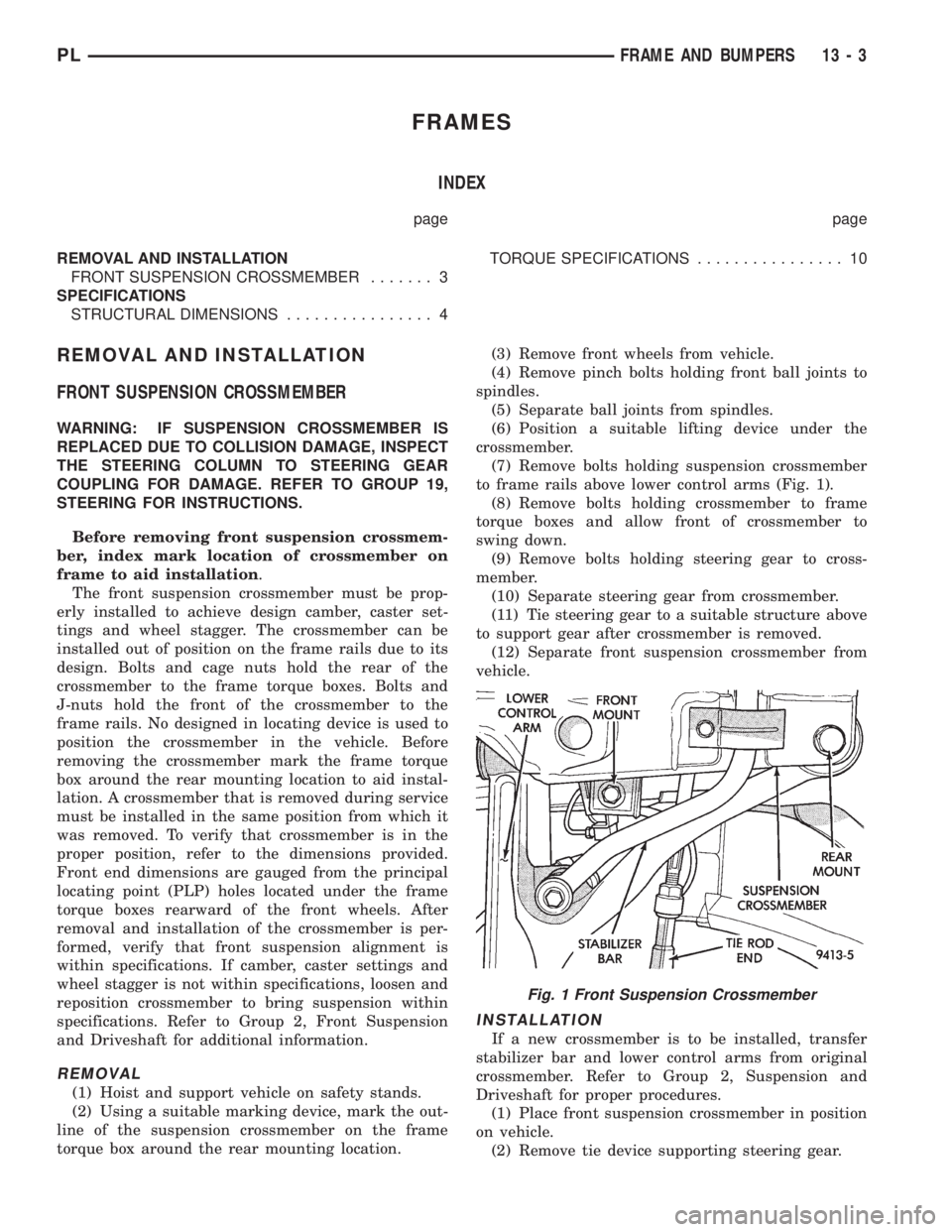
(7) Remove bolts holding suspension crossmember
to frame rails above lower control arms (Fig. 1).
(8) Remove bolts holding crossmember to frame
torque boxes and allow front of crossmember to
swing down.
(9) Remove bolts holding steering gear to cross-
member.
(10) Separate steering gear from crossmember.
(11) Tie steering gear to a suitable structure above
to support gear after crossmember is removed.
(12) Separate front suspension crossmember from
vehicle.
INSTALLATION
If a new crossmember is to be installed, transfer
stabilizer bar and lower control arms from original
crossmember. Refer to Group 2, Suspension and
Driveshaft for proper procedures.
(1) Place front suspension crossmember in position
on vehicle.
(2) Remove tie device supporting steering gear.
Fig. 1 Front Suspension Crossmember
PLFRAME AND BUMPERS 13 - 3
Page 833 of 1200
(3) Place steering gear in position on crossmember.
(4) Install bolts to hold steering gear to crossmem-
ber.
(5) Position lifting device under the crossmember.
(6) Lift crossmember to frame rails.
(7) Engage bolts to hold crossmember rear mounts
into cage nuts in the frame torque boxes. Do not
tighten bolts.
(8) Install bolts to hold crossmember to frame rails
above lower control arms.
(9) Lower and remove lifting device.
(10) Align crossmember to index marks. Verify
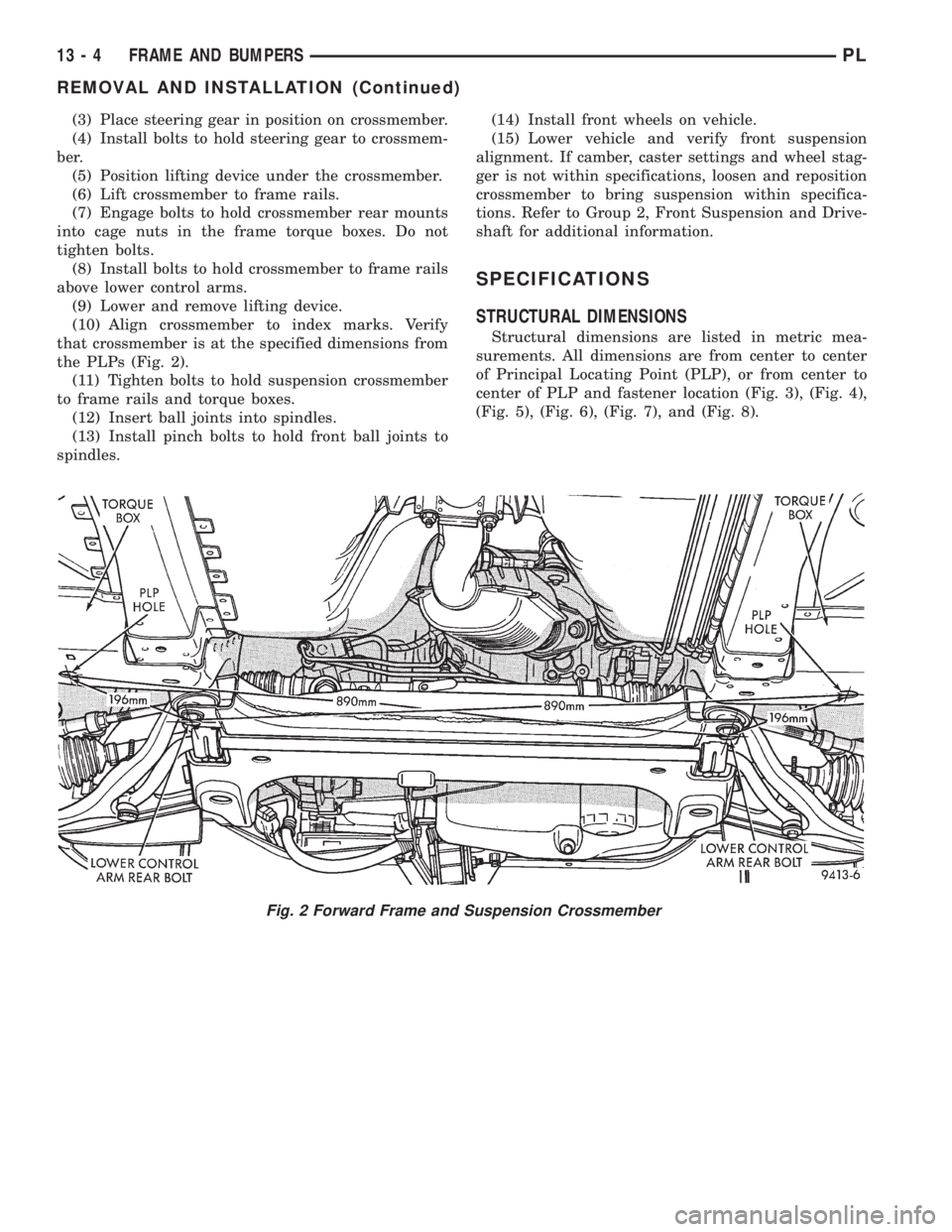
that crossmember is at the specified dimensions from
the PLPs (Fig. 2).
(11) Tighten bolts to hold suspension crossmember
to frame rails and torque boxes.
(12) Insert ball joints into spindles.
(13) Install pinch bolts to hold front ball joints to
spindles.(14) Install front wheels on vehicle.
(15) Lower vehicle and verify front suspension
alignment. If camber, caster settings and wheel stag-
ger is not within specifications, loosen and reposition
crossmember to bring suspension within specifica-
tions. Refer to Group 2, Front Suspension and Drive-
shaft for additional information.
SPECIFICATIONS
STRUCTURAL DIMENSIONS
Structural dimensions are listed in metric mea-
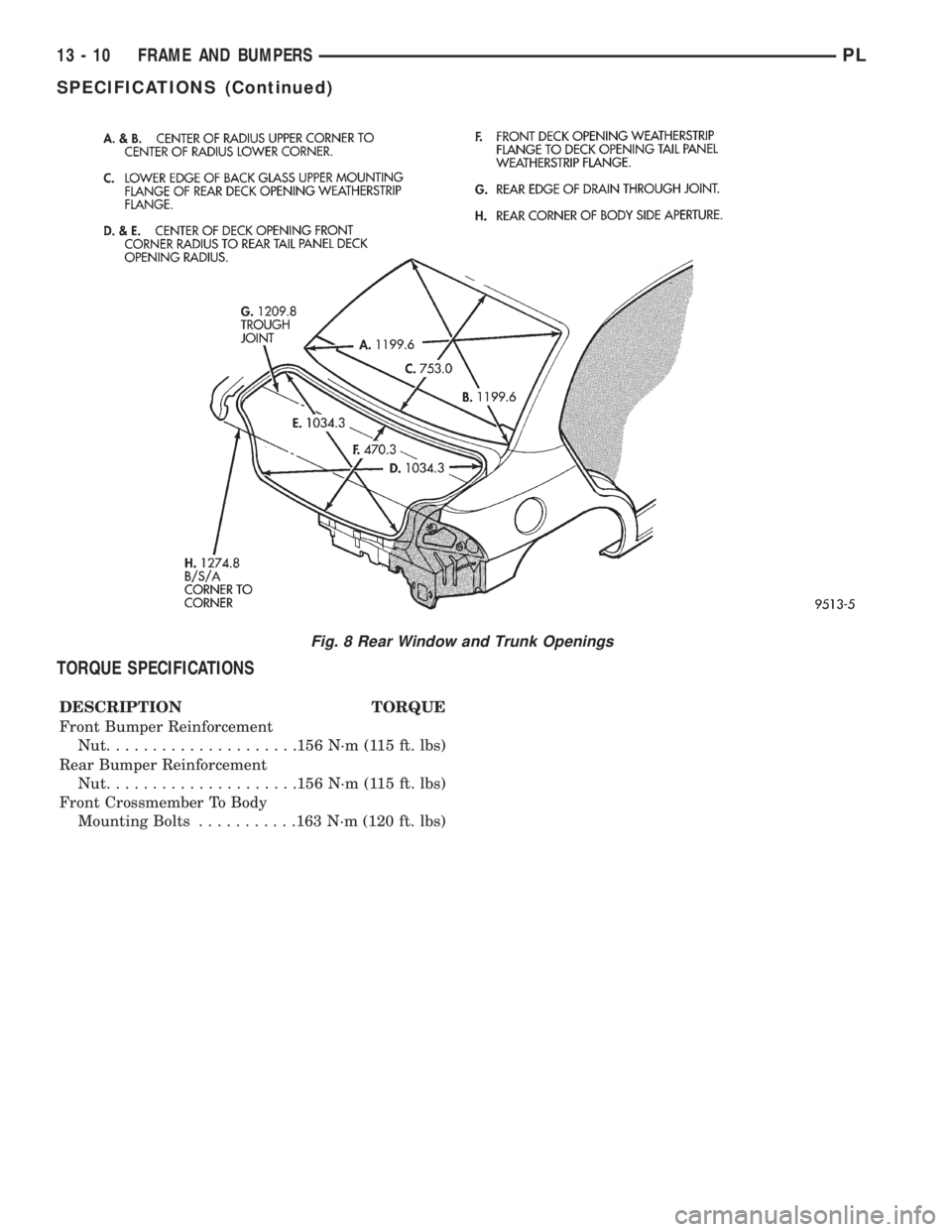
surements. All dimensions are from center to center
of Principal Locating Point (PLP), or from center to
center of PLP and fastener location (Fig. 3), (Fig. 4),
(Fig. 5), (Fig. 6), (Fig. 7), and (Fig. 8).
Fig. 2 Forward Frame and Suspension Crossmember
13 - 4 FRAME AND BUMPERSPL
REMOVAL AND INSTALLATION (Continued)
Page 839 of 1200
TORQUE SPECIFICATIONS
DESCRIPTION TORQUE
Front Bumper Reinforcement
Nut.....................156 N´m (115 ft. lbs)
Rear Bumper Reinforcement
Nut.....................156 N´m (115 ft. lbs)
Front Crossmember To Body
Mounting Bolts...........163 N´m (120 ft. lbs)
Fig. 8 Rear Window and Trunk Openings
13 - 10 FRAME AND BUMPERSPL
SPECIFICATIONS (Continued)
Page 844 of 1200
FUEL DELIVERY SYSTEM
INDEX
page page
DESCRIPTION AND OPERATION
ELECTRIC FUEL PUMP.................... 4
FUEL DELIVERY SYSTEM.................. 3
FUEL FILTER/FUEL PRESSURE REGULATOR . . . 4
FUEL GAUGE SENDING UNIT............... 4
FUEL INJECTORS........................ 5
FUEL PUMP MODULE..................... 3
FUEL RAIL.............................. 4
FUEL TANK............................. 4
PRESSURE-VACUUM FILLER CAP........... 5
QUICK-CONNECT FITTINGS................ 5
ROLLOVER VALVES...................... 5
DIAGNOSIS AND TESTING
FUEL INJECTORS........................ 8
FUEL LEVEL SENSOR..................... 6
FUEL PUMP PRESSURE TEST.............. 6
SERVICE PROCEDURES
DRAINING FUEL TANK.................... 10
FUEL SYSTEM PRESSURE RELEASE
PROCEDURE......................... 10HOSES AND CLAMPS.................... 10
QUICK-CONNECT FITTINGS............... 11
REMOVAL AND INSTALLATION
ACCELERATOR PEDAL................... 17
AUTOMATIC SHUTDOWN RELAY........... 11
FUEL FILLER NECK...................... 16
FUEL FILLER TUBE ROLLOVER VALVE....... 16
FUEL FILTER / PRESSURE REGULATOR..... 12
FUEL INJECTORS....................... 14
FUEL LEVEL SENSOR.................... 13
FUEL PUMP INLET STRAINER............. 13
FUEL PUMP MODULE.................... 11
FUEL PUMP RELAY...................... 11
FUEL TANK............................ 15
THROTTLE CABLEÐAUTOMATIC
TRANSMISSION....................... 18
THROTTLE CABLEÐMANUAL TRANSMISSION . 17
SPECIFICATIONS
FUEL TANK CAPACITY................... 19
TORQUE.............................. 19
DESCRIPTION AND OPERATION
FUEL DELIVERY SYSTEM
The fuel delivery system consists of: the electric
fuel pump, fuel filter/fuel pressure regulator, fuel
tubes/lines/hoses, fuel rail, fuel injectors, fuel tank,
accelerator pedal and throttle cable.
A fuel return system is used on all models (all
engines). Fuel is returned through the fuel pump
module and back into the fuel tank through the fuel
filter/fuel pressure regulator. A separate fuel return
line from the engine to the tank is no longer used
with any engine.
The fuel tank assembly consists of: the fuel tank,
filler tube, fuel gauge sending unit/electric fuel pump
module, a pressure relief/rollover valve and a pres-
sure-vacuum filler cap.
Also to be considered part of the fuel system is the
evaporation control system. This is designed to
reduce the emission of fuel vapors into the atmo-
sphere. The description and function of the Evapora-
tive Control System is found in Group 25, Emission
Control Systems.
FUEL PUMP MODULE
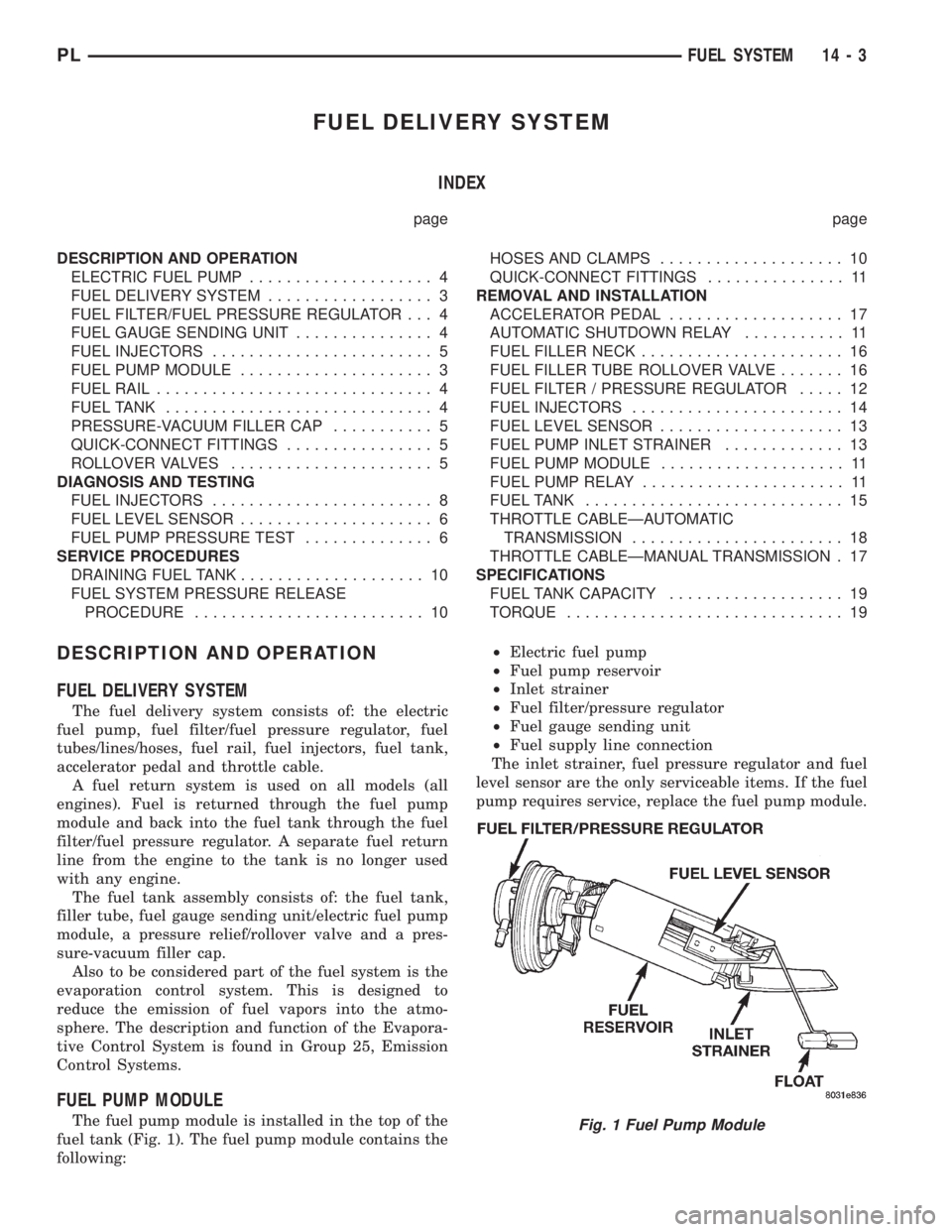
The fuel pump module is installed in the top of the
fuel tank (Fig. 1). The fuel pump module contains the
following:²Electric fuel pump
²Fuel pump reservoir
²Inlet strainer
²Fuel filter/pressure regulator
²Fuel gauge sending unit
²Fuel supply line connection
The inlet strainer, fuel pressure regulator and fuel
level sensor are the only serviceable items. If the fuel
pump requires service, replace the fuel pump module.Fig. 1 Fuel Pump Module
PLFUEL SYSTEM 14 - 3
Page 852 of 1200
The hose clamps have rolled edges to prevent the
clamp from cutting into the hose. Only use clamps
that are original equipment or equivalent. Other
types of clamps may cut into the hoses and cause
high pressure fuel leaks. Tighten hose clamps to 1
N´m (10 in. lbs.) torque.
QUICK-CONNECT FITTINGS
REMOVAL
When disconnecting a quick-connect fitting, the
retainer will remain on the fuel tube nipple.
WARNING: RELEASE FUEL SYSTEM PRESSURE
BEFORE DISCONNECTING A QUICK-CONNECT FIT-
TINGS. REFER TO THE FUEL PRESSURE RELEASE
PROCEDURE.
(1) Disconnect negative cable from battery.
(2) Perform Fuel Pressure Release Procedure.
Refer to the Fuel Pressure Release Procedure in this
section.
(3) Squeeze retainer tabs together and pull fuel
tube/quick-connect fitting assembly off of fuel tube
nipple. The retainer will remain on fuel tube.
INSTALLATION
CAUTION: Never install a quick-connect fitting
without the retainer being either on the fuel tube or
already in the quick-connect fitting. In either case,
ensure the retainer locks securely into the quick-
connect fitting by firmly pulling on fuel tube and fit-
ting to ensure it is secured.
(1) Using a clean lint free cloth, clean the fuel tube
nipple and retainer.
(2) Prior to connecting the fitting to the fuel tube,
coat the fuel tube nipple with clean 30 weight engine
oil.
(3) Push the quick-connect fitting over the fuel
tube until theretainer seats and a click is heard.
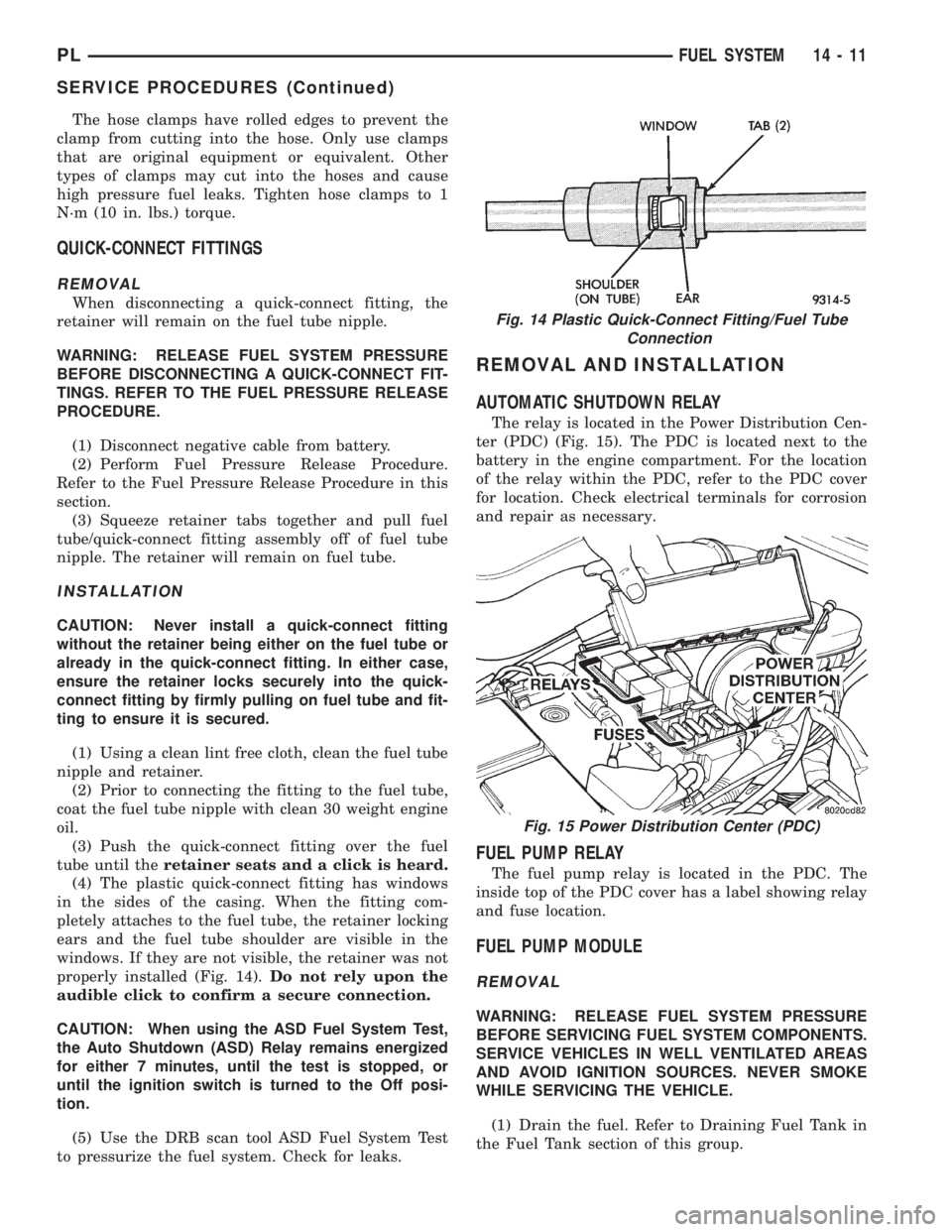
(4) The plastic quick-connect fitting has windows
in the sides of the casing. When the fitting com-
pletely attaches to the fuel tube, the retainer locking
ears and the fuel tube shoulder are visible in the
windows. If they are not visible, the retainer was not
properly installed (Fig. 14).Do not rely upon the
audible click to confirm a secure connection.
CAUTION: When using the ASD Fuel System Test,
the Auto Shutdown (ASD) Relay remains energized
for either 7 minutes, until the test is stopped, or
until the ignition switch is turned to the Off posi-
tion.
(5) Use the DRB scan tool ASD Fuel System Test
to pressurize the fuel system. Check for leaks.
REMOVAL AND INSTALLATION
AUTOMATIC SHUTDOWN RELAY
The relay is located in the Power Distribution Cen-
ter (PDC) (Fig. 15). The PDC is located next to the
battery in the engine compartment. For the location
of the relay within the PDC, refer to the PDC cover
for location. Check electrical terminals for corrosion
and repair as necessary.
FUEL PUMP RELAY
The fuel pump relay is located in the PDC. The
inside top of the PDC cover has a label showing relay
and fuse location.
FUEL PUMP MODULE
REMOVAL
WARNING: RELEASE FUEL SYSTEM PRESSURE
BEFORE SERVICING FUEL SYSTEM COMPONENTS.
SERVICE VEHICLES IN WELL VENTILATED AREAS
AND AVOID IGNITION SOURCES. NEVER SMOKE
WHILE SERVICING THE VEHICLE.
(1) Drain the fuel. Refer to Draining Fuel Tank in
the Fuel Tank section of this group.
Fig. 14 Plastic Quick-Connect Fitting/Fuel Tube
Connection
Fig. 15 Power Distribution Center (PDC)
PLFUEL SYSTEM 14 - 11
SERVICE PROCEDURES (Continued)
Page 857 of 1200
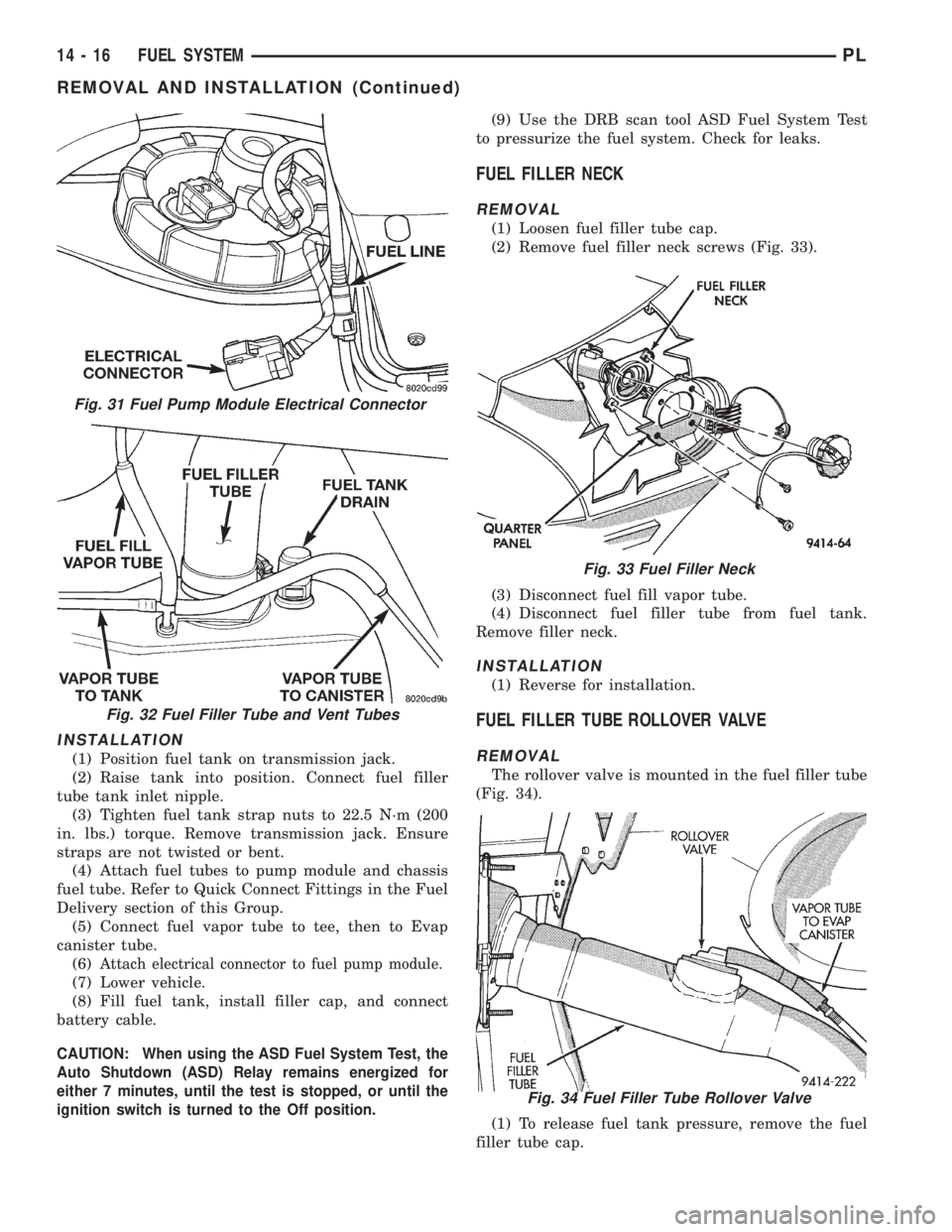
INSTALLATION
(1) Position fuel tank on transmission jack.
(2) Raise tank into position. Connect fuel filler
tube tank inlet nipple.
(3) Tighten fuel tank strap nuts to 22.5 N´m (200
in. lbs.) torque. Remove transmission jack. Ensure
straps are not twisted or bent.
(4) Attach fuel tubes to pump module and chassis
fuel tube. Refer to Quick Connect Fittings in the Fuel
Delivery section of this Group.
(5) Connect fuel vapor tube to tee, then to Evap
canister tube.
(6)
Attach electrical connector to fuel pump module.
(7) Lower vehicle.
(8) Fill fuel tank, install filler cap, and connect
battery cable.
CAUTION: When using the ASD Fuel System Test, the
Auto Shutdown (ASD) Relay remains energized for
either 7 minutes, until the test is stopped, or until the
ignition switch is turned to the Off position.
(9) Use the DRB scan tool ASD Fuel System Test
to pressurize the fuel system. Check for leaks.
FUEL FILLER NECK
REMOVAL
(1) Loosen fuel filler tube cap.
(2) Remove fuel filler neck screws (Fig. 33).
(3) Disconnect fuel fill vapor tube.
(4) Disconnect fuel filler tube from fuel tank.
Remove filler neck.
INSTALLATION
(1) Reverse for installation.
FUEL FILLER TUBE ROLLOVER VALVE
REMOVAL
The rollover valve is mounted in the fuel filler tube
(Fig. 34).
(1) To release fuel tank pressure, remove the fuel
filler tube cap.
Fig. 31 Fuel Pump Module Electrical Connector
Fig. 32 Fuel Filler Tube and Vent Tubes
Fig. 33 Fuel Filler Neck
Fig. 34 Fuel Filler Tube Rollover Valve
14 - 16 FUEL SYSTEMPL
REMOVAL AND INSTALLATION (Continued)
Page 858 of 1200
(2) Disconnect vapor tube from rollover valve.
(3) Using a straight screwdriver, pry the valve out
of the grommet in the fuel filler tube.
INSTALLATION
(1) Apply a light coating of power steering fluid to
the grommet.
(2) Install valve in grommet.
(3) Attach vapor tube to valve.
(4) Install fuel filler tube cap.
ACCELERATOR PEDAL
CAUTION: When servicing the accelerator pedal,
throttle cable or speed control cable, do not dam-
age or kink the core wire inside the cable sheath-
ing.
REMOVAL
(1) Working from the engine compartment, remove
the throttle control shield.
(2) Hold the throttle body throttle lever in the
wide open position. Remove the throttle cable from
the throttle body cam.
(3) From inside the vehicle, hold up the pedal and
remove the cable retainer and throttle cable from the
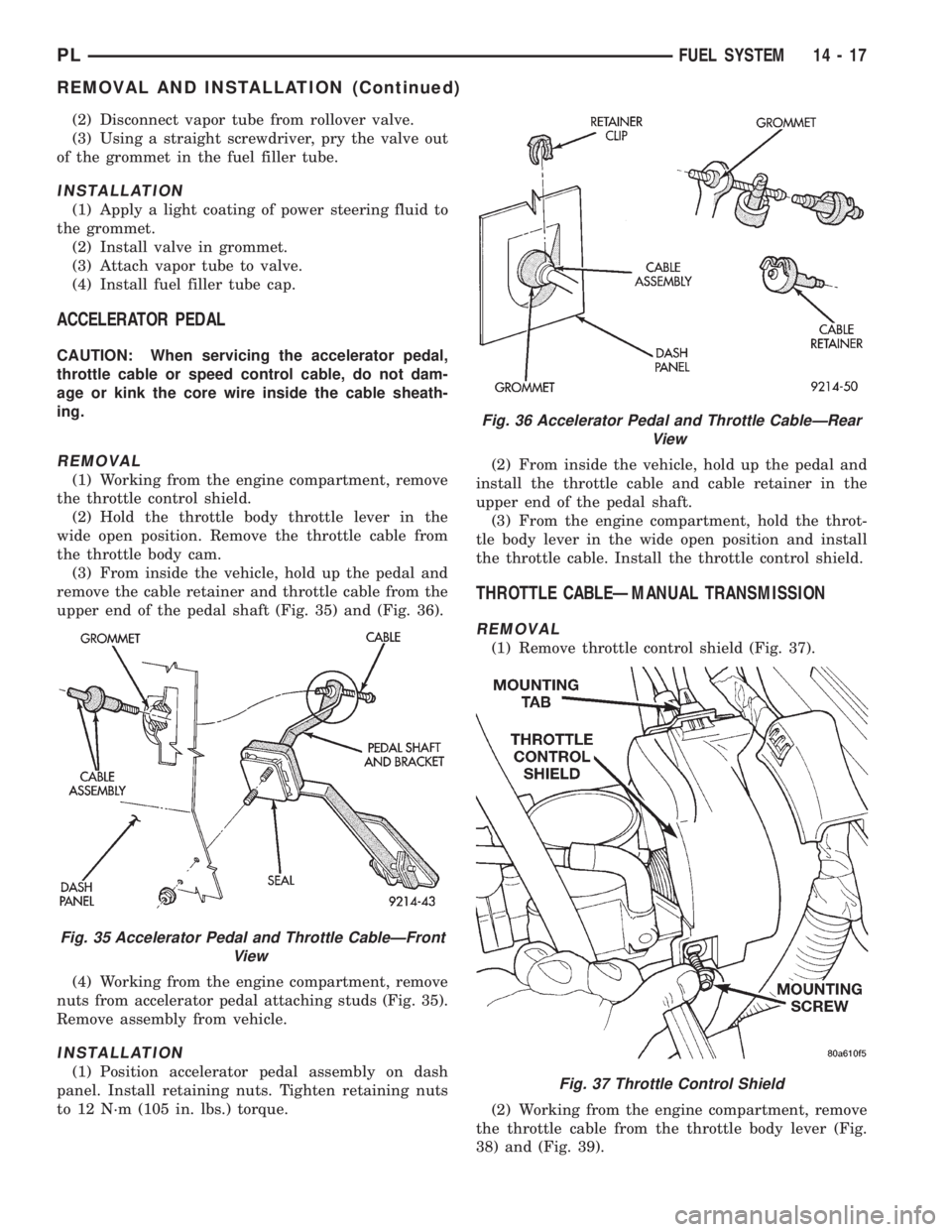
upper end of the pedal shaft (Fig. 35) and (Fig. 36).
(4) Working from the engine compartment, remove
nuts from accelerator pedal attaching studs (Fig. 35).
Remove assembly from vehicle.
INSTALLATION
(1) Position accelerator pedal assembly on dash
panel. Install retaining nuts. Tighten retaining nuts
to 12 N´m (105 in. lbs.) torque.(2) From inside the vehicle, hold up the pedal and
install the throttle cable and cable retainer in the
upper end of the pedal shaft.
(3) From the engine compartment, hold the throt-
tle body lever in the wide open position and install
the throttle cable. Install the throttle control shield.
THROTTLE CABLEÐMANUAL TRANSMISSION
REMOVAL
(1) Remove throttle control shield (Fig. 37).
(2) Working from the engine compartment, remove
the throttle cable from the throttle body lever (Fig.
38) and (Fig. 39).
Fig. 35 Accelerator Pedal and Throttle CableÐFront
View
Fig. 36 Accelerator Pedal and Throttle CableÐRear
View
Fig. 37 Throttle Control Shield
PLFUEL SYSTEM 14 - 17
REMOVAL AND INSTALLATION (Continued)