height DODGE NEON 1999 Service User Guide
[x] Cancel search | Manufacturer: DODGE, Model Year: 1999, Model line: NEON, Model: DODGE NEON 1999Pages: 1200, PDF Size: 35.29 MB
Page 763 of 1200
CAUTION: When depressing the valve spring
retainers with valve spring compressor the locks
can become dislocated. Check to make sure both
locks are in their correct location after removing
tool.
(4) Check the valve spring installed height B after
refacing the valve and seat (Fig. 108). Make sure
measurements are taken from top of spring seat to
the bottom surface of spring retainer. If height is
greater than 40.18 mm (1.58 in.), install a 0.762 mm
(0.030 in.) spacer under the valve spring seat to
bring spring height back within specification.
(5) Install rocker arm shafts as previously
described in this section.
(6) Checking dry lash. Dry lash is the amount of
clearance that exists between the base circle of an
installed cam and the rocker arm roller when the
adjuster is drained of oil and completely collapsed.
Specified dry lash is 1.17 mm (0.046 in.) for intake
and 1.28 mm (0.050 in.) for exhaust. After performing
dry lash check, refill adjuster with oil and allow 10
minutes for adjuster/s to bleed down before rotating
cam.
CLEANING AND INSPECTION
CYLINDER HEAD AND CAMSHAFT JOURNALS
INSPECTING CYLINDER HEAD
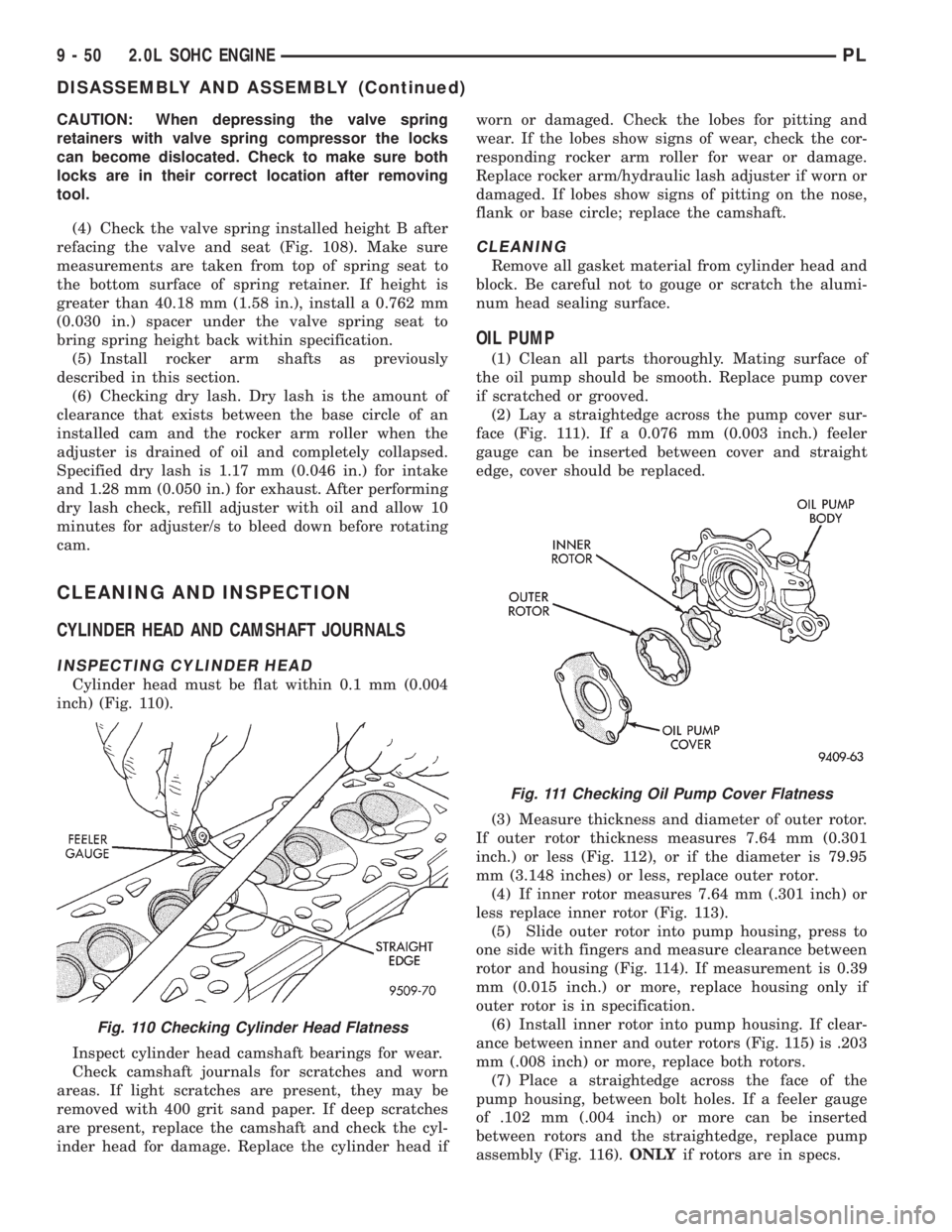
Cylinder head must be flat within 0.1 mm (0.004
inch) (Fig. 110).
Inspect cylinder head camshaft bearings for wear.
Check camshaft journals for scratches and worn
areas. If light scratches are present, they may be
removed with 400 grit sand paper. If deep scratches
are present, replace the camshaft and check the cyl-
inder head for damage. Replace the cylinder head ifworn or damaged. Check the lobes for pitting and
wear. If the lobes show signs of wear, check the cor-
responding rocker arm roller for wear or damage.
Replace rocker arm/hydraulic lash adjuster if worn or
damaged. If lobes show signs of pitting on the nose,
flank or base circle; replace the camshaft.
CLEANING
Remove all gasket material from cylinder head and
block. Be careful not to gouge or scratch the alumi-
num head sealing surface.
OIL PUMP
(1) Clean all parts thoroughly. Mating surface of
the oil pump should be smooth. Replace pump cover
if scratched or grooved.
(2) Lay a straightedge across the pump cover sur-
face (Fig. 111). If a 0.076 mm (0.003 inch.) feeler
gauge can be inserted between cover and straight
edge, cover should be replaced.
(3) Measure thickness and diameter of outer rotor.
If outer rotor thickness measures 7.64 mm (0.301
inch.) or less (Fig. 112), or if the diameter is 79.95
mm (3.148 inches) or less, replace outer rotor.
(4) If inner rotor measures 7.64 mm (.301 inch) or
less replace inner rotor (Fig. 113).
(5) Slide outer rotor into pump housing, press to
one side with fingers and measure clearance between
rotor and housing (Fig. 114). If measurement is 0.39
mm (0.015 inch.) or more, replace housing only if
outer rotor is in specification.
(6) Install inner rotor into pump housing. If clear-
ance between inner and outer rotors (Fig. 115) is .203
mm (.008 inch) or more, replace both rotors.
(7) Place a straightedge across the face of the
pump housing, between bolt holes. If a feeler gauge
of .102 mm (.004 inch) or more can be inserted
between rotors and the straightedge, replace pump
assembly (Fig. 116).ONLYif rotors are in specs.
Fig. 110 Checking Cylinder Head Flatness
Fig. 111 Checking Oil Pump Cover Flatness
9 - 50 2.0L SOHC ENGINEPL
DISASSEMBLY AND ASSEMBLY (Continued)
Page 767 of 1200
Valve Margin
Intake......1.15 ± 1.48 mm (0.0452 ± 0.0582 in.)
Exhaust.....1.475 ± 1.805 mm (0.058 ± 0.071 in.)
Valve Length (Overall)
Intake.....114.69 ± 115.19 mm (4.515 ± 4.535 in.)
Exhaust . . .109.59 ± 110.09 mm (4.603 ± 4.623 in.)
Valve Stem Tip Height
Intake........45.01 ± 46.07 mm (1.77 ± 1.81 in.)
Exhaust.......43.51 ± 44.57 mm (1.71 ± 1.75 in.)
Stem Diameter
Intake......5.934 ± 5.952 mm (0.234 ± 0.234 in.)
Exhaust.....5.906 ± 5.924 mm (0.233 ± 0.233 in.)
Stem to Guide Clearance
Intake. . . .0.048 ± 0.066 mm (0.0018 ± 0.0025 in.)
Exhaust . .0.0736 ± 0.094 mm (0.0029 ± 0.0037 in.)
Max. Allowable Intake......0.076 mm (0.003 in.)
Max. Allowable Exhaust.....0.101 mm (0.004 in.)
Valve Springs
Free Length (Approx.).......44.4 mm (1.747 in.)
Nominal Force (Valve closed) . .91 N´m @ 39.8 mm
(67 ft. lbs. @ 1.57 in.)
Nominal Force (Valve open). . .239 N´m @ 32.6 mm
(176 lbs. @ 1.28 in.)
Installed Height...........40.18 mm (1.580 in.)
* SERVICE AS AN ASSEMBLY WITH ROCKER
ARM.
** ALL READINGS IN CRANKSHAFT DEGREES,
AT 0.5 mm (0.019 in.) OF VALVE LIFT.
TORQUE CHART 2.0L SOHC
DESCRIPTION TORQUE
Camshaft Sensor Pick Up
Bolts....................9.6 N´m (85 in. lbs.)
Camshaft Sprocket
Bolt.....................115N´m(85ft.lbs.)
Connecting Rod Cap
Bolts..........27N´m(20ft.lbs.) Plus 1/4 Turn
CollarÐOil Pan to Transaxle
Step 1: Collar to Oil Pan Bolts . .3 N´m (30 in. lbs.)
Step 2: Collar to Transaxle Bolts.108 N´m (80 ft. lbs.)
Step 3: Collar to Oil Pan Bolts .54 N´m (40 ft. lbs.)
Crankshaft Main Bearing Cap/Bedplate
M8 Bedplate Bolts...........30N´m(22ft.lbs.)
M11 Main Cap Bolts.........81N´m(60ft.lbs.)
Crankshaft Damper
Bolt....................142 N´m (105 ft. lbs.)
Cylinder Head
Bolts........Refer To Cylinder Head Installation
Cylinder Head Cover
Bolts....................12N´m(105 in. lbs.)
Drive Plate to Flywheel
Bolts.....................95N´m(70ft.lbs.)
Engine Mount BracketÐRight
Bolts.....................61N´m(45ft.lbs.)DESCRIPTION TORQUE
Engine Mounting
Bolts........Refer to Engine Mount Installation
Exhaust Manifold to Cylinder Head
Bolts....................23N´m(200 in. lbs.)
Exhaust Manifold Heat Shield
Bolts....................12N´m(105 in. lbs.)
Front Mount Torque Bracket
Bolts.....................33N´m(24ft.lbs.)
Front Powertrain Bending Strut
Long Bolts................101 N´m (75 ft. lbs.)
Short Bolt.................61N´m(45ft.lbs.)
Intake Manifold
Bolts....................12N´m(105 in. lbs.)
Oil Filter Adapter
Fastener..................80N´m(60ft.lbs.)
Oil Filter..................20N´m(15ft.lbs.)
Oil Pan
Bolts....................12N´m(105 in. lbs.)
Drain Plug.................27N´m(20ft.lbs.)
Oil Pump Attaching
Bolts....................28N´m(250 in. lbs.)
Oil Pump Cover Fastener. . . .12 N´m (105 in. lbs.)
Oil Pump Pick-up Tube Bolt . .28 N´m (250 in. lbs.)
Oil Pump Relief Valve Cap. . . .41 N´m (30 ft. lbs.)
Rear Torque BracketÐ2.0L Engine
Bolts w/Auto. Transaxle......110N´m(80ft.lbs.)
Bolts w/Manual Transaxle.....61N´m(45ft.lbs.)
Rocker Arm Shaft
Bolts....................28N´m(250 in. lbs.)
Spark Plugs................28N´m(20ft.lbs.)
Thermostat Housing
Bolts....................23N´m(200 in lbs.)
Timing Belt Cover
Bolts M6.................12N´m(105 in. lbs.)
Timing Belt Tensioner AssemblyÐMechanical
Bolts....................28N´m(250 in. lbs.)
Timing Belt TensionerÐHydraulic
Pulley Bolt.................68N´m(50ft.lbs.)
Pivot Bracket Bolt...........31N´m(23ft.lbs.)
Tensioner Bolts.............31N´m(23ft.lbs.)
Water Pump Mounting
Bolts....................12N´m(105 in. lbs.)
9 - 54 2.0L SOHC ENGINEPL
SPECIFICATIONS (Continued)
Page 805 of 1200
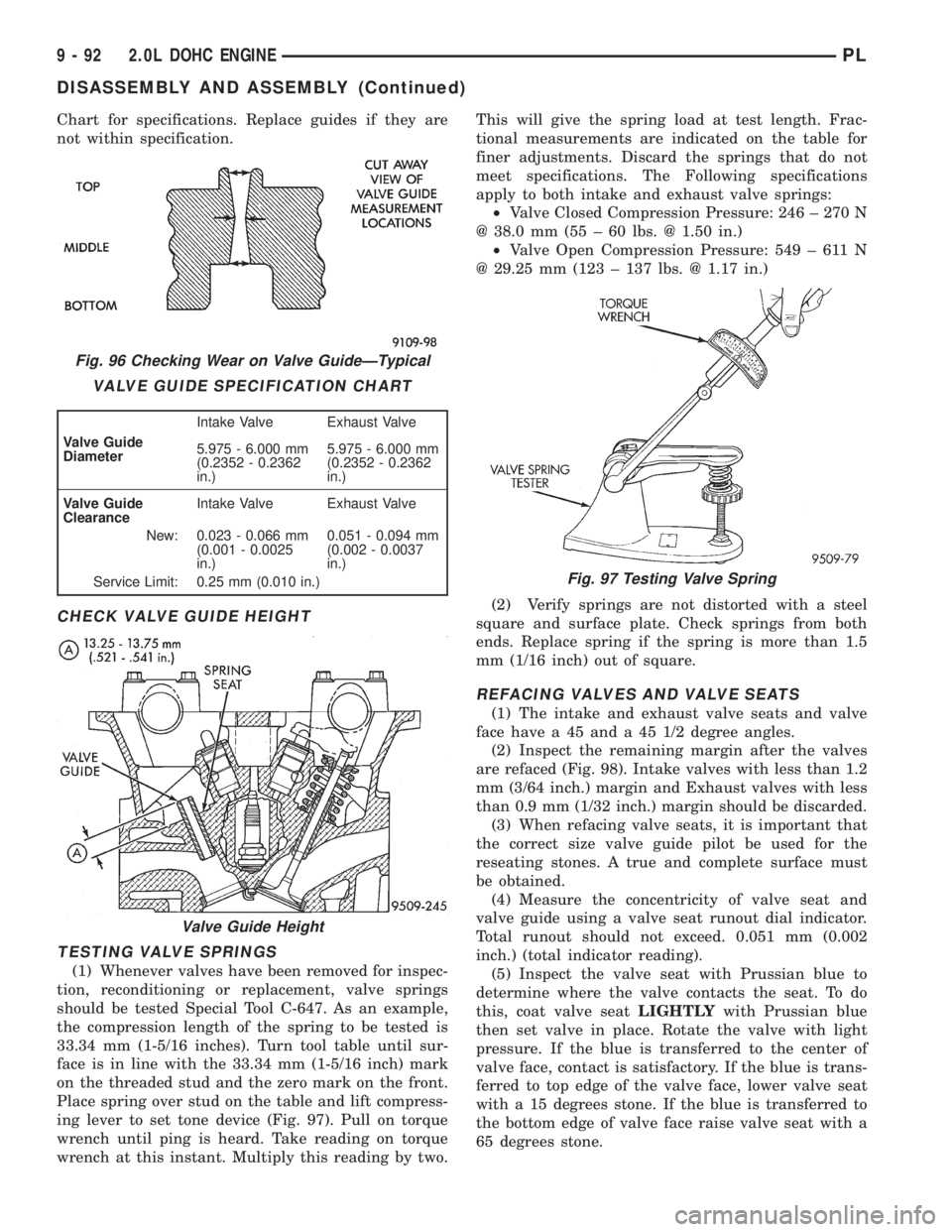
Chart for specifications. Replace guides if they are
not within specification.
CHECK VALVE GUIDE HEIGHT
TESTING VALVE SPRINGS
(1) Whenever valves have been removed for inspec-
tion, reconditioning or replacement, valve springs
should be tested Special Tool C-647. As an example,
the compression length of the spring to be tested is
33.34 mm (1-5/16 inches). Turn tool table until sur-
face is in line with the 33.34 mm (1-5/16 inch) mark
on the threaded stud and the zero mark on the front.
Place spring over stud on the table and lift compress-
ing lever to set tone device (Fig. 97). Pull on torque
wrench until ping is heard. Take reading on torque
wrench at this instant. Multiply this reading by two.This will give the spring load at test length. Frac-
tional measurements are indicated on the table for
finer adjustments. Discard the springs that do not
meet specifications. The Following specifications
apply to both intake and exhaust valve springs:
²Valve Closed Compression Pressure: 246 ± 270 N
@ 38.0 mm (55 ± 60 lbs. @ 1.50 in.)
²Valve Open Compression Pressure: 549 ± 611 N
@ 29.25 mm (123 ± 137 lbs. @ 1.17 in.)
(2) Verify springs are not distorted with a steel
square and surface plate. Check springs from both
ends. Replace spring if the spring is more than 1.5
mm (1/16 inch) out of square.
REFACING VALVES AND VALVE SEATS
(1) The intake and exhaust valve seats and valve
face have a 45 and a 45 1/2 degree angles.
(2) Inspect the remaining margin after the valves
are refaced (Fig. 98). Intake valves with less than 1.2
mm (3/64 inch.) margin and Exhaust valves with less
than 0.9 mm (1/32 inch.) margin should be discarded.
(3) When refacing valve seats, it is important that
the correct size valve guide pilot be used for the
reseating stones. A true and complete surface must
be obtained.
(4) Measure the concentricity of valve seat and
valve guide using a valve seat runout dial indicator.
Total runout should not exceed. 0.051 mm (0.002
inch.) (total indicator reading).
(5) Inspect the valve seat with Prussian blue to
determine where the valve contacts the seat. To do
this, coat valve seatLIGHTLYwith Prussian blue
then set valve in place. Rotate the valve with light
pressure. If the blue is transferred to the center of
valve face, contact is satisfactory. If the blue is trans-
ferred to top edge of the valve face, lower valve seat
with a 15 degrees stone. If the blue is transferred to
the bottom edge of valve face raise valve seat with a
65 degrees stone.
Fig. 96 Checking Wear on Valve GuideÐTypical
VALVE GUIDE SPECIFICATION CHART
Valve Guide
DiameterIntake Valve Exhaust Valve
5.975 - 6.000 mm
(0.2352 - 0.2362
in.)5.975 - 6.000 mm
(0.2352 - 0.2362
in.)
Valve Guide
ClearanceIntake Valve Exhaust Valve
New: 0.023 - 0.066 mm
(0.001 - 0.0025
in.)0.051 - 0.094 mm
(0.002 - 0.0037
in.)
Service Limit: 0.25 mm (0.010 in.)
Valve Guide Height
Fig. 97 Testing Valve Spring
9 - 92 2.0L DOHC ENGINEPL
DISASSEMBLY AND ASSEMBLY (Continued)
Page 806 of 1200
²Intake valve seat diameter is 34.37 - 34.63 mm
(1.353 - 1.363 inch.)
²Exhaust valve seat diameter is 29.37 29.63 mm
(1.156 1.166 inch.)
(6)
Valve seats which are worn or burned can be
reworked, provided that correct angle and seat width
are maintained. The intake valve seat must be serviced
when the valve seat width is 2.0 mm (0.079 in.) or
greater. The exhaust valve seat must be serviced when
the valve seat width is 2.5 mm (0.098 in.) or greater.
Otherwise the cylinder head must be replaced. For spec-
ification refer to Valve Specification Chart.
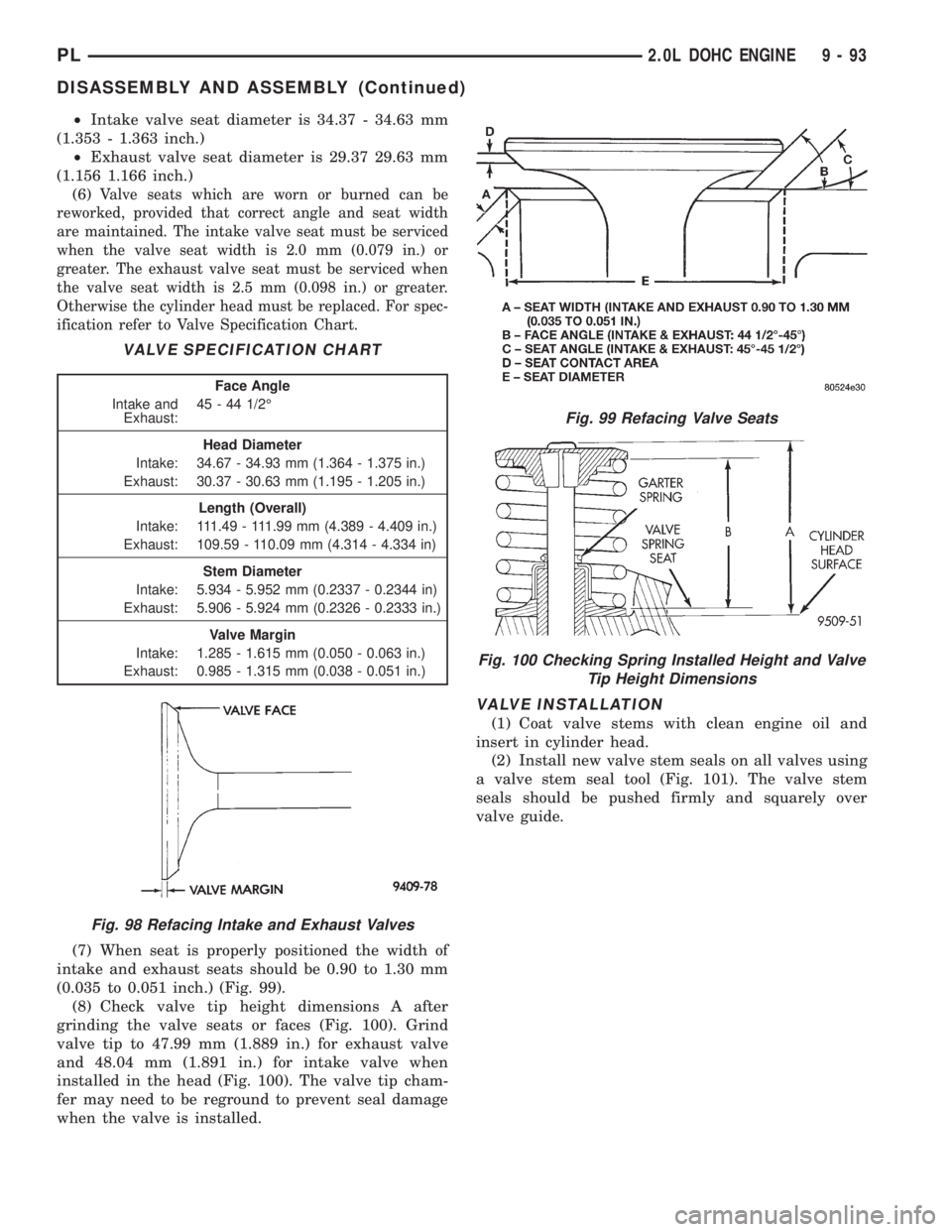
(7) When seat is properly positioned the width of
intake and exhaust seats should be 0.90 to 1.30 mm
(0.035 to 0.051 inch.) (Fig. 99).
(8) Check valve tip height dimensions A after
grinding the valve seats or faces (Fig. 100). Grind
valve tip to 47.99 mm (1.889 in.) for exhaust valve
and 48.04 mm (1.891 in.) for intake valve when
installed in the head (Fig. 100). The valve tip cham-
fer may need to be reground to prevent seal damage
when the valve is installed.
VALVE INSTALLATION
(1) Coat valve stems with clean engine oil and
insert in cylinder head.
(2) Install new valve stem seals on all valves using
a valve stem seal tool (Fig. 101). The valve stem
seals should be pushed firmly and squarely over
valve guide.
VALVE SPECIFICATION CHART
Face Angle
Intake and
Exhaust:45 - 44 1/2É
Head Diameter
Intake: 34.67 - 34.93 mm (1.364 - 1.375 in.)
Exhaust: 30.37 - 30.63 mm (1.195 - 1.205 in.)
Length (Overall)
Intake: 111.49 - 111.99 mm (4.389 - 4.409 in.)
Exhaust: 109.59 - 110.09 mm (4.314 - 4.334 in)
Stem Diameter
Intake: 5.934 - 5.952 mm (0.2337 - 0.2344 in)
Exhaust: 5.906 - 5.924 mm (0.2326 - 0.2333 in.)
Valve Margin
Intake: 1.285 - 1.615 mm (0.050 - 0.063 in.)
Exhaust: 0.985 - 1.315 mm (0.038 - 0.051 in.)
Fig. 98 Refacing Intake and Exhaust Valves
Fig. 99 Refacing Valve Seats
Fig. 100 Checking Spring Installed Height and Valve
Tip Height Dimensions
PL2.0L DOHC ENGINE 9 - 93
DISASSEMBLY AND ASSEMBLY (Continued)
Page 807 of 1200
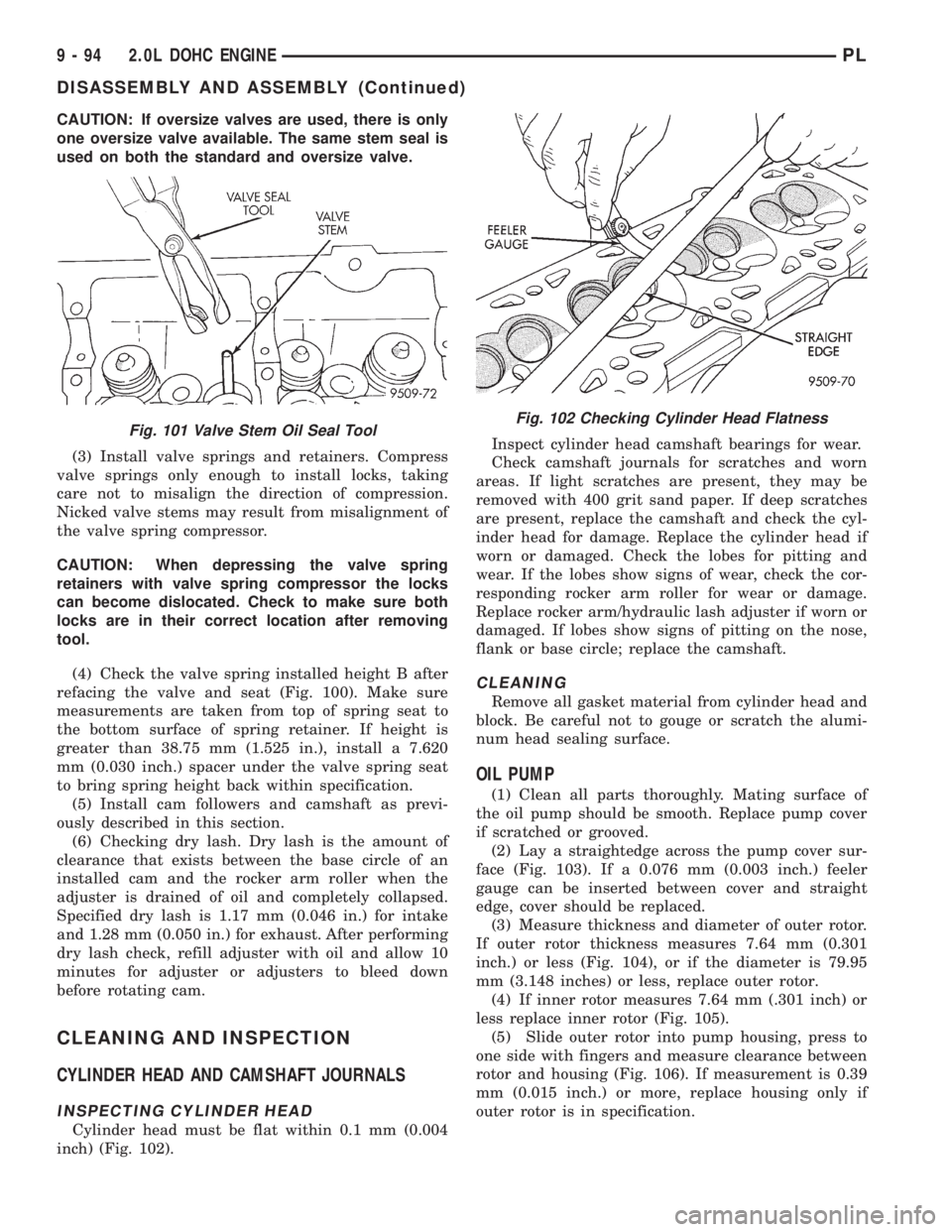
CAUTION: If oversize valves are used, there is only
one oversize valve available. The same stem seal is
used on both the standard and oversize valve.
(3) Install valve springs and retainers. Compress
valve springs only enough to install locks, taking
care not to misalign the direction of compression.
Nicked valve stems may result from misalignment of
the valve spring compressor.
CAUTION: When depressing the valve spring
retainers with valve spring compressor the locks
can become dislocated. Check to make sure both
locks are in their correct location after removing
tool.
(4) Check the valve spring installed height B after
refacing the valve and seat (Fig. 100). Make sure
measurements are taken from top of spring seat to
the bottom surface of spring retainer. If height is
greater than 38.75 mm (1.525 in.), install a 7.620
mm (0.030 inch.) spacer under the valve spring seat
to bring spring height back within specification.
(5) Install cam followers and camshaft as previ-
ously described in this section.
(6) Checking dry lash. Dry lash is the amount of
clearance that exists between the base circle of an
installed cam and the rocker arm roller when the
adjuster is drained of oil and completely collapsed.
Specified dry lash is 1.17 mm (0.046 in.) for intake
and 1.28 mm (0.050 in.) for exhaust. After performing
dry lash check, refill adjuster with oil and allow 10
minutes for adjuster or adjusters to bleed down
before rotating cam.
CLEANING AND INSPECTION
CYLINDER HEAD AND CAMSHAFT JOURNALS
INSPECTING CYLINDER HEAD
Cylinder head must be flat within 0.1 mm (0.004
inch) (Fig. 102).Inspect cylinder head camshaft bearings for wear.
Check camshaft journals for scratches and worn
areas. If light scratches are present, they may be
removed with 400 grit sand paper. If deep scratches
are present, replace the camshaft and check the cyl-
inder head for damage. Replace the cylinder head if
worn or damaged. Check the lobes for pitting and
wear. If the lobes show signs of wear, check the cor-
responding rocker arm roller for wear or damage.
Replace rocker arm/hydraulic lash adjuster if worn or
damaged. If lobes show signs of pitting on the nose,
flank or base circle; replace the camshaft.
CLEANING
Remove all gasket material from cylinder head and
block. Be careful not to gouge or scratch the alumi-
num head sealing surface.
OIL PUMP
(1) Clean all parts thoroughly. Mating surface of
the oil pump should be smooth. Replace pump cover
if scratched or grooved.
(2) Lay a straightedge across the pump cover sur-
face (Fig. 103). If a 0.076 mm (0.003 inch.) feeler
gauge can be inserted between cover and straight
edge, cover should be replaced.
(3) Measure thickness and diameter of outer rotor.
If outer rotor thickness measures 7.64 mm (0.301
inch.) or less (Fig. 104), or if the diameter is 79.95
mm (3.148 inches) or less, replace outer rotor.
(4) If inner rotor measures 7.64 mm (.301 inch) or
less replace inner rotor (Fig. 105).
(5) Slide outer rotor into pump housing, press to
one side with fingers and measure clearance between
rotor and housing (Fig. 106). If measurement is 0.39
mm (0.015 inch.) or more, replace housing only if
outer rotor is in specification.
Fig. 101 Valve Stem Oil Seal ToolFig. 102 Checking Cylinder Head Flatness
9 - 94 2.0L DOHC ENGINEPL
DISASSEMBLY AND ASSEMBLY (Continued)
Page 819 of 1200
DIAGNOSIS AND TESTING
REMOVAL AND INSTALLATION
EXHAUST PIPE AND MUFFLER
REMOVAL
(1) Raise vehicle on hoist and apply penetrating oil
to band clamp fastener of component being removed
(Fig. 6).NOTE: Do not use petroleum-based lubricants
when removing/installing muffler or exhaust pipe
isolators as it may compromise the life of the part.
A suitable substitute is a mixture of liquid dish
soap and water.
(2) Loosen band clamp and remove support insula-
tors at muffler (Fig. 7). Remove muffler from exhaust
pipe.
EXHAUST SYSTEM DIAGNOSIS CHART
CONDITION POSSIBLE CAUSES CORRECTION
EXCESSIVE EXHAUST NOISE
(UNDER HOOD)1. Exhaust manifold cracked or
broken.1. Replace manifold.
2. Manifold to cylinder head leak. 2. Tighten manifold and/or replace
gasket.
3. EGR Valve Leakage. 3. See Below:
(a) EGR valve to manifold gasket. (a) Tighten bolts and/or replace
gasket.
(b) EGR valve to EGR tube gasket. (b) Tighten bolts and/or replace
gasket.
(c) EGR tube to intake manifold
gasket.(c) Tighten bolts and/or replace
gasket.
4. Exhaust flex joint. (non LEV) 4. See Below:
(a) Spring height, not correctly
installed.(a) Check spring height, both sides
(specification is 32.5 mm, 1.28 inch)
look for source of spring height
variation if out of specification
(b) Exhaust sealing ring defective. (b) Inspect seal for damage on
round spherical surface. If no
damage is evident, check for
exhaust restriction causing high back
pressure on heavy acceleration.
5. Exhaust Flex joint to manifold
leak (LEV).5.Tighten nuts or replace gasket.
6. Exhaust flex joint (LEV). 6. Replace catalytic converter
assembly.
7. Pipe and shell noise from front
exhaust pipe.7. Characteristic of single wall pipes.
EXCESSIVE EXHAUST NOISE 1. Leaks at pipe joints. 1. Tighten or replace clamps at
leaking joints.
2. Burned, blown, or rusted out
exhaust pipe or muffler.2. Replace muffler or exhaust pipes.
3. Restriction in muffler or tailpipe. 3. Remove restriction, if possible or
replace as necessary.
4. Catalytic converter material in
muffler.4. replace muffler and converter
assembly. Check fuel injection and
ignition systems for proper operation.
11 - 4 EXHAUST SYSTEM AND INTAKE MANIFOLDPL
Page 1087 of 1200
B-PILLAR TRIMÐ4 DOOR
REMOVAL
(1) Remove bolt holding lower seat belt anchor to
floor pan kick-up.
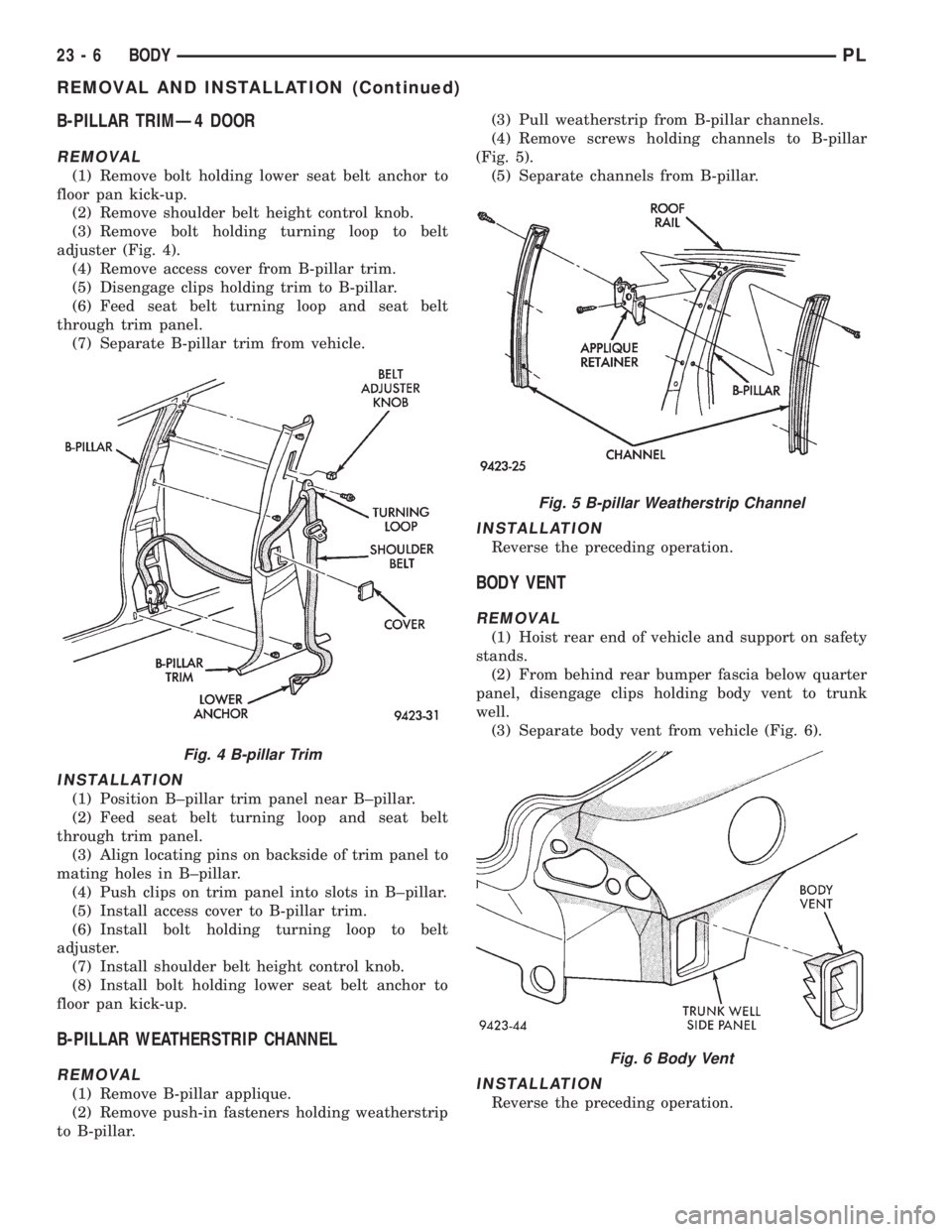
(2) Remove shoulder belt height control knob.
(3) Remove bolt holding turning loop to belt
adjuster (Fig. 4).
(4) Remove access cover from B-pillar trim.
(5) Disengage clips holding trim to B-pillar.
(6) Feed seat belt turning loop and seat belt
through trim panel.
(7) Separate B-pillar trim from vehicle.
INSTALLATION
(1) Position B±pillar trim panel near B±pillar.
(2) Feed seat belt turning loop and seat belt
through trim panel.
(3) Align locating pins on backside of trim panel to
mating holes in B±pillar.
(4) Push clips on trim panel into slots in B±pillar.
(5) Install access cover to B-pillar trim.
(6) Install bolt holding turning loop to belt
adjuster.
(7) Install shoulder belt height control knob.
(8) Install bolt holding lower seat belt anchor to
floor pan kick-up.
B-PILLAR WEATHERSTRIP CHANNEL
REMOVAL
(1) Remove B-pillar applique.
(2) Remove push-in fasteners holding weatherstrip
to B-pillar.(3) Pull weatherstrip from B-pillar channels.
(4) Remove screws holding channels to B-pillar
(Fig. 5).
(5) Separate channels from B-pillar.
INSTALLATION
Reverse the preceding operation.
BODY VENT
REMOVAL
(1) Hoist rear end of vehicle and support on safety
stands.
(2) From behind rear bumper fascia below quarter
panel, disengage clips holding body vent to trunk
well.
(3) Separate body vent from vehicle (Fig. 6).
INSTALLATION
Reverse the preceding operation.
Fig. 4 B-pillar Trim
Fig. 5 B-pillar Weatherstrip Channel
Fig. 6 Body Vent
23 - 6 BODYPL
REMOVAL AND INSTALLATION (Continued)
Page 1101 of 1200
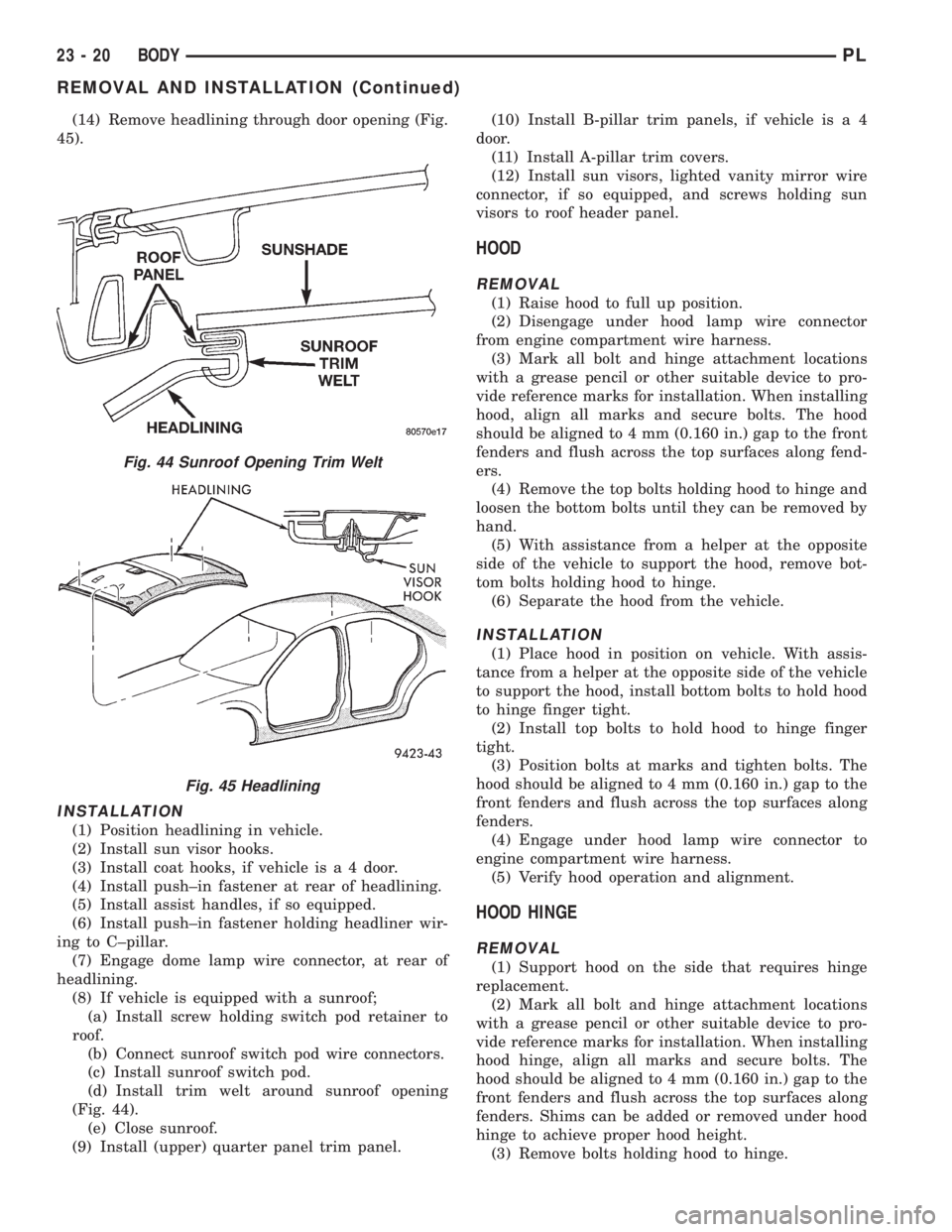
(14) Remove headlining through door opening (Fig.
45).
INSTALLATION
(1) Position headlining in vehicle.
(2) Install sun visor hooks.
(3) Install coat hooks, if vehicle is a 4 door.
(4) Install push±in fastener at rear of headlining.
(5) Install assist handles, if so equipped.
(6) Install push±in fastener holding headliner wir-
ing to C±pillar.
(7) Engage dome lamp wire connector, at rear of
headlining.
(8) If vehicle is equipped with a sunroof;
(a) Install screw holding switch pod retainer to
roof.
(b) Connect sunroof switch pod wire connectors.
(c) Install sunroof switch pod.
(d) Install trim welt around sunroof opening
(Fig. 44).
(e) Close sunroof.
(9) Install (upper) quarter panel trim panel.(10) Install B-pillar trim panels, if vehicle is a 4
door.
(11) Install A-pillar trim covers.
(12) Install sun visors, lighted vanity mirror wire
connector, if so equipped, and screws holding sun
visors to roof header panel.
HOOD
REMOVAL
(1) Raise hood to full up position.
(2) Disengage under hood lamp wire connector
from engine compartment wire harness.
(3) Mark all bolt and hinge attachment locations
with a grease pencil or other suitable device to pro-
vide reference marks for installation. When installing
hood, align all marks and secure bolts. The hood
should be aligned to 4 mm (0.160 in.) gap to the front
fenders and flush across the top surfaces along fend-
ers.
(4) Remove the top bolts holding hood to hinge and
loosen the bottom bolts until they can be removed by
hand.
(5) With assistance from a helper at the opposite
side of the vehicle to support the hood, remove bot-
tom bolts holding hood to hinge.
(6) Separate the hood from the vehicle.
INSTALLATION
(1) Place hood in position on vehicle. With assis-
tance from a helper at the opposite side of the vehicle
to support the hood, install bottom bolts to hold hood
to hinge finger tight.
(2) Install top bolts to hold hood to hinge finger
tight.
(3) Position bolts at marks and tighten bolts. The
hood should be aligned to 4 mm (0.160 in.) gap to the
front fenders and flush across the top surfaces along
fenders.
(4) Engage under hood lamp wire connector to
engine compartment wire harness.
(5) Verify hood operation and alignment.
HOOD HINGE
REMOVAL
(1) Support hood on the side that requires hinge
replacement.
(2) Mark all bolt and hinge attachment locations
with a grease pencil or other suitable device to pro-
vide reference marks for installation. When installing
hood hinge, align all marks and secure bolts. The
hood should be aligned to 4 mm (0.160 in.) gap to the
front fenders and flush across the top surfaces along
fenders. Shims can be added or removed under hood
hinge to achieve proper hood height.
(3) Remove bolts holding hood to hinge.
Fig. 44 Sunroof Opening Trim Welt
Fig. 45 Headlining
23 - 20 BODYPL
REMOVAL AND INSTALLATION (Continued)
Page 1102 of 1200
(4) Remove bolts holding hood hinge to front
fender flange and separate hinge from vehicle. If nec-
essary, paint new hinge before installation.
INSTALLATION
(1) If necessary, paint new hinge before installa-
tion.
(2) Place hinge in position on vehicle.
(3) Install bolts to hold hood hinge to front fender
flange.
(4) Install bolts to hold hood to hinge.
(5) Align all marks and secure bolts. The hood
should be aligned to 4 mm (0.160 in.) gap to the front
fenders and flush across the top surfaces along fend-
ers. Shims can be added or removed under hood
hinge to achieve proper hood height.
(6) Remove support from under hood and verify
hood operation.
HOOD LATCH
REMOVAL
(1) Release hood latch and open hood.
(2) Support hood on prop rod.
(3) Remove grille.
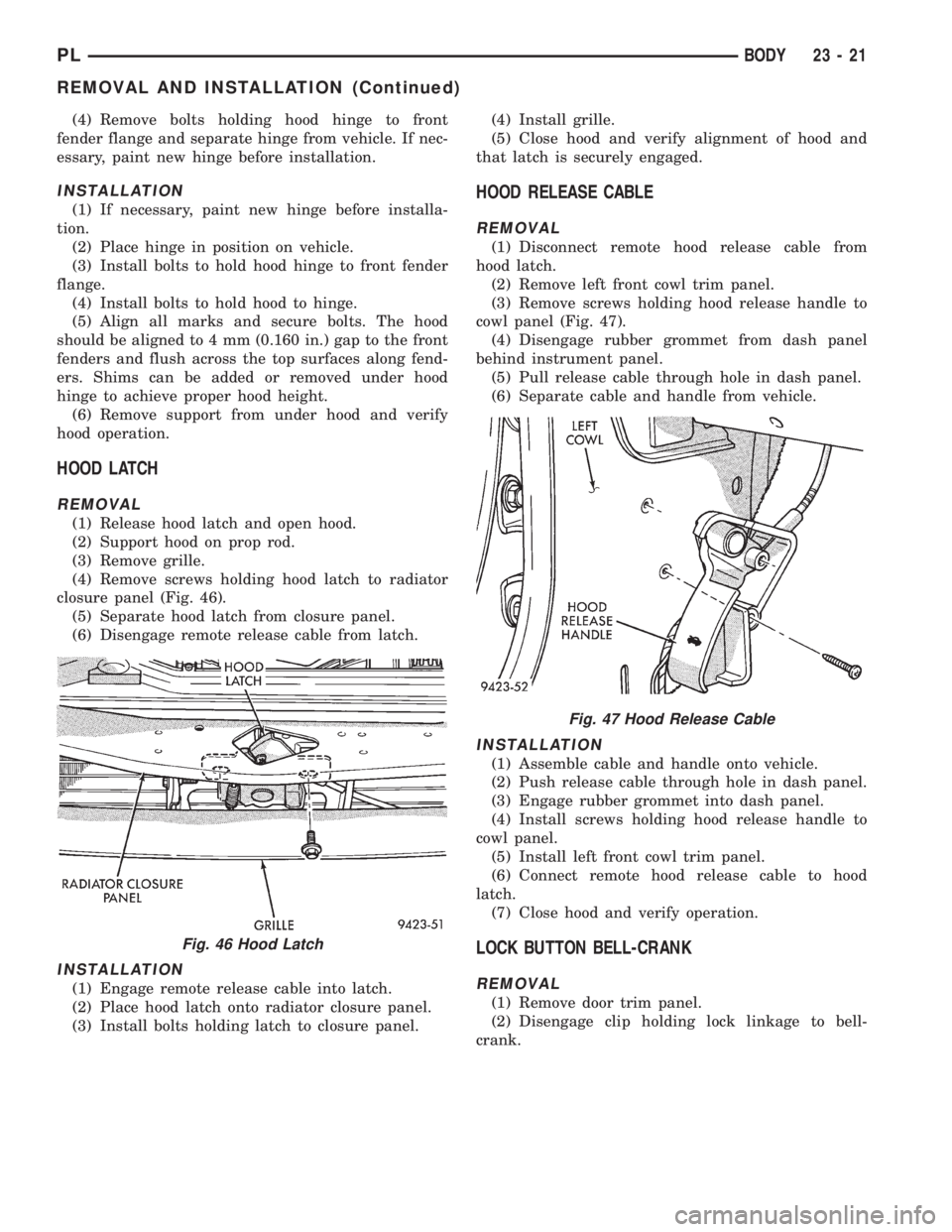
(4) Remove screws holding hood latch to radiator
closure panel (Fig. 46).
(5) Separate hood latch from closure panel.
(6) Disengage remote release cable from latch.
INSTALLATION
(1) Engage remote release cable into latch.
(2) Place hood latch onto radiator closure panel.
(3) Install bolts holding latch to closure panel.(4) Install grille.
(5) Close hood and verify alignment of hood and
that latch is securely engaged.
HOOD RELEASE CABLE
REMOVAL
(1) Disconnect remote hood release cable from
hood latch.
(2) Remove left front cowl trim panel.
(3) Remove screws holding hood release handle to
cowl panel (Fig. 47).
(4) Disengage rubber grommet from dash panel
behind instrument panel.
(5) Pull release cable through hole in dash panel.
(6) Separate cable and handle from vehicle.
INSTALLATION
(1) Assemble cable and handle onto vehicle.
(2) Push release cable through hole in dash panel.
(3) Engage rubber grommet into dash panel.
(4) Install screws holding hood release handle to
cowl panel.
(5) Install left front cowl trim panel.
(6) Connect remote hood release cable to hood
latch.
(7) Close hood and verify operation.
LOCK BUTTON BELL-CRANK
REMOVAL
(1) Remove door trim panel.
(2) Disengage clip holding lock linkage to bell-
crank.
Fig. 46 Hood Latch
Fig. 47 Hood Release Cable
PLBODY 23 - 21
REMOVAL AND INSTALLATION (Continued)
Page 1118 of 1200
(6) Connect wire connector to power window motor,
if so equipped.
(7) Install door speaker, if so equipped.
(8) Install door trim panel and water shield.
ADJUSTMENTS
FRONT DOOR GLASS ADJUSTMENT
UP-STOP ADJUSTMENTS
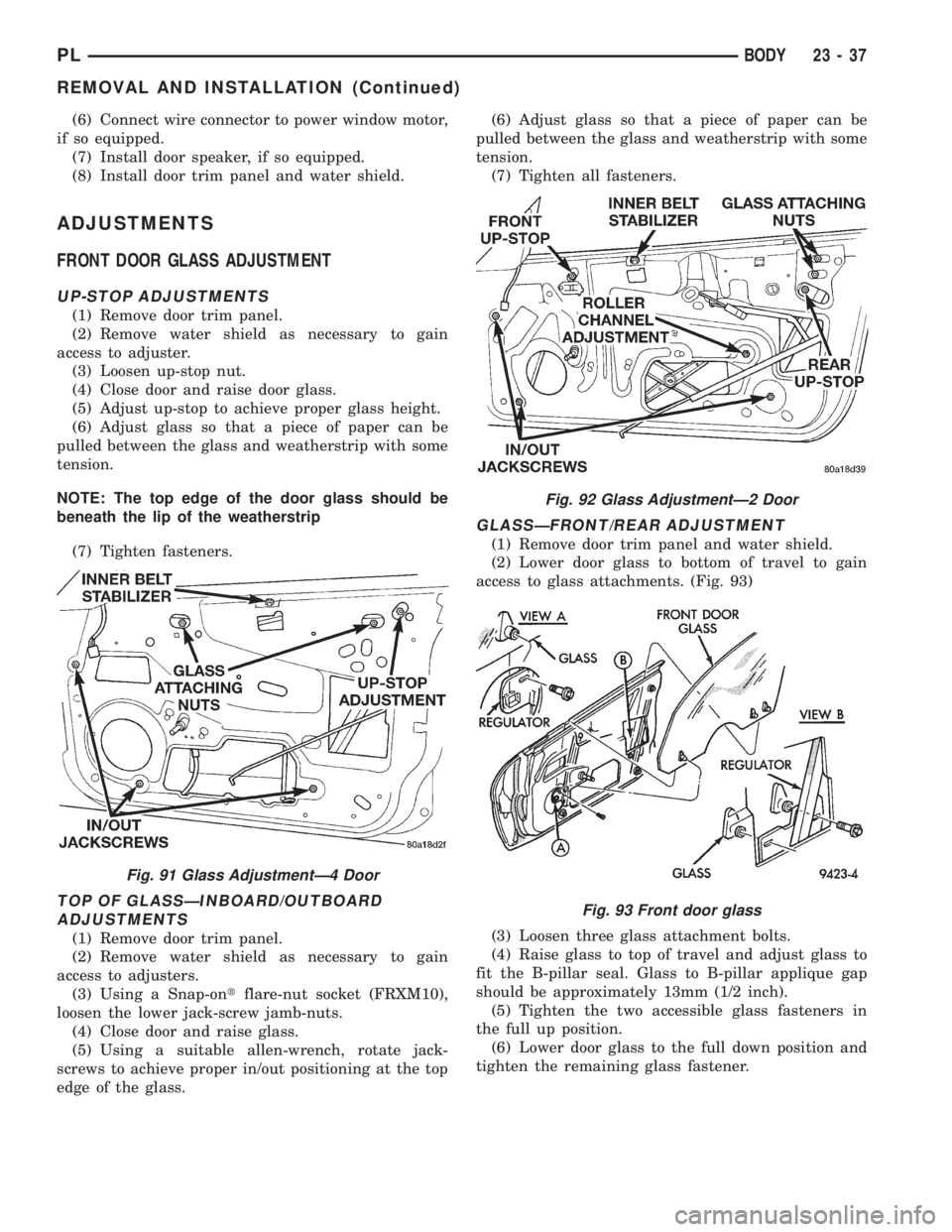
(1) Remove door trim panel.
(2) Remove water shield as necessary to gain
access to adjuster.
(3) Loosen up-stop nut.
(4) Close door and raise door glass.
(5) Adjust up-stop to achieve proper glass height.
(6) Adjust glass so that a piece of paper can be
pulled between the glass and weatherstrip with some
tension.
NOTE: The top edge of the door glass should be
beneath the lip of the weatherstrip
(7) Tighten fasteners.
TOP OF GLASSÐINBOARD/OUTBOARD
ADJUSTMENTS
(1) Remove door trim panel.
(2) Remove water shield as necessary to gain
access to adjusters.
(3) Using a Snap-ontflare-nut socket (FRXM10),
loosen the lower jack-screw jamb-nuts.
(4) Close door and raise glass.
(5) Using a suitable allen-wrench, rotate jack-
screws to achieve proper in/out positioning at the top
edge of the glass.(6) Adjust glass so that a piece of paper can be
pulled between the glass and weatherstrip with some
tension.
(7) Tighten all fasteners.
GLASSÐFRONT/REAR ADJUSTMENT
(1) Remove door trim panel and water shield.
(2) Lower door glass to bottom of travel to gain
access to glass attachments. (Fig. 93)
(3) Loosen three glass attachment bolts.
(4) Raise glass to top of travel and adjust glass to
fit the B-pillar seal. Glass to B-pillar applique gap
should be approximately 13mm (1/2 inch).
(5) Tighten the two accessible glass fasteners in
the full up position.
(6) Lower door glass to the full down position and
tighten the remaining glass fastener.
Fig. 91 Glass AdjustmentÐ4 Door
Fig. 92 Glass AdjustmentÐ2 Door
Fig. 93 Front door glass
PLBODY 23 - 37
REMOVAL AND INSTALLATION (Continued)