fuses DODGE NEON 1999 Service Owner's Manual
[x] Cancel search | Manufacturer: DODGE, Model Year: 1999, Model line: NEON, Model: DODGE NEON 1999Pages: 1200, PDF Size: 35.29 MB
Page 882 of 1200
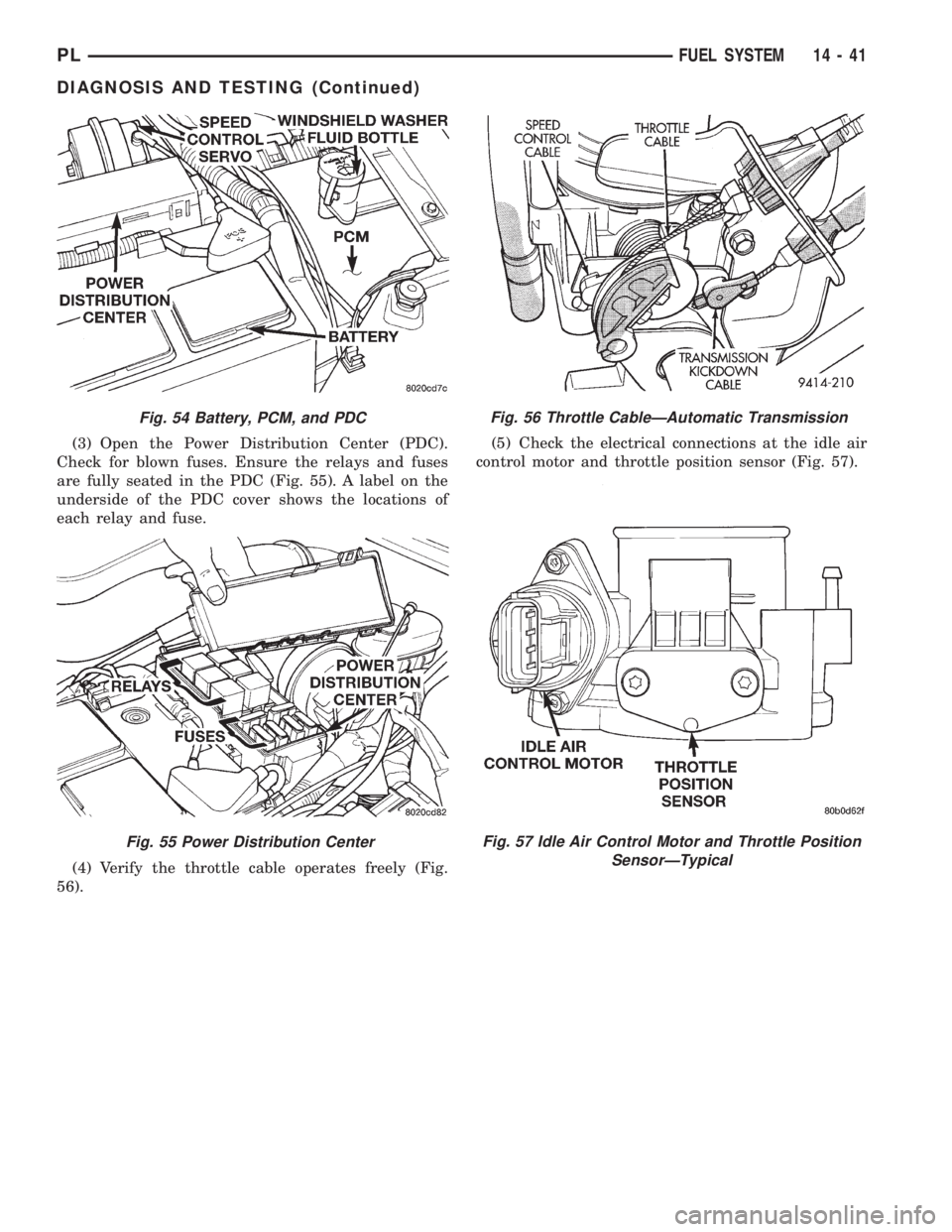
(3) Open the Power Distribution Center (PDC).
Check for blown fuses. Ensure the relays and fuses
are fully seated in the PDC (Fig. 55). A label on the
underside of the PDC cover shows the locations of
each relay and fuse.
(4) Verify the throttle cable operates freely (Fig.
56).(5) Check the electrical connections at the idle air
control motor and throttle position sensor (Fig. 57).
Fig. 54 Battery, PCM, and PDC
Fig. 55 Power Distribution Center
Fig. 56 Throttle CableÐAutomatic Transmission
Fig. 57 Idle Air Control Motor and Throttle Position
SensorÐTypical
PLFUEL SYSTEM 14 - 41
DIAGNOSIS AND TESTING (Continued)
Page 1128 of 1200
SUNROOF
INDEX
page page
DIAGNOSIS AND TESTING
DIAGNOSTIC PROCEDURES............... 47
SUNROOF DIAGNOSIS................... 47
REMOVAL AND INSTALLATION
SUNROOF CABLES...................... 48
SUNROOF COMPONENTS................ 49
SUNROOF DRIVE MOTOR................. 49
SUNROOF GLASS PANEL................. 49SUNROOF GUIDE AND MECHANISM
ASSEMBLY........................... 49
SUNROOF MODULE..................... 50
SUNROOF PROCEDURE INFORMATION...... 48
SUNROOF SUNSHADE................... 50
SUNROOF WIND DEFLECTOR............. 51
ADJUSTMENTS
SUNROOF GLASS HEIGHT ADJUSTMENT.... 51
DIAGNOSIS AND TESTING
DIAGNOSTIC PROCEDURES
Before beginning sunroof diagnostics verify that all
other power accessories are in proper operating con-
dition. If not, a common electrical problem may exist.
Refer to the Wiring Diagrams section of this publica-tion for circuit, splice and component descriptions.
Check the condition of the circuit protection (fuses,
circuit breakers or fuse links). Inspect all wiring con-
nector pins for proper engagement and continuity.
Check for battery voltage at the power sunroof con-
trol switches. If battery voltage is detected at the
control switches, proceed with the following tests.
SUNROOF DIAGNOSIS
SYMPTOM POSSIBLE CAUSE
Sunroof motor inoperative.²Contaminated or corroded slides and channels.
²Binding cable or linkage.
²Faulty circuit ground.
²Faulty power circuit to sunroof drive motor.
²Faulty sunroof drive motor.
²Faulty sunroof motor connector.
Audible whine when switch is depressed,
sunroof does not operate.²Faulty motor drive clutch.
²Binding linkage.
²Faulty sunroof motor connections.
Sunroof opens, but does not close.²Binding linkage.
²Faulty circuit.
²Faulty switch.
Sunroof vents, but does not open.²Binding linkage.
²Faulty circuit.
²Faulty switch.
Sunroof does not vent²Binding cable.
²Faulty circuit.
²Faulty switch.
Sunroof vents and opens but does not
close²Binding linkage.
²Faulty circuit.
²Faulty switch.
Sunroof water leak.²Drain tubes clogged or kinked.
²Glass panel improperly adjusted.
²Faulty glass panel seal.
PLBODY 23 - 47
Page 1141 of 1200
(3) Close all doors, windows and vents to the pas-
senger compartment.
(4) Set Heater-A/C control to A/C, full heat, floor,
RECIRC. and high blower.
(5) Start the engine and hold the idle speed (1000
rpm). After the engine has reached running temper-
ature, allow the passenger compartment to heat up.
This will create the need for maximum refrigerant
flow into the evaporator.
(6) If the refrigerant charge is sufficient, discharge
(high pressure) gauge should read 965 to 2620 kPa
(140 to 380 psi). Suction (low pressure) gauge should
read 103 to 2417 kPa (15 to 35 psi). If system cannot
achieve proper pressure readings, replace the expan-
sion valve. If pressure is correct, proceed with test.
WARNING: PROTECT SKIN AND EYES FROM CON-
TACTING CO2 PERSONAL INJURY CAN RESULT.
(7) If suction side low pressure is within specified
range, freeze the expansion valve control head (Fig.
10) for 30 seconds. Use a super cold substance (liquid
CO2).Do not spray refrigerant on the expansion
valve for this test.Suction side low pressure should
drop to 34.5 kPa (5 psi) If not, replace expansion
valve.
(8) Allow expansion valve to thaw. The low pres-
sure gauge reading should stabilize at 103 to 241
kPa (15 to 35 psi). If not, replace expansion valve.
(9) When expansion valve test is complete, test
A/C overall performance. Refer to the Heater and A/C
Performance Test in this section. Remove all test
equipment before returning vehicle to use.
BLOWER MOTOR ELECTRICAL DIAGNOSIS
Refer to the Blower Motor Electrical System Diag-
nosis chart in this section. Also refer to Group 8W,
Wiring Diagrams for more information.
BLOWER MOTOR VIBRATION AND/OR NOISE
DIAGNOSIS
The resistor block supplies the blower motor with
varied voltage (low and middle speeds) or battery
voltage (high speed).
CAUTION: Stay clear of the blower motor and resis-
tor block (Hot). Do not operate the blower motor
with the resistor block removed from the heater-A/C
housing.
Refer to the Blower Motor Vibration/Noise chart
for diagnosis.
EVAPORATOR PROBE TEST
The work area and vehicle must be between 16É C
(60É F) and 32É C (90É F) when testing the switch.(1) Disconnect the three wire connector from the
evaporator probe lead located behind the glove box.
(2) Start engine and set A/C to low blower motor
speed, panel, full cool, and RECIRC.
(3) Using a voltmeter, check for battery voltage
between Pin 1 and 2. If no voltage is detected, there
is no power to the switch. Check wiring and fuses.
Refer to Group 8W, Wiring Diagrams for circuit diag-
nosis.
(4) Using a voltmeter, check for battery voltage
between Pin 1 and Pin 3. If no voltage is detected,
there is no voltage from the Powertrain Control Mod-
ule. Refer to Group 8W, Wiring Diagrams. If voltage
is OK, connect a jumper wire between Pin 1 and Pin
3. The compressor clutch should engage. If the clutch
engages, remove the jumper wire immediately and go
to Step 5. If the compressor clutch does not engage,
check the operation of the clutch and repair as nec-
essary.
(5) If compressor clutch engages, connect the evap-
orator probe 3-way connector. The compressor clutch
should engage or cycle depending on evaporator tem-
perature. If OK, go to Step 6. If not OK, replace the
clutch cycling switch.
(6) The engine running and the A/C set to:
²Blower motor on low speed
²Panel position
²Full cool
²RECIRC.
Close all doors and windows. Place a thermometer
in the center discharge vent.
(7) If the clutch does not begin to cycle off between
2É C to 7É C (35É F to 45É F), verify that the evapo-
rator probe is fully installed and not loose in evapo-
rator. If it is not properly installed, install probe and
retest outlet temperature. If the evaporator probe is
properly installed, replace the clutch cycling switch.
HEATER PERFORMANCE TEST
PRE-DIAGNOSTIC PREPARATIONS
Review Safety Precautions and Warnings in this
group before performing the following procedures.
Check the coolant level, drive belt tension, vacuum
line connections, radiator air flow and fan operation.
Start engine and allow to warm up to normal tem-
perature.
WARNING: DO NOT REMOVE RADIATOR CAP
WHEN ENGINE IS HOT, PERSONAL INJURY CAN
RESULT.
If vehicle has been run recently, wait 15 minutes
before removing cap. Place a rag over the cap and
turn it to the first safety stop. Allow pressure to
escape through the overflow tube. When the system
stabilizes, remove the cap completely.
24 - 8 HEATING AND AIR CONDITIONINGPL
DIAGNOSIS AND TESTING (Continued)