charging DODGE NEON 1999 Service Owner's Guide
[x] Cancel search | Manufacturer: DODGE, Model Year: 1999, Model line: NEON, Model: DODGE NEON 1999Pages: 1200, PDF Size: 35.29 MB
Page 332 of 1200
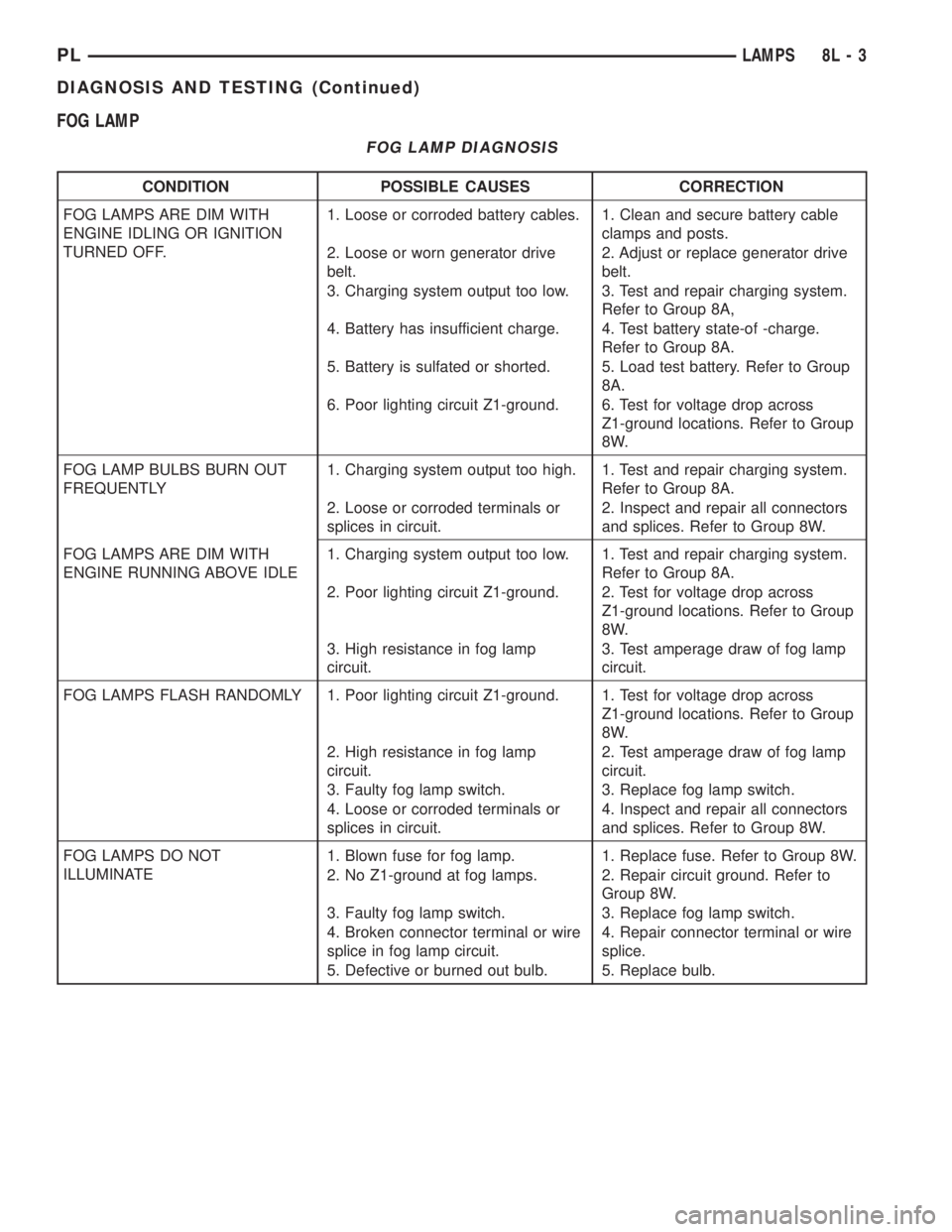
FOG LAMP
FOG LAMP DIAGNOSIS
CONDITION POSSIBLE CAUSES CORRECTION
FOG LAMPS ARE DIM WITH
ENGINE IDLING OR IGNITION
TURNED OFF.1. Loose or corroded battery cables. 1. Clean and secure battery cable
clamps and posts.
2. Loose or worn generator drive
belt.2. Adjust or replace generator drive
belt.
3. Charging system output too low. 3. Test and repair charging system.
Refer to Group 8A,
4. Battery has insufficient charge. 4. Test battery state-of -charge.
Refer to Group 8A.
5. Battery is sulfated or shorted. 5. Load test battery. Refer to Group
8A.
6. Poor lighting circuit Z1-ground. 6. Test for voltage drop across
Z1-ground locations. Refer to Group
8W.
FOG LAMP BULBS BURN OUT
FREQUENTLY1. Charging system output too high. 1. Test and repair charging system.
Refer to Group 8A.
2. Loose or corroded terminals or
splices in circuit.2. Inspect and repair all connectors
and splices. Refer to Group 8W.
FOG LAMPS ARE DIM WITH
ENGINE RUNNING ABOVE IDLE1. Charging system output too low. 1. Test and repair charging system.
Refer to Group 8A.
2. Poor lighting circuit Z1-ground. 2. Test for voltage drop across
Z1-ground locations. Refer to Group
8W.
3. High resistance in fog lamp
circuit.3. Test amperage draw of fog lamp
circuit.
FOG LAMPS FLASH RANDOMLY 1. Poor lighting circuit Z1-ground. 1. Test for voltage drop across
Z1-ground locations. Refer to Group
8W.
2. High resistance in fog lamp
circuit.2. Test amperage draw of fog lamp
circuit.
3. Faulty fog lamp switch. 3. Replace fog lamp switch.
4. Loose or corroded terminals or
splices in circuit.4. Inspect and repair all connectors
and splices. Refer to Group 8W.
FOG LAMPS DO NOT
ILLUMINATE1. Blown fuse for fog lamp. 1. Replace fuse. Refer to Group 8W.
2. No Z1-ground at fog lamps. 2. Repair circuit ground. Refer to
Group 8W.
3. Faulty fog lamp switch. 3. Replace fog lamp switch.
4. Broken connector terminal or wire
splice in fog lamp circuit.4. Repair connector terminal or wire
splice.
5. Defective or burned out bulb. 5. Replace bulb.
PLLAMPS 8L - 3
DIAGNOSIS AND TESTING (Continued)
Page 392 of 1200
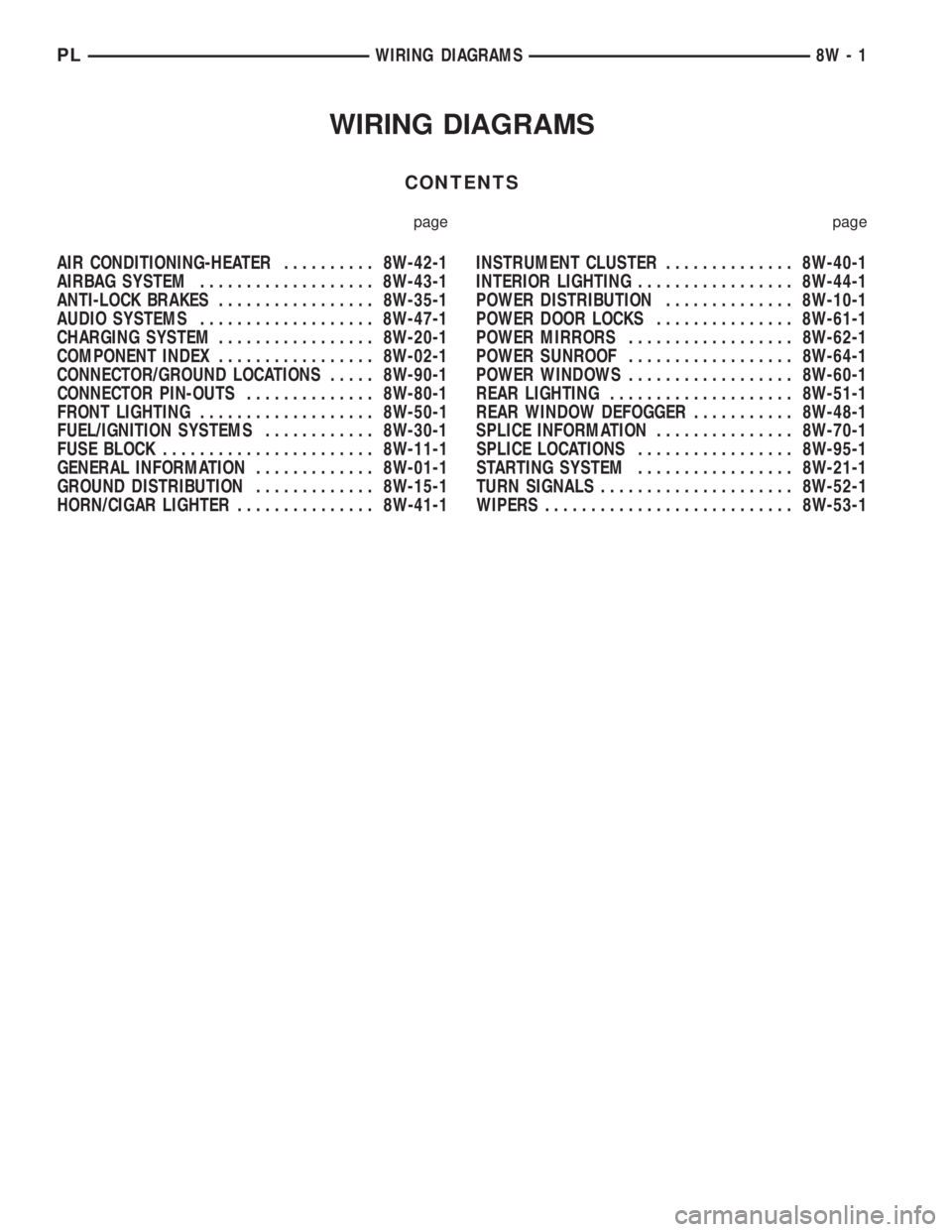
WIRING DIAGRAMS
CONTENTS
page page
AIR CONDITIONING-HEATER.......... 8W-42-1
AIRBAG SYSTEM................... 8W-43-1
ANTI-LOCK BRAKES................. 8W-35-1
AUDIO SYSTEMS................... 8W-47-1
CHARGING SYSTEM................. 8W-20-1
COMPONENT INDEX................. 8W-02-1
CONNECTOR/GROUND LOCATIONS..... 8W-90-1
CONNECTOR PIN-OUTS.............. 8W-80-1
FRONT LIGHTING................... 8W-50-1
FUEL/IGNITION SYSTEMS............ 8W-30-1
FUSE BLOCK....................... 8W-11-1
GENERAL INFORMATION............. 8W-01-1
GROUND DISTRIBUTION............. 8W-15-1
HORN/CIGAR LIGHTER............... 8W-41-1INSTRUMENT CLUSTER.............. 8W-40-1
INTERIOR LIGHTING................. 8W-44-1
POWER DISTRIBUTION.............. 8W-10-1
POWER DOOR LOCKS............... 8W-61-1
POWER MIRRORS.................. 8W-62-1
POWER SUNROOF.................. 8W-64-1
POWER WINDOWS.................. 8W-60-1
REAR LIGHTING.................... 8W-51-1
REAR WINDOW DEFOGGER........... 8W-48-1
SPLICE INFORMATION............... 8W-70-1
SPLICE LOCATIONS................. 8W-95-1
STARTING SYSTEM................. 8W-21-1
TURN SIGNALS..................... 8W-52-1
WIPERS........................... 8W-53-1
PLWIRING DIAGRAMS 8W - 1
Page 398 of 1200
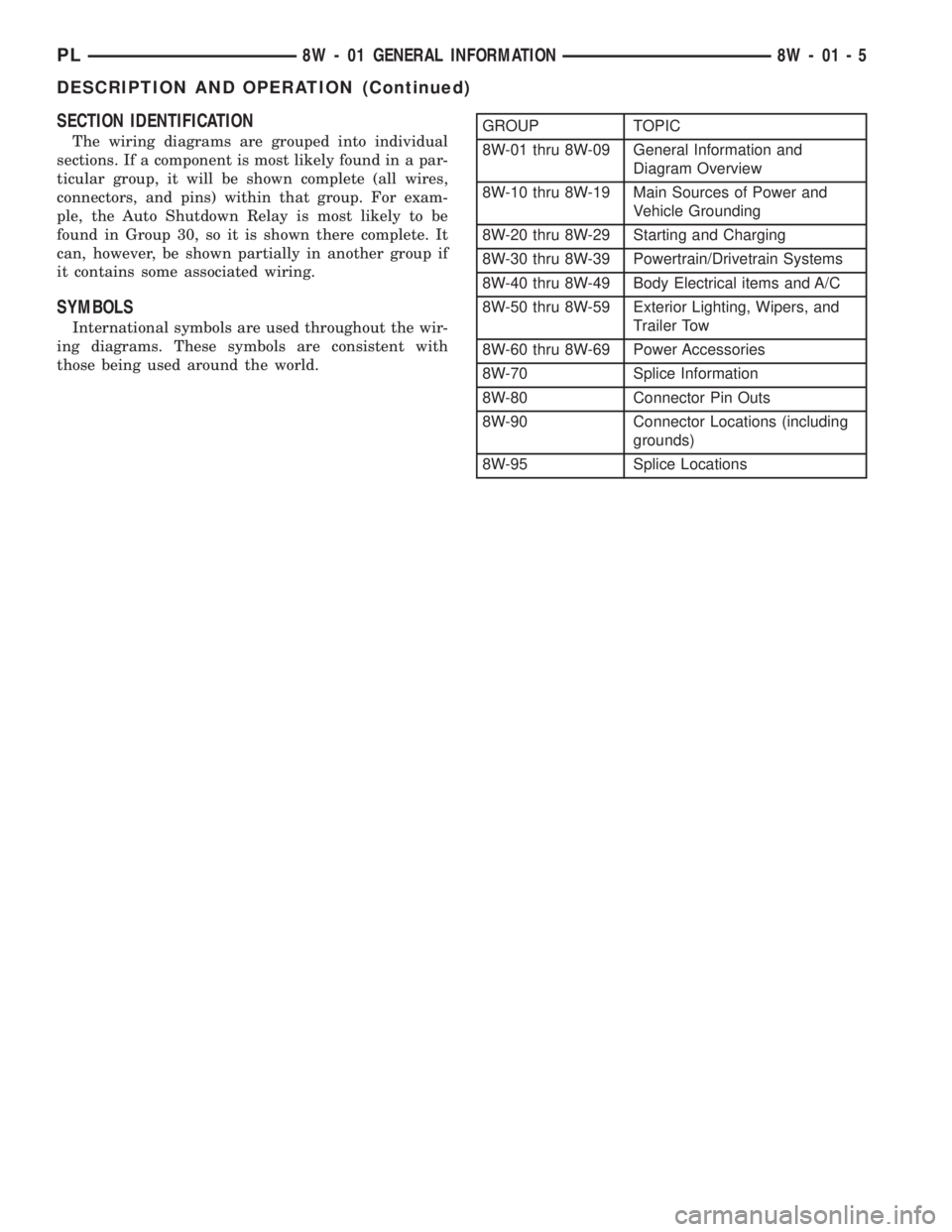
SECTION IDENTIFICATION
The wiring diagrams are grouped into individual
sections. If a component is most likely found in a par-
ticular group, it will be shown complete (all wires,
connectors, and pins) within that group. For exam-
ple, the Auto Shutdown Relay is most likely to be
found in Group 30, so it is shown there complete. It
can, however, be shown partially in another group if
it contains some associated wiring.
SYMBOLS
International symbols are used throughout the wir-
ing diagrams. These symbols are consistent with
those being used around the world.
GROUP TOPIC
8W-01 thru 8W-09 General Information and
Diagram Overview
8W-10 thru 8W-19 Main Sources of Power and
Vehicle Grounding
8W-20 thru 8W-29 Starting and Charging
8W-30 thru 8W-39 Powertrain/Drivetrain Systems
8W-40 thru 8W-49 Body Electrical items and A/C
8W-50 thru 8W-59 Exterior Lighting, Wipers, and
Trailer Tow
8W-60 thru 8W-69 Power Accessories
8W-70 Splice Information
8W-80 Connector Pin Outs
8W-90 Connector Locations (including
grounds)
8W-95 Splice Locations
PL8W - 01 GENERAL INFORMATION 8W - 01 - 5
DESCRIPTION AND OPERATION (Continued)
Page 468 of 1200
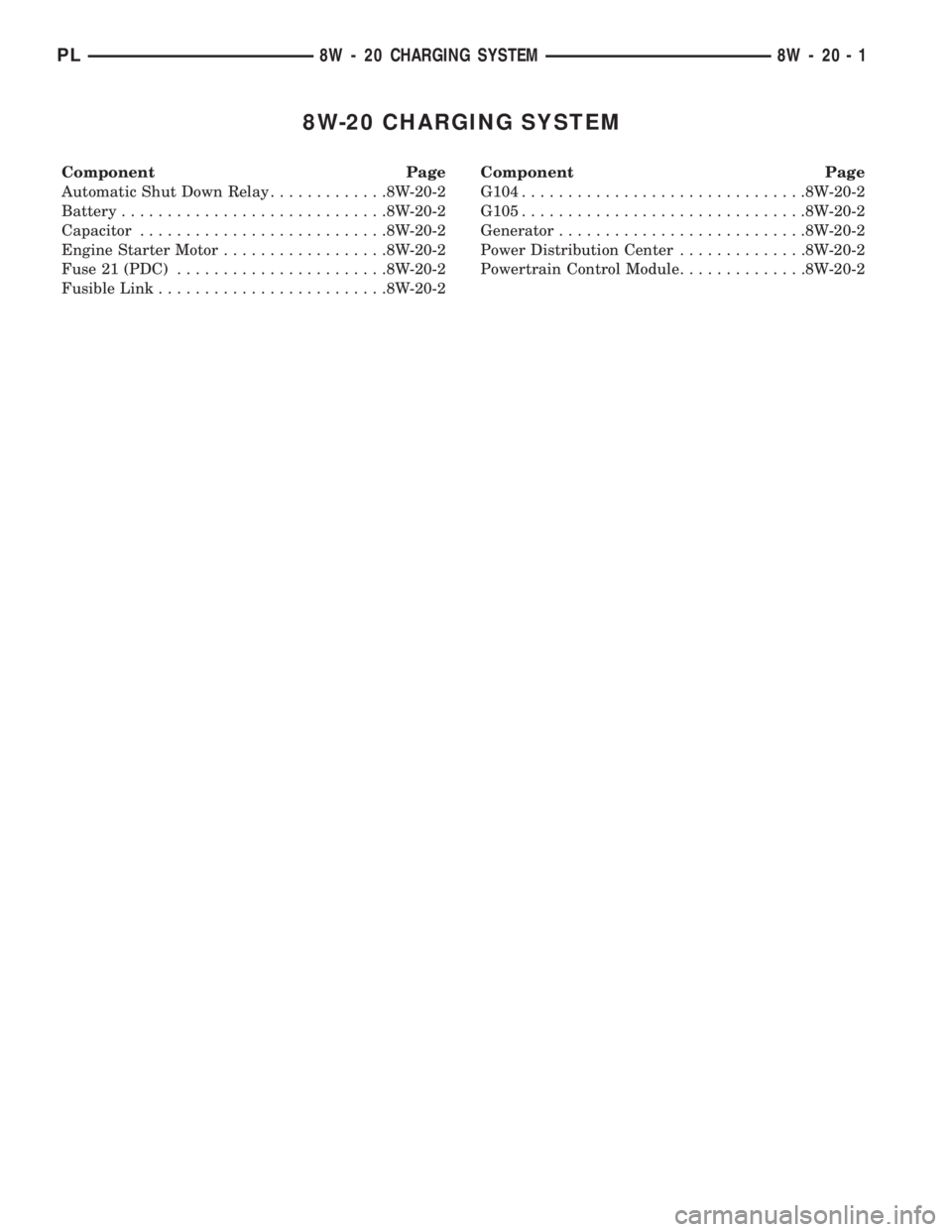
8W-20 CHARGING SYSTEM
Component Page
Automatic Shut Down Relay.............8W-20-2
Battery.............................8W-20-2
Capacitor...........................8W-20-2
Engine Starter Motor..................8W-20-2
Fuse 21 (PDC).......................8W-20-2
Fusible Link.........................8W-20-2Component Page
G104...............................8W-20-2
G105...............................8W-20-2
Generator...........................8W-20-2
Power Distribution Center..............8W-20-2
Powertrain Control Module..............8W-20-2
PL8W - 20 CHARGING SYSTEM 8W - 20 - 1
Page 469 of 1200

GENERATOR
ENGINE
STARTER
MOTOR
C24
GENERATOR
FIELD
DRIVERPOWERTRAIN
CONTROL
MODULE
K20
18
DG
A11
12
BK
A11
8
BK/GY
S125
21FUSE20A
21
57
60
POWER
DISTRIBUTION
CENTER BATTERY
A0
6
RD
A0 8RD
Z0
8
BK
Z1
10
BK
G104 G105
A142
18
DG/OR
6C161
A142
18
DG/OR
A142
18
DG/OR
S122
22
2
1
AUTOMATIC
SHUT
DOWN
RELAY
LINK FUSIBLE
CAPACITOR
BUILT-UP-EXPORT) (EXCEPT
(8W-30-12) (8W-10-16)(8W-10-5)
(8W-10-6)
(8W-15-7)
(8W-15-8)(8W-15-7)
(8W-15-8)
(8W-10-16)
(8W-21-2)
(8W-21-3)
(8W-21-4)(8W-30-2)
8W - 20 - 2 8W-20 CHARGING SYSTEMPL
J988W-18243
Page 861 of 1200
FUEL INJECTION SYSTEM
INDEX
page page
GENERAL INFORMATION
INTRODUCTION......................... 21
MODES OF OPERATION.................. 21
DESCRIPTION AND OPERATION
AIR CONDITIONING CLUTCH RELAYÐ
PCM OUTPUT......................... 31
AIR CONDITIONING PRESSURE
TRANSDUCERÐPCM INPUT............. 25
AUTOMATIC SHUTDOWN (ASD) SENSEÐ
PCM INPUT........................... 25
AUTOMATIC SHUTDOWN RELAYÐ
PCM OUTPUT......................... 32
BATTERY TEMPERATURE SENSORÐ
PCM INPUT........................... 25
BATTERY VOLTAGEÐPCM INPUT........... 25
BRAKE SWITCHÐPCM INPUT.............. 25
CAMSHAFT POSITION SENSORÐPCM INPUT . 25
CHARGING SYSTEM INDICATOR LAMPÐ
PCM OUTPUT......................... 32
CRANKSHAFT POSITION SENSORÐ
PCM INPUT........................... 26
DATA LINK CONNECTOR.................. 33
DUTY CYCLE EVAP PURGE SOLENOIDÐ
PCM OUTPUT......................... 32
ELECTRIC EGR TRANSDUCERÐ
PCM OUTPUT......................... 32
ENGINE COOLANT TEMPERATURE SENSORÐ
PCM INPUT........................... 26
FUEL INJECTORSÐPCM OUTPUT.......... 34
FUEL LEVEL SENSORÐPCM INPUT......... 27
FUEL PUMP RELAYÐPCM OUTPUT......... 32
GENERATOR FIELDÐPCM OUTPUT......... 33
HEATED OXYGEN SENSOR (O2S SENSOR)Ð
PCM INPUT........................... 27
IDLE AIR CONTROL MOTORÐPCM OUTPUT . . 33
IGNITION CIRCUIT SENSEÐPCM INPUT..... 28
IGNITION COILÐPCM OUTPUT............. 34
INTAKE AIR TEMPERATURE SENSORÐ
PCM INPUT........................... 28
KNOCK SENSORÐPCM INPUT............. 29
MALFUNCTION INDICATOR (CHECK ENGINE)
LAMPÐPCM OUTPUT.................. 34
MANIFOLD ABSOLUTE PRESSURE (MAP)
SENSORÐPCM INPUT.................. 29
PARK/NEUTRAL POSITION SWITCHÐ
PCM INPUT........................... 30
POWER DISTRIBUTION CENTER........... 23
POWER STEERING PRESSURE SWITCHÐ
PCM INPUT........................... 30
POWERTRAIN CONTROL MODULE.......... 24SCI RECEIVEÐPCM INPUT................ 30
SCI RECEIVEÐPCM OUTPUT.............. 35
SENSOR RETURNÐPCM INPUT............ 30
SOLID STATE FAN RELAYÐPCM OUTPUT.... 35
SPEED CONTROL SERVOSÐPCM OUTPUT . . . 30
SPEED CONTROLÐPCM INPUT............ 35
SYSTEM DIAGNOSIS..................... 23
TACHOMETERÐPCM OUTPUT............. 35
THROTTLE POSITION SENSORÐPCM INPUT . 30
TORQUE CONVERTOR CLUTCH SOLENOIDÐ
PCM OUTPUT......................... 35
VEHICLE SPEED SENSORÐPCM INPUT..... 30
DIAGNOSIS AND TESTING
ASD AND FUEL PUMP RELAYS............. 46
CAMSHAFT AND CRANKSHAFT POSITION
SENSOR............................. 47
ENGINE COOLANT TEMPERATURE SENSOR . . 47
HEATED OXYGEN SENSOR............... 47
IDLE AIR CONTROL (IAC) MOTOR TEST...... 47
KNOCK SENSOR........................ 47
MANIFOLD ABSOLUTE PRESSURE (MAP)
SENSOR............................. 48
THROTTLE BODY MINIMUM AIR FLOW....... 48
THROTTLE POSITION SENSOR............ 48
VEHICLE SPEED SENSOR................ 49
VISUAL INSPECTIONÐDOHC.............. 40
VISUAL INSPECTIONÐSOHC.............. 35
REMOVAL AND INSTALLATION
AIR CLEANER ELEMENT.................. 55
CAMSHAFT POSITION SENSOR............ 54
CRANKSHAFT POSITION SENSOR.......... 54
DOWNSTREAM HEATED OXYGEN SENSOR . . . 55
DUTY CYCLE EVAP PURGE SOLENOID VALVE . 53
ENGINE COOLANT TEMPERATURE SENSOR . . 56
IDLE AIR CONTROL MOTOR............... 52
KNOCK SENSOR........................ 57
MAP/IAT SENSORÐDOHC................. 53
MAP/IAT SENSORÐSOHC................. 53
POWERTRAIN CONTROL MODULE (PCM).... 54
THROTTLE BODYÐAUTOMATIC
TRANSMISSION....................... 50
THROTTLE BODYÐMANUAL TRANSMISSION . 50
THROTTLE POSITION SENSOR (TPS)....... 52
UPSTREAM HEATED OXYGEN SENSOR...... 54
VEHICLE SPEED SENSOR................ 56
SPECIFICATIONS
TORQUE.............................. 57
VECI LABEL............................ 57
SPECIAL TOOLS
FUEL................................. 57
14 - 20 FUEL SYSTEMPL
Page 862 of 1200
GENERAL INFORMATION
INTRODUCTION
All engines used in this section have a sequential
Multi-Port Electronic Fuel Injection system. The MPI
system is computer regulated and provides precise
air/fuel ratios for all driving conditions. The Power-
train Control Module (PCM) operates the fuel injec-
tion system.
The PCM regulates:
²Ignition timing
²Air/fuel ratio
²Emission control devices
²Cooling fan
²Charging system
²Idle speed
²Vehicle speed control
Various sensors provide the inputs necessary for
the PCM to correctly operate these systems. In addi-
tion to the sensors, various switches also provide
inputs to the PCM.
All inputs to the PCM are converted into signals.
The PCM can adapt its programming to meet chang-
ing operating conditions.
Fuel is injected into the intake port above the
intake valve in precise metered amounts through
electrically operated injectors. The PCM fires the
injectors in a specific sequence. Under most operat-
ing conditions, the PCM maintains an air fuel ratio
of 14.7 parts air to 1 part fuel by constantly adjust-
ing injector pulse width. Injector pulse width is the
length of time the injector is open.
The PCM adjusts injector pulse width by opening
and closing the ground path to the injector. Engine
RPM (speed) and manifold absolute pressure (air
density) are the primary inputs that determine injec-
tor pulse width.
MODES OF OPERATION
As input signals to the PCM change, the PCM
adjusts its response to output devices. For example,
the PCM must calculate a different injector pulse
width and ignition timing for idle than it does for
Wide Open Throttle (WOT). There are several differ-
ent modes of operation that determine how the PCM
responds to the various input signals.
There are two different areas of operation, OPEN
LOOP and CLOSED LOOP.
During OPEN LOOP modes the PCM receives
input signals and responds according to preset PCM
programming. Inputs from the upstream and down-
stream heated oxygen sensors are not monitored dur-
ing OPEN LOOP modes, except for heated oxygen
sensor diagnostics (they are checked for shorted con-
ditions at all times).During CLOSED LOOP modes the PCM monitors
the inputs from the upstream and downstream
heated oxygen sensors. The upstream heated oxygen
sensor input tells the PCM if the calculated injector
pulse width resulted in the ideal air-fuel ratio of 14.7
to one. By monitoring the exhaust oxygen content
through the upstream heated oxygen sensor, the
PCM can fine tune injector pulse width. Fine tuning
injector pulse width allows the PCM to achieve opti-
mum fuel economy combined with low emissions.
For the PCM to enter CLOSED LOOP operation,
the following must occur:
(1) Engine coolant temperature must be over 35ÉF.
²If the coolant is over 35É the PCM will wait 44
seconds.
²If the coolant is over 50ÉF the PCM will wait 38
seconds.
²If the coolant is over 167ÉF the PCM will wait
11 seconds.
(2) For other temperatures the PCM will interpo-
late the correct waiting time.
(3) O2 sensor must read either greater than .745
volts or less than .1 volt.
(4) The multi-port fuel injection systems has the
following modes of operation:
²Ignition switch ON (Zero RPM)
²Engine start-up
²Engine warm-up
²Cruise
²Idle
²Acceleration
²Deceleration
²Wide Open Throttle
²Ignition switch OFF
(5) The engine start-up (crank), engine warm-up,
deceleration with fuel shutoff and wide open throttle
modes are OPEN LOOP modes. Under most operat-
ing conditions, the acceleration, deceleration (with
A/C on), idle and cruise modes,with the engine at
operating temperatureare CLOSED LOOP modes.
IGNITION SWITCH ON (ZERO RPM) MODE
When the ignition switch activates the fuel injec-
tion system, the following actions occur:
²The PCM monitors the engine coolant tempera-
ture sensor and throttle position sensor input. The
PCM determines basic fuel injector pulse width from
this input.
²The PCM determines atmospheric air pressure
from the MAP sensor input to modify injector pulse
width.
When the key is in the ON position and the engine
is not running (zero rpm), the Auto Shutdown (ASD)
and fuel pump relays de-energize after approximately
1 second. Therefore, battery voltage is not supplied to
the fuel pump, ignition coil, fuel injectors and heated
oxygen sensors.
PLFUEL SYSTEM 14 - 21
Page 865 of 1200
POWERTRAIN CONTROL MODULE
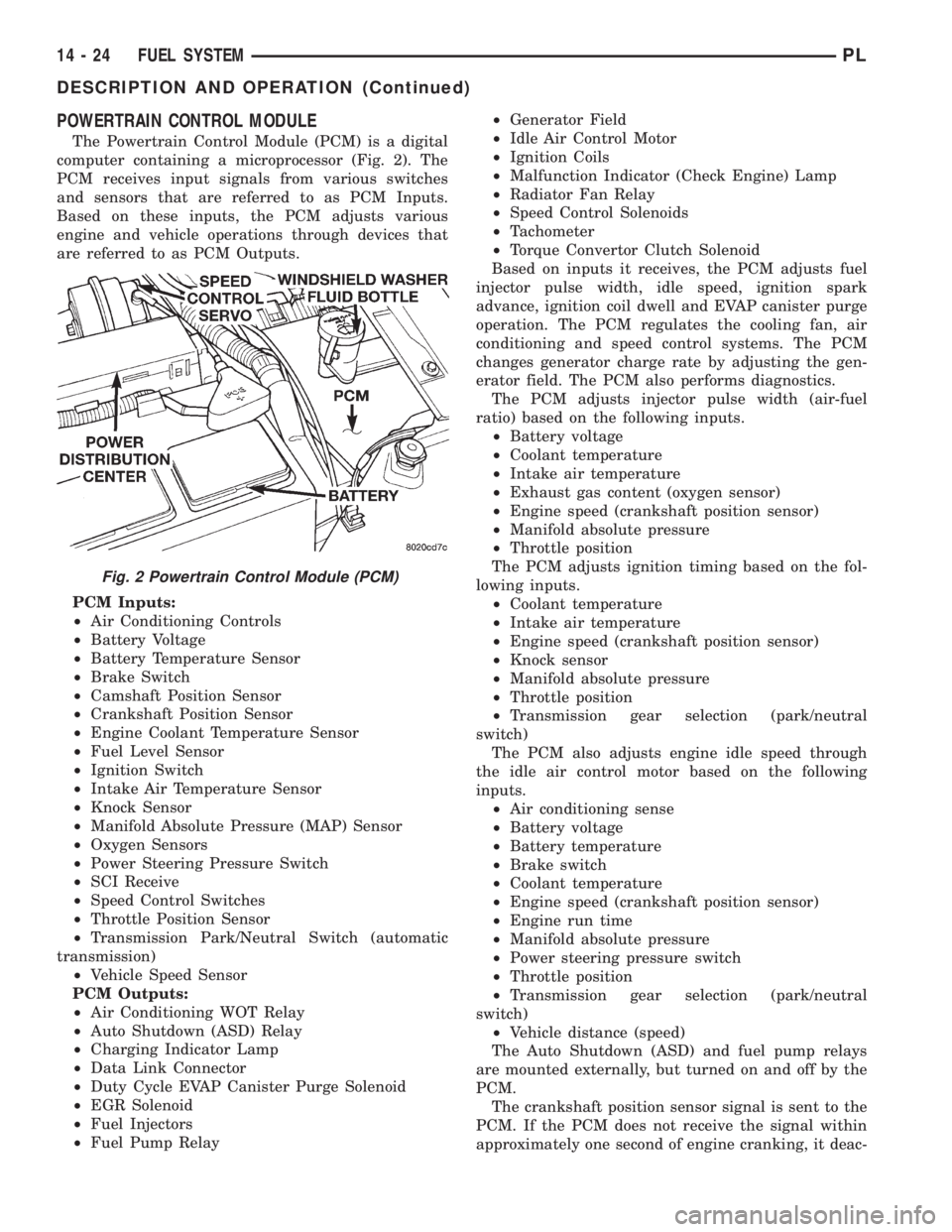
The Powertrain Control Module (PCM) is a digital
computer containing a microprocessor (Fig. 2). The
PCM receives input signals from various switches
and sensors that are referred to as PCM Inputs.
Based on these inputs, the PCM adjusts various
engine and vehicle operations through devices that
are referred to as PCM Outputs.
PCM Inputs:
²Air Conditioning Controls
²Battery Voltage
²Battery Temperature Sensor
²Brake Switch
²Camshaft Position Sensor
²Crankshaft Position Sensor
²Engine Coolant Temperature Sensor
²Fuel Level Sensor
²Ignition Switch
²Intake Air Temperature Sensor
²Knock Sensor
²Manifold Absolute Pressure (MAP) Sensor
²Oxygen Sensors
²Power Steering Pressure Switch
²SCI Receive
²Speed Control Switches
²Throttle Position Sensor
²Transmission Park/Neutral Switch (automatic
transmission)
²Vehicle Speed Sensor
PCM Outputs:
²Air Conditioning WOT Relay
²Auto Shutdown (ASD) Relay
²Charging Indicator Lamp
²Data Link Connector
²Duty Cycle EVAP Canister Purge Solenoid
²EGR Solenoid
²Fuel Injectors
²Fuel Pump Relay²Generator Field
²Idle Air Control Motor
²Ignition Coils
²Malfunction Indicator (Check Engine) Lamp
²Radiator Fan Relay
²Speed Control Solenoids
²Tachometer
²Torque Convertor Clutch Solenoid
Based on inputs it receives, the PCM adjusts fuel
injector pulse width, idle speed, ignition spark
advance, ignition coil dwell and EVAP canister purge
operation. The PCM regulates the cooling fan, air
conditioning and speed control systems. The PCM
changes generator charge rate by adjusting the gen-
erator field. The PCM also performs diagnostics.
The PCM adjusts injector pulse width (air-fuel
ratio) based on the following inputs.
²Battery voltage
²Coolant temperature
²Intake air temperature
²Exhaust gas content (oxygen sensor)
²Engine speed (crankshaft position sensor)
²Manifold absolute pressure
²Throttle position
The PCM adjusts ignition timing based on the fol-
lowing inputs.
²Coolant temperature
²Intake air temperature
²Engine speed (crankshaft position sensor)
²Knock sensor
²Manifold absolute pressure
²Throttle position
²Transmission gear selection (park/neutral
switch)
The PCM also adjusts engine idle speed through
the idle air control motor based on the following
inputs.
²Air conditioning sense
²Battery voltage
²Battery temperature
²Brake switch
²Coolant temperature
²Engine speed (crankshaft position sensor)
²Engine run time
²Manifold absolute pressure
²Power steering pressure switch
²Throttle position
²Transmission gear selection (park/neutral
switch)
²Vehicle distance (speed)
The Auto Shutdown (ASD) and fuel pump relays
are mounted externally, but turned on and off by the
PCM.
The crankshaft position sensor signal is sent to the
PCM. If the PCM does not receive the signal within
approximately one second of engine cranking, it deac-
Fig. 2 Powertrain Control Module (PCM)
14 - 24 FUEL SYSTEMPL
DESCRIPTION AND OPERATION (Continued)
Page 873 of 1200
disables the A/C compressor clutch for several sec-
onds.
The air conditioning clutch relay is located in the
PDC. The inside top of the PDC cover has a label
showing relay and fuse location.
AUTOMATIC SHUTDOWN RELAYÐPCM OUTPUT
The automatic shutdown (ASD) relay supplies bat-
tery voltage to the fuel injectors, electronic ignition
coil and the heating elements in the oxygen sensors.
A buss bar in the power distribution center (PDC)
supplies voltage to the solenoid side and contact side
of the relay. The ASD relay power circuit contains a
20 amp fuse between the buss bar in the PDC and
the relay. The fuse also protects the power circuit for
the fuel pump relay and pump. The fuse is located in
the PDC. Refer to Group 8W, Wiring Diagrams for
circuit information.
The PCM controls the relay by switching the
ground path for the solenoid side of the relay on and
off. The PCM turns the ground path off when the
ignition switch is in the Off position unless the 02
Heater Monitor test is being run. Refer to Group 25,
On-Board Diagnostics. When the ignition switch is in
the On or Crank position, the PCM monitors the
crankshaft position sensor and camshaft position sen-
sor signals to determine engine speed and ignition
timing (coil dwell). If the PCM does not receive the
crankshaft position sensor and camshaft position sen-
sor signals when the ignition switch is in the Run
position, it will de- energize the ASD relay.
The ASD relay is located in the PDC. The inside
top of the PDC cover has a label showing relay and
fuse location.
CHARGING SYSTEM INDICATOR LAMPÐPCM
OUTPUT
The PCM turns the instrument panel Charging
System Lamp on. Refer to Group 8C for charging sys-
tem information.
FUEL PUMP RELAYÐPCM OUTPUT
The fuel pump relay supplies battery voltage to the
fuel pump. A buss bar in the Power Distribution Cen-
ter (PDC) supplies voltage to the solenoid side and
contact side of the relay. The fuel pump relay power
circuit contains a 20 amp fuse between the buss bar
in the PDC and the relay. The fuse also protects the
power circuit for the Automatic Shutdown (ASD)
relay. The fuse is located in the PDC. Refer to Group
8W, Wiring Diagrams for circuit information.
The PCM controls the fuel pump relay by switch-
ing the ground path for the solenoid side of the relay
on and off. The PCM turns the ground path off when
the ignition switch is in the Off position. When the
ignition switch is in the On position, the PCM ener-gizes the fuel pump. If the crankshaft position sensor
does not detect engine rotation, the PCM de-ener-
gizes the relay after approximately one second.
The fuel pump relay is located in the PDC. The
inside top of the PDC cover has a label showing relay
and fuse location.
DUTY CYCLE EVAP PURGE SOLENOIDÐPCM
OUTPUT
The duty cycle EVAP purge solenoid regulates the
rate of vapor flow from the EVAP canister to the
throttle body. The powertrain control module oper-
ates the solenoid.
During the cold start warm-up period and the hot
start time delay, the PCM does not energize the sole-
noid. When de-energized, no vapors are purged.
The engine enters closed loop operation after it
reaches a specified temperature and the programmed
time delay ends. During closed loop operation, the
PCM energizes and de-energizes the solenoid 5 to 10
times per second, depending upon operating condi-
tions. The PCM varies the vapor flow rate by chang-
ing solenoid pulse width. Pulse width is the amount
of time the solenoid is energized.
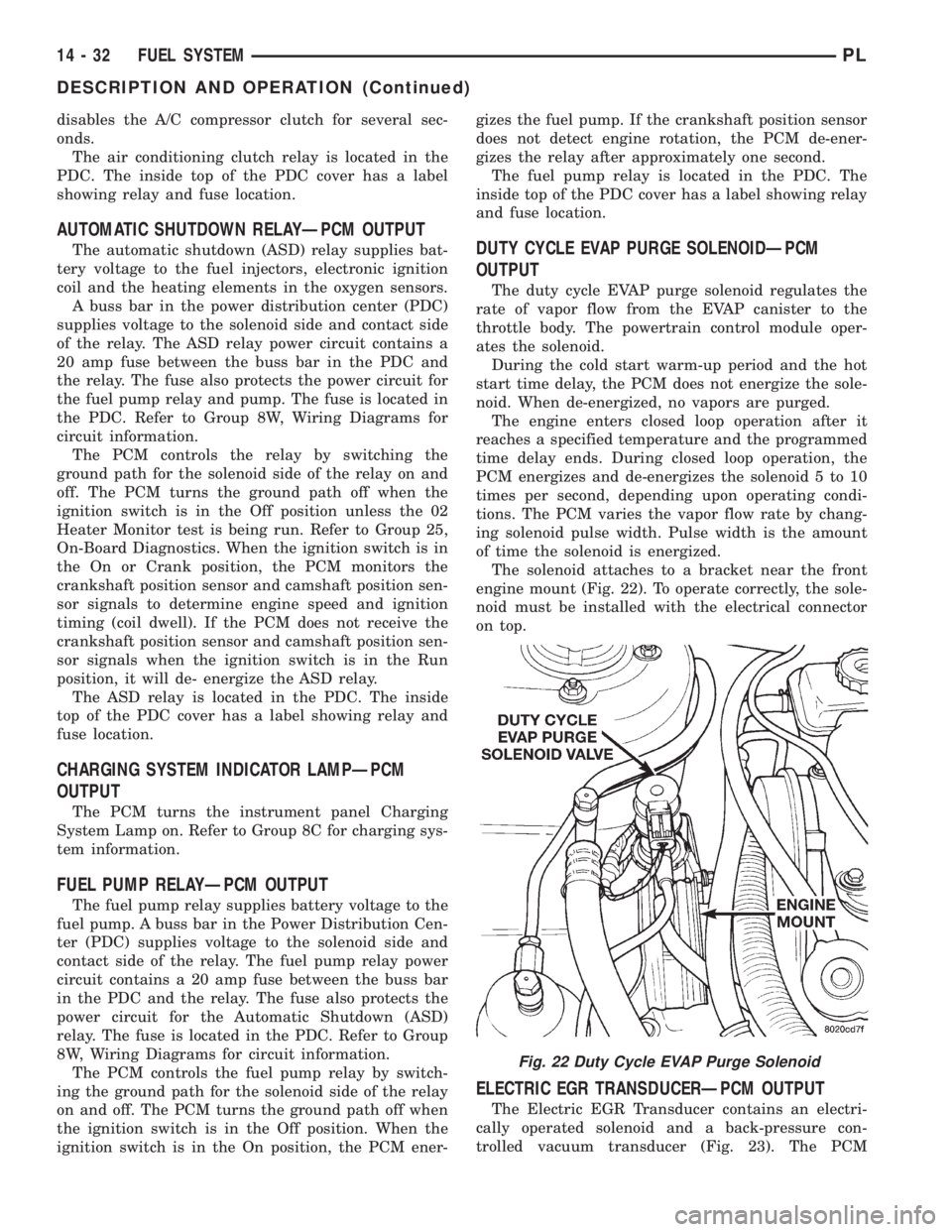
The solenoid attaches to a bracket near the front
engine mount (Fig. 22). To operate correctly, the sole-
noid must be installed with the electrical connector
on top.
ELECTRIC EGR TRANSDUCERÐPCM OUTPUT
The Electric EGR Transducer contains an electri-
cally operated solenoid and a back-pressure con-
trolled vacuum transducer (Fig. 23). The PCM
Fig. 22 Duty Cycle EVAP Purge Solenoid
14 - 32 FUEL SYSTEMPL
DESCRIPTION AND OPERATION (Continued)
Page 874 of 1200
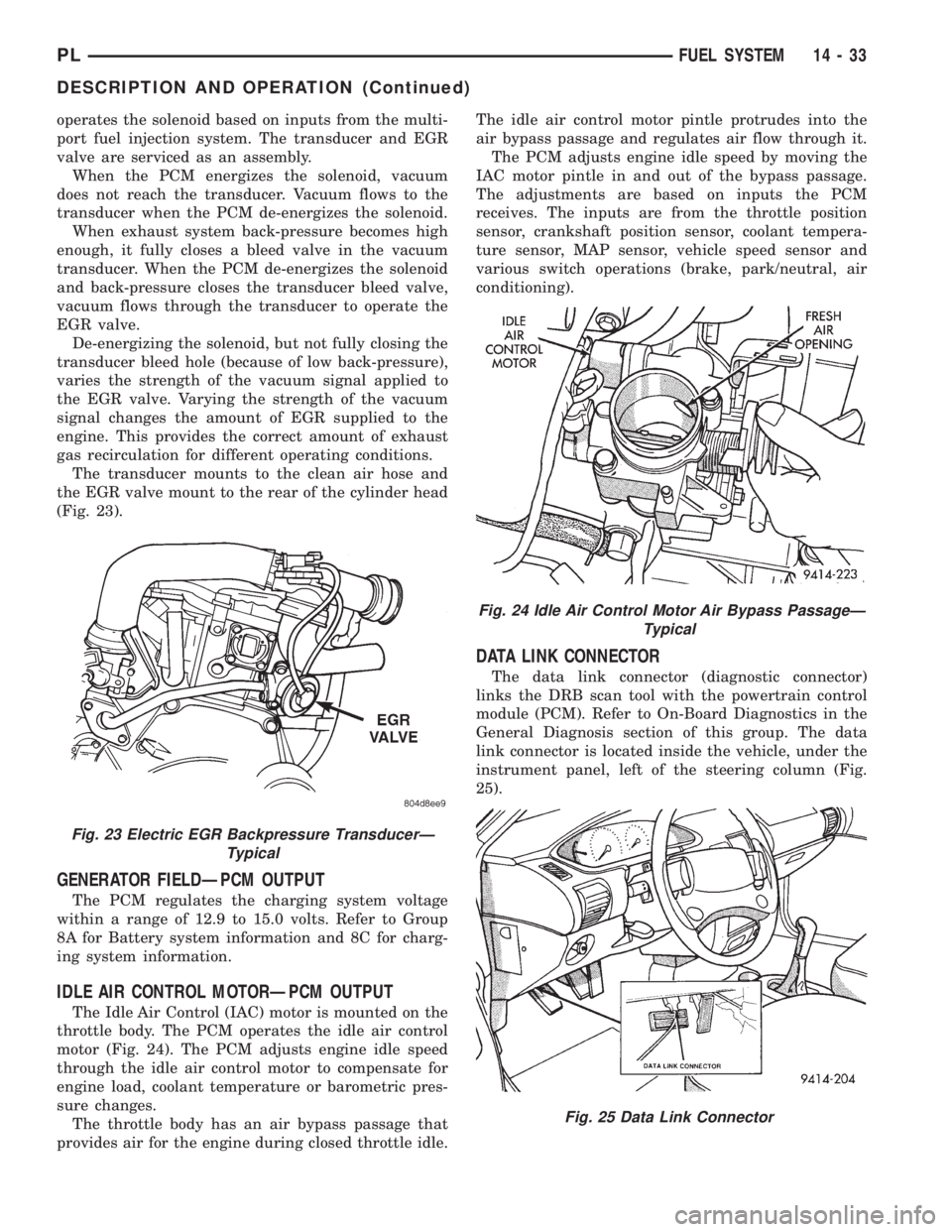
operates the solenoid based on inputs from the multi-
port fuel injection system. The transducer and EGR
valve are serviced as an assembly.
When the PCM energizes the solenoid, vacuum
does not reach the transducer. Vacuum flows to the
transducer when the PCM de-energizes the solenoid.
When exhaust system back-pressure becomes high
enough, it fully closes a bleed valve in the vacuum
transducer. When the PCM de-energizes the solenoid
and back-pressure closes the transducer bleed valve,
vacuum flows through the transducer to operate the
EGR valve.
De-energizing the solenoid, but not fully closing the
transducer bleed hole (because of low back-pressure),
varies the strength of the vacuum signal applied to
the EGR valve. Varying the strength of the vacuum
signal changes the amount of EGR supplied to the
engine. This provides the correct amount of exhaust
gas recirculation for different operating conditions.
The transducer mounts to the clean air hose and
the EGR valve mount to the rear of the cylinder head
(Fig. 23).
GENERATOR FIELDÐPCM OUTPUT
The PCM regulates the charging system voltage
within a range of 12.9 to 15.0 volts. Refer to Group
8A for Battery system information and 8C for charg-
ing system information.
IDLE AIR CONTROL MOTORÐPCM OUTPUT
The Idle Air Control (IAC) motor is mounted on the
throttle body. The PCM operates the idle air control
motor (Fig. 24). The PCM adjusts engine idle speed
through the idle air control motor to compensate for
engine load, coolant temperature or barometric pres-
sure changes.
The throttle body has an air bypass passage that
provides air for the engine during closed throttle idle.The idle air control motor pintle protrudes into the
air bypass passage and regulates air flow through it.
The PCM adjusts engine idle speed by moving the
IAC motor pintle in and out of the bypass passage.
The adjustments are based on inputs the PCM
receives. The inputs are from the throttle position
sensor, crankshaft position sensor, coolant tempera-
ture sensor, MAP sensor, vehicle speed sensor and
various switch operations (brake, park/neutral, air
conditioning).
DATA LINK CONNECTOR
The data link connector (diagnostic connector)
links the DRB scan tool with the powertrain control
module (PCM). Refer to On-Board Diagnostics in the
General Diagnosis section of this group. The data
link connector is located inside the vehicle, under the
instrument panel, left of the steering column (Fig.
25).
Fig. 23 Electric EGR Backpressure TransducerÐ
Typical
Fig. 24 Idle Air Control Motor Air Bypass PassageÐ
Typical
Fig. 25 Data Link Connector
PLFUEL SYSTEM 14 - 33
DESCRIPTION AND OPERATION (Continued)