mileage DODGE NEON 2000 Service User Guide
[x] Cancel search | Manufacturer: DODGE, Model Year: 2000, Model line: NEON, Model: DODGE NEON 2000Pages: 1285, PDF Size: 29.42 MB
Page 942 of 1285
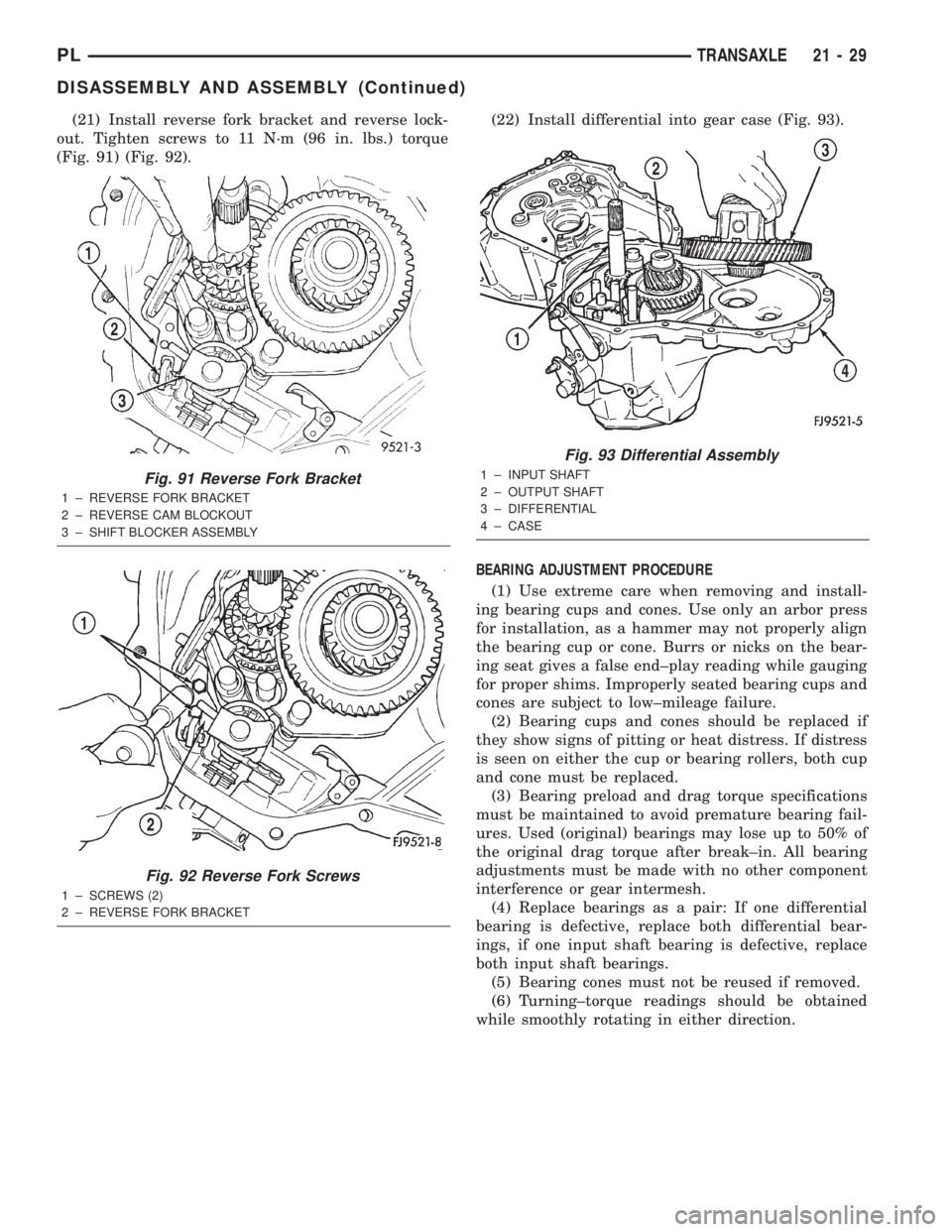
(21) Install reverse fork bracket and reverse lock-
out. Tighten screws to 11 N´m (96 in. lbs.) torque
(Fig. 91) (Fig. 92).(22) Install differential into gear case (Fig. 93).
BEARING ADJUSTMENT PROCEDURE
(1) Use extreme care when removing and install-
ing bearing cups and cones. Use only an arbor press
for installation, as a hammer may not properly align
the bearing cup or cone. Burrs or nicks on the bear-
ing seat gives a false end±play reading while gauging
for proper shims. Improperly seated bearing cups and
cones are subject to low±mileage failure.
(2) Bearing cups and cones should be replaced if
they show signs of pitting or heat distress. If distress
is seen on either the cup or bearing rollers, both cup
and cone must be replaced.
(3) Bearing preload and drag torque specifications
must be maintained to avoid premature bearing fail-
ures. Used (original) bearings may lose up to 50% of
the original drag torque after break±in. All bearing
adjustments must be made with no other component
interference or gear intermesh.
(4) Replace bearings as a pair: If one differential
bearing is defective, replace both differential bear-
ings, if one input shaft bearing is defective, replace
both input shaft bearings.
(5) Bearing cones must not be reused if removed.
(6) Turning±torque readings should be obtained
while smoothly rotating in either direction.
Fig. 91 Reverse Fork Bracket
1 ± REVERSE FORK BRACKET
2 ± REVERSE CAM BLOCKOUT
3 ± SHIFT BLOCKER ASSEMBLY
Fig. 92 Reverse Fork Screws
1 ± SCREWS (2)
2 ± REVERSE FORK BRACKET
Fig. 93 Differential Assembly
1 ± INPUT SHAFT
2 ± OUTPUT SHAFT
3 ± DIFFERENTIAL
4 ± CASE
PLTRANSAXLE 21 - 29
DISASSEMBLY AND ASSEMBLY (Continued)
Page 963 of 1285
(10) Install center console assembly (Fig. 158). Ver-
ify that boot is not pinched at console opening before
tightening.
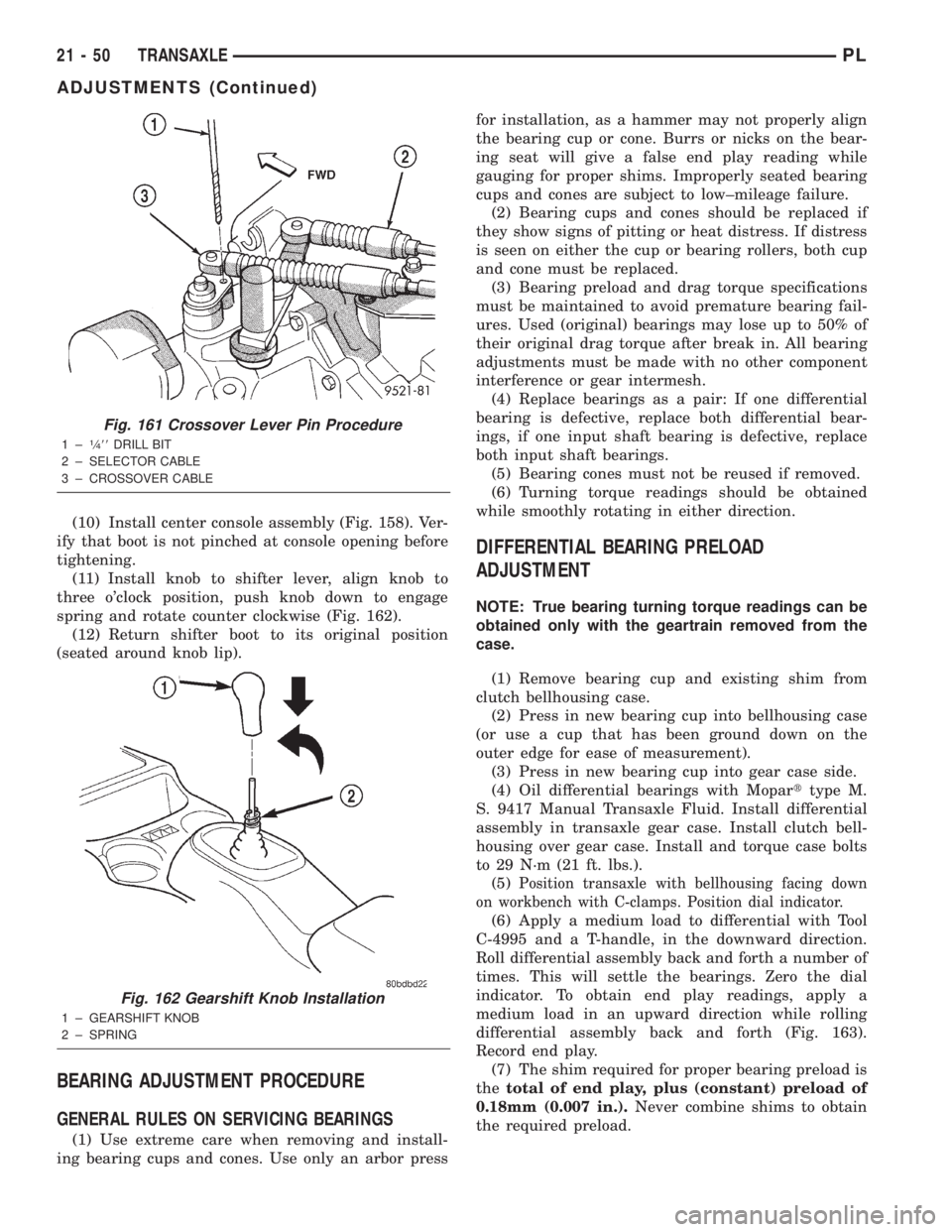
(11) Install knob to shifter lever, align knob to
three o'clock position, push knob down to engage
spring and rotate counter clockwise (Fig. 162).
(12) Return shifter boot to its original position
(seated around knob lip).
BEARING ADJUSTMENT PROCEDURE
GENERAL RULES ON SERVICING BEARINGS
(1) Use extreme care when removing and install-
ing bearing cups and cones. Use only an arbor pressfor installation, as a hammer may not properly align
the bearing cup or cone. Burrs or nicks on the bear-
ing seat will give a false end play reading while
gauging for proper shims. Improperly seated bearing
cups and cones are subject to low±mileage failure.
(2) Bearing cups and cones should be replaced if
they show signs of pitting or heat distress. If distress
is seen on either the cup or bearing rollers, both cup
and cone must be replaced.
(3) Bearing preload and drag torque specifications
must be maintained to avoid premature bearing fail-
ures. Used (original) bearings may lose up to 50% of
their original drag torque after break in. All bearing
adjustments must be made with no other component
interference or gear intermesh.
(4) Replace bearings as a pair: If one differential
bearing is defective, replace both differential bear-
ings, if one input shaft bearing is defective, replace
both input shaft bearings.
(5) Bearing cones must not be reused if removed.
(6) Turning torque readings should be obtained
while smoothly rotating in either direction.
DIFFERENTIAL BEARING PRELOAD
ADJUSTMENT
NOTE: True bearing turning torque readings can be
obtained only with the geartrain removed from the
case.
(1) Remove bearing cup and existing shim from
clutch bellhousing case.
(2) Press in new bearing cup into bellhousing case
(or use a cup that has been ground down on the
outer edge for ease of measurement).
(3) Press in new bearing cup into gear case side.
(4) Oil differential bearings with Moparttype M.
S. 9417 Manual Transaxle Fluid. Install differential
assembly in transaxle gear case. Install clutch bell-
housing over gear case. Install and torque case bolts
to 29 N´m (21 ft. lbs.).
(5)
Position transaxle with bellhousing facing down
on workbench with C-clamps. Position dial indicator.
(6) Apply a medium load to differential with Tool
C-4995 and a T-handle, in the downward direction.
Roll differential assembly back and forth a number of
times. This will settle the bearings. Zero the dial
indicator. To obtain end play readings, apply a
medium load in an upward direction while rolling
differential assembly back and forth (Fig. 163).
Record end play.
(7) The shim required for proper bearing preload is
thetotal of end play, plus (constant) preload of
0.18mm (0.007 in.).Never combine shims to obtain
the required preload.
Fig. 161 Crossover Lever Pin Procedure
1±1¤488DRILL BIT
2 ± SELECTOR CABLE
3 ± CROSSOVER CABLE
Fig. 162 Gearshift Knob Installation
1 ± GEARSHIFT KNOB
2 ± SPRING
21 - 50 TRANSAXLEPL
ADJUSTMENTS (Continued)
Page 1070 of 1285
TIRES AND WHEELS
TABLE OF CONTENTS
page page
TIRES................................... 1WHEELS................................ 10
TIRES
TABLE OF CONTENTS
page page
DESCRIPTION AND OPERATION
TIRE...................................1
RADIAL-PLY TIRES........................2
SPARE TIRE±TEMPORARY..................3
REPLACEMENT TIRES.....................3
DIAGNOSIS AND TESTING
TREAD WEAR INDICATORS.................3
TIRE WEAR PATTERNS.....................4
TIRE NOISE OR VIBRATION.................4
VEHICLE LEAD DIAGNOSIS AND
CORRECTION..........................4
SERVICE PROCEDURES
PRESSURE GAUGES......................6TIRE INFLATION PRESSURES...............6
TIRE PRESSURE FOR HIGH SPEED
OPERATION............................6
TIRE AND WHEEL ROTATION................6
REPAIRING TIRE LEAKS....................7
TIRE AND WHEEL MATCH MOUNTING.........7
CLEANING AND INSPECTION
CLEANING TIRES.........................9
SPECIFICATIONS
TIRE SPECIFICATIONS.....................9
DESCRIPTION AND OPERATION
TIRE
Tires are designed and engineered for each specific
vehicle (Fig. 1). They provide the best overall perfor-
mance for normal operation. The ride and handling
characteristics match the vehicle's requirements.
With proper care they will give excellent reliability,
traction, skid resistance, and tread life.
Driving habits have more effect on tire life than
any other factor. Careful drivers will obtain, in most
cases, much greater mileage than severe use or care-
less drivers. A few of the driving habits which will
shorten the life of any tire are:²Rapid acceleration
²Severe application of brakes
²High-speed driving
²Taking turns at excessive speeds
²Striking curbs and other obstacles
²Operating vehicle with over or under inflated
tire pressures
Radial ply tires are more prone to irregular tread
wear. It is important to follow the tire rotation inter-
val shown in the section on Tire Rotation. This will
help to achieve a greater tread-life potential.
PLTIRES AND WHEELS 22 - 1
Page 1076 of 1285
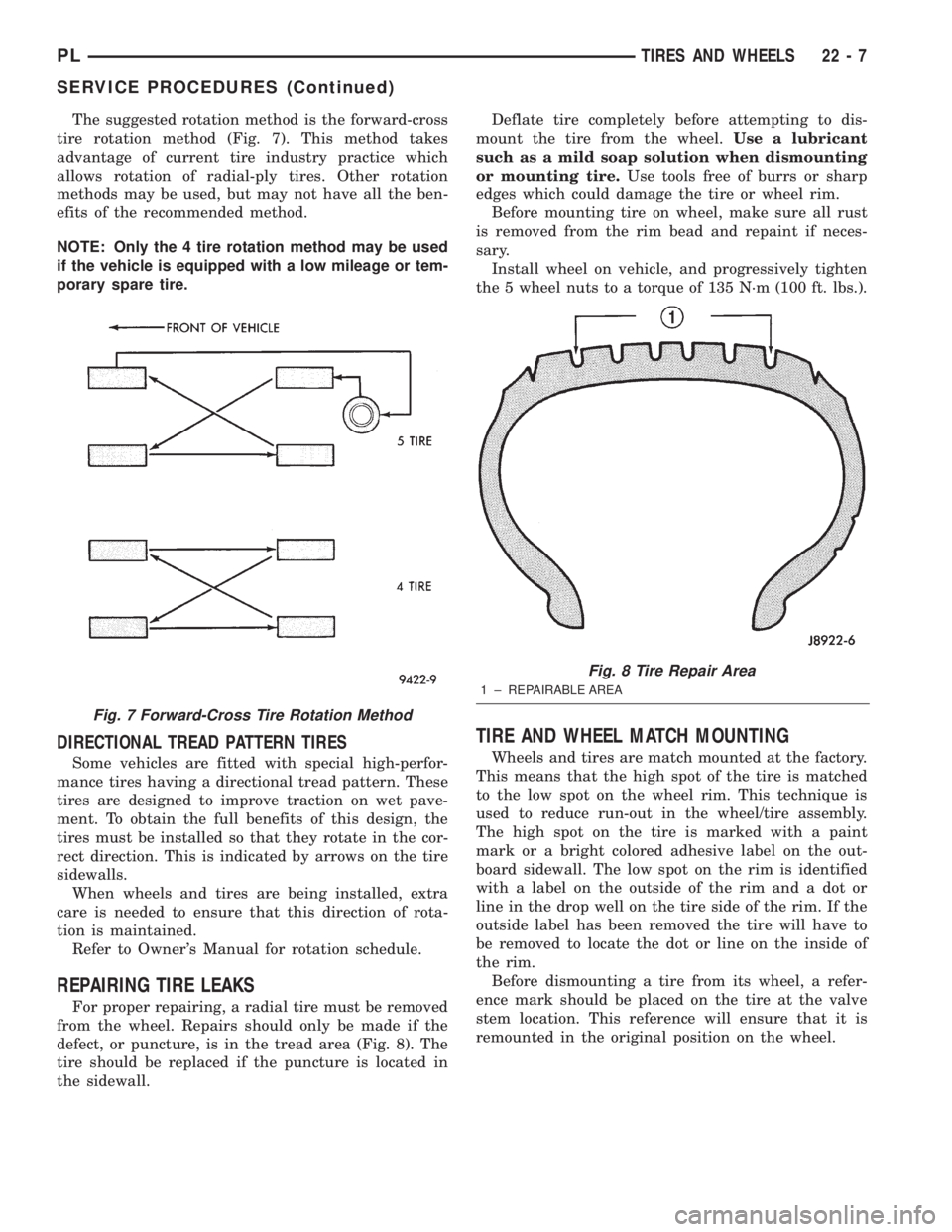
The suggested rotation method is the forward-cross
tire rotation method (Fig. 7). This method takes
advantage of current tire industry practice which
allows rotation of radial-ply tires. Other rotation
methods may be used, but may not have all the ben-
efits of the recommended method.
NOTE: Only the 4 tire rotation method may be used
if the vehicle is equipped with a low mileage or tem-
porary spare tire.
DIRECTIONAL TREAD PATTERN TIRES
Some vehicles are fitted with special high-perfor-
mance tires having a directional tread pattern. These
tires are designed to improve traction on wet pave-
ment. To obtain the full benefits of this design, the
tires must be installed so that they rotate in the cor-
rect direction. This is indicated by arrows on the tire
sidewalls.
When wheels and tires are being installed, extra
care is needed to ensure that this direction of rota-
tion is maintained.
Refer to Owner's Manual for rotation schedule.
REPAIRING TIRE LEAKS
For proper repairing, a radial tire must be removed
from the wheel. Repairs should only be made if the
defect, or puncture, is in the tread area (Fig. 8). The
tire should be replaced if the puncture is located in
the sidewall.Deflate tire completely before attempting to dis-
mount the tire from the wheel.Use a lubricant
such as a mild soap solution when dismounting
or mounting tire.Use tools free of burrs or sharp
edges which could damage the tire or wheel rim.
Before mounting tire on wheel, make sure all rust
is removed from the rim bead and repaint if neces-
sary.
Install wheel on vehicle, and progressively tighten
the 5 wheel nuts to a torque of 135 N´m (100 ft. lbs.).
TIRE AND WHEEL MATCH MOUNTING
Wheels and tires are match mounted at the factory.
This means that the high spot of the tire is matched
to the low spot on the wheel rim. This technique is
used to reduce run-out in the wheel/tire assembly.
The high spot on the tire is marked with a paint
mark or a bright colored adhesive label on the out-
board sidewall. The low spot on the rim is identified
with a label on the outside of the rim and a dot or
line in the drop well on the tire side of the rim. If the
outside label has been removed the tire will have to
be removed to locate the dot or line on the inside of
the rim.
Before dismounting a tire from its wheel, a refer-
ence mark should be placed on the tire at the valve
stem location. This reference will ensure that it is
remounted in the original position on the wheel.
Fig. 7 Forward-Cross Tire Rotation Method
Fig. 8 Tire Repair Area
1 ± REPAIRABLE AREA
PLTIRES AND WHEELS 22 - 7
SERVICE PROCEDURES (Continued)
Page 1081 of 1285
pilot hole and bolt circle of the wheel should be the
same as the original wheel.
WARNING: FAILURE TO USE EQUIVALENT
REPLACEMENT WHEELS MAY ADVERSELY AFFECT
THE SAFETY AND HANDLING OF THE VEHICLE.
USED WHEELS ARE NOT RECOMMENDED. THE
SERVICE HISTORY OF THE WHEEL MAY HAVE
INCLUDED SEVERE TREATMENT OR VERY HIGH
MILEAGE. THE RIM COULD FAIL WITHOUT WARN-
ING.
TIRE AND WHEEL RUNOUT
NOTE: Runout should always be measured off the
vehicle and on a suitable balance machine.
Radial run out is the difference between the high
and low points on the outer edge of the tire or wheel.
Lateral run out is the total side±to±side wobble of
the tire or wheel.
Radial run out of more than 1.5 mm (.060 inch)
measured at the center line of the tread may cause
the vehicle to shake.
Lateral run out of more than 2.0 mm (.080 inch)
measured at the side of the tire as close to the tread
as possible may cause the vehicle to shake.
Sometimes radial run out can be reduced by relo-
cating the wheel and tire on the wheel studs (See
Method 1). If this does not reduce run out to an
acceptable level, the tire can be rotated on the wheel.
(See Method 2).
METHOD 1 (RELOCATE WHEEL ON HUB)
Check accuracy of the wheel mounting surface;
adjust wheel bearings.
Drive vehicle a short distance to eliminate tire flat
spotting from a parked position.
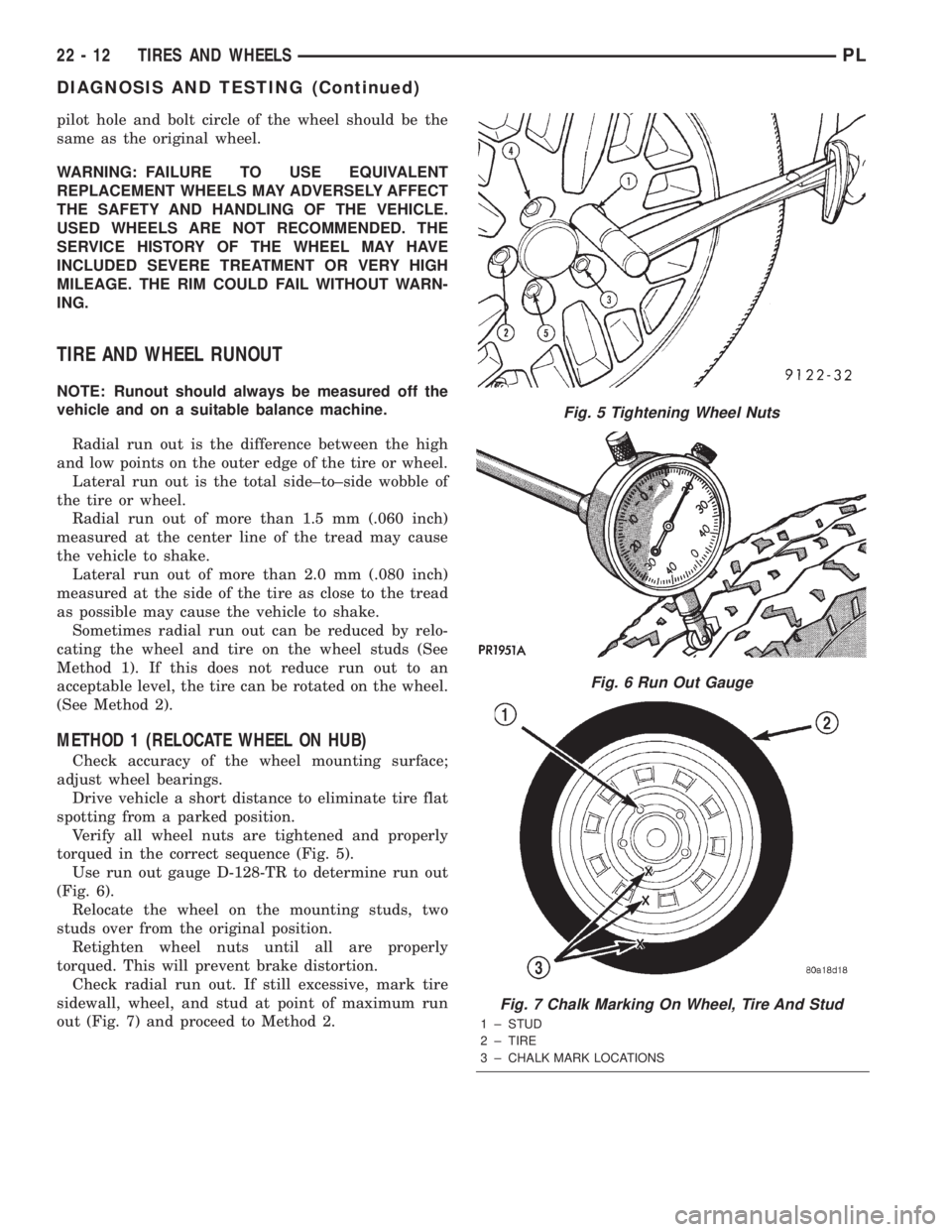
Verify all wheel nuts are tightened and properly
torqued in the correct sequence (Fig. 5).
Use run out gauge D-128-TR to determine run out
(Fig. 6).
Relocate the wheel on the mounting studs, two
studs over from the original position.
Retighten wheel nuts until all are properly
torqued. This will prevent brake distortion.
Check radial run out. If still excessive, mark tire
sidewall, wheel, and stud at point of maximum run
out (Fig. 7) and proceed to Method 2.
Fig. 5 Tightening Wheel Nuts
Fig. 6 Run Out Gauge
Fig. 7 Chalk Marking On Wheel, Tire And Stud
1 ± STUD
2 ± TIRE
3 ± CHALK MARK LOCATIONS
22 - 12 TIRES AND WHEELSPL
DIAGNOSIS AND TESTING (Continued)
Page 1101 of 1285
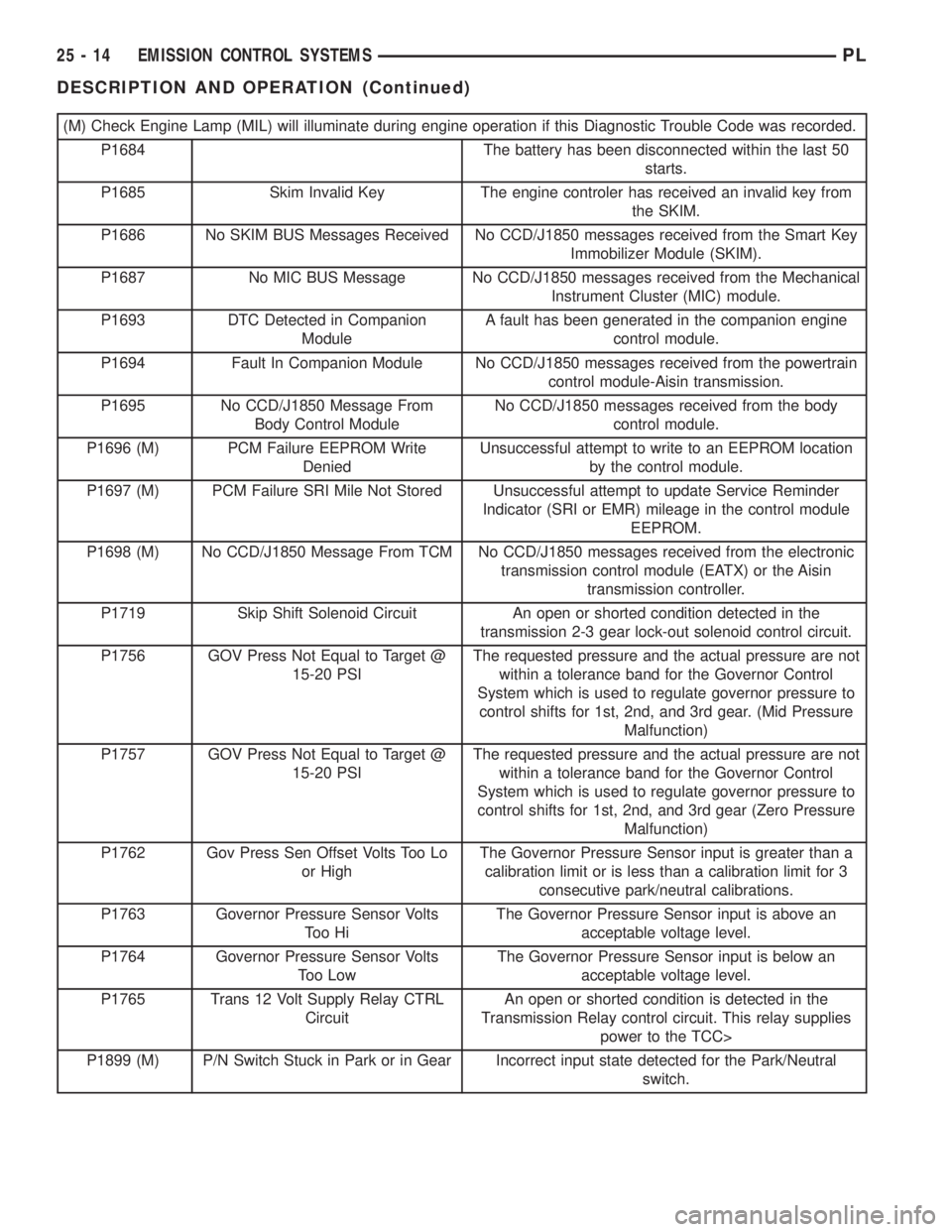
(M) Check Engine Lamp (MIL) will illuminate during engine operation if this Diagnostic Trouble Code was recorded.
P1684 The battery has been disconnected within the last 50
starts.
P1685 Skim Invalid Key The engine controler has received an invalid key from
the SKIM.
P1686 No SKIM BUS Messages Received No CCD/J1850 messages received from the Smart Key
Immobilizer Module (SKIM).
P1687 No MIC BUS Message No CCD/J1850 messages received from the Mechanical
Instrument Cluster (MIC) module.
P1693 DTC Detected in Companion
ModuleA fault has been generated in the companion engine
control module.
P1694 Fault In Companion Module No CCD/J1850 messages received from the powertrain
control module-Aisin transmission.
P1695 No CCD/J1850 Message From
Body Control ModuleNo CCD/J1850 messages received from the body
control module.
P1696 (M) PCM Failure EEPROM Write
DeniedUnsuccessful attempt to write to an EEPROM location
by the control module.
P1697 (M) PCM Failure SRI Mile Not Stored Unsuccessful attempt to update Service Reminder
Indicator (SRI or EMR) mileage in the control module
EEPROM.
P1698 (M) No CCD/J1850 Message From TCM No CCD/J1850 messages received from the electronic
transmission control module (EATX) or the Aisin
transmission controller.
P1719 Skip Shift Solenoid Circuit An open or shorted condition detected in the
transmission 2-3 gear lock-out solenoid control circuit.
P1756 GOV Press Not Equal to Target @
15-20 PSIThe requested pressure and the actual pressure are not
within a tolerance band for the Governor Control
System which is used to regulate governor pressure to
control shifts for 1st, 2nd, and 3rd gear. (Mid Pressure
Malfunction)
P1757 GOV Press Not Equal to Target @
15-20 PSIThe requested pressure and the actual pressure are not
within a tolerance band for the Governor Control
System which is used to regulate governor pressure to
control shifts for 1st, 2nd, and 3rd gear (Zero Pressure
Malfunction)
P1762 Gov Press Sen Offset Volts Too Lo
or HighThe Governor Pressure Sensor input is greater than a
calibration limit or is less than a calibration limit for 3
consecutive park/neutral calibrations.
P1763 Governor Pressure Sensor Volts
To o H iThe Governor Pressure Sensor input is above an
acceptable voltage level.
P1764 Governor Pressure Sensor Volts
Too LowThe Governor Pressure Sensor input is below an
acceptable voltage level.
P1765 Trans 12 Volt Supply Relay CTRL
CircuitAn open or shorted condition is detected in the
Transmission Relay control circuit. This relay supplies
power to the TCC>
P1899 (M) P/N Switch Stuck in Park or in Gear Incorrect input state detected for the Park/Neutral
switch.
25 - 14 EMISSION CONTROL SYSTEMSPL
DESCRIPTION AND OPERATION (Continued)
Page 1155 of 1285
INSTALLATION
(1) Apply MopartMultimileage Grease to inside of
door hinge bushings.
(2) Position door to the hinges on vehicle.
(3) Install bolt into hinge top hole on the right side
or bottom hole left side (smallest hole).
(4) Install bolt into hinge bottom hole on the right
side or top hole left side (slotted hole).
(5) Install bolts attaching door check strap to
hinge pillar.
(6) Connect wire connector at hinge pillar, if nec-
essary.
FRONT DOOR HINGE
REMOVAL
(1) Open and support door on a suitable lifting
device.
(2) Remove bolts attaching door check strap to
lower A-pillar for greater access, if necessary.
(3) Mark position of hinge on both the door end
frame and lower A-pillar to ease installation.
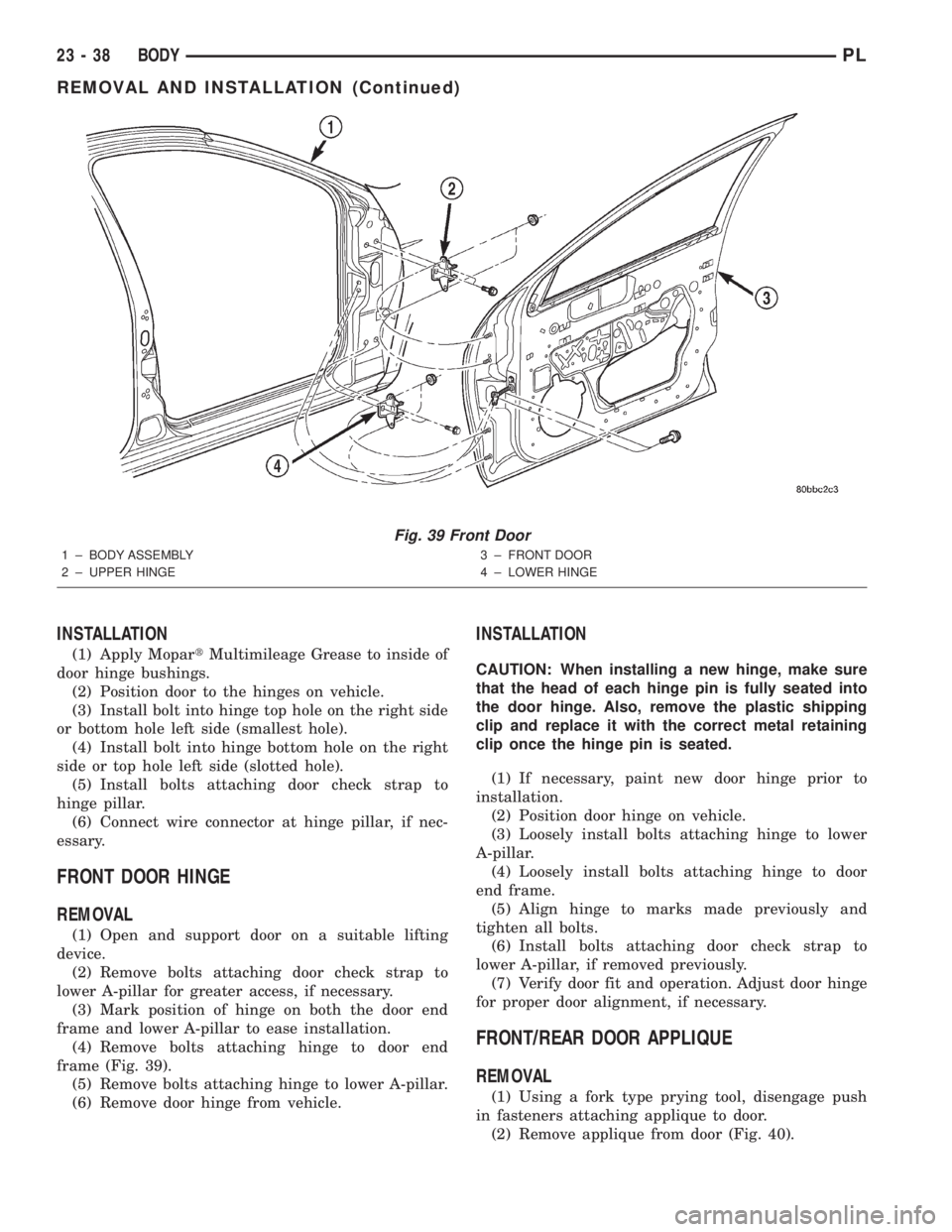
(4) Remove bolts attaching hinge to door end
frame (Fig. 39).
(5) Remove bolts attaching hinge to lower A-pillar.
(6) Remove door hinge from vehicle.
INSTALLATION
CAUTION: When installing a new hinge, make sure
that the head of each hinge pin is fully seated into
the door hinge. Also, remove the plastic shipping
clip and replace it with the correct metal retaining
clip once the hinge pin is seated.
(1) If necessary, paint new door hinge prior to
installation.
(2) Position door hinge on vehicle.
(3) Loosely install bolts attaching hinge to lower
A-pillar.
(4) Loosely install bolts attaching hinge to door
end frame.
(5) Align hinge to marks made previously and
tighten all bolts.
(6) Install bolts attaching door check strap to
lower A-pillar, if removed previously.
(7) Verify door fit and operation. Adjust door hinge
for proper door alignment, if necessary.
FRONT/REAR DOOR APPLIQUE
REMOVAL
(1) Using a fork type prying tool, disengage push
in fasteners attaching applique to door.
(2) Remove applique from door (Fig. 40).
Fig. 39 Front Door
1 ± BODY ASSEMBLY
2 ± UPPER HINGE3 ± FRONT DOOR
4 ± LOWER HINGE
23 - 38 BODYPL
REMOVAL AND INSTALLATION (Continued)
Page 1162 of 1285
REAR DOOR CHECK STRAP
REMOVAL
(1) Remove door trim panel.
(2) Remove bolts attaching check strap to hinge
pillar.
(3) Remove check strap seal from door end frame.
(4) Remove bolts attaching check strap to door end
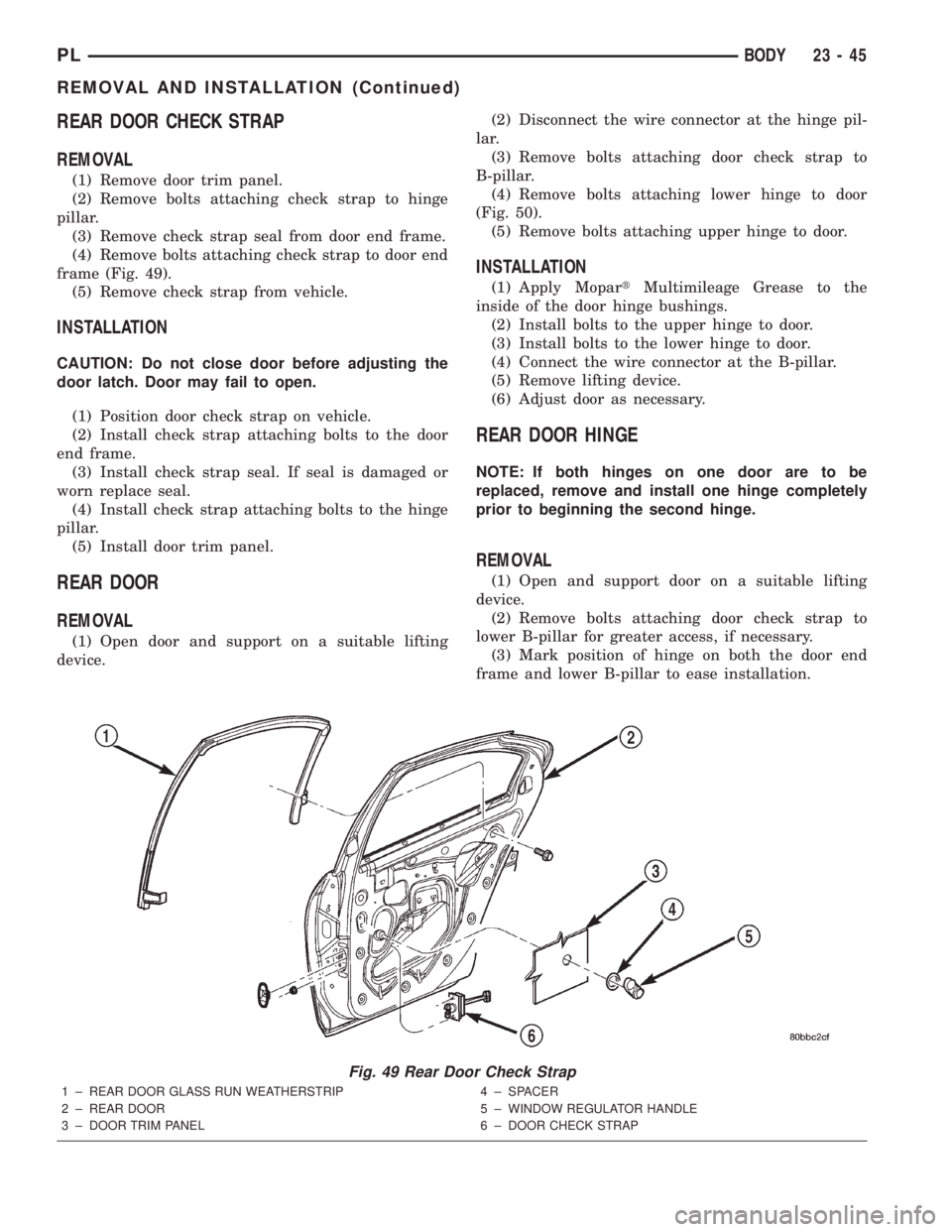
frame (Fig. 49).
(5) Remove check strap from vehicle.
INSTALLATION
CAUTION: Do not close door before adjusting the
door latch. Door may fail to open.
(1) Position door check strap on vehicle.
(2) Install check strap attaching bolts to the door
end frame.
(3) Install check strap seal. If seal is damaged or
worn replace seal.
(4) Install check strap attaching bolts to the hinge
pillar.
(5) Install door trim panel.
REAR DOOR
REMOVAL
(1) Open door and support on a suitable lifting
device.(2) Disconnect the wire connector at the hinge pil-
lar.
(3) Remove bolts attaching door check strap to
B-pillar.
(4) Remove bolts attaching lower hinge to door
(Fig. 50).
(5) Remove bolts attaching upper hinge to door.
INSTALLATION
(1) Apply MopartMultimileage Grease to the
inside of the door hinge bushings.
(2) Install bolts to the upper hinge to door.
(3) Install bolts to the lower hinge to door.
(4) Connect the wire connector at the B-pillar.
(5) Remove lifting device.
(6) Adjust door as necessary.
REAR DOOR HINGE
NOTE: If both hinges on one door are to be
replaced, remove and install one hinge completely
prior to beginning the second hinge.
REMOVAL
(1) Open and support door on a suitable lifting
device.
(2) Remove bolts attaching door check strap to
lower B-pillar for greater access, if necessary.
(3) Mark position of hinge on both the door end
frame and lower B-pillar to ease installation.
Fig. 49 Rear Door Check Strap
1 ± REAR DOOR GLASS RUN WEATHERSTRIP
2 ± REAR DOOR
3 ± DOOR TRIM PANEL4 ± SPACER
5 ± WINDOW REGULATOR HANDLE
6 ± DOOR CHECK STRAP
PLBODY 23 - 45
REMOVAL AND INSTALLATION (Continued)