air DODGE NEON 2000 Service Repair Manual
[x] Cancel search | Manufacturer: DODGE, Model Year: 2000, Model line: NEON, Model: DODGE NEON 2000Pages: 1285, PDF Size: 29.42 MB
Page 919 of 1285
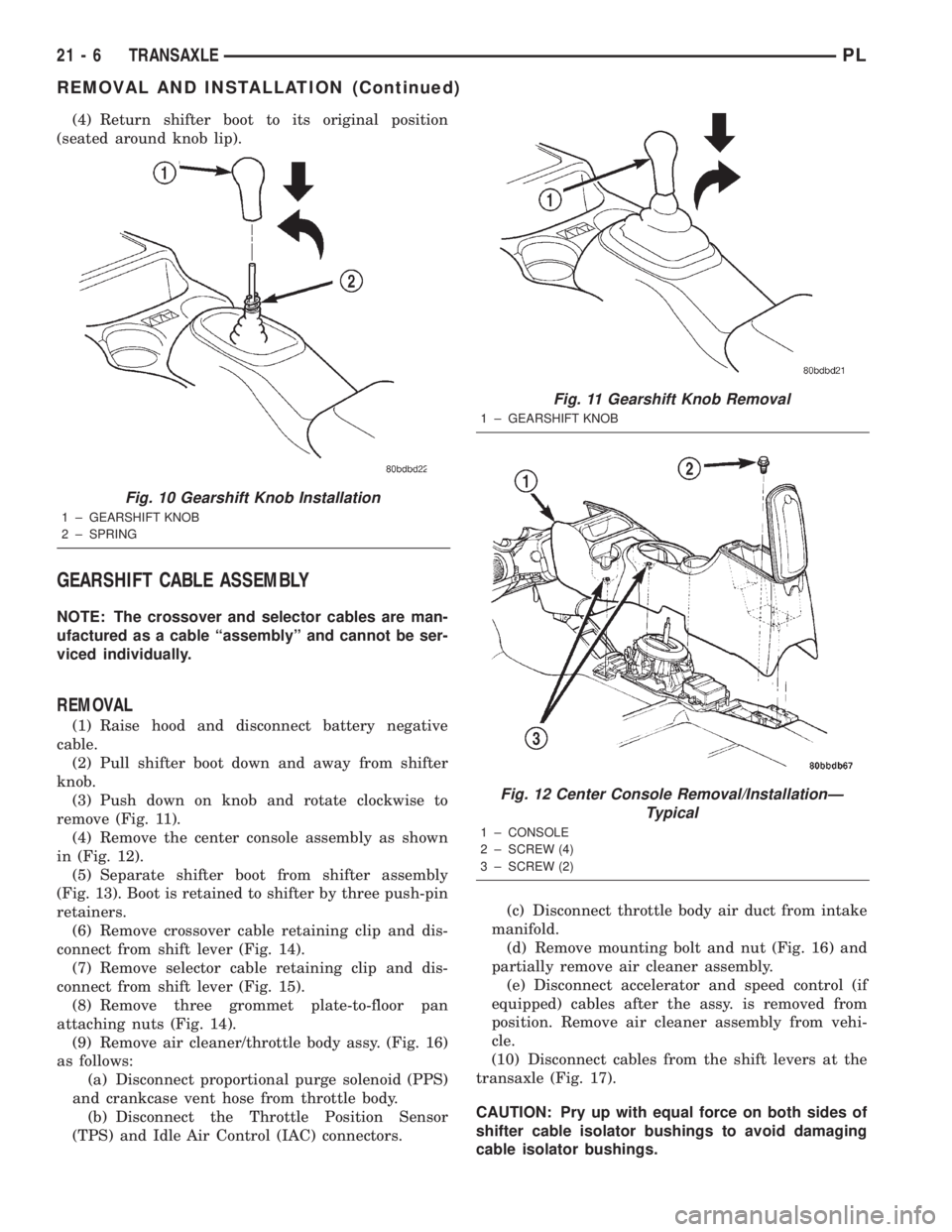
(4) Return shifter boot to its original position
(seated around knob lip).
GEARSHIFT CABLE ASSEMBLY
NOTE: The crossover and selector cables are man-
ufactured as a cable ªassemblyº and cannot be ser-
viced individually.
REMOVAL
(1) Raise hood and disconnect battery negative
cable.
(2) Pull shifter boot down and away from shifter
knob.
(3) Push down on knob and rotate clockwise to
remove (Fig. 11).
(4) Remove the center console assembly as shown
in (Fig. 12).
(5) Separate shifter boot from shifter assembly
(Fig. 13). Boot is retained to shifter by three push-pin
retainers.
(6) Remove crossover cable retaining clip and dis-
connect from shift lever (Fig. 14).
(7) Remove selector cable retaining clip and dis-
connect from shift lever (Fig. 15).
(8) Remove three grommet plate-to-floor pan
attaching nuts (Fig. 14).
(9) Remove air cleaner/throttle body assy. (Fig. 16)
as follows:
(a) Disconnect proportional purge solenoid (PPS)
and crankcase vent hose from throttle body.
(b) Disconnect the Throttle Position Sensor
(TPS) and Idle Air Control (IAC) connectors.(c) Disconnect throttle body air duct from intake
manifold.
(d) Remove mounting bolt and nut (Fig. 16) and
partially remove air cleaner assembly.
(e) Disconnect accelerator and speed control (if
equipped) cables after the assy. is removed from
position. Remove air cleaner assembly from vehi-
cle.
(10) Disconnect cables from the shift levers at the
transaxle (Fig. 17).
CAUTION: Pry up with equal force on both sides of
shifter cable isolator bushings to avoid damaging
cable isolator bushings.
Fig. 10 Gearshift Knob Installation
1 ± GEARSHIFT KNOB
2 ± SPRING
Fig. 11 Gearshift Knob Removal
1 ± GEARSHIFT KNOB
Fig. 12 Center Console Removal/InstallationÐ
Typical
1 ± CONSOLE
2 ± SCREW (4)
3 ± SCREW (2)
21 - 6 TRANSAXLEPL
REMOVAL AND INSTALLATION (Continued)
Page 920 of 1285
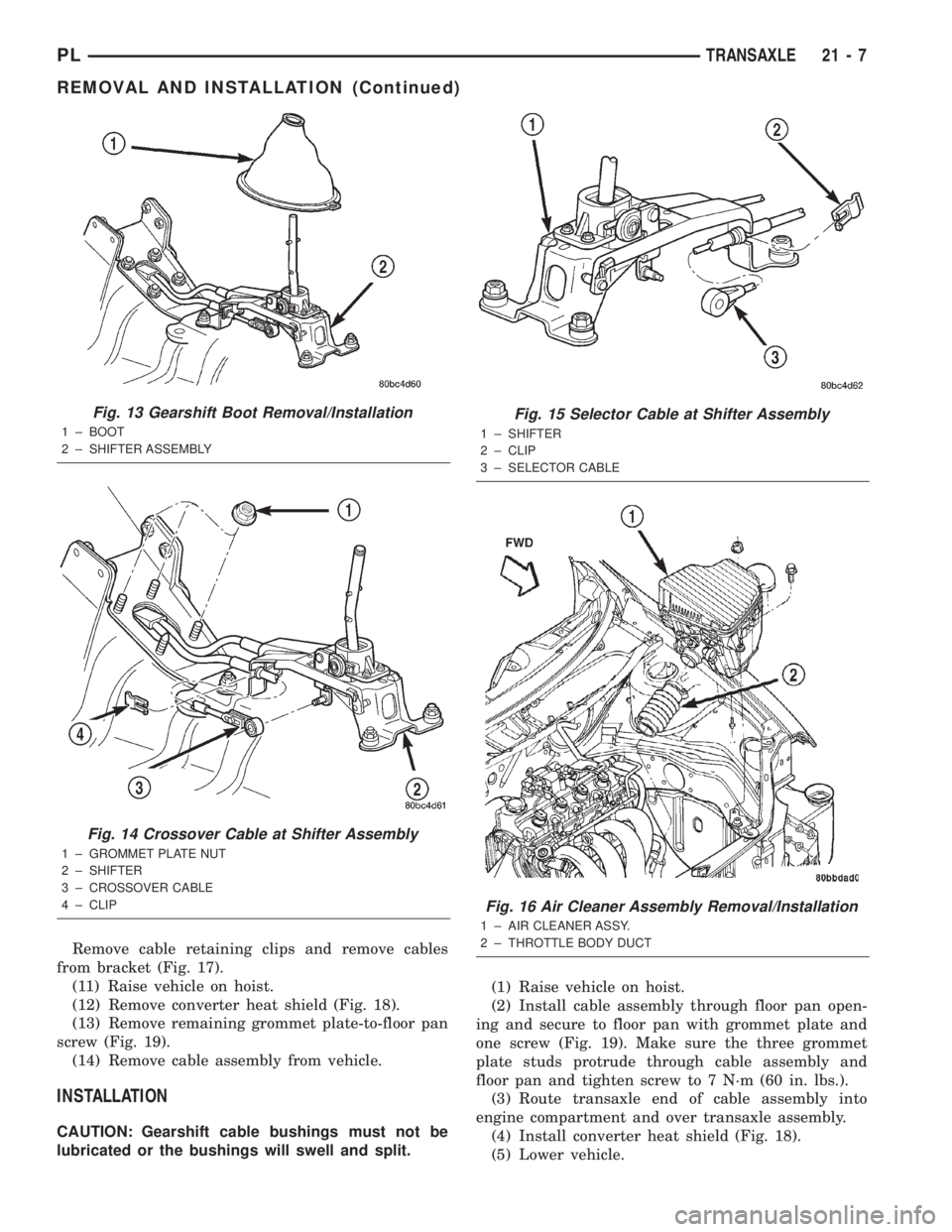
Remove cable retaining clips and remove cables
from bracket (Fig. 17).
(11) Raise vehicle on hoist.
(12) Remove converter heat shield (Fig. 18).
(13) Remove remaining grommet plate-to-floor pan
screw (Fig. 19).
(14) Remove cable assembly from vehicle.
INSTALLATION
CAUTION: Gearshift cable bushings must not be
lubricated or the bushings will swell and split.(1) Raise vehicle on hoist.
(2) Install cable assembly through floor pan open-
ing and secure to floor pan with grommet plate and
one screw (Fig. 19). Make sure the three grommet
plate studs protrude through cable assembly and
floor pan and tighten screw to 7 N´m (60 in. lbs.).
(3) Route transaxle end of cable assembly into
engine compartment and over transaxle assembly.
(4) Install converter heat shield (Fig. 18).
(5) Lower vehicle.
Fig. 13 Gearshift Boot Removal/Installation
1 ± BOOT
2 ± SHIFTER ASSEMBLY
Fig. 14 Crossover Cable at Shifter Assembly
1 ± GROMMET PLATE NUT
2 ± SHIFTER
3 ± CROSSOVER CABLE
4 ± CLIP
Fig. 15 Selector Cable at Shifter Assembly
1 ± SHIFTER
2 ± CLIP
3 ± SELECTOR CABLE
Fig. 16 Air Cleaner Assembly Removal/Installation
1 ± AIR CLEANER ASSY.
2 ± THROTTLE BODY DUCT
PLTRANSAXLE 21 - 7
REMOVAL AND INSTALLATION (Continued)
Page 921 of 1285
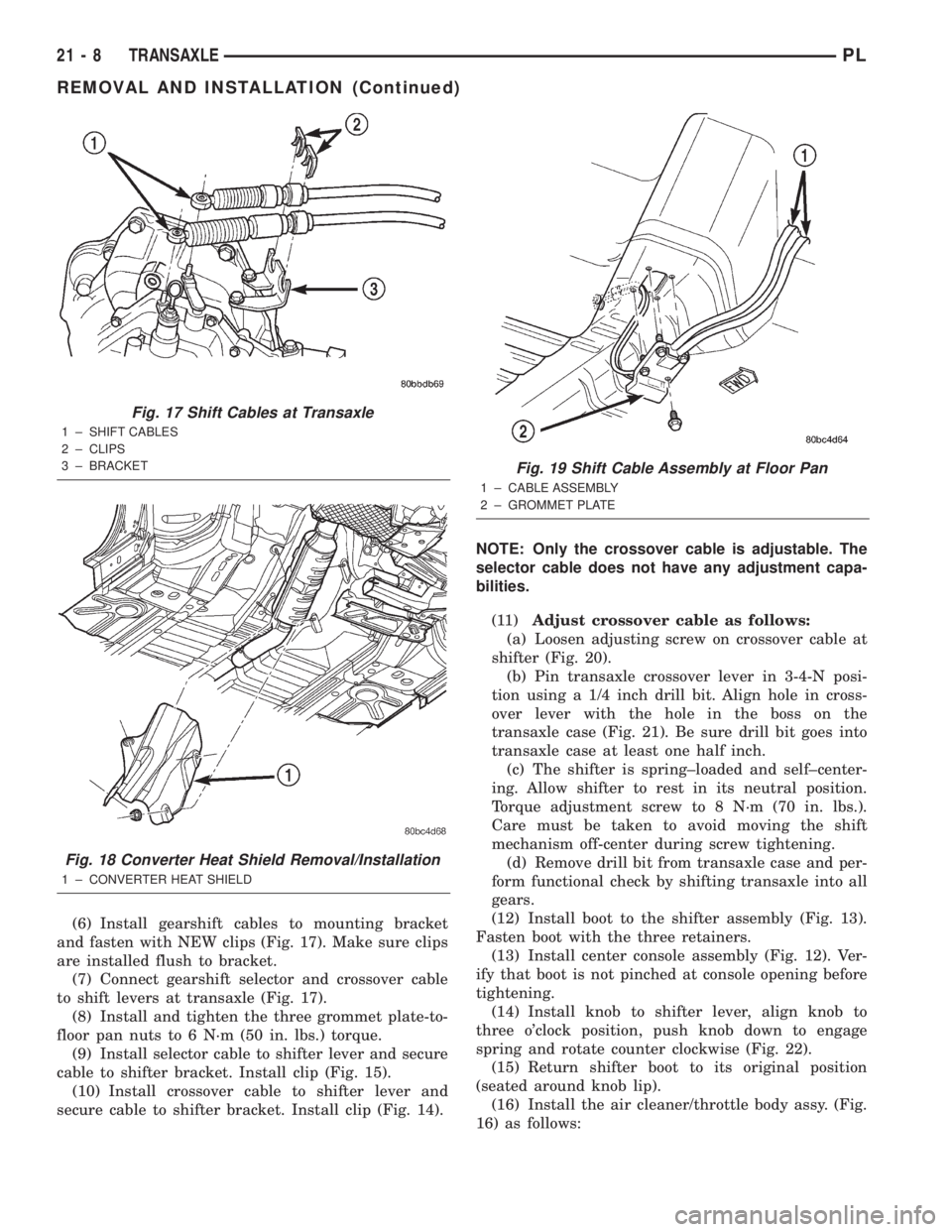
(6) Install gearshift cables to mounting bracket
and fasten with NEW clips (Fig. 17). Make sure clips
are installed flush to bracket.
(7) Connect gearshift selector and crossover cable
to shift levers at transaxle (Fig. 17).
(8) Install and tighten the three grommet plate-to-
floor pan nuts to 6 N´m (50 in. lbs.) torque.
(9) Install selector cable to shifter lever and secure
cable to shifter bracket. Install clip (Fig. 15).
(10) Install crossover cable to shifter lever and
secure cable to shifter bracket. Install clip (Fig. 14).NOTE: Only the crossover cable is adjustable. The
selector cable does not have any adjustment capa-
bilities.
(11)Adjust crossover cable as follows:
(a) Loosen adjusting screw on crossover cable at
shifter (Fig. 20).
(b) Pin transaxle crossover lever in 3-4-N posi-
tion using a 1/4 inch drill bit. Align hole in cross-
over lever with the hole in the boss on the
transaxle case (Fig. 21). Be sure drill bit goes into
transaxle case at least one half inch.
(c) The shifter is spring±loaded and self±center-
ing. Allow shifter to rest in its neutral position.
Torque adjustment screw to 8 N´m (70 in. lbs.).
Care must be taken to avoid moving the shift
mechanism off-center during screw tightening.
(d) Remove drill bit from transaxle case and per-
form functional check by shifting transaxle into all
gears.
(12) Install boot to the shifter assembly (Fig. 13).
Fasten boot with the three retainers.
(13) Install center console assembly (Fig. 12). Ver-
ify that boot is not pinched at console opening before
tightening.
(14) Install knob to shifter lever, align knob to
three o'clock position, push knob down to engage
spring and rotate counter clockwise (Fig. 22).
(15) Return shifter boot to its original position
(seated around knob lip).
(16) Install the air cleaner/throttle body assy. (Fig.
16) as follows:
Fig. 17 Shift Cables at Transaxle
1 ± SHIFT CABLES
2 ± CLIPS
3 ± BRACKET
Fig. 18 Converter Heat Shield Removal/Installation
1 ± CONVERTER HEAT SHIELD
Fig. 19 Shift Cable Assembly at Floor Pan
1 ± CABLE ASSEMBLY
2 ± GROMMET PLATE
21 - 8 TRANSAXLEPL
REMOVAL AND INSTALLATION (Continued)
Page 922 of 1285
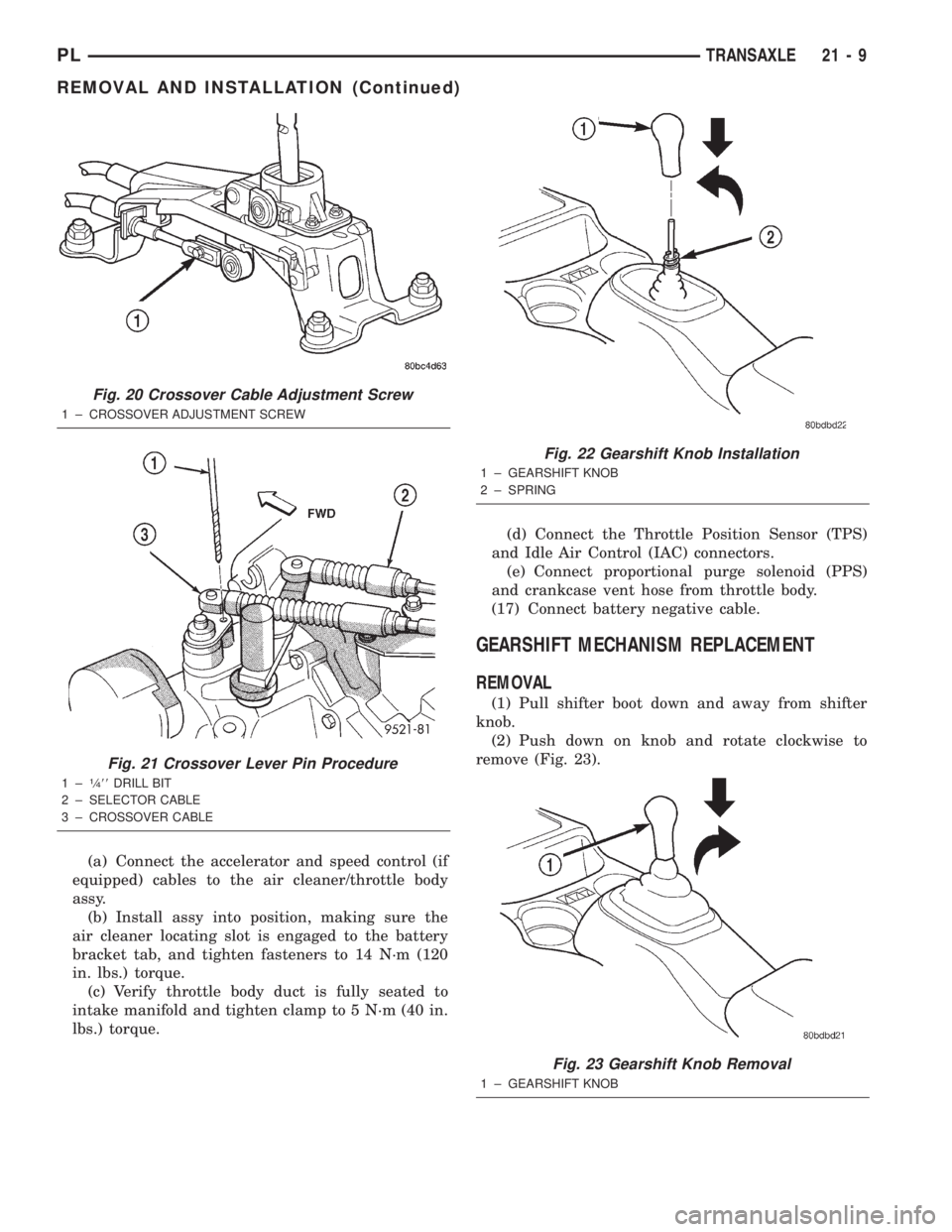
(a) Connect the accelerator and speed control (if
equipped) cables to the air cleaner/throttle body
assy.
(b) Install assy into position, making sure the
air cleaner locating slot is engaged to the battery
bracket tab, and tighten fasteners to 14 N´m (120
in. lbs.) torque.
(c) Verify throttle body duct is fully seated to
intake manifold and tighten clamp to 5 N´m (40 in.
lbs.) torque.(d) Connect the Throttle Position Sensor (TPS)
and Idle Air Control (IAC) connectors.
(e) Connect proportional purge solenoid (PPS)
and crankcase vent hose from throttle body.
(17) Connect battery negative cable.
GEARSHIFT MECHANISM REPLACEMENT
REMOVAL
(1) Pull shifter boot down and away from shifter
knob.
(2) Push down on knob and rotate clockwise to
remove (Fig. 23).
Fig. 20 Crossover Cable Adjustment Screw
1 ± CROSSOVER ADJUSTMENT SCREW
Fig. 21 Crossover Lever Pin Procedure
1±1¤488DRILL BIT
2 ± SELECTOR CABLE
3 ± CROSSOVER CABLE
Fig. 22 Gearshift Knob Installation
1 ± GEARSHIFT KNOB
2 ± SPRING
Fig. 23 Gearshift Knob Removal
1 ± GEARSHIFT KNOB
PLTRANSAXLE 21 - 9
REMOVAL AND INSTALLATION (Continued)
Page 927 of 1285
TRANSAXLE
REMOVAL
(1) Raise hood.
(2) Disconnect both battery cables, remove battery
hold down clamp and bolt, and remove battery.
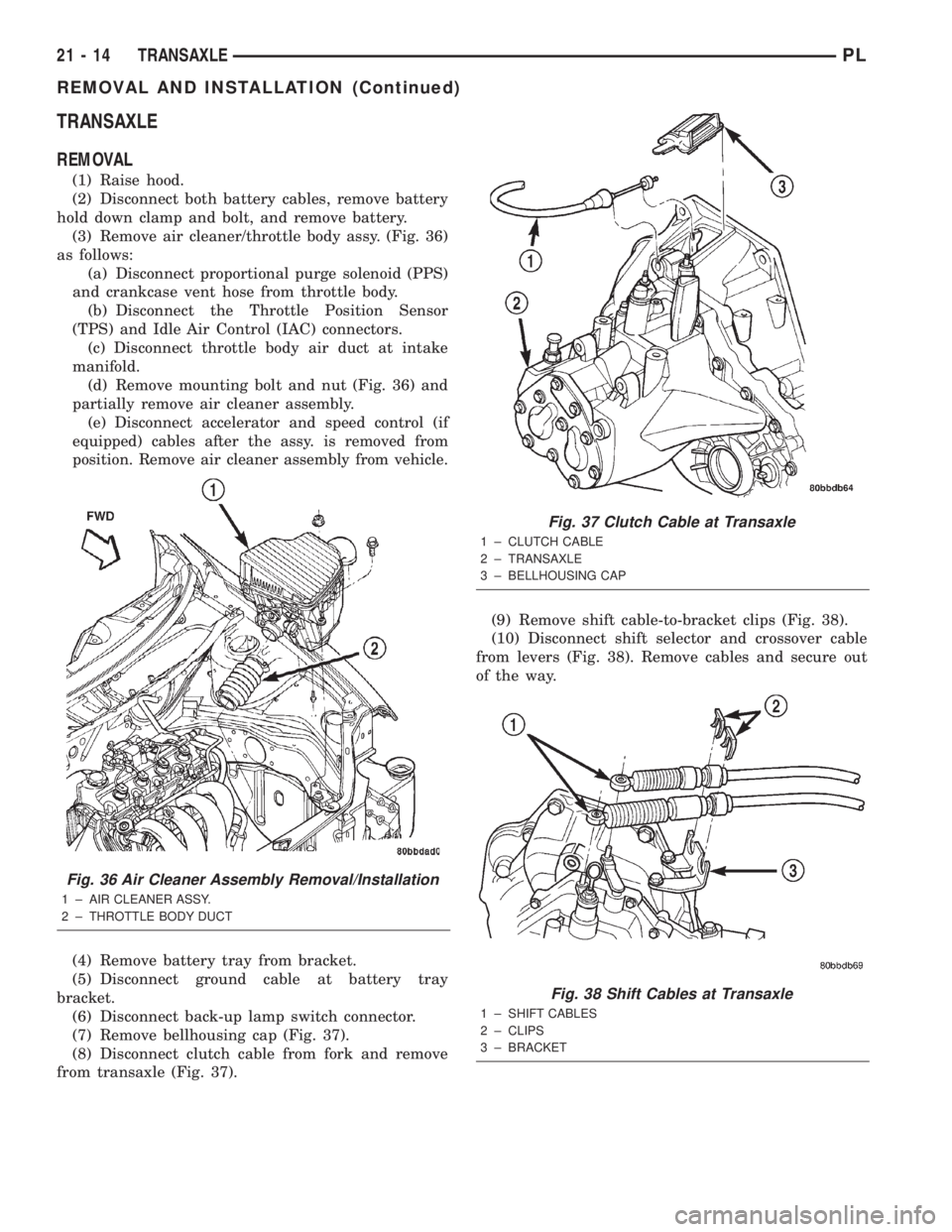
(3) Remove air cleaner/throttle body assy. (Fig. 36)
as follows:
(a) Disconnect proportional purge solenoid (PPS)
and crankcase vent hose from throttle body.
(b) Disconnect the Throttle Position Sensor
(TPS) and Idle Air Control (IAC) connectors.
(c) Disconnect throttle body air duct at intake
manifold.
(d) Remove mounting bolt and nut (Fig. 36) and
partially remove air cleaner assembly.
(e)
Disconnect accelerator and speed control (if
equipped) cables after the assy. is removed from
position. Remove air cleaner assembly from vehicle.
(4) Remove battery tray from bracket.
(5) Disconnect ground cable at battery tray
bracket.
(6) Disconnect back-up lamp switch connector.
(7) Remove bellhousing cap (Fig. 37).
(8) Disconnect clutch cable from fork and remove
from transaxle (Fig. 37).(9) Remove shift cable-to-bracket clips (Fig. 38).
(10) Disconnect shift selector and crossover cable
from levers (Fig. 38). Remove cables and secure out
of the way.
Fig. 36 Air Cleaner Assembly Removal/Installation
1 ± AIR CLEANER ASSY.
2 ± THROTTLE BODY DUCT
Fig. 37 Clutch Cable at Transaxle
1 ± CLUTCH CABLE
2 ± TRANSAXLE
3 ± BELLHOUSING CAP
Fig. 38 Shift Cables at Transaxle
1 ± SHIFT CABLES
2 ± CLIPS
3 ± BRACKET
21 - 14 TRANSAXLEPL
REMOVAL AND INSTALLATION (Continued)
Page 930 of 1285
(22) Install the air cleaner/throttle body assy. as
follows:
(a) Connect the accelerator and speed control (if
equipped) cables to the air cleaner/throttle body
assy.
(b) Install assy into position, making sure the
air cleaner locating slot is engaged to the battery
bracket tab, and tighten fasteners to 14 N´m (120
in. lbs.) torque.
(c) Verify throttle body duct is fully seated to
intake manifold and tighten clamp to 5 N´m (40 in.
lbs.) torque.
(d) Connect the Throttle Position Sensor (TPS)
and Idle Air Control (IAC) connectors.
(e) Connect proportional purge solenoid (PPS)
and crankcase vent hose from throttle body.
(23) Connect the battery cables.
(24) Road test vehicle and inspect for leaks.
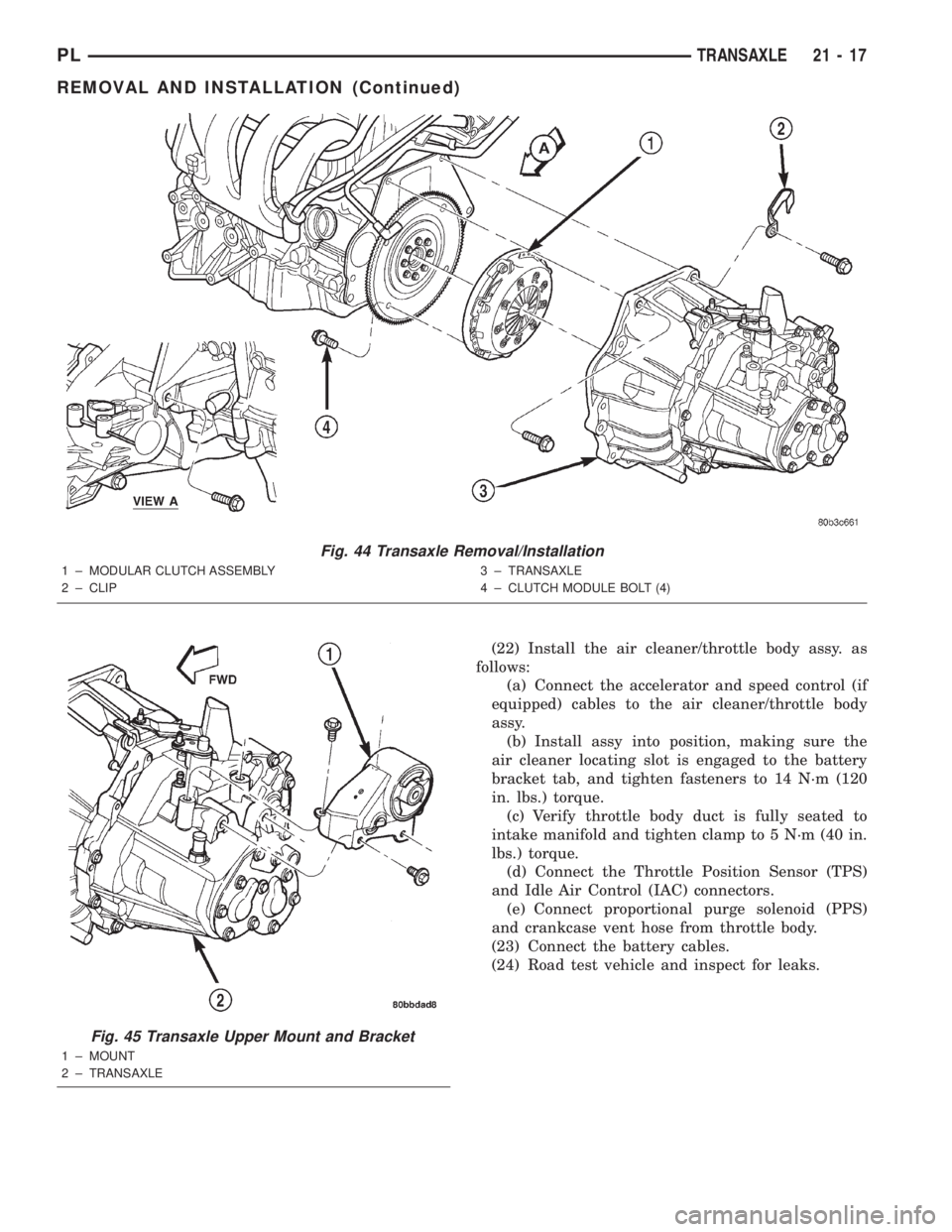
Fig. 44 Transaxle Removal/Installation
1 ± MODULAR CLUTCH ASSEMBLY
2 ± CLIP3 ± TRANSAXLE
4 ± CLUTCH MODULE BOLT (4)
Fig. 45 Transaxle Upper Mount and Bracket
1 ± MOUNT
2 ± TRANSAXLE
PLTRANSAXLE 21 - 17
REMOVAL AND INSTALLATION (Continued)
Page 937 of 1285
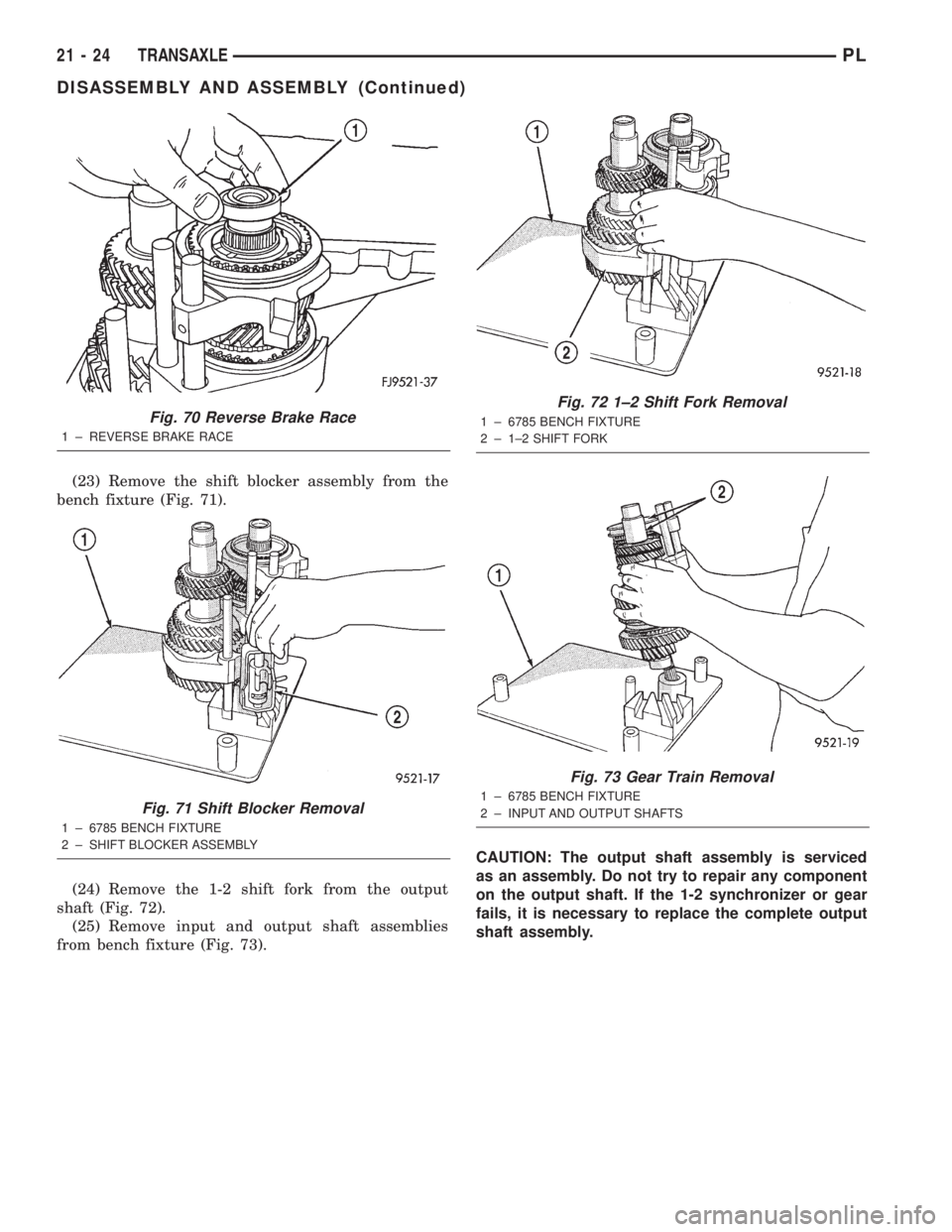
(23) Remove the shift blocker assembly from the
bench fixture (Fig. 71).
(24) Remove the 1-2 shift fork from the output
shaft (Fig. 72).
(25) Remove input and output shaft assemblies
from bench fixture (Fig. 73).CAUTION: The output shaft assembly is serviced
as an assembly. Do not try to repair any component
on the output shaft. If the 1-2 synchronizer or gear
fails, it is necessary to replace the complete output
shaft assembly.
Fig. 70 Reverse Brake Race
1 ± REVERSE BRAKE RACE
Fig. 71 Shift Blocker Removal
1 ± 6785 BENCH FIXTURE
2 ± SHIFT BLOCKER ASSEMBLY
Fig. 72 1±2 Shift Fork Removal
1 ± 6785 BENCH FIXTURE
2 ± 1±2 SHIFT FORK
Fig. 73 Gear Train Removal
1 ± 6785 BENCH FIXTURE
2 ± INPUT AND OUTPUT SHAFTS
21 - 24 TRANSAXLEPL
DISASSEMBLY AND ASSEMBLY (Continued)
Page 942 of 1285
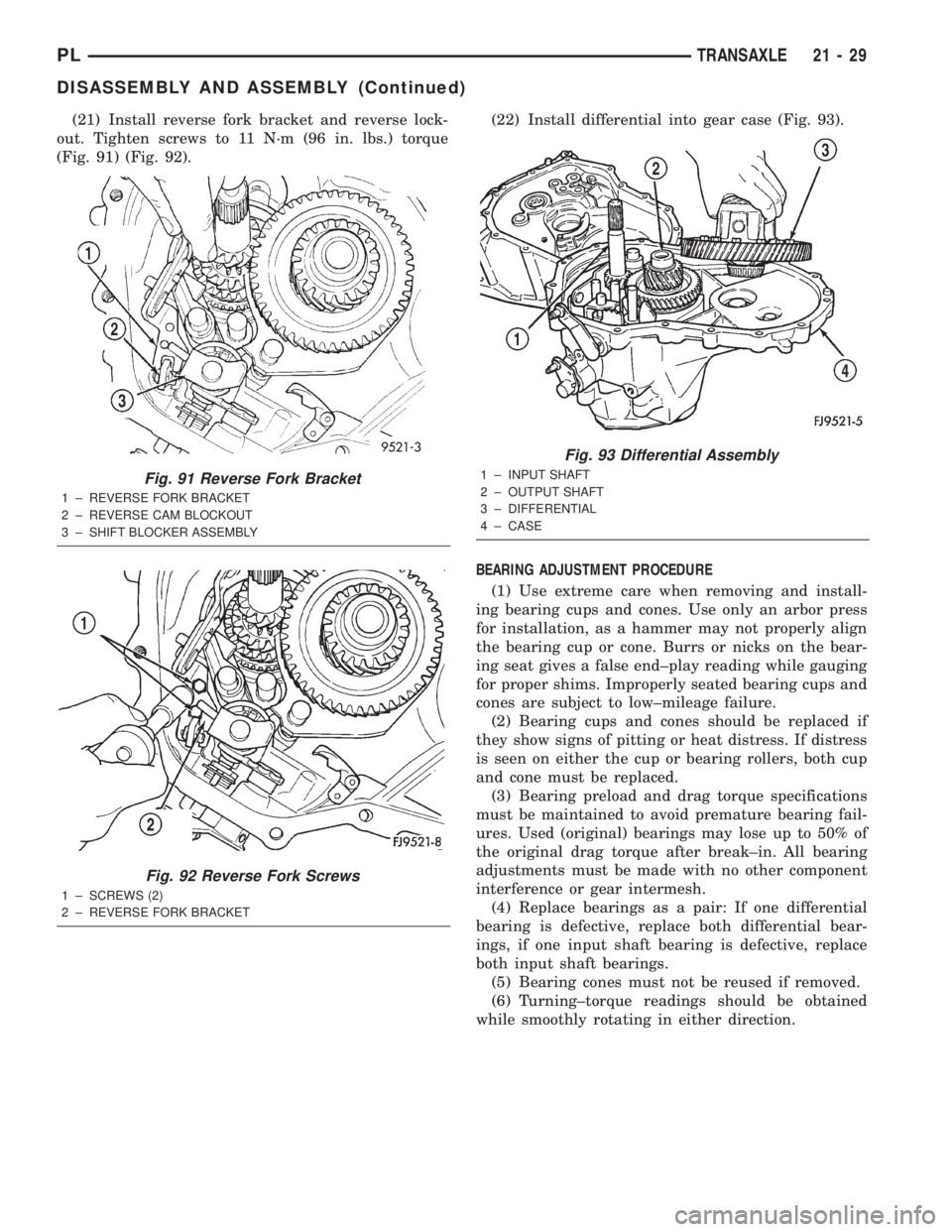
(21) Install reverse fork bracket and reverse lock-
out. Tighten screws to 11 N´m (96 in. lbs.) torque
(Fig. 91) (Fig. 92).(22) Install differential into gear case (Fig. 93).
BEARING ADJUSTMENT PROCEDURE
(1) Use extreme care when removing and install-
ing bearing cups and cones. Use only an arbor press
for installation, as a hammer may not properly align
the bearing cup or cone. Burrs or nicks on the bear-
ing seat gives a false end±play reading while gauging
for proper shims. Improperly seated bearing cups and
cones are subject to low±mileage failure.
(2) Bearing cups and cones should be replaced if
they show signs of pitting or heat distress. If distress
is seen on either the cup or bearing rollers, both cup
and cone must be replaced.
(3) Bearing preload and drag torque specifications
must be maintained to avoid premature bearing fail-
ures. Used (original) bearings may lose up to 50% of
the original drag torque after break±in. All bearing
adjustments must be made with no other component
interference or gear intermesh.
(4) Replace bearings as a pair: If one differential
bearing is defective, replace both differential bear-
ings, if one input shaft bearing is defective, replace
both input shaft bearings.
(5) Bearing cones must not be reused if removed.
(6) Turning±torque readings should be obtained
while smoothly rotating in either direction.
Fig. 91 Reverse Fork Bracket
1 ± REVERSE FORK BRACKET
2 ± REVERSE CAM BLOCKOUT
3 ± SHIFT BLOCKER ASSEMBLY
Fig. 92 Reverse Fork Screws
1 ± SCREWS (2)
2 ± REVERSE FORK BRACKET
Fig. 93 Differential Assembly
1 ± INPUT SHAFT
2 ± OUTPUT SHAFT
3 ± DIFFERENTIAL
4 ± CASE
PLTRANSAXLE 21 - 29
DISASSEMBLY AND ASSEMBLY (Continued)
Page 949 of 1285
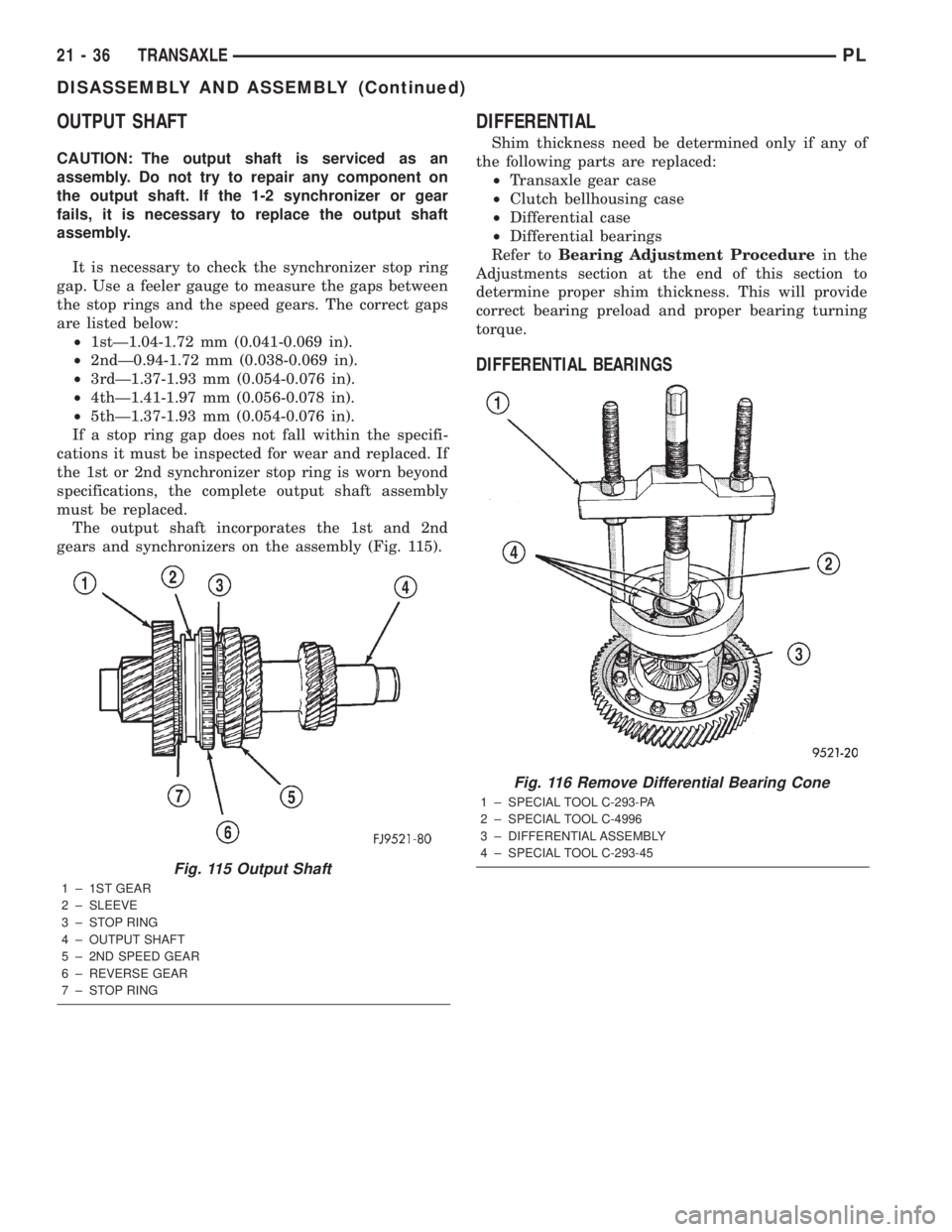
OUTPUT SHAFT
CAUTION: The output shaft is serviced as an
assembly. Do not try to repair any component on
the output shaft. If the 1-2 synchronizer or gear
fails, it is necessary to replace the output shaft
assembly.
It is necessary to check the synchronizer stop ring
gap. Use a feeler gauge to measure the gaps between
the stop rings and the speed gears. The correct gaps
are listed below:
²1stÐ1.04-1.72 mm (0.041-0.069 in).
²2ndÐ0.94-1.72 mm (0.038-0.069 in).
²3rdÐ1.37-1.93 mm (0.054-0.076 in).
²4thÐ1.41-1.97 mm (0.056-0.078 in).
²5thÐ1.37-1.93 mm (0.054-0.076 in).
If a stop ring gap does not fall within the specifi-
cations it must be inspected for wear and replaced. If
the 1st or 2nd synchronizer stop ring is worn beyond
specifications, the complete output shaft assembly
must be replaced.
The output shaft incorporates the 1st and 2nd
gears and synchronizers on the assembly (Fig. 115).
DIFFERENTIAL
Shim thickness need be determined only if any of
the following parts are replaced:
²Transaxle gear case
²Clutch bellhousing case
²Differential case
²Differential bearings
Refer toBearing Adjustment Procedurein the
Adjustments section at the end of this section to
determine proper shim thickness. This will provide
correct bearing preload and proper bearing turning
torque.
DIFFERENTIAL BEARINGS
Fig. 115 Output Shaft
1 ± 1ST GEAR
2 ± SLEEVE
3 ± STOP RING
4 ± OUTPUT SHAFT
5 ± 2ND SPEED GEAR
6 ± REVERSE GEAR
7 ± STOP RING
Fig. 116 Remove Differential Bearing Cone
1 ± SPECIAL TOOL C-293-PA
2 ± SPECIAL TOOL C-4996
3 ± DIFFERENTIAL ASSEMBLY
4 ± SPECIAL TOOL C-293-45
21 - 36 TRANSAXLEPL
DISASSEMBLY AND ASSEMBLY (Continued)
Page 961 of 1285
SHIFT CROSSOVER SHAFT BUSHING
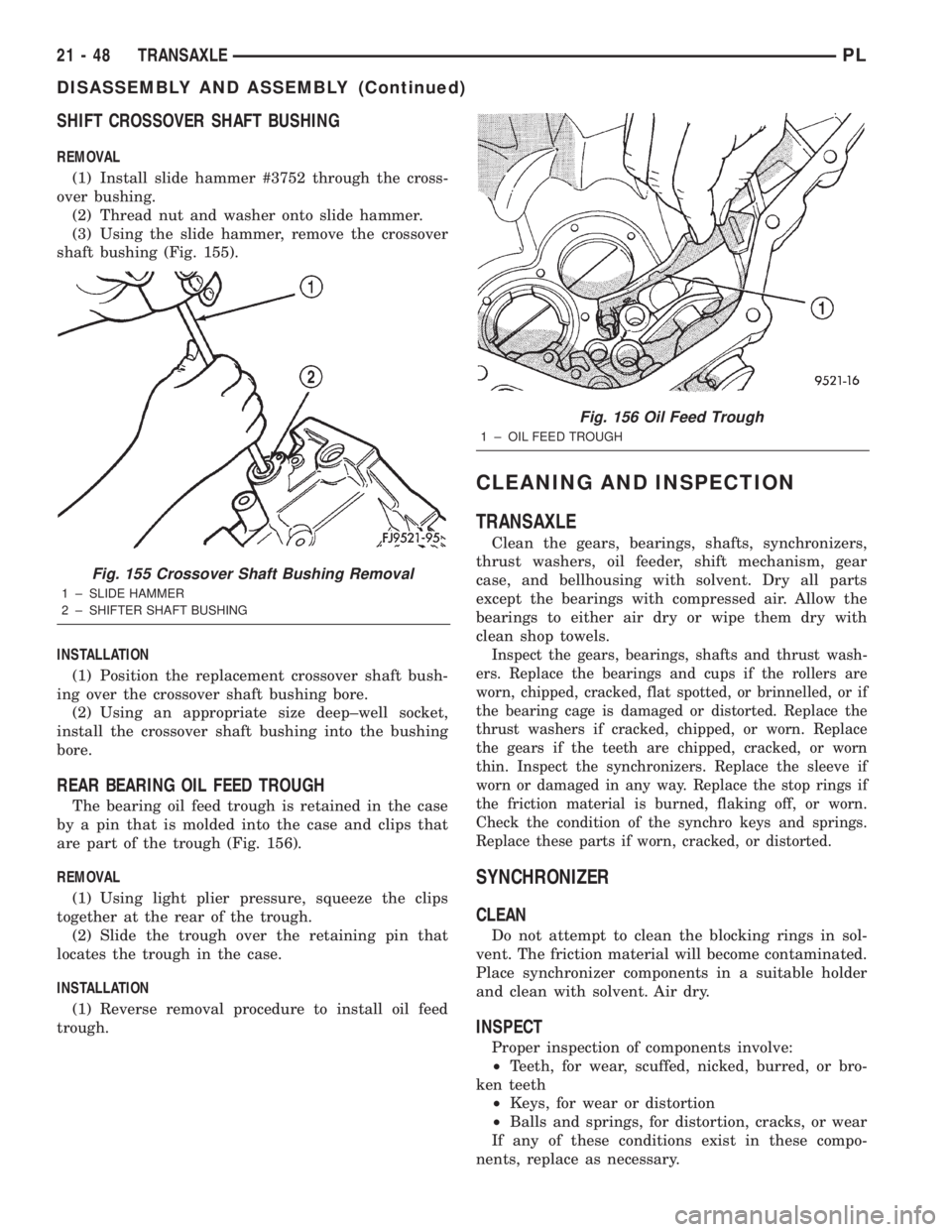
REMOVAL
(1) Install slide hammer #3752 through the cross-
over bushing.
(2) Thread nut and washer onto slide hammer.
(3) Using the slide hammer, remove the crossover
shaft bushing (Fig. 155).
INSTALLATION
(1) Position the replacement crossover shaft bush-
ing over the crossover shaft bushing bore.
(2) Using an appropriate size deep±well socket,
install the crossover shaft bushing into the bushing
bore.
REAR BEARING OIL FEED TROUGH
The bearing oil feed trough is retained in the case
by a pin that is molded into the case and clips that
are part of the trough (Fig. 156).
REMOVAL
(1) Using light plier pressure, squeeze the clips
together at the rear of the trough.
(2) Slide the trough over the retaining pin that
locates the trough in the case.
INSTALLATION
(1) Reverse removal procedure to install oil feed
trough.
CLEANING AND INSPECTION
TRANSAXLE
Clean the gears, bearings, shafts, synchronizers,
thrust washers, oil feeder, shift mechanism, gear
case, and bellhousing with solvent. Dry all parts
except the bearings with compressed air. Allow the
bearings to either air dry or wipe them dry with
clean shop towels.
Inspect the gears, bearings, shafts and thrust wash-
ers. Replace the bearings and cups if the rollers are
worn, chipped, cracked, flat spotted, or brinnelled, or if
the bearing cage is damaged or distorted. Replace the
thrust washers if cracked, chipped, or worn. Replace
the gears if the teeth are chipped, cracked, or worn
thin. Inspect the synchronizers. Replace the sleeve if
worn or damaged in any way. Replace the stop rings if
the friction material is burned, flaking off, or worn.
Check the condition of the synchro keys and springs.
Replace these parts if worn, cracked, or distorted.
SYNCHRONIZER
CLEAN
Do not attempt to clean the blocking rings in sol-
vent. The friction material will become contaminated.
Place synchronizer components in a suitable holder
and clean with solvent. Air dry.
INSPECT
Proper inspection of components involve:
²Teeth, for wear, scuffed, nicked, burred, or bro-
ken teeth
²Keys, for wear or distortion
²Balls and springs, for distortion, cracks, or wear
If any of these conditions exist in these compo-
nents, replace as necessary.
Fig. 155 Crossover Shaft Bushing Removal
1 ± SLIDE HAMMER
2 ± SHIFTER SHAFT BUSHING
Fig. 156 Oil Feed Trough
1 ± OIL FEED TROUGH
21 - 48 TRANSAXLEPL
DISASSEMBLY AND ASSEMBLY (Continued)