air DODGE NEON 2000 Service Repair Manual
[x] Cancel search | Manufacturer: DODGE, Model Year: 2000, Model line: NEON, Model: DODGE NEON 2000Pages: 1285, PDF Size: 29.42 MB
Page 991 of 1285
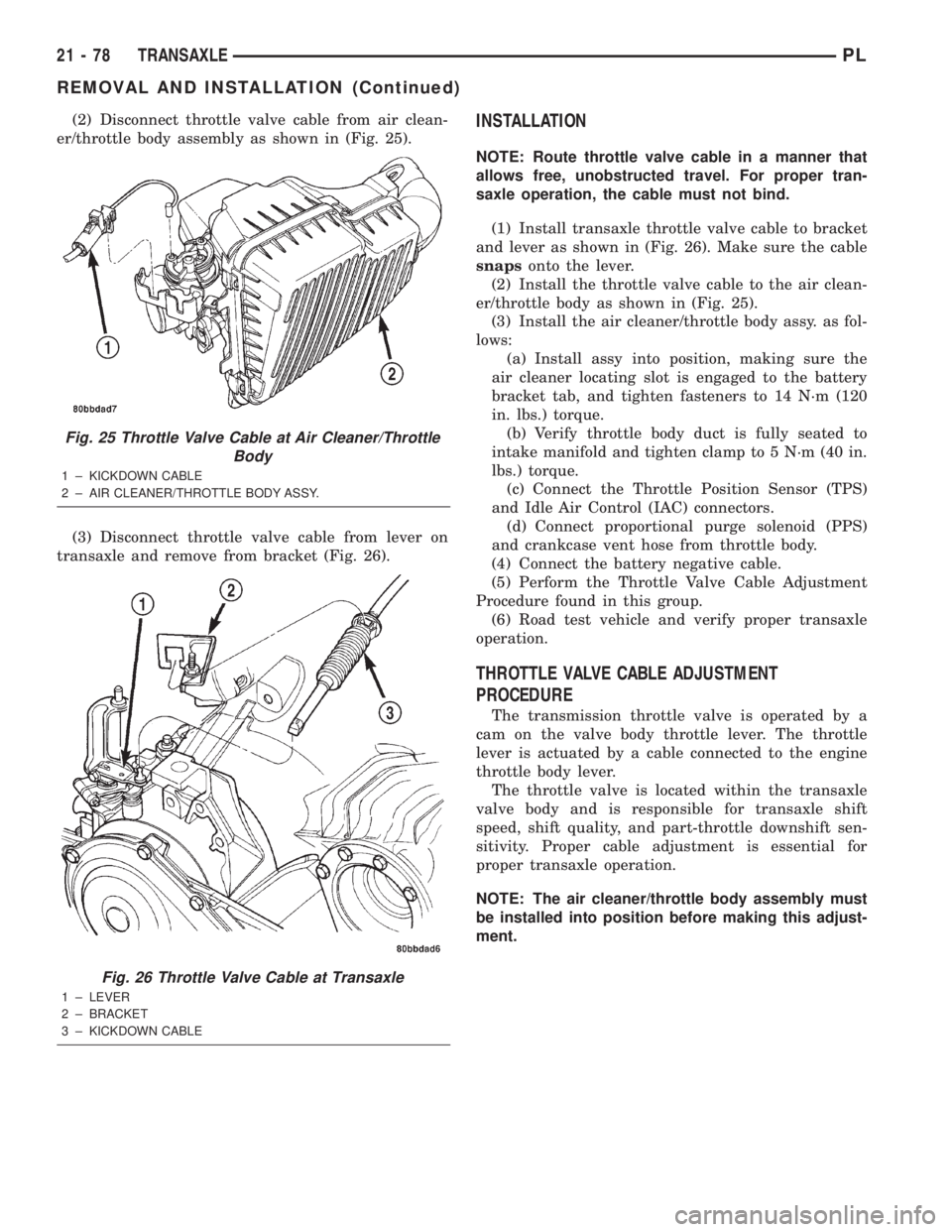
(2) Disconnect throttle valve cable from air clean-
er/throttle body assembly as shown in (Fig. 25).
(3) Disconnect throttle valve cable from lever on
transaxle and remove from bracket (Fig. 26).INSTALLATION
NOTE: Route throttle valve cable in a manner that
allows free, unobstructed travel. For proper tran-
saxle operation, the cable must not bind.
(1) Install transaxle throttle valve cable to bracket
and lever as shown in (Fig. 26). Make sure the cable
snapsonto the lever.
(2) Install the throttle valve cable to the air clean-
er/throttle body as shown in (Fig. 25).
(3) Install the air cleaner/throttle body assy. as fol-
lows:
(a) Install assy into position, making sure the
air cleaner locating slot is engaged to the battery
bracket tab, and tighten fasteners to 14 N´m (120
in. lbs.) torque.
(b) Verify throttle body duct is fully seated to
intake manifold and tighten clamp to 5 N´m (40 in.
lbs.) torque.
(c) Connect the Throttle Position Sensor (TPS)
and Idle Air Control (IAC) connectors.
(d) Connect proportional purge solenoid (PPS)
and crankcase vent hose from throttle body.
(4) Connect the battery negative cable.
(5) Perform the Throttle Valve Cable Adjustment
Procedure found in this group.
(6) Road test vehicle and verify proper transaxle
operation.
THROTTLE VALVE CABLE ADJUSTMENT
PROCEDURE
The transmission throttle valve is operated by a
cam on the valve body throttle lever. The throttle
lever is actuated by a cable connected to the engine
throttle body lever.
The throttle valve is located within the transaxle
valve body and is responsible for transaxle shift
speed, shift quality, and part-throttle downshift sen-
sitivity. Proper cable adjustment is essential for
proper transaxle operation.
NOTE: The air cleaner/throttle body assembly must
be installed into position before making this adjust-
ment.
Fig. 25 Throttle Valve Cable at Air Cleaner/Throttle
Body
1 ± KICKDOWN CABLE
2 ± AIR CLEANER/THROTTLE BODY ASSY.
Fig. 26 Throttle Valve Cable at Transaxle
1 ± LEVER
2 ± BRACKET
3 ± KICKDOWN CABLE
21 - 78 TRANSAXLEPL
REMOVAL AND INSTALLATION (Continued)
Page 995 of 1285
(9) Verify that shifter is in gated ªPARKº.
(10) Install the cable core end to the plastic cam of
the shifter mechanism. Snap the shifter/ignition
interlock cable end fitting into the groove in the gear-
shift mechanism as shown in (Fig. 32).
(11)Adjust interlock cable/system as follows:
If interlock cable is being replaced, it will come with
an adjustment pin. Remove the pin from the cable
and allow the cable to ªself-adjustº. Lock cable
adjustment by pressing down on the adjuster lock
until bottomed at the cable housing. If interlock cable
is being re-used, no pin will be provided. Pry up on
cable adjuster lock to release and allow cable to ªself-
adjustº. Lock cable adjustment by pressing down on
the adjuster lock until bottomed at the cable housing.
(12)Connect battery negative cable and ver-
ify interlock system operation as follows:
(13) Install shifter bezel (Fig. 31).
(14) Install center console assembly (Fig. 30).
(15) Install gearshift knob and tighten set screw to
2 N´m (15 in. lbs.) torque (Fig. 29).
INTERLOCK MECHANISM
REMOVAL
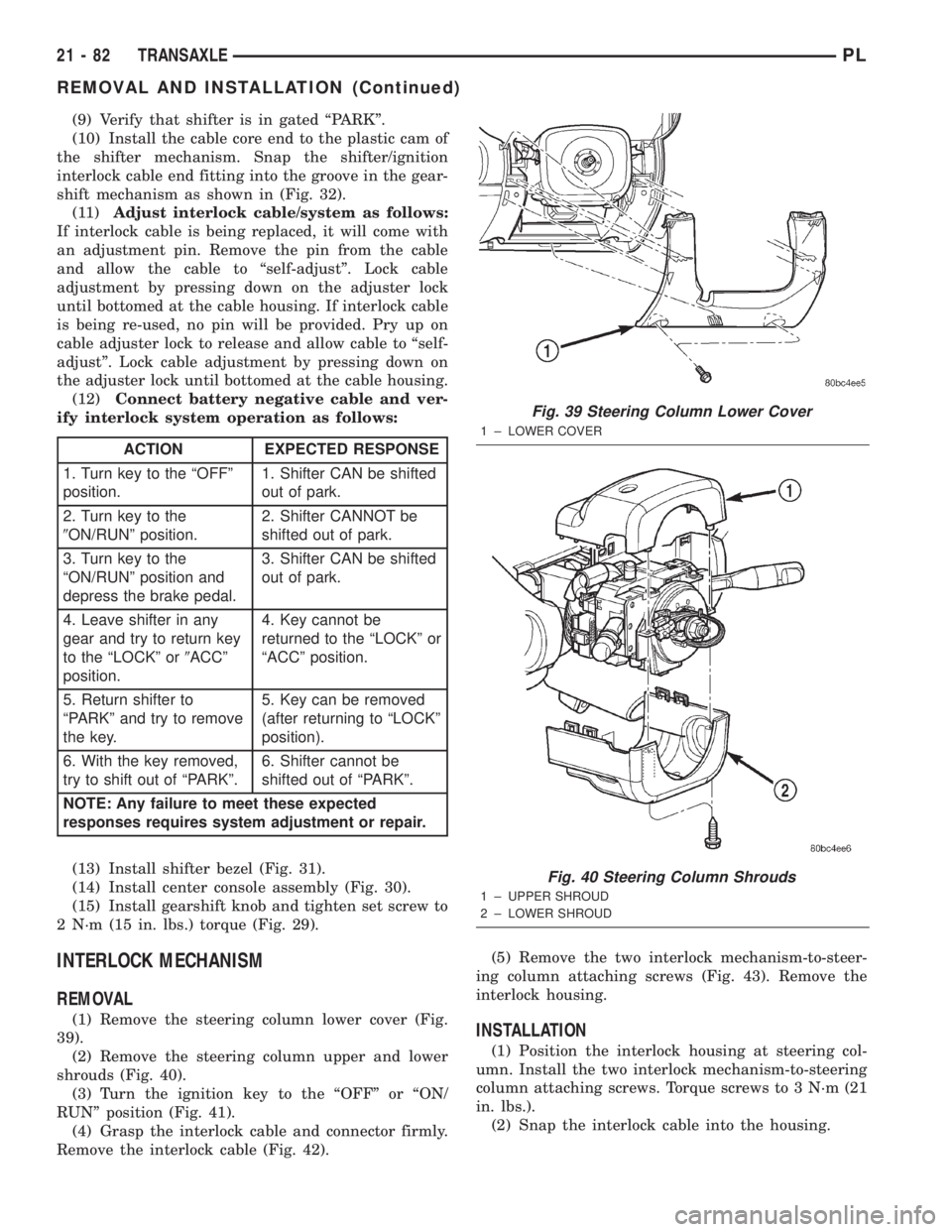
(1) Remove the steering column lower cover (Fig.
39).
(2) Remove the steering column upper and lower
shrouds (Fig. 40).
(3) Turn the ignition key to the ªOFFº or ªON/
RUNº position (Fig. 41).
(4) Grasp the interlock cable and connector firmly.
Remove the interlock cable (Fig. 42).(5) Remove the two interlock mechanism-to-steer-
ing column attaching screws (Fig. 43). Remove the
interlock housing.INSTALLATION
(1) Position the interlock housing at steering col-
umn. Install the two interlock mechanism-to-steering
column attaching screws. Torque screws to 3 N´m (21
in. lbs.).
(2) Snap the interlock cable into the housing.
ACTION EXPECTED RESPONSE
1. Turn key to the ªOFFº
position.1. Shifter CAN be shifted
out of park.
2. Turn key to the
9ON/RUNº position.2. Shifter CANNOT be
shifted out of park.
3. Turn key to the
ªON/RUNº position and
depress the brake pedal.3. Shifter CAN be shifted
out of park.
4. Leave shifter in any
gear and try to return key
to the ªLOCKº or9ACCº
position.4. Key cannot be
returned to the ªLOCKº or
ªACCº position.
5. Return shifter to
ªPARKº and try to remove
the key.5. Key can be removed
(after returning to ªLOCKº
position).
6. With the key removed,
try to shift out of ªPARKº.6. Shifter cannot be
shifted out of ªPARKº.
NOTE: Any failure to meet these expected
responses requires system adjustment or repair.
Fig. 39 Steering Column Lower Cover
1 ± LOWER COVER
Fig. 40 Steering Column Shrouds
1 ± UPPER SHROUD
2 ± LOWER SHROUD
21 - 82 TRANSAXLEPL
REMOVAL AND INSTALLATION (Continued)
Page 997 of 1285
PARK/NEUTRAL STARTING AND BACK-UP
LAMP SWITCH
TEST
The park/neutral starting switch is the center ter-
minal of the three terminal switch. It provides
ground for the starter solenoid circuit through the
selector lever in PARK and NEUTRAL positions only.
(1) To test switch, remove wiring connector from
switch and test for continuity between center pin of
switch and transaxle case. Continuity should exist
only when transaxle is in PARK or NEUTRAL.
(2) Check gearshift cable adjustment before replac-
ing a switch that tests bad.
REMOVAL
(1) Unscrew switch from transaxle case allowing
fluid to drain into a container. Move selector lever to
PARK, then to NEUTRAL position, and inspect to see
the switch operating lever fingers are centered in
switch opening.
INSTALLATION
(1) Screw the switch with a new seal into tran-
saxle case and tighten to 33 N´m (24 ft. lbs.). Retest
switch with the test lamp.
(2) Add fluid to transaxle to bring up to proper
level.
(3) The back-up lamp switch circuit is through the
two outside terminals of the three terminal switch.
(4) To test switch, remove wiring connector from
switch and test for continuity between the two out-
side pins.
(5) Continuity should exist only with transaxle in
REVERSE position.
(6) No continuity should exist from either pin to
the case.
TRANSAXLE AND TORQUE CONVERTER
REMOVAL
(1) Raise hood.
(2) Disconnect both battery cables, remove battery
hold down clamp and bolt, and remove battery.
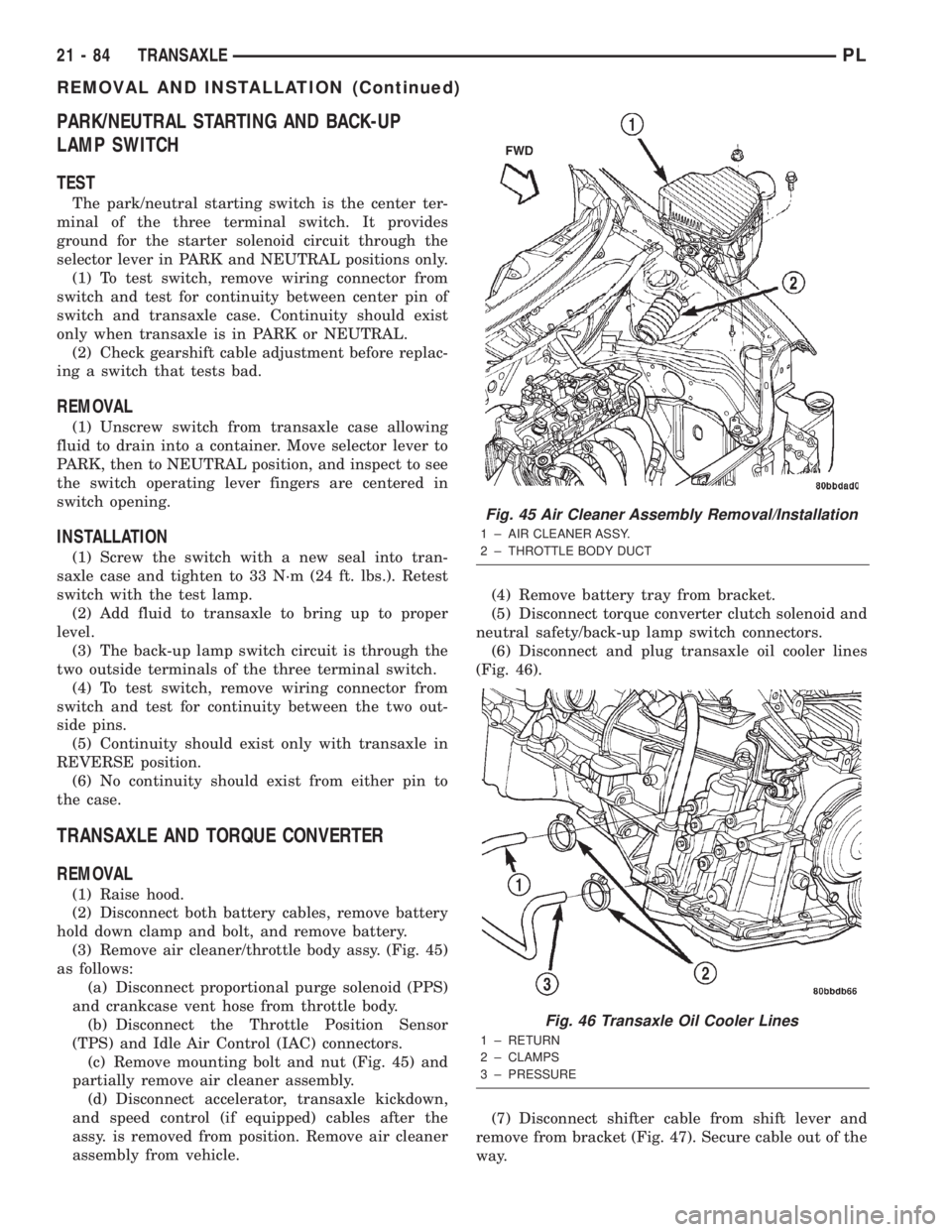
(3) Remove air cleaner/throttle body assy. (Fig. 45)
as follows:
(a) Disconnect proportional purge solenoid (PPS)
and crankcase vent hose from throttle body.
(b) Disconnect the Throttle Position Sensor
(TPS) and Idle Air Control (IAC) connectors.
(c) Remove mounting bolt and nut (Fig. 45) and
partially remove air cleaner assembly.
(d) Disconnect accelerator, transaxle kickdown,
and speed control (if equipped) cables after the
assy. is removed from position. Remove air cleaner
assembly from vehicle.(4) Remove battery tray from bracket.
(5) Disconnect torque converter clutch solenoid and
neutral safety/back-up lamp switch connectors.
(6) Disconnect and plug transaxle oil cooler lines
(Fig. 46).
(7) Disconnect shifter cable from shift lever and
remove from bracket (Fig. 47). Secure cable out of the
way.
Fig. 45 Air Cleaner Assembly Removal/Installation
1 ± AIR CLEANER ASSY.
2 ± THROTTLE BODY DUCT
Fig. 46 Transaxle Oil Cooler Lines
1 ± RETURN
2 ± CLAMPS
3 ± PRESSURE
21 - 84 TRANSAXLEPL
REMOVAL AND INSTALLATION (Continued)
Page 1001 of 1285
(c) Tighten the collar-to-transaxle bolts to 108
N´m (80 ft. lbs.) torque.
(d) Final torque the collar-to-oil pan bolts to 54
N´m (40 ft. lbs.) torque.
(11) Install both front axle driveshafts. Refer to
Group 3, Differential and Driveline for the correct
procedures.
(12) Connect vehicle speed sensor connector (Fig.
50).
(13) Install right lateral bending brace and tighten
bolts to 81 N´m (60 ft. lbs.) torque.
(14) Lower vehicle.
(15) Connect transaxle cooler lines and tighten
clamps (Fig. 46).
(16) Connect torque converter clutch solenoid and
neutral safety/back-up lamp switch connectors.
(17) Install transaxle dipstick tube.
(18) Install gear shift cable to bracket and connect
to shift lever (Fig. 47).
(19) Install transaxle kickdown cable to bracket
and lever as shown in (Fig. 48).
(20) Install battery lower tray and battery, and
tighten battery hold down clamp to secure battery.
(21) Install the air cleaner/throttle body assy. as
follows:
(a) Connect the accelerator, transaxle kickdown,
and speed control (if equipped) cables to the air
cleaner/throttle body assy.
(b) Install assy into position and tighten fasten-
ers to 14 N´m (120 in. lbs.) torque.
(c) Connect the Throttle Position Sensor (TPS)
and Idle Air Control (IAC) connectors.
(d) Connect proportional purge solenoid (PPS)
and crankcase vent hose from throttle body.
(22) Fill transaxle with a suitable amount of
ATF+4.
(23) Road test vehicle.
(24) Check for leaks, inspect fluid level, and adjust
as necessary.
PUMP OIL SEAL
The pump oil seal can be replaced without remov-
ing the pump and reaction shaft support assembly
from the transaxle case.
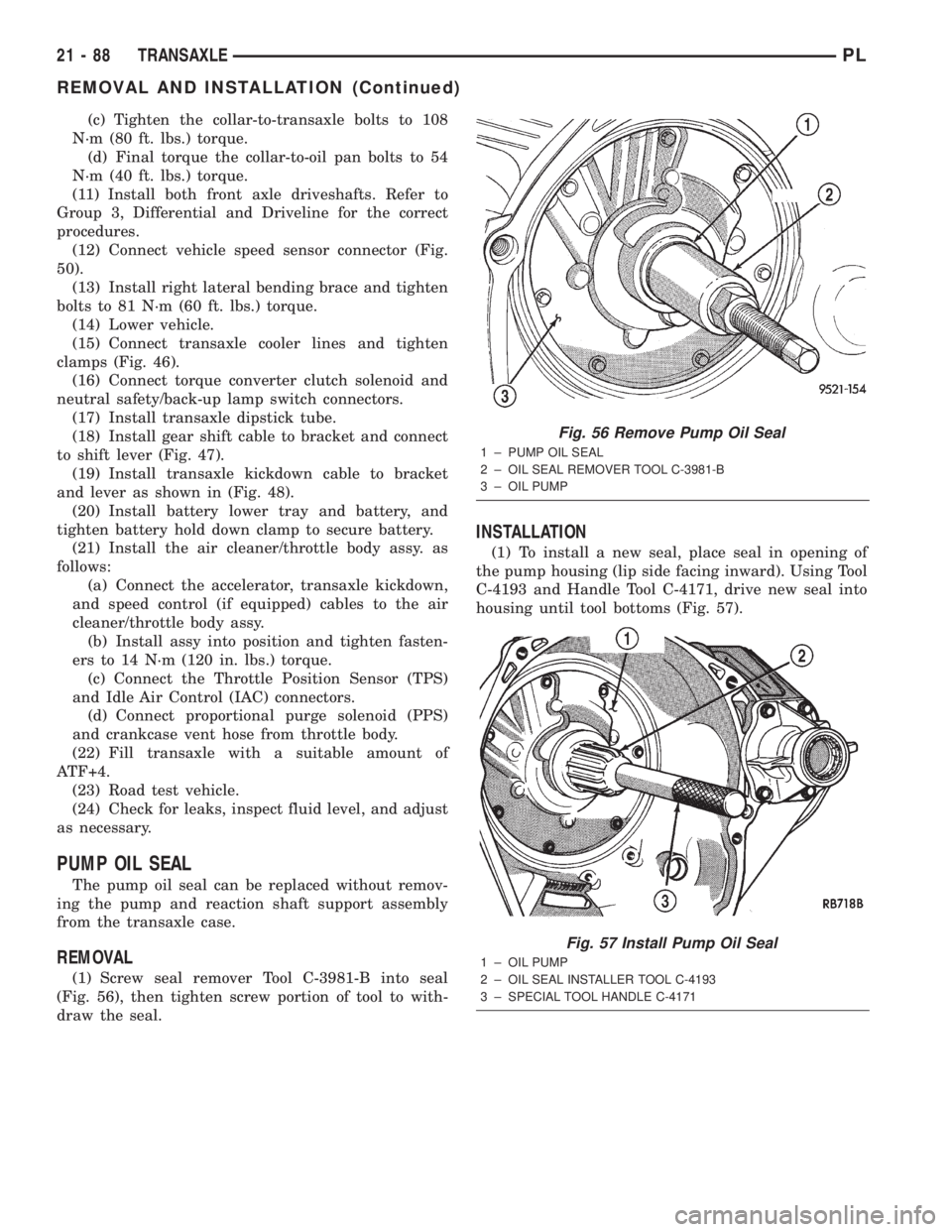
REMOVAL
(1) Screw seal remover Tool C-3981-B into seal
(Fig. 56), then tighten screw portion of tool to with-
draw the seal.
INSTALLATION
(1) To install a new seal, place seal in opening of
the pump housing (lip side facing inward). Using Tool
C-4193 and Handle Tool C-4171, drive new seal into
housing until tool bottoms (Fig. 57).
Fig. 56 Remove Pump Oil Seal
1 ± PUMP OIL SEAL
2 ± OIL SEAL REMOVER TOOL C-3981-B
3 ± OIL PUMP
Fig. 57 Install Pump Oil Seal
1 ± OIL PUMP
2 ± OIL SEAL INSTALLER TOOL C-4193
3 ± SPECIAL TOOL HANDLE C-4171
21 - 88 TRANSAXLEPL
REMOVAL AND INSTALLATION (Continued)
Page 1027 of 1285
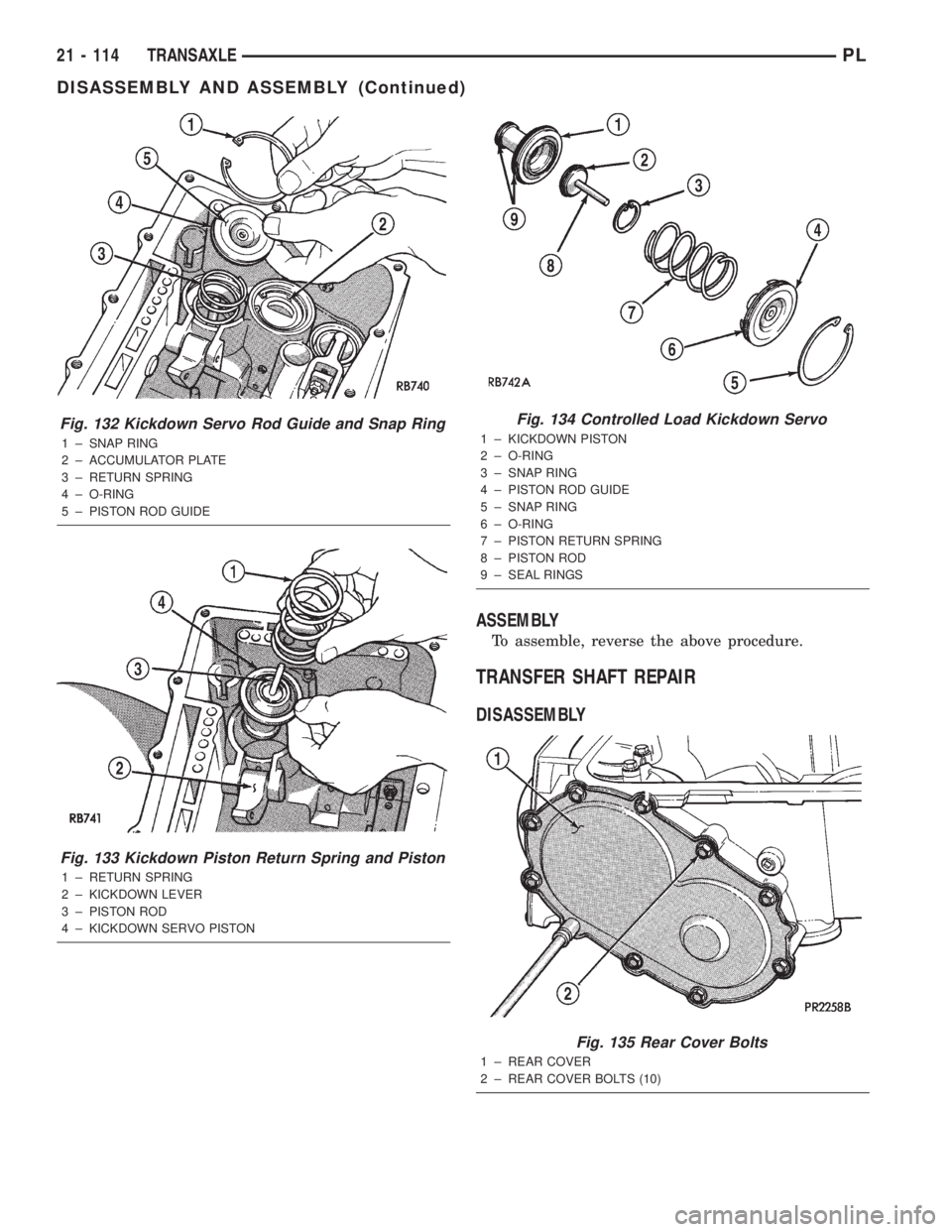
ASSEMBLY
To assemble, reverse the above procedure.
TRANSFER SHAFT REPAIR
DISASSEMBLY
Fig. 132 Kickdown Servo Rod Guide and Snap Ring
1 ± SNAP RING
2 ± ACCUMULATOR PLATE
3 ± RETURN SPRING
4 ± O-RING
5 ± PISTON ROD GUIDE
Fig. 133 Kickdown Piston Return Spring and Piston
1 ± RETURN SPRING
2 ± KICKDOWN LEVER
3 ± PISTON ROD
4 ± KICKDOWN SERVO PISTON
Fig. 134 Controlled Load Kickdown Servo
1 ± KICKDOWN PISTON
2 ± O-RING
3 ± SNAP RING
4 ± PISTON ROD GUIDE
5 ± SNAP RING
6 ± O-RING
7 ± PISTON RETURN SPRING
8 ± PISTON ROD
9 ± SEAL RINGS
Fig. 135 Rear Cover Bolts
1 ± REAR COVER
2 ± REAR COVER BOLTS (10)
21 - 114 TRANSAXLEPL
DISASSEMBLY AND ASSEMBLY (Continued)
Page 1034 of 1285
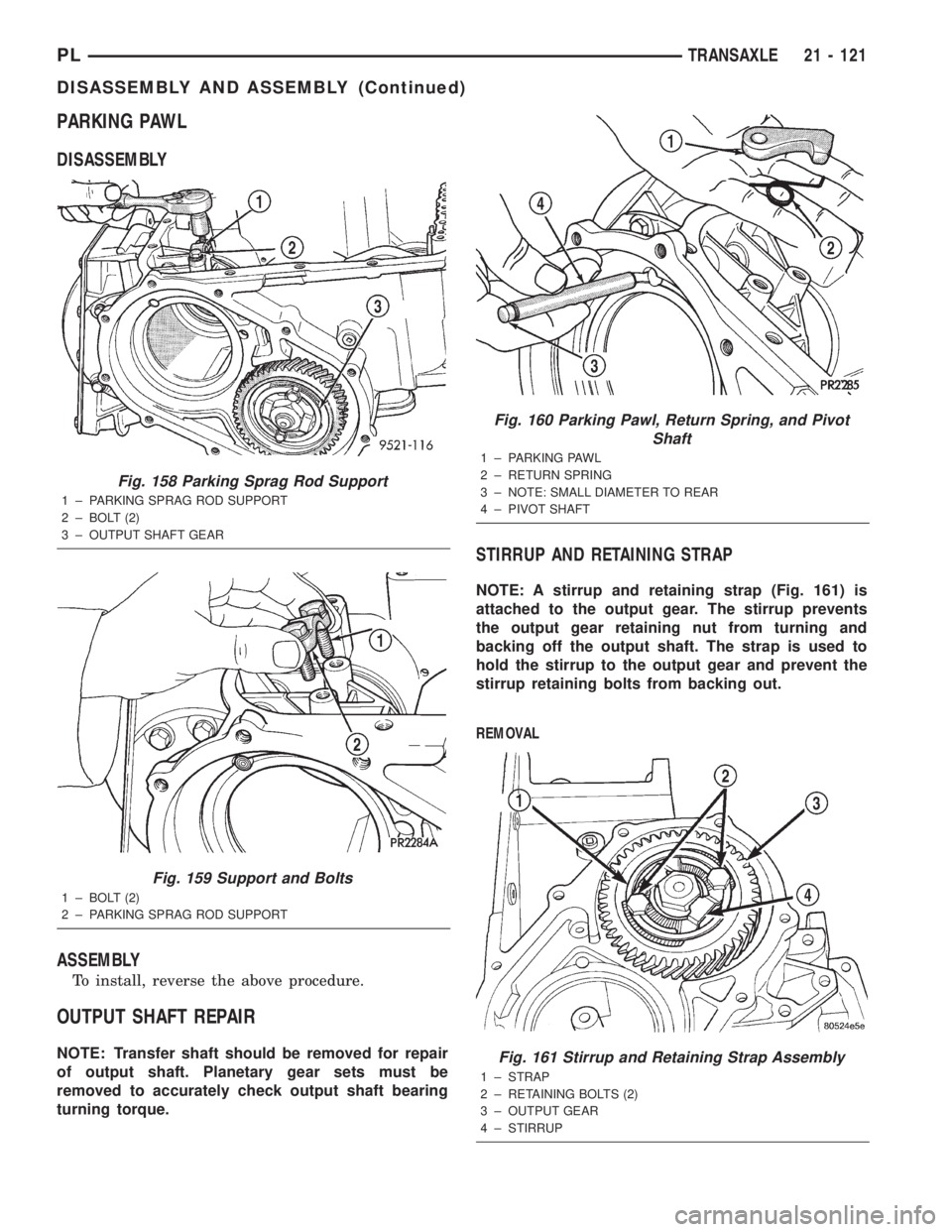
PARKING PAWL
DISASSEMBLY
ASSEMBLY
To install, reverse the above procedure.
OUTPUT SHAFT REPAIR
NOTE: Transfer shaft should be removed for repair
of output shaft. Planetary gear sets must be
removed to accurately check output shaft bearing
turning torque.
STIRRUP AND RETAINING STRAP
NOTE: A stirrup and retaining strap (Fig. 161) is
attached to the output gear. The stirrup prevents
the output gear retaining nut from turning and
backing off the output shaft. The strap is used to
hold the stirrup to the output gear and prevent the
stirrup retaining bolts from backing out.
REMOVAL
Fig. 158 Parking Sprag Rod Support
1 ± PARKING SPRAG ROD SUPPORT
2 ± BOLT (2)
3 ± OUTPUT SHAFT GEAR
Fig. 159 Support and Bolts
1 ± BOLT (2)
2 ± PARKING SPRAG ROD SUPPORT
Fig. 160 Parking Pawl, Return Spring, and Pivot
Shaft
1 ± PARKING PAWL
2 ± RETURN SPRING
3 ± NOTE: SMALL DIAMETER TO REAR
4 ± PIVOT SHAFT
Fig. 161 Stirrup and Retaining Strap Assembly
1 ± STRAP
2 ± RETAINING BOLTS (2)
3 ± OUTPUT GEAR
4 ± STIRRUP
PLTRANSAXLE 21 - 121
DISASSEMBLY AND ASSEMBLY (Continued)
Page 1042 of 1285
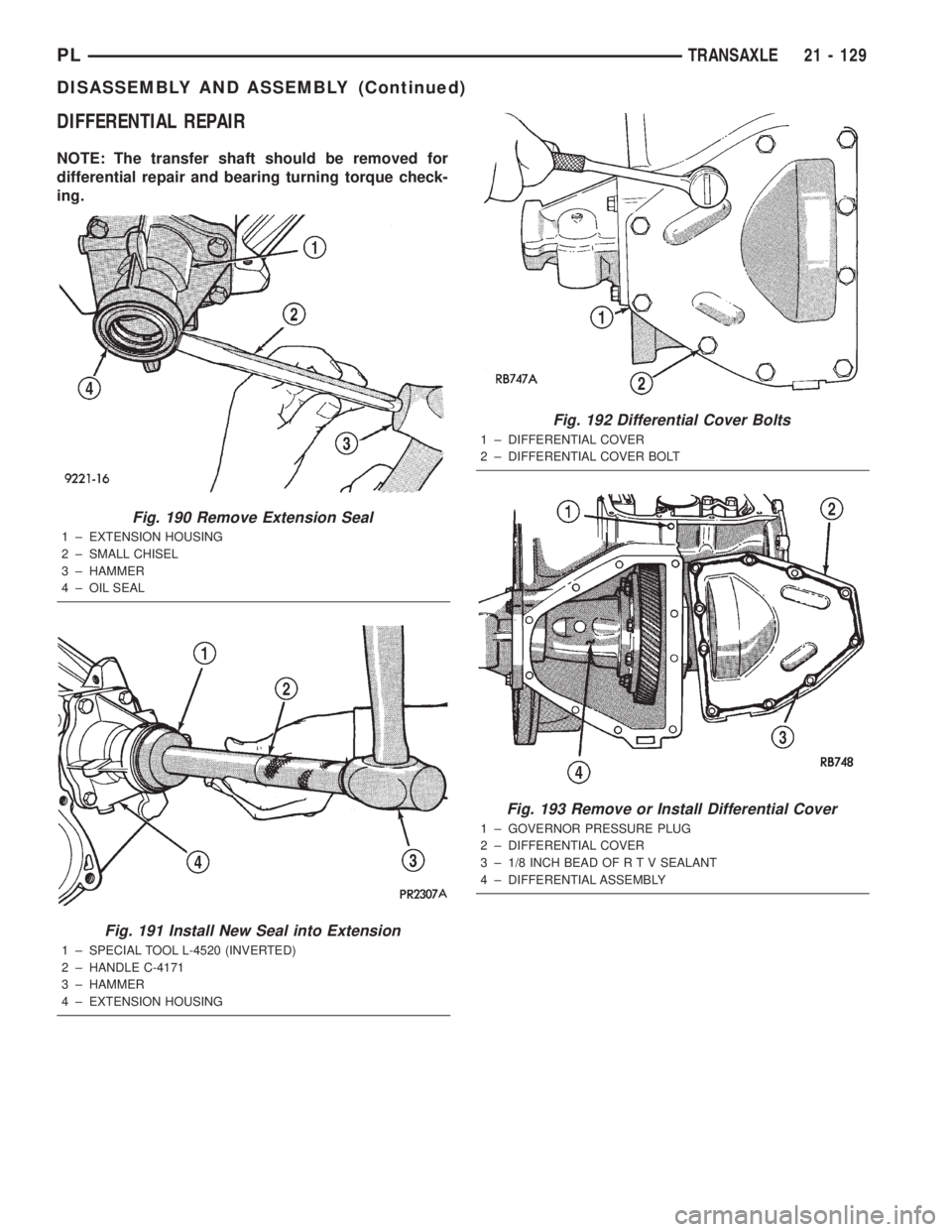
DIFFERENTIAL REPAIR
NOTE: The transfer shaft should be removed for
differential repair and bearing turning torque check-
ing.
Fig. 190 Remove Extension Seal
1 ± EXTENSION HOUSING
2 ± SMALL CHISEL
3 ± HAMMER
4 ± OIL SEAL
Fig. 191 Install New Seal into Extension
1 ± SPECIAL TOOL L-4520 (INVERTED)
2 ± HANDLE C-4171
3 ± HAMMER
4 ± EXTENSION HOUSING
Fig. 192 Differential Cover Bolts
1 ± DIFFERENTIAL COVER
2 ± DIFFERENTIAL COVER BOLT
Fig. 193 Remove or Install Differential Cover
1 ± GOVERNOR PRESSURE PLUG
2 ± DIFFERENTIAL COVER
3 ± 1/8 INCH BEAD OF R T V SEALANT
4 ± DIFFERENTIAL ASSEMBLY
PLTRANSAXLE 21 - 129
DISASSEMBLY AND ASSEMBLY (Continued)
Page 1048 of 1285
CLEANING AND INSPECTION
VALVE BODY
Allow all parts to soak a few minutes in a suitable
clean solvent. Wash thoroughly and blow dry with
compressed air. Be sure all passages are clean and
free from obstructions.
Inspect manual and throttle valve operating levers
and shafts for being bent, worn or loose. If a lever is
loose on its shaft, it should be replaced. Do not
attempt to straighten bent levers.
Inspect all mating surfaces for burrs, nicks and
scratches. Minor blemishes may be removed with cro-
cus cloth, using only a very light pressure. Using a
straightedge, inspect all mating surfaces for warpage
or distortion. Slight distortion may be corrected,
using a surface plate. Be sure all metering holes in
steel plate are open. Using a penlight, inspect bores
in valve body for scores, scratches, pits, and irregu-
larities.
Inspect all valve springs for distortion and col-
lapsed coils. Inspect all valves and plugs for burrs,
nicks, and scores. Small nicks and scores may be
removed with crocus cloth, providing extreme care is
taken not to round off sharp edges. The sharpness of
these edges is vitally important. It prevents foreign
matter from lodging between valve and valve body.
This reduces the possibility of sticking. Inspect all
valves and plugs for freedom of operation in valve
body bores.
When bores, valves, and plugs are clean and dry,
the valves and plugs should fall freely in the bores.
The valve body bores do not change their dimensions
with use. Therefore, a valve body that was function-
ing properly when vehicle was new, will operate cor-
rectly if it is properly and thoroughly cleaned. There
is no need to replace a valve body unless it is dam-
aged in handling.
ADJUSTMENTS
GEARSHIFT CABLE
Normal operation of the Park/Neutral Position
Switch provides a quick check to confirm proper link-
age adjustment. The engine starter should only oper-
ate when the transaxle shift lever is in the PARK (P)
or NEUTRAL (N) positions.
If the engine starts in any other gear position, or
the vehicle rolls when the shifter is in gated PARK
(P), a gearshift cable adjustment is necessary.
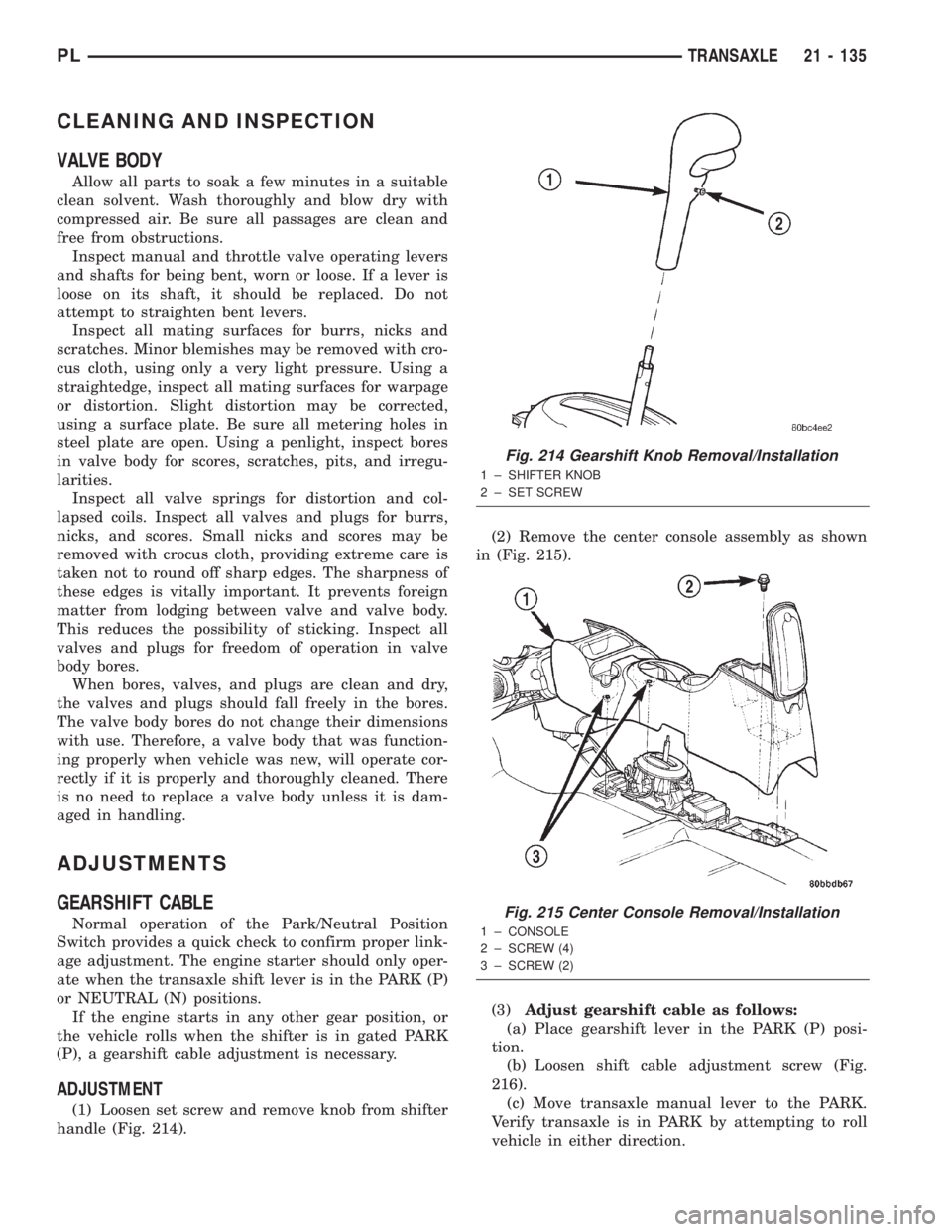
ADJUSTMENT
(1) Loosen set screw and remove knob from shifter
handle (Fig. 214).(2) Remove the center console assembly as shown
in (Fig. 215).
(3)Adjust gearshift cable as follows:
(a) Place gearshift lever in the PARK (P) posi-
tion.
(b) Loosen shift cable adjustment screw (Fig.
216).
(c) Move transaxle manual lever to the PARK.
Verify transaxle is in PARK by attempting to roll
vehicle in either direction.
Fig. 214 Gearshift Knob Removal/Installation
1 ± SHIFTER KNOB
2 ± SET SCREW
Fig. 215 Center Console Removal/Installation
1 ± CONSOLE
2 ± SCREW (4)
3 ± SCREW (2)
PLTRANSAXLE 21 - 135
Page 1049 of 1285
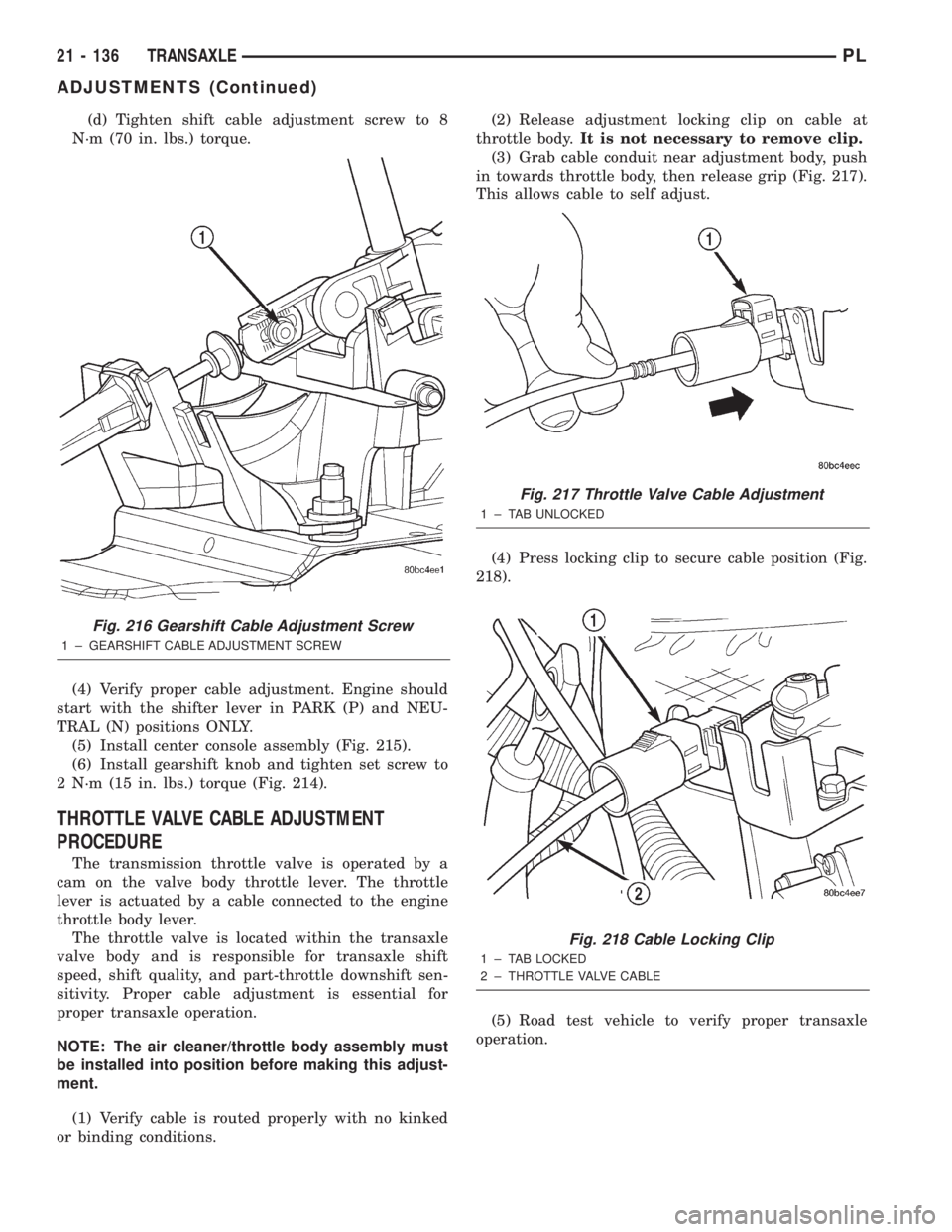
(d) Tighten shift cable adjustment screw to 8
N´m (70 in. lbs.) torque.
(4) Verify proper cable adjustment. Engine should
start with the shifter lever in PARK (P) and NEU-
TRAL (N) positions ONLY.
(5) Install center console assembly (Fig. 215).
(6) Install gearshift knob and tighten set screw to
2 N´m (15 in. lbs.) torque (Fig. 214).
THROTTLE VALVE CABLE ADJUSTMENT
PROCEDURE
The transmission throttle valve is operated by a
cam on the valve body throttle lever. The throttle
lever is actuated by a cable connected to the engine
throttle body lever.
The throttle valve is located within the transaxle
valve body and is responsible for transaxle shift
speed, shift quality, and part-throttle downshift sen-
sitivity. Proper cable adjustment is essential for
proper transaxle operation.
NOTE: The air cleaner/throttle body assembly must
be installed into position before making this adjust-
ment.
(1) Verify cable is routed properly with no kinked
or binding conditions.(2) Release adjustment locking clip on cable at
throttle body.It is not necessary to remove clip.
(3) Grab cable conduit near adjustment body, push
in towards throttle body, then release grip (Fig. 217).
This allows cable to self adjust.
(4) Press locking clip to secure cable position (Fig.
218).
(5) Road test vehicle to verify proper transaxle
operation.
Fig. 216 Gearshift Cable Adjustment Screw
1 ± GEARSHIFT CABLE ADJUSTMENT SCREW
Fig. 217 Throttle Valve Cable Adjustment
1 ± TAB UNLOCKED
Fig. 218 Cable Locking Clip
1 ± TAB LOCKED
2 ± THROTTLE VALVE CABLE
21 - 136 TRANSAXLEPL
ADJUSTMENTS (Continued)
Page 1050 of 1285
BRAKE TRANSMISSION SHIFT INTERLOCK
SYSTEM
VERIFICATION
The following chart describes the normal operation
of the Brake Transmission Shift Interlock (BTSI) sys-
tem. If the ªexpected responseº differs from the vehi-
cle's response, then system repair and/or adjustment
is necessary.
ADJUSTMENT
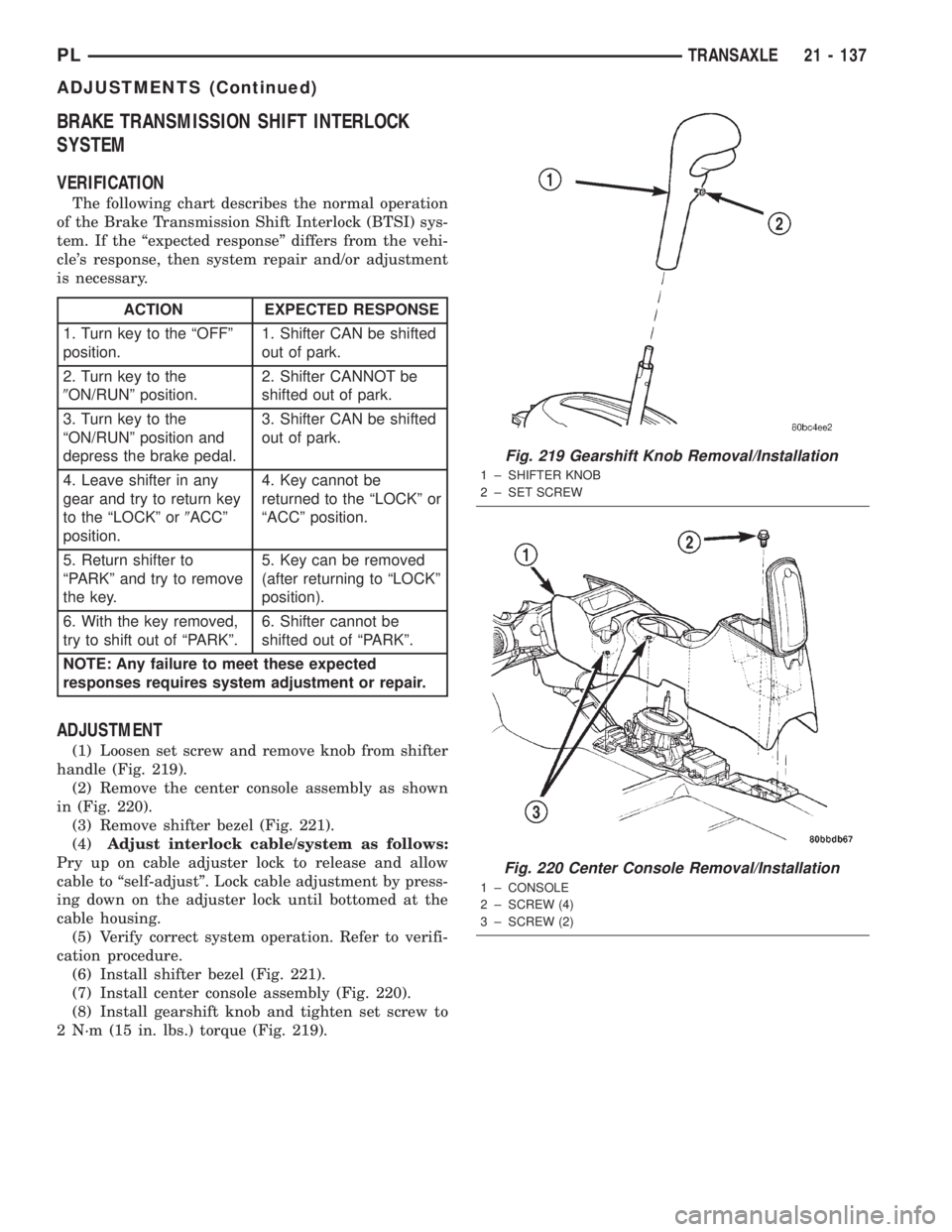
(1) Loosen set screw and remove knob from shifter
handle (Fig. 219).
(2) Remove the center console assembly as shown
in (Fig. 220).
(3) Remove shifter bezel (Fig. 221).
(4)Adjust interlock cable/system as follows:
Pry up on cable adjuster lock to release and allow
cable to ªself-adjustº. Lock cable adjustment by press-
ing down on the adjuster lock until bottomed at the
cable housing.
(5) Verify correct system operation. Refer to verifi-
cation procedure.
(6) Install shifter bezel (Fig. 221).
(7) Install center console assembly (Fig. 220).
(8) Install gearshift knob and tighten set screw to
2 N´m (15 in. lbs.) torque (Fig. 219).
ACTION EXPECTED RESPONSE
1. Turn key to the ªOFFº
position.1. Shifter CAN be shifted
out of park.
2. Turn key to the
9ON/RUNº position.2. Shifter CANNOT be
shifted out of park.
3. Turn key to the
ªON/RUNº position and
depress the brake pedal.3. Shifter CAN be shifted
out of park.
4. Leave shifter in any
gear and try to return key
to the ªLOCKº or9ACCº
position.4. Key cannot be
returned to the ªLOCKº or
ªACCº position.
5. Return shifter to
ªPARKº and try to remove
the key.5. Key can be removed
(after returning to ªLOCKº
position).
6. With the key removed,
try to shift out of ªPARKº.6. Shifter cannot be
shifted out of ªPARKº.
NOTE: Any failure to meet these expected
responses requires system adjustment or repair.
Fig. 219 Gearshift Knob Removal/Installation
1 ± SHIFTER KNOB
2 ± SET SCREW
Fig. 220 Center Console Removal/Installation
1 ± CONSOLE
2 ± SCREW (4)
3 ± SCREW (2)
PLTRANSAXLE 21 - 137
ADJUSTMENTS (Continued)