boot DODGE NEON 2000 Service Owner's Manual
[x] Cancel search | Manufacturer: DODGE, Model Year: 2000, Model line: NEON, Model: DODGE NEON 2000Pages: 1285, PDF Size: 29.42 MB
Page 78 of 1285
SPECIFICATIONS
TORQUE
DESCRIPTION TORQUE
Driveshaft-to-Hub/Bearing
Nut................... 244N´m(180 ft. lbs.)
Knuckle-to-Ball Joint
Bolt/Nut................. 95N´m(70ft.lbs.)
Wheel/Tire-to-Hub/Bearing
Lug Nuts............... 128N´m(95ft.lbs.)
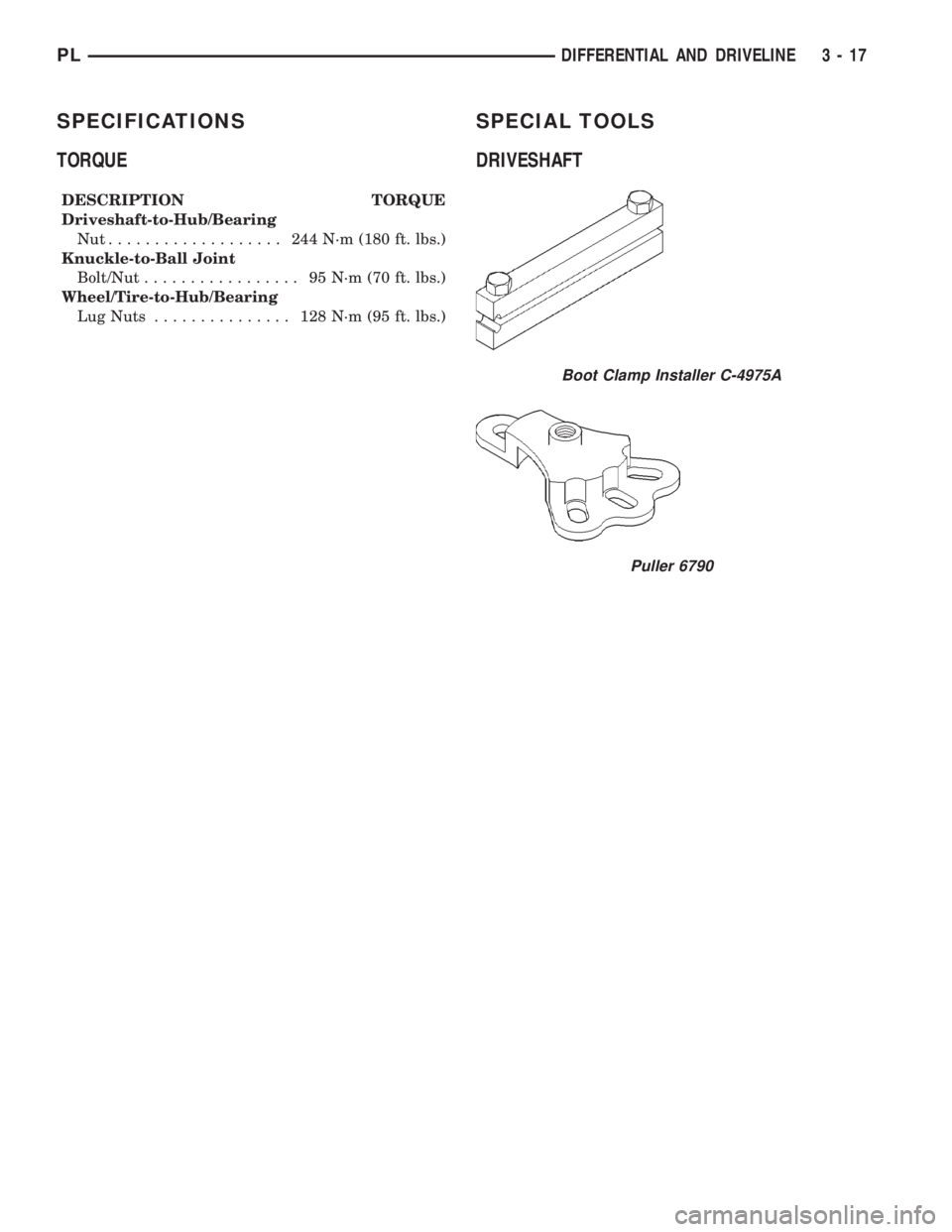
SPECIAL TOOLS
DRIVESHAFT
Boot Clamp Installer C-4975A
Puller 6790
PLDIFFERENTIAL AND DRIVELINE 3 - 17
Page 83 of 1285
Proportioning valves balance front to rear braking
by controlling the brake fluid hydraulic pressure to
the rear brakes. Under light pedal application, the
proportioning valve allows normal fluid flow to the
rear brakes. Under higher pedal effort, the valve
reduces fluid pressure to the rear brakes.
The non-antilock master cylinder is a four-outlet
design with two screw-in proportioning valves
attached directly to the master cylinder housing (Fig.
3). One proportioning valve controls each rear brake.
BRAKE TUBES AND HOSES
The purpose of the brake tubes and flex hoses is to
transfer the pressurized brake fluid developed by the
master cylinder to the brakes at each wheel of the
vehicle. The flex hoses connect the chassis brake
tubes, which are mounted to the vehicle's underbody,
to the brake at each wheel, allowing for movement of
the vehicle's suspension. The brake tubes are steel
with a corrosion-resistant nylon coating applied to
the external surfaces. The flex hoses are made of
reinforced rubber.
DISC BRAKES (FRONT)
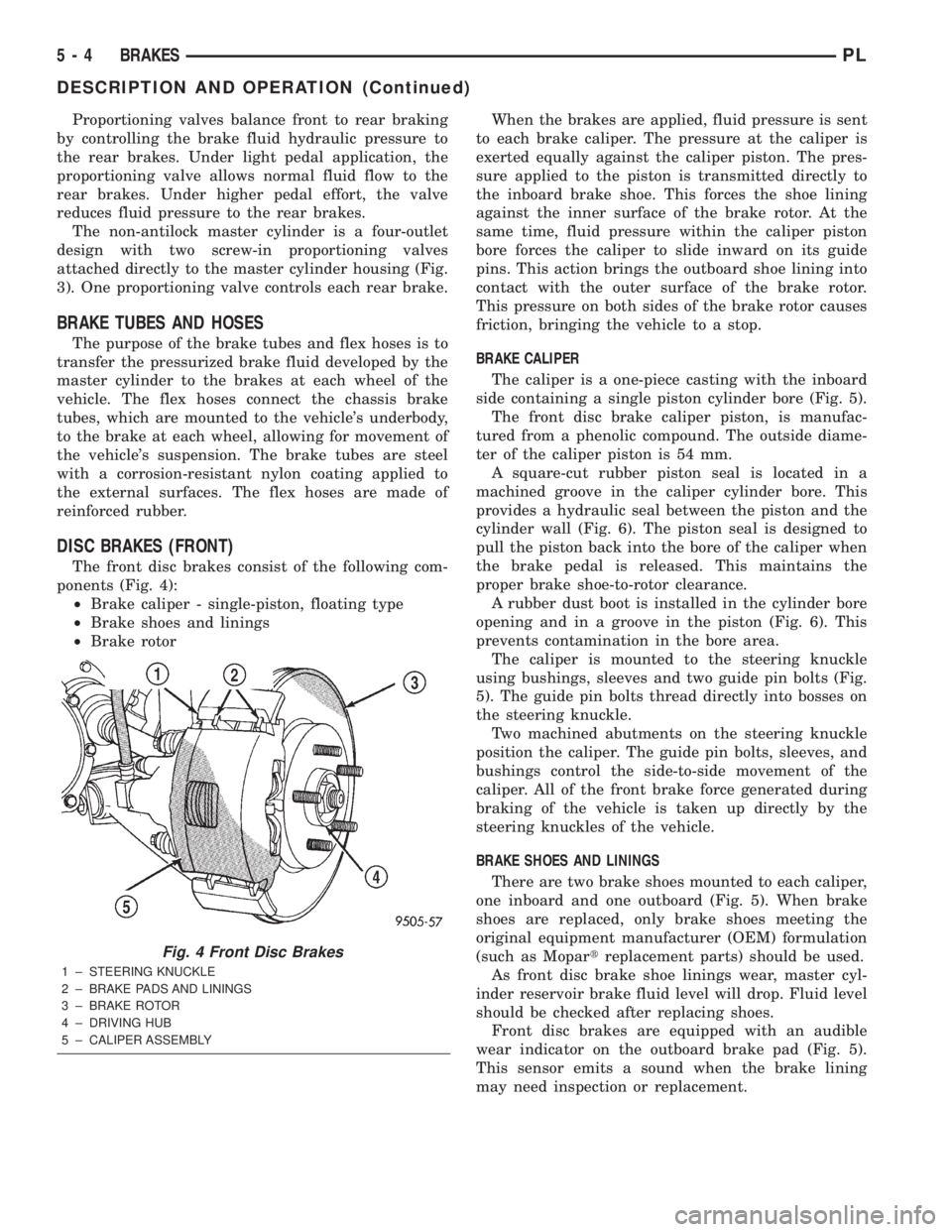
The front disc brakes consist of the following com-
ponents (Fig. 4):
²Brake caliper - single-piston, floating type
²Brake shoes and linings
²Brake rotorWhen the brakes are applied, fluid pressure is sent
to each brake caliper. The pressure at the caliper is
exerted equally against the caliper piston. The pres-
sure applied to the piston is transmitted directly to
the inboard brake shoe. This forces the shoe lining
against the inner surface of the brake rotor. At the
same time, fluid pressure within the caliper piston
bore forces the caliper to slide inward on its guide
pins. This action brings the outboard shoe lining into
contact with the outer surface of the brake rotor.
This pressure on both sides of the brake rotor causes
friction, bringing the vehicle to a stop.
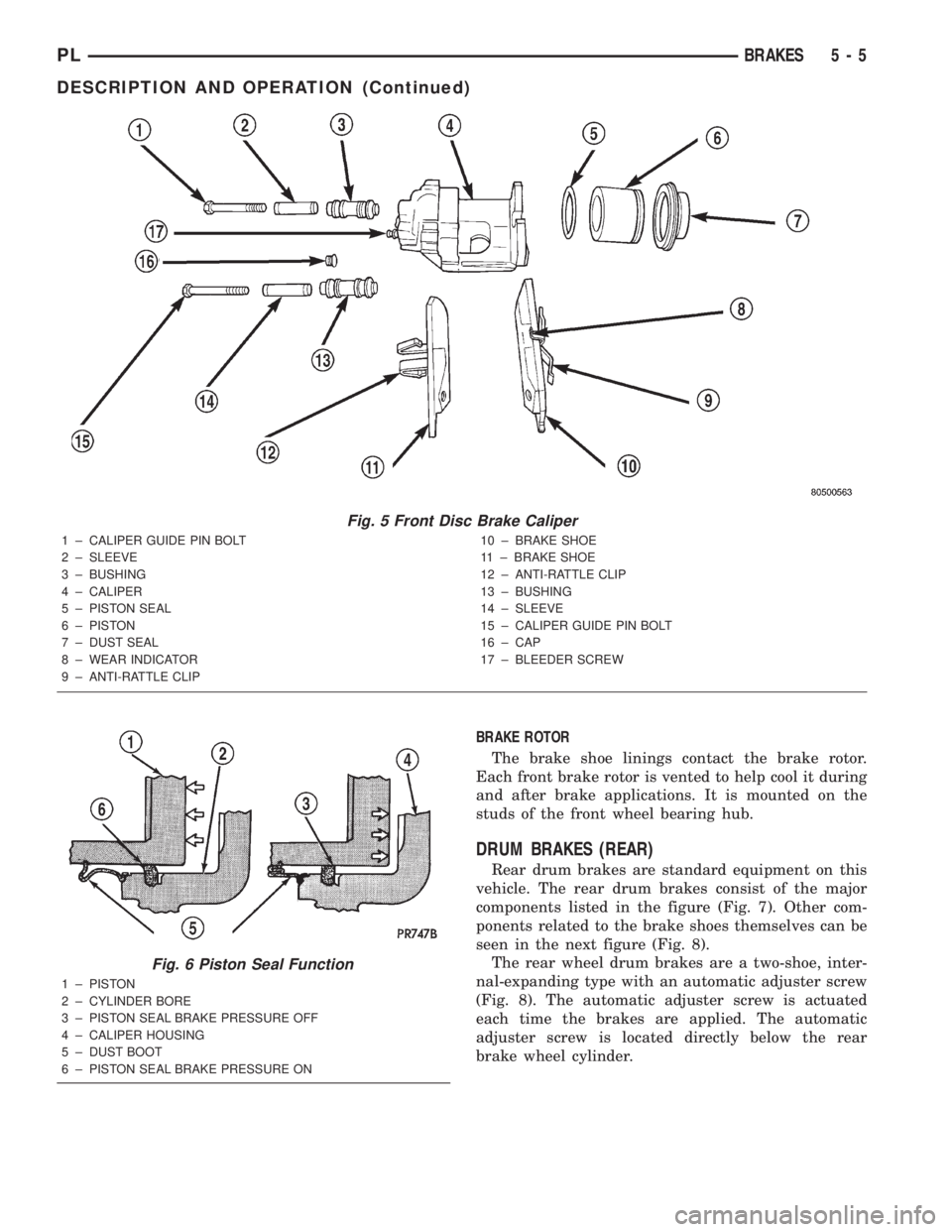
BRAKE CALIPER
The caliper is a one-piece casting with the inboard
side containing a single piston cylinder bore (Fig. 5).
The front disc brake caliper piston, is manufac-
tured from a phenolic compound. The outside diame-
ter of the caliper piston is 54 mm.
A square-cut rubber piston seal is located in a
machined groove in the caliper cylinder bore. This
provides a hydraulic seal between the piston and the
cylinder wall (Fig. 6). The piston seal is designed to
pull the piston back into the bore of the caliper when
the brake pedal is released. This maintains the
proper brake shoe-to-rotor clearance.
A rubber dust boot is installed in the cylinder bore
opening and in a groove in the piston (Fig. 6). This
prevents contamination in the bore area.
The caliper is mounted to the steering knuckle
using bushings, sleeves and two guide pin bolts (Fig.
5). The guide pin bolts thread directly into bosses on
the steering knuckle.
Two machined abutments on the steering knuckle
position the caliper. The guide pin bolts, sleeves, and
bushings control the side-to-side movement of the
caliper. All of the front brake force generated during
braking of the vehicle is taken up directly by the
steering knuckles of the vehicle.
BRAKE SHOES AND LININGS
There are two brake shoes mounted to each caliper,
one inboard and one outboard (Fig. 5). When brake
shoes are replaced, only brake shoes meeting the
original equipment manufacturer (OEM) formulation
(such as Mopartreplacement parts) should be used.
As front disc brake shoe linings wear, master cyl-
inder reservoir brake fluid level will drop. Fluid level
should be checked after replacing shoes.
Front disc brakes are equipped with an audible
wear indicator on the outboard brake pad (Fig. 5).
This sensor emits a sound when the brake lining
may need inspection or replacement.
Fig. 4 Front Disc Brakes
1 ± STEERING KNUCKLE
2 ± BRAKE PADS AND LININGS
3 ± BRAKE ROTOR
4 ± DRIVING HUB
5 ± CALIPER ASSEMBLY
5 - 4 BRAKESPL
DESCRIPTION AND OPERATION (Continued)
Page 84 of 1285
BRAKE ROTOR
The brake shoe linings contact the brake rotor.
Each front brake rotor is vented to help cool it during
and after brake applications. It is mounted on the
studs of the front wheel bearing hub.
DRUM BRAKES (REAR)
Rear drum brakes are standard equipment on this
vehicle. The rear drum brakes consist of the major
components listed in the figure (Fig. 7). Other com-
ponents related to the brake shoes themselves can be
seen in the next figure (Fig. 8).
The rear wheel drum brakes are a two-shoe, inter-
nal-expanding type with an automatic adjuster screw
(Fig. 8). The automatic adjuster screw is actuated
each time the brakes are applied. The automatic
adjuster screw is located directly below the rear
brake wheel cylinder.
Fig. 5 Front Disc Brake Caliper
1 ± CALIPER GUIDE PIN BOLT
2 ± SLEEVE
3 ± BUSHING
4 ± CALIPER
5 ± PISTON SEAL
6 ± PISTON
7 ± DUST SEAL
8 ± WEAR INDICATOR
9 ± ANTI-RATTLE CLIP10 ± BRAKE SHOE
11 ± BRAKE SHOE
12 ± ANTI-RATTLE CLIP
13 ± BUSHING
14 ± SLEEVE
15 ± CALIPER GUIDE PIN BOLT
16 ± CAP
17 ± BLEEDER SCREW
Fig. 6 Piston Seal Function
1 ± PISTON
2 ± CYLINDER BORE
3 ± PISTON SEAL BRAKE PRESSURE OFF
4 ± CALIPER HOUSING
5 ± DUST BOOT
6 ± PISTON SEAL BRAKE PRESSURE ON
PLBRAKES 5 - 5
DESCRIPTION AND OPERATION (Continued)
Page 135 of 1285
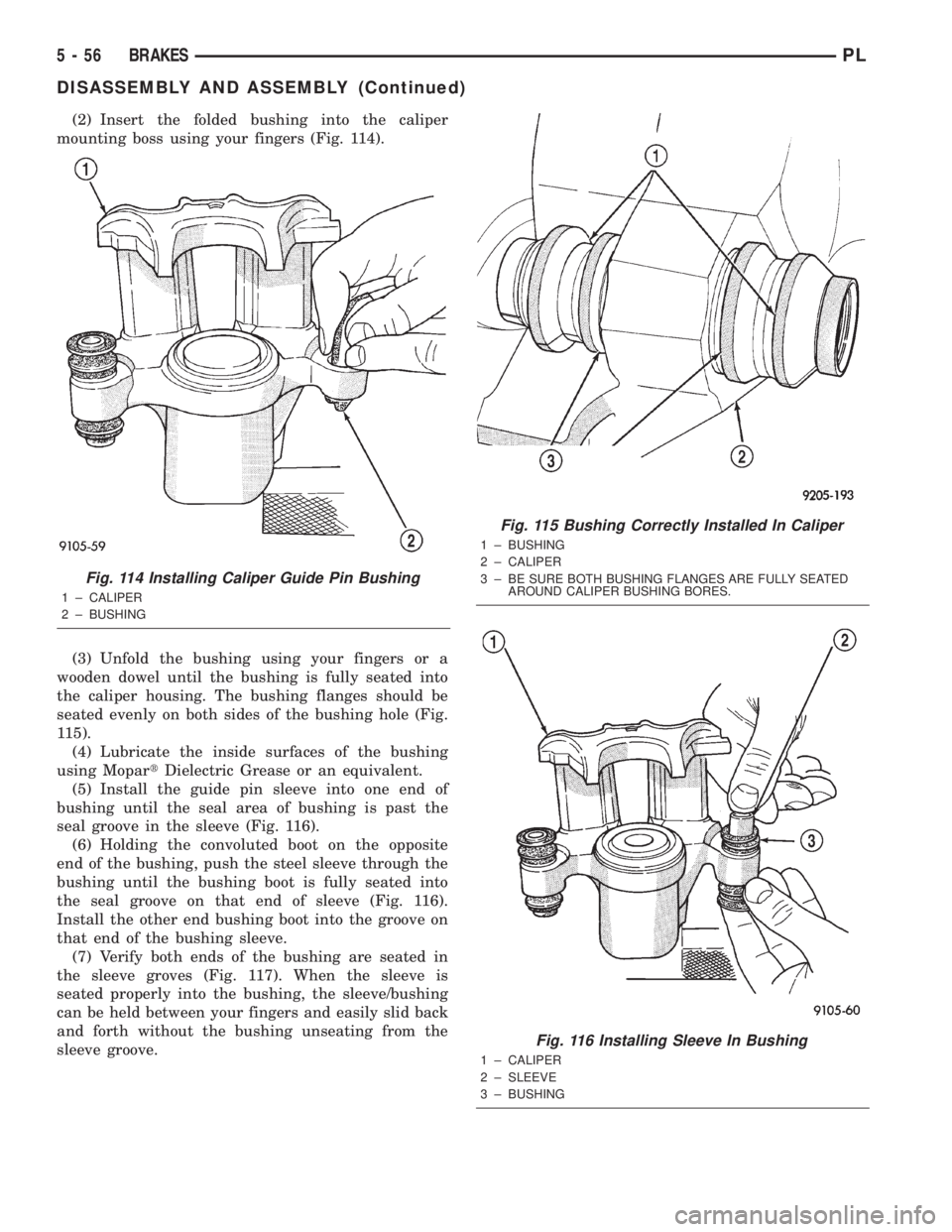
(2) Insert the folded bushing into the caliper
mounting boss using your fingers (Fig. 114).
(3) Unfold the bushing using your fingers or a
wooden dowel until the bushing is fully seated into
the caliper housing. The bushing flanges should be
seated evenly on both sides of the bushing hole (Fig.
115).
(4) Lubricate the inside surfaces of the bushing
using MopartDielectric Grease or an equivalent.
(5) Install the guide pin sleeve into one end of
bushing until the seal area of bushing is past the
seal groove in the sleeve (Fig. 116).
(6) Holding the convoluted boot on the opposite
end of the bushing, push the steel sleeve through the
bushing until the bushing boot is fully seated into
the seal groove on that end of sleeve (Fig. 116).
Install the other end bushing boot into the groove on
that end of the bushing sleeve.
(7) Verify both ends of the bushing are seated in
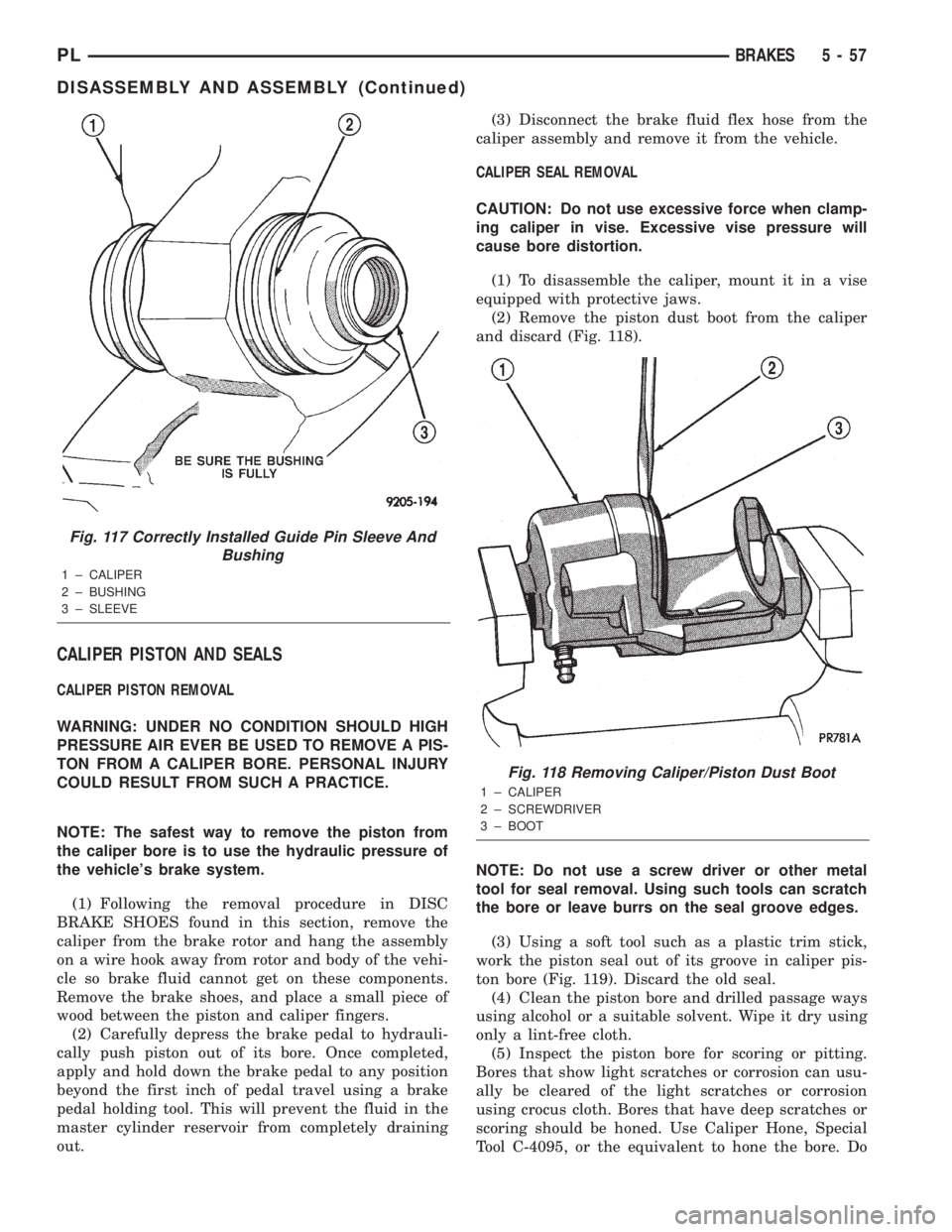
the sleeve groves (Fig. 117). When the sleeve is
seated properly into the bushing, the sleeve/bushing
can be held between your fingers and easily slid back
and forth without the bushing unseating from the
sleeve groove.
Fig. 114 Installing Caliper Guide Pin Bushing
1 ± CALIPER
2 ± BUSHING
Fig. 115 Bushing Correctly Installed In Caliper
1 ± BUSHING
2 ± CALIPER
3 ± BE SURE BOTH BUSHING FLANGES ARE FULLY SEATED
AROUND CALIPER BUSHING BORES.
Fig. 116 Installing Sleeve In Bushing
1 ± CALIPER
2 ± SLEEVE
3 ± BUSHING
5 - 56 BRAKESPL
DISASSEMBLY AND ASSEMBLY (Continued)
Page 136 of 1285
CALIPER PISTON AND SEALS
CALIPER PISTON REMOVAL
WARNING: UNDER NO CONDITION SHOULD HIGH
PRESSURE AIR EVER BE USED TO REMOVE A PIS-
TON FROM A CALIPER BORE. PERSONAL INJURY
COULD RESULT FROM SUCH A PRACTICE.
NOTE: The safest way to remove the piston from
the caliper bore is to use the hydraulic pressure of
the vehicle's brake system.
(1) Following the removal procedure in DISC
BRAKE SHOES found in this section, remove the
caliper from the brake rotor and hang the assembly
on a wire hook away from rotor and body of the vehi-
cle so brake fluid cannot get on these components.
Remove the brake shoes, and place a small piece of
wood between the piston and caliper fingers.
(2) Carefully depress the brake pedal to hydrauli-
cally push piston out of its bore. Once completed,
apply and hold down the brake pedal to any position
beyond the first inch of pedal travel using a brake
pedal holding tool. This will prevent the fluid in the
master cylinder reservoir from completely draining
out.(3) Disconnect the brake fluid flex hose from the
caliper assembly and remove it from the vehicle.
CALIPER SEAL REMOVAL
CAUTION: Do not use excessive force when clamp-
ing caliper in vise. Excessive vise pressure will
cause bore distortion.
(1) To disassemble the caliper, mount it in a vise
equipped with protective jaws.
(2) Remove the piston dust boot from the caliper
and discard (Fig. 118).
NOTE: Do not use a screw driver or other metal
tool for seal removal. Using such tools can scratch
the bore or leave burrs on the seal groove edges.
(3) Using a soft tool such as a plastic trim stick,
work the piston seal out of its groove in caliper pis-
ton bore (Fig. 119). Discard the old seal.
(4) Clean the piston bore and drilled passage ways
using alcohol or a suitable solvent. Wipe it dry using
only a lint-free cloth.
(5) Inspect the piston bore for scoring or pitting.
Bores that show light scratches or corrosion can usu-
ally be cleared of the light scratches or corrosion
using crocus cloth. Bores that have deep scratches or
scoring should be honed. Use Caliper Hone, Special
Tool C-4095, or the equivalent to hone the bore. Do
Fig. 117 Correctly Installed Guide Pin Sleeve And
Bushing
1 ± CALIPER
2 ± BUSHING
3 ± SLEEVE
Fig. 118 Removing Caliper/Piston Dust Boot
1 ± CALIPER
2 ± SCREWDRIVER
3 ± BOOT
PLBRAKES 5 - 57
DISASSEMBLY AND ASSEMBLY (Continued)
Page 137 of 1285
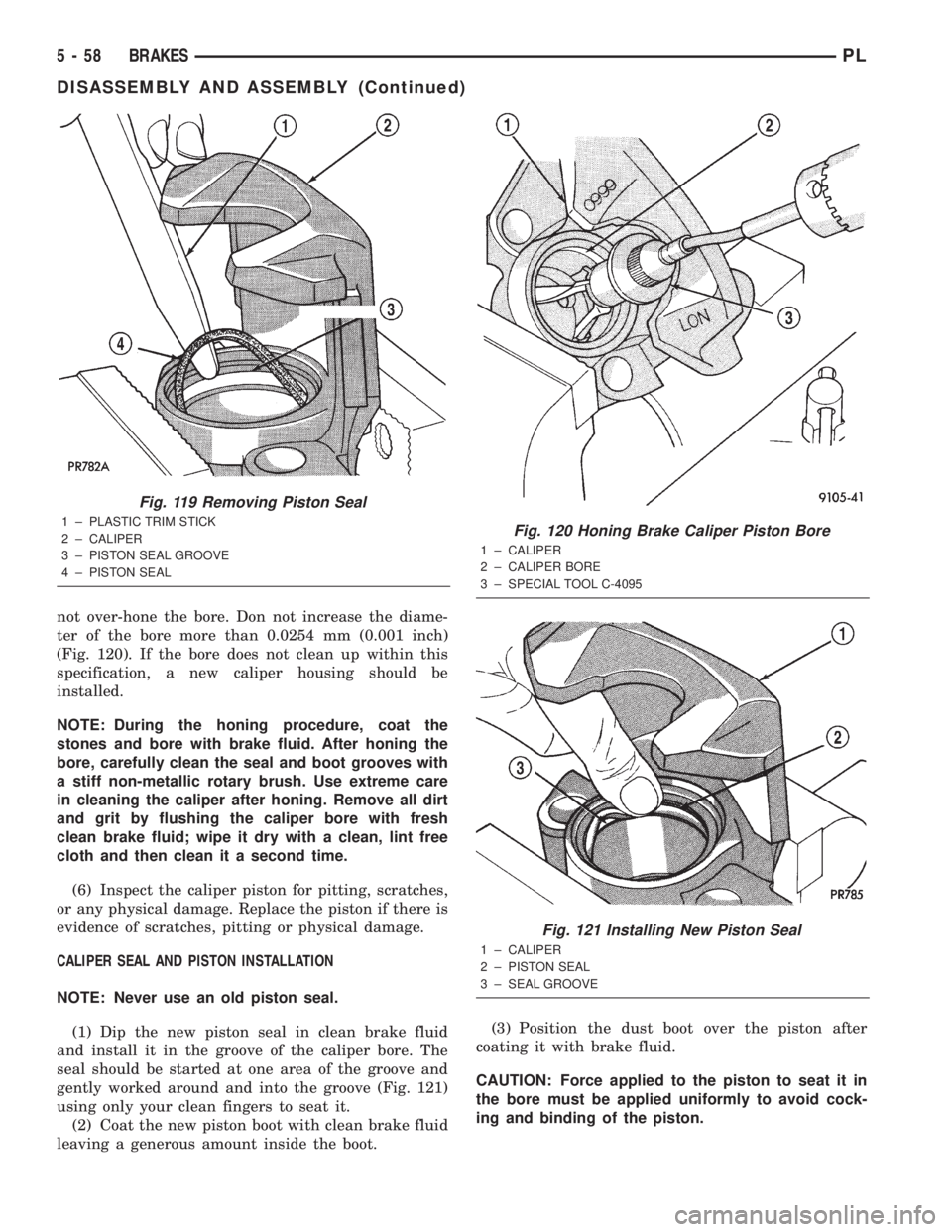
not over-hone the bore. Don not increase the diame-
ter of the bore more than 0.0254 mm (0.001 inch)
(Fig. 120). If the bore does not clean up within this
specification, a new caliper housing should be
installed.
NOTE: During the honing procedure, coat the
stones and bore with brake fluid. After honing the
bore, carefully clean the seal and boot grooves with
a stiff non-metallic rotary brush. Use extreme care
in cleaning the caliper after honing. Remove all dirt
and grit by flushing the caliper bore with fresh
clean brake fluid; wipe it dry with a clean, lint free
cloth and then clean it a second time.
(6) Inspect the caliper piston for pitting, scratches,
or any physical damage. Replace the piston if there is
evidence of scratches, pitting or physical damage.
CALIPER SEAL AND PISTON INSTALLATION
NOTE: Never use an old piston seal.
(1) Dip the new piston seal in clean brake fluid
and install it in the groove of the caliper bore. The
seal should be started at one area of the groove and
gently worked around and into the groove (Fig. 121)
using only your clean fingers to seat it.
(2) Coat the new piston boot with clean brake fluid
leaving a generous amount inside the boot.(3) Position the dust boot over the piston after
coating it with brake fluid.
CAUTION: Force applied to the piston to seat it in
the bore must be applied uniformly to avoid cock-
ing and binding of the piston.
Fig. 119 Removing Piston Seal
1 ± PLASTIC TRIM STICK
2 ± CALIPER
3 ± PISTON SEAL GROOVE
4 ± PISTON SEALFig. 120 Honing Brake Caliper Piston Bore
1 ± CALIPER
2 ± CALIPER BORE
3 ± SPECIAL TOOL C-4095
Fig. 121 Installing New Piston Seal
1 ± CALIPER
2 ± PISTON SEAL
3 ± SEAL GROOVE
5 - 58 BRAKESPL
DISASSEMBLY AND ASSEMBLY (Continued)
Page 138 of 1285
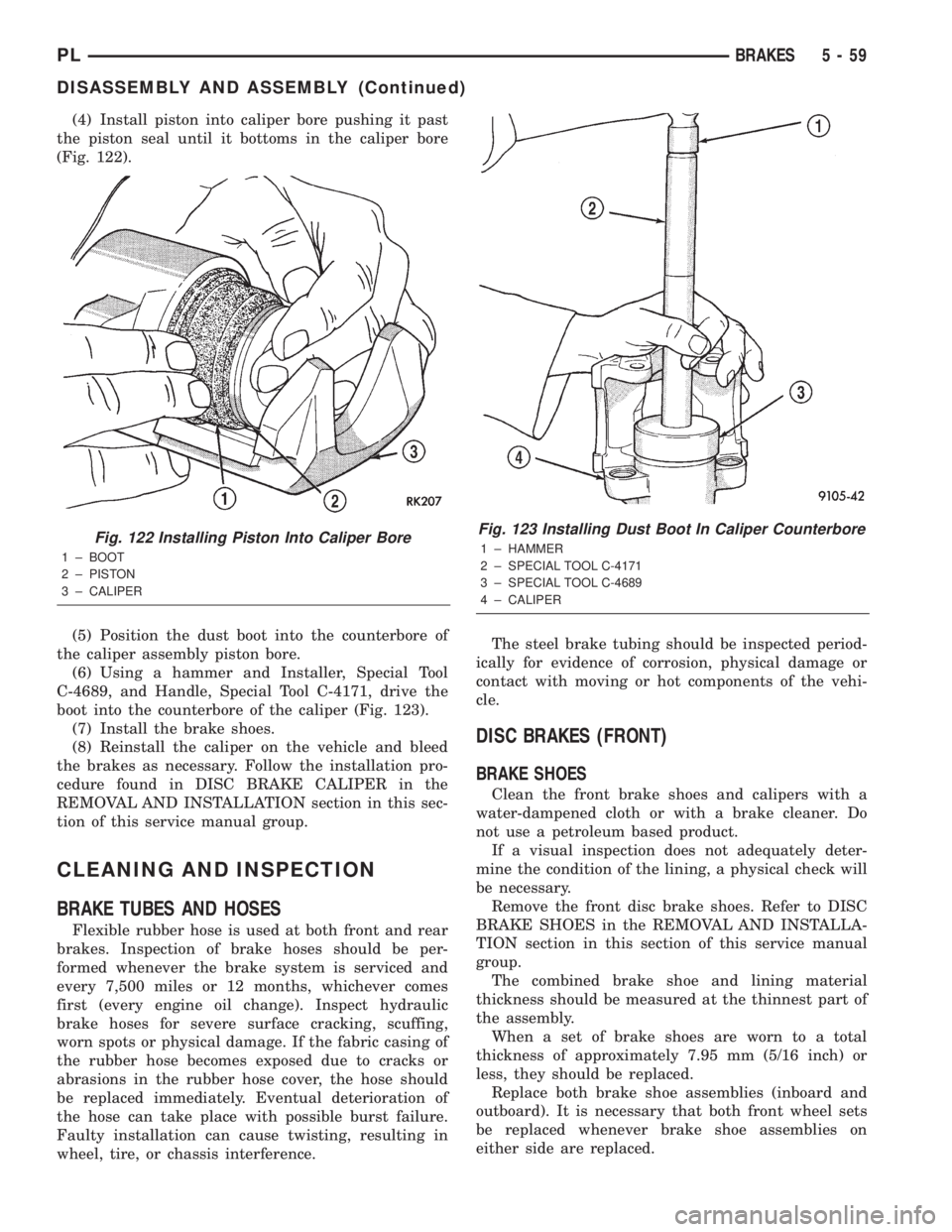
(4) Install piston into caliper bore pushing it past
the piston seal until it bottoms in the caliper bore
(Fig. 122).
(5) Position the dust boot into the counterbore of
the caliper assembly piston bore.
(6) Using a hammer and Installer, Special Tool
C-4689, and Handle, Special Tool C-4171, drive the
boot into the counterbore of the caliper (Fig. 123).
(7) Install the brake shoes.
(8) Reinstall the caliper on the vehicle and bleed
the brakes as necessary. Follow the installation pro-
cedure found in DISC BRAKE CALIPER in the
REMOVAL AND INSTALLATION section in this sec-
tion of this service manual group.
CLEANING AND INSPECTION
BRAKE TUBES AND HOSES
Flexible rubber hose is used at both front and rear
brakes. Inspection of brake hoses should be per-
formed whenever the brake system is serviced and
every 7,500 miles or 12 months, whichever comes
first (every engine oil change). Inspect hydraulic
brake hoses for severe surface cracking, scuffing,
worn spots or physical damage. If the fabric casing of
the rubber hose becomes exposed due to cracks or
abrasions in the rubber hose cover, the hose should
be replaced immediately. Eventual deterioration of
the hose can take place with possible burst failure.
Faulty installation can cause twisting, resulting in
wheel, tire, or chassis interference.The steel brake tubing should be inspected period-
ically for evidence of corrosion, physical damage or
contact with moving or hot components of the vehi-
cle.
DISC BRAKES (FRONT)
BRAKE SHOES
Clean the front brake shoes and calipers with a
water-dampened cloth or with a brake cleaner. Do
not use a petroleum based product.
If a visual inspection does not adequately deter-
mine the condition of the lining, a physical check will
be necessary.
Remove the front disc brake shoes. Refer to DISC
BRAKE SHOES in the REMOVAL AND INSTALLA-
TION section in this section of this service manual
group.
The combined brake shoe and lining material
thickness should be measured at the thinnest part of
the assembly.
When a set of brake shoes are worn to a total
thickness of approximately 7.95 mm (5/16 inch) or
less, they should be replaced.
Replace both brake shoe assemblies (inboard and
outboard). It is necessary that both front wheel sets
be replaced whenever brake shoe assemblies on
either side are replaced.
Fig. 122 Installing Piston Into Caliper Bore
1 ± BOOT
2 ± PISTON
3 ± CALIPER
Fig. 123 Installing Dust Boot In Caliper Counterbore
1 ± HAMMER
2 ± SPECIAL TOOL C-4171
3 ± SPECIAL TOOL C-4689
4 ± CALIPER
PLBRAKES 5 - 59
DISASSEMBLY AND ASSEMBLY (Continued)
Page 139 of 1285
If the brake shoe assemblies do not require
replacement, reinstall the assemblies making sure
each brake shoe is returned to the original position.
Refer to DISC BRAKE SHOES in the REMOVAL
AND INSTALLATION section in this section of this
service manual group.
CALIPER INSPECTION
Check for brake fluid leaks in and around the boot
area. Check for any ruptures, brittleness or damage
to the piston dust boot. If the boot is damaged, or a
fluid leak is visible, disassemble the caliper assembly
and install a new seal and boot, and a piston if it is
scored. Refer to DISC BRAKE CALIPER in the DIS-
ASSEMBLY AND ASSEMBLY section in this section
of this service manual group.
Check the guide pin dust boots to determine if they
are in good condition. Replace if they are damaged,
dry, or found to be brittle. Refer to DISC BRAKE
CALIPER in the DISASSEMBLY AND ASSEMBLY
section in this section of this service manual group.
DISC BRAKES (REAR)
BRAKE SHOES
Clean the rear brake shoes and calipers with a
water-dampened cloth or with a brake cleaner. Do
not use a petroleum based product.
If a visual inspection does not adequately deter-
mine the condition of the lining, a physical check will
be necessary.
Remove the rear disc brake shoes. Refer to DISC
BRAKE SHOES in the REMOVAL AND INSTALLA-
TION section in this section of this service manual
group.
The combined brake shoe and lining material
thickness should be measured at the thinnest part of
the assembly.
When a set of brake shoes are worn to a total
thickness of approximately 7.0 mm (9/32 inch) or
less, they should be replaced.
Replace both brake shoe assemblies (inboard and
outboard). It is necessary that both front wheel sets
be replaced whenever brake shoe assemblies on
either side are replaced.
If the brake shoe assemblies do not require
replacement, reinstall the assemblies making sure
each brake shoe is returned to the original position.
Refer to DISC BRAKE SHOES in the REMOVAL
AND INSTALLATION section in this section of this
service manual group.
CALIPER INSPECTION
Check for brake fluid leaks in and around the boot
area. Check for any ruptures, brittleness or damage
to the piston dust boot. If the boot is damaged, or afluid leak is visible, disassemble the caliper assembly
and install a new seal and boot, and a piston if it is
scored. Refer to DISC BRAKE CALIPER in the DIS-
ASSEMBLY AND ASSEMBLY section in this section
of this service manual group.
Check the guide pin dust boots to determine if they
are in good condition. Replace if they are damaged,
dry, or found to be brittle. Refer to DISC BRAKE
CALIPER in the DISASSEMBLY AND ASSEMBLY
section in this section of this service manual group.
DRUM BRAKES (REAR)
BRAKE SHOES
Clean the rear brake shoes and springs with a
water-dampened cloth or with a brake cleaner. Do
not use a petroleum based product.
Rear brake shoe lining should show contact across
the entire width of the lining and also from the heel
to the toe of the lining. Replace the shoes if noted
otherwise.
Brake shoes with lack of contact at the toe or heel
of the brake shoe lining may be improperly ground.
Clean and inspect the brake support plate and
shoe adjuster screw. Apply a thin coat of Mopart
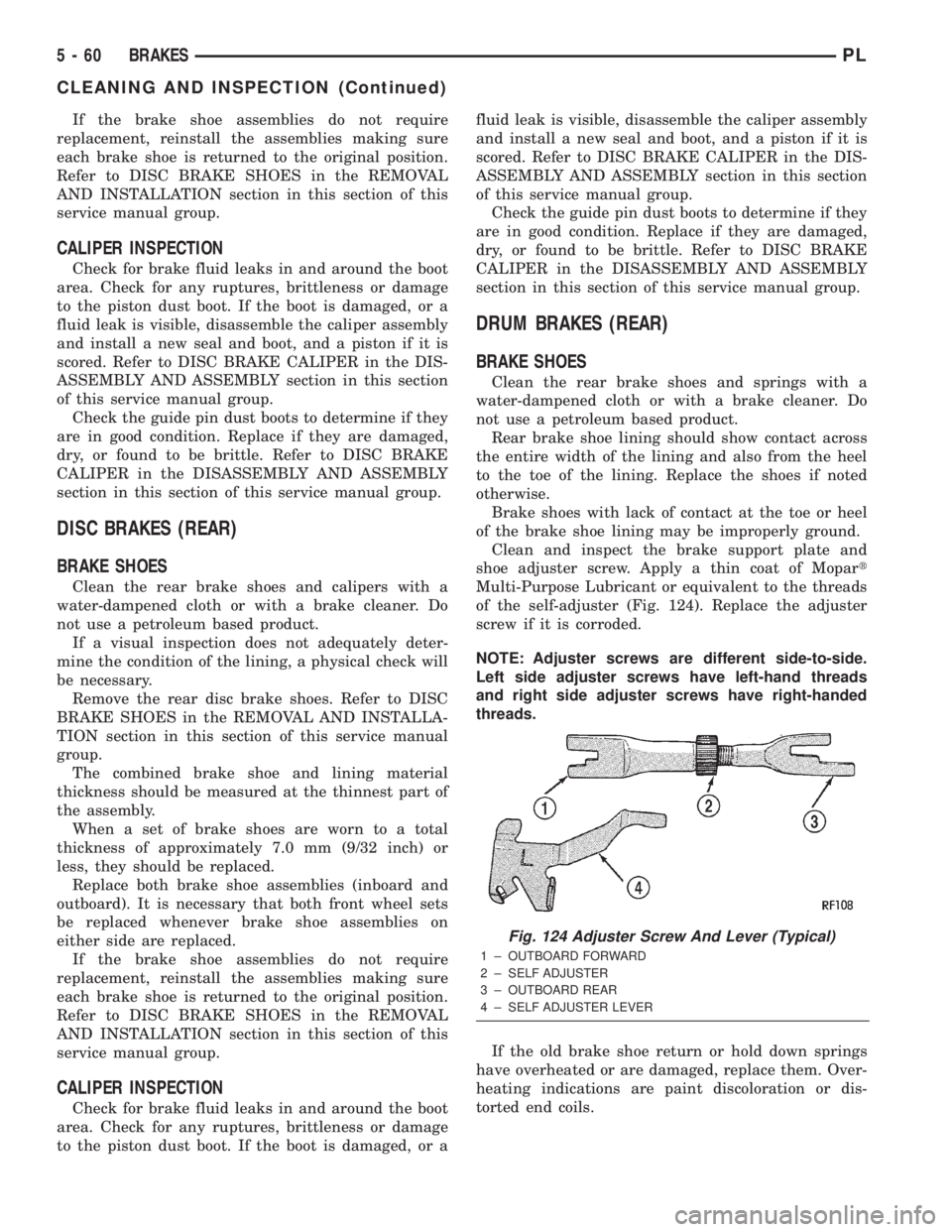
Multi-Purpose Lubricant or equivalent to the threads
of the self-adjuster (Fig. 124). Replace the adjuster
screw if it is corroded.
NOTE: Adjuster screws are different side-to-side.
Left side adjuster screws have left-hand threads
and right side adjuster screws have right-handed
threads.
If the old brake shoe return or hold down springs
have overheated or are damaged, replace them. Over-
heating indications are paint discoloration or dis-
torted end coils.
Fig. 124 Adjuster Screw And Lever (Typical)
1 ± OUTBOARD FORWARD
2 ± SELF ADJUSTER
3 ± OUTBOARD REAR
4 ± SELF ADJUSTER LEVER
5 - 60 BRAKESPL
CLEANING AND INSPECTION (Continued)
Page 140 of 1285
WHEEL CYLINDER
With the brake drums removed, inspect the wheel
cylinder boots for evidence of a brake fluid leak.
Visually check the boots for cuts, tears, or heat
cracks. If any of these conditions exist, the wheel cyl-
inders should be completely cleaned, inspected and
new parts installed.
If a wheel cylinder is leaking and the brake lining
material is saturated with brake fluid, the brake
shoes must be replaced.
ADJUSTMENTS
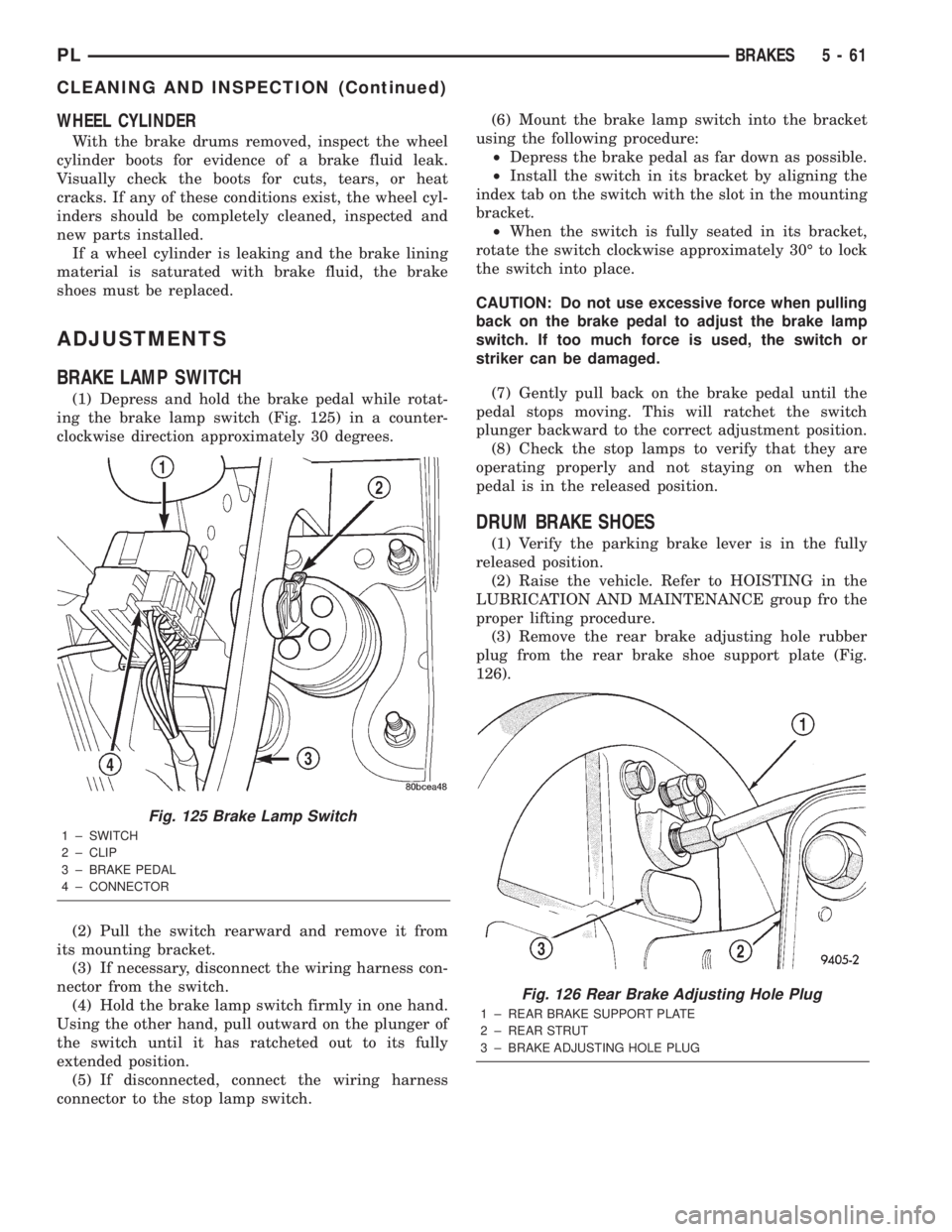
BRAKE LAMP SWITCH
(1) Depress and hold the brake pedal while rotat-
ing the brake lamp switch (Fig. 125) in a counter-
clockwise direction approximately 30 degrees.
(2) Pull the switch rearward and remove it from
its mounting bracket.
(3) If necessary, disconnect the wiring harness con-
nector from the switch.
(4) Hold the brake lamp switch firmly in one hand.
Using the other hand, pull outward on the plunger of
the switch until it has ratcheted out to its fully
extended position.
(5) If disconnected, connect the wiring harness
connector to the stop lamp switch.(6) Mount the brake lamp switch into the bracket
using the following procedure:
²Depress the brake pedal as far down as possible.
²Install the switch in its bracket by aligning the
index tab on the switch with the slot in the mounting
bracket.
²When the switch is fully seated in its bracket,
rotate the switch clockwise approximately 30É to lock
the switch into place.
CAUTION: Do not use excessive force when pulling
back on the brake pedal to adjust the brake lamp
switch. If too much force is used, the switch or
striker can be damaged.
(7) Gently pull back on the brake pedal until the
pedal stops moving. This will ratchet the switch
plunger backward to the correct adjustment position.
(8) Check the stop lamps to verify that they are
operating properly and not staying on when the
pedal is in the released position.
DRUM BRAKE SHOES
(1) Verify the parking brake lever is in the fully
released position.
(2) Raise the vehicle. Refer to HOISTING in the
LUBRICATION AND MAINTENANCE group fro the
proper lifting procedure.
(3) Remove the rear brake adjusting hole rubber
plug from the rear brake shoe support plate (Fig.
126).
Fig. 125 Brake Lamp Switch
1 ± SWITCH
2 ± CLIP
3 ± BRAKE PEDAL
4 ± CONNECTOR
Fig. 126 Rear Brake Adjusting Hole Plug
1 ± REAR BRAKE SUPPORT PLATE
2 ± REAR STRUT
3 ± BRAKE ADJUSTING HOLE PLUG
PLBRAKES 5 - 61
CLEANING AND INSPECTION (Continued)
Page 143 of 1285
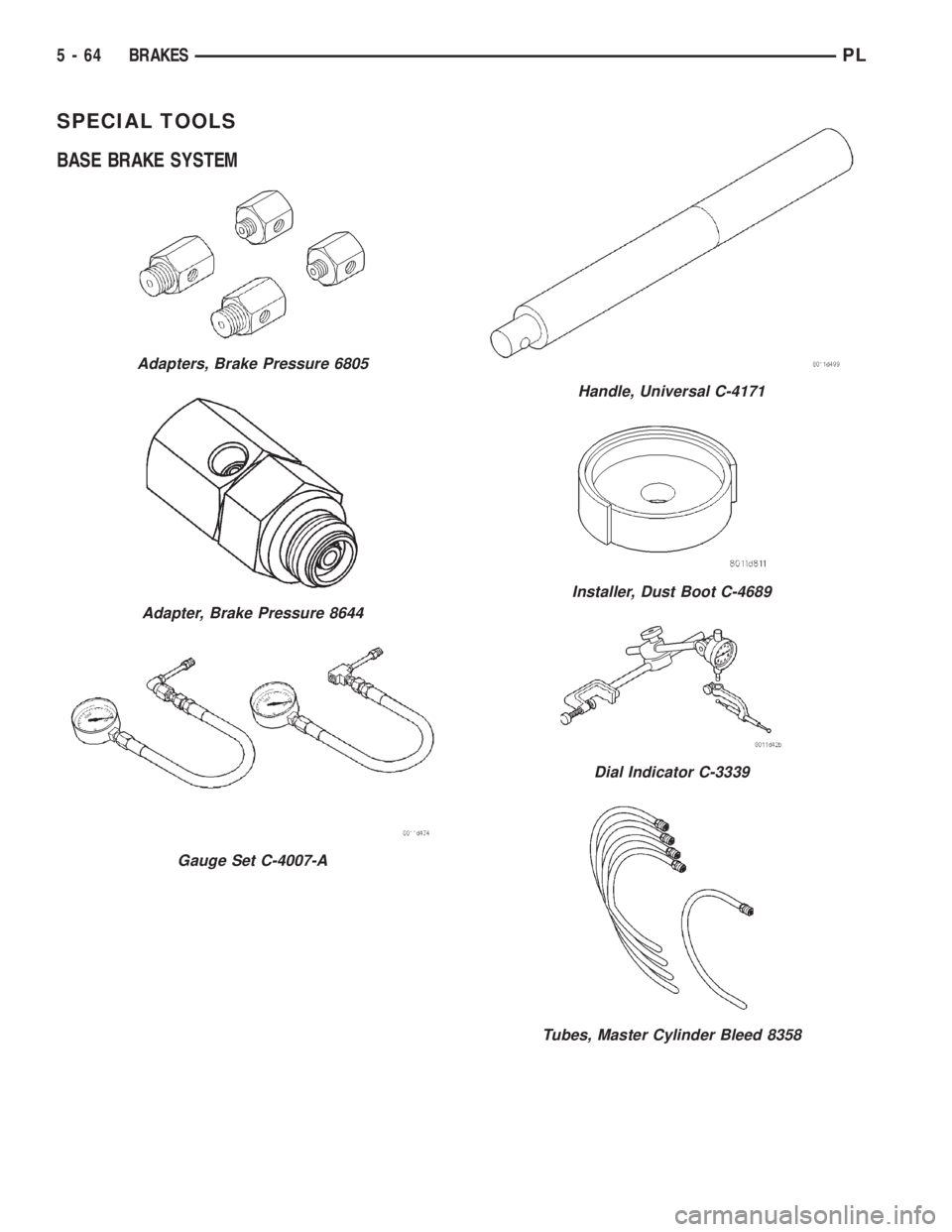
SPECIAL TOOLS
BASE BRAKE SYSTEM
Adapters, Brake Pressure 6805
Adapter, Brake Pressure 8644
Gauge Set C-4007-A
Handle, Universal C-4171
Installer, Dust Boot C-4689
Dial Indicator C-3339
Tubes, Master Cylinder Bleed 8358
5 - 64 BRAKESPL