light DODGE NEON 2005 2.G User Guide
[x] Cancel search | Manufacturer: DODGE, Model Year: 2005, Model line: NEON, Model: DODGE NEON 2005 2.GPages: 246, PDF Size: 3.69 MB
Page 37 of 246
However, if you have not healed significantly within a
few days, or if you have any blistering, see your doctor
immediately.
²As the airbags deflate you may see some smoke-like
particles. The particles are a normal by-product of the
process that generates the nontoxic gas used for airbag
inflation. These airborne particles may irritate the skin,
eyes, nose, or throat. If you have skin or eye irritation,
rinse the area with cool water. For nose or throat
irritation, move to fresh air. If the irritation continues,
see your doctor. If these particles settle on your
clothing, follow the garment manufacturer's instruc-
tions for cleaning.
²It is not advisable to drive your vehicle after the
airbags have deployed. If you are involved in another
collision, the airbags will not be in place to protect you.
WARNING!
Deployed airbags can't protect you in another colli-
sion. Have the airbags replaced by an authorized
dealer as soon as possible.
Side Airbag System Ð If Equipped
²
The Side Impact Airbag Control Modules determine if
a side collision is severe enough to require the airbag
to inflate. The Side Impact Airbag Control Modules is
not designed to detect roll over, front, or rear impacts.
²The Side Impact Airbag Control Module monitors the
readiness of the electronic parts of the system when-
ever the ignition switch is in the START or ON/RUN
positions. These include all of the items listed above. If
the left or right SIACM detects a malfunction in any
part of the system, it will send a message to the frontal
ACM to turn the Airbag Light on. The Airbag Control
Module also turns on the AIRBAG light in the instru-
ment panel for 6 to 8 seconds when the ignition switch
is first turned on as a diagnostic or system check, then
turns the light off.
THINGS TO KNOW BEFORE STARTING YOUR VEHICLE 37
2
Page 38 of 246
²In moderate to severe side collisions, the side airbag
inflator on the crash side of the vehicle is triggered by
the appropriate SIACM, releasing a quantity of non-
toxic gas. The inflating side airbag exits through the
seat seam into the space between the occupant and the
door. The side airbag moves at a very high speed and
with such a high force, that it could injure you if you
are not seated properly, or if items are positioned in
the area where the side airbag inflates. This especially
applies to children.
Enhanced Accident Response Time Ð If Equipped
If the airbags deploy after an impact and the electrical
system remains functional, vehicles equipped with
power door locks will unlock automatically. In addition,
approximately 10 seconds after the vehicle has stopped
moving, the interior lights will light until the ignition
switch is turned off.
Maintaining Your Airbag Systems
WARNING!
²Modifications to any part of the airbag system
could cause it to fail when you need it. You could
be injured because the airbags are not there to
protect you. Do not modify the components or
wiring, including adding any kind of badges or
stickers to the steering wheel hub trim cover or
the upper right side of the instrument panel. Do
not modify the front bumper, vehicle body struc-
ture, or frame.
²You need proper knee impact protection in a
collision. Do not mount or locate any aftermarket
equipment on or behind the knee bolster.
²It is dangerous to try to repair any part of the
airbag system yourself. Be sure to tell anyone who
works on your vehicle that it has airbags.
38 THINGS TO KNOW BEFORE STARTING YOUR VEHICLE
Page 39 of 246
Airbag Light
You will want to have the airbags ready to inflate for your
protection in an impact. While the airbag system is
designed to be maintenance free, if any of the following
occurs, have an authorized dealer service the system
immediately:
²The AIRBAG light does not come on or flickers during
the 6 to 8 seconds when the ignition switch is first
turned on.
²The light remains on or flickers after the 6 to 8 second
interval.
²The light flickers or comes on and remains on while
driving.
Child Restraint
Everyone in your vehicle needs to be buckled up at all
times Ð babies and children, too. Every state in the
United States and all Canadian provinces require that
small children ride in proper restraint systems. This is the
law, and you can be prosecuted for ignoring it.Children 12 years and under should ride properly buck-
led up in a rear seat, if available. According to crash
statistics, children are safer when properly restrained in
the rear seats, rather than in the front.
WARNING!
In a collision, an unrestrained child, even a tiny
baby, can become a missile inside the vehicle. The
force required to hold even an infant on your lap
could become so great that you could not hold the
child, no matter how strong you are. The child and
others could be badly injured. Any child riding in
your vehicle should be in a proper restraint for the
child's size.
THINGS TO KNOW BEFORE STARTING YOUR VEHICLE 39
2
Page 47 of 246

Safety Checks You Should Make Inside The Vehicle
Seat Belts
Inspect the belt system periodically, checking for cuts,
frays and loose parts. Damaged parts must be replaced
immediately. Do not disassemble or modify the system.
Front seat belt assemblies must be replaced after a
collision. Rear seat belt assemblies must be replaced after
a collision if they have been damaged (bent retractor, torn
webbing, etc.). If there is any question regarding belt or
retractor condition, replace the belt.
Airbag Light
The light should come on and remain on for 6 to
8 seconds as a bulb check when the ignition
switch is first turned to ON/RUN. If the bulb is
not lit during starting, have it replaced. If the light stays
on or comes on while driving, have the system checked
by an authorized dealer.
Defrosters
Check operation by selecting the defrost mode and place
the blower control on high speed. You should be able to
feel the air directed against the windshield.
Periodic Safety Checks You Should Make Outside
The Vehicle
Tires
Examine tires for excessive tread wear or uneven wear
patterns. Check for stones, nails, glass, or other objects
lodged in the tread. Inspect for tread cuts or sidewall
cracks. Check wheel nuts for tightness, and tires (includ-
ing spare) for proper pressure.
Lights
Have someone observe the operation of exterior lights
while you work the controls. Check turn signal and high
beam indicator lights on the instrument panel.
Fluid Leaks
Check area under vehicle after overnight parking for fuel,
water, oil, or other fluid leaks. Also, if gasoline fumes are
present, the cause should be corrected immediately.
THINGS TO KNOW BEFORE STARTING YOUR VEHICLE 47
2
Page 49 of 246

UNDERSTANDING THE FEATURES OF YOUR VEHICLE
CONTENTS
mMirrors..............................51
NInside Day/Night Mirror.................51
NInside Compass/Temperature MirrorÐ
If Equipped..........................51
NOutside Mirror Ð Driver's Side............54
NOutside Mirror Ð Passenger's Side..........54
N
Electric Remote-Control Mirrors Ð If Equipped..55
mSeats................................55
NFront Seat Adjustment...................55
NReclining Bucket Seats...................56
NAdjustable Head Restraints...............57
NFolding Rear Seat......................57
mTo Open And Close The Hood.............58
mLights...............................60
NFront Map/Reading Lights Ð If Equipped....60
NInterior Lights........................60
NMulti-Function Control Lever..............61
NHeadlights, Parking Lights, Instrument Panel
Lights..............................61
NDaytime Running Lights (Canada Only)......62
NLights-On Reminder....................62
NFog Lights Ð If Equipped................62
NTurn Signals..........................62
NHeadlight Dimmer Switch................62
3
Page 50 of 246

NPassing Light.........................62
mWindshield Wipers And Washers...........63
NWindshield Washers....................63
NMist Function.........................63
NIntermittent Wiper System................64
NLo Speed Wipers.......................64
NHi Speed Wipers.......................64
mTilt Steering Column.....................64
mElectronic Speed Control Ð If Equipped......65
NTo Activate...........................65
NTo Set At A Desired Speed................66NTo Deactivate.........................66
NTo Resume Speed......................66
NTo Vary The Speed Setting................66
NManual Transaxle......................67
NTo Accelerate For Passing................67
mPower Sunroof Ð If Equipped.............68
NSunroof Maintenance....................69
NWind Buffeting........................69
mConsole Features.......................70
NAsh Receiver And Cigar Lighter............70
50 UNDERSTANDING THE FEATURES OF YOUR VEHICLE
Page 51 of 246

MIRRORS
Inside Day/Night Mirror
Adjust the mirror to center on the view through the rear
window. A two point pivot system allows for horizontal
and vertical mirror adjustment.
Annoying headlight glare can be reduced by moving the
small control under the mirror to the night position
(toward rear of vehicle). The mirror should be adjusted
while set in the day position (toward windshield).
Inside Compass/Temperature MirrorÐIf Equipped
Adjust the mirror to center the view through the rear
window. A two point pivot system allows for horizontal
and vertical mirror adjustments.
Annoying headlight glare can be reduced by rotating the
small knob under the mirror in the clockwise direction,
so the knob points to the right (night position). The
mirror should be adjusted while set in the day position
(knob points towards rear of vehicle.)
Adjusting Rear View MirrorAdjusting Rear View Mirror
UNDERSTANDING THE FEATURES OF YOUR VEHICLE 51
3
Page 52 of 246

Lights
²
Briefly press the ªRightº button to toggle the right
reading lamp ªON/OFFº. Repeat the key press to
cycle the light
²Briefly press the ªLeftº button to toggle the left
reading lamp ªON/OFFº. Repeat the key press to
cycle the light.
NOTE:The light can be activated with the ignition off.
NOTE:The light(s) will automatically shut off after
seven minutes with ignition off.
Temperature
Press and hold the ªRightº button for 5±10 seconds (until
ÉF/ÉC toggles in the display) then release the button.
Repeat the key press to cycle the ÉF/ÉC in the display.Display ON/OFF
Press and hold the ªRightº button for 10±15 seconds
(until display toggles ON/OFF) then release the button.
Repeat the key press to cycle the display ON/OFF.
NOTE:The display will default ªONº at each new
ignition cycle.
Automatic Dimming Mirror
52 UNDERSTANDING THE FEATURES OF YOUR VEHICLE
Page 54 of 246
Compass Calibration
If ªCALº is not displayed, press and hold the ªLeftº
button for 10±15 seconds, or until ªCALº appears in the
display, then release the button. The compass is now in
calibration mode.
The mirror can be calibrated in one of two ways
²
Drive the vehicle in circles at less then 5 mph (8 km/h)
until ªCALº no longer appears in the display.
²Drive the vehicle under normal operating conditions.
Outside Mirror Ð Driver's Side
Adjust the outside mirror to center on the adjacent lane of
traffic, with a slight overlap of the view obtained on the
inside mirror.
Outside Mirror Ð Passenger's Side
Adjust the convex outside mirror so you can just see the
side of your vehicle in the part of the mirror closest to the
vehicle.
WARNING!
Vehicles and other objects seen in the passenger side
convex mirror will look smaller and farther away
than they really are. Relying too much on your
passenger side mirror could cause you to collide
with another vehicle or other object. Use your inside
mirror when judging the size or distance of a vehicle
seen in this convex mirror.
54 UNDERSTANDING THE FEATURES OF YOUR VEHICLE
Page 56 of 246
WARNING!
²Adjusting a seat while the vehicle is moving is
dangerous. The sudden movement of the seat
could cause you to lose control. The seat belt
might not be properly adjusted and you could be
injured. Adjust the seat only while the vehicle is
parked.
²Do not ride with the seatback reclined so that the
shoulder belt is no longer resting against your
chest. In a collision you could slide under the seat
belt and be seriously or even fatally injured. Use
the recliner only when the vehicle is parked.
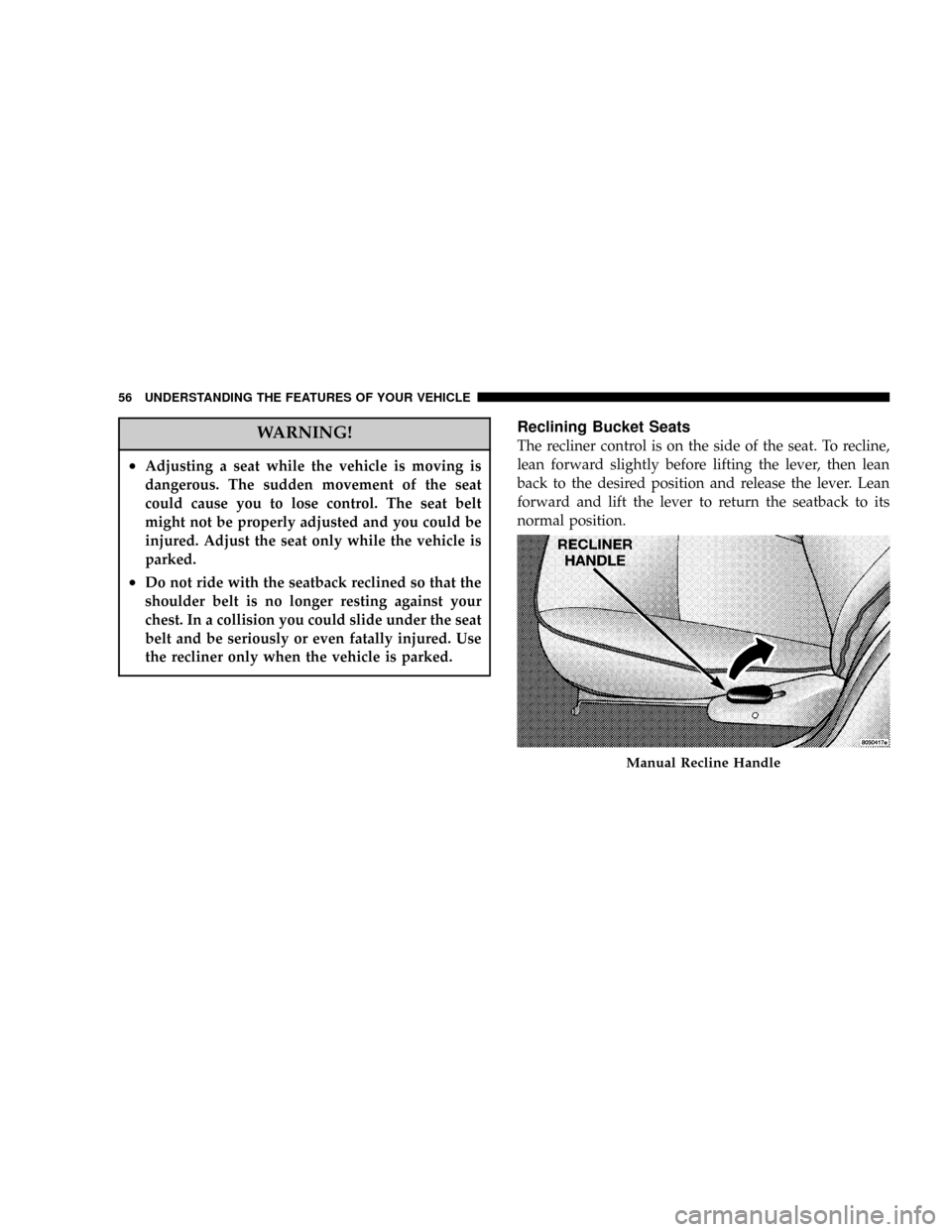
Reclining Bucket Seats
The recliner control is on the side of the seat. To recline,
lean forward slightly before lifting the lever, then lean
back to the desired position and release the lever. Lean
forward and lift the lever to return the seatback to its
normal position.
Manual Recline Handle
56 UNDERSTANDING THE FEATURES OF YOUR VEHICLE