ignition DODGE NEON 2005 2.G Service Manual
[x] Cancel search | Manufacturer: DODGE, Model Year: 2005, Model line: NEON, Model: DODGE NEON 2005 2.GPages: 246, PDF Size: 3.69 MB
Page 122 of 246
You should always apply the parking brake before leav-
ing the vehicle.
WARNING!
²Leaving children in a vehicle unattended is dan-
gerous for a number of reasons. A child or others
could be injured. Children should be warned not
to touch the parking brake or the gear selector.
Don't leave the keys in the ignition. A child could
operate power windows, other controls, or move
the vehicle.
²Be sure the parking brake is fully disengaged
before driving; failure to do so can lead to brake
failure and an accident.
BRAKE SYSTEM
Your vehicle is equipped with power assisted brakes as
standard equipment. In the event power assist is lost for
any reason (for example, repeated brake applications
with the engine off), the brakes will still function. The
effort required to brake the vehicle will be much greater
than that required with the power system operating.
WARNING!
Riding the brakes can lead to brake failure and
possibly an accident. Driving with your foot resting
or riding on the brake pedal can result in abnormally
high brake temperatures, excessive lining wear, and
possible brake damage. You wouldn't have your full
braking capacity in an emergency.
If either of the two hydraulic systems lose normal capa-
bility, the remaining system will still function with some
loss of overall braking effectiveness. This will be evident
by increased pedal travel during application and greater
pedal force required to slow or stop. In addition, if the
122 STARTING AND OPERATING
Page 143 of 246

MMT in Gasoline
MMT is a manganese containing metallic additive that is
blended into some gasoline to increase octane. Gasolines
blended with MMT provide no performance advantage
beyond gasolines of the same octane number without
MMT. Gasolines blended with MMT have shown to reduce
spark plug life and reduce emission system performance in
some vehicles. The manufacturer recommends that gaso-
lines free of MMT be used in your vehicle. The MMT
content of gasoline may not be indicated on the gasoline
pump, therefore you should ask your gasoline retailer
whether or not his/her gasoline contains MMT.
It is even more important to look for gasolines without
MMT in Canada because MMT can be used at higher
levels than allowed in the United States.
MMT is prohibited in both Federal and California refor-
mulated gasolines.
Materials Added to Fuel
All gasoline sold in the United States is required to
contain effective detergent additives. Use of additional
detergents or other additives is not needed under normalconditions and would result in unnecessary cost. There-
fore you should not have to add anything to the fuel.
Fuel System Cautions
CAUTION!
Follow these guidelines to maintain your vehicle's
performance:
²The use of leaded gas is prohibited by Federal law.
Using leaded gasoline can impair engine performance,
damage the emission control system.
²An out-of-tune engine, or certain fuel or ignition
malfunctions, can cause the catalytic converter to
overheat. If you notice a pungent burning odor or
some light smoke, your engine may be out of tune or
malfunctioning and may require immediate service.
Contact your dealer for service assistance.
²The use of fuel additives which are now being sold as
octane enhancers is not recommended. Most of these
products contain high concentrations of methanol.
STARTING AND OPERATING 143
5
Page 149 of 246

WHAT TO DO IN EMERGENCIES
CONTENTS
mHazard Warning Flasher.................150
mIf Your Engine Overheats................150
mJacking And Tire Changing...............152
NPreparations For Jacking................152
NInstructions.........................152
mJump-Starting Procedures If Battery Is Low...155
mDriving On Slippery Surfaces.............158
NAcceleration.........................158NTraction............................159
mFreeing A Stuck Vehicle.................159
mTowing A Disabled Vehicle...............160
NWith Ignition Key.....................160
NWithout The Ignition Key...............161
NTowing This Vehicle Behind Another Vehicle
(Flat Towing With All Four Wheels On The
Ground)............................161
6
Page 150 of 246

HAZARD WARNING FLASHER
The flasher switch is on top of the steering column,
just behind the steering wheel. Depress the switch
and both cluster indicators and all front and rear direc-
tional signals will flash. Depress the switch again to turn
Hazard Warning Flashers off.
Do not use this emergency warning system when the
vehicle is in motion. Use it when your vehicle is disabled
and is creating a safety hazard for other motorists.If it is necessary to leave the vehicle to go for service, the
flasher system will continue to operate with the ignition
key removed and the vehicle locked.
NOTE:With extended use, the flasher may wear down
your battery.
IF YOUR ENGINE OVERHEATS
In any of the following situations, you can reduce the
potential for overheating by taking the appropriate ac-
tion.
²On the highways Ð Slow down.
²In city traffic Ð While stopped, put transaxle in
neutral, but do not increase engine idle speed.
NOTE:There are steps that you can take to slow down
an impending overheat condition. If your air conditioner
is on, turn it off. The air conditioning system adds heat to
the engine cooling system and turning off the A/C
removes this heat. You can also turn the Temperature
control to maximum heat, the Mode control to floor, and
Hazard Flasher Switch
150 WHAT TO DO IN EMERGENCIES
Page 155 of 246
100 ft. lbs. (135 N´m). If you are not sure about the
tightness, have them checked with a torque wrench by
your dealer or at a service station.
8. Remove the wheel blocks and lower the jack until it is
free. Stow the lug wrench, replaced tire, and jack. Secure
all parts using the means provided.
WARNING!
A loose tire or jack thrown forward in a collision or
hard stop could endanger the occupants of the ve-
hicle. Always stow the jack parts and the spare tire in
the places provided.
9. Adjust the tire pressure as soon as possible.
NOTE:The spare tire well is designed to hold the
compact spare tire or a deflated (flat) tire. A fully inflated
tire will not fit in the spare tire well.
JUMP-STARTING PROCEDURES IF BATTERY IS
LOW
WARNING!
Take care to avoid the radiator cooling fan whenever
the hood is raised. It can start anytime the ignition
switch is on. You can be hurt by the fan.
WARNING!
Do not attempt to push or tow your vehicle to get it
started. Vehicles equipped with an automatic trans-
axle cannot be started this way. Unburned fuel could
enter the catalytic converter and once the engine has
started, ignite and damage the converter and vehicle.
If the vehicle has a discharged battery, booster cables
may be used to obtain a start from another vehicle.
This type of start can be dangerous if done improp-
erly, so follow this procedure carefully.
WHAT TO DO IN EMERGENCIES 155
6
Page 156 of 246
1. Wear eye protection and remove any metal jewelry
such as watch bands or bracelets that might make an
inadvertent electrical contact.
2. When boosting from a battery in another vehicle, park
that vehicle within booster cable reach but without
letting the vehicles touch. Set parking brake, place auto-
matic transaxle in PARK (manual transaxle in NEU-
TRAL) and turn ignition to OFF for both vehicles.
3. Turn off the heater, radio and all unnecessary electrical
loads.
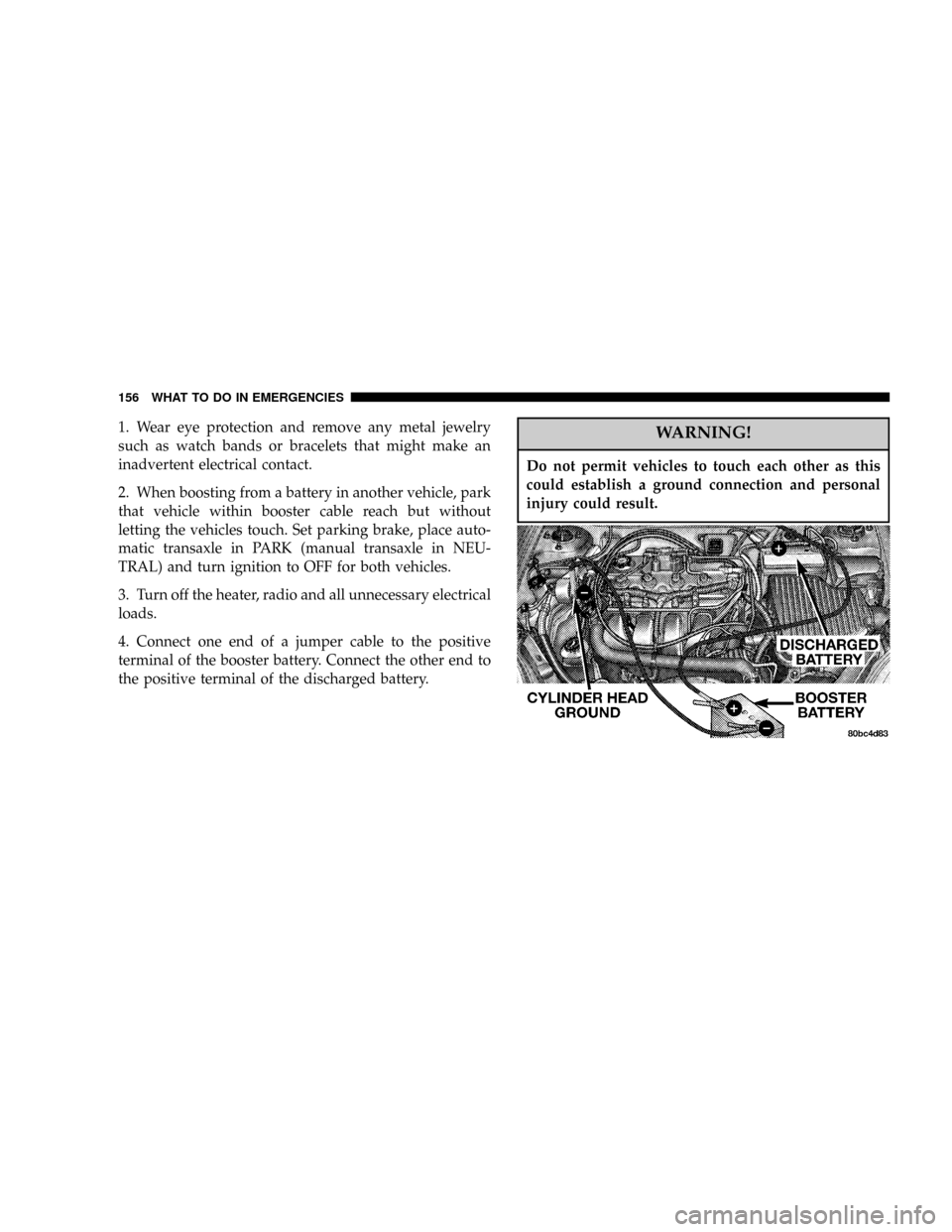
4. Connect one end of a jumper cable to the positive
terminal of the booster battery. Connect the other end to
the positive terminal of the discharged battery.WARNING!
Do not permit vehicles to touch each other as this
could establish a ground connection and personal
injury could result.
156 WHAT TO DO IN EMERGENCIES
Page 157 of 246
WARNING!
Battery fluid is a corrosive acid solution; do not
allow battery fluid to contact eyes, skin or clothing.
Don't lean over battery when attaching clamps or
allow the clamps to touch each other. If acid splashes
in eyes or on skin, flush the contaminated area
immediately with large quantities of water.
A battery generates hydrogen gas which is flam-
mable and explosive. Keep flame or spark away
from the vent holes. Do not use a booster battery or
any other booster source with an output that exceeds
12 volts.
5. Connect the other cable, first to the negative terminal
of the booster battery and then to the engine of the
vehicle with the discharged battery. Make sure you have
a good contact on the engine.
WARNING!
Do not connect the cable to the negative post of the
discharge battery. The resulting electrical spark
could cause the battery to explode.
During cold weather when temperatures are below
freezing point, electrolyte in a discharged battery
may freeze. Do not attempt jump starting because
the battery could rupture or explode. The battery
temperature must be brought up above freezing
point before attempting to jump start.
6. If the vehicle is equipped with sentry key immobilizer,
turn the ignition switch to the ON/RUN position for 3
seconds prior to moving the ignition switch to the crank
position and starting the vehicle.
7. Start the engine in the vehicle that has the booster
battery, let the engine idle a few minutes, then start the
engine in the vehicle with the discharged battery.
WHAT TO DO IN EMERGENCIES 157
6
Page 160 of 246

CAUTION!
Racing the engine or spinning the wheels too fast
may lead to transaxle overheating and failure. It can
also damage the tires. Do not spin the wheels above
35 mph (55km/h).
TOWING A DISABLED VEHICLE
With Ignition Key
Four Speed Automatic Transaxle
Your vehicle may be towed under the following condi-
tions: The steering column must be unlocked and the
gear selector must be in NEUTRAL, the distance to be
towed must not exceed 100 miles (160 km), and the
towing speed must not exceed 44 mph (72 km/h). If the
transaxle is not operative, or if the vehicle is to be towed
more than 100 miles (160 km), the vehicle must be towed
with the front wheels off the ground to avoid damage to
the transaxle.
Manual Transaxle
Your vehicle may be towed if the gearshift lever is in
NEUTRAL. If the transaxle is not operative, the vehicle
must be towed with the front wheels off the ground.
All Transaxles
CAUTION!
If the vehicle being towed requires steering, the
ignition switch must be in the OFF position, not in
the LOCK or ACCESSORY positions.
If it is necessary to use the accessories while being towed
(wipers, defrosters, etc.), the key must be in the ON
position, not the ACCESSORY position. Make certain the
transaxle remains in NEUTRAL.
160 WHAT TO DO IN EMERGENCIES
Page 161 of 246

Without The Ignition Key
Special care must be taken when the vehicle is towed
with the ignition in the LOCK position. A dolly should be
used under the front wheels if the rear wheels are raised.
Proper towing equipment is necessary to prevent dam-
age to the vehicle.
Towing This Vehicle Behind Another Vehicle (Flat
Towing With All Four Wheels On The Ground)
If your vehicle is equipped with a manual transaxle, it
may be towed at any legal highway speed, for any
distance, if the transaxle is in neutral.
If the ignition key is not available, vehicles with auto-
matic transaxles can not be flat towed at any time.
WHAT TO DO IN EMERGENCIES 161
6
Page 163 of 246

MAINTAINING YOUR VEHICLE
CONTENTS
m2.0L Engine Compartment...............165
mOnboard Diagnostic System Ð OBD II......166
mEmissions Inspection And Maintenance
Programs
............................167
mReplacement Parts.....................168
mDealer Service........................168
mMaintenance Procedures.................169
NEngine Oil..........................169
NIgnition Wiring System.................175
NCrankcase Emission Control System........175
NFuel Filter..........................175
NAir Cleaner Element (Filter)..............175NMaintenance-Free Battery................176
NAir Conditioner......................177
NPower Steering Fluid Check..............178
NFront Suspension Ball Joints..............178
NBody Lubrication.....................178
NWindshield Wiper Blades................179
NWindshield Wiper Blade Replacement.......179
NWindshield Washer Aiming..............180
NWindshield Washer Reservoir.............180
NExhaust System......................180
NCooling System.......................181
7