check oil DODGE NEON SRT 2004 2.G User Guide
[x] Cancel search | Manufacturer: DODGE, Model Year: 2004, Model line: NEON SRT, Model: DODGE NEON SRT 2004 2.GPages: 200, PDF Size: 3.23 MB
Page 145 of 200
Power Steering Fluid Check
Checking the power steering fluid level at a defined
service interval is not required. The fluid should only be
checked if a leak is suspected, abnormal noises are
apparent, and/or the system is not functioning as antici-
pated. Coordinate inspection efforts through a certified
DaimlerChrysler Dealership.9
WARNING!
Fluid level should be checked on a level surface and
with the engine off to prevent injury from moving
parts and to insure accurate fluid level reading. Do
not overfill. Use only manufacturers recommended
power steering fluid.
If necessary, add fluid to restore to the proper indicated
level. With a clean cloth, wipe any spilled fluid from all
surfaces. Refer to Recommended Fluids, Lubricants, and
Genuine Parts for correct fluid types.
Front Suspension Ball Joints
There are two front suspension lower ball joints that are
permanently lubricated. Inspect these ball joints when-
ever under-vehicle service is done. Damaged seals
should be replaced to prevent leakage or grease contami-
nation.
Body Lubrication
Locks and all body pivot points, including such items as
seat tracks, doors, trunk and hood hinges, should be
lubricated periodically to assure quiet, easy operation
and to protect against rust and wear. Prior to the appli-
cation of any lubricant, the parts concerned should be
wiped clean to remove dust and grit; after lubricating
excess oil and grease should be removed. Particular
attention should also be given to hood latching compo-
nents to insure proper function. When performing other
underhood services, the hood latch, release mechanism
and safety catch should be cleaned and lubricated.
The external lock cylinders should be lubricated twice a
year, preferably in the fall and spring. Apply a small
amount of a high quality lubricant such as MopartLock
Cylinder Lubricant directly into the lock cylinder.
MAINTAINING YOUR VEHICLE 145
7
Page 147 of 200
Windshield Washer Reservoir
The washer fluid reservoir is located in the engine
compartment and should be checked for fluid level at
regular intervals. Fill the reservoir with windshield
washer solvent (not radiator antifreeze)
Exhaust System
The best protection against carbon monoxide entry into
the vehicle body is a properly maintained engine exhaust
system.
If you notice a change in the sound of the exhaust system;
or if exhaust fumes can be detected inside the vehicle; or
when the underside or rear of the vehicle is damaged;
have a competent mechanic inspect the complete exhaust
system and adjacent body areas of broken, damaged,
deteriorated, or mispositioned parts. Open seams or
loose connections could permit exhaust fumes to seep
into the passenger compartment. In addition, inspect the
exhaust system each time the vehicle is raised for lubri-
cation or oil change. Replace as required.
WARNING!
Exhaust gases can injure or kill. They contain carbon
monoxide which is colorless and odorless. Breathing
it can make you unconscious and can eventually
poison you. Follow the above precautions to keep
your exhaust system as safe as possible.
MAINTAINING YOUR VEHICLE 147
7
Page 148 of 200
Cooling System
WARNING!
²When working near the radiator cooling fan, dis-
connect the fan motor lead or turn the ignition key
to the OFF position. The fan is temperature con-
trolled and can start at any time the ignition key is
in the ON position.
²You or others can be badly burned by hot coolant
or steam from your radiator. If you see or hear
steam coming from under the hood, don't open
the hood until the radiator has had time to cool.
Never try to open a cooling system pressure cap
when the radiator is hot.
Coolant Checks
Check coolant protection every 12 months (before the
onset of freezing weather, where applicable). If coolant is
dirty or rusty in appearance, the system should be
drained, flushed and refilled with fresh coolant.Check the front of the radiator for an accumulation of
bugs, leaves, etc. Clean the radiator by gently spraying
water from a garden hose at the back of the core.
Check the recovery bottle tank tubing for condition and
tightness of connection at the bottle and radiator. Inspect
the entire system for leaks.
With the engine at normal operating temperature (but
not running), check the cooling system pressure cap for
proper vacuum sealing by draining a small amount of
coolant from the radiator drain cock. If the cap is sealing
properly, the coolant will begin to drain from the reserve
tank. Do not remove the cap when the cooling system is
hot.
Cooling System Ð Drain, Flush and Refill
At the intervals shown on the Maintenance Schedules,
the system should be drained, flushed and refilled.
If the solution is dirty and contains a considerable
amount of sediment, clean and flush with a reliable
cooling system cleaner. Follow with a thorough rinsing to
remove all deposits and chemicals. Discard oil antifreeze
solution.
148 MAINTAINING YOUR VEHICLE
Page 153 of 200
Brake System
In order to assure brake system performance, all brake
system components should be inspected periodically.
Suggested service intervals can be found in the Mainte-
nance Section.
WARNING!
Riding the brakes can lead to brake failure and
possibly an accident. Driving with your foot resting
or riding on the brake pedal can result in abnormally
high brake temperatures, excessive lining wear, and
possible brake damage. You wouldn't have your full
braking capacity in an emergency.
Brake and Power Steering System Hoses
When servicing the vehicle for scheduled maintenance,
inspect surface of hoses and nylon tubing for evidence of
heat and mechanical damage. Hard and brittle rubber,
cracking, checking, tears, cuts, abrasions, and excessive
swelling suggest deterioration of the rubber. Particularattention should be made to examining those hose sur-
faces nearest to high heat sources, such as the exhaust
manifold.
Inspect all hose clamps and couplings to make sure they
are secure and no leaks are present.
Insure nylon tubing in these areas has not melted or
collapsed.
NOTE:Often, fluids such as oil, power steering fluid,
and brake fluid are used during assembly plant opera-
tions to ease the assembly of hoses to couplings. There-
fore, oil wetness at the hose-coupling area is not neces-
sarily an indication of leakage. Actual dripping of hot
fluid when systems are under pressure (during vehicle
operation) should be noted before hose is replaced based
on leakage.
NOTE:Inspection of brake hoses should be done
whenever the brake system is serviced and every engine
oil change.
MAINTAINING YOUR VEHICLE 153
7
Page 154 of 200
WARNING!
Worn brake hoses can burst and cause brake failure.
You could have an accident. If you see any signs of
cracking, scuffing, or worn spots, have the brake
hoses replaced immediately.
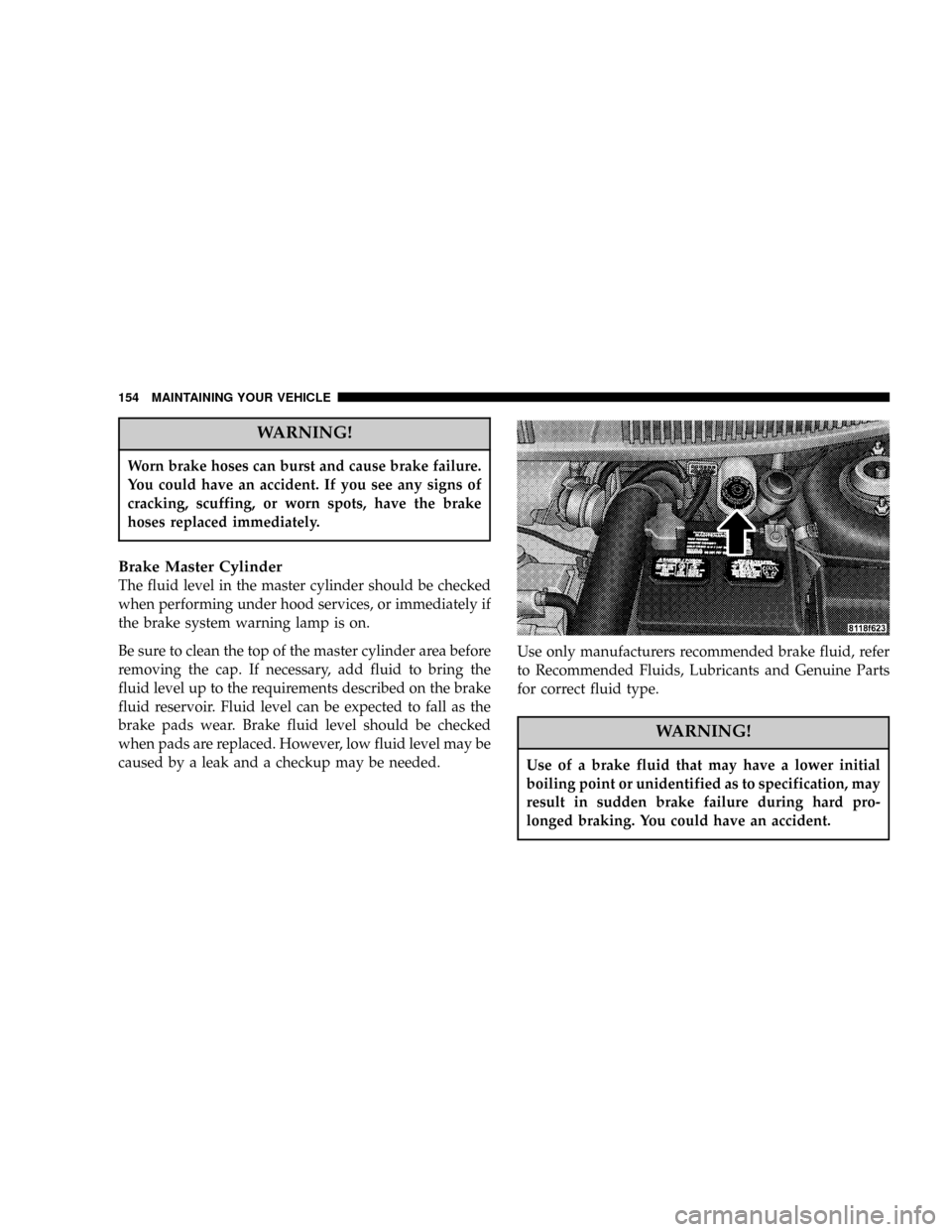
Brake Master Cylinder
The fluid level in the master cylinder should be checked
when performing under hood services, or immediately if
the brake system warning lamp is on.
Be sure to clean the top of the master cylinder area before
removing the cap. If necessary, add fluid to bring the
fluid level up to the requirements described on the brake
fluid reservoir. Fluid level can be expected to fall as the
brake pads wear. Brake fluid level should be checked
when pads are replaced. However, low fluid level may be
caused by a leak and a checkup may be needed.Use only manufacturers recommended brake fluid, refer
to Recommended Fluids, Lubricants and Genuine Parts
for correct fluid type.
WARNING!
Use of a brake fluid that may have a lower initial
boiling point or unidentified as to specification, may
result in sudden brake failure during hard pro-
longed braking. You could have an accident.
154 MAINTAINING YOUR VEHICLE
Page 169 of 200
NOTE:IfANYof these apply to you then change your
engine oil every 3,000 miles (5 000 km) or 3 months,
whichever comes first and follow schedule ªBº of the
9Maintenance Schedules9section of this manual.
NOTE:Most vehicles are operated under the conditions
listed for Schedule9B9.
Second is ScheduleªAº. It is for vehicles that are not
operated under any of the conditions listed under Sched-
ule9B9
Use the schedule that best describes your driving condi-
tions. Where time and mileage are listed, follow the
interval that occurs first.
CAUTION!
Failure to perform the required maintenance items
may result in damage to the vehicle.
At Each Stop for Fuel
²
Check the engine oil level about 5 minutes after a fully
warmed engine is shut off. Checking the oil level while
the vehicle is on level ground will improve the accu-
racy of the oil level reading. Add oil only when the
level is at or below the ADD or MIN mark.
²Check the windshield washer solvent and add if
required.
Once a Month
²
Check tire pressure and look for unusual wear or
damage.
²Inspect the battery and clean and tighten the terminals
as required.
²Check the fluid levels of coolant reservoir, brake
master cylinder and transaxle and add as needed.
²Check all lights and all other electrical items for correct
operation.
²Check rubber seals on each side of the radiator for
proper fit.
MAINTENANCE SCHEDULES 169
8
M
A
I
N
T
E
N
A
N
C
E
S
C
H
E
D
U
L
E
S
Page 170 of 200
At Each Oil Change
²
Change the engine oil filter.
²Inspect the exhaust system.
²Inspect the brake hoses.
²Inspect the CV joints and front suspension compo-
nents.
²Check the manual transaxle fluid level and fill plug
condition.
²Check the coolant level, hoses, and clamps.
²Rotate the tires at each oil change interval shown on
SCHEDULE ªAº 5,000 miles (8 000 km), or every other
interval shown on SCHEDULE ªBº 6,000 miles (10,000
km).
170 MAINTENANCE SCHEDULES
8
M
A
I
N
T
E
N
A
N
C
E
S
C
H
E
D
U
L
E
S
Page 194 of 200

Downshifting........................... 92
Drive Belts............................ 140
Driving
On Slippery Surfaces.................. 128
Electric Remote Mirrors................... 48
Emergency, In Case of
Jacking............................. 122
Jump Starting........................ 125
Towing............................. 130
Emergency Trunk Release................. 15
Emission Control System Maintenance....... 168
Engine
Break-In Recommendations............... 42
Checking Oil Level.................... 137
Jump Starting........................ 125
Oil ..........................137,165,166
Oil Change Interval................... 138
Oil Filter............................ 166
Oil Selection......................... 138
Oil Synthetic......................... 139
Overheating......................... 120
Temperature Gauge.................... 67Timing Belt.......................... 142
Exhaust Gas Caution..................... 43
Exhaust System........................ 147
Filters
Air Cleaner.......................... 142
Engine Fuel......................... 142
Engine Oil.......................140,166
Flooded Engine Starting................... 88
Fluid, Brake........................... 166
Fluid Capacities........................ 165
Fluid Leaks............................ 44
Fluid Level Checks
Manual Transaxle..................... 155
Fog Lights...........................54,63
Freeing A Stuck Vehicle.................. 129
Fuel.............................. 113,166
Adding............................. 116
Filler Cap........................... 116
Filter.............................. 142
Gauge.............................. 65
Light............................... 65
Octane Rating........................ 113
194 INDEX
Page 196 of 200

Keyless Entry System..................... 16
Keys.................................. 9
Lane Change and Turn Signals.............. 64
Lap/Shoulder Belts...................... 20
Lead Free Gasoline...................... 113
Leaks, Fluid............................ 44
Light Bulbs........................162,163
Lighter, Cigar.......................... 58
Lights................................ 52
Airbag..........................35,44,65
Anti-Lock............................ 63
Brake Warning........................ 63
Center Mounted Stop.................. 164
Daytime Running...................... 54
Dimmer Switch, Headlight.............53,55
Dome............................... 53
Exterior Check........................ 44
Fog ................................ 54
Headlights On Reminder................ 54
High Beam Indicator................... 64
Instrument Cluster..................... 54
Lights On Reminder.................... 54Malfunction Indicator................... 66
Map Reading......................... 52
Oil Pressure.......................... 64
Park................................ 54
Passing............................. 55
Rear Servicing....................... 164
Rear Tail............................ 164
Seat Belt Reminder..................... 65
Side Marker......................... 164
Theft Alarm.......................... 65
Turn Signal.....................55,64,164
Voltage.............................. 65
Loading Vehicle........................ 117
Tires ............................... 100
Locks................................ 12
Child Protection....................... 14
Door............................... 12
Ignition............................ 134
Power Door.......................... 13
Steering Wheel........................ 12
Lubrication, Body....................... 145
Maintenance Free Battery................. 142
196 INDEX
Page 197 of 200

Maintenance Procedures.................. 136
Maintenance Schedule
Schedule9A9......................... 178
Schedule9B9......................... 171
Maintenance Schedules.................. 168
Malfunction Indicator Light.............66,134
Manual, Service........................ 188
Manual Transaxle..................87,90,155
Fluid Level Check..................... 155
Frequency of Fluid Change.............. 155
Lubricant Selection.................... 155
Master Cylinder........................ 154
Mirrors............................... 47
Electric Remote....................... 48
Outside............................. 47
Rearview............................ 47
Modifications/Alterations, Vehicle............ 6
Mopar Parts........................136,187
Multi-Function Control Lever.............53,55
Occupant Restraints...................... 19
Odometer
Trip ................................ 66Oil, Engine........................... 137
Change Interval...................... 138
Checking........................... 137
Disposal............................ 140
Filter.............................. 140
Identification Logo.................... 139
Materials Added to.................... 139
Quality............................. 139
Recommendation..................... 138
Synthetic........................... 139
Oil Pressure Light....................... 64
Onboard Diagnostic System............... 134
Operator Manuals........................ 4
Outside Air Intake....................... 82
Overheating, Engine..................... 120
Owner's Manual......................4,188
Paint Care............................ 155
Panic Alarm........................... 17
Parking Brake.......................... 92
Passing Light........................... 55
Pets.................................. 42
Placard, Tire and Loading Information....... 100
INDEX 197
10