ECU DODGE NITRO 2008 1.G User Guide
[x] Cancel search | Manufacturer: DODGE, Model Year: 2008, Model line: NITRO, Model: DODGE NITRO 2008 1.GPages: 434, PDF Size: 6.2 MB
Page 27 of 434

The vehicle can be started remotely a maximum of two
times consecutively. The vehicle is also allowed a maxi-
mum of one failed start, where the remote start sequence
was initiated but the engine stopped cranking without
starting. Following either of these conditions, or if the
Vehicle Security Alarm (if equipped) is alarming, or if the
PANIC button was pressed, the system must be reset
before remote starting the vehicle again. To reset the
system, insert a valid key into the ignition and turn it to
the ON position and then back to the LOCK position.DOOR LOCKS
The vacuum fluorescent (VF) display located in the
odometer area displays the word ªdoorº as an indication
of a door ajar or door not completely closed. When the
vehicle is not moving and the door is ajar or not
completely closed, the VF display will show the word
ªdoor.º
If any other active warnings including ªGATEº, or ªGAS-
CAPº are present, they will be shown in the VF display
and will also continue to cycle. If the vehicle is moving,
three single chimes will occur (One chime for each
complete display cycle (three cycles total). After this, the
display will continue to cycle only (no chimes).
If the trip/reset button is pressed while the VF warnings
are being displayed, the VF display will revert back to
only displaying the odometer/trip odometer mileage.
THINGS TO KNOW BEFORE STARTING YOUR VEHICLE 27
2
Page 28 of 434
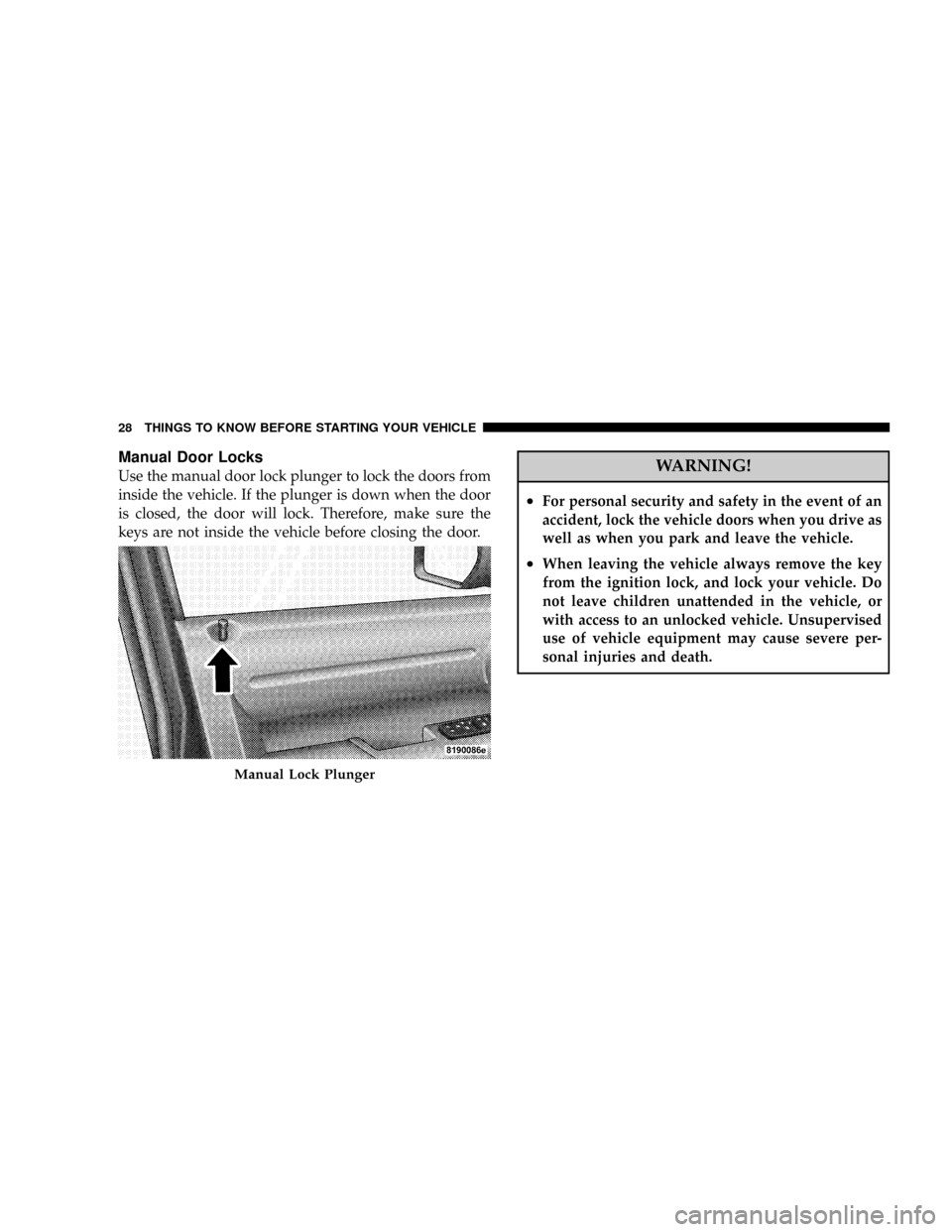
Manual Door Locks
Use the manual door lock plunger to lock the doors from
inside the vehicle. If the plunger is down when the door
is closed, the door will lock. Therefore, make sure the
keys are not inside the vehicle before closing the door.WARNING!
²For personal security and safety in the event of an
accident, lock the vehicle doors when you drive as
well as when you park and leave the vehicle.
²When leaving the vehicle always remove the key
from the ignition lock, and lock your vehicle. Do
not leave children unattended in the vehicle, or
with access to an unlocked vehicle. Unsupervised
use of vehicle equipment may cause severe per-
sonal injuries and death.
Manual Lock Plunger
28 THINGS TO KNOW BEFORE STARTING YOUR VEHICLE
Page 52 of 434

Children that are not big enough to properly wear the
vehicle seat belt should be secured in the rear seat, in a
child restraint or belt-positioning booster seat. Older
children who do not use child restraints or belt-
positioning booster seats should ride properly buckled
up in the rear seat. Never allow children to slide the
shoulder belt behind them or under their arm.
If a child from 1 to 12 years old must ride in the front
passenger seat because the vehicle is crowded, move the
seat as far back as possible, and use the proper child
restraint. See ªChild Restraintº in this section.
You should read the instructions provided with your
child restraint to make sure that you are using it properly.2. All occupants should use their lap and shoulder belts
properly.
3. The driver and front passenger seats should be moved
back as far as practical to allow the front airbags room to
inflate.
4. Do not lean against the door or window, airbags will
inflate forcefully into the space between you and the
door.
5. If the airbag system in this vehicle needs to be
modified to accommodate a disabled person, contact the
Customer Center. Phone numbers are provided under ªIf
You Need Assistanceº in Section 9 of this manual.
52 THINGS TO KNOW BEFORE STARTING YOUR VEHICLE
Page 66 of 434
²Cruise control status
²Traction/stability control status
²Tire pressure monitoring system status
Child Restraint
Everyone in your vehicle needs to be buckled up all the
time Ð babies and children, too. Every state in the United
States and all Canadian provinces require that small
children ride in proper restraint systems. This is the law,
and you can be prosecuted for ignoring it.
Children 12 years and under should ride properly buck-
led up in a rear seat, if available. According to crash
statistics, children are safer when properly restrained in
the rear seats rather than in the front.There are different sizes and types of restraints for
children from newborn size to the child almost large
enough for an adult safety belt. Always check the child
seat Owner's Manual to ensure you have the right seat
for your child. Use the restraint that is correct for your
child:
WARNING!
In a collision, an unrestrained child, even a tiny baby,
can become a missile inside the vehicle. The force
required to hold even an infant on your lap can
become so great that you could not hold the child, no
matter how strong you are. The child and others
could be badly injured. Any child riding in your
vehicle should be in a proper restraint for the child's
size.
66 THINGS TO KNOW BEFORE STARTING YOUR VEHICLE
Page 69 of 434

²In the rear seat, you may have trouble tightening the
lap/shoulder belt on the child restraint because the
buckle or latch plate is too close to the belt path
opening on the restraint. Disconnect the latch plate
from the buckle and twist the short buckle-end belt
several times to shorten it. Insert the latch plate into
the buckle with the release button facing out.
²If the belt still cannot be tightened, or if pulling and
pushing on the restraint loosens the belt, disconnect
the latch plate from the buckle, turn the buckle
around, and insert the latch plate into the buckle
again. If you still cannot make the child restraint
secure, try a different seating position.
²Buckle the child into the restraint exactly as the
manufacturer's instructions tell you.
²When your child restraint is not in use, secure it in the
vehicle with the seat belt or remove it from the vehicle.
Do not leave it loose in the vehicle. In a sudden stop or
collision, it could strike the occupants or seat backs
and cause serious personal injury.
NOTE:For additional information refer to
www.seatcheck.org or call 1-866-SEATCHECK.
Older Children and Child Restraints
Children who weigh more than 20 lbs (9 kg) and who are
older than one year can ride forward-facing in the
vehicle. Forward-facing child seats and convertible child
seats used in the forward-facing direction, are for chil-
dren who weigh 20 to 40 lbs (9 to 18 kg), and who are
older than one year. These child seats are also held in the
vehicle by the lap/shoulder belt or the LATCH child
restraint anchorage system (Refer to LATCH Ð Child
Seat Anchorage System in this section.)
THINGS TO KNOW BEFORE STARTING YOUR VEHICLE 69
2
Page 70 of 434

The belt-positioning booster seat is for children weighing
more than 40 lbs (18 kg), but who are still too small to fit
the vehicle's seat belts properly. If the child cannot sit
with knees bent over the vehicle's seat cushion while the
child's back is against the seat back, they should use a
belt-positioning booster seat. The child and belt-
positioning booster seat are held in the vehicle by the
lap/shoulder belt.
Children Too Large for Booster Seats
Children who are large enough to wear the shoulder belt
comfortably, and whose legs are long enough to bend
over the front of the seat when their back is against the
seat back, should use the lap/shoulder belt in a rear seat.
²Make sure that the child is upright in the seat.
²The lap portion should be low on the hips and as snug
as possible.
²Check belt fit periodically. A child's squirming or
slouching can move the belt out of position.
²If the shoulder belt contacts the face or neck, move the
child closer to the center of the vehicle. Never allow a
child to put the shoulder belt under an arm or behind
their back.
LATCH Ð Child Seat Anchorage System (Lower
Anchors and Tether for CHildren)
Your vehicle's rear seat is equipped with the child
restraint anchorage system called LATCH. The LATCH
system provides for the installation of the child restraint
without using the vehicle's seat belts, instead securing
the child restraint using lower anchorages and upper
tether straps from the child restraint to the vehicle
structure.
LATCH-compatible child restraint systems are now avail-
able. However, because the lower anchorages are to be
introduced over a period of years, child restraint systems
70 THINGS TO KNOW BEFORE STARTING YOUR VEHICLE
Page 74 of 434

belt. However, any seat belt system may loosen with
time, so check the belt occasionally and pull it tight if
necessary.
If the seat belt has a automatic locking retractor, it will
have a distinctive label. Pull the belt from the retractor
until there is enough to allow you to pass through the
child restraint and slide the latch plate into the buckle.
Then, pull the belt until it is all extracted from the
retractor. Allow the belt to return to the retractor, pulling
on the excess webbing to tighten the lap portion about
the child restraint. Refer to ªAutomatic Locking Modeº
earlier in this section.
In the rear seat, you may have trouble tightening the
lap/shoulder belt on the child restraint because the
buckle or latch plate is too close to the belt path opening
on the restraint. Disconnect the latch plate from thebuckle and twist the short buckle-end belt several times
to shorten it. Insert the latch plate into the buckle with the
release button facing out.
If the belt still can't be tightened, or if by pulling and
pushing on the restraint loosens the belt, you may need
to do something more. Disconnect the latch plate from
the buckle, turn the buckle around, and insert the latch
plate into the buckle again. If you still can't make the
child restraint secure, try a different seating position.
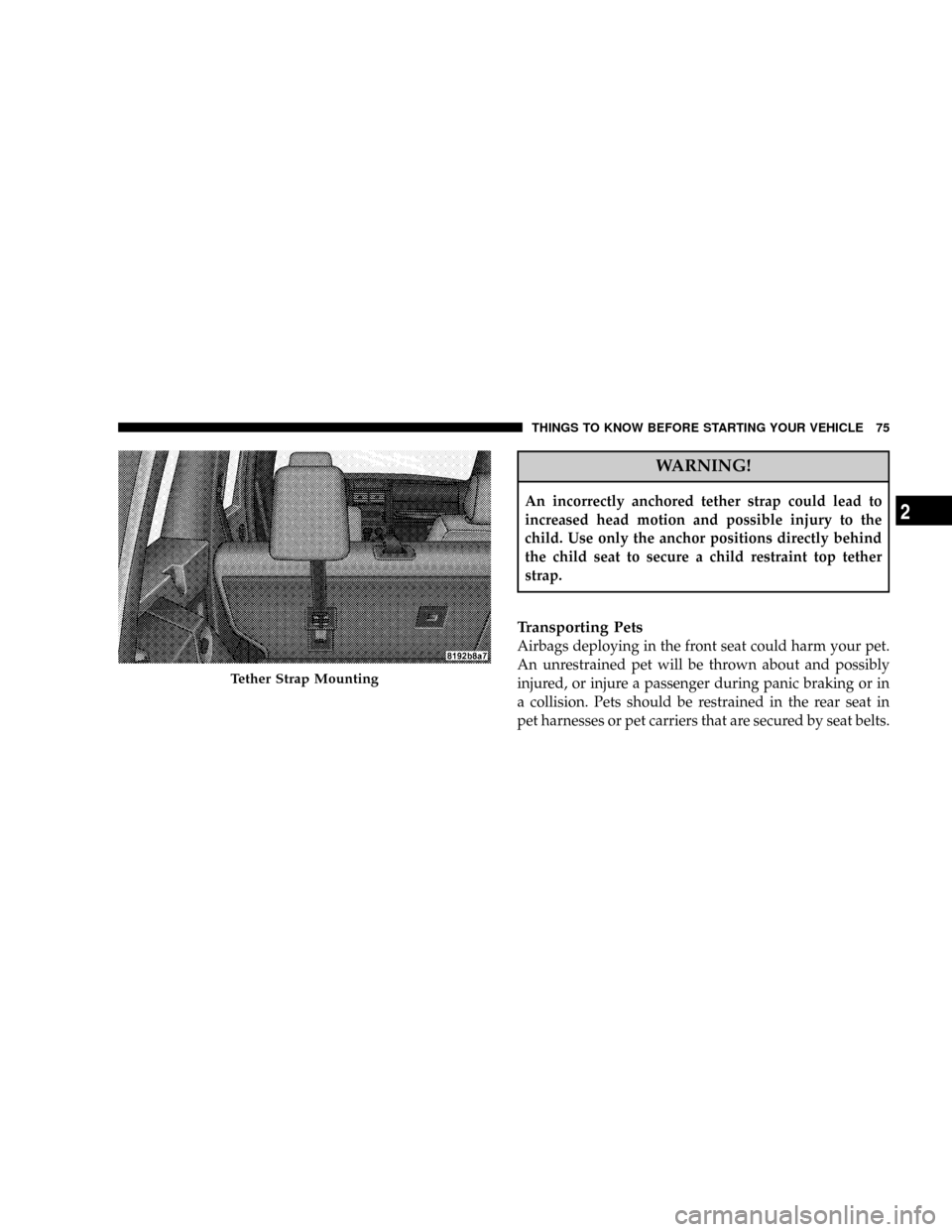
To attach a child restraint tether strap:
Route the tether strap over the seat back and attach the
hook to the tether anchor located on the back of the seat.
For the outboard seating positions, route the tether over
the head rests, and attach the hook to the tether anchor
located on the back of the seat.
74 THINGS TO KNOW BEFORE STARTING YOUR VEHICLE
Page 75 of 434
WARNING!
An incorrectly anchored tether strap could lead to
increased head motion and possible injury to the
child. Use only the anchor positions directly behind
the child seat to secure a child restraint top tether
strap.
Transporting Pets
Airbags deploying in the front seat could harm your pet.
An unrestrained pet will be thrown about and possibly
injured, or injure a passenger during panic braking or in
a collision. Pets should be restrained in the rear seat in
pet harnesses or pet carriers that are secured by seat belts.
Tether Strap Mounting
THINGS TO KNOW BEFORE STARTING YOUR VEHICLE 75
2
Page 81 of 434

NElectronic Speed Control Operation........128
NTo Activate..........................128
NTo Set At A Desired Speed...............129
NTo Deactivate........................129
NTo Resume Speed.....................129
NTo Vary The Speed Setting...............129
NManual Transmission..................130
NTo Accelerate For Passing...............130
mElectronic Brake Control System............131
NABS (Anti-Lock Brake System)............131
NTCS (Traction Control System)............132
NBAS (Brake Assist System)...............132
NERM (Electronic Roll Mitigation)..........133NESP (Electronic Stability Program).........134
NESP/BAS Warning Lamp................137
mGarage Door Opener Ð If Equipped.........137
NProgramming HomeLinkt...............139
NGate Operator/Canadian Programming.....141
NUsing HomeLinkt.....................142
NReprogramming a Single HomeLinktButton . . 142
NSecurity............................143
NTroubleshooting Tips...................143
NGeneral Information...................143
mPower Sunroof Ð If Equipped.............144
NOpening Sunroof - Express..............145
NClosing Sunroof - Express...............145
UNDERSTANDING THE FEATURES OF YOUR VEHICLE 81
3
Page 120 of 434
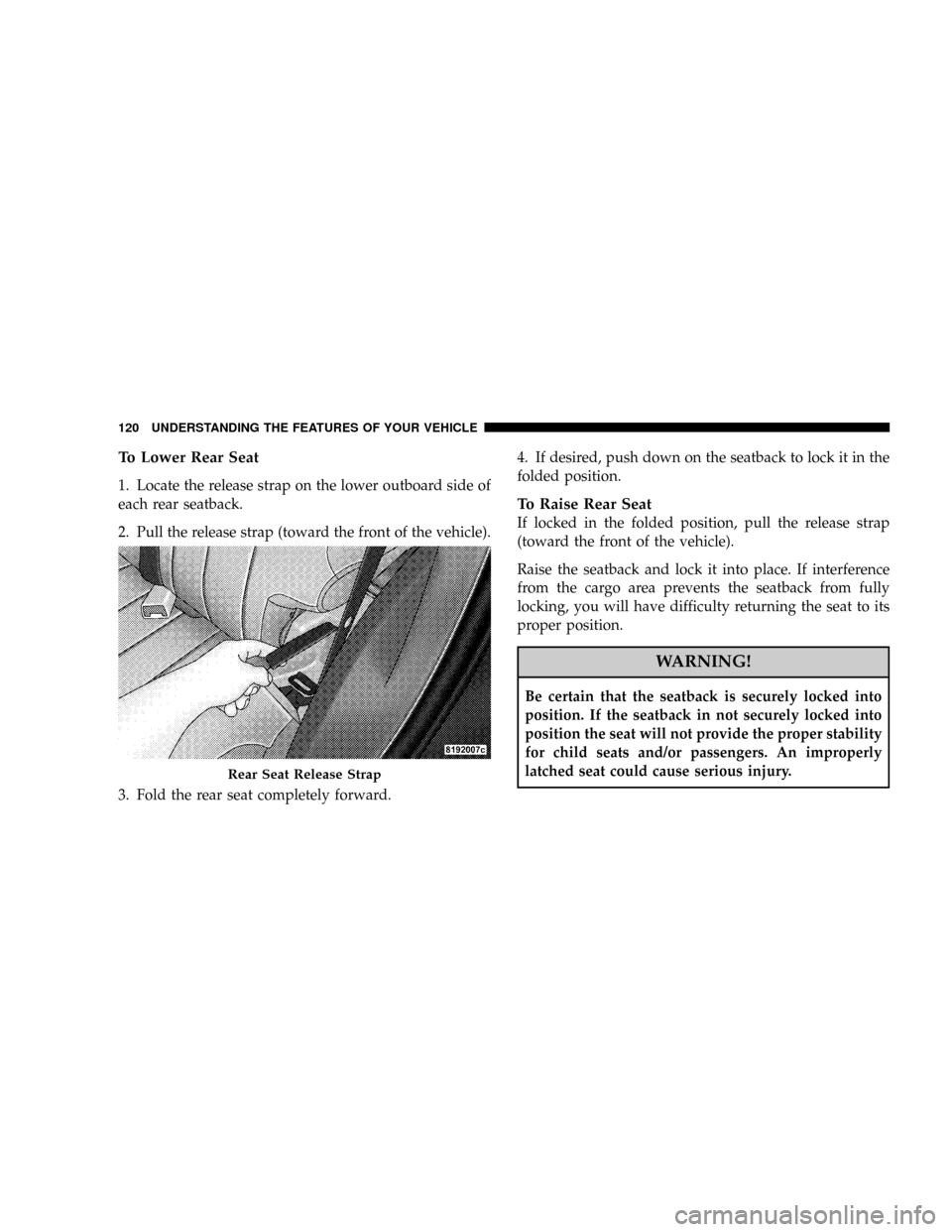
To Lower Rear Seat
1. Locate the release strap on the lower outboard side of
each rear seatback.
2. Pull the release strap (toward the front of the vehicle).
3. Fold the rear seat completely forward.4. If desired, push down on the seatback to lock it in the
folded position.
To Raise Rear Seat
If locked in the folded position, pull the release strap
(toward the front of the vehicle).
Raise the seatback and lock it into place. If interference
from the cargo area prevents the seatback from fully
locking, you will have difficulty returning the seat to its
proper position.
WARNING!
Be certain that the seatback is securely locked into
position. If the seatback in not securely locked into
position the seat will not provide the proper stability
for child seats and/or passengers. An improperly
latched seat could cause serious injury.
Rear Seat Release Strap
120 UNDERSTANDING THE FEATURES OF YOUR VEHICLE