transmission DODGE NITRO 2008 1.G Owner's Manual
[x] Cancel search | Manufacturer: DODGE, Model Year: 2008, Model line: NITRO, Model: DODGE NITRO 2008 1.GPages: 434, PDF Size: 6.2 MB
Page 241 of 434

STARTING AND OPERATING
CONTENTS
mStarting Procedures.....................245
NManual Transmission..................245
NAutomatic Transmission................245
NNormal Starting......................245
NExtreme Cold Weather (Below ±20ÉF Or
±29ÉC).............................246
NIf Engine Fails To Start.................246
NAfter Starting........................248
mEngine Block Heater Ð If Equipped.........248mManual Transmission Ð If Equipped.........249
N6-Speed Manual Transmission............249
mAutomatic Transmission..................252
NShift Lock Manual Override Ð If Equipped . . . 253
NBrake/Transmission Interlock System.......254
N4±Speed Automatic Transmission (3.7L
Engine)............................255
N5±Speed Automatic Transmission (4.0L
Engine)............................260
NGear Ranges.........................260
5
Page 245 of 434
STARTING PROCEDURES
Before starting your vehicle, adjust your seat, adjust both
inside and outside mirrors, and fasten your seat belts.
CAUTION!
Long periods of engine idling, especially at high
engine speeds can cause excessive exhaust tempera-
tures which can damage your vehicle. Do not leave
your vehicle unattended with the engine running.
WARNING!
Do not leave children or animals inside parked
vehicles in hot weather. Interior heat build up may
cause serious injury or death.
Manual Transmission
Apply the parking brake, place the gearshift control lever
in ªNº (Neutral) and depress the clutch pedal before
starting vehicle. This vehicle is equipped with a clutch
interlocking ignition system. It will not start unless the
clutch pedal is pressed to the floor.
Automatic Transmission
Start the engine with the selector lever in the ªNº
(Neutral) or ªPº (Park) position. Apply the brake before
shifting to any driving range.
Normal Starting
Normal starting of either a cold or a warm engine is
obtained without pumping or depressing the accelerator
pedal. Turn the key to the START position and release
when the engine starts. If the engine fails to start within
10 seconds, turn the key to the OFF position, wait 5
seconds, then repeat the normal starting procedure.
STARTING AND OPERATING 245
5
Page 246 of 434

Tip Start Feature Ð Automatic Transmission Only
Do notpress the accelerator. Turn the ignition key briefly
to START position, and release it. The starter motor will
continue to run, but will automatically disengage itself
when the engine is running.
Extreme Cold Weather (below ±20ÉF or ±29ÉC)
To insure reliable starting at these temperatures, use of an
externally powered electric engine block heater (available
from your dealer) is recommended.
If Engine Fails to Start
If the engine fails to start after you have followed the
ªNormal Startingº or ªExtreme Cold Weatherº proce-
dures, it may be flooded. Push the accelerator pedal all
the way to the floor and hold it there while cranking the
engine. This should clear any excess fuel in case the
engine is flooded.
CAUTION!
To prevent damage to the starter, do not crank the
engine for more than 15 seconds at a time. Wait 10 to
15 seconds before trying again.
Ignition Key Positions
246 STARTING AND OPERATING
Page 249 of 434
WARNING!
Remember to disconnect the cord before driving.
Damage to the 110-115 volt AC electrical cord could
cause electrocution.
Use the heater when temperatures below 0ÉF (-18ÉC) are
expected to last for several days.
MANUAL TRANSMISSION Ð IF EQUIPPED
6-Speed Manual Transmission
WARNING!
You or others could be injured if you leave the
vehicle unattended without having the parking
brake fully applied. The parking brake should al-
ways be applied when the driver is not in the vehicle,
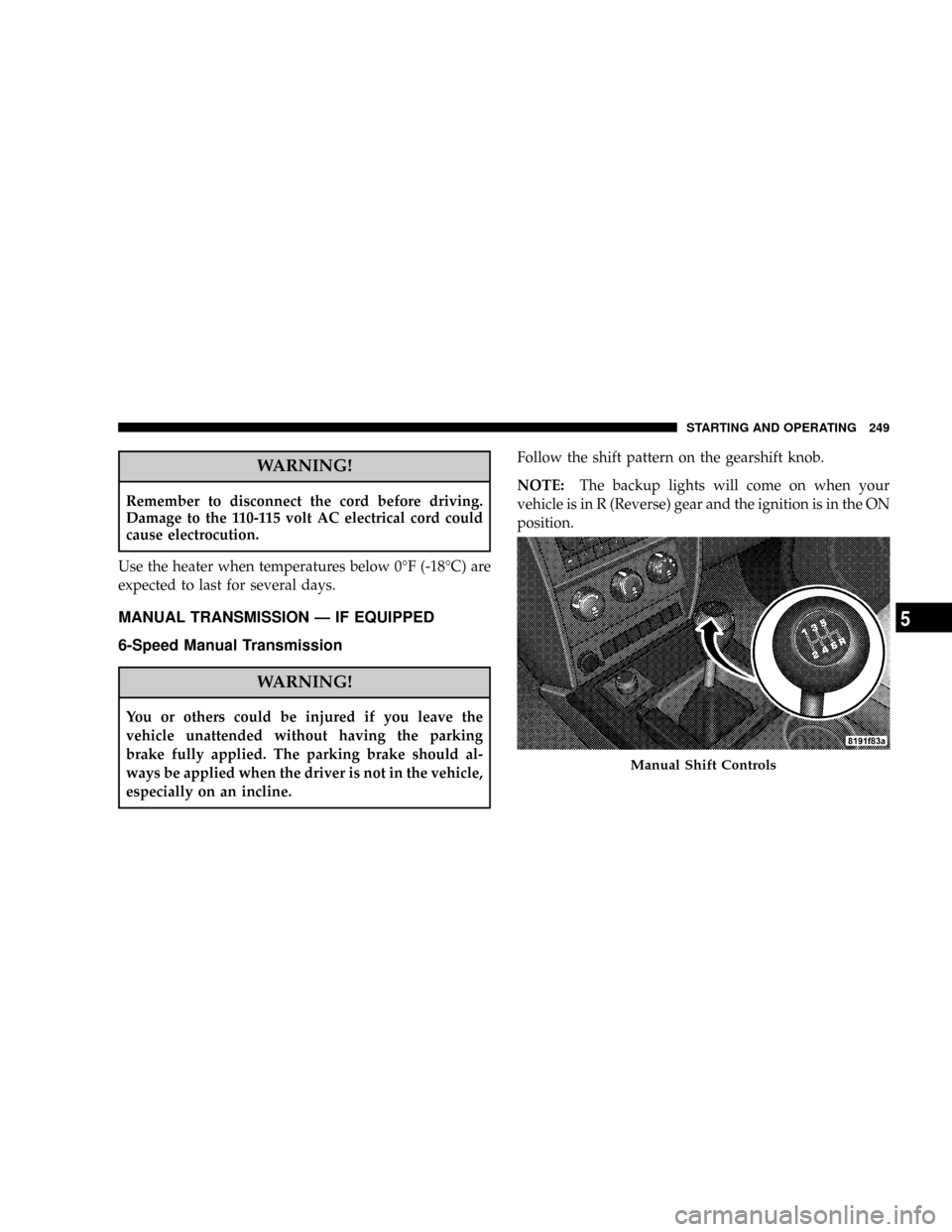
especially on an incline.Follow the shift pattern on the gearshift knob.
NOTE:The backup lights will come on when your
vehicle is in R (Reverse) gear and the ignition is in the ON
position.
Manual Shift Controls
STARTING AND OPERATING 249
5
Page 250 of 434
WARNING!
When parking your vehicle, always leave a manual
transmission in first gear and apply the parking
brake fully to guard against vehicle movement and
possible injury or damage. Never use any gear as a
substitute for the parking brake.
CAUTION!
To drive as safely as possible and to prolong the life
of your manual transmission, follow these tips:
²Before shifting from a forward gear into reverse, or
from reverse to a forward gear, stop vehicle com-
pletely. Otherwise, accelerated transmission wear may
result.
²Do not operate at sustained high engine or road
speeds in lower gears. Engine damage may result.
²Do not downshift into a low gear while traveling at too
high a speed for that gear. Engine, clutch, or transmis-
sion damage may result.
²Do not rest your foot on the clutch pedal. This causes
heat buildup and damages the clutch.
²When you slow down or go up a grade, downshift as
speed requires or the engine may overheat.
²Never hold the vehicle stopped on a hill by using the
clutch pedal. The clutch may be damaged.
²During cold weather, you may experience increased
effort in shifting until the transmission fluid warms
up. This is normal.
²Push in the clutch pedal completely when shifting.
Otherwise, transmission or clutch damage may result.
250 STARTING AND OPERATING
Page 251 of 434
²When ªrockingº a stuck vehicle by shifting between a
forward gear and reverse, do not spin wheels faster
than 15 mph (24 km/h), or drivetrain damage may
result.
Recommended Manual Transmission Shifting
Speeds
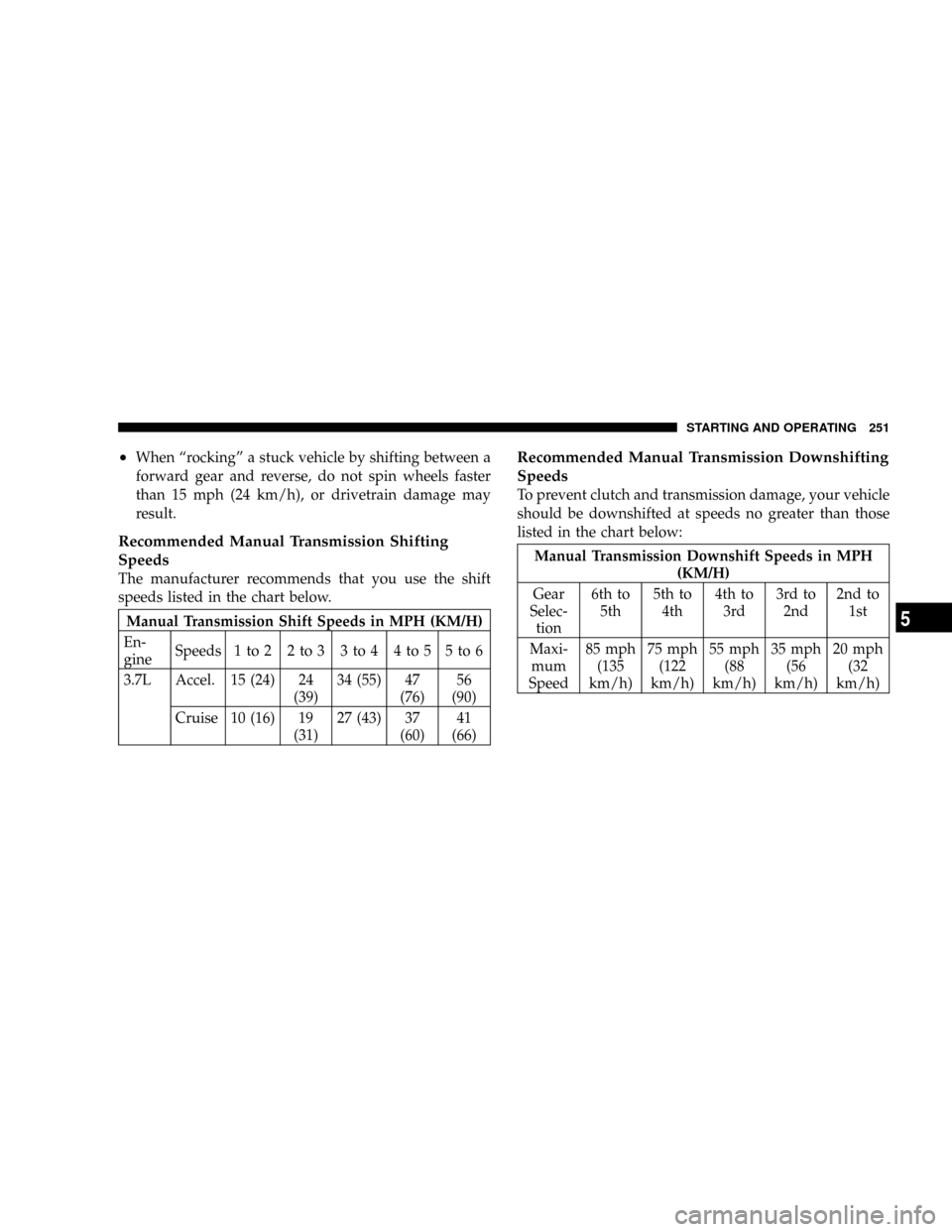
The manufacturer recommends that you use the shift
speeds listed in the chart below.
Manual Transmission Shift Speeds in MPH (KM/H)
En-
gineSpeeds 1 to 2 2 to 3 3 to 4 4 to 5 5 to 6
3.7L Accel. 15 (24) 24
(39)34 (55) 47
(76)56
(90)
Cruise 10 (16) 19
(31)27 (43) 37
(60)41
(66)
Recommended Manual Transmission Downshifting
Speeds
To prevent clutch and transmission damage, your vehicle
should be downshifted at speeds no greater than those
listed in the chart below:
Manual Transmission Downshift Speeds in MPH
(KM/H)
Gear
Selec-
tion6th to
5th5th to
4th4th to
3rd3rd to
2nd2nd to
1st
Maxi-
mum
Speed85 mph
(135
km/h)75 mph
(122
km/h)55 mph
(88
km/h)35 mph
(56
km/h)20 mph
(32
km/h)
STARTING AND OPERATING 251
5
Page 252 of 434

CAUTION!
Failure to follow the recommended downshifting
speeds may cause the engine to over speed and/or
damage the clutch disc even if the clutch pedal is
depressed.
AUTOMATIC TRANSMISSION
CAUTION!
Damage to the transmission may occur if the follow-
ing precautions are not observed:
²Shift into P (Park) only after the vehicle has come
to a complete stop.
²Shift into or out of R (Reverse) only after the
vehicle has come to a complete stop and the engine
is at idle speed.
²Do not shift from R (Reverse), P (Park), or N
(Neutral) into any forward gear when the engine is
above idle speed.
²Before shifting into any gear, make sure your foot
is firmly on the brake pedal.
252 STARTING AND OPERATING
Page 254 of 434

4. Using the screwdriver, reach into the manual override
opening. Press and hold the shift lock lever down.5. Move the shift lever into the N (Neutral) position.
6. The vehicle may then be started in N (Neutral).
Have your vehicle inspected by your local authorized
dealer, if the shift lock manual override has been used.
Brake/Transmission Interlock System
This system prevents you from moving the gear shift out
of P (Park) and into any gear unless the brake pedal is
pressed. Always depress thebrake pedal first,before
moving the gear selector out of P (Park).
254 STARTING AND OPERATING
Page 255 of 434

4±Speed Automatic Transmission (3.7L Engine)
Shifting from D (Drive) to P (Park) or R (Reverse) (or
from P or R to D) should be done only after the
accelerator pedal is released and the vehicle is stopped.
Be sure to keep your foot on the brake when moving the
shift lever between these gears.
Gear Ranges
DO NOT race the engine when shifting from P (Park) or
N (Neutral) position into another gear range.
P (Park)
This gear position supplements the parking brake by
locking the transmission. The engine can be started in
this range. Never use P (Park) while the vehicle is in
motion. Apply the parking brake when leaving the
vehicle in this range. Always apply parking brake first,
then place the selector in P (Park) position.
WARNING!
Never use P (Park) position as a substitute for the
parking brake. Always apply parking brake fully
when parked to guard against vehicle movement and
possible injury or damage.
Automatic Shift Controls
STARTING AND OPERATING 255
5
Page 256 of 434

WARNING!
It is dangerous to shift the selector lever out of P
(Park) or N (Neutral) if the engine speed is higher
than idle speed. If your foot is not firmly on the
brake pedal, the vehicle could accelerate quickly
forward or in reverse. You could lose control of the
vehicle and hit someone or something. Only shift
into gear when the engine is idling normally and
when your right foot is firmly on the brake pedal.
R (Reverse)
Use this range only after the vehicle has come to a
complete stop.N (Neutral)
Shift into N (Neutral) when the vehicle is standing for
prolonged periods with the engine running. The engine
may be started in this range. Set the parking brake if you
must leave the vehicle.
NOTE:Towing the vehicle, coasting, or driving for any
other reason with selector lever in N (Neutral) can result
in severe transmission damage. Refer to ªRecreational
Towingº in Section 5 and ªTowing a Disabled Vehicleº in
Section 6 of this manual.
D (Drive)
For most city and highway driving.
2 (Second)
For moderate grades and to assist braking on dry pave-
ment or in mud and snow. Begins at a stop in low gear
with automatic upshift to 2nd gear. Will not shift to 3rd.
256 STARTING AND OPERATING