transmission DODGE NITRO 2008 1.G Service Manual
[x] Cancel search | Manufacturer: DODGE, Model Year: 2008, Model line: NITRO, Model: DODGE NITRO 2008 1.GPages: 434, PDF Size: 6.2 MB
Page 270 of 434

Driving In Snow, Mud and Sand
In heavy snow, when pulling a load, or for additional
control at slower speeds, shift the transmission to a low
gear and shift the transfer case to 4L or 4LO if necessary.
Refer to ªFour-Wheel Drive Operationº in this section.
Do not shift to a lower gear than necessary to maintain
headway. Over-revving the engine can spin the wheels
and traction will be lost.
Avoid abrupt downshifts on icy or slippery roads, be-
cause engine braking may cause skidding and loss of
control.
Hill Climbing
NOTE:Before attempting to climb a hill, determine the
conditions at the crest and/or on the other side.
Before climbing a steep hill,shift the transmission to a
lower gear and shift the transfer case to 4L or 4LO. Use
first gear and 4L or 4LO for very steep hills.If you stall or begin to lose headwaywhile climbing a
steep hill, allow your vehicle to come to a stop and
immediately apply the brakes. Restart the engine and
shift to R (Reverse). Back slowly down the hill allowing
the compression braking of the engine to help regulate
your speed. If the brakes are required to control vehicle
speed, apply them lightly and avoid locking or skidding
the tires.
WARNING!
If the engine stalls or you lose headway or cannot
make it to the top of a steep hill or grade, never
attempt to turn around. To do so may result in
tipping and rolling the vehicle. Always back straight
down a hill in R (Reverse) gear carefull. Never back
down a hill in N (Neutral) using only the brake.
270 STARTING AND OPERATING
Page 271 of 434

Remember, never drive diagonally across a hill-always
drive straight up or down.
If the wheels start to slip as you approach the crest of a
hill, ease off the accelerator and maintain headway by
turning the front wheels slowly left and right. This may
provide a fresh ªbiteº into the surface and will usually
provide traction to complete the climb.
Traction Downhill
Shift the transmission into a low gear and the transfer
case to 4L or 4LO range. Let the vehicle go slowly down
the hill with all four wheels turning against engine
compression drag. This will permit you to control the
vehicle speed and direction.
When descending mountains or hills, repeated braking
can cause brake fade with loss of braking control. Avoid
repeated heavy braking by downshifting the transmis-
sion whenever possible.
After Driving Off-Road
Off-road operation puts more stress on your vehicle than
does most on-road driving. After going off-road, it is
always a good idea to check for damage. That way you
can get any problems taken care of right away and have
your vehicle ready when you need it.
²Completely inspect the underbody of your vehicle.
Check tires, body structure, steering, suspension, and
exhaust system for damage.
²Check threaded fasteners for looseness, particularly on
the chassis, drivetrain components, steering, and sus-
pension. Retighten them, if required, and torque to the
values specified in the Service Manual.
²Check for accumulations of plants or brush. These
things could be a fire hazard. They might hide damage
to fuel lines, brake hoses, axle pinion seals, and
propeller shafts.
STARTING AND OPERATING 271
5
Page 273 of 434

NOTE:The instrument cluster ªBrake Warning Lightº
indicates only that the parking brake is applied. You must
be sure the parking brake is fully applied before leaving
the vehicle.Be sure the parking brake is firmly set when parked, and
the gear selector lever is in the ªPº (Park) position
(automatic transmission) or ªRº (Reverse) or 1st gear
(manual transmission). When parking on a hill, you
should apply the parking brake before placing the gear
selector lever in ªPº (Park); otherwise, the load on the
transmission locking mechanism may make it difficult to
move the selector out of ªPº (Park).
Parking Brake
STARTING AND OPERATING 273
5
Page 274 of 434

WARNING!
²Always apply the parking brake fully when leav-
ing your vehicle or it may roll and cause damage or
injury. Also, be certain to leave an automatic
transmission in ªPº (Park) or a manual transmis-
sion in ªRº (Reverse) or 1st gear. Failure to do so
may allow the vehicle to roll and cause damage or
injury.
²Leaving children in a vehicle unattended is dan-
gerous for a number of reasons. A child or others
could be injured. Don't leave the keys in the
ignition. A child could operate power windows,
other controls, or move the vehicle.
²Be sure the parking brake is fully disengaged
before driving, failure to do so can lead to brake
problems due to excessive heating of the rear
brakes.When parking on a hill, turn the front wheels toward the
curb on a downhill grade and away from the curb on an
uphill grade.
The parking brake should always be applied whenever
the driver is not in the vehicle.
ANTI-LOCK BRAKE SYSTEM
The Anti-Lock Brake System (ABS) is designed to aid the
driver in maintaining vehicle control under adverse
braking conditions. The system operates with a separate
computer to modulate hydraulic pressure to prevent
wheel lock-up and help avoid skidding on slippery
surfaces.
All vehicle wheels and tires must be the same size and
type and tires must be properly inflated to produce
accurate signals for the computer.
274 STARTING AND OPERATING
Page 277 of 434

²Do not ªrideº the brakes by resting your foot on the
pedal. This could overheat the brakes and result in
unpredictable braking action, longer stopping dis-
tances, or brake damage.
²When descending mountains or hills, repeated brak-
ing can cause brake fade with loss of braking control.
Avoid repeated heavy braking by downshifting the
transmission or locking out overdrive whenever pos-
sible.
²Engines may idle at higher speeds during warm-up,
which could cause rear wheels to spin and result in
loss of vehicle control. Be especially careful while
driving on slippery roads, in close quarter maneuver-
ing, parking, or stopping.
²Do not drive too fast for road conditions, especially
when roads are wet or slushy. A wedge of water canbuild up between the tire tread and the road. This
hydroplaning action can cause loss of traction, braking
ability, and control.
²After going through deep water or a car wash, brakes
may become wet, resulting in decreased performance
and unpredictable braking action. Dry the brakes by
gentle, intermittent pedal action while driving at very
slow speeds.
POWER STEERING
The standard power steering system will give you good
vehicle response and increased ease of maneuverability
in tight spaces. The system will provide mechanical
steering capability if power assist is lost.
If for some reason the power assist is interrupted, it will
still be possible to steer your vehicle. Under these condi-
tions, you will observe a substantial increase in steering
effort, especially at very low vehicle speeds and during
parking maneuvers.
STARTING AND OPERATING 277
5
Page 320 of 434
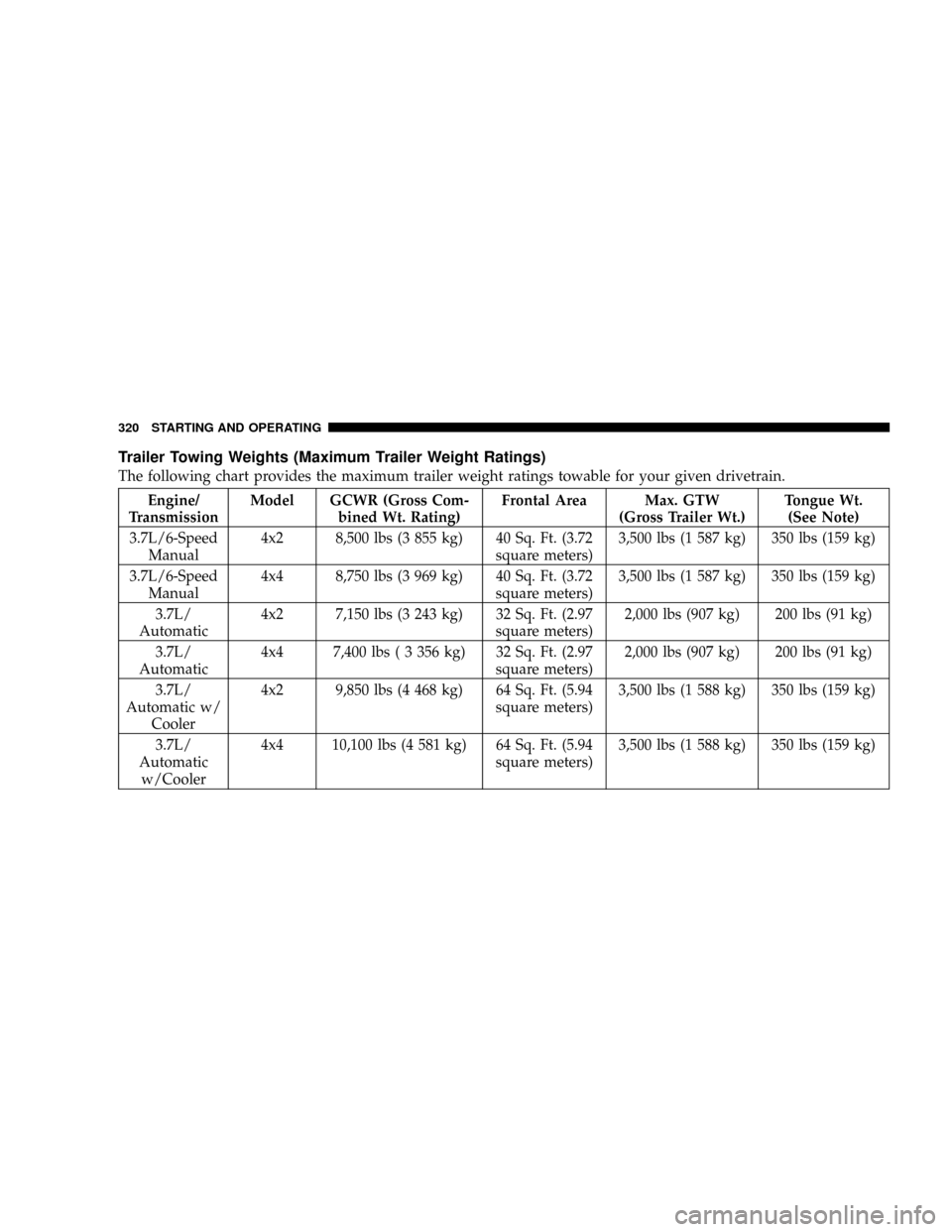
Trailer Towing Weights (Maximum Trailer Weight Ratings)
The following chart provides the maximum trailer weight ratings towable for your given drivetrain.
Engine/
TransmissionModel GCWR (Gross Com-
bined Wt. Rating)Frontal Area Max. GTW
(Gross Trailer Wt.)Tongue Wt.
(See Note)
3.7L/6-Speed
Manual4x2 8,500 lbs (3 855 kg) 40 Sq. Ft. (3.72
square meters)3,500 lbs (1 587 kg) 350 lbs (159 kg)
3.7L/6-Speed
Manual4x4 8,750 lbs (3 969 kg) 40 Sq. Ft. (3.72
square meters)3,500 lbs (1 587 kg) 350 lbs (159 kg)
3.7L/
Automatic4x2 7,150 lbs (3 243 kg) 32 Sq. Ft. (2.97
square meters)2,000 lbs (907 kg) 200 lbs (91 kg)
3.7L/
Automatic4x4 7,400 lbs ( 3 356 kg) 32 Sq. Ft. (2.97
square meters)2,000 lbs (907 kg) 200 lbs (91 kg)
3.7L/
Automatic w/
Cooler4x2 9,850 lbs (4 468 kg) 64 Sq. Ft. (5.94
square meters)3,500 lbs (1 588 kg) 350 lbs (159 kg)
3.7L/
Automatic
w/Cooler4x4 10,100 lbs (4 581 kg) 64 Sq. Ft. (5.94
square meters)3,500 lbs (1 588 kg) 350 lbs (159 kg)
320 STARTING AND OPERATING
Page 322 of 434

When Towing Trailers with Gross Trailer Weight (GTW) between 3,500 Lbs (1 588 kg) and 5,000 Lbs (2 268 kg)
The following chart provides maximum trailer weight ratings towable for the following engine/transmission
combinations,ONLYif using a weight distributing hitch.
Engine/
TransmissionModel GCWR (Gross Com-
bined Wt. Rating)Frontal Area Max. GTW
(Gross Trailer Wt.)Tongue Wt.
(See Note)
3.7L/
Automatic w/
Cooler4x2 9,850 lbs (4 468 kg) 64 Sq. Ft. (5.94
square meters)5,000 lbs (2 268 kg) 500 lbs (227 kg)
3.7L/
Automatic
w/Cooler4x4 10,100 lbs (4 581 kg) 64 Sq. Ft. (5.94
square meters)5,000 lbs (2 268 kg) 500 lbs (227 kg)
4.0L/
Automatic w/
Cooler4x2 9,850 lbs (4 468 kg) 64 Sq. Ft. (5.94
square meters)5,000 lbs (2 268 kg) 500 lbs (227 kg)
4.0L/
Automatic w/
Cooler4x4 10,100 lbs (4 581 kg) 64 Sq. Ft. (5.94
square meters)5,000 lbs (2 268 kg) 500 lbs (227 kg)
Refer to local laws for maximum trailer towing speeds.
322 STARTING AND OPERATING
Page 325 of 434

²When hauling cargo or towing a trailer, do not over-
load your vehicle or trailer. Overloading can cause a
loss of control, poor performance or damage to brakes,
axle, engine, transmission, steering, suspension, chas-
sis structure or tires.
²Safety chains must always be used between your
vehicle and trailer. Always connect the chains to the
frame or hook retainers of the vehicle hitch. Cross the
chains under the trailer tongue and allow enough
slack for turning corners.
²Vehicles with trailers should not be parked on a grade.
When parking, apply the parking brake on the tow
vehicle. Put the tow vehicle automatic transmission in
P (Park). With a manual transmission, shift the trans-
mission into R (Reverse). Always, block or9chock9the
trailer wheels.
²GCWR must not be exceeded.
²Total weight must be distributed between the tow
vehicle and the trailer such that the following four
ratings are not exceeded:
1. GVWR
2. GTW
3. GAWR
4. Tongue weight rating for the trailer hitch utilized
(This requirement may limit the ability to always
achieve the 10% to 15% range of tongue weight as a
percentage of total trailer weight).
Towing Requirements Ð Tires
þ
Do not attempt to tow a trailer while using a compact
spare tire.
þProper tire inflation pressures are essential to the safe
and satisfactory operation of your vehicle. Refer to the
Tires±General Information section of this manual on
Tire Pressures for proper tire inflation procedures.
STARTING AND OPERATING 325
5
Page 329 of 434

Towing Tips
Before setting out on a trip, practice turning, stopping
and backing the trailer in an area away from heavy
traffic.
If using a manual transmission vehicle for trailer towing,
all starts must be in FIRST gear to avoid excessive clutch
slippage.
Towing Tips Ð Automatic Transmission
The ªDº range can be selected when towing. However, if
frequent shifting occurs while in this range, the ª3º range
should be selected.
NOTE:Using the ª3º (3.7L engine) or ª4º (4.0L engine)
range while operating the vehicle under heavy operating
conditions will improve performance and extend trans-
mission life by reducing excessive shifting and heat build
up. This action will also provide better engine braking.The automatic transmission fluid and filter should be
changed if you REGULARLY tow a trailer for more than
45 minutes of continuous operation. See Schedule ªBº in
section 8 of this manual for transmission fluid change
intervals.
Towing Tips Ð TOW/HAUL (If Equipped)
To reduce potential for automatic transmission overheat-
ing, press the ªTOW HAULº button when driving in
hilly areas or shift the transmission to Drive position 2 on
more severe grades. Refer to ªTransmission Shiftingº in
this section.
Towing Tips Ð Electronic Speed Control (If
Equipped)
þ
Don't use in hilly terrain or with heavy loads.
þWhen using the speed control, if you experience speed
drops greater than 10 mph (16 km/h), disengage until
you can get back to cruising speed.
STARTING AND OPERATING 329
5
Page 330 of 434

þUse speed control in flat terrain and with light loads to
maximize fuel efficiency.
Towing Tips Ð Cooling System
To reduce potential for engine and transmission over-
heating, take the following actions:
þCity Driving
When stopped for short periods of time, put transmission
in neutral and increase engine idle speed.
þHighway Driving
Reduce speed.
þAir Conditioning
Turn off temporarily.
þrefer to Cooling System Operating information in the
Maintenance section of this manual for more informa-
tion.
RECREATIONAL TOWING (BEHIND
MOTORHOME, ETC.)
Towing ± 2WD Models
Recreational towing (all four wheels on the
ground)
Recreational towing is allowedONLYif the driveshaft is
removed. Towing with the rear wheels on the ground
while the driveshaft is connected can result in severe
transmission damage.
NOTE:This vehicle may be towed on a flatbed or
vehicle trailer provided all four wheels areOFFthe
ground.
330 STARTING AND OPERATING