transmission DODGE NITRO 2008 1.G Workshop Manual
[x] Cancel search | Manufacturer: DODGE, Model Year: 2008, Model line: NITRO, Model: DODGE NITRO 2008 1.GPages: 434, PDF Size: 6.2 MB
Page 331 of 434

Towing Ð 4WD or All-Wheel Drive Models
CAUTION!
Front or rear wheel lifts should not be used. Internal
damage to the transmission or transfer case will occur
if a front or rear wheel lift is used when recreational
towing.
Recreational towing (all four wheels on the
ground)
Recreational towing isNOTallowed. These models do
not have a N (Neutral) position in the transfer case.
NOTE:This vehicle may be towed on a flatbed or
vehicle trailer provided all four wheels areOFFthe
ground.
STARTING AND OPERATING 331
5
Page 335 of 434

IF YOUR ENGINE OVERHEATS
In any of the following situations, you can reduce the
potential for overheating by taking the appropriate ac-
tion.
²On the highways Ð Slow down.
²In city traffic Ð While stopped, put transmission in N
(Neutral), but do not increase engine idle speed.
NOTE:There are steps that you can take to slow down
an impending overheat condition. If your air conditioner
is on, turn it off. The air conditioning system adds heat to
the engine cooling system and turning off the A/C
removes this heat. You can also turn the Temperature
Control to maximum heat, the Mode Control to floor, and
the Fan Control to High. This allows the heater core to act
as a supplement to the radiator and aids in removing heat
from the engine cooling system.
CAUTION!
Driving with a hot cooling system could damage
your vehicle. If the temperature gauge reads ªH,º
pull over and stop the vehicle. Idle the vehicle with
the air conditioner turned off until the pointer drops
back into the normal range. If the pointer remains on
the ªH,º and you hear continuous chimes, turn the
engine off immediately, and call for service.
WHAT TO DO IN EMERGENCIES 335
6
Page 338 of 434
CAUTION!
The winch mechanism is designed for use with the
jack extension tube only. Use of an air wrench or
other power tools is not recommended and they can
damage the winch.
When the spare is clear, tilt the retainer at the end of the
cable, and pull it through the center of the wheel.
Preparations For Jacking
²
Park the vehicle on a firm level surface as far from the
edge of the roadway as possible. Avoid icy or slippery
areas.
²Set the parking brakeand place the gear selector in
PARK (automatic transmission) or REVERSE (manual
transmission).
²Turn the ignition to the LOCK position.
WARNING!
Do not attempt to change a tire on the side of the
vehicle close to moving traffic. Pull far enough off
the road to avoid being hit when operating the jack
or changing the wheel.
²Turn on the Hazard Warning Flasher.
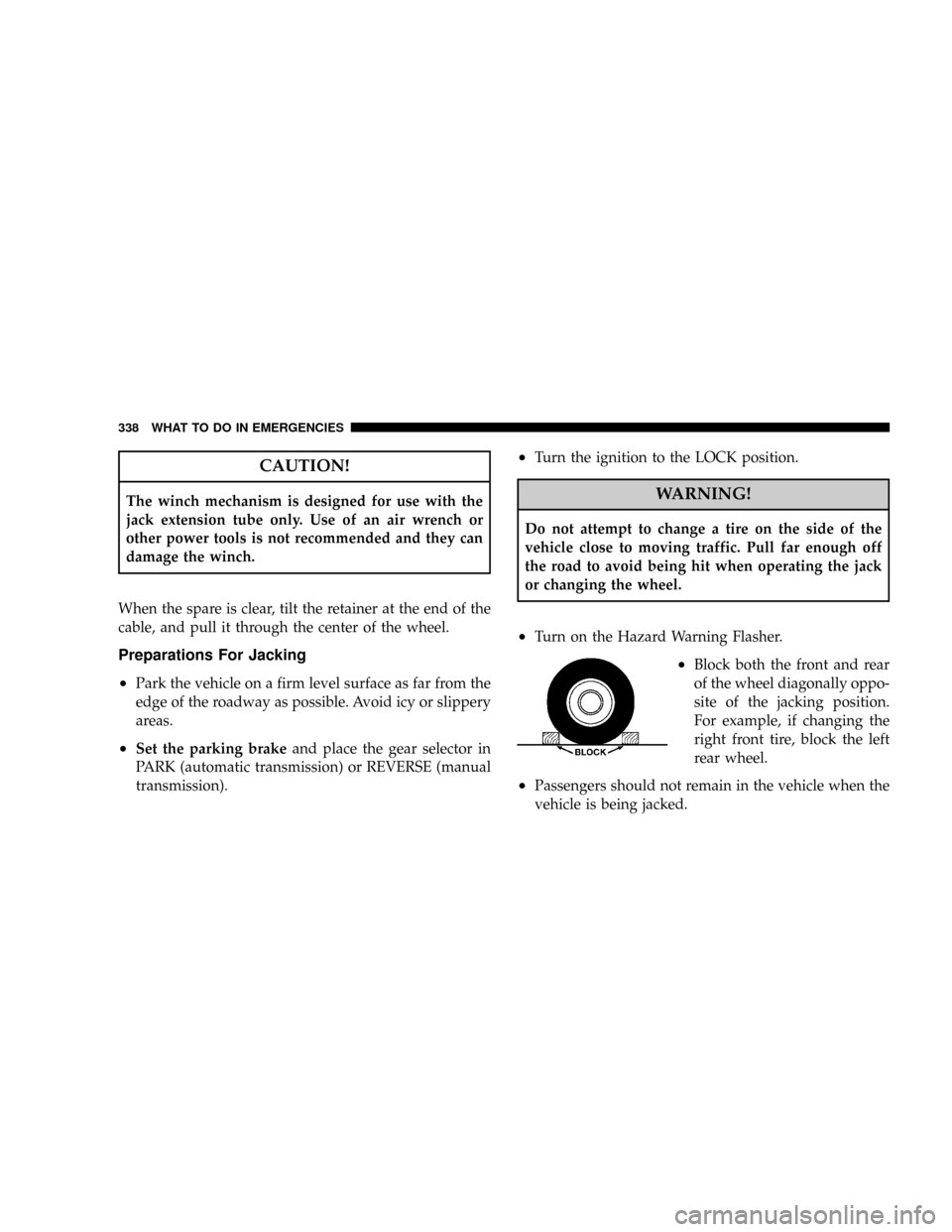
²Block both the front and rear
of the wheel diagonally oppo-
site of the jacking position.
For example, if changing the
right front tire, block the left
rear wheel.
²Passengers should not remain in the vehicle when the
vehicle is being jacked.
338 WHAT TO DO IN EMERGENCIES
Page 342 of 434

1. Wear eye protection and remove all metal jewelry such
as watch bands or bracelets which might make an
unintended electrical contact.
2. Park the booster vehicle within cable reach but with-
out letting the vehicles touch. Set the parking brake, place
the automatic transmission in PARK and turn the ignition
OFF on both vehicles.
3. Turn OFF heater, radio and all unnecessary electrical
loads.
4. Connect one end of a jumper cable to the positive
terminal of the booster battery. Connect the other end of
the same cable to the positive terminal of the discharged
battery.WARNING!
Do not permit vehicles to touch each other as this
could establish a ground connection and personal
injury could result.
5. Connect the other cable, first to the negative terminal
of the booster battery and then to the engine of the
vehicle with the discharged battery. Make sure you have
a good contact on the engine.
342 WHAT TO DO IN EMERGENCIES
Page 344 of 434

NOTE:Transmission must be in ªNº (Neutral) under
any towing configuration.
Two-Wheel Drive Vehicles
Front Wheels Raised
The speed mustnotexceed 30 mph (50 km/h) and the
distance mustnotexceed 15 miles (25 km).
This vehicle may be towed with the transmission in ªNº,
the ignition key in the LOCK position, the front wheels
raised, and the rear wheels on the ground.
NOTE:Towing the vehicle, with the rear wheels on the
ground, at more than 30 mph (50 km/h) or for more than
15 miles (25 km) can cause severe transmission damage.
If the vehicle is to be towed more than 15 miles (25 km )
or faster than 30 mph, it must be towed on a flatbed.
Rear Wheels Raised
The speed mustnotexceed 30 mph (50 km/h) and the
distance mustnotexceed 15 miles (25 km).
This vehicle may be towed with the transmission in ªNº,
the ignition key in the LOCK position, the rear wheels
raised, and the front wheels on the ground.
If the vehicle is to be towed more than 15 miles (25 km )
or faster than 30 mph, it must be towed on a flatbed.
Four-Wheel Drive Vehicles
The manufacturer recommends flatbed towing with all
wheelsOFFthe ground.
344 WHAT TO DO IN EMERGENCIES
Page 346 of 434

NPower Steering Fluid Check..............363
NDriveline And Steering Component
Lubrication..........................364
NBody Lubrication.....................364
NWindshield Wiper Blades................365
NWindshield Washers...................365
NExhaust System......................366
NCooling System.......................366
NHoses And Vacuum/Vapor Harnesses.......371
NBrake System........................372
NAutomatic Transmission................374
NHydraulic Clutch Fluid Ð Manual
Transmission........................375
NManual Transmission..................375NTransfer Case........................376
NFront/Rear Axle Fluid..................377
NAppearance Care And Protection From
Corrosion...........................377
mFuses (Integrated Power Module)...........381
mReplacement Light Bulbs.................389
mBulb Replacement......................389
NHead Light..........................389
NLeft Front Turn Signal..................390
NRight Front Turn Signal.................391
NFront Side Marker.....................391
NFront Fog Light (Front Fascia Mounted).....391
NRear Tail, Stop, Turn Signal, And Back-Up
Lights.............................392
346 MAINTAINING YOUR VEHICLE
Page 350 of 434

ONBOARD DIAGNOSTIC SYSTEM Ð OBD II
Your vehicle is equipped with a sophisticated onboard
diagnostic system called OBD II. This system monitors
the performance of the emissions, engine, and automatic
transmission control systems. When these systems are
operating properly, your vehicle will provide excellent
performance and fuel economy, as well as engine emis-
sions well within current government regulations.
If any of these systems require service, the OBD II system
will turn on the ªMalfunction Indicator Light.º It will
also store diagnostic codes and other information to
assist your service technician in making repairs. Al-
though your vehicle will usually be drivable and not
need towing, see your dealer for service as soon as
possible.CAUTION!
²Prolonged driving with the ªMalfunction Indica-
tor Lightº on could cause further damage to the
emission control system. It could also affect fuel
economy and driveability. The vehicle must be
serviced before any emissions tests can be per-
formed.
²If the ªMalfunction Indicator Lightº is flashing
while the engine is running, severe catalytic con-
verter damage and power loss will soon occur.
Immediate service is required.
350 MAINTAINING YOUR VEHICLE
Page 360 of 434

WARNING!
A hot exhaust system can start a fire if you park over
materials that can burn. Such materials might be
grass or leaves coming into contact with your exhaust
system. Do not park or operate your vehicle in areas
where your exhaust system can contact anything that
can burn.
In unusual situations involving grossly malfunctioning
engine operation, a scorching odor may suggest severe
and abnormal catalyst overheating. If this occurs, stop
the vehicle, turn off the engine and allow it to cool.
Service, including a tune up to manufacturer's specifica-
tions, should be obtained immediately.
To minimize the possibility of catalytic converter dam-
age:
²Do not shut off the engine or interrupt the ignition
when the transmission is in gear and the vehicle is in
motion.
²Do not try to start the engine by pushing or towing the
vehicle.
²Do not idle the engine with any spark plug wires
disconnected or removed, such as when diagnostic
testing.
²Do not idle the engine for prolonged periods during
very rough idle or malfunctioning operating condi-
tions.
²Do not allow vehicle to run out of fuel.
NOTE:Intentional tampering with emissions control
systems can result in civil penalties being assessed
against you.
360 MAINTAINING YOUR VEHICLE
Page 374 of 434

Use only brake fluid that has been in a tightly closed
container to avoid contamination from foreign matter. Do
not allow petroleum base fluid to contaminate the brake
fluid as seal damage will result.
Automatic Transmission
Selection of Lubricant
It is important that the proper lubricant is used in the
transmission to assure optimum transmission perfor-
mance. Use only manufacturer's recommended transmis-
sion fluid, refer to Fluids, Lubricants, and Genuine Parts
for correct fluid type. It is important that the transmission
fluid be maintained at the prescribed level using the
recommended fluid.
CAUTION!
Using a transmission fluid other than the manufac-
turer's recommended fluid may cause deterioration
in transmission shift quality and/or torque converter
shudder. Using a transmission fluid other than the
manufacturer's recommended fluid will result in
more frequent fluid and filter changes. Refer to
Fluids, Lubricants, and Genuine Parts for correct
fluid type.
Fluid Level Check Ð 42RLE (3.7L Engine)
Your vehicle is equipped with a capped dipstick tube, it
is sealed and should not be tampered with. Your autho-
rized dealer has the proper tools to ensure that the fluid
level is set properly.
374 MAINTAINING YOUR VEHICLE
Page 375 of 434

Fluid Level Check Ð W5A580 (4.0L Engine)
Your vehicle is equipped with a capped dipstick tube, it
is sealed and should not be tampered with. Your autho-
rized dealer has the proper tools to ensure that the fluid
level is set properly.
Special Additives
The manufacturer strongly recommends against the ad-
dition of any additives to the transmission. The only
exception to this policy is the use of special dyes to aid in
detecting fluid leaks. The use of transmission sealers
should be avoided as they may adversely affect seals.
Hydraulic Clutch Fluid Ð Manual Transmission
The clutch hydraulic system is fed by a segregated
volume of fluid within the brake system master cylinder
reservoir. In the event of leakage or wear, use only
manufacturer's recommended brake fluid, refer to Fluids,
Lubricants, and Genuine Parts for correct fluid type.
Manual Transmission
Selection of Lubricant
Use only manufacturer's recommended manual trans-
mission fluid, refer to Fluids, Lubricants, and Genuine
Parts for correct fluid type.
Fluid Level Check
Check the fluid level by removing the fill plug. The fluid
level should be between the bottom of the fill hole and a
point not more than 3/16º (4.76 mm) below the bottom of
the hole.
Add fluid, if necessary, to maintain the proper level.
Frequency of Fluid Change
Under normal operating conditions, the fluid installed at
the factory will give satisfactory lubrication for the life of
the vehicle. Fluid changes are not necessary unless the
lubricant has become contaminated with water. If con-
taminated with water, the fluid should be changed im-
mediately.
MAINTAINING YOUR VEHICLE 375
7