cooling DODGE POWER WAGON 2007 2.G User Guide
[x] Cancel search | Manufacturer: DODGE, Model Year: 2007, Model line: POWER WAGON, Model: DODGE POWER WAGON 2007 2.GPages: 492, PDF Size: 8.25 MB
Page 405 of 492
accumulation of bugs, leaves, etc. If dirty, clean by gently
spraying water from a garden hose vertically down the
face of the condenser.
Check the coolant recovery bottle tubing for brittle rub-
ber, cracking, tears, cuts and tightness of the connection
at the bottle and radiator. Inspect the entire system for
leaks.
With the engine at normal operating temperature (but
not running), check the cooling system pressure cap for
proper vacuum sealing by draining a small amount of
coolant from the radiator drain cock. If the cap is sealing
properly, the engine coolant (antifreeze) will begin to
drain from the coolant recovery bottle. DO NOT RE-
MOVE THE COOLANT PRESSURE CAP WHEN THE
COOLING SYSTEM IS HOT.Cooling System Ð Drain, Flush and Refill
At the intervals shown on the Maintenance Schedules,
the system should be drained, flushed and refilled.
If the solution is dirty or contains a considerable amount
of sediment, clean and flush with a reliable cooling
system cleaner. Follow with a thorough rinsing to remove
all deposits and chemicals. Properly dispose of old
antifreeze solution.
Selection Of Coolant
Use only the manufacturers recommended coolant, refer
to Fluids, Lubricants and Genuine Parts for correct
coolant type.
404 MAINTAINING YOUR VEHICLE
Page 406 of 492
CAUTION!
Mixing of coolants other than specified HOAT en-
gine coolants, may result in engine damage and may
decrease corrosion protection. If a non-HOAT cool-
ant is introduced into the cooling system in an
emergency, it should be replaced with the specified
coolant as soon as possible.
Do not use plain water alone or alcohol base engine
coolant (antifreeze) products. Do not use additional
rust inhibitors or antirust products, as they may not
be compatible with the radiator engine coolant and
may plug the radiator.
This vehicle has not been designed for use with
Propylene Glycol based coolants. Use of Propylene
Glycol based coolants is not recommended.
Adding Coolant
Your vehicle has been built with an improved engine
coolant that allows extended maintenance intervals. This
coolant can be used up to 5 Years or 100,000 miles before
replacement. To prevent reducing this extended mainte-
nance period, it is important that you use the same
coolant throughout the life of your vehicle. Please review
these recommendations for using Hybrid Organic Addi-
tive Technology (HOAT) coolant.
When adding coolant, a minimum solution of 50% rec-
ommended Mopar Antifreeze/ Coolant 5 Year/100,000
Mile Formula HOAT (Hybrid Organic Additive Technol-
ogy), or equivalent, in water should be used. Use higher
concentrations (not to exceed 70%) if temperatures below
234ÉF (237ÉC ) are anticipated.
Use only high purity water such as distilled or deionized
water when mixing the water/engine coolant solution.
MAINTAINING YOUR VEHICLE 405
7
Page 407 of 492
The use of lower quality water will reduce the amount of
corrosion protection in the engine cooling system.
Please note that it is the owner's responsibility to main-
tain the proper level of protection against freezing ac-
cording to the temperatures occurring in the area where
the vehicle is operated.
NOTE:Mixing coolant types will decrease the life of the
engine coolant and will require more frequent coolant
changes.
Cooling System Pressure Cap
The cap must be fully tightened to prevent loss of
coolant, and to insure that coolant will return to the
radiator from the coolant recovery bottle.
The cap should be inspected and cleaned if there is any
accumulation of foreign material on the sealing surfaces.
WARNING!
²The warning words ªDO NOT OPEN HOTº on
the cooling system pressure cap are a safety pre-
caution. Never add coolant when the engine is
overheated. Do not loosen or remove the cap to
cool an overheated engine. Heat causes pressure
to build up in the cooling system. To prevent
scalding or injury, do not remove the pressure cap
while the system is hot or under pressure.
²Do not use a pressure cap other than the one
specified for your vehicle. Personal injury or
engine damage may result.
Disposal of Used Engine Coolant
Used ethylene glycol based engine coolant is a regulated
substance requiring proper disposal. Check with your
local authorities to determine the disposal rules for your
community. To prevent ingestion by animals or children
406 MAINTAINING YOUR VEHICLE
Page 409 of 492
²Check coolant freeze point in the radiator and in the
coolant recovery bottle. If antifreeze needs to be
added, contents of coolant recovery bottle must also be
protected against freezing.
²If frequent coolant additions are required, or if the
level in the coolant recovery bottle does not drop when
the engine cools, the cooling system should be pres-
sure tested for leaks.
²Maintain coolant concentration at 50% HOAT engine
coolant (minimum) and distilled water for proper
corrosion protection of your engine which contains
aluminum components.
²Make sure that the radiator and coolant recovery
bottle overflow hoses are not kinked or obstructed.
²Keep the front of the radiator clean. If your vehicle is
equipped with air conditioning, keep the front of the
condenser clean, also.
²Do not change the thermostat for summer or winter
operation. If replacement is ever necessary, install
ONLY the correct type thermostat. Other designs may
result in unsatisfactory coolant performance, poor gas
mileage, and increased emissions.
Hoses And Vacuum/Vapor Harnesses
Inspect surfaces of hoses and nylon tubing for evidence
of heat and mechanical damage. Hard or soft spots,
brittle rubber, cracking, tears, cuts, abrasions, and exces-
sive swelling indicate deterioration of the rubber.
Pay particular attention to those hoses nearest to high
heat sources such as the exhaust manifold. Inspect hose
routing to be sure hoses do not come in contact with any
heat source or moving component which may cause heat
damage or mechanical wear.
Insure nylon tubing in these areas has not melted or
collapsed.
408 MAINTAINING YOUR VEHICLE
Page 419 of 492
Tampering with Noise Control System Prohibited
Federal law prohibits the following acts or the causing
thereof: (1) the removal or rendering inoperative by any
person, other than for purposes of maintenance, repair, or
replacement, of any device or element of design incorpo-
rated into any new vehicle for the purpose of noise
control prior to its sale or delivery to the ultimate
purchaser or while it is in use, or (2) the use of the vehicle
after such device or element of design has been removed
or rendered inoperative by any person.
Among those acts presumed to constitute tampering are
the acts listed below.
AIR CLEANER
²Removal of the air cleaner.
²Inverting the air cleaner lid.
²Removal of the air ducting.EXHAUST SYSTEM
²Removal or rendering inoperative exhaust system
components including the muffler or tailpipe.
ENGINE COOLING SYSTEM
²Removal or rendering inoperative the fan clutch.
²Removal of the fan shroud.
Noise Emission Warranty
The manufacturer warrants that this vehicle as manufac-
tured by the manufacturer, was designed, built and
equipped to conform at the time it left the manufacturers
control with all applicable U.S. EPA Noise Control Regu-
lations.
This warranty covers this vehicle as designed, built and
equipped by the manufacturer, and is not limited to any
particular part, component or system of the vehicle
manufactured by the manufacturer. Defects in design,
418 MAINTAINING YOUR VEHICLE
Page 442 of 492
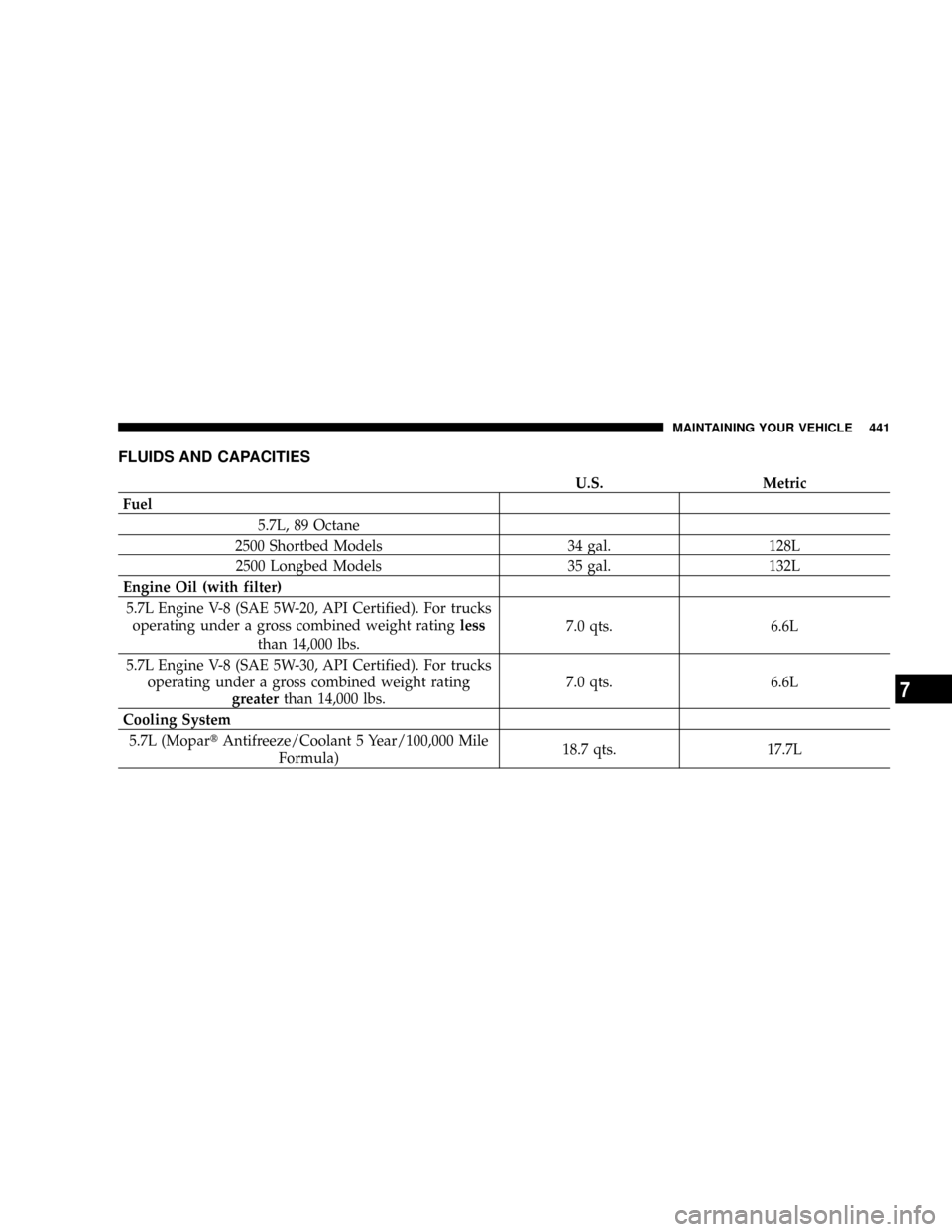
FLUIDS AND CAPACITIES
U.S. Metric
Fuel
5.7L, 89 Octane
2500 Shortbed Models 34 gal. 128L
2500 Longbed Models 35 gal. 132L
Engine Oil (with filter)
5.7L Engine V-8 (SAE 5W-20, API Certified). For trucks
operating under a gross combined weight ratingless
than 14,000 lbs.7.0 qts. 6.6L
5.7L Engine V-8 (SAE 5W-30, API Certified). For trucks
operating under a gross combined weight rating
greaterthan 14,000 lbs.7.0 qts. 6.6L
Cooling System
5.7L (MopartAntifreeze/Coolant 5 Year/100,000 Mile
Formula)18.7 qts. 17.7L
MAINTAINING YOUR VEHICLE 441
7
Page 477 of 492
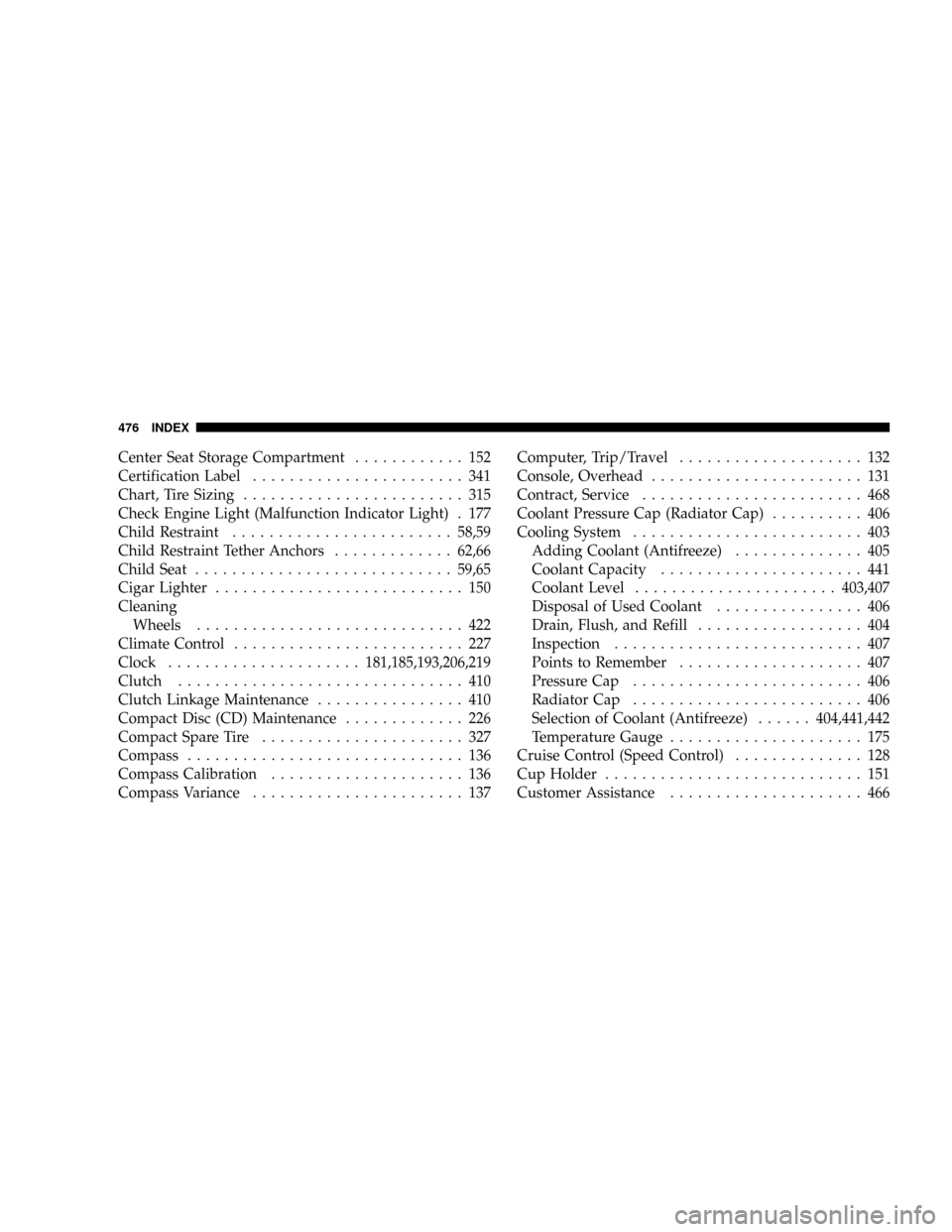
Center Seat Storage Compartment............ 152
Certification Label....................... 341
Chart, Tire Sizing........................ 315
Check Engine Light (Malfunction Indicator Light) . 177
Child Restraint........................58,59
Child Restraint Tether Anchors.............62,66
Child Seat............................59,65
Cigar Lighter........................... 150
Cleaning
Wheels............................. 422
Climate Control......................... 227
Clock.....................181,185,193,206,219
Clutch............................... 410
Clutch Linkage Maintenance................ 410
Compact Disc (CD) Maintenance............. 226
Compact Spare Tire...................... 327
Compass.............................. 136
Compass Calibration..................... 136
Compass Variance....................... 137Computer, Trip/Travel.................... 132
Console, Overhead....................... 131
Contract, Service........................ 468
Coolant Pressure Cap (Radiator Cap).......... 406
Cooling System......................... 403
Adding Coolant (Antifreeze).............. 405
Coolant Capacity...................... 441
Coolant Level......................403,407
Disposal of Used Coolant................ 406
Drain, Flush, and Refill.................. 404
Inspection........................... 407
Points to Remember.................... 407
Pressure Cap......................... 406
Radiator Cap......................... 406
Selection of Coolant (Antifreeze)......404,441,442
Temperature Gauge..................... 175
Cruise Control (Speed Control).............. 128
Cup Holder............................ 151
Customer Assistance..................... 466
476 INDEX
Page 489 of 492
Air Pressure.......................... 322
Alignment........................... 331
Chains.............................. 332
Changing............................ 368
Compact Spare........................ 327
General Information.................... 322
High Speed.......................... 325
Inflation Pressures..................... 323
Jacking............................. 369
Life of Tires.......................... 330
Load Capacity.....................318,319
Off-Road............................. 80
Quality Grading....................... 471
Radial.............................. 326
Replacement......................... 330
Rotation............................. 334
Safety...........................313,322
Sizes............................... 315
Snow Tires........................... 333Spare Tire........................... 368
Spinning............................ 328
Tread Wear Indicators................... 329
Wheel Mounting....................... 369
Wheel Nut Torque..................... 372
Tongue Weight/Trailer Weight.............. 350
Torque Converter Clutch.................. 255
Tow Hooks, Emergency................... 379
Towing............................... 345
Disabled Vehicle....................... 380
Guide.............................. 350
Recreational.......................... 360
Weight.............................. 350
Traction.............................. 263
Trailer Towing.......................... 345
Cooling System Tips.................... 357
Hitches............................. 349
Minimum Requirements................. 351
Mirrors...........................86,358
488 INDEX