lock DODGE POWER WAGON 2007 2.G Owner's Manual
[x] Cancel search | Manufacturer: DODGE, Model Year: 2007, Model line: POWER WAGON, Model: DODGE POWER WAGON 2007 2.GPages: 492, PDF Size: 8.25 MB
Page 42 of 492
WARNING!
If the black latch and buckle are not connected when
the seat belt is used by an occupant, the seat belt will
not restrain you properly.
Adjustable Upper Shoulder Belt Anchorage
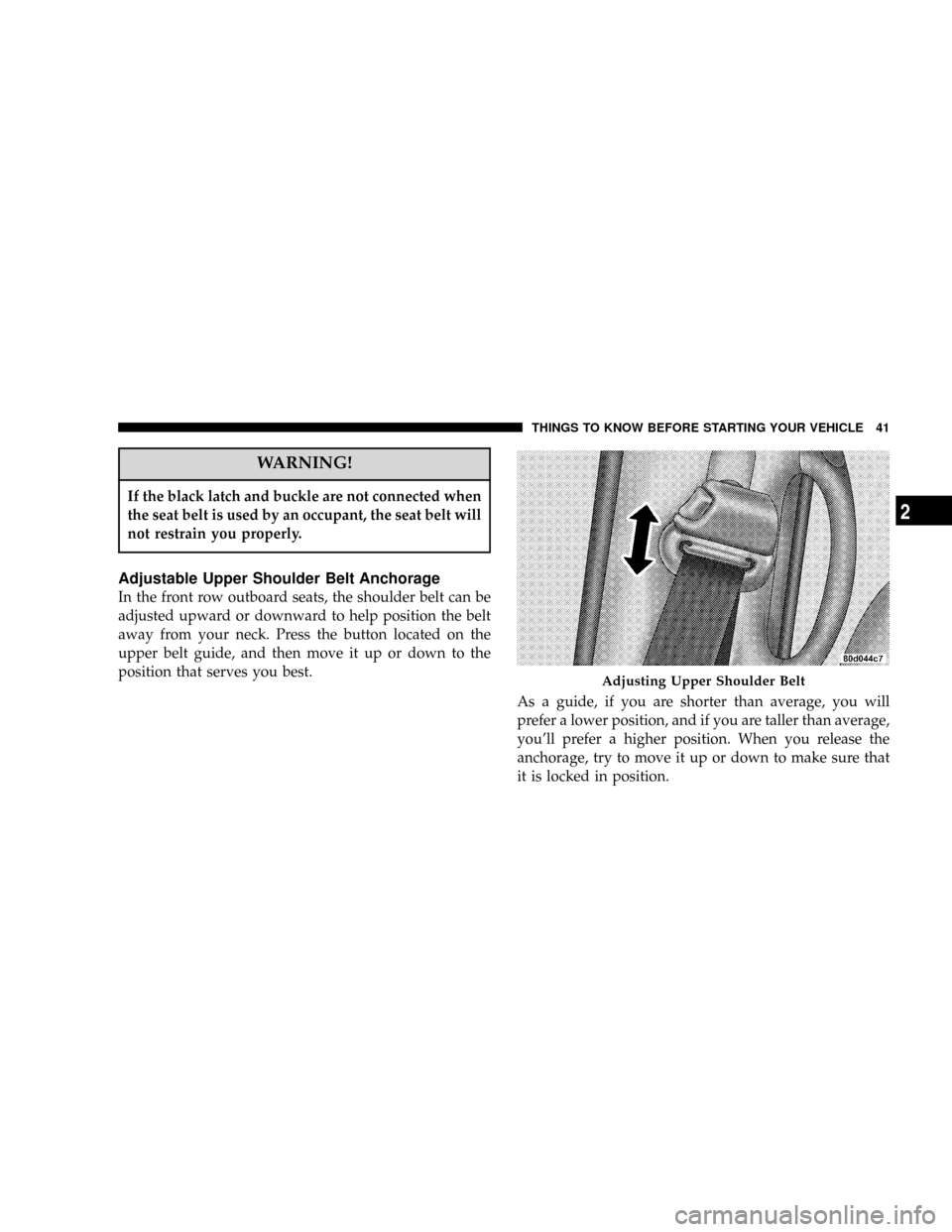
In the front row outboard seats, the shoulder belt can be
adjusted upward or downward to help position the belt
away from your neck. Press the button located on the
upper belt guide, and then move it up or down to the
position that serves you best.
As a guide, if you are shorter than average, you will
prefer a lower position, and if you are taller than average,
you'll prefer a higher position. When you release the
anchorage, try to move it up or down to make sure that
it is locked in position.
Adjusting Upper Shoulder Belt
THINGS TO KNOW BEFORE STARTING YOUR VEHICLE 41
2
Page 43 of 492
Automatic Locking Restraint (ALR) Mode ± If
Equipped
In this mode, the shoulder belt is automatically pre-
locked. The belt will still retract to remove any slack in
the shoulder belt. The automatic locking mode is avail-
able on all passenger seating positions with a combina-
tion lap/shoulder belt.
When To Use The Automatic Locking Mode
Anytime a child safety seat is installed in a passenger
seating position. Children 12 years old and under should
be properly restrained in the rear seat whenever possible.
How To Use The Automatic Locking Mode
1. Buckle the combination lap/shoulder belt.
2. Grasp the shoulder portion and pull downward until
the entire belt is extracted.3. Allow the belt to retract. As the belt retracts, you will
hear a clicking sound. This indicates the safety belt is
now in the automatic locking mode.
How To Disengage The Automatic Locking Mode
Disconnect the combination lap/shoulder belt and allow
it to retract completely to disengage the automatic lock-
ing mode and activate the vehicle sensitive (emergency)
locking mode.
Center Lap Belts
The center seating position for the Quad Cab front seat
has a lap belt only. To fasten the lap belt, slide the latch
plate into the buckle until you hear a9click.9To lengthen
the lap belt, tilt the latch plate and pull. To remove slack,
pull the loose end of the webbing. Wear the lap belt snug
against the hips. Sit back and erect in the seat, then adjust
the belt as tightly as is comfortable.
42 THINGS TO KNOW BEFORE STARTING YOUR VEHICLE
Page 47 of 492
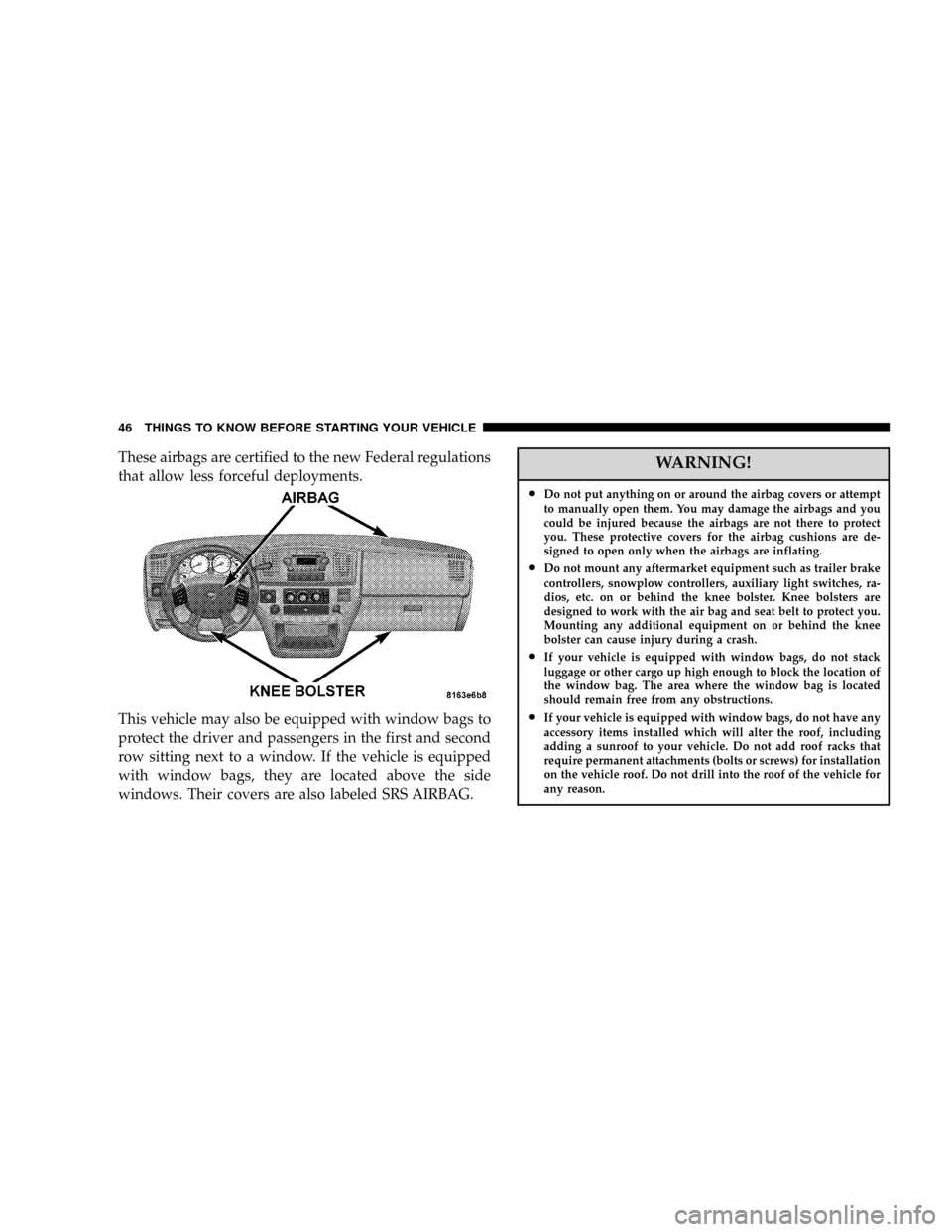
These airbags are certified to the new Federal regulations
that allow less forceful deployments.
This vehicle may also be equipped with window bags to
protect the driver and passengers in the first and second
row sitting next to a window. If the vehicle is equipped
with window bags, they are located above the side
windows. Their covers are also labeled SRS AIRBAG.WARNING!
²Do not put anything on or around the airbag covers or attempt
to manually open them. You may damage the airbags and you
could be injured because the airbags are not there to protect
you. These protective covers for the airbag cushions are de-
signed to open only when the airbags are inflating.
²Do not mount any aftermarket equipment such as trailer brake
controllers, snowplow controllers, auxiliary light switches, ra-
dios, etc. on or behind the knee bolster. Knee bolsters are
designed to work with the air bag and seat belt to protect you.
Mounting any additional equipment on or behind the knee
bolster can cause injury during a crash.
²If your vehicle is equipped with window bags, do not stack
luggage or other cargo up high enough to block the location of
the window bag. The area where the window bag is located
should remain free from any obstructions.
²If your vehicle is equipped with window bags, do not have any
accessory items installed which will alter the roof, including
adding a sunroof to your vehicle. Do not add roof racks that
require permanent attachments (bolts or screws) for installation
on the vehicle roof. Do not drill into the roof of the vehicle for
any reason.
46 THINGS TO KNOW BEFORE STARTING YOUR VEHICLE
Page 53 of 492
because the infant has a medical condition which
makes it necessary for the driver to be able to see the
infant,
²is a child, age 1 to 12 who must ride in the front seat
because there is no rear seat, because there is no rear
seat position available, or because the child has a
medical condition which makes it necessary for the
driver to be able to see the child,
²has a medical condition which makes passenger airbag
inflation (deployment) a greater risk for the passenger
than the risk of hitting the dashboard (instrument
panel) or windshield in a crash.
WARNING!
Whenever an airbag is turned off, even a lap/
shoulder belted passenger may hit their head, neck,
or chest on the dashboard (instrument panel) or
windshield in a crash. This may result in serious
injury or death.
To Shut Off the Passenger Airbag (Standard Cab Ve-
hicles Only)
Place the ignition key in the Passenger Airbag On/Off
Switch, push the key in and turn clockwise, and remove
the key from the switch. This will shut off the passenger
side airbag. The ªOffº light near the switch will illumi-
nate when the ignition switch is turned to the ON
position.
52 THINGS TO KNOW BEFORE STARTING YOUR VEHICLE
Page 54 of 492
To Turn On the Passenger Airbag (Standard Cab Ve-
hicles Only)
Place the ignition key in the Passenger Airbag On/Off
Switch, push the key in and turn counterclockwise, and
remove the key from the switch. This will turn on the
passenger airbag. The ªOffº light near the switch will be
off when the ignition switch is turned to the ON position.
If A Deployment Occurs
The airbag system is designed to deploy when the air bag
control module detects a moderate-to-severe frontal col-
lision, and then immediately to deflate.
NOTE:A frontal collision that is not severe enough to
need airbag protection will not activate the system. This
does not mean something is wrong with the airbag
system.If you do have a collision which deploys the airbags, any
or all of the following may occur:
²The nylon airbag material may sometimes cause abra-
sions and/or skin reddening to the driver and front
passenger as the airbags deploy and unfold. The
abrasions are similar to friction rope burns or those
you might get sliding along a carpet or gymnasium
floor. They are not caused by contact with chemicals.
They are not permanent and normally heal quickly.
However, if you haven't healed significantly within a
few days, or if you have any blistering, see your doctor
immediately.
²As the airbags deflate you may see some smoke-like
particles. The particles are a normal by-product of the
process that generates the nontoxic gas used for airbag
inflation. These airborne particles may irritate the skin,
eyes, nose, or throat. If you have skin or eye irritation,
rinse the area with cool water. For nose or throat
THINGS TO KNOW BEFORE STARTING YOUR VEHICLE 53
2
Page 56 of 492
bags to inflate, it signals the inflators on the crash side of
the vehicle. A quantity of nontoxic gas is generated to
inflate the window bag. The inflating window bag
pushes the side pillar molding out of the way and covers
the window. The airbag inflates in about 30 milliseconds
(about one-quarter of the time it takes to blink your eyes)
with enough force to injure you if you are not belted and
seated properly, or if items are positioned in the area
where the window bag inflates. This especially applies to
children. The window bag is only about 3
1¤2inches (8.9
cm) thick when it is inflated.
Enhanced Accident Response System
If the airbags deploy after an impact and the electrical
system remains functional, vehicles equipped with
power door locks will unlock automatically. In addition,
approximately 10 seconds after the vehicle has stopped
moving, the interior lights will light until the ignition
switch is turned off.
Maintaining Your Airbag Systems
WARNING!
²Modifications to any part of the airbag system
could cause it to fail when you need it. You could
be injured because the airbags are not there to
protect you. Do not modify the components or
wiring, including adding any kind of badges or
stickers to the steering wheel hub trim cover or
the upper right side of the instrument panel. Do
not modify the front bumper, vehicle body struc-
ture, or frame.
²You need proper knee impact protection in a
collision. Do not mount or locate any aftermarket
equipment on or behind the knee bolster.
²It is dangerous to try to repair any part of the
airbag system yourself. Be sure to tell anyone who
works on your vehicle that it has airbags.
THINGS TO KNOW BEFORE STARTING YOUR VEHICLE 55
2
Page 62 of 492
Here are some tips for getting the most out of your child
restraint:
²Before buying any restraint system, make sure that it
has a label certifying that it meets all applicable Safety
Standards. We also recommend that you make sure
that you can install the child restraint in the vehicle
where you will use it before you buy it.
²The restraint must be appropriate for your child's
weight and height. Check the label on the restraint for
weight and height limits.
²Carefully follow the instructions that come with the
restraint. If you install the restraint improperly, it may
not work when you need it.
²The passenger seat belts are equipped with Automatic
Locking Retractors (ALR), which are designed to keep
the lap portion tight around the child restraint so that
it is not necessary to use a locking clip.Pull the belt from the retractor until there is enough to
allow you to pass through the child restraint and slide
the latch plate into the buckle. Then pull on the belt
until it is all removed from the retractor. Allow the belt
to return to the retractor, pulling on the excess web-
bing to tighten the lap portion about the child re-
straint. Refer to the9Automatic Locking Retractors
(ALR) Mode9earlier in this section.
²In the rear seat, you may have trouble tightening the
lap/shoulder belt on the child restraint because the
buckle or latch plate is too close to the belt path
opening on the restraint. Disconnect the latch plate
from the buckle and twist the short buckle-end belt
several times to shorten it. Insert the latch plate into
the buckle with the release button facing out.
²If the belt still can't be tightened, or if pulling and
pushing on the restraint loosens the belt, disconnect
the latch plate from the buckle, turn the latch plate
THINGS TO KNOW BEFORE STARTING YOUR VEHICLE 61
2
Page 74 of 492
UNDERSTANDING THE FEATURES OF YOUR VEHICLE
CONTENTS
mPower Wagon Features....................78
NLocking Front And Rear Differentials........78
N4.56:1 Gears..........................78
NElectronically Disconnecting Stabilizer/
Sway Bar............................79
NIncreased Ride Height...................79
N12,000 Lb. Winch.......................79
NHigh-Pressure Monotube Shocks/New Front And
Rear Springs..........................80
NOff-Road Tires........................80NSkid Plates And Underbody Protection.......80
NWheel Flares..........................80
NWheels..............................81
NStandard Package Features................81
NMopar Options........................82
mMirrors...............................83
NInside Mirror.........................83
NAutomatic Dimming Mirror ± If Equipped....84
NOutside Mirrors.......................84
3
Page 78 of 492
mElectrical Power Outlets..................148
mCigar Lighter And Ash Receiver............150
mCupholders...........................151
NFront Instrument Panel Cupholders........151
NRear Cupholder Ð Quad Cab Ð If Equipped . 151
mStorage..............................152
NCenter Storage Compartment Ð If Equipped . . 152
NStorage And Seats Ð If Equipped..........153
mRear Window Features...................154
NElectric Rear Window Defroster And Heated
Side View Mirrors Ð If Equipped..........154
NPower Sliding Rear WindowÐIf Equipped . . . 154
NSliding Rear WindowÐIf Equipped........155mFold Flat Load Floor Ð If Equipped.........155
mPickup Box...........................159
mSlide-In Campers.......................160
mEasy-Off Tailgate.......................160
mSafety Tips...........................162
NTransporting Passengers................162
NLock Your Vehicle.....................162
NExhaust Gas.........................163
NSafety Checks You Should Make Inside The
Vehicle.............................163
NSafety Checks You Should Make Outside The
Vehicle.............................164
UNDERSTANDING THE FEATURES OF YOUR VEHICLE 77
3
Page 79 of 492
POWER WAGON FEATURES
Locking Front and Rear Differentials
Most 4WD trucks are equipped with open differentials
front and rear. This design is used because it allows each
wheel to turn independently helping to eliminate bind-
ing when cornering. A disadvantage of using an open
differential is when one or more wheels lose traction; all
of the power is directed to those wheels resulting in a loss
of momentum. The Power Wagon is equipped with
electronically locking front and rear differentials. These
differentials, when engaged, mechanically lock together
the axle shafts forcing the wheels to spin at an equal rate.
This allows the vehicle to maintain its momentum and
thus prevents it from becoming stuck. The locking front
and rear differentials should only be engaged during
low-speed, extreme off-road situations where one wheel
is likely to not be in contact with the ground. It is notrecommended to drive the vehicle with the differentials
locked on pavement due to the reduced ability to turn
and speed limitations.
4.56:1 Gears
This is the highest axle ratio available in a full-size
pickup. The high gearing helps to compensate for the
increased rolling mass and increase diameter of the
off-road tires. As well, there are many advantages to a
higher axle ratio in off-road applications. When driving
downhill the high gearing enables the driver to use the
engine to slow the vehicle down in a more controlled
manner. When driving up a steep grade, the ratio helps
by keeping the truck in its power band helping to
maintain upward momentum.
78 UNDERSTANDING THE FEATURES OF YOUR VEHICLE