lock DODGE POWER WAGON 2007 2.G Repair Manual
[x] Cancel search | Manufacturer: DODGE, Model Year: 2007, Model line: POWER WAGON, Model: DODGE POWER WAGON 2007 2.GPages: 492, PDF Size: 8.25 MB
Page 242 of 492
STARTING AND OPERATING
CONTENTS
mStarting Procedures ± Gas Engines...........245
NManual Transmission..................245
NAutomatic Transmission................245
NNormal Starting......................246
NIf Engine Fails To Start.................246
NAfter Starting........................248
mEngine Block Heater Ð If Equipped.........249
mAutomatic Transmission..................249
NAutomatic Transmission With Overdrive.....250mManual Transmission....................255
NManual Transmission Ð 6 Speed (G56)......256
NRecommended Vehicle Shift Speeds........257
NDownshifting ± All Manual Transmissions....257
mFour-Wheel- Drive Operation..............258
NManually Shifted Transfer Case Operating
Information/Precautions................258
NShifting Procedure - Manually Shifted Transfer
Case..............................261
NTransfer Case Reminder Light............262
5
Page 243 of 492
mLimited-Slip Differential Ð If Equipped.......262
mDriving On Slippery Surfaces..............263
mAxle Locker System.....................264
mStabilizer/Sway Bar System...............267
mPower Wagon ± Safe Off-Road Driving.......268
NOff-Road Driving Tips And Vehicle
Characteristics.......................268
NDriving In Snow, Mud And Sand..........273
NCrossing Obstacles (Rocks And Other High
Points).............................275
NHill Climbing........................278
NDriving Through Water.................281
NAiring Down For Off-Road Driving........283
NVehicle Recovery......................284NAfter Driving Off-Road.................288
mWinch Usage ± If Equipped...............289
NThings To Know Before Using Your Winch . . . 289
NUnderstanding The Features Of Your Winch . . 291
NWinch Accessories.....................293
NOperating Your Winch..................294
NRigging Techniques....................305
mParking Brake.........................308
mBrake System..........................309
NBrake Noise.........................310
NFour-Wheel Anti-Lock Brake System (ABS)Ð
If Equipped.........................310
mPower Steering........................312
242 STARTING AND OPERATING
Page 246 of 492
STARTING PROCEDURES ± GAS ENGINES
The starter should not be operated for more than 15-
second intervals. Waiting a few seconds between such
intervals will protect the starter from overheating.
WARNING!
Be sure to turn off the engine if you want to rest or
sleep in your car. Accidents can be caused by inad-
vertently moving the gear selection lever or by
pressing the accelerator pedal. This may cause exces-
sive heat in the exhaust system, resulting in over-
heating and vehicle fire which may cause serious or
fatal injuries.
WARNING!
Do not leave children or animals inside parked
vehicles in hot weather. Interior heat build up may
cause serious injury or death.
Manual Transmission
Apply the parking brake, place the gearshift control lever
in NEUTRAL and depress the clutch pedal to the floor
before starting the vehicle. This vehicle is equipped with
a clutch interlocking ignition system. It will not start
unless the clutch is fully depressed.
Automatic Transmission
Start the engine with the selector lever in NEUTRAL or
PARK position. Apply the brake before shifting to any
driving range.
STARTING AND OPERATING 245
5
Page 247 of 492
Normal Starting
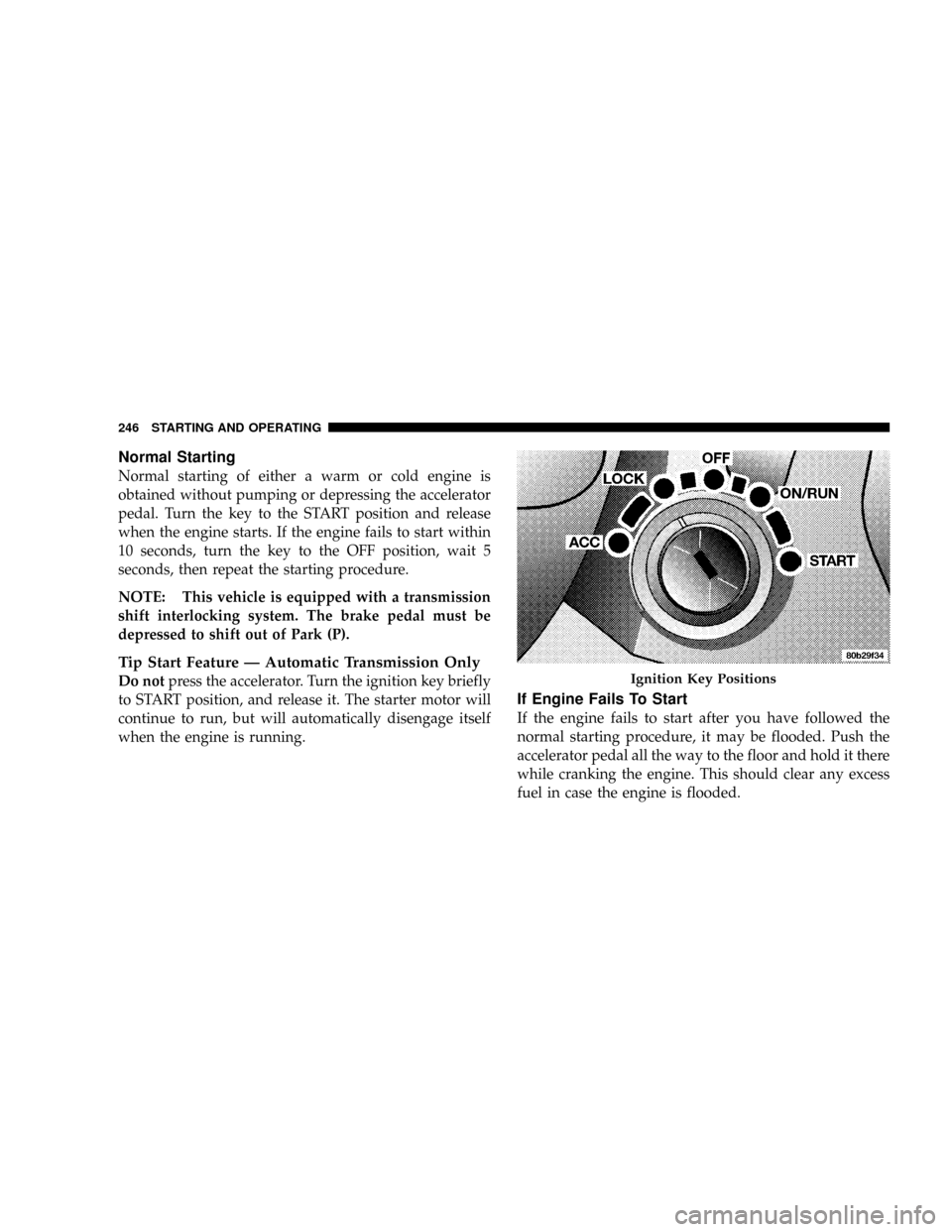
Normal starting of either a warm or cold engine is
obtained without pumping or depressing the accelerator
pedal. Turn the key to the START position and release
when the engine starts. If the engine fails to start within
10 seconds, turn the key to the OFF position, wait 5
seconds, then repeat the starting procedure.
NOTE: This vehicle is equipped with a transmission
shift interlocking system. The brake pedal must be
depressed to shift out of Park (P).
Tip Start Feature Ð Automatic Transmission Only
Do notpress the accelerator. Turn the ignition key briefly
to START position, and release it. The starter motor will
continue to run, but will automatically disengage itself
when the engine is running.
If Engine Fails To Start
If the engine fails to start after you have followed the
normal starting procedure, it may be flooded. Push the
accelerator pedal all the way to the floor and hold it there
while cranking the engine. This should clear any excess
fuel in case the engine is flooded.
Ignition Key Positions
246 STARTING AND OPERATING
Page 250 of 492
ENGINE BLOCK HEATER Ð IF EQUIPPED
The engine block heater warms engine coolant and
permits quicker starts in cold weather. Connect the cord
to a standard 110-115 volt AC electrical outlet with a
grounded, three-wire extension cord.
The engine block heater cord is routed under the hood on
the driver side of the vehicle. It has a removable cap that
is located on the driver side of the Integrated Power
Module.
WARNING!
Remember to disconnect the cord before driving.
Damage to the 110-115 volt electrical cord could
cause electrocution.
AUTOMATIC TRANSMISSION
CAUTION!
Damage to the transmission may occur if the follow-
ing precautions are not observed:
²Shift into PARK only after the vehicle has come to
a complete stop.
²Shift into or out of REVERSE only after the
vehicle has come to a complete stop and the
engine is at idle speed.
²Do not shift from REVERSE, PARK, or NEUTRAL
into any forward gear when the engine is above
idle speed.
²Before shifting into any gear, make sure your foot
is firmly on the brake pedal.
STARTING AND OPERATING 249
5
Page 251 of 492
WARNING!
It is dangerous to shift the selector lever out of ªPº or
ªNº if the engine speed is higher than idle speed. If
your foot is not firmly on the brake pedal, the
vehicle could accelerate quickly forward or in re-
verse. You could lose control of the vehicle and hit
someone or something. Only shift into gear when
the engine is idling normally and when your right
foot is firmly on the brake pedal.
Automatic Transmission with Overdrive
The gear shift selector display, located in the instrument
panel cluster, indicates the transmission gear range (the
selector is illuminated for night driving). The selector
lever is mounted on the right side of the steering column.
You must depress the brake pedal, to pull the selector
lever out of park (P) position (Brake Interlock System). To
drive, move the selector lever from Park or Neutral to thedesired drive position. Pull the selector lever toward you
when shifting into Reverse, Second, First or Park, or
when shifting out of Park.
Gear Ranges
DO NOT race the engine when shifting from Park or
Neutral position into another gear range.
ªPº Park
This gear position supplements the parking brake by
locking the transmission. The engine can be started in
this range. Never use Park while the vehicle is in motion.
Apply the parking brake when leaving the vehicle in this
range. Always apply parking brake first, then place the
selector in Park position. On 4-wheel-drive vehicles be
sure that the transfer case is in a drive position!
250 STARTING AND OPERATING
Page 257 of 492
Truck models with manual transmission are equipped
with a clutch interlocking ignition system. The clutch
pedal must be fully depressed to start the vehicle.
Fully depress the clutch pedal before shifting gears. As
you release the clutch pedal, lightly depress the accelera-
tor pedal.
To shift into Reverse, come to a complete stop. Depress
the clutch and pause briefly to allow the gear train to
stop. Move the shift lever from the Neutral position
straight across and back into Reverse.
Never drive with your foot resting on the clutch pedal, or
attempt to hold the vehicle on a hill with the clutch pedal
partially engaged, as this will cause abnormal wear on
the clutch.Manual Transmission Ð 6 Speed (G56)
The Power Wagon may be equipped with the G56
manual transmission. This transmission has a ªcreeperº
1st gear which should be used to start from a standing
position when carrying a payload or towing a trailer.
Damage to the clutch can result from starting in 2nd or
3rd gear with a loaded vehicle. An unloaded vehicle may
be launched in 2nd gear. Use each gear in numerical
order ± do not skip a gear.
For most city driving you may find it easier to use only
1st through 5th gear ranges. For steady highway driving
with light accelerations, 6th gear is recommended. To
shift into 5th gear, move the shift lever to the right
beyond the spring pressure point and push it forward.
When shifting from 5th to 4th gear, pull the lever down
toward you in one motion. Do not pull the lever sharply
left as you may shift accidentally into 2nd gear and
damage the transmission.
256 STARTING AND OPERATING
Page 258 of 492
To shift into Reverse, come to a complete stop. Depress
the clutch and pause briefly to allow the gear train to
stop. Reverse has a ªcrash-throughº lockout feature.
Move the shift lever from the Neutral position straight
across, in one swift motion, and down into Reverse.
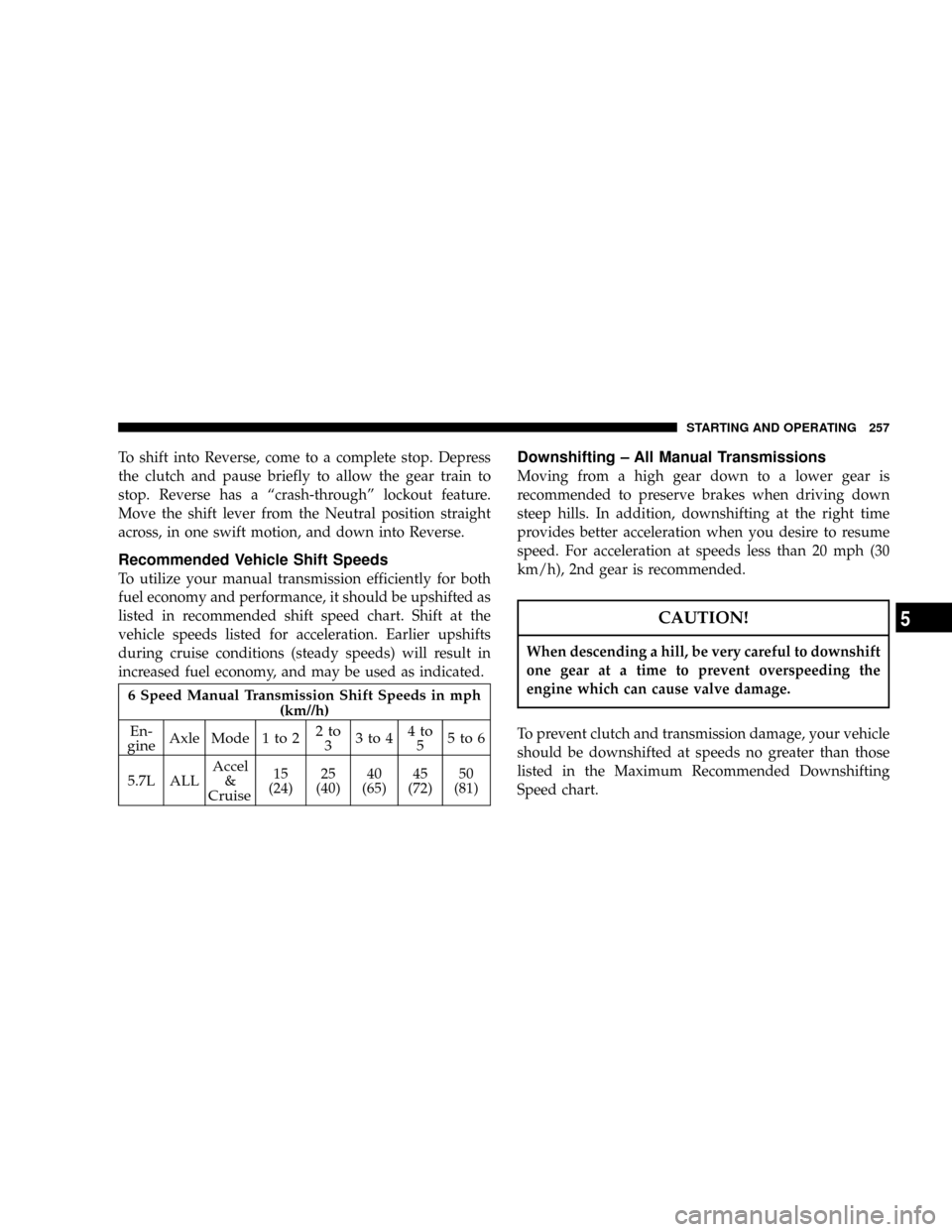
Recommended Vehicle Shift Speeds
To utilize your manual transmission efficiently for both
fuel economy and performance, it should be upshifted as
listed in recommended shift speed chart. Shift at the
vehicle speeds listed for acceleration. Earlier upshifts
during cruise conditions (steady speeds) will result in
increased fuel economy, and may be used as indicated.
6 Speed Manual Transmission Shift Speeds in mph
(km//h)
En-
gineAxle Mode 1 to 22to
33to44to
55to6
5.7L ALLAccel
&
Cruise15
(24)25
(40)40
(65)45
(72)50
(81)
Downshifting ± All Manual Transmissions
Moving from a high gear down to a lower gear is
recommended to preserve brakes when driving down
steep hills. In addition, downshifting at the right time
provides better acceleration when you desire to resume
speed. For acceleration at speeds less than 20 mph (30
km/h), 2nd gear is recommended.
CAUTION!
When descending a hill, be very careful to downshift
one gear at a time to prevent overspeeding the
engine which can cause valve damage.
To prevent clutch and transmission damage, your vehicle
should be downshifted at speeds no greater than those
listed in the Maximum Recommended Downshifting
Speed chart.
STARTING AND OPERATING 257
5
Page 259 of 492
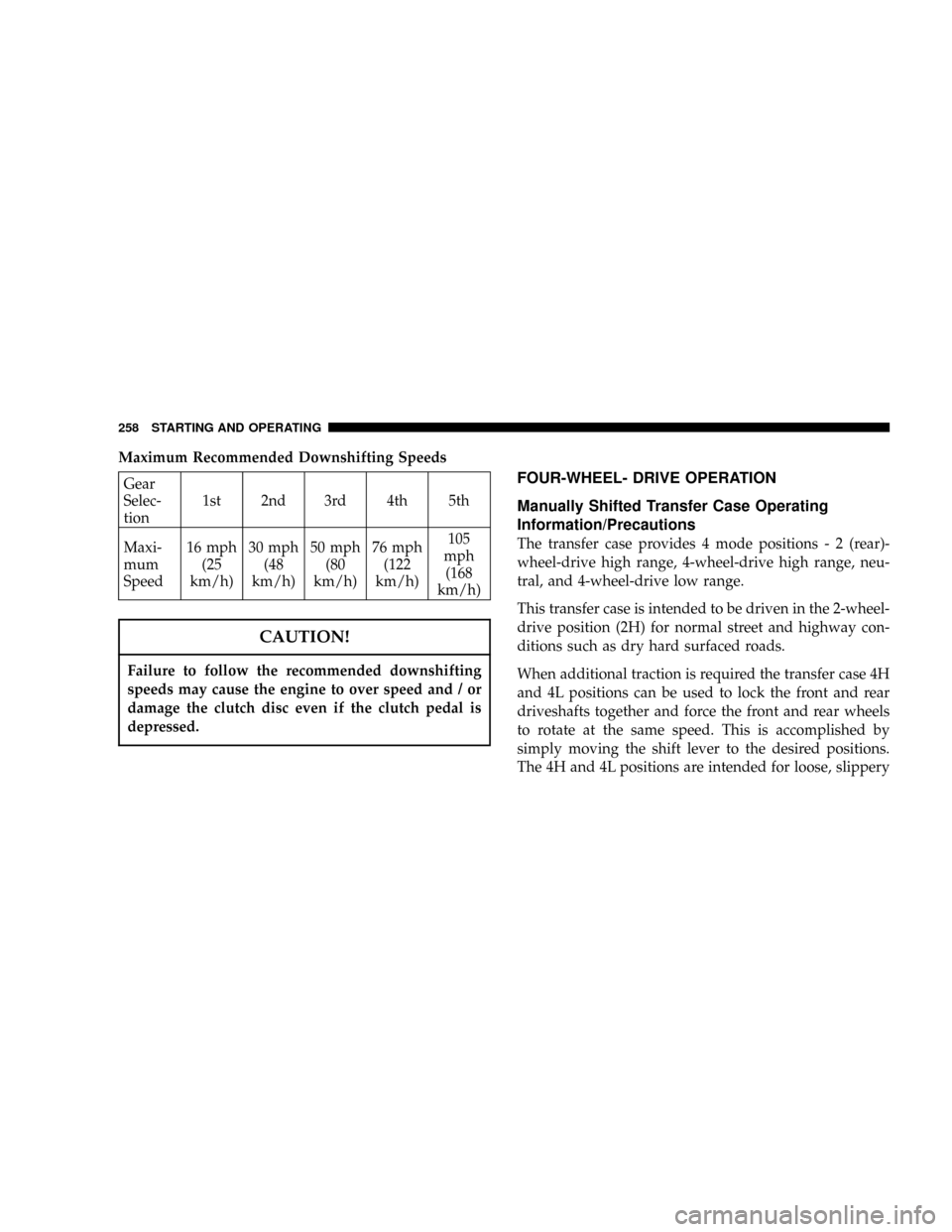
Maximum Recommended Downshifting Speeds
Gear
Selec-
tion1st 2nd 3rd 4th 5th
Maxi-
mum
Speed16 mph
(25
km/h)30 mph
(48
km/h)50 mph
(80
km/h)76 mph
(122
km/h)105
mph
(168
km/h)
CAUTION!
Failure to follow the recommended downshifting
speeds may cause the engine to over speed and / or
damage the clutch disc even if the clutch pedal is
depressed.
FOUR-WHEEL- DRIVE OPERATION
Manually Shifted Transfer Case Operating
Information/Precautions
The transfer case provides 4 mode positions-2(rear)-
wheel-drive high range, 4-wheel-drive high range, neu-
tral, and 4-wheel-drive low range.
This transfer case is intended to be driven in the 2-wheel-
drive position (2H) for normal street and highway con-
ditions such as dry hard surfaced roads.
When additional traction is required the transfer case 4H
and 4L positions can be used to lock the front and rear
driveshafts together and force the front and rear wheels
to rotate at the same speed. This is accomplished by
simply moving the shift lever to the desired positions.
The 4H and 4L positions are intended for loose, slippery
258 STARTING AND OPERATING
Page 260 of 492
road surfaces only. Driving in the 4H and 4L positions on
dry hard surfaced roads may cause increased tire wear
and damage to the driveline components.
The 4-wheel drive high (4LOCK) and 4±wheel drive low
(4LOW) lights, located in the instrument cluster, alert the
driver that the vehicle is either in 4-wheel drive high or
4±wheel drive low and that the front and rear driveshafts
are locked together. There are no lights for the 2H or N
(Neutral) positions.
When operating your vehicle in 4L, the engine speed is
approximately three times that of the 2H or 4H positions
at a given road speed. Take care not to overspeed the
engine and do not exceed 25 mph (40 km/h).
Proper operation of 4-wheel-drive vehicles depends on
tires of equal size, type and circumference on each wheel.
Any difference will adversely affect shifting and can
cause damage to the transfer case.NOTE:Do not attempt to make a shift while only the
front or rear wheels are spinning. The transfer case is not
equipped with a synchronizer and therefore the front and
rear driveshaft speeds must be equal for the shift to take
place. Shifting while only the front or rear wheels are
spinning can cause damage to the transfer case.
Because 4-wheel drive provides improved traction, there
is a tendency to exceed safe turning and stopping speeds.
Do not go faster than road conditions permit.
NOTE:Delayed shifts out of four-wheel drive may be
experienced due to uneven tire wear, low or uneven tire
pressures, excessive vehicle loading, or cold tempera-
tures.
STARTING AND OPERATING 259
5