tow DODGE POWER WAGON 2007 2.G Workshop Manual
[x] Cancel search | Manufacturer: DODGE, Model Year: 2007, Model line: POWER WAGON, Model: DODGE POWER WAGON 2007 2.GPages: 492, PDF Size: 8.25 MB
Page 354 of 492
²Safety chains must always be used between your
vehicle and trailer. Always connect the chains to the
frame or hook retainers of the vehicle hitch. Cross the
chains under the trailer tongue and allow enough
slack for turning corners.
²Vehicles with trailers should not be parked on a grade.
When parking, apply the parking brake on the tow
vehicle. Put the tow vehicle automatic transmission in
P for Park. With a manual transmission, shift the
transmission into reverse. And with four-wheel-drive
vehicles, make sure the transfer case is not in neutral.
Always, block or9chock9the trailer wheels.
²GCWR must not be exceeded.
²Total weight must be distributed between the tow
vehicle and the trailer such that the following four
ratings are not exceeded:
1. GVWR2. GTW
3. GAWR
4. Tongue weight rating for the trailer hitch utilized
(This requirement may limit the ability to always
achieve the 10% to 15% range of tongue weight as a
percentage of total trailer weight).
Towing Requirements Ð Tires
þ
Do not attempt to tow a trailer while using a compact
spare tire.
þProper tire inflation pressures are essential to the safe
and satisfactory operation of your vehicle. Refer to the
Tires±General Information section of this manual on
Tire Pressures for proper tire inflation procedures.
þAlso, check the trailer tires for proper tire inflation
pressures before trailer usage.
STARTING AND OPERATING 353
5
Page 355 of 492
þCheck for signs of tire wear or visible tire damage
before towing a trailer. Refer to the Tires±General
Information section of this manual on Tread Wear
Indicators for the proper inspection procedure.
þWhen replacing tires refer to the Tires±General Infor-
mation section of this manual on Replacement Tires for
proper tire replacement procedures. Replacing tires
with a higher load carrying capacity will not increase
the vehicle's GVWR and GAWR limits.
Towing Requirements Ð Trailer Brakes
þ
Donotinterconnect the hydraulic brake system or
vacuum system of your vehicle with that of the trailer.
This could cause inadequate braking and possible
personal injury.
þAn electronically actuated trailer brake controller is
required when towing a trailer with electronicallyactuated brakes. When towing a trailer equipped with
a hydraulic surge actuated brake system, an electronic
brake controller is not required.
þTrailer brakes are recommended for trailers over 1,000
lbs (454 kg) and required for trailers in excess of 2,000
lbs (907 kg).
CAUTION!
If the trailer weighs more than 1,000 lbs (454 kg)
loaded, it should have its own brakes and they
should be of adequate capacity. Failure to do this
could lead to accelerated brake lining wear, higher
brake pedal effort, and longer stopping distances.
354 STARTING AND OPERATING
Page 356 of 492
WARNING!
Do not connect trailer brakes to your vehicle's hy-
draulic brake lines. It can overload your brake sys-
tem and cause it to fail. You might not have brakes
when you need them and could have an accident.
Towing any trailer will increase your stopping dis-
tance. When towing you should allow for additional
space between your vehicle and the vehicle in front
of you. Failure to do so could result in an accident.
Towing Requirements Ð Trailer Lights & Wiring
Whenever you pull a trailer, regardless of the trailer size,
stop lights and turn signals on the trailer are required for
motoring safety.
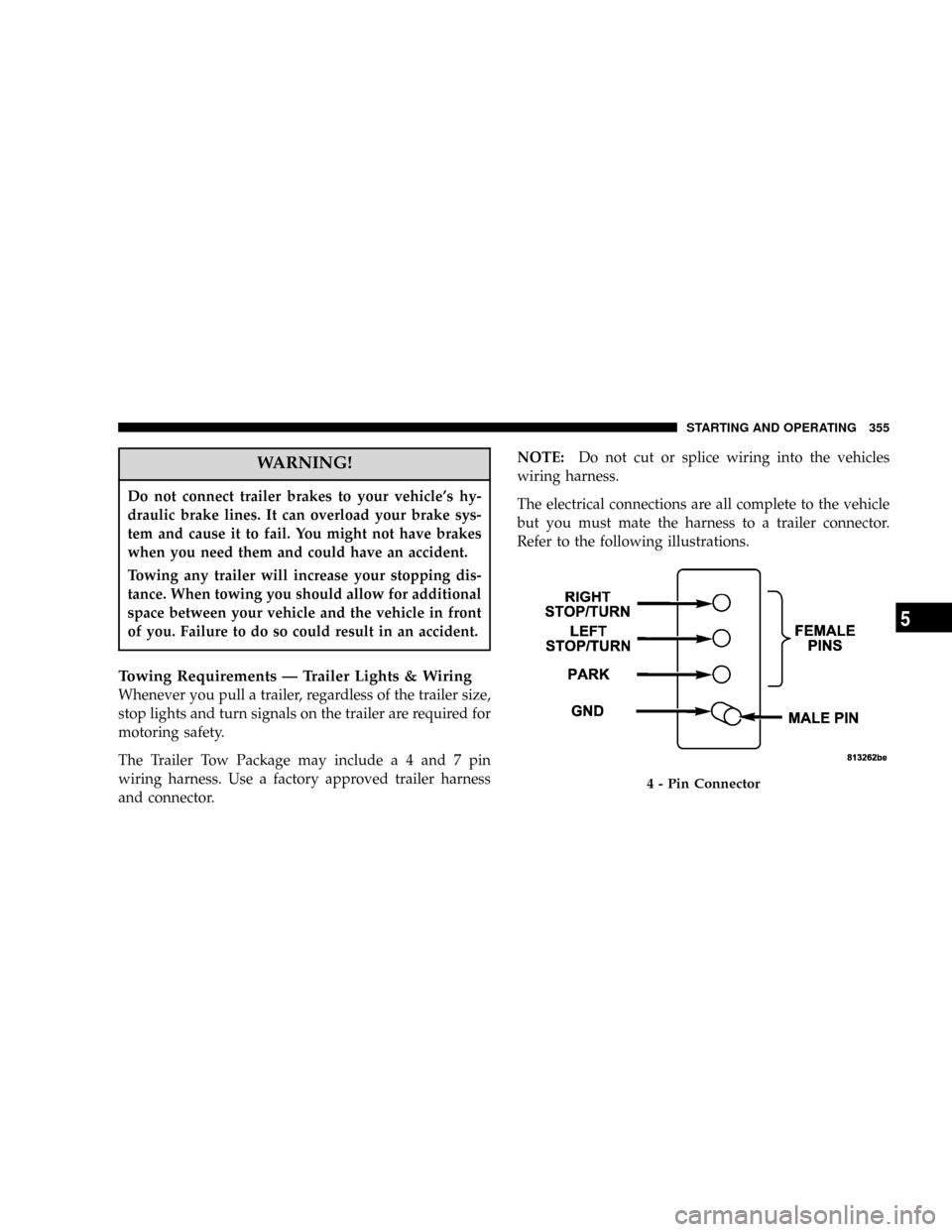
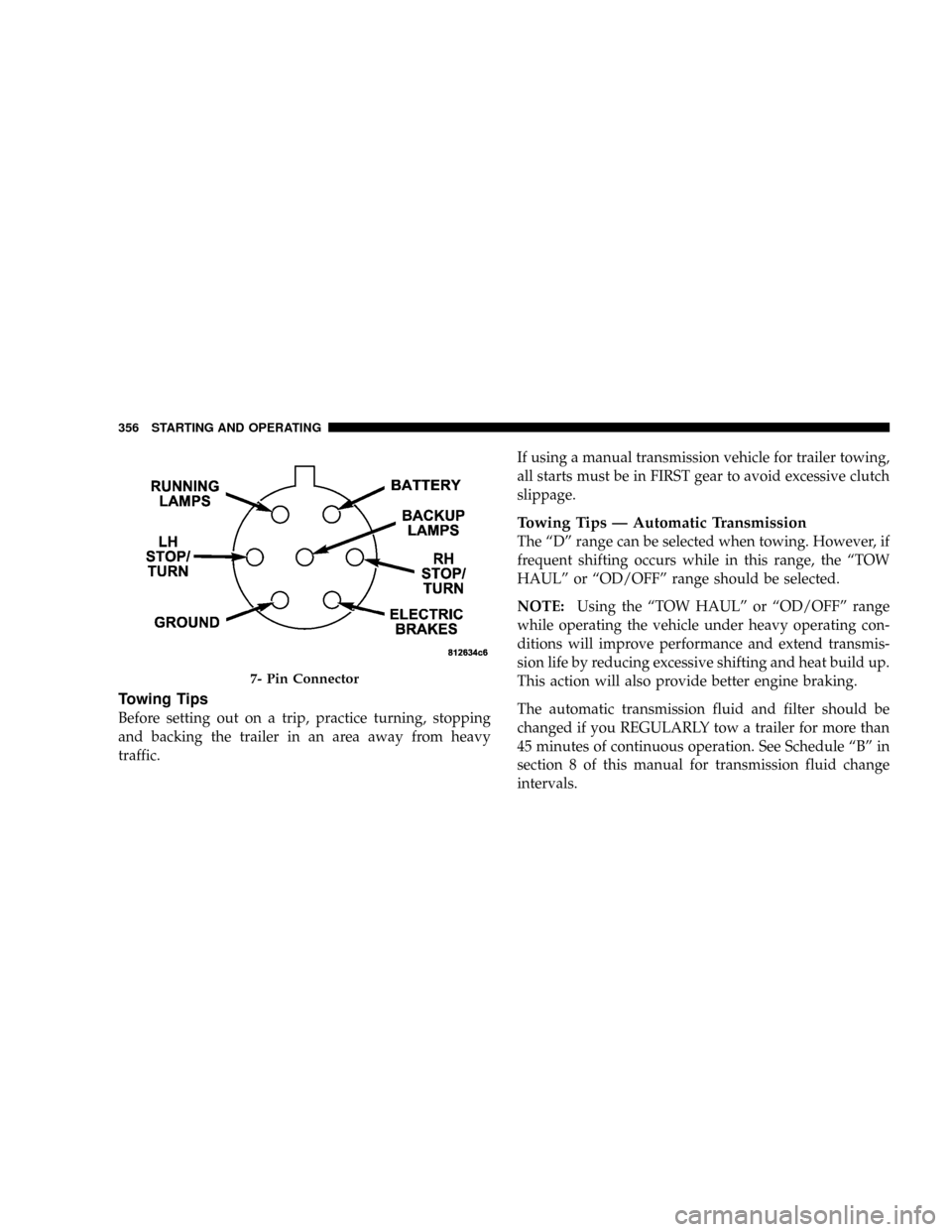
The Trailer Tow Package may includea4and7pin
wiring harness. Use a factory approved trailer harness
and connector.NOTE:Do not cut or splice wiring into the vehicles
wiring harness.
The electrical connections are all complete to the vehicle
but you must mate the harness to a trailer connector.
Refer to the following illustrations.
4 - Pin Connector
STARTING AND OPERATING 355
5
Page 357 of 492
Towing Tips
Before setting out on a trip, practice turning, stopping
and backing the trailer in an area away from heavy
traffic.If using a manual transmission vehicle for trailer towing,
all starts must be in FIRST gear to avoid excessive clutch
slippage.
Towing Tips Ð Automatic Transmission
The ªDº range can be selected when towing. However, if
frequent shifting occurs while in this range, the ªTOW
HAULº or ªOD/OFFº range should be selected.
NOTE:Using the ªTOW HAULº or ªOD/OFFº range
while operating the vehicle under heavy operating con-
ditions will improve performance and extend transmis-
sion life by reducing excessive shifting and heat build up.
This action will also provide better engine braking.
The automatic transmission fluid and filter should be
changed if you REGULARLY tow a trailer for more than
45 minutes of continuous operation. See Schedule ªBº in
section 8 of this manual for transmission fluid change
intervals.
7- Pin Connector
356 STARTING AND OPERATING
Page 358 of 492
NOTE:Check the automatic transmission fluid level
before towing.
Towing Tips Ð Tow/Haul (If Equipped)
To reduce potential for automatic transmission overheat-
ing, turn the ªTOW HAUL OD/OFFº feature ON when
driving in hilly areas or shift the transmission to Drive
position 2 on more severe grades.
Towing Tips Ð Electronic Speed Control (If
Equipped)
þ
Don't use in hilly terrain or with heavy loads.
þWhen using the speed control, if you experience speed
drops greater than 10 mph (16 km/h), disengage until
you can get back to cruising speed.
þUse speed control in flat terrain and with light loads to
maximize fuel efficiency.
Towing Tips Ð Cooling System
To reduce potential for engine and transmission over-
heating, take the following actions:
þCity Driving
When stopped for short periods of time, put transmission
in neutral and increase engine idle speed.
þHighway Driving
Reduce speed.
þAir Conditioning
Turn off temporarily.
þrefer to Cooling System Operating information in the
Maintenance section of this manual for more informa-
tion.
STARTING AND OPERATING 357
5
Page 359 of 492
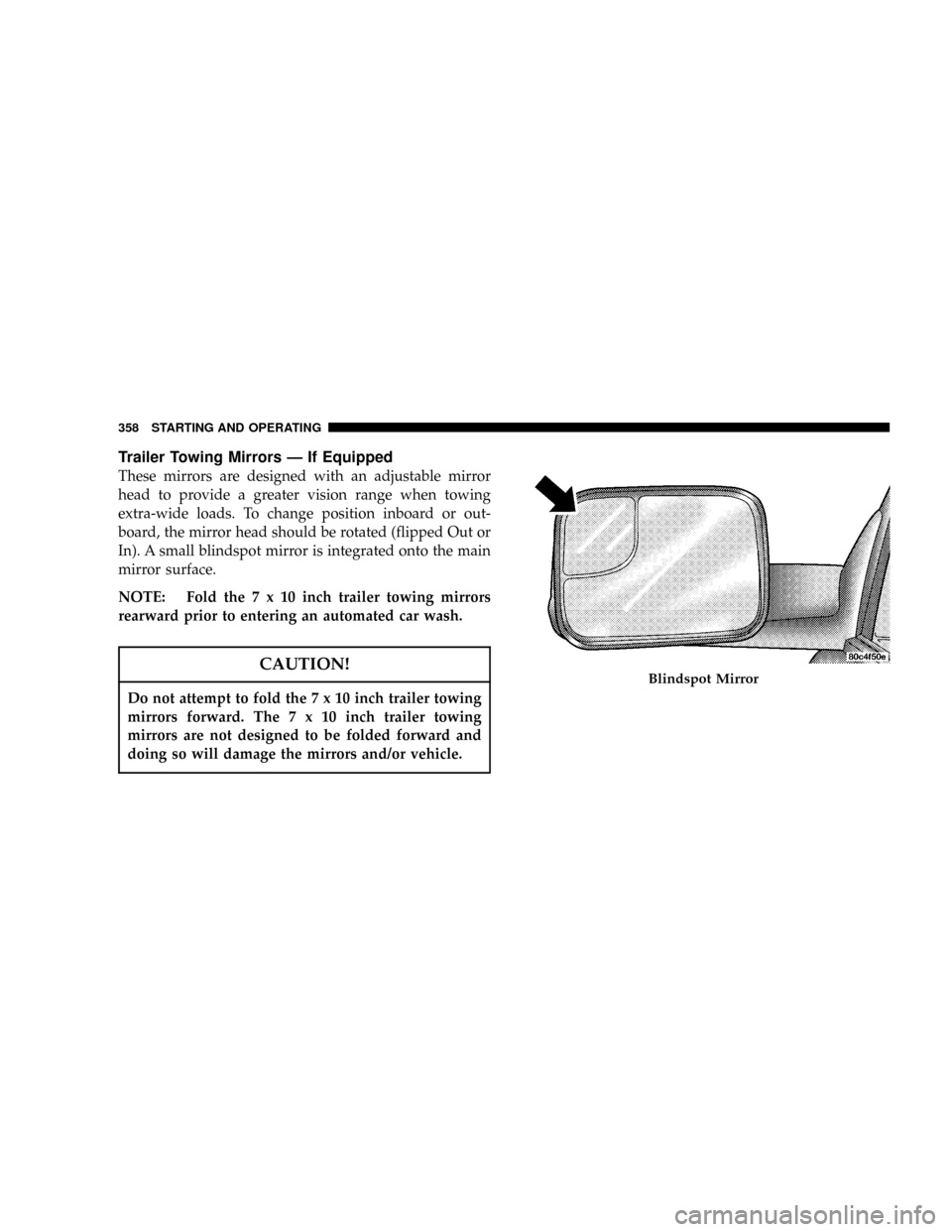
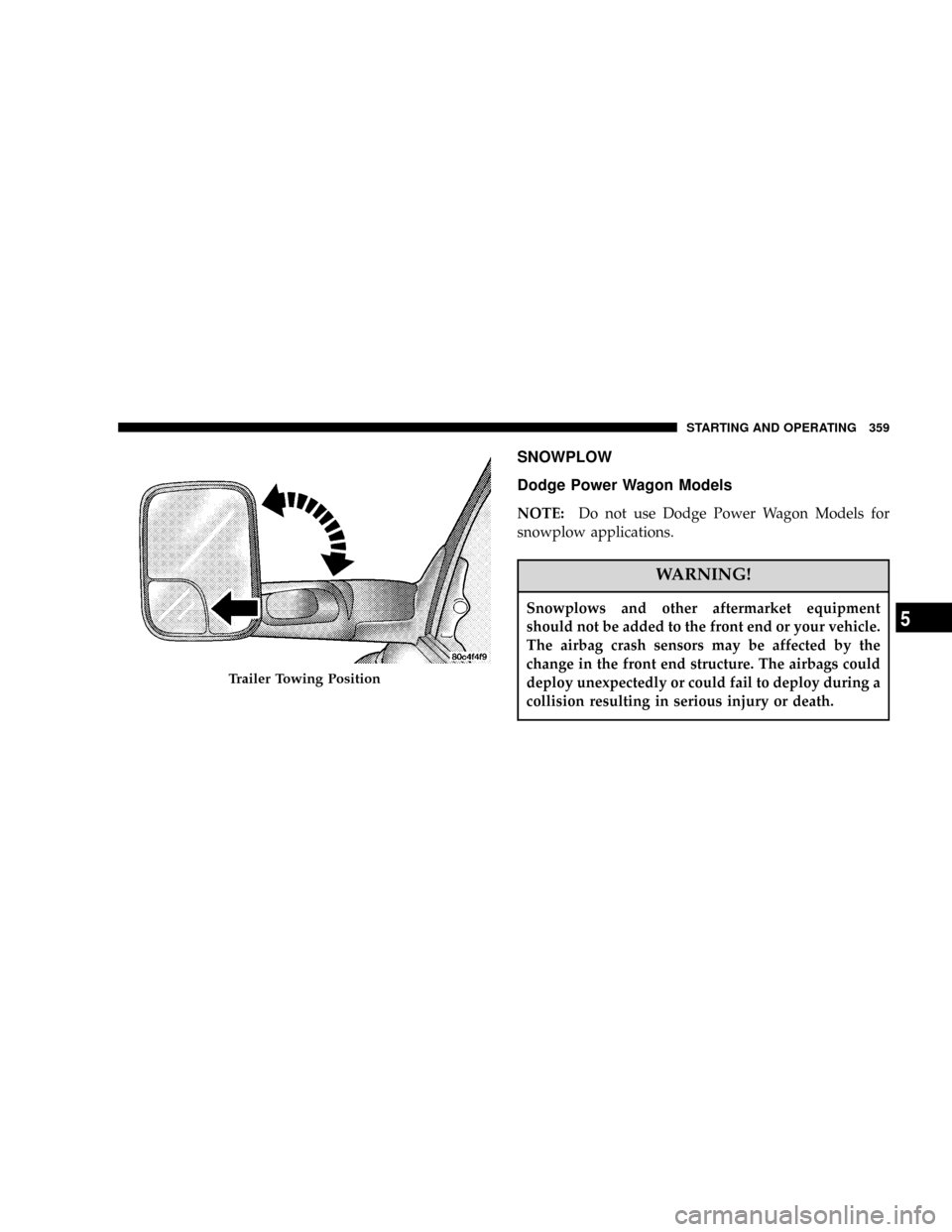
Trailer Towing Mirrors Ð If Equipped
These mirrors are designed with an adjustable mirror
head to provide a greater vision range when towing
extra-wide loads. To change position inboard or out-
board, the mirror head should be rotated (flipped Out or
In). A small blindspot mirror is integrated onto the main
mirror surface.
NOTE: Fold the7x10inch trailer towing mirrors
rearward prior to entering an automated car wash.
CAUTION!
Do not attempt to fold the7x10inch trailer towing
mirrors forward. The7x10inch trailer towing
mirrors are not designed to be folded forward and
doing so will damage the mirrors and/or vehicle.
Blindspot Mirror
358 STARTING AND OPERATING
Page 360 of 492
SNOWPLOW
Dodge Power Wagon Models
NOTE:Do not use Dodge Power Wagon Models for
snowplow applications.
WARNING!
Snowplows and other aftermarket equipment
should not be added to the front end or your vehicle.
The airbag crash sensors may be affected by the
change in the front end structure. The airbags could
deploy unexpectedly or could fail to deploy during a
collision resulting in serious injury or death.
Trailer Towing Position
STARTING AND OPERATING 359
5
Page 361 of 492
CAUTION!
Using this vehicle for snowplow applications can
cause damage to the vehicle.
WARNING!
Attaching a snowplow to this vehicle could ad-
versely affect performance of the airbag system in an
accident. Do not expect that the airbag will perform
as described earlier in this manual
RECREATIONAL TOWING Ð 4±WHEEL DRIVE
VEHICLES (BEHIND MOTORHOME, ETC.)
CAUTION!
Internal damage to the transfer case will occur if a
front or rear wheel lift is used when recreational
towing.
NOTE:The transfer case must be shifted into Neutral
(N) for recreational towing. Automatic transmissions
must be placed in P (Park) position for recreational
towing. Manual transmissions must be left in gear (not in
neutral) for recreational towing. Refer below for the
proper transfer case Neutral shifting procedure for your
vehicle.
360 STARTING AND OPERATING
Page 362 of 492
Recreational Towing Procedure Ð Manual Shift
Transfer Case Ð If Equipped
Use the following procedure to prepare your vehicle for
recreational towing:
CAUTION!
It is necessary to follow these steps to be certain that
the transfer case is fully in N (NEUTRAL) before
recreational towing to prevent damage to internal
parts.
1. Bring the vehicle to a complete stop.
2. Shut OFF the engine.
3. Depress the brake pedal.
4. Shift automatic transmission to N (NEUTRAL), or
depress the clutch on manual transmissions.5. Shift transfer case lever into N (NEUTRAL).
6. Start the engine.
7. Shift automatic transmission into Reverse (R).
8. Release brake pedal for five seconds and ensure that
there is no vehicle movement.
9. Repeat steps 7 and 8 with the transmission in Drive
(D).
10. Shut OFF the engine and place the ignition key to the
unlocked OFF position.
11. Shift automatic transmission into P (PARK).
12. Apply the parking brake.
13. Attach vehicle to tow vehicle with tow bar.
14. Release the parking brake.
STARTING AND OPERATING 361
5
Page 364 of 492
CAUTION!
²Do not use a bumper mounted clamp-on tow bar
on your vehicle. The bumper face bar will be
damaged.
²Do not disconnect the rear driveshaft because
fluid will leak from the transfer case and damage
the internal parts.
EQUIPMENT IDENTIFICATION PLATE
The equipment Identification Plate is located on the hood
inner surface.
The following information about your vehicle is dis-
played on this plate: Model, Wheelbase, Vehicle Identifi-
cation Number, Truck Order Number, and code numbers
with descriptions of all production and special equip-
ment on the truck as shipped from the factory.
NOTE:Always refer to the Equipment Identification
Plate When Ordering Parts.
STARTING AND OPERATING 363
5