5.9l DODGE RAM 1500 1998 2.G Workshop Manual
[x] Cancel search | Manufacturer: DODGE, Model Year: 1998, Model line: RAM 1500, Model: DODGE RAM 1500 1998 2.GPages: 2627
Page 1701 of 2627

(4) Remove the support and lower the vehicle.
(5) Reconnect the return hose at the reservoir.
(6) Refill the power steering system,(Refer to 19 -
STEERING/PUMP - STANDARD PROCEDURE).
POWER STEERING PRESSURE
SWITCH
DESCRIPTION
A pressure sensing switch is used in the power
steering system. It is mounted on the high-pressure
steering hose (Fig. 9). This switch will be used with
both 3.7L and 5.7L engines. There is no pressure
switch used for the 4.7L or the 5.9L pump.
OPERATION
The switch is used on the 3.7L V-6 & 5.7L V-8
engines.
The power steering pressure switch provides an
input to the Powertrain Control Module (PCM). This
input is provided during periods of high steering
pump load and low engine rpm; such as during park-
ing maneuvers. The PCM increases the idle speed
through the Idle Air Control (IAC) motor. This is
done to prevent the engine from stalling under the
increased load.
When steering pump pressure exceeds 3275 kPa
690 kPa (475 psi 100 psi), the Normally Closed
(NC) switch will open and the PCM will increase the
engine idle speed. This will prevent the engine from
stalling.
When pump pressure drops to approximately 1379
kPa (200 psi), the switch circuit will re-close and
engine idle speed will return to its previous setting.
REMOVAL - 3.7L & 5.7L
The power steering pressure switch is installed in
the power steering high-pressure hose (Fig. 9).
(1) Disconnect electrical connector from power
steering pressure switch.(2) Place a small container or shop towel beneath
switch to collect any excess fluid.
(3) Remove switch. Use back-up wrench on power
steering line to prevent line bending.
INSTALLATION - 3.7L & 5.7L
This switch is used only with the 3.7L V±6 and the
5.7L V-8 engines.
(1) Install power steering switch into power steer-
ing line.
(2) Tighten to 8±11 N´m (70±100 in. lbs.) torque.
(3) Connect electrical connector to switch.
(4) Check power steering fluid and add as neces-
sary.
(5) Start engine and again check power steering
fluid. Add fluid if necessary.
Fig. 9 PRESSURE SWITCH
1 - POWER STEERING PULLEY
2 - POWER STEERING PUMP HOUSING
3 - POWER STEERING FLUID RESERVOIR
4 - RETURN HOSE
5 - HIGH PRESSURE HOSE WITH PRESSURE SWITCH
19 - 46 PUMPDR
HOSES - LINK/COIL (Continued)
Page 2494 of 2627
²Faulty A/C-heater control.
²Faulty related wiring harness or connectors.
²Improper engine coolant temperature.
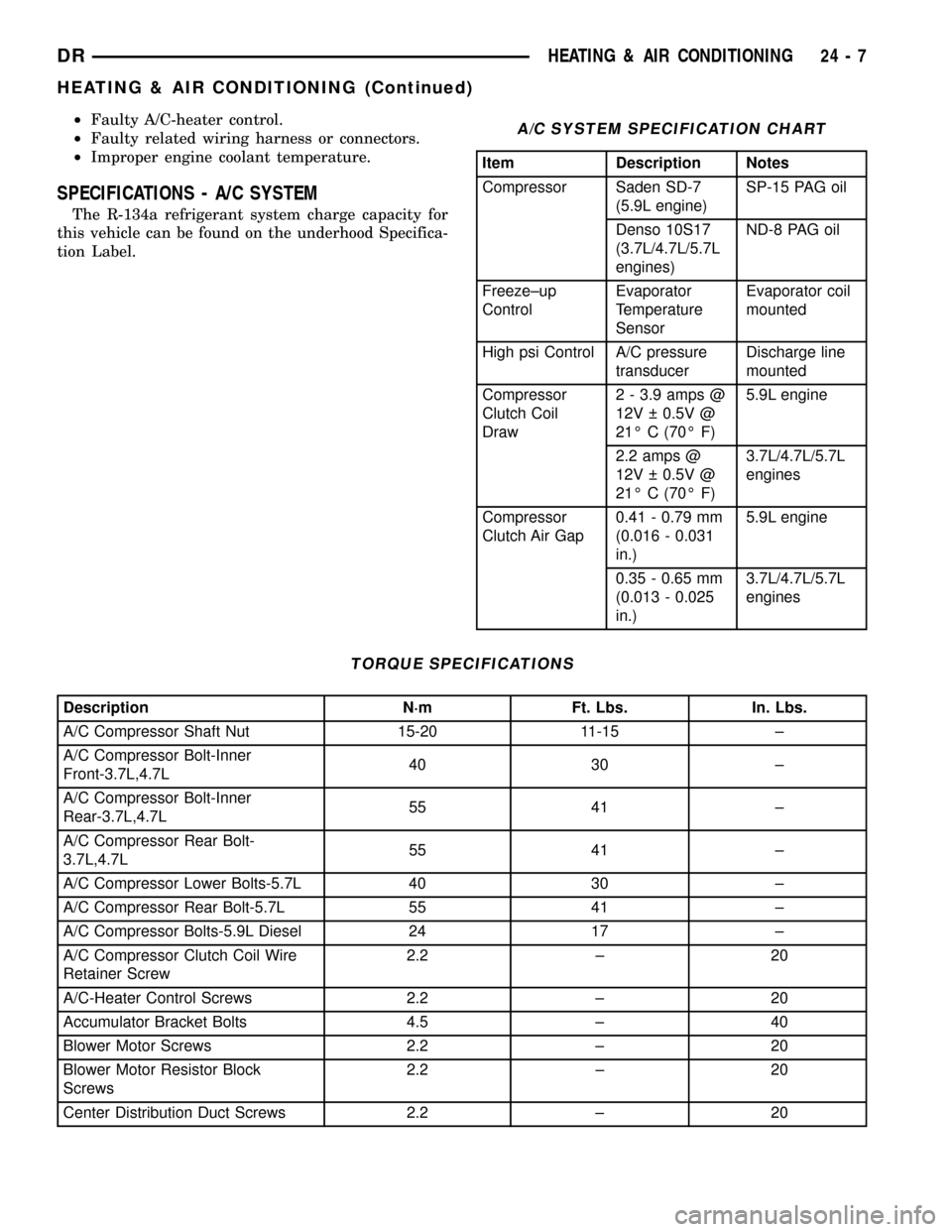
SPECIFICATIONS - A/C SYSTEM
The R-134a refrigerant system charge capacity for
this vehicle can be found on the underhood Specifica-
tion Label.
A/C SYSTEM SPECIFICATION CHART
Item Description Notes
Compressor Saden SD-7
(5.9L engine)SP-15 PAG oil
Denso 10S17
(3.7L/4.7L/5.7L
engines)ND-8 PAG oil
Freeze±up
ControlEvaporator
Temperature
SensorEvaporator coil
mounted
High psi Control A/C pressure
transducerDischarge line
mounted
Compressor
Clutch Coil
Draw2 - 3.9 amps @
12V 0.5V @
21É C (70É F)5.9L engine
2.2 amps @
12V 0.5V @
21É C (70É F)3.7L/4.7L/5.7L
engines
Compressor
Clutch Air Gap0.41 - 0.79 mm
(0.016 - 0.031
in.)5.9L engine
0.35 - 0.65 mm
(0.013 - 0.025
in.)3.7L/4.7L/5.7L
engines
TORQUE SPECIFICATIONS
Description N´m Ft. Lbs. In. Lbs.
A/C Compressor Shaft Nut 15-20 11-15 ±
A/C Compressor Bolt-Inner
Front-3.7L,4.7L40 30 ±
A/C Compressor Bolt-Inner
Rear-3.7L,4.7L55 41 ±
A/C Compressor Rear Bolt-
3.7L,4.7L55 41 ±
A/C Compressor Lower Bolts-5.7L 40 30 ±
A/C Compressor Rear Bolt-5.7L 55 41 ±
A/C Compressor Bolts-5.9L Diesel 24 17 ±
A/C Compressor Clutch Coil Wire
Retainer Screw2.2 ± 20
A/C-Heater Control Screws 2.2 ± 20
Accumulator Bracket Bolts 4.5 ± 40
Blower Motor Screws 2.2 ± 20
Blower Motor Resistor Block
Screws2.2 ± 20
Center Distribution Duct Screws 2.2 ± 20
DRHEATING & AIR CONDITIONING 24 - 7
HEATING & AIR CONDITIONING (Continued)
Page 2495 of 2627
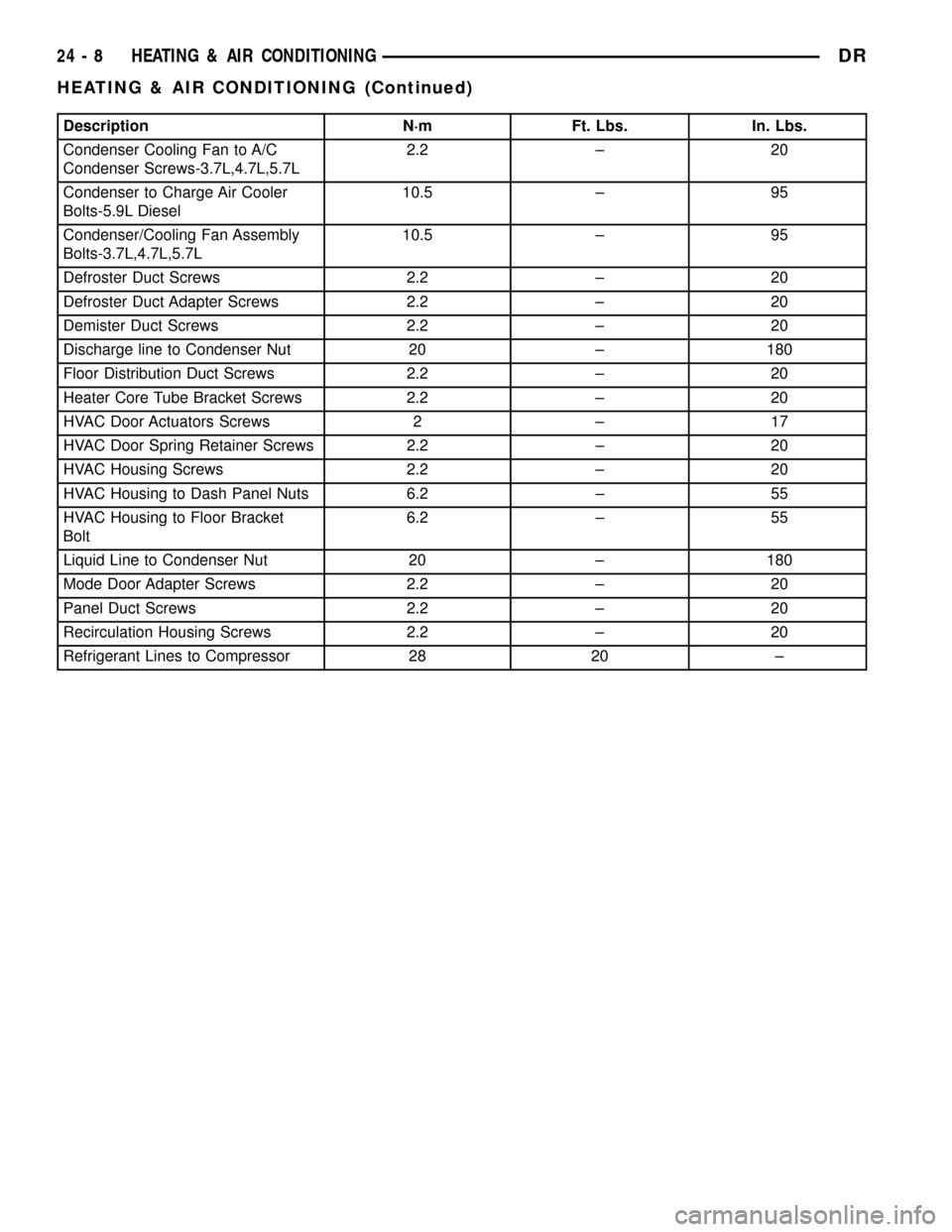
Description N´m Ft. Lbs. In. Lbs.
Condenser Cooling Fan to A/C
Condenser Screws-3.7L,4.7L,5.7L2.2 ± 20
Condenser to Charge Air Cooler
Bolts-5.9L Diesel10.5 ± 95
Condenser/Cooling Fan Assembly
Bolts-3.7L,4.7L,5.7L10.5 ± 95
Defroster Duct Screws 2.2 ± 20
Defroster Duct Adapter Screws 2.2 ± 20
Demister Duct Screws 2.2 ± 20
Discharge line to Condenser Nut 20 ± 180
Floor Distribution Duct Screws 2.2 ± 20
Heater Core Tube Bracket Screws 2.2 ± 20
HVAC Door Actuators Screws 2 ± 17
HVAC Door Spring Retainer Screws 2.2 ± 20
HVAC Housing Screws 2.2 ± 20
HVAC Housing to Dash Panel Nuts 6.2 ± 55
HVAC Housing to Floor Bracket
Bolt6.2 ± 55
Liquid Line to Condenser Nut 20 ± 180
Mode Door Adapter Screws 2.2 ± 20
Panel Duct Screws 2.2 ± 20
Recirculation Housing Screws 2.2 ± 20
Refrigerant Lines to Compressor 28 20 ±
24 - 8 HEATING & AIR CONDITIONINGDR
HEATING & AIR CONDITIONING (Continued)
Page 2528 of 2627

PLUMBING
TABLE OF CONTENTS
page page
PLUMBING
DESCRIPTION - REFRIGERANT LINE.......42
OPERATION- REFRIGERANT LINES........42
WARNING
ENGINE COOLING SYSTEM.............42
A/C SYSTEM.........................43
CAUTION
A/C SYSTEM.........................43
DIAGNOSIS AND TESTING - REFRIGERANT
SYSTEM LEAKS......................44
STANDARD PROCEDURE
STANDARD PROCEDURE - HANDLING
TUBING AND FITTINGS.................45
STANDARD PROCEDURE - DIODE
REPLACEMENT.......................45
STANDARD PROCEDURE - REFRIGERANT
SYSTEM SERVICE EQUIPMENT..........46
STANDARD PROCEDURE - REFRIGERANT
RECOVERY..........................47
STANDARD PROCEDURE - REFRIGERANT
SYSTEM EVACUATE...................47
STANDARD PROCEDURE - REFRIGERANT
SYSTEM CHARGE.....................47
A/C COMPRESSOR
DESCRIPTION
DESCRIPTION - A/C COMPRESSOR.......48
DESCRIPTION - HIGH PRESSURE RELIEF
VALVE..............................48
OPERATION
OPERATION - A/C COMPRESSOR........48
OPERATION - HIGH PRESSURE RELIEF
VALVE..............................48
DIAGNOSIS AND TESTING - A/C
COMPRESSOR.......................49
REMOVAL.............................49
INSTALLATION.........................51
A/C CONDENSER
DESCRIPTION.........................52
OPERATION...........................52
REMOVAL
REMOVAL - 3.7, 4.7 AND 5.7L ENGINES....52
REMOVAL - 5.9L DIESEL ENGINE.........53
INSTALLATION
INSTALLATION - 3.7, 4.7 AND 5.7L ENGINES . 53
INSTALLATION - 5.9L DIESEL ENGINE.....54
A/C CONDENSER FAN
REMOVAL - 3.7, 4.7 and 5.7L ENGINES......55
INSTALLATION - 3.7, 4.7 and 5.7L ENGINES . . . 55A/C DISCHARGE LINE
DESCRIPTION.........................56
REMOVAL
REMOVAL - 5.9L DIESEL ENGINE.........56
REMOVAL - 3.7L/4.7L AND 5.7L HEMI
ENGINE.............................57
INSTALLATION
INSTALLATION - 5.9L DIESEL ENGINE.....58
INSTALLATION - 3.7L/4.7L AND 5.7L HEMI
ENGINE.............................59
A/C EVAPORATOR
DESCRIPTION.........................59
OPERATION...........................59
REMOVAL.............................60
INSTALLATION.........................60
A/C ORIFICE TUBE
DESCRIPTION.........................60
OPERATION...........................60
DIAGNOSIS AND TESTING - A/C ORIFICE
TUBE...............................61
ACCUMULATOR
DESCRIPTION.........................61
OPERATION...........................61
REMOVAL.............................61
INSTALLATION.........................62
HEATER CORE
DESCRIPTION.........................63
OPERATION...........................63
REMOVAL.............................63
INSTALLATION.........................63
HEATER INLET HOSE
REMOVAL.............................64
INSTALLATION.........................64
HEATER RETURN HOSE
REMOVAL.............................64
INSTALLATION.........................65
LIQUID LINE
DESCRIPTION.........................65
REMOVAL.............................65
INSTALLATION.........................66
REFRIGERANT
DESCRIPTION.........................67
OPERATION...........................67
REFRIGERANT LINE COUPLER
DESCRIPTION.........................67
OPERATION...........................67
REMOVAL.............................68
INSTALLATION.........................68
DRPLUMBING 24 - 41
Page 2529 of 2627

REFRIGERANT OIL
DESCRIPTION.........................68
OPERATION...........................69
STANDARD PROCEDURE - REFRIGERANT
OIL LEVEL...........................69
SERVICE PORT VALVE CORE
DESCRIPTION.........................70
REMOVAL - SERVICE PORT VALVE CORES . . 70
INSTALLATION.........................70
SUCTION LINE
DESCRIPTION.........................70REMOVAL
REMOVAL - 5.9L DIESEL ENGINE.........70
REMOVAL - 3.7L/4.7L AND 5.7L HEMI
ENGINE.............................71
INSTALLATION
INSTALLATION - 5.9L DIESEL ENGINE.....72
INSTALLATION - 3.7L/4.7L AND 5.7L HEMI
ENGINE.............................73
PLUMBING
DESCRIPTION - REFRIGERANT LINE
The refrigerant lines and hoses are used to carry
the refrigerant between the various air conditioning
system components. A barrier hose design with a
nylon tube, which is sandwiched between rubber lay-
ers, is used for the R-134a air conditioning system on
this vehicle. This nylon tube helps to further contain
the R-134a refrigerant, which has a smaller molecu-
lar structure than R-12 refrigerant. The ends of the
refrigerant hoses are made from lightweight alumi-
num or steel, and commonly use braze-less fittings.
Any kinks or sharp bends in the refrigerant plumb-
ing will reduce the capacity of the entire air condi-
tioning system. Kinks and sharp bends reduce the
flow of refrigerant in the system. A good rule for the
flexible hose refrigerant lines is to keep the radius of
all bends at least ten times the diameter of the hose.
In addition, the flexible hose refrigerant lines should
be routed so they are at least 80 millimeters (3
inches) from an exhaust manifold.
OPERATION- REFRIGERANT LINES
High pressures are produced in the refrigerant sys-
tem when the air conditioning compressor is operat-
ing. Extreme care must be exercised to make sure
that each of the refrigerant system connections is
pressure-tight and leak free. It is a good practice to
inspect all flexible hose refrigerant lines at least once
a year to make sure they are in good condition and
properly routed.
The refrigerant lines and hoses are coupled with
other components of the HVAC system with either
O-rings or dual plane seals.
The refrigerant lines and hoses cannot be repaired
and, if faulty or damaged, they must be replaced.
WARNING
ENGINE COOLING SYSTEM
WARNING: THE ENGINE COOLING SYSTEM IS
DESIGNED TO DEVELOP INTERNAL PRESSURES
OF 97 TO 123 KILOPASCALS (14 TO 18 POUNDS
PER SQUARE INCH). DO NOT REMOVE OR
LOOSEN THE COOLANT PRESSURE CAP, CYLIN-
DER BLOCK DRAIN PLUGS, RADIATOR DRAIN,
RADIATOR HOSES, HEATER HOSES, OR HOSE
CLAMPS WHILE THE ENGINE COOLING SYSTEM IS
HOT AND UNDER PRESSURE. FAILURE TO
OBSERVE THIS WARNING CAN RESULT IN SERI-
OUS BURNS FROM THE HEATED ENGINE COOL-
ANT. ALLOW THE VEHICLE TO COOL FOR A
MINIMUM OF 15 MINUTES BEFORE OPENING THE
COOLING SYSTEM FOR SERVICE.
24 - 42 PLUMBINGDR
Page 2535 of 2627

After the system has been tested for leaks and
evacuated, a refrigerant (R-134a) charge can be
injected into the system.
NOTE: When connecting the service equipment
coupling to the line fitting, verify that the valve of
the coupling is fully closed. This will reduce the
amount of effort required to make the connection.
(1) If using a separate vacuum pump close all
valves before disconnecting pump. Connect manifold
gauge set to the A/C service ports.
NOTE: Always refer to the underhood HVAC Speci-
fication label for the refrigerant fill level of the vehi-
cle being serviced.
(2) Measure refrigerant (refer to capacities). Refer
to the instructions provided with the equipment
being used.
(3) Verify engine is shut off. Open the suction and
discharge valves. Open the charge valve to allow the
refrigerant to flow into the system. When the trans-
fer of refrigerant has stopped, close the suction and
discharge valve.
(4) If all of the charge did not transfer from the
dispensing device, put vehicle controls into the fol-
lowing mode:
²Automatic transmission in park or manual
transmission in neutral
²Engine at idle
²A/C mode control set to outside air
²A/C mode control set to panel mode
²A/C temperature control set to full cool
²Blower motor control set on highest speed
²Vehicle windows closed
If the A/C compressor does not engage, test the
compressor clutch control circuit and correct any fail-
ure (Refer to 8 - ELECTRICAL/WIRING DIAGRAM
INFORMATION - DIAGNOSIS AND TESTING).
(5) Open the suction valve to allow the remaining
refrigerant to transfer to the system.
WARNING: TAKE CARE NOT TO OPEN THE DIS-
CHARGE (HIGH-PRESSURE) VALVE AT THIS TIME.
(6) Close all valves and test the A/C system perfor-
mance.
(7) Disconnect the charging station or manifold
gauge set. Install the service port caps.
REFRIGERANT CHARGE CAPACITY
The R-134a refrigerant system charge capacity for
this vehicle can be found on the underhood HVAC
specfication tag.
A/C COMPRESSOR
DESCRIPTION
DESCRIPTION - A/C COMPRESSOR
The A/C system on models equipped with the 5.9L
engine use a Sanden SD-7 reciprocating swash plate-
type compressor. This compressor has a fixed dis-
placement of 165 cubic centimeter (10.068 cubic
inches) and has both the suction and discharge ports
located on the cylinder head.
The A/C system on models equipped with the 3.7L,
4.7L and 5.7L engines use a Denso 10S17 reciprocat-
ing swash plate-type compressor. This compressor
has a fixed displacement of 170 cubic centimeter and
has both the suction and discharge ports located on
the cylinder head.
A label identifying the use of R-134a refrigerant is
located on both A/C compressors.
DESCRIPTION - HIGH PRESSURE RELIEF
VALVE
A high pressure relief valve is located on the com-
pressor cylinder head, which is on the rear of the
compressor. This mechanical valve is designed to
vent refrigerant from the system to protect against
damage to the compressor and other system compo-
nents, caused by condenser air flow restriction or an
overcharge of refrigerant.
OPERATION
OPERATION - A/C COMPRESSOR
The A/C compressor is driven by the engine
through an electric clutch, drive pulley and belt
arrangement. The compressor is lubricated by refrig-
erant oil that is circulated throughout the refrigerant
system with the refrigerant.
The compressor draws in low-pressure refrigerant
vapor from the evaporator through its suction port. It
then compresses the refrigerant into a high-pressure,
high-temperature refrigerant vapor, which is then
pumped to the condenser through the compressor dis-
charge port.
The compressor cannot be repaired. If faulty or
damaged, the entire compressor assembly must be
replaced. The compressor clutch, pulley and clutch
coil are available for service.
OPERATION - HIGH PRESSURE RELIEF VALVE
The high pressure relief valve vents the system
when a discharge pressure of 3445 to 4135 kPa (500
to 600 psi) or above is reached. The valve closes
24 - 48 PLUMBINGDR
PLUMBING (Continued)
Page 2537 of 2627

ING/PLUMBING - STANDARD PROCEDURE -
REFRIGERANT RECOVERY).
(2) Disconnect and isolate the battery negative
cable.
(3) Remove the serpentine drive belt (Refer to 7 -
COOLING/ACCESSORY DRIVE/DRIVE BELTS -
REMOVAL).
(4) Disconnect the A/C compressor clutch coil wire
harness connector.
(5) Depending on engine usage, remove the bolt or
nuts that secure the suction and discharge line fit-
tings to the A/C compressor.
(6) Disconnect the suction and discharge line fit-
tings from the A/C compressor.
(7) Remove the O-ring seals from the suction and
discharge line fittings and discard.
(8) Install plugs in, or tape over all of the opened
refrigerant line fittings and the compressor ports.
(9) If equipped with the 5.7L Hemi engine, remove
the nuts and bolts that secure the generator and A/C
compressor support bracket and remove the bracket
from the engine.
(10) Remove the bolts that secure the A/C com-
pressor to the mounting bracket (Fig. 4), (Fig. 5) or
(Fig. 6).
(11) Remove the A/C compressor from the engine
compartment.
Fig. 4 A/C Compressor - 3.7L Shown, 4.7L Typical
1 - BOLT #1
2 - BOLT #2
3 - BOLT #3
4 - A/C COMPRESSOR
5 - A/C CLUTCH AND PULLEY
6 - MOUNTING BRACKET
Fig. 5 A/C Compressor - 5.7L Hemi
1 - BOLT (2)
2 - A/C COMPRESSOR
3 - BOLT
4 - MOUNTING BRACKET
Fig. 6 A/C Compressor - 5.9L Diesel
1 - ENGINE BLOCK
2 - MOUNTING BRACKET
3 - A/C COMPRESSOR
4 - BOLT (4)
24 - 50 PLUMBINGDR
A/C COMPRESSOR (Continued)
Page 2538 of 2627

INSTALLATION
NOTE: If a replacement compressor is being
installed, be certain to check the refrigerant oil
level. See Refrigerant Oil Level in this group for the
procedures. Use only refrigerant oil of the type rec-
ommended for the compressor in the vehicle.
(1) Install the compressor onto the mounting
bracket.
(2) On the 3.7L and 4.7L engines, install and
tighten the bolts in the following sequence (Fig. 7):
²Install the inner front bolt #3 and hand tight-
ened.
²Install the outer front bolt #2 and hand tight-
ened.
²Install the rear bolt #1 and hand tightened.
²Tightened the inner front bolt #3 to 40 N´m (30
ft. lbs.).
²Tightened the outer front bolt #2 to 55 N´m (41
ft. lbs.).
²Tightened the rear bolt #1 to 55 N´m (41 ft. lbs.).
(3) For the 5.7L Hemi engine, install and tighten
the bolts in the following sequence (Fig. 8):
²Install the two long bolts into the mounting
bracket and hand tightened.
²Install the rear bolt and hand tightened.²Tightened the two long bolts to 40 N´m (30 ft.
lbs.).
²Tightened the rear bolt to 55 N´m (41 ft. lbs.).
(4) For the 5.7L Hemi engine, install the generator
and A/C compressor support bracket and retaining
nuts and bolts. Tighten the nuts and bolts securely.
(5) For the 5.9L diesel engine, install and tighten
the bolts in the following sequence (Fig. 9):
²Install the four bolts into the mounting bracket
and hand tightened.
²Tightened the four bolts to 24 N´m (17 ft. lbs.).
(6) Remove the tape or plugs from the opened
refrigerant line fittings and compressor ports.
(7) Lubricate new rubber O-ring seals with clean
refrigerant oil and install them on the suction and
discharge line fittings. Use only the specified O-rings
as they are made of a special material for the R-134a
system. Use only refrigerant oil of the type recom-
mended for the A/C compressor in the vehicle.
(8) Install the suction and discharge line fittings
onto the compressor.
(9) Install the bolt or nuts (depending on engine
application) that secure the suction and discharge
line fittings to the compressor. Tighten the bolt or
nuts to 28 N´m (20 ft. lbs.).
(10) Connect the wire harness connector to the
compressor clutch coil.
Fig. 7 A/C Compressor - 3.7L Shown, 4.7L Typical
1 - BOLT #1
2 - BOLT #2
3 - BOLT #3
4 - A/C COMPRESSOR
5 - A/C CLUTCH AND PULLEY
6 - MOUNTING BRACKET
Fig. 8 A/C Compressor - 5.7L Hemi
1 - BOLT (2)
2 - A/C COMPRESSOR
3 - BOLT
4 - MOUNTING BRACKET
DRPLUMBING 24 - 51
A/C COMPRESSOR (Continued)
Page 2539 of 2627

(11) Install the serpentine drive belt (Refer to 7 -
COOLING/ACCESSORY DRIVE/DRIVE BELTS -
INSTALLATION).
(12) Reconnect the battery negative cable.
(13) Evacuate the refrigerant system (Refer to 24 -
HEATING & AIR CONDITIONING/PLUMBING -
STANDARD PROCEDURE).
(14) Charge the refrigerant system (Refer to 24 -
HEATING & AIR CONDITIONING/PLUMBING -
STANDARD PROCEDURE).
A/C CONDENSER
DESCRIPTION
The condenser is located in the air flow next to the
engine cooling radiator. The condenser is a heat
exchanger that allows the high-pressure refrigerant
gas being discharged by the compressor to give up its
heat to the air passing over the condenser fins.
OPERATION
When air passes through the condenser fins, the
high-pressure refrigerant gas within the A/C con-
denser gives up its heat. The refrigerant then con-
denses as it leaves the A/C condenser and becomes a
high-pressure liquid. The volume of air flowing over
the condenser fins is critical to the proper cooling
performance of the air conditioning system. There-fore, it is important that there are no objects placed
in front of the radiator grille openings at the front of
the vehicle or foreign material on the condenser fins
that might obstruct proper air flow. Also, any factory-
installed air seals or shrouds must be properly rein-
stalled following radiator or A/C condenser service.
The A/C condenser cannot be repaired and, if
faulty or damaged, it must be replaced.
REMOVAL
REMOVAL - 3.7, 4.7 AND 5.7L ENGINES
WARNING: REVIEW THE WARNINGS AND CAU-
TIONS IN THE FRONT OF THIS SECTION BEFORE
PERFORMING THE FOLLOWING OPERATION (Refer
to 24 - HEATING & AIR CONDITIONING/PLUMBING -
WARNING) and (Refer to 24 - HEATING & AIR CON-
DITIONING/PLUMBING - CAUTION).
(1) Disconnect and isolate the battery negative
cable.
(2) Recover the refrigerant from the refrigerant
system (Refer to 24 - HEATING & AIR CONDITION-
ING/PLUMBING - STANDARD PROCEDURE -
REFRIGERANT RECOVERY).
(3) Remove the nut that secures the discharge line
fitting to the condenser inlet port (Fig. 10).
(4) Disconnect the discharge line from the con-
denser.
(5) Remove the seal from the discharge line fitting
and discard.
(6) Install plugs in, or tape over the discharge line
fitting and condenser inlet port.
(7) Remove the plastic cover from the condenser
outlet stud.
(8) Remove the nut that secures the liquid line fit-
ting to the condenser outlet.
(9) Disconnect the liquid line from the condenser.
(10) Remove the seal from the liquid line fitting
and discard.
(11) Install plugs in, or tape over the liquid line
fitting and condenser outlet port.
(12) Disconnect the wire harness connector from
the condenser cooling fan motor (Fig. 11).
(13) Remove the two bolts that secure the con-
denser to the front upper crossmember.
(14) Remove the condenser/cooling fan assembly
from the vehicle.
(15) Place the condenser/cooling fan assembly on a
flat work area and remove the four screws that
secure the cooling fan to the condenser.
(16) Separate the cooling fan from the condenser.
Fig. 9 A/C Compressor - 5.9L Diesel
1 - ENGINE BLOCK
2 - MOUNTING BRACKET
3 - A/C COMPRESSOR
4 - BOLT (4)
24 - 52 PLUMBINGDR
A/C COMPRESSOR (Continued)
Page 2540 of 2627

REMOVAL - 5.9L DIESEL ENGINE
WARNING: REVIEW THE WARNINGS AND CAU-
TIONS IN THE FRONT OF THIS SECTION BEFORE
PERFORMING THE FOLLOWING OPERATION (Refer
to 24 - HEATING & AIR CONDITIONING/PLUMBING -
WARNING) and (Refer to 24 - HEATING & AIR CON-
DITIONING/PLUMBING - CAUTION).
(1) Disconnect and isolate the battery negative
cable.
(2) Recover the refrigerant from the refrigerant
system (Refer to 24 - HEATING & AIR CONDITION-
ING/PLUMBING - STANDARD PROCEDURE -
REFRIGERANT RECOVERY).
(3) Remove the plastic cover from the condenser
inlet stud.
(4) Remove the nut that secures the discharge line
fitting to the condenser inlet port (Fig. 12).
(5) Disconnect the discharge line from the con-
denser.
(6) Remove the seal from the discharge line fitting
and discard.
(7) Install plugs in, or tape over the discharge line
fitting and condenser inlet port.
(8) Remove the plastic cover from the condenser
outlet stud.
(9) Remove the nut that secures the liquid line fit-
ting to the condenser outlet.
(10) Disconnect the liquid line from the condenser.
(11) Remove the seal from the liquid line fitting
and discard.
(12) Install plugs in, or tape over the liquid line
fitting and condenser inlet port.
(13) Remove the four bolts that secure the con-
denser to the charge air cooler.
(14) Remove the condenser from the engine com-
partment.
INSTALLATION
INSTALLATION - 3.7, 4.7 AND 5.7L ENGINES
NOTE: If the condenser is replaced, add 30 millili-
ters (1 fluid ounce) of refrigerant oil to the refriger-
ant system. Use only refrigerant oil of the type
recommended for the compressor in the vehicle.
(1) Position the condenser cooling fan onto the A/C
condenser.
(2) Install and tighten the four screws that secure
the condenser cooling fan to the A/C condenser.
Tighten the screws to 2.2 N´m (20 in. lbs.).
(3) Carefully position the condenser/cooling fan
assembly into the engine compartment.
Fig. 10 A/C Discharge Line - 3.7L Shown, 4.7L/5.7L
Typical
1 - NUT
2 - FRONT UPPER CROSSMEMBER
3 - A/C CONDENSER
4 - NUT (2)
5 - SUCTION LINE
6 - A/C COMPRESSOR
7 - A/C PRESSURE TRANSDUCER
8 - WIRE HARNESS CONNECTOR
9 - A/C DISCHARGE LINE
Fig. 11 Condenser/Cooling Fan Assembly
1 - LH MOUNTING BOLT
2 - FRONT UPPER CROSSMEMBER
3 - LOWER MOUNTING FLANGE
4 - UPPER MOUNTING SCREW (2)
5 - LOWER MOUNTING SCREW (2)
6 - MOUNTING TABS
7 - CONDENSER COOLING FAN MOTOR
8 - COOLING FAN WIRE CONNECTOR
9 - RH MOUNTING BOLT
DRPLUMBING 24 - 53
A/C CONDENSER (Continued)