transmission DODGE RAM 1999 Service Repair Manual
[x] Cancel search | Manufacturer: DODGE, Model Year: 1999, Model line: RAM, Model: DODGE RAM 1999Pages: 1691, PDF Size: 40.34 MB
Page 1391 of 1691

TRUCKS & RWD VANS article.
Transmission Governor Pressure Sensor (A/T Models)
Transmission governor pressure sensor is located on
transmission valve body. If problem exists in transmission governor
pressure sensor or wiring circuit, a Diagnostic Trouble Code (DTC)
will be stored in Powertrain Control Module (PCM). See appropriate
governor pressure sensor test in SELF-DIAGNOSTICS - JEEP, TRUCKS & RWD
VANS article.
Transmission Overdrive Solenoid (A/T Models)
Transmission overdrive solenoid may also be referred to as
overdrive solenoid or 3-4 solenoid. Transmission overdrive solenoid is
located transmission valve body. If problem exists in transmission
overdrive solenoid or wiring circuit, a Diagnostic Trouble Code (DTC)
will be stored in Powertrain Control Module (PCM). See DTC P1740: TCC
OR O/D SOLENOID PERFORMANCE test in SELF-DIAGNOSTICS - JEEP, TRUCKS &
RWD VANS article.
Transmission Relay (A/T Models)
See RELAYS under RELAYS & SOLENOIDS.
Transmission Speed Sensor (A/T Models)
Transmission speed sensor may also be referred to as
transmission output shaft speed sensor. Transmission speed sensor is
located on overdrive case at rear of transmission. Transmission speed
sensor contains a 2-pin connector with a Dark Blue/Black wire and a
Light Green/Black wire. If problem exists in transmission speed sensor
or wiring circuit, a Diagnostic Trouble Code (DTC) will be stored in
Powertrain Control Module (PCM). See DTC P0720: LOW OUTPUT SPEED
SENSOR RPM, ABOVE 15 MPH test in SELF-DIAGNOSTICS - JEEP, TRUCKS & RWD
VANS article.
Transmission Temperature Sensor (A/T Models)
Transmission temperature sensor is incorporated into governor
pressure sensor on transmission valve body. If problem exists in
transmission temperature sensor or wiring circuit, a Diagnostic
Trouble Code (DTC) will be stored in Powertrain Control Module (PCM)\
.
See appropriate transmission temperature sensor test in SELF-
DIAGNOSTICS - JEEP, TRUCKS & RWD VANS article.
Transmission Torque Converter Clutch Solenoid (A/T Models)
The transmission Torque Converter Clutch (TCC) solenoid is
located on transmission valve body. If problem exists in TCC solenoid
or wiring circuit, a Diagnostic Trouble Code (DTC) will be stored in
Powertrain Control Module (PCM). See DTC P0743: TORQUE CONVERTER
CLUTCH SOLENOID/TRANSMISSION RELAY CIRCUIT test in SELF-DIAGNOSTICS -
JEEP, TRUCKS & RWD VANS article.
Page 1393 of 1691

Intake Air Temperature (IAT) Sensor
See appropriate DTC P0112: IAT SENSOR VOLTAGE LOW and DTC
P0113: IAT SENSOR VOLTAGE HIGH tests in SELF-DIAGNOSTICS - JEEP,
TRUCKS & RWD VANS article.
Manifold Absolute Pressure (MAP) Sensor
See appropriate DTC P0107: MAP SENSOR VOLTAGE TOO LOW and DTC
P0108: MAP SENSOR VOLTAGE TOO HIGH tests in SELF-DIAGNOSTICS - JEEP,
TRUCKS & RWD VANS article.
Transmission Temperature (TRANS Temp) Sensor
See appropriate DTC P0711: TRANSMISSION TEMPERATURE SENSOR,
NO TEMPERATURE RISE AFTER START, DTC P0712: TRANSMISSION TEMPERATURE
SENSOR VOLTAGE TOO LOW, and DTC P0713: TRANSMISSION TEMPERATURE SENSOR
VOLTAGE TOO HIGH tests in SELF-DIAGNOSTICS - JEEP, TRUCKS & RWD VANS
article.
Throttle Position (TP) Sensor
See appropriate DTC P0122: THROTTLE POSITION SENSOR VOLTAGE
LOW and DTC P0123: THROTTLE POSITION SENSOR VOLTAGE HIGH tests in
SELF-DIAGNOSTICS - JEEP, TRUCKS & RWD VANS article.
Vehicle Speed Sensor (VSS)
See appropriate DTC P0500: NO VEHICLE SPEED SENSOR SIGNAL
test in SELF-DIAGNOSTICS - JEEP, TRUCKS & RWD VANS article.
SOLENOIDS
Evaporative (EVAP) Purge Solenoid
See appropriate DTC P0443: EVAP PURGE SOLENOID CIRCUIT test
in SELF-DIAGNOSTICS - JEEP, TRUCKS & RWD VANS article.
Leak Detection Pump (LDP) Solenoid
See appropriate DTC P1495: LEAK DETECTION PUMP SOLENOID
CIRCUIT test in SELF-DIAGNOSTICS - JEEP, TRUCKS & RWD VANS article.
Speed Control (S/C) Solenoid
See appropriate DTC P1595: SPEED CONTROL SOLENOID CIRCUITS
test in SELF-DIAGNOSTICS - JEEP, TRUCKS & RWD VANS article.
Transmission Governor Pressure Solenoid
See appropriate DTC P0748: GOVERNOR PRESSURE
SOLENOID/TRANSMISSION RELAY CIRCUITS test in SELF-DIAGNOSTICS - JEEP,
TRUCKS & RWD VANS article.
Transmission 3-4 Solenoid
See appropriate DTC P0783: TRANSMISSION 3-4 SHIFT SOLENOID,
NO RPM DROP AT 3-4 SHIFT test in SELF-DIAGNOSTICS - JEEP, TRUCKS & RWD
VANS article.
SWITCHES
Leak Detection Pump (LDP) Switch
See appropriate DTC P1494: LEAK DETECTION PUMP SWITCH OR
MECHANICAL FAULT test in SELF-DIAGNOSTICS - JEEP, TRUCKS & RWD VANS
article.
Park/Neutral (P/N) Switch
See appropriate DTC P1899: PARK/NEUTRAL SWITCH STUCK IN PARK
OR IN GEAR test in SELF-DIAGNOSTICS - JEEP, TRUCKS & RWD VANS article.
Power Steering (PS) Switch
See appropriate DTC P0551: POWER STEERING SWITCH FAILURE test
Page 1394 of 1691

in SELF-DIAGNOSTICS - JEEP, TRUCKS & RWD VANS article.
Speed Control Switch
See appropriate DTC P1596: SPEED CONTROL SWITCH ALWAYS HIGH
and DTC P1597: SPEED CONTROL SWITCH ALWAYS LOW tests in SELF-
DIAGNOSTICS - JEEP, TRUCKS & RWD VANS article.
RELAYS
A/C Clutch Relay
See appropriate DTC P0645: A/C CLUTCH RELAY CIRCUIT test in
SELF-DIAGNOSTICS - JEEP, TRUCKS & RWD VANS article.
Auto Shutdown (ASD) Relay
See appropriate DTC P1388: AUTO SHUTDOWN RELAY CONTROL
CIRCUIT test in SELF-DIAGNOSTICS - JEEP, TRUCKS & RWD VANS article.
Fuel Pump Relay
See appropriate DTC P1282: FUEL PUMP RELAY CONTROL CIRCUIT
test in SELF-DIAGNOSTICS - JEEP, TRUCKS & RWD VANS article.
Radiator Fan Control Relay
See appropriate DTC P1491: RADIATOR FAN CONTROL RELAY CIRCUIT
test in SELF-DIAGNOSTICS - JEEP, TRUCKS & RWD VANS article.
Torque Converter Clutch (TCC) Relay
See appropriate DTC P0743: TORQUE CONVERTER CLUTCH
SOLENOID/TRANSMISSION RELAY CIRCUIT test in SELF-DIAGNOSTICS - JEEP,
TRUCKS & RWD VANS article.
Transmission Governor Pressure Solenoid Relay
See appropriate DTC P0748: GOVERNOR PRESSURE
SOLENOID/TRANSMISSION RELAY CIRCUIT test in SELF-DIAGNOSTICS - JEEP,
TRUCKS & RWD VANS article.
Transmission 12-Volt Supply Relay
See appropriate DTC P1765: TRANSMISSION 12-VOLT SUPPLY RELAY
CONTROL CIRCUIT test in SELF-DIAGNOSTICS - JEEP, TRUCKS & RWD VANS
article.
Vehicle Speed Control Relay
See appropriate DTC P1683: SPEED CONTROL POWER RELAY CIRCUIT
test in SELF-DIAGNOSTICS - JEEP, TRUCKS & RWD VANS article.
FUEL SYSTEM
FUEL DELIVERY
NOTE: For fuel system pressure testing, see BASIC DIAGNOSTIC
PROCEDURES - TRUCKS & RWD VANS - GASOLINE article.
FUEL CONTROL
Fuel Injector
See appropriate injector control circuit test in SELF-
DIAGNOSTICS - JEEP, TRUCKS & RWD VANS article.
IDLE CONTROL SYSTEM
IDLE AIR CONTROL (IAC) MOTOR
Page 1396 of 1691

article.
POSITIVE CRANKCASE VENTILATION (PCV)
PCV Valve
1) With engine running at curb idle, remove PCV valve from
grommet. If valve is functioning properly, a hissing sound will be
heard as air passes through valve.
2) With engine running, place finger over valve inlet. Strong
vacuum should be felt at valve inlet. Stop engine. Remove and shake
PCV valve to ensure a metallic clicking noise can be heard, indicating
valve is free. Reinstall PCV valve.
3) Remove crankcase ventilation filter or oil filler cap from
valve cover. Hold a piece of stiff paper over opening. After allowing
about one minute for crankcase pressure stabilization, paper should be
drawn against opening.
4) If paper is held against opening, performance is okay. If
paper is not held against opening, replace PCV valve and retest. If
performance does not improve, inspect system for restrictions and
clean as necessary.
MISCELLANEOUS CONTROLS
NOTE: Although the controlled devices listed here are not
technically engine performance components, they can affect
driveability if they malfunction.
RELAYS
A/C Clutch Relay
See A/C CLUTCH RELAY under RELAYS.
Radiator Fan Control Relay
See RADIATOR FAN CONTROL RELAY under RELAYS.
Torque Converter Clutch (TCC) Relay
See TORQUE CONVERTER CLUTCH (TCC) RELAY under RELAYS
Transmission Governor Pressure Solenoid Relay
See TRANSMISSION GOVERNOR PRESSURE SOLENOID RELAY under
RELAYS.
Transmission 12-Volt Supply Relay
See TRANSMISSION 12-VOLT SUPPLY RELAY under RELAYS.
Vehicle Speed Control Relay
See VEHICLE SPEED CONTROL RELAY under RELAYS.
Page 1443 of 1691
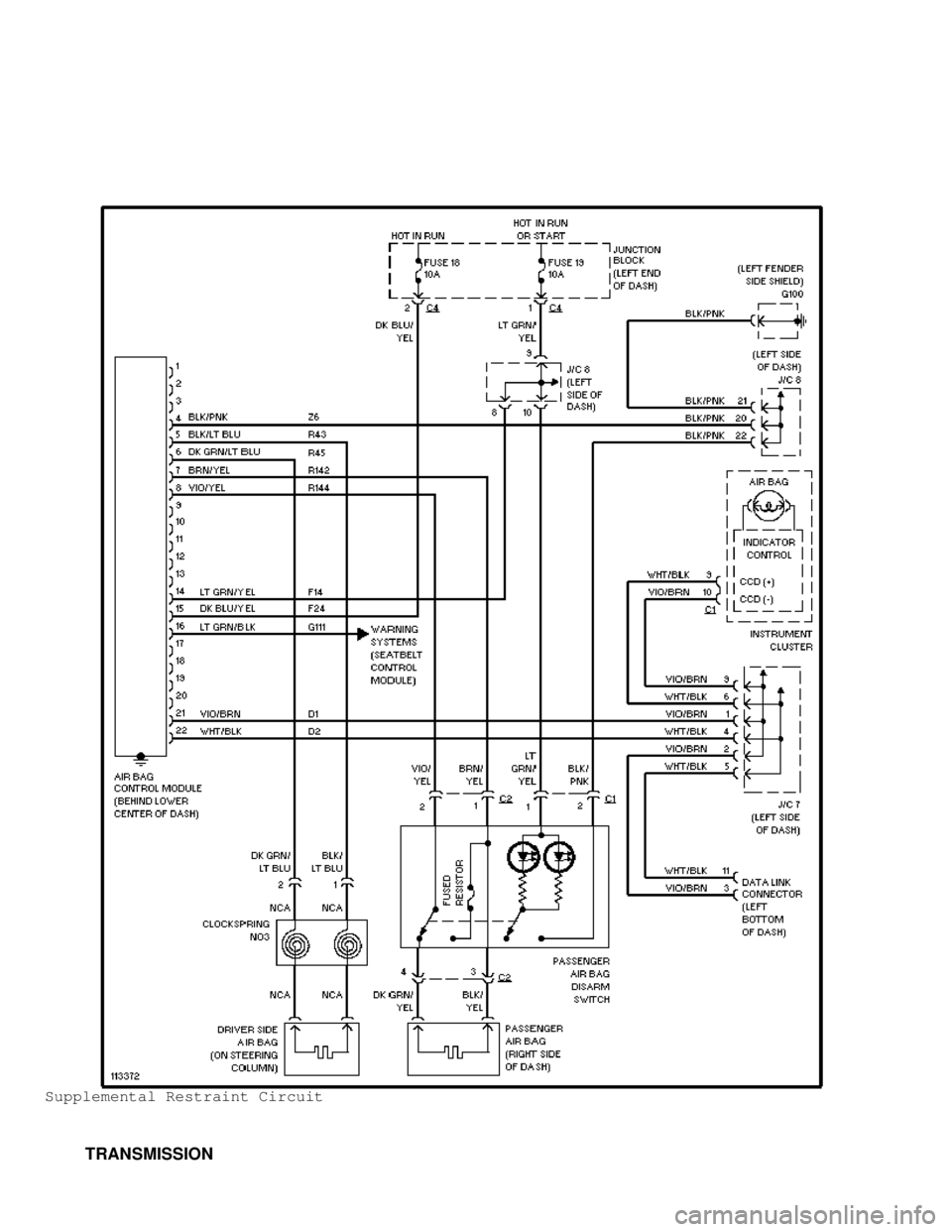
Supplemental Restraint Circuit
TRANSMISSION
Page 1461 of 1691
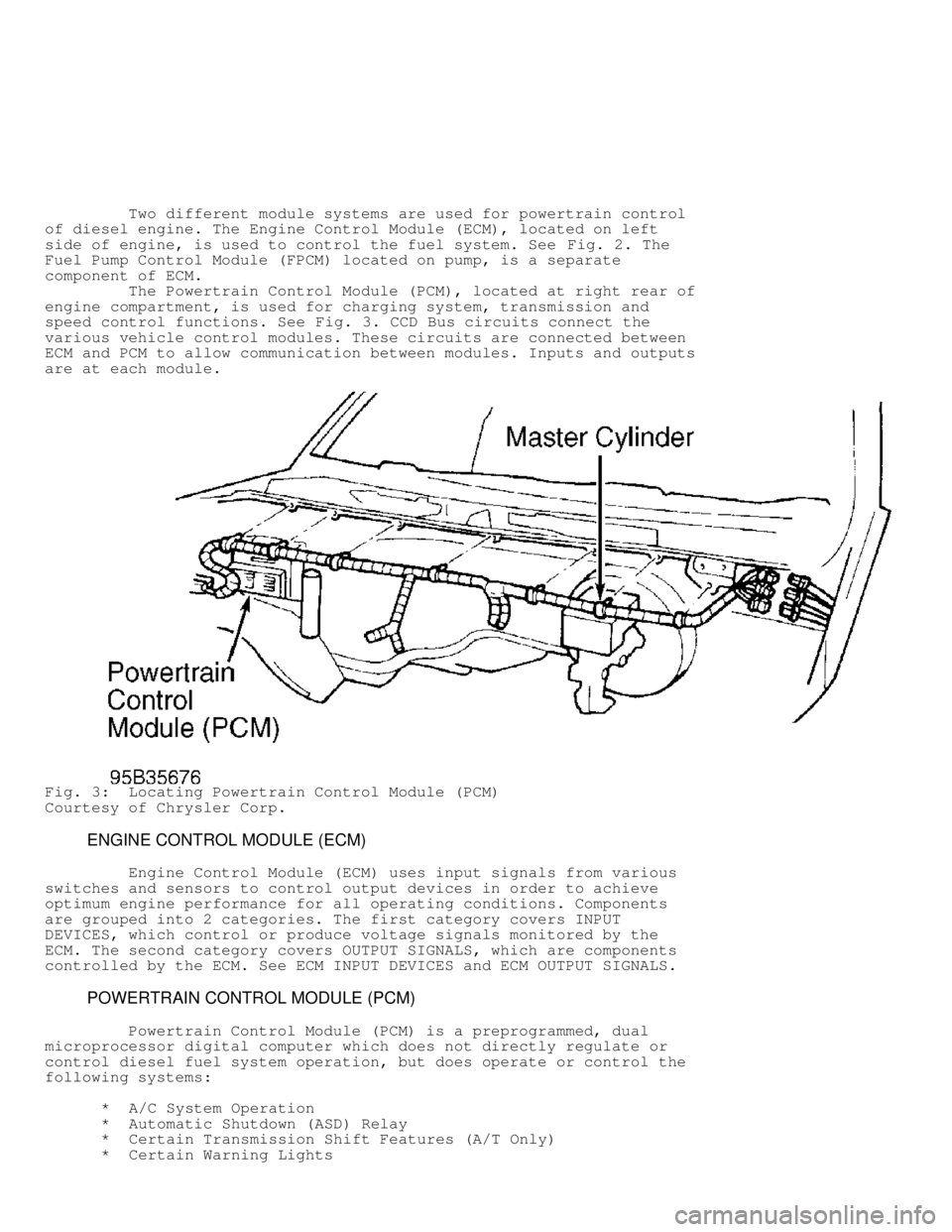
Two different module systems are used for powertrain control
of diesel engine. The Engine Control Module (ECM), located on left
side of engine, is used to control the fuel system. See Fig. 2. The
Fuel Pump Control Module (FPCM) located on pump, is a separate
component of ECM.
The Powertrain Control Module (PCM), located at right rear of\
engine compartment, is used for charging system, transmission and
speed control functions. See Fig. 3. CCD Bus circuits connect the
various vehicle control modules. These circuits are connected between
ECM and PCM to allow communication between modules. Inputs and outputs
are at each module.
Fig. 3: Locating Powertrain Control Module (PCM)
Courtesy of Chrysler Corp.
ENGINE CONTROL MODULE (ECM)
Engine Control Module (ECM) uses input signals from various
switches and sensors to control output devices in order to achieve
optimum engine performance for all operating conditions. Components
are grouped into 2 categories. The first category covers INPUT
DEVICES, which control or produce voltage signals monitored by the
ECM. The second category covers OUTPUT SIGNALS, which are components
controlled by the ECM. See ECM INPUT DEVICES and ECM OUTPUT SIGNALS.
POWERTRAIN CONTROL MODULE (PCM)
Powertrain Control Module (PCM) is a preprogrammed, dual
microprocessor digital computer which does not directly regulate or
control diesel fuel system operation, but does operate or control the
following systems:
* A/C System Operation
* Automatic Shutdown (ASD) Relay
* Certain Transmission Shift Features (A/T Only)
* Certain Warning Lights
Page 1462 of 1691

* Charging System
* Cruise Control System
* Intake Manifold Air Heater
* Tachometer
* Torque Convertor Clutch Engagement (A/T Only)
* Transmission Overdrive Solenoid (A/T Only) Components are
grouped into 2 categories. The first category covers INPUT
DEVICES, which control or produce voltage signals monitored
by the PCM. The second category covers OUTPUT SIGNALS, which
are components controlled by the PCM. See PCM INPUT SIGNALS
and ECM/PCM OUTPUT SIGNALS.
ECM INPUT SIGNALS
Accelerator Pedal Position Sensor (APPS)
APPS sensor is mounted on top left of engine. See Fig. 2.
Sensor provides DC voltage input signal to Engine Control Module (ECM)\
to indicate throttle position. On previous engines, there were
linkages between accelerator pedal, throttle position sensor and
injection pump. On this engine, no linkage exists between accelerator
pedal and injection pump. ECM uses input signals from APPS sensor to
determine proper fuel delivery. ECM also outputs this signal to PCM.
Battery Voltage
Battery voltage input signal provides operating voltage to
Engine Control Module (ECM). This input signal keeps ECM memory alive
and informs ECM what generator output voltage is when engine is
running. ECM memory is used to store Diagnostic Trouble Codes (DTCs),
store APPS sensor voltages from previous key cycles and provide a
speed control adaptive memory.
Camshaft Position Sensor (CMP)
Camshaft Position (CMP) sensor is a hall effect sensor (0-5
volts switched), located below injection pump in rear face of timing
gear cover. Sensor is not used for fuel control. Sensor is used only
for diagnostic purposes.
CCD Bus Circuits
These circuits are connected between Engine Control Module
(ECM) and Powertrain Control Module (PCM) to allow communication
between modules.
Crankshaft Position Sensor (CKP)
Crankshaft Position (CKP) sensor delivers input signal (35
tooth wheel with gap) to Engine Control Module (ECM) to indicate
engine speed and crankshaft position. ECM uses CKP signal along with
other input signals for controlling injector firing sequence and
timing. Sensor is located below fuel transfer pump, on side of engine
block. See Fig. 2.
Data Link Connector (DLC)
Data Link Connector (DLC) provides an input signal to Engine
Control Module (ECM) when using scan tool to retrieve Diagnostic
Trouble Codes (DTCs) from ECM. Input signal may also be used when
performing various tests on the ECM and electronic control system.
Data link connector is a 16-pin connector located at lower edge of
driver's side of instrument panel, just above accelerator pedal.
Engine Coolant Temperature (ECT) Sensor
Engine coolant temperature sensor delivers input signal to
Engine Control Module (ECM) to indicate engine coolant temperature.
ECM uses input signal for controlling fuel control and timing. Engine
coolant temperature sensor is located on front of head, near
Page 1465 of 1691

located in power distribution center at driver's side front corner of
engine compartment, near the battery. Automatic Shutdown (ASD) relay
may also be referred to as Auto Shutdown (ASD) relay.
Battery Temperature Sensor
Battery temperature sensor delivers input signal to
Powertrain Control Module (PCM) to indicate the battery temperature.
PCM uses battery temperature input to modify rate of output from the
charging system. Battery temperature sensor is snapped into battery
tray below driver's side battery.
Battery Voltage
Battery voltage input signal provides operating voltage to
Powertrain Control Module (PCM). This input signal keeps PCM memory
alive and informs PCM what generator output voltage is when engine is
running. PCM memory is used to store Diagnostic Trouble Codes (DTCs),
store APPS sensor voltages from previous key cycles and provide a
speed control adaptive memory.
Brake Switch
Brake switch delivers input signal to Powertrain Control
Module (PCM) to indicate when brakes are applied. PCM uses input
signal for controlling cruise control system and transmission torque
converter clutch operation on A/T models. Brake switch is located near
top of brake pedal and may also be referred to as brakelight switch.
CKP Sensor
Crankshaft Position (CKP) sensor delivers input signal (35
tooth wheel with gap) to Engine Control Module (ECM) to indicate
engine speed and crankshaft position. ECM uses CKP signal along with
other input signals for controlling injector firing sequence and
timing. Sensor is located below fuel transfer pump, on side of engine
block. See Fig. 2.
Cruise Control System Switches
Cruise control system functions, controlled by momentary
contact switches, are monitored through multiplexed input signal to
Powertrain Control Module (PCM). Resistance monitored at this input
signal, in conjunction with the length of time the PCM measures the
resistance, determines which switch feature has been selected.
Data Link Connector (DLC)
Data Link Connector (DLC) provides an input signal to
Powertrain Control Module (PCM) when using scan tool to retrieve
Diagnostic Trouble Codes (DTCs) from PCM. Input signal may also be
used when performing various tests on the PCM and electronic control
system. DLC is a 16-pin connector located at lower edge of driver's
side of instrument panel, just above accelerator pedal.
Fuel Level Sensor
The Powertrain Control Module (PCM) sends a 5-volt signal to
the fuel level sensor. The fuel level sensor will return a signal to
PCM. This signal is used for fuel gauge operation and to prevent
setting a false misfire or fuel system trouble codes. If fuel level is
less than 15 percent, PCM will not set code.
Ignition Sense
Ignition switch position input to Powertrain Control Module
(PCM). PCM uses input to determine proper output functions, including
cruise control, generator output, sensor supply and transmission
functions.
Transmission Speed Sensor (A/T Models)
Page 1466 of 1691

Transmission speed sensor may also be referred to as
transmission output shaft speed sensor. Transmission speed sensor is
located on overdrive case at rear of transmission. Transmission speed
sensor delivers input signal to Powertrain Control Module (PCM) to
indicate transmission output shaft speed.
Overdrive Switch (A/T Models)
Transmission overdrive switch may be referred to as
overdrive/override switch, OD switch or overdrive off switch.
Transmission overdrive switch is located on end of gearshift lever.
When vehicle operator depresses transmission overdrive switch, an
input signal is delivered to the Powertrain Control Module (PCM). The
PCM uses input signal for controlling transmission overdrive shifts by
use of transmission overdrive solenoid on transmission valve body.
Transmission overdrive switch is normally in the ON position, allowing
transmission overdrive operation. If transmission overdrive switch is
depressed once, switch is in OFF position, allowing no transmission
overdrive upshift. If transmission overdrive switch is depressed
again, switch returns to the ON position, allowing transmission
overdrive operation.
Park/Neutral Switch (A/T Models)
Park/neutral switch delivers input signal to Powertrain
Control Module (PCM) to indicate if transmission is in Park, Neutral
or Drive. PCM uses input signal for controlling cruise control system,
transmission torque converter clutch operation and transmission
overdrive solenoid. When park/neutral switch is in Park or Neutral,
switch also provides a ground circuit for the engine starting system.
Park/neutral switch is located on the driver's side of transmission,
near shift linkage.
Transmission Governor Pressure Sensor (A/T Models)
Transmission governor pressure sensor delivers input signal
to Powertrain Control Module (PCM) to indicate transmission governor
pressure. PCM uses input signal for controlling governor pressure by
use of governor pressure solenoid on transmission valve body.
Transmission Temperature Sensor (A/T Models)
Transmission temperature sensor monitors transmission fluid
temperature and delivers input signal to Powertrain Control Module
(PCM). PCM uses input signal for controlling transmission torque
converter clutch operation, transmission overdrive shifts and governor
pressure. Transmission temperature sensor is located on transmission
valve body, incorporated into governor pressure sensor.
PCM prevents torque converter clutch engagement and
transmission overdrive operation when transmission fluid temperature
is less than 50
F (10C). If transmission fluid temperature is more
than 260F (126C), PCM forces a 4-3 downshift and engages torque
converter clutch until transmission fluid cools down. Once
transmission fluid cools to less than 230
F (110C), PCM allows a 3-4
shift again.
Vehicle Speed & Distance
Vehicle speed sensor is no longer used. The vehicle speed and
distance traveled are determined by rear wheel speed sensor. Rear
wheel speed sensor is mounted on top of rear axle housing, above the
ring gear. Rear wheel speed sensor delivers an input signal to
Controller Anti-Lock Brake (CAB) to indicate vehicle speed and
distance traveled. The CAB then delivers input signal to Powertrain
Control Module (PCM) to indicate vehicle speed and distance traveled.
PCM uses input signal for controlling control cruise control system
and fuel system. The CAB is mounted on top of the hydraulic control
unit. Hydraulic control unit contains the pump assembly that
Page 1471 of 1691

signal to the transmission solenoid assembly for transmission
temperature sensor.
Generator Field
Engine Control Module (ECM) provides output signals to
generator field for regulating charging system voltage at 12.9-15.0
volts. ECM contains an internal electronic voltage regulator for
controlling the charging system voltage.
Generator Light
If Engine Control Module (ECM) senses a low charging system
condition, generator light on instrument panel (if equipped) will be
turned on. Generator light may also come on momentarily at low idle
speed when all accessories are on.
Malfunction Indicator Light (MIL)
The MIL is located on the instrument panel, just below
tachometer and may also be referred to as the CHECK ENGINE light. MIL
comes on for a short period and then goes off as a bulb and wiring
circuit test each time ignition switch is turned to the ON position.
If Engine Control Module (ECM) receives an incorrect signal or
receives no signal from certain sensors or components, ECM will turn
on the MIL to warn the driver that a malfunction exists in the
electronic system.
Overdrive Indicator Light (A/T Models)
Engine Control Module (ECM) delivers output signal to operate\
transmission overdrive indicator (O/D OFF) light in accordance with
position of the transmission overdrive switch. If overdrive is turned
off with transmission overdrive switch, transmission overdrive
indicator light will be turned on. Transmission overdrive indicator
light is located on instrument panel, just below the speedometer.
Tachometer
Engine Control Module (ECM) delivers output signal to operate\
tachometer on instrument panel to indicate engine RPM.
Transmission Overdrive Solenoid (A/T Models)
Engine Control Module (ECM) delivers output signal to
transmission overdrive solenoid for controlling transmission overdrive
shifts. Transmission overdrive solenoid is located on transmission
valve body.
Transmission Relay (A/T Models)
Transmission relay may be referred to as transmission control
relay or transmission 12-volt supply relay. Transmission relay ground
circuit is controlled by the Engine Control Module (ECM). When ground
circuit is completed, transmission relay supplies voltage to solenoid
assembly on the transmission. Transmission relay is located in power
distribution center at driver's side front corner of engine
compartment, near the battery.
Transmission Temperature Warning Light (A/T Models With
Heavy-Duty Transmission)
Engine Control Module (ECM) delivers output signal to turn on\
transmission temperature warning light if transmission fluid
temperature is determined to be greater than 280
F (138C) by the
transmission temperature sensor. Transmission temperature warning
light is located on instrument panel, just below the tachometer.
Transmission Torque Converter Clutch Solenoid (A/T Models)
Engine Control Module (ECM) delivers an output signal to
operate transmission torque converter clutch solenoid for torque