radiator DODGE RAM 1999 Service Owner's Manual
[x] Cancel search | Manufacturer: DODGE, Model Year: 1999, Model line: RAM, Model: DODGE RAM 1999Pages: 1691, PDF Size: 40.34 MB
Page 822 of 1691
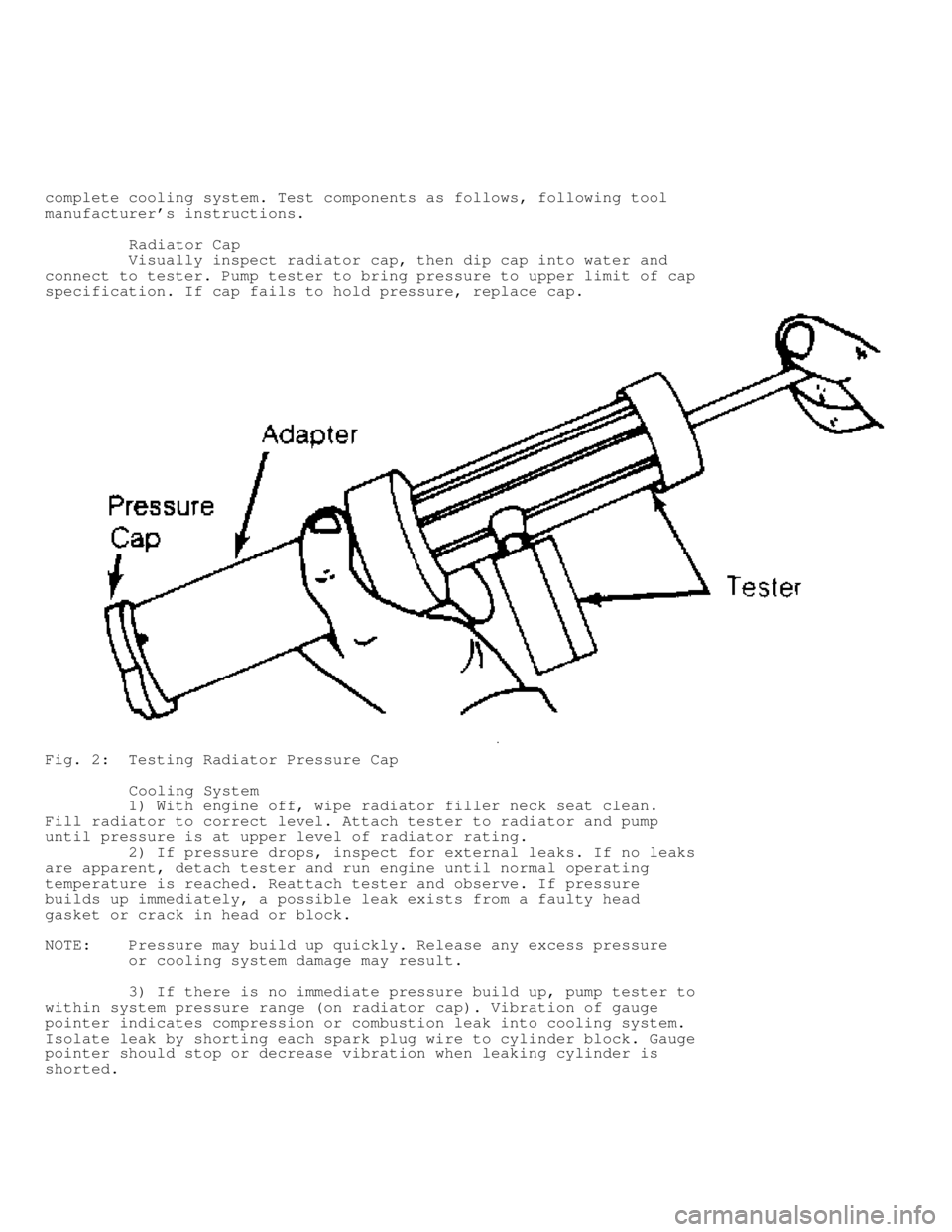
complete cooling system. Test components as follows, following tool
manufacturer's instructions.
Radiator Cap
Visually inspect radiator cap, then dip cap into water and
connect to tester. Pump tester to bring pressure to upper limit of cap
specification. If cap fails to hold pressure, replace cap.
Fig. 2: Testing Radiator Pressure Cap
Cooling System
1) With engine off, wipe radiator filler neck seat clean.
Fill radiator to correct level. Attach tester to radiator and pump
until pressure is at upper level of radiator rating.
2) If pressure drops, inspect for external leaks. If no leaks
are apparent, detach tester and run engine until normal operating
temperature is reached. Reattach tester and observe. If pressure
builds up immediately, a possible leak exists from a faulty head
gasket or crack in head or block.
NOTE: Pressure may build up quickly. Release any excess pressure
or cooling system damage may result.
3) If there is no immediate pressure build up, pump tester to
within system pressure range (on radiator cap). Vibration of gauge
pointer indicates compression or combustion leak into cooling system.
Isolate leak by shorting each spark plug wire to cylinder block. Gauge
pointer should stop or decrease vibration when leaking cylinder is
shorted.
Page 824 of 1691

pointer is at one o'clock position. Push in on knob slightly and
continue rotating knob to its full clockwise stop. Place knob pointer
at a position about .32" (8 mm) beyond end of Red stripe. Release
knob. If knob is pointing at about .32" (8 mm) beyond end of Red
stripe, go to next step. If knob is not pointing at about .32" (8 mm)
beyond end of Red stripe, go back to step 2) and repeat adjustment
procedure.
4) Rotate temperature control knob counterclockwise so that
knob pointer is at 12 o'clock position. Push temperature control knob
straight into heater control panel until perimeter of knob (not knob
pointer) is flush with base of heater control panel.
5) Rotate temperature control knob to its full clockwise
stop. Release knob. Knob pointer should be aimed at end of Red stripe.
If knob is pointed at end of Red stripe, go to next step. If knob is
not pointed at end of Red stripe, go back to step 2) and repeat
adjustment procedure.
6) Rotate temperature control knob to its full
counterclockwise stop. Release knob. If knob springs back, self-
adjuster clip securing temperature control cable to blend-air door
lever is improperly installed. See TEMPERATURE CONTROL CABLE R & I
under REMOVAL & INSTALLATION. If knob does not springs back,
temperature control cable adjustment is complete.
TROUBLE SHOOTING
HEATER PERFORMANCE
Check cooling system. Check serpentine drive belt tension.
Check radiator and radiator fan operation. Ensure that accessory
vacuum supply line is connected at power brake booster (Dakota) or
engine vacuum source (except Dakota).
TESTING
WARNING: To avoid injury from accidental air bag deployment, read and
carefully follow all SERVICE PRECAUTIONS and DISABLING &
ACTIVATING AIR BAG SYSTEM procedures in AIR BAG SYSTEM SAFETY
article.
BLOWER MOTOR RELAYS
1) Blower motor relay is located in Power Distribution Center
(PDC). On Ram Van/Wagon, high speed blower motor relay is located in
engine compartment (on side of heater assembly). On all models,
disconnect negative battery cable. Remove blower motor relay. Using an
ohmmeter, check for continuity between terminals No. 87A and 30 of
relay. See Fig. 1. If continuity does not exist, replace relay. If
continuity exists, go to next step.
2) Using an ohmmeter, check for continuity between terminals
No. 30 and 87 of relay. If continuity exists, replace relay. If
continuity does not exist, go to next step.
3) Measure resistance between terminals No. 85 and 86 of
relay. Reading should be 70-80 ohms. If reading is not as specified,
replace relay. If reading is as specified, go to next step.
4) Using jumper wires, connect battery voltage to terminal
No. 86 and ground terminal No. 85. See Fig. 1. Check that continuity
exists between terminals No. 30 and 87. Check that continuity does not
exist between terminals No. 87A and 30. If continuity is not as
specified, replace blower motor relay. If continuity is as specified,
relay is okay.
Page 829 of 1691

door servo motor electrical connector and mounting bolts. Remove blend
air door servo motor. Ensure blend air door operates properly without
restriction or binding. To install, reverse removal procedure.
Removal & Installation (Ram Van/Wagon)
Disconnect negative battery cable. Remove glove box.
Disconnect wire harness connector from blend air door motor.
Disconnect blend air door motor lever and remove link from retainer.
Remove 3 mounting bolts and remove blend air door motor.
BLOWER MOTOR
Removal (Dakota & Durango)
1) Disconnect negative battery cable. Remove and disassemble
heater assembly. See HEATER ASSEMBLY. Disconnect blower motor lead at
bottom of housing. Remove 6 bolts and blower motor housing cover.
2) Remove blower motor and fan assembly. Place reference
marks on blower motor and fan for installation reference. Remove
blower fan retainer clip. Pull blower motor fan off blower motor
shaft.
Installation
Align reference marks made during removal. Press blower fan
hub onto blower motor shaft. Ensure retainer clip ears are indexed
over flats of blower motor shaft and fan hub. To complete
installation, reverse removal procedure.
Removal (Ram Pickup)
1) Blower motor is located under glove box and can be removed
from passenger compartment. See Fig. 5. Disconnect negative battery
cable. Disconnect blower motor cooling tube. Remove blower motor
electrical connector from retainer. Disconnect electrical connector.
2) Remove blower motor and fan assembly mounting bolts.
Remove blower motor and fan assembly. Place reference marks on blower
motor and fan for installation reference. Remove blower motor fan
retainer clip. Pull blower motor fan off blower motor shaft.
Installation
Align reference marks made during removal. Press blower fan
hub onto blower motor shaft. Ensure retainer clip ears are indexed
over flats of blower motor shaft and fan hub. Ensure blower motor seal
is installed on housing. To complete installation, reverse removal
procedure.
Removal (Ram Van/Wagon)
1) Disconnect negative battery cable. Remove top half of
radiator shroud. At right side of engine compartment, disconnect
blower motor wiring connector and motor cooling tube. Remove nuts and
washers from blower motor backing plate to heater housing studs. See
Fig. 6 .
2) Remove blower motor assembly. Place reference marks on
blower motor and fan for installation reference. Remove blower motor
fan retainer clip. Pull blower motor fan off blower motor shaft.
Inspect backing plate seal for breaks and adhesion.
Installation
Align reference marks made during removal. Press blower fan
hub onto blower motor shaft. Ensure retainer clip ears are indexed
over flats of blower motor shaft and fan hub. Apply a small bead of
rubber sealant to blower motor side of rubber seal. To complete
installation, reverse removal procedure.
Page 832 of 1691

removal procedure.
HEATER ASSEMBLY
Removal (Dakota & Durango)
1) Disconnect negative battery cable. Drain cooling system.
Remove instrument panel. See INSTRUMENT PANEL.
2) In engine compartment, disconnect heater hoses and plug
all openings. Remove 4 heater assembly nuts from engine compartment
firewall. Inside vehicle, remove heater assembly support brace screw,
and swing support brace out of way. Move passenger seat rearward.
3) Carefully pull heater assembly rearward until studs and
heater core tubes clear firewall. Lower heater assembly and rotate
assembly until studs are facing downward. Remove heater assembly from
vehicle.
4) Place heater assembly on work bench with assembly housing
cover facing down. Remove 2 bolts securing heater assembly housing
cover to blower motor housing cover. Unplug vacuum harness connector
from panel/defrost door actuator.
5) Remove floor duct from heater assembly housing. Remove 2
bolts securing heater assembly housing cover to lower housing near
floor outlet. Turn assembly over. Disengage vacuum harness retainer
and vacuum harness. Remove 13 screws securing housing cover.
6) Remove blend-air door lever. Gently pry panel-defrost door
lever off. Pull up on heater assembly housing cover far enough to
separate cover sealant and remove cover.
Installation
Ensure blower motor housing cover sealant is in place and in
good condition. To complete installation, reverse removal procedure.
Removal (Ram Pickup)
1) Disconnect negative battery cable. Drain cooling system.
In engine compartment, remove coolant hoses from heater core tubes.
Plug all openings. Remove coolant overflow bottle. Remove instrument
panel. See INSTRUMENT PANEL . Remove Powertrain Control Module (PCM)
and position aside. DO NOT disconnect 60-pin connector from PCM.
2) Remove attaching nuts from studs on engine compartment
side of dash panel. Remove defrost duct. Disconnect electrical
connectors. Remove attaching nuts from studs in passenger compartment
side of dash panel. Remove heater assembly from vehicle.
3) Place heater assembly upside-down on work bench. Remove
screw securing floor duct to bottom of heater assembly and slide floor
duct off of center heat duct adapter. Unsnap center heat duct adapter
from bottom of heater assembly housing. Remove screw hidden behind
adapter. Remove remaining screws and separate heater assembly.
Installation
Ensure mode door pivot pins are properly inserted in holes.
To complete installation, reverse removal procedure.
Removal & Installation (Ram Van/Wagon)
1) Disconnect negative battery cable. Drain engine cooling
system. In engine compartment, protect generator from coolant
spillage. Remove heater hoses from heater core tubes. Plug all
openings. Remove grille, cowl grille support panel, right headlight
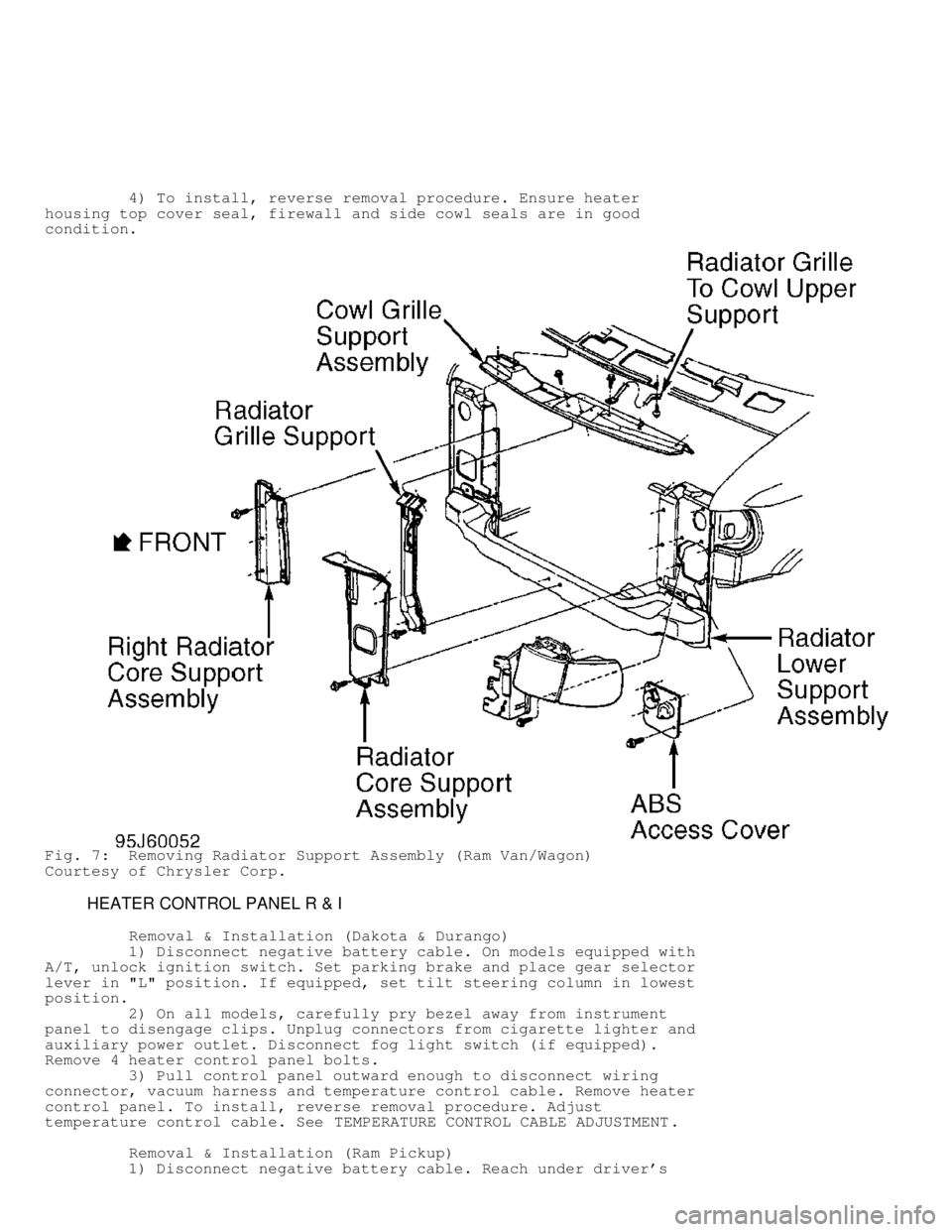
assembly, and right radiator core support assembly. See Fig. 7.
2) From inside vehicle, remove glove box bin. Through glove
box opening and from under instrument panel, remove nuts and bolts
attaching heater assembly to dash panel.
3) Remove blower housing flange screws. Separate heater
assembly from blower housing. See Fig. 6. Carefully remove heater
assembly from vehicle.
Page 833 of 1691
4) To install, reverse removal procedure. Ensure heater
housing top cover seal, firewall and side cowl seals are in good
condition.
Fig. 7: Removing Radiator Support Assembly (Ram Van/Wagon)
Courtesy of Chrysler Corp.
HEATER CONTROL PANEL R & I
Removal & Installation (Dakota & Durango)
1) Disconnect negative battery cable. On models equipped with
A/T, unlock ignition switch. Set parking brake and place gear selector
lever in "L" position. If equipped, set tilt steering column in lowest
position.
2) On all models, carefully pry bezel away from instrument
panel to disengage clips. Unplug connectors from cigarette lighter and
auxiliary power outlet. Disconnect fog light switch (if equipped).
Remove 4 heater control panel bolts.
3) Pull control panel outward enough to disconnect wiring
connector, vacuum harness and temperature control cable. Remove heater
control panel. To install, reverse removal procedure. Adjust
temperature control cable. See TEMPERATURE CONTROL CABLE ADJUSTMENT .
Removal & Installation (Ram Pickup)
1) Disconnect negative battery cable. Reach under driver's
Page 852 of 1691

Parking Brake Switch ...................... Analog Instrument Panels
Park Lights ........................................ Exterior Lights
Park/Neutral Position Switch .............................. Starters
Engine Performance
Anti-Theft System
Body Control Module
Perimeter Lighting Control Relay ................... Exterior Lights
Power Amplifier ..................................... Power Antennas
Power Antenna Module ................................ Power Antennas
Power Antenna Motor ................................. Power Antennas
Power Distribution Center ....................... Power Distribution
Generators & Regulators
Starters
Power Door Lock Motors ............................ Power Door Locks
Power Mirror Motors .................................. Power Mirrors
Memory Systems
Power Sliding Door Controller .............. Power Sliding Side Door
Power Seat Motors ...................................... Power Seats
Memory Systems
Power Steering Pressure Switch .................. Engine Performance
Power Top Motor .............................. Power Convertible Top
Power Top Relay(s) ........................... Power Convertible Top\
Powertrain Control Module ....................... Engine Performance
Analog Instrument Panels
Cruise Control Systems
Data Link Connectors
Generators & Regulators
Starters
Power Window Motors .................................. Power Windows
Power Window Relay(s) ................................ Power Windows\
Radiator Fan Motor(s) ........................ Electric Cooling Fans\
Radiator Fan Relay(s) ........................... Engine Performance\
Electric Cooling Fans
Rainsense Module .............................. Wiper/Washer Systems
Raise Relay .................................. Power Convertible Top
Remote Anti-Theft Personality (RAP) Module ....... Anti-Theft System\
Starters
Warning Systems
Seat Belt Pretensioners ................... Air Bag Restraint System
Seat Belt Retractor Solenoid .................... Passive Restraints
Seat Belt Switch .......................... Air Bag Restraint System
Passive Restraints
Shift Interlock Solenoid ................... Shift Interlock Systems
Shift Lock Actuator ........................ Shift Interlock Systems
Side Marker Lights ................................. Exterior Lights
SIR Coil Assembly (Clockspring) ........... Air Bag Restraint System\
Slip Ring (Clockspring) ................... Air Bag Restraint System\
Steering Column Switches
SRS Control Module ........................ Air Bag Restraint System
Starter Motor ............................................. Starters
Starter Interrupt Relay ................................... Starters
Starter Solenoid .......................................... Starters
Starter Relay ............................................. Starters
Steering Wheel Position Sensor .................... Anti-Lock Brakes
Stoplights ......................................... Exterior Lights
Stoplight Switch ................................ Engine Performance
Cruise Control Systems
Anti-Lock Brakes
Sun Roof ECU ........................................ Power Sun Roof
Sun Roof Motor ...................................... Power Sun Roof
Sun Roof Position Sensor ............................ Power Sun Roof
Taillights ......................................... Exterior Lights
Throttle Position (TP) Sensor ................... Engine Performance\
Page 895 of 1691

CAUTION: If fuel contamination due to fungi or other microorganisms is
suspected a fuel additive with a biocide may be used. Follow
the manufacturers dosage as recommended on product label. Use
biocides ONLY when necessary, excessive use can may cause
other fuel system problems.
DIESEL FUEL CONTAMINATION
WARNING: Diesel fuel system may be contaminated with fungi or other
microorganisms. Keep contaminated fuel away from open skin
cuts or sores to prevent skin irritation or infection.
DIESEL FUEL REQUIREMENTS
CAUTION: All diesel engines have been developed to take advantage of
the high energy content of No. 2 diesel fuel or No. 2
climatized-diesel fuels. It also operates on No. 1-diesel
fuels if temperatures are expected to be extended arctic
conditions -10
\bF (-23\bC).
WARNING: Do NOT use alcohol or gasoline as a fuel blending agent. They
can be unstable under certain conditions and hazardous or
explosive when mixed with diesel fuel.
ELECTROSTATIC DISCHARGE SENSITIVE (ESD) PARTS
WARNING: Many solid state electrical components can be damaged by
static electricity (ESD). Some will display a warning label,
but many will not. Discharge personal static electricity by
touching a metal ground point on the vehicle prior to
servicing any ESD sensitive component.
ENGINE OIL
CAUTION: Never use non-detergent or straight mineral oil.
ENGINE OIL FILTER (CARTRIDGE TYPE)
CAUTION: Use of Mopar Oil Filter Cartridge (P/N 04746914) is
RECOMMENDED. The engine oil filter cartridge should be
changed at every engine oil change. Use the same type oil
that will be used in the engine.
FUEL SYSTEM SERVICE
WARNING: Relieve fuel system pressure prior to servicing any fuel
system component (fuel injection models).
HALOGEN BULBS
WARNING: Halogen bulbs contain pressurized gas which may explode if
overheated. DO NOT touch glass portion of bulb with bare
hands. Eye protection should be worn when handling or working
around halogen bulbs.
RADIATOR CAP
CAUTION: Always disconnect the fan motor when working near the
radiator fan. The fan is temperature controlled and could
start at any time even when the ignition key is in the OFF
position. DO NOT loosen or remove radiator cap when cooling
system is hot.
Page 896 of 1691

RADIATOR FAN
WARNING: Keep hands away from radiator fan.
STARTING FLUID USE (TURBO DIESEL)
WARNING: DO NOT USE starting fluids (ether) or flammable liquids to
aid the starting of a Cummins Turbo-Diesel. NEVER pour diesel
fuel, flammable liquids or starting fluids into the air
cleaner canister, air intake or turbocharger housing in an
attempt to start the vehicle. A flash fire may result causing
personal injury.
TIRE CHAINS
CAUTION: Do NOT install tire chains or traction devices on front
wheels of 4x4 models with tires larger than P215/75R15. Do
NOT install tire chains or traction devices on rear wheels of
4x4 models with tires larger than P235/75R15. These tires are
too large for sufficient body clearance with chains or other
traction devices. Tire chains are not allowed on 4x2 vehicles
equipped with P235/70R15 tires or 4x4 vehicles equipped with
31 x 10.50R15 tires.
CAUTION: Do NOT drive for a prolonged period of time on dry pavement.
TURBOCHARGED MODELS (TURBO-DIESEL)
CAUTION: Do not race engine immediately after starting. When
stopping engine, allow engine to idle for approximately 60
seconds before shutting it off. Failure to do so may cause
turbocharger damage due to lack of oil flowing to
the turbocharger bearings.
WARRANTY INFORMATION
CAUTION: Due to the different warranties offered in various regions
and the variety of after-market extended warranties
available, please refer to the warranty package that came
with the vehicle to verify all warranty options.
FUSES & CIRCUIT BREAKERS
Page 1394 of 1691

in SELF-DIAGNOSTICS - JEEP, TRUCKS & RWD VANS article.
Speed Control Switch
See appropriate DTC P1596: SPEED CONTROL SWITCH ALWAYS HIGH
and DTC P1597: SPEED CONTROL SWITCH ALWAYS LOW tests in SELF-
DIAGNOSTICS - JEEP, TRUCKS & RWD VANS article.
RELAYS
A/C Clutch Relay
See appropriate DTC P0645: A/C CLUTCH RELAY CIRCUIT test in
SELF-DIAGNOSTICS - JEEP, TRUCKS & RWD VANS article.
Auto Shutdown (ASD) Relay
See appropriate DTC P1388: AUTO SHUTDOWN RELAY CONTROL
CIRCUIT test in SELF-DIAGNOSTICS - JEEP, TRUCKS & RWD VANS article.
Fuel Pump Relay
See appropriate DTC P1282: FUEL PUMP RELAY CONTROL CIRCUIT
test in SELF-DIAGNOSTICS - JEEP, TRUCKS & RWD VANS article.
Radiator Fan Control Relay
See appropriate DTC P1491: RADIATOR FAN CONTROL RELAY CIRCUIT
test in SELF-DIAGNOSTICS - JEEP, TRUCKS & RWD VANS article.
Torque Converter Clutch (TCC) Relay
See appropriate DTC P0743: TORQUE CONVERTER CLUTCH
SOLENOID/TRANSMISSION RELAY CIRCUIT test in SELF-DIAGNOSTICS - JEEP,
TRUCKS & RWD VANS article.
Transmission Governor Pressure Solenoid Relay
See appropriate DTC P0748: GOVERNOR PRESSURE
SOLENOID/TRANSMISSION RELAY CIRCUIT test in SELF-DIAGNOSTICS - JEEP,
TRUCKS & RWD VANS article.
Transmission 12-Volt Supply Relay
See appropriate DTC P1765: TRANSMISSION 12-VOLT SUPPLY RELAY
CONTROL CIRCUIT test in SELF-DIAGNOSTICS - JEEP, TRUCKS & RWD VANS
article.
Vehicle Speed Control Relay
See appropriate DTC P1683: SPEED CONTROL POWER RELAY CIRCUIT
test in SELF-DIAGNOSTICS - JEEP, TRUCKS & RWD VANS article.
FUEL SYSTEM
FUEL DELIVERY
NOTE: For fuel system pressure testing, see BASIC DIAGNOSTIC
PROCEDURES - TRUCKS & RWD VANS - GASOLINE article.
FUEL CONTROL
Fuel Injector
See appropriate injector control circuit test in SELF-
DIAGNOSTICS - JEEP, TRUCKS & RWD VANS article.
IDLE CONTROL SYSTEM
IDLE AIR CONTROL (IAC) MOTOR
Page 1396 of 1691

article.
POSITIVE CRANKCASE VENTILATION (PCV)
PCV Valve
1) With engine running at curb idle, remove PCV valve from
grommet. If valve is functioning properly, a hissing sound will be
heard as air passes through valve.
2) With engine running, place finger over valve inlet. Strong
vacuum should be felt at valve inlet. Stop engine. Remove and shake
PCV valve to ensure a metallic clicking noise can be heard, indicating
valve is free. Reinstall PCV valve.
3) Remove crankcase ventilation filter or oil filler cap from
valve cover. Hold a piece of stiff paper over opening. After allowing
about one minute for crankcase pressure stabilization, paper should be
drawn against opening.
4) If paper is held against opening, performance is okay. If
paper is not held against opening, replace PCV valve and retest. If
performance does not improve, inspect system for restrictions and
clean as necessary.
MISCELLANEOUS CONTROLS
NOTE: Although the controlled devices listed here are not
technically engine performance components, they can affect
driveability if they malfunction.
RELAYS
A/C Clutch Relay
See A/C CLUTCH RELAY under RELAYS.
Radiator Fan Control Relay
See RADIATOR FAN CONTROL RELAY under RELAYS.
Torque Converter Clutch (TCC) Relay
See TORQUE CONVERTER CLUTCH (TCC) RELAY under RELAYS
Transmission Governor Pressure Solenoid Relay
See TRANSMISSION GOVERNOR PRESSURE SOLENOID RELAY under
RELAYS.
Transmission 12-Volt Supply Relay
See TRANSMISSION 12-VOLT SUPPLY RELAY under RELAYS.
Vehicle Speed Control Relay
See VEHICLE SPEED CONTROL RELAY under RELAYS.