height adjustment DODGE RAM 2001 Service User Guide
[x] Cancel search | Manufacturer: DODGE, Model Year: 2001, Model line: RAM, Model: DODGE RAM 2001Pages: 2889, PDF Size: 68.07 MB
Page 304 of 2889
The drum forces both brake shoes to move in the
same direction of rotation. Servo action begins with
the primary brake shoe which begins to wedge (or
wrap) itself against the rotating drum surface. This
force is transmitted equally to the secondary brake
shoe through the adjuster screw and anchor pin. The
net result is that each shoe helps the other exert
extra force against the drum. It is servo action that
creates the wedging (or wrap) effect which produces
increased force on the drum braking surface.
All drum brake assemblies are equipped with a self
adjusting mechanism. The components forming the
mechanism consist of the: adjuster screw, adjuster
lever, actuating lever (11 inch brake), lever return
spring and the adjuster lever spring. The adjuster
lever on the 12 inch brake, is also equipped with a
lever and tension spring.
The adjuster mechanism performs two important
functions. First, is in maintaining proper brake shoe
operating clearance. And second, is to maintain brake
pedal height. The mechanism does so, by adjusting
the shoes in small increments to compensate for lin-
ing wear. The adjustment process is continuous
throughout the useful life of the brake lining.
The adjuster components are all connected to the
secondary brake shoes. Actual adjustment only
occurs during reverse brake stops. Secondary brake
shoe movement (during reverse stops), is what acti-
vates the adjuster components.
In operation, secondary shoe movement causes the
adjuster lever spring to exert pull on the lever. This
pivots the lever away from the adjuster screw teeth.
When the stop is completed and the brakes released,
the adjuster lever pivots back to a normal position. It
is during this return movement of the lever when
adjustment occurs. At this point, the lever comes
back into contact with the adjuster screw teeth as it
moves upward. The lever will then rotate the
adjuster screw one or two teeth as needed for adjust-
ment.
NOTE: The adjustment process requires a complete
stop to actually occur. Rolling stops will NOT acti-
vate the adjuster components. In addition, the
adjuster screws are left and right hand parts and
must NOT be interchanged.
DIAGNOSIS AND TESTING - BRAKE DRUM
The maximum allowable diameter of the drum
braking surface is indicated on the drum outer edge.
Generally, a drum can be machined to a maximum of
1.52 mm (0.060 in.) oversize. Always replace the
drum if machining would cause drum diameter to
exceed the size limit indicated on the drum.
BRAKE DRUM RUNOUT
Measure drum diameter and runout with an accu-
rate gauge. The most accurate method of measure-
ment involves mounting the drum in a brake lathe
and checking variation and runout with a dial indi-
cator.
Variations in drum diameter should not exceed
0.069 mm (0.0028 in.). Drum runout should not
exceed 0.18 mm (0.007 in.) out of round. Machine the
drum if runout or variation exceed these values.
Replace the drum if machining causes the drum to
exceed the maximum allowable diameter.
STANDARD PROCEDURE - BRAKE DRUM
MACHINING
The brake drums can be machined on a drum lathe
when necessary. Initial machining cuts should be lim-
ited to 0.12 - 0.20 mm (0.005 - 0.008 in.) at a time as
heavier feed rates can produce taper and surface
variation. Final finish cuts of 0.025 to 0.038 mm
(0.001 to 0.0015 in.) are recommended and will gen-
erally provide the best surface finish.
Be sure the drum is securely mounted in the lathe
before machining operations. A damper strap should
always be used around the drum to reduce vibration
and avoid chatter marks.
The maximum allowable diameter of the drum
braking surface is stamped or cast into the drum
outer edge.
CAUTION: Replace the drum if machining will cause
the drum to exceed the maximum allowable diame-
ter.
CLEANING
Clean the individual brake components, including
the support plate and wheel cylinder exterior, with a
water dampened cloth or with brake cleaner. Do not
use any other cleaning agents. Remove light rust and
scale from the brake shoe contact pads on the sup-
port plate with fine sandpaper.
INSPECTION
As a general rule, riveted brake shoes should be
replaced when worn to within 0.78 mm (1/32 in.) of
the rivet heads. Bonded lining should be replaced
when worn to a thickness of 1.6 mm (1/16 in.).
Examine the lining contact pattern to determine if
the shoes are bent or the drum is tapered. The lining
should exhibit contact across its entire width. Shoes
exhibiting contact only on one side should be
replaced and the drum checked for runout or taper.
Inspect the adjuster screw assembly. Replace the
assembly if the star wheel or threads are damaged,
or the components are severely rusted or corroded.
BR/BEBRAKES 5 - 33
DRUM (Continued)
Page 609 of 2889
SPORT
The fog lamps are serviced from the rearward side
of the front bumper.
(1) Disconnect and isolate the battery negative
cable.
(2) Disengage fog lamp harness connector.
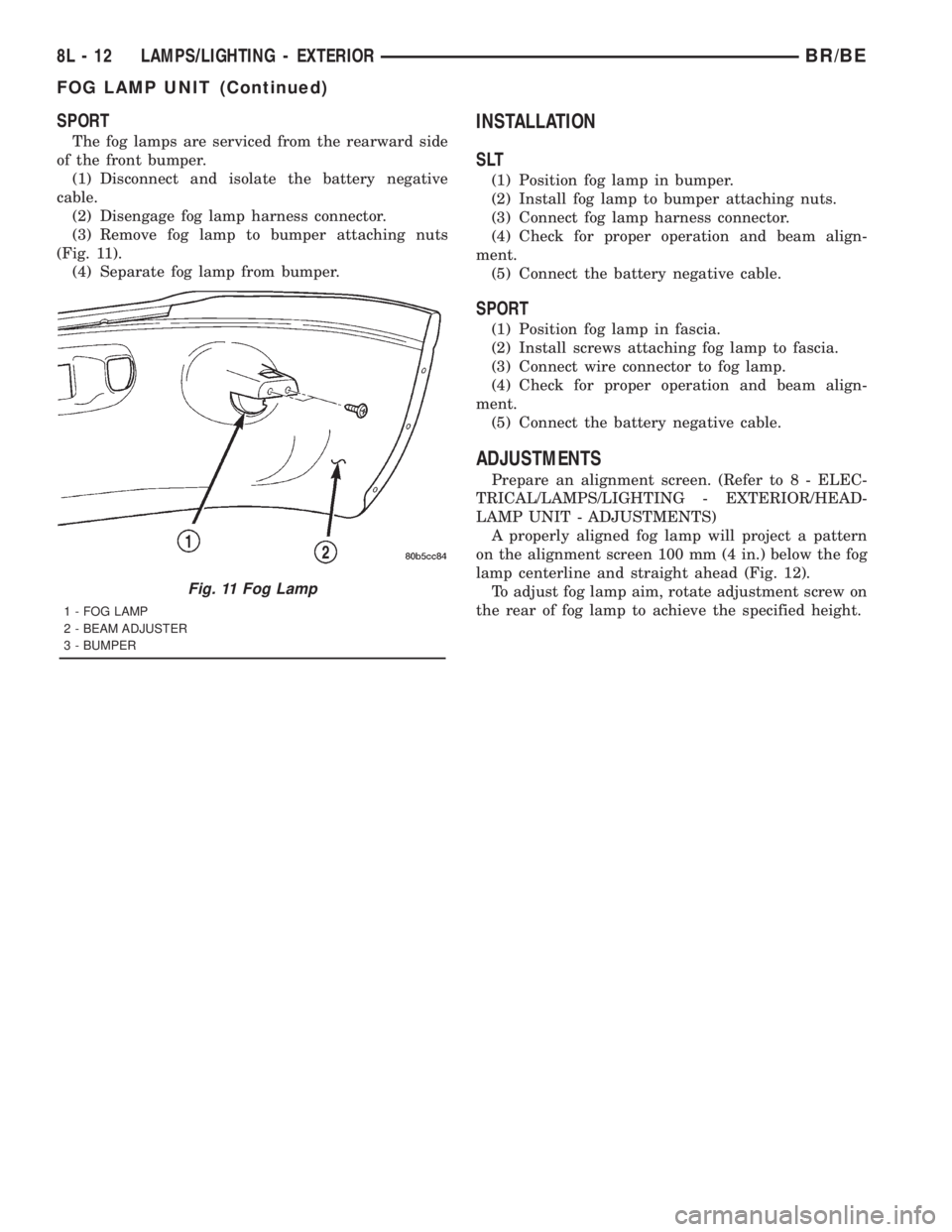
(3) Remove fog lamp to bumper attaching nuts
(Fig. 11).
(4) Separate fog lamp from bumper.
INSTALLATION
SLT
(1) Position fog lamp in bumper.
(2) Install fog lamp to bumper attaching nuts.
(3) Connect fog lamp harness connector.
(4) Check for proper operation and beam align-
ment.
(5) Connect the battery negative cable.
SPORT
(1) Position fog lamp in fascia.
(2) Install screws attaching fog lamp to fascia.
(3) Connect wire connector to fog lamp.
(4) Check for proper operation and beam align-
ment.
(5) Connect the battery negative cable.
ADJUSTMENTS
Prepare an alignment screen. (Refer to 8 - ELEC-
TRICAL/LAMPS/LIGHTING - EXTERIOR/HEAD-
LAMP UNIT - ADJUSTMENTS)
A properly aligned fog lamp will project a pattern
on the alignment screen 100 mm (4 in.) below the fog
lamp centerline and straight ahead (Fig. 12).
To adjust fog lamp aim, rotate adjustment screw on
the rear of fog lamp to achieve the specified height.
Fig. 11 Fog Lamp
1 - FOG LAMP
2 - BEAM ADJUSTER
3 - BUMPER
8L - 12 LAMPS/LIGHTING - EXTERIORBR/BE
FOG LAMP UNIT (Continued)
Page 1174 of 2889
(1) When refacing valve seats, it is important that
the correct size valve guide pilot be used for reseat-
ing stones. A true and complete surface must be
obtained.
(2) Measure the concentricity of valve seat using a
dial indicator. Total runout should not exceed 0.051
mm (0.002 in.) total indicator reading.
(3) Inspect the valve seat with Prussian blue, to
determine where the valve contacts the seat. To do
this, coat valve seat LIGHTLY with Prussian blue
then set valve in place. Rotate the valve with light
pressure. If the blue is transferred to the center of
valve face, contact is satisfactory. If the blue is trans-
ferred to the top edge of valve face, lower valve seat
with a 15É stone. If the blue is transferred to bottom
edge of valve face raise valve seat with a 60É stone.
(4) When seat is properly positioned the width of
intake seats should be 1.016-1.524 mm (0.040-0.060
in.). The width of the exhaust seats should be 1.524-
2.032 mm (0.060-0.080 in.).
VALVE SPRINGS
Whenever valves have been removed for inspection,
reconditioning or replacement, valve springs should
be tested. As an example the compression length of
the spring to be tested is 1-5/16 in.. Turn table of
Universal Valve Spring Tester Tool until surface is in
line with the 1-5/16 in. mark on the threaded stud.
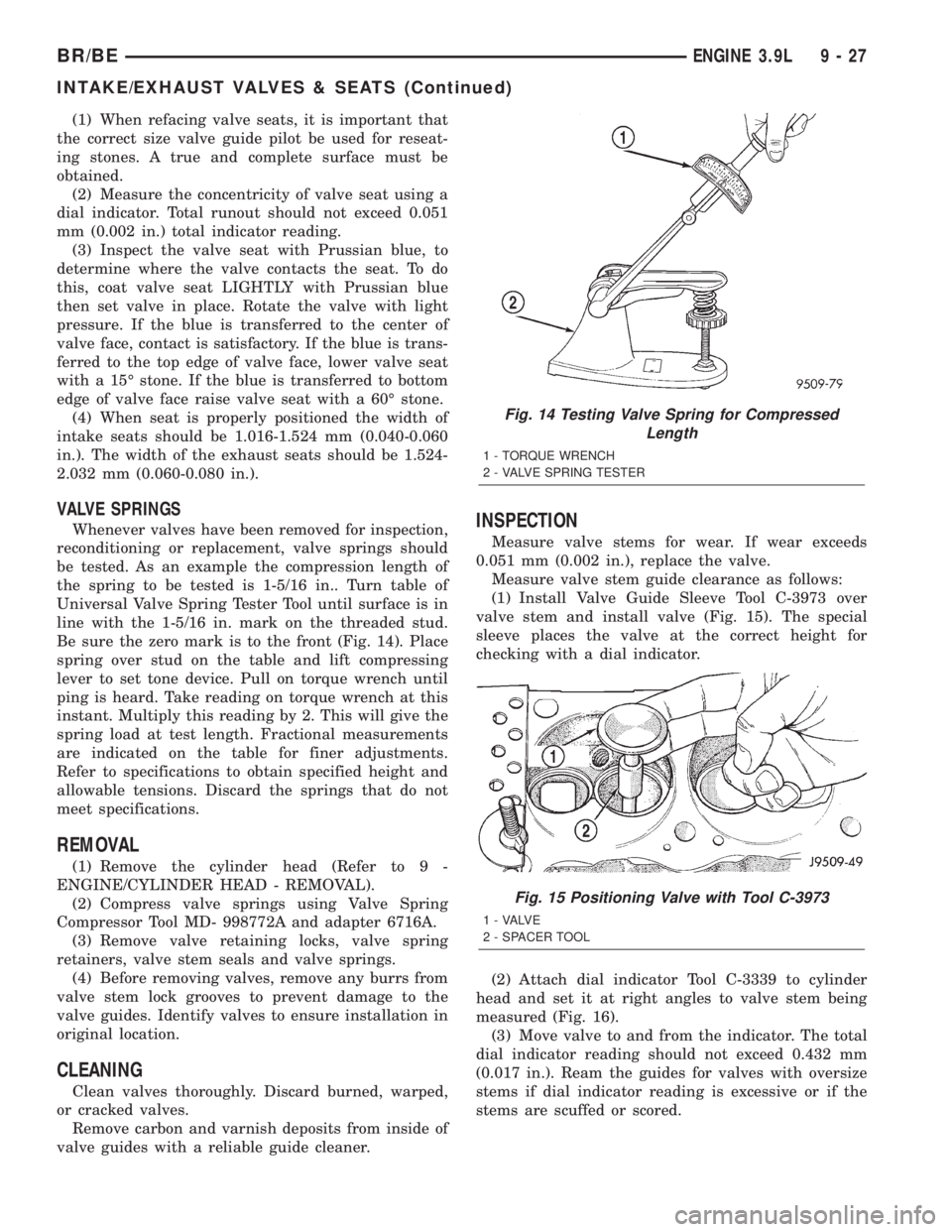
Be sure the zero mark is to the front (Fig. 14). Place
spring over stud on the table and lift compressing
lever to set tone device. Pull on torque wrench until
ping is heard. Take reading on torque wrench at this
instant. Multiply this reading by 2. This will give the
spring load at test length. Fractional measurements
are indicated on the table for finer adjustments.
Refer to specifications to obtain specified height and
allowable tensions. Discard the springs that do not
meet specifications.
REMOVAL
(1) Remove the cylinder head (Refer to 9 -
ENGINE/CYLINDER HEAD - REMOVAL).
(2) Compress valve springs using Valve Spring
Compressor Tool MD- 998772A and adapter 6716A.
(3) Remove valve retaining locks, valve spring
retainers, valve stem seals and valve springs.
(4) Before removing valves, remove any burrs from
valve stem lock grooves to prevent damage to the
valve guides. Identify valves to ensure installation in
original location.
CLEANING
Clean valves thoroughly. Discard burned, warped,
or cracked valves.
Remove carbon and varnish deposits from inside of
valve guides with a reliable guide cleaner.
INSPECTION
Measure valve stems for wear. If wear exceeds
0.051 mm (0.002 in.), replace the valve.
Measure valve stem guide clearance as follows:
(1) Install Valve Guide Sleeve Tool C-3973 over
valve stem and install valve (Fig. 15). The special
sleeve places the valve at the correct height for
checking with a dial indicator.
(2) Attach dial indicator Tool C-3339 to cylinder
head and set it at right angles to valve stem being
measured (Fig. 16).
(3) Move valve to and from the indicator. The total
dial indicator reading should not exceed 0.432 mm
(0.017 in.). Ream the guides for valves with oversize
stems if dial indicator reading is excessive or if the
stems are scuffed or scored.
Fig. 14 Testing Valve Spring for Compressed
Length
1 - TORQUE WRENCH
2 - VALVE SPRING TESTER
Fig. 15 Positioning Valve with Tool C-3973
1 - VALVE
2 - SPACER TOOL
BR/BEENGINE 3.9L 9 - 27
INTAKE/EXHAUST VALVES & SEATS (Continued)
Page 1231 of 2889
(1) When refacing valve seats, it is important that
the correct size valve guide pilot be used for reseat-
ing stones. A true and complete surface must be
obtained.
(2) Measure the concentricity of valve seat using a
dial indicator. Total runout should not exceed 0.051
mm (0.002 in.) total indicator reading.
(3) Inspect the valve seat with Prussian blue, to
determine where the valve contacts the seat. To do
this, coat valve seat LIGHTLY with Prussian blue
then set valve in place. Rotate the valve with light
pressure. If the blue is transferred to the center of
valve face, contact is satisfactory. If the blue is trans-
ferred to the top edge of valve face, lower valve seat
with a 15É stone. If the blue is transferred to bottom
edge of valve face raise valve seat with a 60É stone.
(4) When seat is properly positioned the width of
intake seats should be 1.016-1.524 mm (0.040-0.060
in.). The width of the exhaust seats should be 1.524-
2.032 mm (0.060-0.080 in.).
VALVE SPRINGS
Whenever valves have been removed for inspection,
reconditioning or replacement, valve springs should
be tested. As an example the compression length of
the spring to be tested is 1-5/16 in.. Turn table of
Universal Valve Spring Tester Tool until surface is in
line with the 1-5/16 in. mark on the threaded stud.
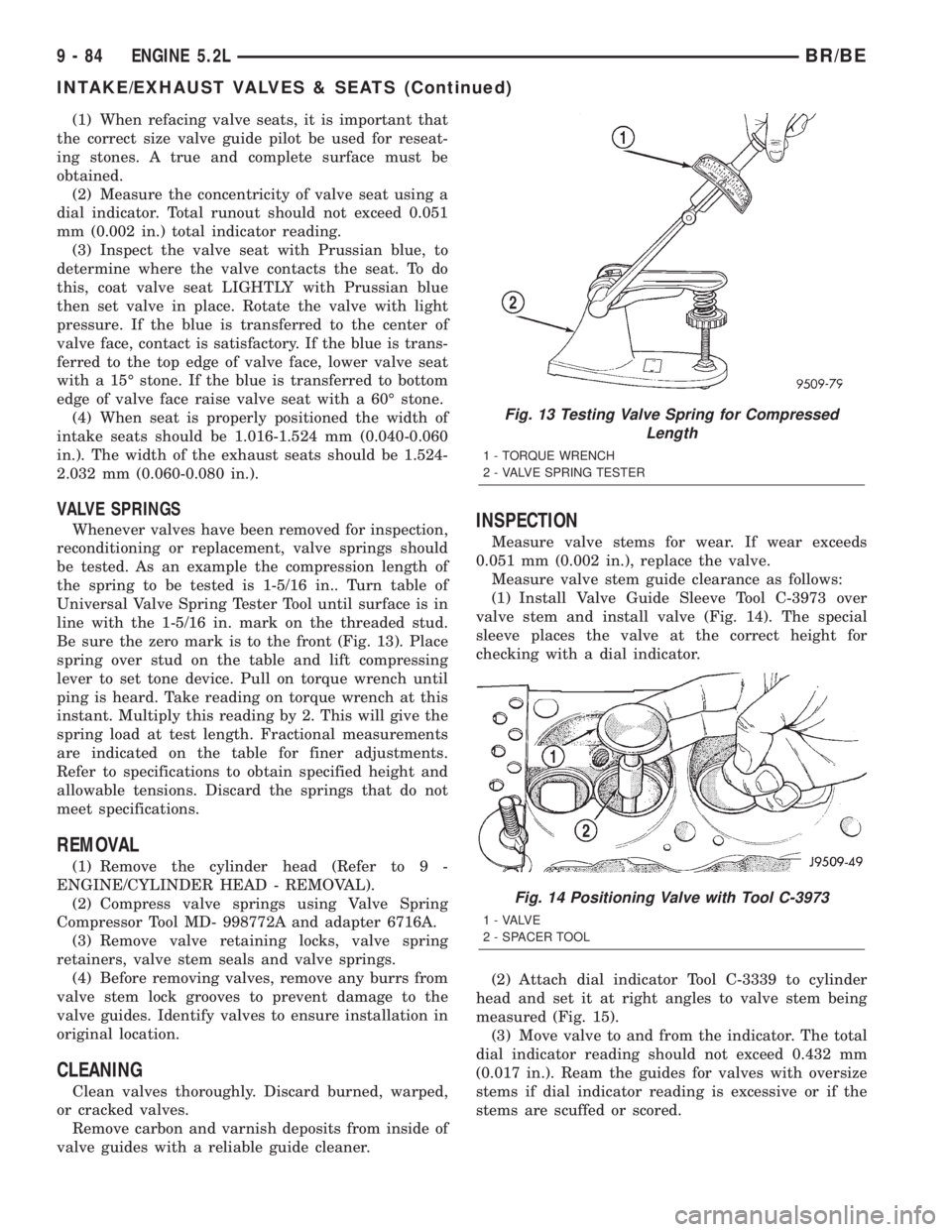
Be sure the zero mark is to the front (Fig. 13). Place
spring over stud on the table and lift compressing
lever to set tone device. Pull on torque wrench until
ping is heard. Take reading on torque wrench at this
instant. Multiply this reading by 2. This will give the
spring load at test length. Fractional measurements
are indicated on the table for finer adjustments.
Refer to specifications to obtain specified height and
allowable tensions. Discard the springs that do not
meet specifications.
REMOVAL
(1) Remove the cylinder head (Refer to 9 -
ENGINE/CYLINDER HEAD - REMOVAL).
(2) Compress valve springs using Valve Spring
Compressor Tool MD- 998772A and adapter 6716A.
(3) Remove valve retaining locks, valve spring
retainers, valve stem seals and valve springs.
(4) Before removing valves, remove any burrs from
valve stem lock grooves to prevent damage to the
valve guides. Identify valves to ensure installation in
original location.
CLEANING
Clean valves thoroughly. Discard burned, warped,
or cracked valves.
Remove carbon and varnish deposits from inside of
valve guides with a reliable guide cleaner.
INSPECTION
Measure valve stems for wear. If wear exceeds
0.051 mm (0.002 in.), replace the valve.
Measure valve stem guide clearance as follows:
(1) Install Valve Guide Sleeve Tool C-3973 over
valve stem and install valve (Fig. 14). The special
sleeve places the valve at the correct height for
checking with a dial indicator.
(2) Attach dial indicator Tool C-3339 to cylinder
head and set it at right angles to valve stem being
measured (Fig. 15).
(3) Move valve to and from the indicator. The total
dial indicator reading should not exceed 0.432 mm
(0.017 in.). Ream the guides for valves with oversize
stems if dial indicator reading is excessive or if the
stems are scuffed or scored.
Fig. 13 Testing Valve Spring for Compressed
Length
1 - TORQUE WRENCH
2 - VALVE SPRING TESTER
Fig. 14 Positioning Valve with Tool C-3973
1 - VALVE
2 - SPACER TOOL
9 - 84 ENGINE 5.2LBR/BE
INTAKE/EXHAUST VALVES & SEATS (Continued)
Page 1287 of 2889
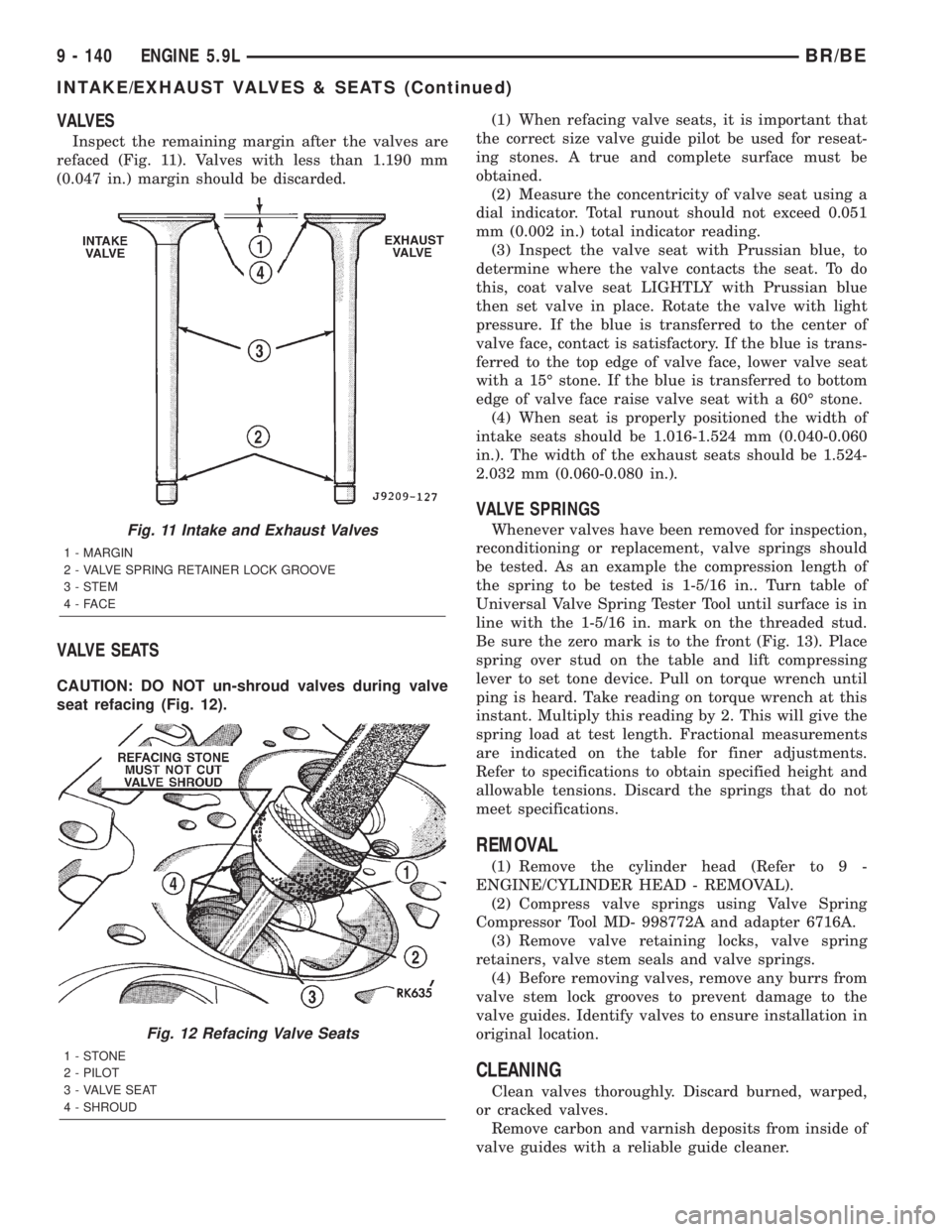
VALVES
Inspect the remaining margin after the valves are
refaced (Fig. 11). Valves with less than 1.190 mm
(0.047 in.) margin should be discarded.
VALVE SEATS
CAUTION: DO NOT un-shroud valves during valve
seat refacing (Fig. 12).(1) When refacing valve seats, it is important that
the correct size valve guide pilot be used for reseat-
ing stones. A true and complete surface must be
obtained.
(2) Measure the concentricity of valve seat using a
dial indicator. Total runout should not exceed 0.051
mm (0.002 in.) total indicator reading.
(3) Inspect the valve seat with Prussian blue, to
determine where the valve contacts the seat. To do
this, coat valve seat LIGHTLY with Prussian blue
then set valve in place. Rotate the valve with light
pressure. If the blue is transferred to the center of
valve face, contact is satisfactory. If the blue is trans-
ferred to the top edge of valve face, lower valve seat
with a 15É stone. If the blue is transferred to bottom
edge of valve face raise valve seat with a 60É stone.
(4) When seat is properly positioned the width of
intake seats should be 1.016-1.524 mm (0.040-0.060
in.). The width of the exhaust seats should be 1.524-
2.032 mm (0.060-0.080 in.).
VALVE SPRINGS
Whenever valves have been removed for inspection,
reconditioning or replacement, valve springs should
be tested. As an example the compression length of
the spring to be tested is 1-5/16 in.. Turn table of
Universal Valve Spring Tester Tool until surface is in
line with the 1-5/16 in. mark on the threaded stud.
Be sure the zero mark is to the front (Fig. 13). Place
spring over stud on the table and lift compressing
lever to set tone device. Pull on torque wrench until
ping is heard. Take reading on torque wrench at this
instant. Multiply this reading by 2. This will give the
spring load at test length. Fractional measurements
are indicated on the table for finer adjustments.
Refer to specifications to obtain specified height and
allowable tensions. Discard the springs that do not
meet specifications.
REMOVAL
(1) Remove the cylinder head (Refer to 9 -
ENGINE/CYLINDER HEAD - REMOVAL).
(2) Compress valve springs using Valve Spring
Compressor Tool MD- 998772A and adapter 6716A.
(3) Remove valve retaining locks, valve spring
retainers, valve stem seals and valve springs.
(4) Before removing valves, remove any burrs from
valve stem lock grooves to prevent damage to the
valve guides. Identify valves to ensure installation in
original location.
CLEANING
Clean valves thoroughly. Discard burned, warped,
or cracked valves.
Remove carbon and varnish deposits from inside of
valve guides with a reliable guide cleaner.
Fig. 11 Intake and Exhaust Valves
1 - MARGIN
2 - VALVE SPRING RETAINER LOCK GROOVE
3 - STEM
4-FACE
Fig. 12 Refacing Valve Seats
1-STONE
2 - PILOT
3 - VALVE SEAT
4 - SHROUD
9 - 140 ENGINE 5.9LBR/BE
INTAKE/EXHAUST VALVES & SEATS (Continued)
Page 1344 of 2889
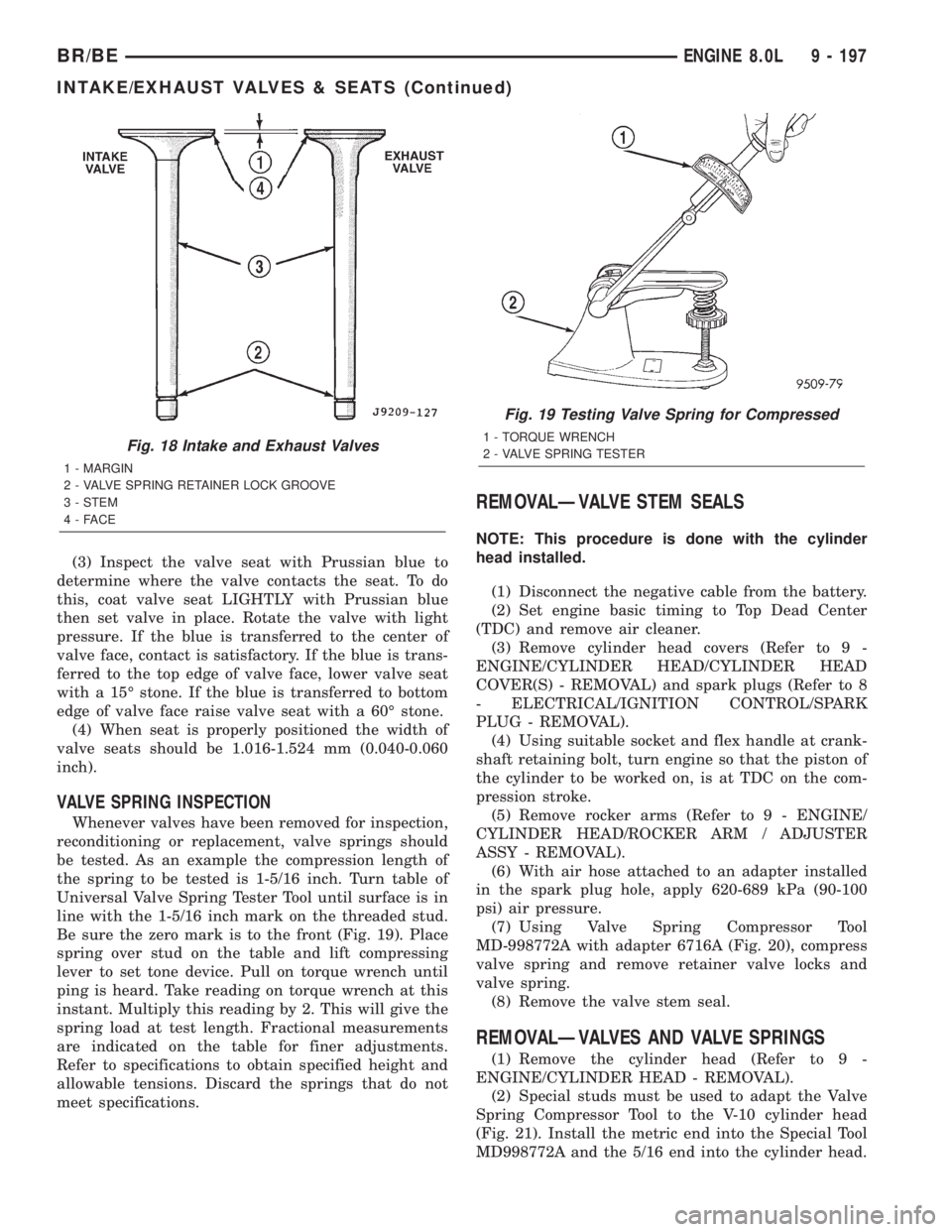
(3) Inspect the valve seat with Prussian blue to
determine where the valve contacts the seat. To do
this, coat valve seat LIGHTLY with Prussian blue
then set valve in place. Rotate the valve with light
pressure. If the blue is transferred to the center of
valve face, contact is satisfactory. If the blue is trans-
ferred to the top edge of valve face, lower valve seat
with a 15É stone. If the blue is transferred to bottom
edge of valve face raise valve seat with a 60É stone.
(4) When seat is properly positioned the width of
valve seats should be 1.016-1.524 mm (0.040-0.060
inch).
VALVE SPRING INSPECTION
Whenever valves have been removed for inspection,
reconditioning or replacement, valve springs should
be tested. As an example the compression length of
the spring to be tested is 1-5/16 inch. Turn table of
Universal Valve Spring Tester Tool until surface is in
line with the 1-5/16 inch mark on the threaded stud.
Be sure the zero mark is to the front (Fig. 19). Place
spring over stud on the table and lift compressing
lever to set tone device. Pull on torque wrench until
ping is heard. Take reading on torque wrench at this
instant. Multiply this reading by 2. This will give the
spring load at test length. Fractional measurements
are indicated on the table for finer adjustments.
Refer to specifications to obtain specified height and
allowable tensions. Discard the springs that do not
meet specifications.
REMOVALÐVALVE STEM SEALS
NOTE: This procedure is done with the cylinder
head installed.
(1) Disconnect the negative cable from the battery.
(2) Set engine basic timing to Top Dead Center
(TDC) and remove air cleaner.
(3) Remove cylinder head covers (Refer to 9 -
ENGINE/CYLINDER HEAD/CYLINDER HEAD
COVER(S) - REMOVAL) and spark plugs (Refer to 8
- ELECTRICAL/IGNITION CONTROL/SPARK
PLUG - REMOVAL).
(4) Using suitable socket and flex handle at crank-
shaft retaining bolt, turn engine so that the piston of
the cylinder to be worked on, is at TDC on the com-
pression stroke.
(5) Remove rocker arms (Refer to 9 - ENGINE/
CYLINDER HEAD/ROCKER ARM / ADJUSTER
ASSY - REMOVAL).
(6) With air hose attached to an adapter installed
in the spark plug hole, apply 620-689 kPa (90-100
psi) air pressure.
(7) Using Valve Spring Compressor Tool
MD-998772A with adapter 6716A (Fig. 20), compress
valve spring and remove retainer valve locks and
valve spring.
(8) Remove the valve stem seal.
REMOVALÐVALVES AND VALVE SPRINGS
(1) Remove the cylinder head (Refer to 9 -
ENGINE/CYLINDER HEAD - REMOVAL).
(2) Special studs must be used to adapt the Valve
Spring Compressor Tool to the V-10 cylinder head
(Fig. 21). Install the metric end into the Special Tool
MD998772A and the 5/16 end into the cylinder head.
Fig. 18 Intake and Exhaust Valves
1 - MARGIN
2 - VALVE SPRING RETAINER LOCK GROOVE
3 - STEM
4-FACE
Fig. 19 Testing Valve Spring for Compressed
1 - TORQUE WRENCH
2 - VALVE SPRING TESTER
BR/BEENGINE 8.0L 9 - 197
INTAKE/EXHAUST VALVES & SEATS (Continued)
Page 1663 of 2889
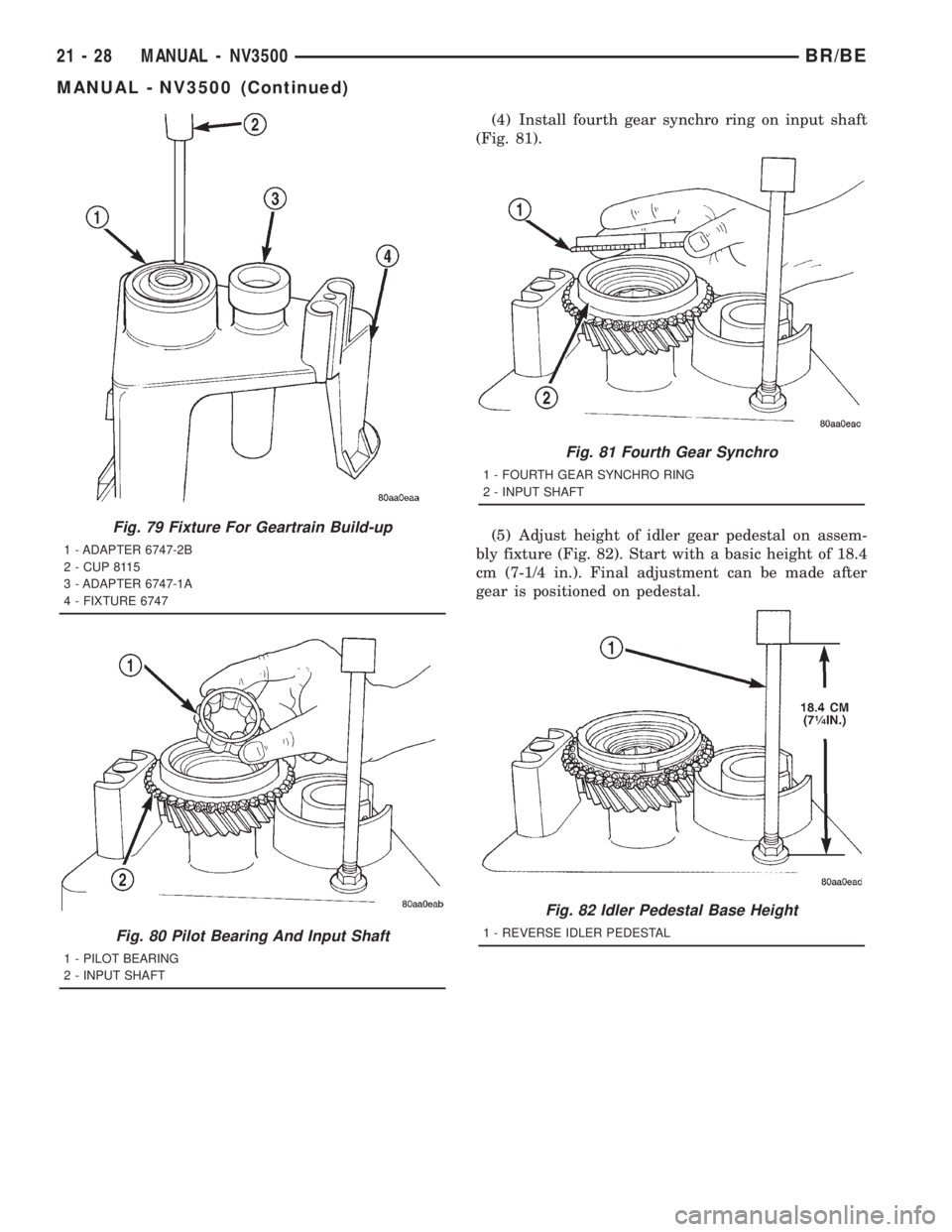
(4) Install fourth gear synchro ring on input shaft
(Fig. 81).
(5) Adjust height of idler gear pedestal on assem-
bly fixture (Fig. 82). Start with a basic height of 18.4
cm (7-1/4 in.). Final adjustment can be made after
gear is positioned on pedestal.
Fig. 79 Fixture For Geartrain Build-up
1 - ADAPTER 6747-2B
2 - CUP 8115
3 - ADAPTER 6747-1A
4 - FIXTURE 6747
Fig. 80 Pilot Bearing And Input Shaft
1 - PILOT BEARING
2 - INPUT SHAFT
Fig. 81 Fourth Gear Synchro
1 - FOURTH GEAR SYNCHRO RING
2 - INPUT SHAFT
Fig. 82 Idler Pedestal Base Height
1 - REVERSE IDLER PEDESTAL
21 - 28 MANUAL - NV3500BR/BE
MANUAL - NV3500 (Continued)
Page 2838 of 2889
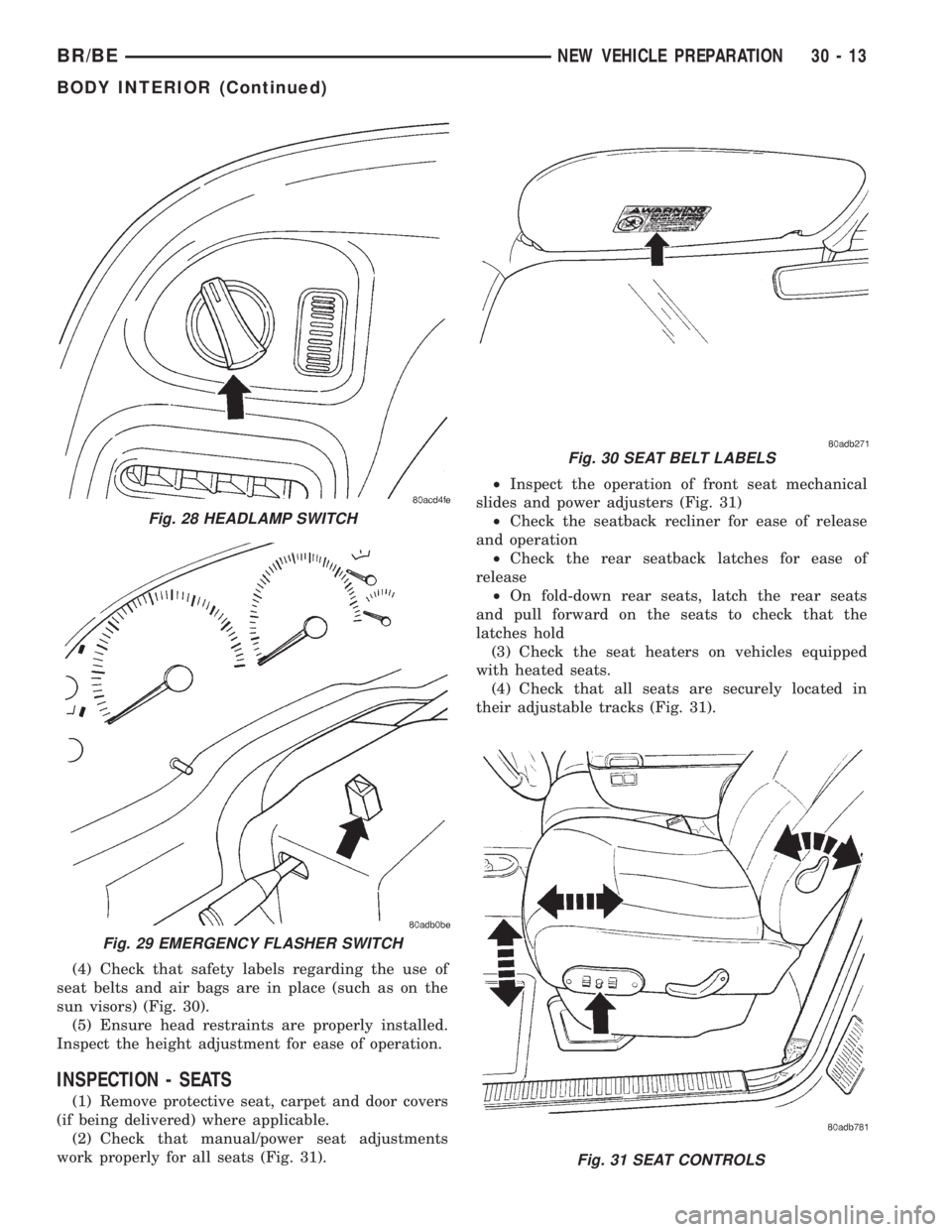
(4) Check that safety labels regarding the use of
seat belts and air bags are in place (such as on the
sun visors) (Fig. 30).
(5) Ensure head restraints are properly installed.
Inspect the height adjustment for ease of operation.
INSPECTION - SEATS
(1) Remove protective seat, carpet and door covers
(if being delivered) where applicable.
(2) Check that manual/power seat adjustments
work properly for all seats (Fig. 31).²Inspect the operation of front seat mechanical
slides and power adjusters (Fig. 31)
²Check the seatback recliner for ease of release
and operation
²Check the rear seatback latches for ease of
release
²On fold-down rear seats, latch the rear seats
and pull forward on the seats to check that the
latches hold
(3) Check the seat heaters on vehicles equipped
with heated seats.
(4) Check that all seats are securely located in
their adjustable tracks (Fig. 31).
Fig. 31 SEAT CONTROLS
Fig. 28 HEADLAMP SWITCH
Fig. 29 EMERGENCY FLASHER SWITCH
Fig. 30 SEAT BELT LABELS
BR/BENEW VEHICLE PREPARATION 30 - 13
BODY INTERIOR (Continued)
Page 2848 of 2889
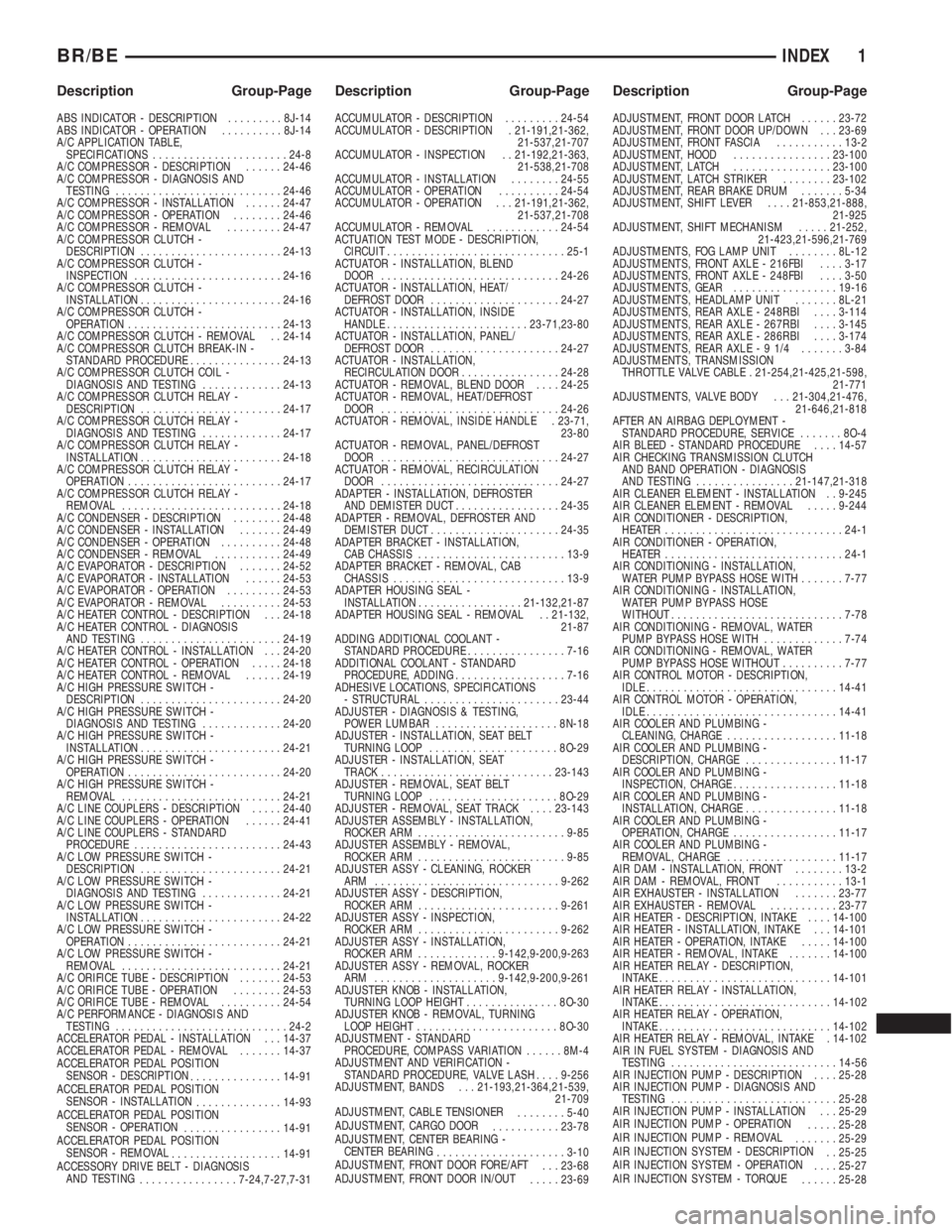
ABS INDICATOR - DESCRIPTION.........8J-14
ABS INDICATOR - OPERATION..........8J-14
A/C APPLICATION TABLE,
SPECIFICATIONS......................24-8
A/C COMPRESSOR - DESCRIPTION......24-46
A/C COMPRESSOR - DIAGNOSIS AND
TESTING...........................24-46
A/C COMPRESSOR - INSTALLATION......24-47
A/C COMPRESSOR - OPERATION........24-46
A/C COMPRESSOR - REMOVAL.........24-47
A/C COMPRESSOR CLUTCH -
DESCRIPTION.......................24-13
A/C COMPRESSOR CLUTCH -
INSPECTION........................24-16
A/C COMPRESSOR CLUTCH -
INSTALLATION.......................24-16
A/C COMPRESSOR CLUTCH -
OPERATION.........................24-13
A/C COMPRESSOR CLUTCH - REMOVAL . . 24-14
A/C COMPRESSOR CLUTCH BREAK-IN -
STANDARD PROCEDURE...............24-13
A/C COMPRESSOR CLUTCH COIL -
DIAGNOSIS AND TESTING.............24-13
A/C COMPRESSOR CLUTCH RELAY -
DESCRIPTION.......................24-17
A/C COMPRESSOR CLUTCH RELAY -
DIAGNOSIS AND TESTING.............24-17
A/C COMPRESSOR CLUTCH RELAY -
INSTALLATION.......................24-18
A/C COMPRESSOR CLUTCH RELAY -
OPERATION.........................24-17
A/C COMPRESSOR CLUTCH RELAY -
REMOVAL..........................24-18
A/C CONDENSER - DESCRIPTION........24-48
A/C CONDENSER - INSTALLATION.......24-49
A/C CONDENSER - OPERATION..........24-48
A/C CONDENSER - REMOVAL...........24-49
A/C EVAPORATOR - DESCRIPTION.......24-52
A/C EVAPORATOR - INSTALLATION......24-53
A/C EVAPORATOR - OPERATION.........24-53
A/C EVAPORATOR - REMOVAL..........24-53
A/C HEATER CONTROL - DESCRIPTION . . . 24-18
A/C HEATER CONTROL - DIAGNOSIS
AND TESTING.......................24-19
A/C HEATER CONTROL - INSTALLATION . . . 24-20
A/C HEATER CONTROL - OPERATION.....24-18
A/C HEATER CONTROL - REMOVAL......24-19
A/C HIGH PRESSURE SWITCH -
DESCRIPTION.......................24-20
A/C HIGH PRESSURE SWITCH -
DIAGNOSIS AND TESTING.............24-20
A/C HIGH PRESSURE SWITCH -
INSTALLATION.......................24-21
A/C HIGH PRESSURE SWITCH -
OPERATION.........................24-20
A/C HIGH PRESSURE SWITCH -
REMOVAL..........................24-21
A/C LINE COUPLERS - DESCRIPTION.....24-40
A/C LINE COUPLERS - OPERATION......24-41
A/C LINE COUPLERS - STANDARD
PROCEDURE........................24-43
A/C LOW PRESSURE SWITCH -
DESCRIPTION.......................24-21
A/C LOW PRESSURE SWITCH -
DIAGNOSIS AND TESTING.............24-21
A/C LOW PRESSURE SWITCH -
INSTALLATION.......................24-22
A/C LOW PRESSURE SWITCH -
OPERATION.........................24-21
A/C LOW PRESSURE SWITCH -
REMOVAL..........................24-21
A/C ORIFICE TUBE - DESCRIPTION.......24-53
A/C ORIFICE TUBE - OPERATION........24-53
A/C ORIFICE TUBE - REMOVAL..........24-54
A/C PERFORMANCE - DIAGNOSIS AND
TESTING............................24-2
ACCELERATOR PEDAL - INSTALLATION . . . 14-37
ACCELERATOR PEDAL - REMOVAL.......14-37
ACCELERATOR PEDAL POSITION
SENSOR - DESCRIPTION
...............14-91
ACCELERATOR PEDAL POSITION
SENSOR - INSTALLATION
..............14-93
ACCELERATOR PEDAL POSITION
SENSOR - OPERATION
................14-91
ACCELERATOR PEDAL POSITION
SENSOR - REMOVAL
..................14-91
ACCESSORY DRIVE BELT - DIAGNOSIS
AND TESTING
................7-24,7-27,7-31ACCUMULATOR - DESCRIPTION.........24-54
ACCUMULATOR - DESCRIPTION . 21-191,21-362,
21-537,21-707
ACCUMULATOR - INSPECTION . . 21-192,21-363,
21-538,21-708
ACCUMULATOR - INSTALLATION........24-55
ACCUMULATOR - OPERATION..........24-54
ACCUMULATOR - OPERATION . . . 21-191,21-362,
21-537,21-708
ACCUMULATOR - REMOVAL............24-54
ACTUATION TEST MODE - DESCRIPTION,
CIRCUIT.............................25-1
ACTUATOR - INSTALLATION, BLEND
DOOR.............................24-26
ACTUATOR - INSTALLATION, HEAT/
DEFROST DOOR.....................24-27
ACTUATOR - INSTALLATION, INSIDE
HANDLE.......................23-71,23-80
ACTUATOR - INSTALLATION, PANEL/
DEFROST DOOR.....................24-27
ACTUATOR - INSTALLATION,
RECIRCULATION DOOR................24-28
ACTUATOR - REMOVAL, BLEND DOOR....24-25
ACTUATOR - REMOVAL, HEAT/DEFROST
DOOR.............................24-26
ACTUATOR - REMOVAL, INSIDE HANDLE . 23-71,
23-80
ACTUATOR - REMOVAL, PANEL/DEFROST
DOOR.............................24-27
ACTUATOR - REMOVAL, RECIRCULATION
DOOR.............................24-27
ADAPTER - INSTALLATION, DEFROSTER
AND DEMISTER DUCT.................24-35
ADAPTER - REMOVAL, DEFROSTER AND
DEMISTER DUCT.....................24-35
ADAPTER BRACKET - INSTALLATION,
CAB CHASSIS........................13-9
ADAPTER BRACKET - REMOVAL, CAB
CHASSIS............................13-9
ADAPTER HOUSING SEAL -
INSTALLATION.................21-132,21-87
ADAPTER HOUSING SEAL - REMOVAL . . 21-132,
21-87
ADDING ADDITIONAL COOLANT -
STANDARD PROCEDURE................7-16
ADDITIONAL COOLANT - STANDARD
PROCEDURE, ADDING..................7-16
ADHESIVE LOCATIONS, SPECIFICATIONS
- STRUCTURAL......................23-44
ADJUSTER - DIAGNOSIS & TESTING,
POWER LUMBAR....................8N-18
ADJUSTER - INSTALLATION, SEAT BELT
TURNING LOOP.....................8O-29
ADJUSTER - INSTALLATION, SEAT
TRACK............................23-143
ADJUSTER - REMOVAL, SEAT BELT
TURNING LOOP.....................8O-29
ADJUSTER - REMOVAL, SEAT TRACK....23-143
ADJUSTER ASSEMBLY - INSTALLATION,
ROCKER ARM........................9-85
ADJUSTER ASSEMBLY - REMOVAL,
ROCKER ARM........................9-85
ADJUSTER ASSY - CLEANING, ROCKER
ARM ..............................9-262
ADJUSTER ASSY - DESCRIPTION,
ROCKER ARM.......................9-261
ADJUSTER ASSY - INSPECTION,
ROCKER ARM.......................9-262
ADJUSTER ASSY - INSTALLATION,
ROCKER ARM.............9-142,9-200,9-263
ADJUSTER ASSY - REMOVAL, ROCKER
ARM ....................9-142,9-200,9-261
ADJUSTER KNOB - INSTALLATION,
TURNING LOOP HEIGHT...............8O-30
ADJUSTER KNOB - REMOVAL, TURNING
LOOP HEIGHT.......................8O-30
ADJUSTMENT - STANDARD
PROCEDURE, COMPASS VARIATION......8M-4
ADJUSTMENT AND VERIFICATION -
STANDARD PROCEDURE, VALVE LASH....9-256
ADJUSTMENT, BANDS . . . 21-193,21-364,21-539,
21-709
ADJUSTMENT, CABLE TENSIONER
........5-40
ADJUSTMENT, CARGO DOOR
...........23-78
ADJUSTMENT, CENTER BEARING -
CENTER BEARING
.....................3-10
ADJUSTMENT, FRONT DOOR FORE/AFT
. . . 23-68
ADJUSTMENT, FRONT DOOR IN/OUT
.....23-69ADJUSTMENT, FRONT DOOR LATCH......23-72
ADJUSTMENT, FRONT DOOR UP/DOWN . . . 23-69
ADJUSTMENT, FRONT FASCIA...........13-2
ADJUSTMENT, HOOD................23-100
ADJUSTMENT, LATCH................23-100
ADJUSTMENT, LATCH STRIKER........23-102
ADJUSTMENT, REAR BRAKE DRUM.......5-34
ADJUSTMENT, SHIFT LEVER....21-853,21-888,
21-925
ADJUSTMENT, SHIFT MECHANISM.....21-252,
21-423,21-596,21-769
ADJUSTMENTS, FOG LAMP UNIT........8L-12
ADJUSTMENTS, FRONT AXLE - 216FBI....3-17
ADJUSTMENTS, FRONT AXLE - 248FBI....3-50
ADJUSTMENTS, GEAR.................19-16
ADJUSTMENTS, HEADLAMP UNIT.......8L-21
ADJUSTMENTS, REAR AXLE - 248RBI....3-114
ADJUSTMENTS, REAR AXLE - 267RBI....3-145
ADJUSTMENTS, REAR AXLE - 286RBI....3-174
ADJUSTMENTS, REAR AXLE - 9 1/4 .......3-84
ADJUSTMENTS, TRANSMISSION
THROTTLE VALVE CABLE . 21-254,21-425,21-598,
21-771
ADJUSTMENTS, VALVE BODY . . . 21-304,21-476,
21-646,21-818
AFTER AN AIRBAG DEPLOYMENT -
STANDARD PROCEDURE, SERVICE.......8O-4
AIR BLEED - STANDARD PROCEDURE....14-57
AIR CHECKING TRANSMISSION CLUTCH
AND BAND OPERATION - DIAGNOSIS
AND TESTING................21-147,21-318
AIR CLEANER ELEMENT - INSTALLATION . . 9-245
AIR CLEANER ELEMENT - REMOVAL.....9-244
AIR CONDITIONER - DESCRIPTION,
HEATER .............................24-1
AIR CONDITIONER - OPERATION,
HEATER .............................24-1
AIR CONDITIONING - INSTALLATION,
WATER PUMP BYPASS HOSE WITH.......7-77
AIR CONDITIONING - INSTALLATION,
WATER PUMP BYPASS HOSE
WITHOUT............................7-78
AIR CONDITIONING - REMOVAL, WATER
PUMP BYPASS HOSE WITH.............7-74
AIR CONDITIONING - REMOVAL, WATER
PUMP BYPASS HOSE WITHOUT..........7-77
AIR CONTROL MOTOR - DESCRIPTION,
IDLE...............................14-41
AIR CONTROL MOTOR - OPERATION,
IDLE...............................14-41
AIR COOLER AND PLUMBING -
CLEANING, CHARGE..................11-18
AIR COOLER AND PLUMBING -
DESCRIPTION, CHARGE...............11-17
AIR COOLER AND PLUMBING -
INSPECTION, CHARGE.................11-18
AIR COOLER AND PLUMBING -
INSTALLATION, CHARGE...............11-18
AIR COOLER AND PLUMBING -
OPERATION, CHARGE.................11-17
AIR COOLER AND PLUMBING -
REMOVAL, CHARGE..................11-17
AIR DAM - INSTALLATION, FRONT........13-2
AIR DAM - REMOVAL, FRONT...........13-1
AIR EXHAUSTER - INSTALLATION.......23-77
AIR EXHAUSTER - REMOVAL...........23-77
AIR HEATER - DESCRIPTION, INTAKE....14-100
AIR HEATER - INSTALLATION, INTAKE . . . 14-101
AIR HEATER - OPERATION, INTAKE.....14-100
AIR HEATER - REMOVAL, INTAKE.......14-100
AIR HEATER RELAY - DESCRIPTION,
INTAKE............................14-101
AIR HEATER RELAY - INSTALLATION,
INTAKE............................14-102
AIR HEATER RELAY - OPERATION,
INTAKE............................14-102
AIR HEATER RELAY - REMOVAL, INTAKE . 14-102
AIR IN FUEL SYSTEM - DIAGNOSIS AND
TESTING...........................14-56
AIR INJECTION PUMP - DESCRIPTION....25-28
AIR INJECTION PUMP - DIAGNOSIS AND
TESTING...........................25-28
AIR INJECTION PUMP - INSTALLATION . . . 25-29
AIR INJECTION PUMP - OPERATION
.....25-28
AIR INJECTION PUMP - REMOVAL
.......25-29
AIR INJECTION SYSTEM - DESCRIPTION
. . 25-25
AIR INJECTION SYSTEM - OPERATION
....25-27
AIR INJECTION SYSTEM - TORQUE
......25-28
BR/BEINDEX 1
Description Group-Page Description Group-Page Description Group-Page
Page 2864 of 2889
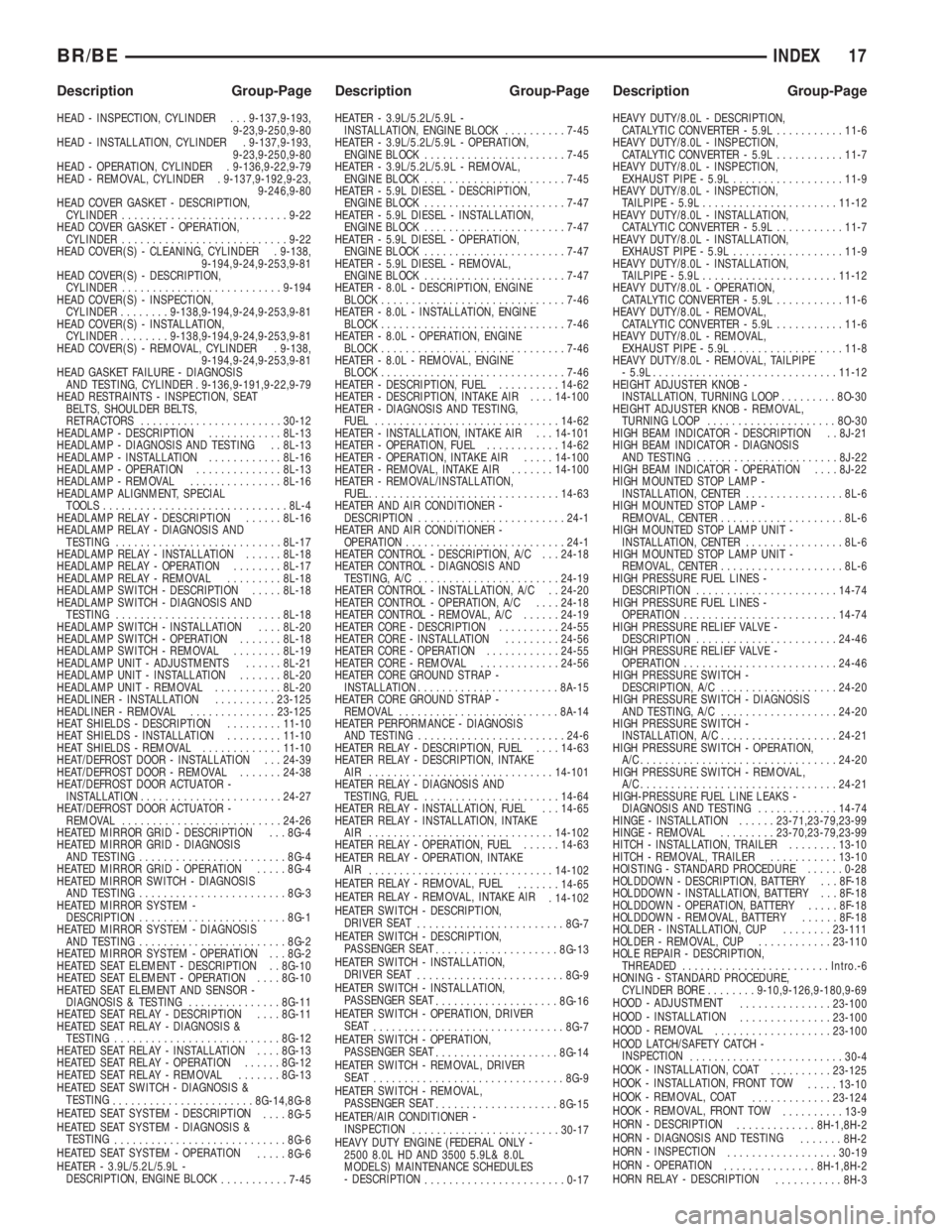
HEAD - INSPECTION, CYLINDER . . . 9-137,9-193,
9-23,9-250,9-80
HEAD - INSTALLATION, CYLINDER . 9-137,9-193,
9-23,9-250,9-80
HEAD - OPERATION, CYLINDER . 9-136,9-22,9-79
HEAD - REMOVAL, CYLINDER . 9-137,9-192,9-23,
9-246,9-80
HEAD COVER GASKET - DESCRIPTION,
CYLINDER...........................9-22
HEAD COVER GASKET - OPERATION,
CYLINDER...........................9-22
HEAD COVER(S) - CLEANING, CYLINDER . 9-138,
9-194,9-24,9-253,9-81
HEAD COVER(S) - DESCRIPTION,
CYLINDER..........................9-194
HEAD COVER(S) - INSPECTION,
CYLINDER........9-138,9-194,9-24,9-253,9-81
HEAD COVER(S) - INSTALLATION,
CYLINDER........9-138,9-194,9-24,9-253,9-81
HEAD COVER(S) - REMOVAL, CYLINDER . 9-138,
9-194,9-24,9-253,9-81
HEAD GASKET FAILURE - DIAGNOSIS
AND TESTING, CYLINDER . 9-136,9-191,9-22,9-79
HEAD RESTRAINTS - INSPECTION, SEAT
BELTS, SHOULDER BELTS,
RETRACTORS.......................30-12
HEADLAMP - DESCRIPTION............8L-13
HEADLAMP - DIAGNOSIS AND TESTING . . 8L-13
HEADLAMP - INSTALLATION............8L-16
HEADLAMP - OPERATION..............8L-13
HEADLAMP - REMOVAL...............8L-16
HEADLAMP ALIGNMENT, SPECIAL
TOOLS..............................8L-4
HEADLAMP RELAY - DESCRIPTION......8L-16
HEADLAMP RELAY - DIAGNOSIS AND
TESTING...........................8L-17
HEADLAMP RELAY - INSTALLATION......8L-18
HEADLAMP RELAY - OPERATION........8L-17
HEADLAMP RELAY - REMOVAL.........8L-18
HEADLAMP SWITCH - DESCRIPTION.....8L-18
HEADLAMP SWITCH - DIAGNOSIS AND
TESTING...........................8L-18
HEADLAMP SWITCH - INSTALLATION....8L-20
HEADLAMP SWITCH - OPERATION.......8L-18
HEADLAMP SWITCH - REMOVAL........8L-19
HEADLAMP UNIT - ADJUSTMENTS......8L-21
HEADLAMP UNIT - INSTALLATION.......8L-20
HEADLAMP UNIT - REMOVAL...........8L-20
HEADLINER - INSTALLATION..........23-125
HEADLINER - REMOVAL..............23-125
HEAT SHIELDS - DESCRIPTION.........11-10
HEAT SHIELDS - INSTALLATION.........11-10
HEAT SHIELDS - REMOVAL.............11-10
HEAT/DEFROST DOOR - INSTALLATION . . . 24-39
HEAT/DEFROST DOOR - REMOVAL.......24-38
HEAT/DEFROST DOOR ACTUATOR -
INSTALLATION.......................24-27
HEAT/DEFROST DOOR ACTUATOR -
REMOVAL..........................24-26
HEATED MIRROR GRID - DESCRIPTION . . . 8G-4
HEATED MIRROR GRID - DIAGNOSIS
AND TESTING........................8G-4
HEATED MIRROR GRID - OPERATION.....8G-4
HEATED MIRROR SWITCH - DIAGNOSIS
AND TESTING........................8G-3
HEATED MIRROR SYSTEM -
DESCRIPTION........................8G-1
HEATED MIRROR SYSTEM - DIAGNOSIS
AND TESTING........................8G-2
HEATED MIRROR SYSTEM - OPERATION . . . 8G-2
HEATED SEAT ELEMENT - DESCRIPTION . . 8G-10
HEATED SEAT ELEMENT - OPERATION....8G-10
HEATED SEAT ELEMENT AND SENSOR -
DIAGNOSIS & TESTING...............8G-11
HEATED SEAT RELAY - DESCRIPTION....8G-11
HEATED SEAT RELAY - DIAGNOSIS &
TESTING...........................8G-12
HEATED SEAT RELAY - INSTALLATION....8G-13
HEATED SEAT RELAY - OPERATION......8G-12
HEATED SEAT RELAY - REMOVAL.......8G-13
HEATED SEAT SWITCH - DIAGNOSIS &
TESTING
.......................8G-14,8G-8
HEATED SEAT SYSTEM - DESCRIPTION
....8G-5
HEATED SEAT SYSTEM - DIAGNOSIS &
TESTING
............................8G-6
HEATED SEAT SYSTEM - OPERATION
.....8G-6
HEATER - 3.9L/5.2L/5.9L -
DESCRIPTION, ENGINE BLOCK
...........7-45HEATER - 3.9L/5.2L/5.9L -
INSTALLATION, ENGINE BLOCK..........7-45
HEATER - 3.9L/5.2L/5.9L - OPERATION,
ENGINE BLOCK.......................7-45
HEATER - 3.9L/5.2L/5.9L - REMOVAL,
ENGINE BLOCK.......................7-45
HEATER - 5.9L DIESEL - DESCRIPTION,
ENGINE BLOCK.......................7-47
HEATER - 5.9L DIESEL - INSTALLATION,
ENGINE BLOCK.......................7-47
HEATER - 5.9L DIESEL - OPERATION,
ENGINE BLOCK.......................7-47
HEATER - 5.9L DIESEL - REMOVAL,
ENGINE BLOCK.......................7-47
HEATER - 8.0L - DESCRIPTION, ENGINE
BLOCK..............................7-46
HEATER - 8.0L - INSTALLATION, ENGINE
BLOCK..............................7-46
HEATER - 8.0L - OPERATION, ENGINE
BLOCK..............................7-46
HEATER - 8.0L - REMOVAL, ENGINE
BLOCK..............................7-46
HEATER - DESCRIPTION, FUEL..........14-62
HEATER - DESCRIPTION, INTAKE AIR....14-100
HEATER - DIAGNOSIS AND TESTING,
FUEL..............................14-62
HEATER - INSTALLATION, INTAKE AIR . . . 14-101
HEATER - OPERATION, FUEL............14-62
HEATER - OPERATION, INTAKE AIR.....14-100
HEATER - REMOVAL, INTAKE AIR.......14-100
HEATER - REMOVAL/INSTALLATION,
FUEL................................14-63
HEATER AND AIR CONDITIONER -
DESCRIPTION........................24-1
HEATER AND AIR CONDITIONER -
OPERATION..........................24-1
HEATER CONTROL - DESCRIPTION, A/C . . . 24-18
HEATER CONTROL - DIAGNOSIS AND
TESTING, A/C.......................24-19
HEATER CONTROL - INSTALLATION, A/C . . 24-20
HEATER CONTROL - OPERATION, A/C....24-18
HEATER CONTROL - REMOVAL, A/C......24-19
HEATER CORE - DESCRIPTION..........24-55
HEATER CORE - INSTALLATION.........24-56
HEATER CORE - OPERATION............24-55
HEATER CORE - REMOVAL.............24-56
HEATER CORE GROUND STRAP -
INSTALLATION.......................8A-15
HEATER CORE GROUND STRAP -
REMOVAL..........................8A-14
HEATER PERFORMANCE - DIAGNOSIS
AND TESTING........................24-6
HEATER RELAY - DESCRIPTION, FUEL....14-63
HEATER RELAY - DESCRIPTION, INTAKE
AIR ..............................14-101
HEATER RELAY - DIAGNOSIS AND
TESTING, FUEL......................14-64
HEATER RELAY - INSTALLATION, FUEL . . . 14-65
HEATER RELAY - INSTALLATION, INTAKE
AIR ..............................14-102
HEATER RELAY - OPERATION, FUEL......14-63
HEATER RELAY - OPERATION, INTAKE
AIR
..............................14-102
HEATER RELAY - REMOVAL, FUEL
.......14-65
HEATER RELAY - REMOVAL, INTAKE AIR
. 14-102
HEATER SWITCH - DESCRIPTION,
DRIVER SEAT
........................8G-7
HEATER SWITCH - DESCRIPTION,
PASSENGER SEAT
....................8G-13
HEATER SWITCH - INSTALLATION,
DRIVER SEAT
........................8G-9
HEATER SWITCH - INSTALLATION,
PASSENGER SEAT
....................8G-16
HEATER SWITCH - OPERATION, DRIVER
SEAT
...............................8G-7
HEATER SWITCH - OPERATION,
PASSENGER SEAT
....................8G-14
HEATER SWITCH - REMOVAL, DRIVER
SEAT
...............................8G-9
HEATER SWITCH - REMOVAL,
PASSENGER SEAT
....................8G-15
HEATER/AIR CONDITIONER -
INSPECTION
........................30-17
HEAVY DUTY ENGINE (FEDERAL ONLY -
2500 8.0L HD AND 3500 5.9L& 8.0L
MODELS) MAINTENANCE SCHEDULES
- DESCRIPTION
.......................0-17HEAVY DUTY/8.0L - DESCRIPTION,
CATALYTIC CONVERTER - 5.9L...........11-6
HEAVY DUTY/8.0L - INSPECTION,
CATALYTIC CONVERTER - 5.9L...........11-7
HEAVY DUTY/8.0L - INSPECTION,
EXHAUST PIPE - 5.9L..................11-9
HEAVY DUTY/8.0L - INSPECTION,
TAILPIPE - 5.9L......................11-12
HEAVY DUTY/8.0L - INSTALLATION,
CATALYTIC CONVERTER - 5.9L...........11-7
HEAVY DUTY/8.0L - INSTALLATION,
EXHAUST PIPE - 5.9L..................11-9
HEAVY DUTY/8.0L - INSTALLATION,
TAILPIPE - 5.9L......................11-12
HEAVY DUTY/8.0L - OPERATION,
CATALYTIC CONVERTER - 5.9L...........11-6
HEAVY DUTY/8.0L - REMOVAL,
CATALYTIC CONVERTER - 5.9L...........11-6
HEAVY DUTY/8.0L - REMOVAL,
EXHAUST PIPE - 5.9L..................11-8
HEAVY DUTY/8.0L - REMOVAL, TAILPIPE
- 5.9L..............................11-12
HEIGHT ADJUSTER KNOB -
INSTALLATION, TURNING LOOP.........8O-30
HEIGHT ADJUSTER KNOB - REMOVAL,
TURNING LOOP.....................8O-30
HIGH BEAM INDICATOR - DESCRIPTION . . 8J-21
HIGH BEAM INDICATOR - DIAGNOSIS
AND TESTING.......................8J-22
HIGH BEAM INDICATOR - OPERATION....8J-22
HIGH MOUNTED STOP LAMP -
INSTALLATION, CENTER................8L-6
HIGH MOUNTED STOP LAMP -
REMOVAL, CENTER....................8L-6
HIGH MOUNTED STOP LAMP UNIT -
INSTALLATION, CENTER................8L-6
HIGH MOUNTED STOP LAMP UNIT -
REMOVAL, CENTER....................8L-6
HIGH PRESSURE FUEL LINES -
DESCRIPTION.......................14-74
HIGH PRESSURE FUEL LINES -
OPERATION.........................14-74
HIGH PRESSURE RELIEF VALVE -
DESCRIPTION.......................24-46
HIGH PRESSURE RELIEF VALVE -
OPERATION.........................24-46
HIGH PRESSURE SWITCH -
DESCRIPTION, A/C...................24-20
HIGH PRESSURE SWITCH - DIAGNOSIS
AND TESTING, A/C...................24-20
HIGH PRESSURE SWITCH -
INSTALLATION, A/C...................24-21
HIGH PRESSURE SWITCH - OPERATION,
A/C................................24-20
HIGH PRESSURE SWITCH - REMOVAL,
A/C................................24-21
HIGH-PRESSURE FUEL LINE LEAKS -
DIAGNOSIS AND TESTING.............14-74
HINGE - INSTALLATION......23-71,23-79,23-99
HINGE - REMOVAL.........23-70,23-79,23-99
HITCH - INSTALLATION, TRAILER........13-10
HITCH - REMOVAL, TRAILER...........13-10
HOISTING - STANDARD PROCEDURE......0-28
HOLDDOWN - DESCRIPTION, BATTERY . . . 8F-18
HOLDDOWN - INSTALLATION, BATTERY . . . 8F-18
HOLDDOWN - OPERATION, BATTERY.....8F-18
HOLDDOWN - REMOVAL, BATTERY......8F-18
HOLDER - INSTALLATION, CUP........23-111
HOLDER - REMOVAL, CUP............23-110
HOLE REPAIR - DESCRIPTION,
THREADED........................Intro.-6
HONING - STANDARD PROCEDURE,
CYLINDER BORE........9-10,9-126,9-180,9-69
HOOD - ADJUSTMENT
...............23-100
HOOD - INSTALLATION
...............23-100
HOOD - REMOVAL
...................23-100
HOOD LATCH/SAFETY CATCH -
INSPECTION
.........................30-4
HOOK - INSTALLATION, COAT
..........23-125
HOOK - INSTALLATION, FRONT TOW
.....13-10
HOOK - REMOVAL, COAT
.............23-124
HOOK - REMOVAL, FRONT TOW
..........13-9
HORN - DESCRIPTION
.............8H-1,8H-2
HORN - DIAGNOSIS AND TESTING
.......8H-2
HORN - INSPECTION
..................30-19
HORN - OPERATION
...............8H-1,8H-2
HORN RELAY - DESCRIPTION
...........8H-3
BR/BEINDEX 17
Description Group-Page Description Group-Page Description Group-Page