brake sensor DODGE RAM 2001 Service Owner's Manual
[x] Cancel search | Manufacturer: DODGE, Model Year: 2001, Model line: RAM, Model: DODGE RAM 2001Pages: 2889, PDF Size: 68.07 MB
Page 186 of 2889
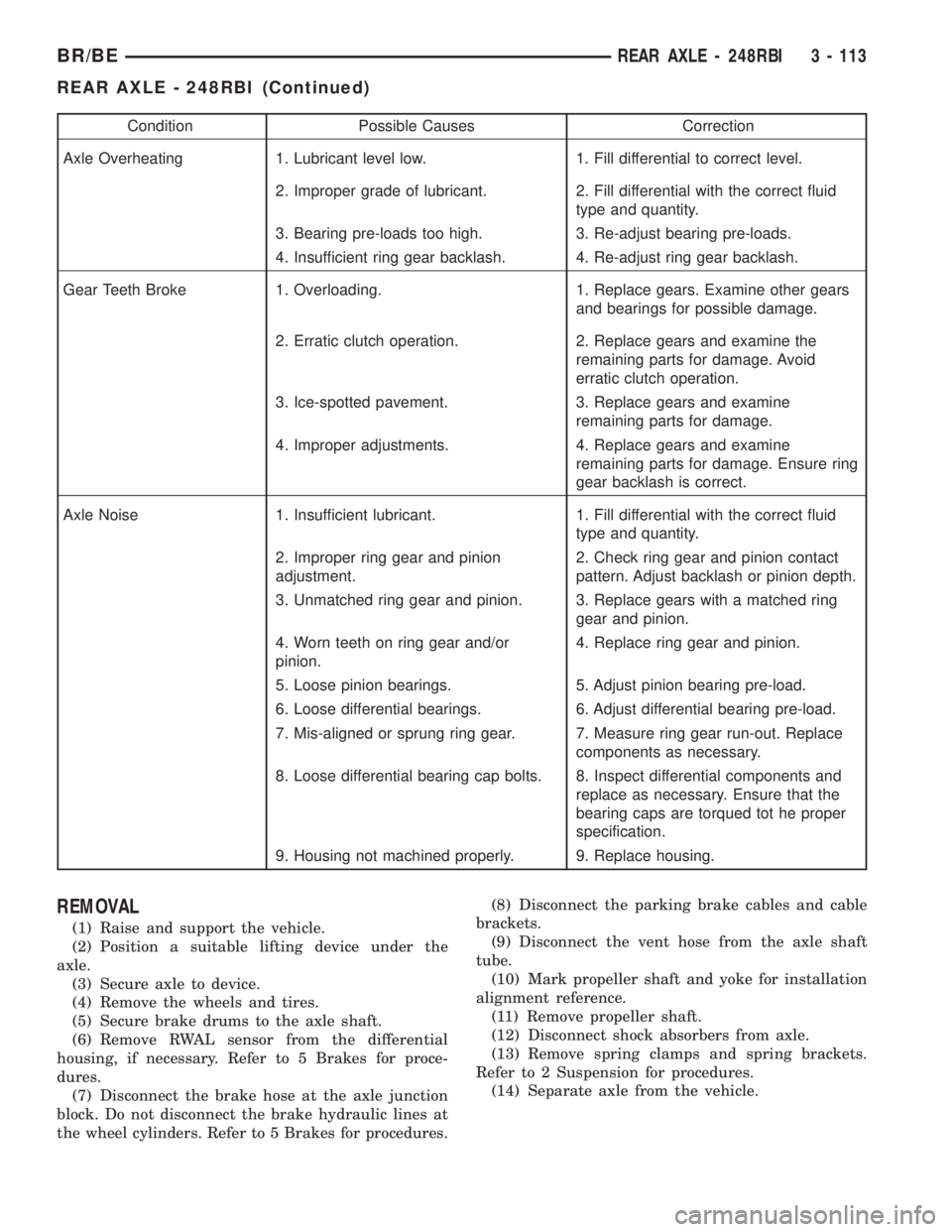
Condition Possible Causes Correction
Axle Overheating 1. Lubricant level low. 1. Fill differential to correct level.
2. Improper grade of lubricant. 2. Fill differential with the correct fluid
type and quantity.
3. Bearing pre-loads too high. 3. Re-adjust bearing pre-loads.
4. Insufficient ring gear backlash. 4. Re-adjust ring gear backlash.
Gear Teeth Broke 1. Overloading. 1. Replace gears. Examine other gears
and bearings for possible damage.
2. Erratic clutch operation. 2. Replace gears and examine the
remaining parts for damage. Avoid
erratic clutch operation.
3. Ice-spotted pavement. 3. Replace gears and examine
remaining parts for damage.
4. Improper adjustments. 4. Replace gears and examine
remaining parts for damage. Ensure ring
gear backlash is correct.
Axle Noise 1. Insufficient lubricant. 1. Fill differential with the correct fluid
type and quantity.
2. Improper ring gear and pinion
adjustment.2. Check ring gear and pinion contact
pattern. Adjust backlash or pinion depth.
3. Unmatched ring gear and pinion. 3. Replace gears with a matched ring
gear and pinion.
4. Worn teeth on ring gear and/or
pinion.4. Replace ring gear and pinion.
5. Loose pinion bearings. 5. Adjust pinion bearing pre-load.
6. Loose differential bearings. 6. Adjust differential bearing pre-load.
7. Mis-aligned or sprung ring gear. 7. Measure ring gear run-out. Replace
components as necessary.
8. Loose differential bearing cap bolts. 8. Inspect differential components and
replace as necessary. Ensure that the
bearing caps are torqued tot he proper
specification.
9. Housing not machined properly. 9. Replace housing.
REMOVAL
(1) Raise and support the vehicle.
(2) Position a suitable lifting device under the
axle.
(3) Secure axle to device.
(4) Remove the wheels and tires.
(5) Secure brake drums to the axle shaft.
(6) Remove RWAL sensor from the differential
housing, if necessary. Refer to 5 Brakes for proce-
dures.
(7) Disconnect the brake hose at the axle junction
block. Do not disconnect the brake hydraulic lines at
the wheel cylinders. Refer to 5 Brakes for procedures.(8) Disconnect the parking brake cables and cable
brackets.
(9) Disconnect the vent hose from the axle shaft
tube.
(10) Mark propeller shaft and yoke for installation
alignment reference.
(11) Remove propeller shaft.
(12) Disconnect shock absorbers from axle.
(13) Remove spring clamps and spring brackets.
Refer to 2 Suspension for procedures.
(14) Separate axle from the vehicle.
BR/BEREAR AXLE - 248RBI 3 - 113
REAR AXLE - 248RBI (Continued)
Page 187 of 2889
INSTALLATION
(1) Raise axle with lifting device and align to the
leaf spring centering bolts.
(2) Install spring clamps and spring brackets.
Refer to 2 Suspension for procedures.
(3) Install shock absorbers and tighten nuts to 82
N´m (60 ft. lbs.).
(4) Install RWAL sensor to the differential hous-
ing, if necessary. Refer to 5 Brakes for procedures.
(5) Install parking brake cables, cable brackets
and brake drums. Refer to 5 Brakes for procedures.
(6) Connect brake hose to axle junction block.
Refer to 5 Brakes for procedures.
(7) Install axle vent hose.
(8) Align propeller shaft and pinion yoke reference
marks. Install universal joint straps and bolts.
Tighten to 19 N´m (14 ft. lbs.).
(9) Install the wheels and tires.
(10) Add gear lubricant, if necessary. Refer to
Lubricant Specifications for lubricant requirements.
(11) Remove lifting device from axle and lower the
vehicle.
ADJUSTMENTS
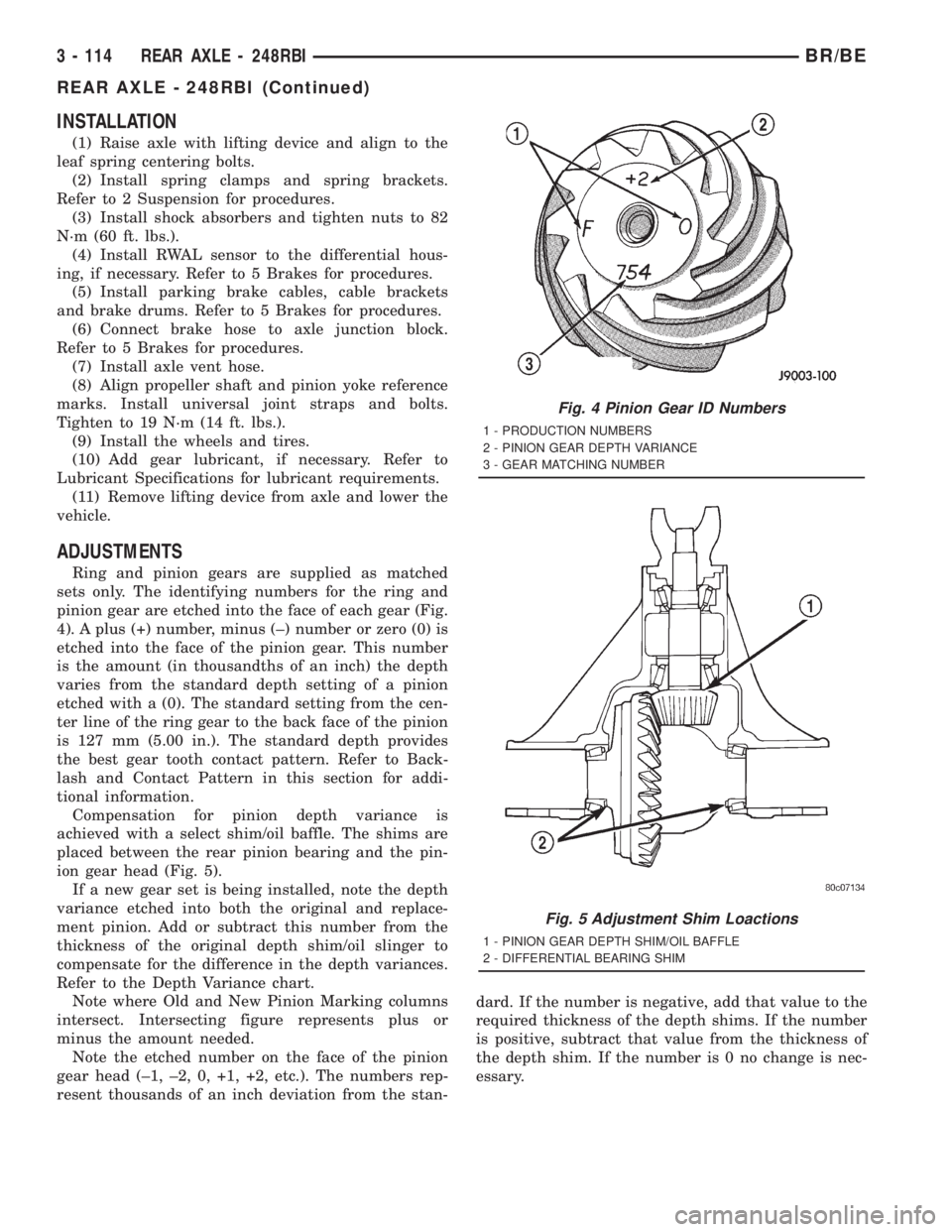
Ring and pinion gears are supplied as matched
sets only. The identifying numbers for the ring and
pinion gear are etched into the face of each gear (Fig.
4). A plus (+) number, minus (±) number or zero (0) is
etched into the face of the pinion gear. This number
is the amount (in thousandths of an inch) the depth
varies from the standard depth setting of a pinion
etched with a (0). The standard setting from the cen-
ter line of the ring gear to the back face of the pinion
is 127 mm (5.00 in.). The standard depth provides
the best gear tooth contact pattern. Refer to Back-
lash and Contact Pattern in this section for addi-
tional information.
Compensation for pinion depth variance is
achieved with a select shim/oil baffle. The shims are
placed between the rear pinion bearing and the pin-
ion gear head (Fig. 5).
If a new gear set is being installed, note the depth
variance etched into both the original and replace-
ment pinion. Add or subtract this number from the
thickness of the original depth shim/oil slinger to
compensate for the difference in the depth variances.
Refer to the Depth Variance chart.
Note where Old and New Pinion Marking columns
intersect. Intersecting figure represents plus or
minus the amount needed.
Note the etched number on the face of the pinion
gear head (±1, ±2, 0, +1, +2, etc.). The numbers rep-
resent thousands of an inch deviation from the stan-dard. If the number is negative, add that value to the
required thickness of the depth shims. If the number
is positive, subtract that value from the thickness of
the depth shim. If the number is 0 no change is nec-
essary.
Fig. 4 Pinion Gear ID Numbers
1 - PRODUCTION NUMBERS
2 - PINION GEAR DEPTH VARIANCE
3 - GEAR MATCHING NUMBER
Fig. 5 Adjustment Shim Loactions
1 - PINION GEAR DEPTH SHIM/OIL BAFFLE
2 - DIFFERENTIAL BEARING SHIM
3 - 114 REAR AXLE - 248RBIBR/BE
REAR AXLE - 248RBI (Continued)
Page 213 of 2889
REAR AXLE - 267RBI
TABLE OF CONTENTS
page page
REAR AXLE - 267RBI
DESCRIPTION..........................140
OPERATION............................140
DIAGNOSIS AND TESTING................142
AXLE...............................142
REMOVAL.............................144
INSTALLATION..........................145
ADJUSTMENTS.........................145
SPECIFICATIONS........................153
SPECIAL TOOLS........................153
AXLE SHAFTS
REMOVAL.............................156
INSTALLATION..........................156
AXLE BEARINGS
REMOVAL.............................156
INSTALLATION..........................156
PINION SEAL
REMOVAL.............................156INSTALLATION..........................157
DIFFERENTIAL
REMOVAL.............................158
DISASSEMBLY..........................158
ASSEMBLY............................159
INSTALLATION..........................159
DIFFERENTIAL - POWR-LOK
DIAGNOSIS AND TESTING................161
POWR-LOK .........................161
DISASSEMBLY..........................161
ASSEMBLY............................163
DIFFERENTIAL CASE BEARINGS
REMOVAL.............................164
INSTALLATION..........................164
PINION GEAR/RING GEAR/TONE RING
REMOVAL.............................165
INSTALLATION..........................166
REAR AXLE - 267RBI
DESCRIPTION
The Rear Beam-design Iron (RBI) axle housings
consist of an iron center casting (differential housing)
with axle shaft tubes extending from either side. The
tubes are pressed in to form a one-piece axle housing.
The integral type housing, hypoid gear design has
the centerline of the pinion set below the centerline
of the ring gear.
The axles are equipped with full-floating axle
shafts, meaning that loads are supported by the axle
housing tubes. The full-float axle shafts are retained
by bolts attached to the hub. The hub rides on two
bearings at the outboard end of the axle tube. The
axle shafts can be removed without disturbing or
removing the wheel bearings. The wheel bearings are
opposed tapered roller bearings and are contained in
the hub assembly.
The removable, stamped steel cover provides a
means for inspection and service without removing
the complete axle from the vehicle. A small, stamped
metal axle gear ratio identification tag is attached to
the housing cover via one of the cover bolts. This tag
also identifies the number of ring and pinion teeth.
The rear wheel anti-lock (RWAL) brake speed sen-
sor is attached to the top, forward exterior of the dif-
ferential housing. A seal is located between the
sensor and the wire harness connector. The seal mustbe in place when the wire connector is connected to
the sensor. The RWAL brake exciter ring is press-fit-
ted onto the differential case against the ring gear
flange.
The differential case for the standard differential is
a one-piece design. The differential pinion mate shaft
is retained with a roll pin. Differential bearing pre-
load and ring gear backlash are adjusted by the use
of shims located between the differential bearing
cones and case. Pinion bearing preload is set and
maintained by the use of a solid shims.
Axles equipped with a Powr-Lokydifferential are
optional. A Powr-lokydifferential has a two-piece dif-
ferential case. A Powr-lokydifferential contains four
pinion gears and a two-piece pinion mate cross shaft
to provide increased torque to the non-slipping wheel
through a ramping motion in addition to the stan-
dard Trac-lokycomponents.
OPERATION
STANDARD DIFFERENTIAL
The axle receives power from the transmission/
transfer case through the rear propeller shaft. The
rear propeller shaft is connected to the pinion gear
which rotates the differential through the gear mesh
with the ring gear bolted to the differential case. The
engine power is transmitted to the axle shafts
3 - 140 REAR AXLE - 267RBIBR/BE
Page 217 of 2889
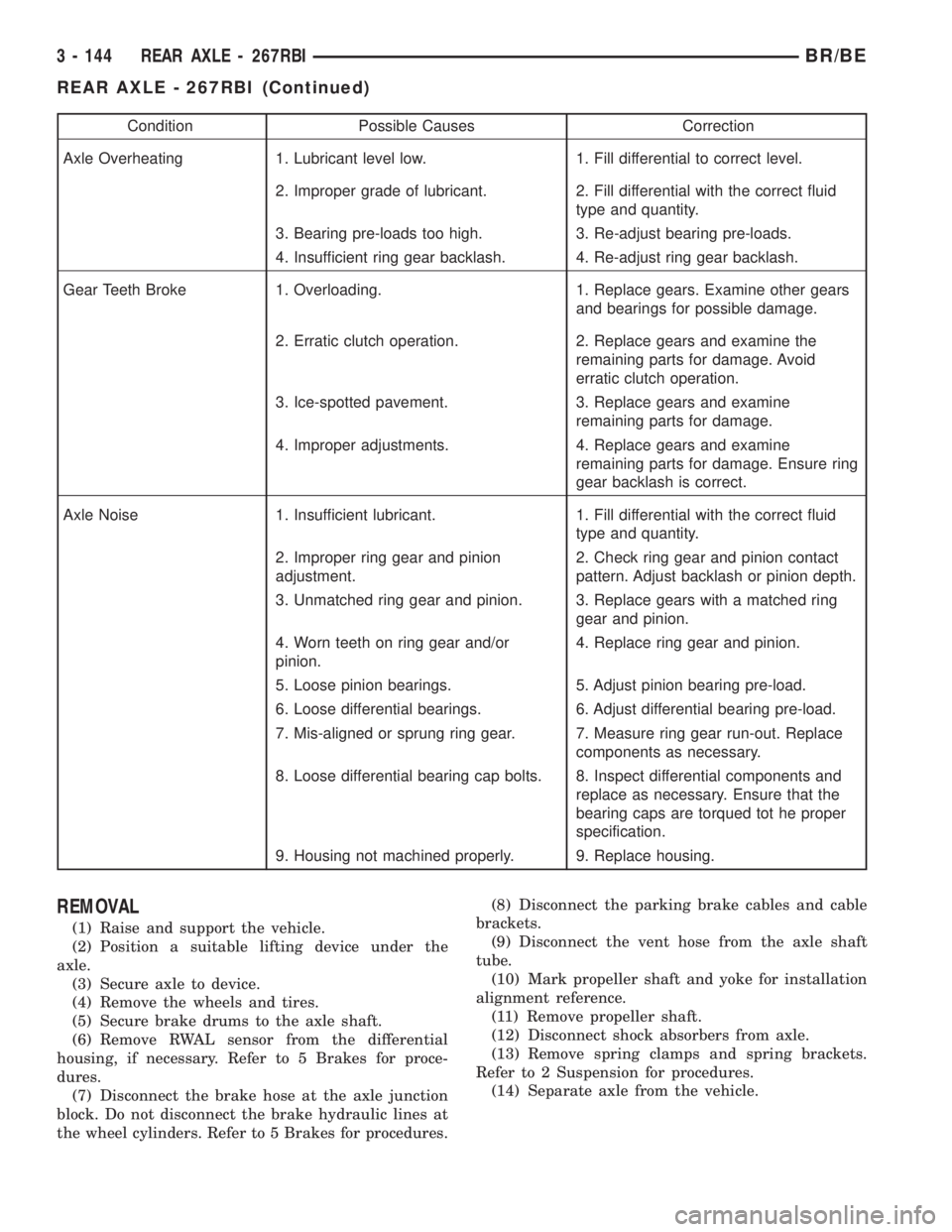
Condition Possible Causes Correction
Axle Overheating 1. Lubricant level low. 1. Fill differential to correct level.
2. Improper grade of lubricant. 2. Fill differential with the correct fluid
type and quantity.
3. Bearing pre-loads too high. 3. Re-adjust bearing pre-loads.
4. Insufficient ring gear backlash. 4. Re-adjust ring gear backlash.
Gear Teeth Broke 1. Overloading. 1. Replace gears. Examine other gears
and bearings for possible damage.
2. Erratic clutch operation. 2. Replace gears and examine the
remaining parts for damage. Avoid
erratic clutch operation.
3. Ice-spotted pavement. 3. Replace gears and examine
remaining parts for damage.
4. Improper adjustments. 4. Replace gears and examine
remaining parts for damage. Ensure ring
gear backlash is correct.
Axle Noise 1. Insufficient lubricant. 1. Fill differential with the correct fluid
type and quantity.
2. Improper ring gear and pinion
adjustment.2. Check ring gear and pinion contact
pattern. Adjust backlash or pinion depth.
3. Unmatched ring gear and pinion. 3. Replace gears with a matched ring
gear and pinion.
4. Worn teeth on ring gear and/or
pinion.4. Replace ring gear and pinion.
5. Loose pinion bearings. 5. Adjust pinion bearing pre-load.
6. Loose differential bearings. 6. Adjust differential bearing pre-load.
7. Mis-aligned or sprung ring gear. 7. Measure ring gear run-out. Replace
components as necessary.
8. Loose differential bearing cap bolts. 8. Inspect differential components and
replace as necessary. Ensure that the
bearing caps are torqued tot he proper
specification.
9. Housing not machined properly. 9. Replace housing.
REMOVAL
(1) Raise and support the vehicle.
(2) Position a suitable lifting device under the
axle.
(3) Secure axle to device.
(4) Remove the wheels and tires.
(5) Secure brake drums to the axle shaft.
(6) Remove RWAL sensor from the differential
housing, if necessary. Refer to 5 Brakes for proce-
dures.
(7) Disconnect the brake hose at the axle junction
block. Do not disconnect the brake hydraulic lines at
the wheel cylinders. Refer to 5 Brakes for procedures.(8) Disconnect the parking brake cables and cable
brackets.
(9) Disconnect the vent hose from the axle shaft
tube.
(10) Mark propeller shaft and yoke for installation
alignment reference.
(11) Remove propeller shaft.
(12) Disconnect shock absorbers from axle.
(13) Remove spring clamps and spring brackets.
Refer to 2 Suspension for procedures.
(14) Separate axle from the vehicle.
3 - 144 REAR AXLE - 267RBIBR/BE
REAR AXLE - 267RBI (Continued)
Page 218 of 2889
INSTALLATION
(1) Raise axle with lifting device and align to the
leaf spring centering bolts.
(2) Install spring clamps and spring brackets.
Refer to 2 Suspension for procedures.
(3) Install shock absorbers and tighten nuts to 82
N´m (60 ft. lbs.).
(4) Install RWAL sensor to the differential hous-
ing, if necessary. Refer to 5 Brakes for procedures.
(5) Install parking brake cables, cable brackets
and brake drums. Refer to 5 Brakes for procedures.
(6) Connect brake hose to axle junction block.
Refer to 5 Brakes for procedures.
(7) Install axle vent hose.
(8) Align propeller shaft and pinion yoke reference
marks. Install universal joint straps and bolts.
Tighten to 19 N´m (14 ft. lbs.).
(9) Install the wheels and tires.
(10) Add gear lubricant, if necessary. Refer to
Lubricant Specifications for lubricant requirements.
(11) Remove lifting device from axle and lower the
vehicle.
ADJUSTMENTS
Ring and pinion gears are supplied as matched
sets only. The identifying numbers for the ring and
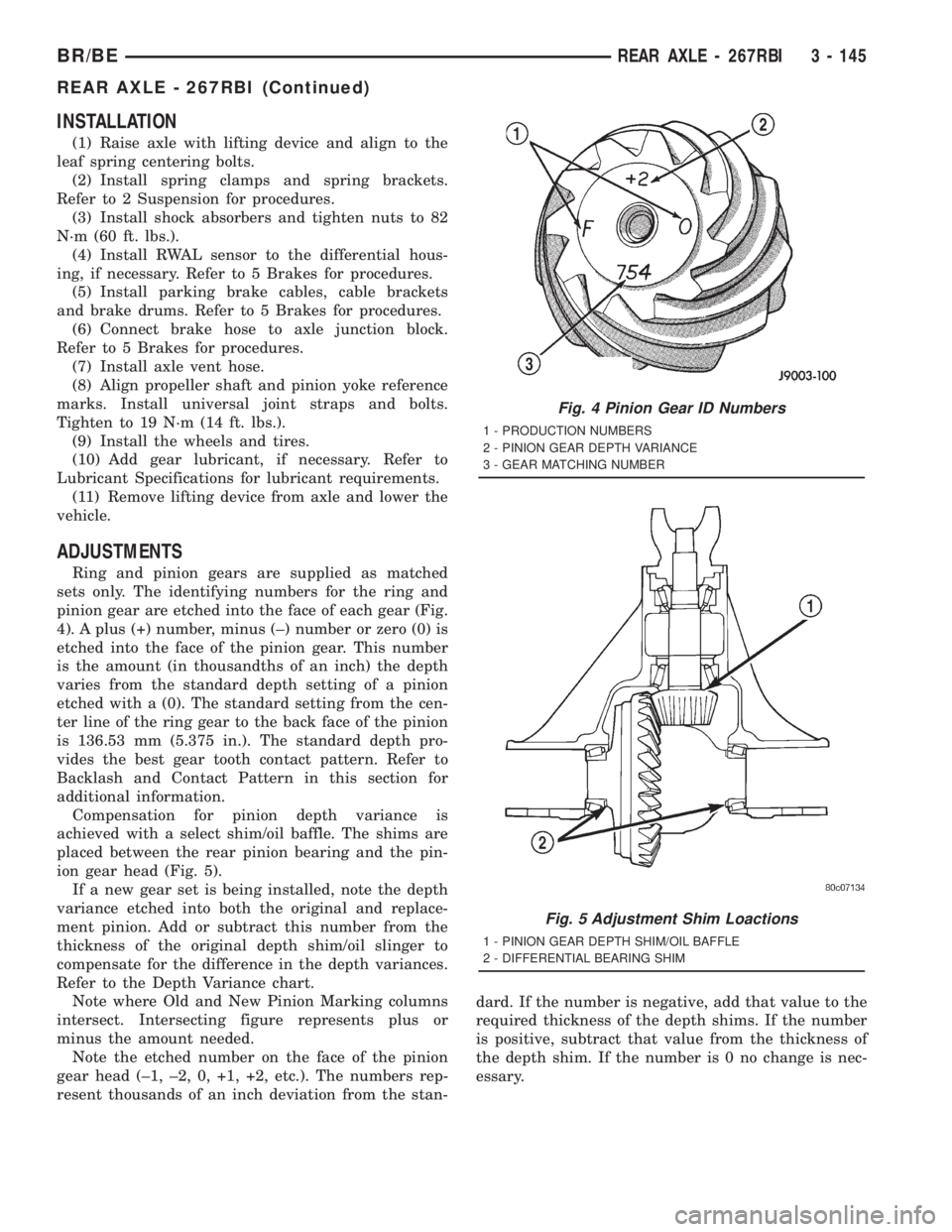
pinion gear are etched into the face of each gear (Fig.
4). A plus (+) number, minus (±) number or zero (0) is
etched into the face of the pinion gear. This number
is the amount (in thousandths of an inch) the depth
varies from the standard depth setting of a pinion
etched with a (0). The standard setting from the cen-
ter line of the ring gear to the back face of the pinion
is 136.53 mm (5.375 in.). The standard depth pro-
vides the best gear tooth contact pattern. Refer to
Backlash and Contact Pattern in this section for
additional information.
Compensation for pinion depth variance is
achieved with a select shim/oil baffle. The shims are
placed between the rear pinion bearing and the pin-
ion gear head (Fig. 5).
If a new gear set is being installed, note the depth
variance etched into both the original and replace-
ment pinion. Add or subtract this number from the
thickness of the original depth shim/oil slinger to
compensate for the difference in the depth variances.
Refer to the Depth Variance chart.
Note where Old and New Pinion Marking columns
intersect. Intersecting figure represents plus or
minus the amount needed.
Note the etched number on the face of the pinion
gear head (±1, ±2, 0, +1, +2, etc.). The numbers rep-
resent thousands of an inch deviation from the stan-dard. If the number is negative, add that value to the
required thickness of the depth shims. If the number
is positive, subtract that value from the thickness of
the depth shim. If the number is 0 no change is nec-
essary.
Fig. 4 Pinion Gear ID Numbers
1 - PRODUCTION NUMBERS
2 - PINION GEAR DEPTH VARIANCE
3 - GEAR MATCHING NUMBER
Fig. 5 Adjustment Shim Loactions
1 - PINION GEAR DEPTH SHIM/OIL BAFFLE
2 - DIFFERENTIAL BEARING SHIM
BR/BEREAR AXLE - 267RBI 3 - 145
REAR AXLE - 267RBI (Continued)
Page 242 of 2889
REAR AXLE - 286RBI
TABLE OF CONTENTS
page page
REAR AXLE - 286RBI
DESCRIPTION..........................169
OPERATION............................169
DIAGNOSIS AND TESTING................171
AXLE...............................171
REMOVAL.............................173
INSTALLATION..........................174
ADJUSTMENTS.........................174
SPECIFICATIONS........................182
SPECIAL TOOLS........................182
AXLE SHAFTS
REMOVAL.............................185
INSTALLATION..........................185
AXLE BEARINGS
REMOVAL.............................185
INSTALLATION..........................185
PINION SEAL
REMOVAL.............................185INSTALLATION..........................185
DIFFERENTIAL
REMOVAL.............................187
DISASSEMBLY..........................188
ASSEMBLY............................188
INSTALLATION..........................188
DIFFERENTIAL - TRAC-LOK
DIAGNOSIS AND TESTING................190
TRAC-LOK...........................190
DISASSEMBLY..........................190
ASSEMBLY............................190
DIFFERENTIAL CASE BEARINGS
REMOVAL.............................192
INSTALLATION..........................192
PINION GEAR/RING GEAR/TONE RING
REMOVAL.............................193
INSTALLATION..........................195
REAR AXLE - 286RBI
DESCRIPTION
The 286 Rear Beam-design Iron (RBI) axle hous-
ings consist of an iron center casting (differential
housing) with axle shaft tubes extending from either
side. The tubes are pressed in to form a one-piece
axle housing.
The integral type housing, hypoid gear design has
the centerline of the pinion set below the centerline
of the ring gear.
The axles are equipped with full-floating axle
shafts, meaning that loads are supported by the axle
housing tubes. The full-float axle shafts are retained
by bolts attached to the hub. The hub rides on two
bearings at the outboard end of the axle tube. The
axle shafts can be removed without disturbing or
removing the wheel bearings. The wheel bearings are
opposed tapered roller bearings and are contained in
the hub assembly.
The removable, stamped steel cover provides a
means for inspection and service without removing
the complete axle from the vehicle. A small, stamped
metal axle gear ratio identification tag is attached to
the housing cover via one of the cover bolts. This tag
also identifies the number of ring and pinion teeth.
The rear wheel anti-lock (RWAL) brake speed sen-
sor is attached to the top, forward exterior of the dif-
ferential housing. A seal is located between thesensor and the wire harness connector. The seal must
be in place when the wire connector is connected to
the sensor. The RWAL brake exciter ring is press-fit-
ted onto the differential case against the ring gear
flange.
The differential case for the standard differential is
a one-piece design. The differential pinion mate shaft
is retained with a roll pin. Differential bearing pre-
load and ring gear backlash are adjusted by the use
of shims located between the differential bearing
cones and case. Pinion bearing preload is set and
maintained by the use of solid shims.
Axles equipped with a Trac-Lokydifferential are
optional for the 286 RBI axle. A Trac-lokydifferen-
tial contains two clutch packs, four pinion gears, and
a one-piece pinion mate cross shaft to provide
increased torque to the non-slipping wheel in addi-
tion to the standard differential components. A Trac-
lokydifferential for the 286 RBI axle has a two-piece
differential case.
OPERATION
STANDARD DIFFERENTIAL
The axle receives power from the transmission/
transfer case through the rear propeller shaft. The
rear propeller shaft is connected to the pinion gear
which rotates the differential through the gear mesh
with the ring gear bolted to the differential case. The
engine power is transmitted to the axle shafts
BR/BEREAR AXLE - 286RBI 3 - 169
Page 246 of 2889
Condition Possible Causes Correction
Axle Overheating 1. Lubricant level low. 1. Fill differential to correct level.
2. Improper grade of lubricant. 2. Fill differential with the correct fluid
type and quantity.
3. Bearing pre-loads too high. 3. Re-adjust bearing pre-loads.
4. Insufficient ring gear backlash. 4. Re-adjust ring gear backlash.
Gear Teeth Broke 1. Overloading. 1. Replace gears. Examine other gears
and bearings for possible damage.
2. Erratic clutch operation. 2. Replace gears and examine the
remaining parts for damage. Avoid
erratic clutch operation.
3. Ice-spotted pavement. 3. Replace gears and examine
remaining parts for damage.
4. Improper adjustments. 4. Replace gears and examine
remaining parts for damage. Ensure ring
gear backlash is correct.
Axle Noise 1. Insufficient lubricant. 1. Fill differential with the correct fluid
type and quantity.
2. Improper ring gear and pinion
adjustment.2. Check ring gear and pinion contact
pattern. Adjust backlash or pinion depth.
3. Unmatched ring gear and pinion. 3. Replace gears with a matched ring
gear and pinion.
4. Worn teeth on ring gear and/or
pinion.4. Replace ring gear and pinion.
5. Loose pinion bearings. 5. Adjust pinion bearing pre-load.
6. Loose differential bearings. 6. Adjust differential bearing pre-load.
7. Mis-aligned or sprung ring gear. 7. Measure ring gear run-out. Replace
components as necessary.
8. Loose differential bearing cap bolts. 8. Inspect differential components and
replace as necessary. Ensure that the
bearing caps are torqued tot he proper
specification.
9. Housing not machined properly. 9. Replace housing.
REMOVAL
(1) Raise and support the vehicle.
(2) Position a suitable lifting device under the
axle.
(3) Secure axle to device.
(4) Remove the wheels and tires.
(5) Secure brake drums to the axle shaft.
(6) Remove the RWAL sensor from the differential
housing, if necessary. Refer to 5 Brakes for proce-
dures.
(7) Disconnect the brake hose at the axle junction
block. Do not disconnect the brake hydraulic lines at
the wheel cylinders. Refer to 5 Brakes for procedures.(8) Disconnect the parking brake cables and cable
brackets.
(9) Disconnect the vent hose from the axle shaft
tube.
(10) Mark the propeller shaft and companion
flange for installation alignment reference.
(11) Remove propeller shaft.
(12) Disconnect shock absorbers from axle.
(13) Remove the spring clamps and spring brack-
ets. Refer to 2 Suspension for procedures.
(14) Separate the axle from the vehicle.
BR/BEREAR AXLE - 286RBI 3 - 173
REAR AXLE - 286RBI (Continued)
Page 247 of 2889
INSTALLATION
(1) Raise the axle with lifting device and align to
the leaf spring centering bolts.
(2) Install the spring clamps and spring brackets.
Refer to 2 Suspension for procedures.
(3) Install shock absorbers and tighten nuts to 82
N´m (60 ft. lbs.).
(4) Install the RWAL sensor to the differential
housing, if necessary. Refer to 5 Brakes for proce-
dures.
(5) Connect the parking brake cables and cable
brackets.
(6) Install the brake drums. Refer to 5 Brakes for
procedures.
(7) Connect the brake hose to the axle junction
block. Refer to 5 Brakes for procedures.
(8) Install axle vent hose.
(9) Align propeller shaft and pinion companion
flange reference marks. Install the companion flange
bolts. Tighten to 108 N´m (80 ft. lbs.).
(10) Install the wheels and tires.
(11) Add gear lubricant, if necessary. Refer to
Specifications for lubricant requirements.
(12) Remove lifting device from axle and lower the
vehicle.
ADJUSTMENTS
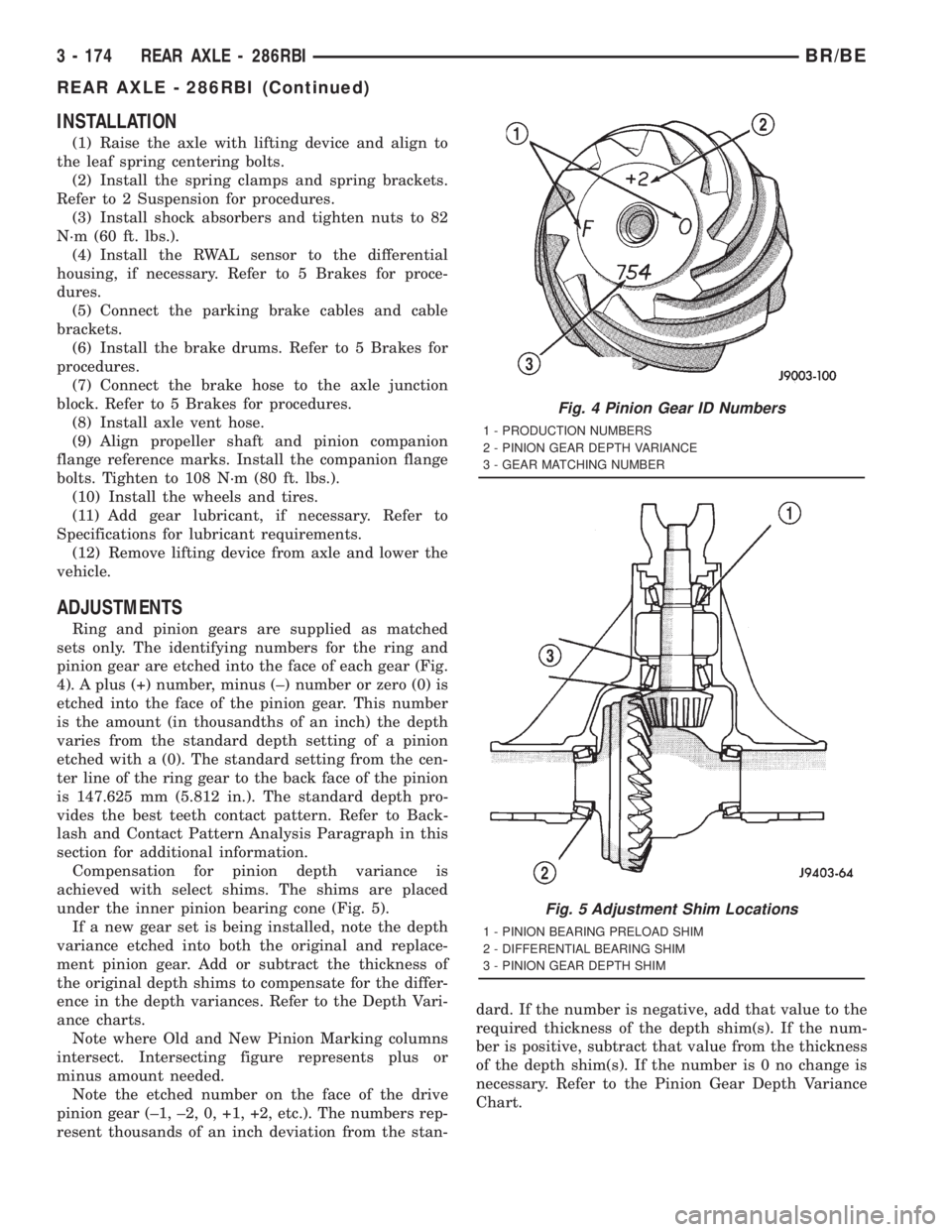
Ring and pinion gears are supplied as matched
sets only. The identifying numbers for the ring and
pinion gear are etched into the face of each gear (Fig.
4). A plus (+) number, minus (±) number or zero (0) is
etched into the face of the pinion gear. This number
is the amount (in thousandths of an inch) the depth
varies from the standard depth setting of a pinion
etched with a (0). The standard setting from the cen-
ter line of the ring gear to the back face of the pinion
is 147.625 mm (5.812 in.). The standard depth pro-
vides the best teeth contact pattern. Refer to Back-
lash and Contact Pattern Analysis Paragraph in this
section for additional information.
Compensation for pinion depth variance is
achieved with select shims. The shims are placed
under the inner pinion bearing cone (Fig. 5).
If a new gear set is being installed, note the depth
variance etched into both the original and replace-
ment pinion gear. Add or subtract the thickness of
the original depth shims to compensate for the differ-
ence in the depth variances. Refer to the Depth Vari-
ance charts.
Note where Old and New Pinion Marking columns
intersect. Intersecting figure represents plus or
minus amount needed.
Note the etched number on the face of the drive
pinion gear (±1, ±2, 0, +1, +2, etc.). The numbers rep-
resent thousands of an inch deviation from the stan-dard. If the number is negative, add that value to the
required thickness of the depth shim(s). If the num-
ber is positive, subtract that value from the thickness
of the depth shim(s). If the number is 0 no change is
necessary. Refer to the Pinion Gear Depth Variance
Chart.
Fig. 4 Pinion Gear ID Numbers
1 - PRODUCTION NUMBERS
2 - PINION GEAR DEPTH VARIANCE
3 - GEAR MATCHING NUMBER
Fig. 5 Adjustment Shim Locations
1 - PINION BEARING PRELOAD SHIM
2 - DIFFERENTIAL BEARING SHIM
3 - PINION GEAR DEPTH SHIM
3 - 174 REAR AXLE - 286RBIBR/BE
REAR AXLE - 286RBI (Continued)
Page 348 of 2889
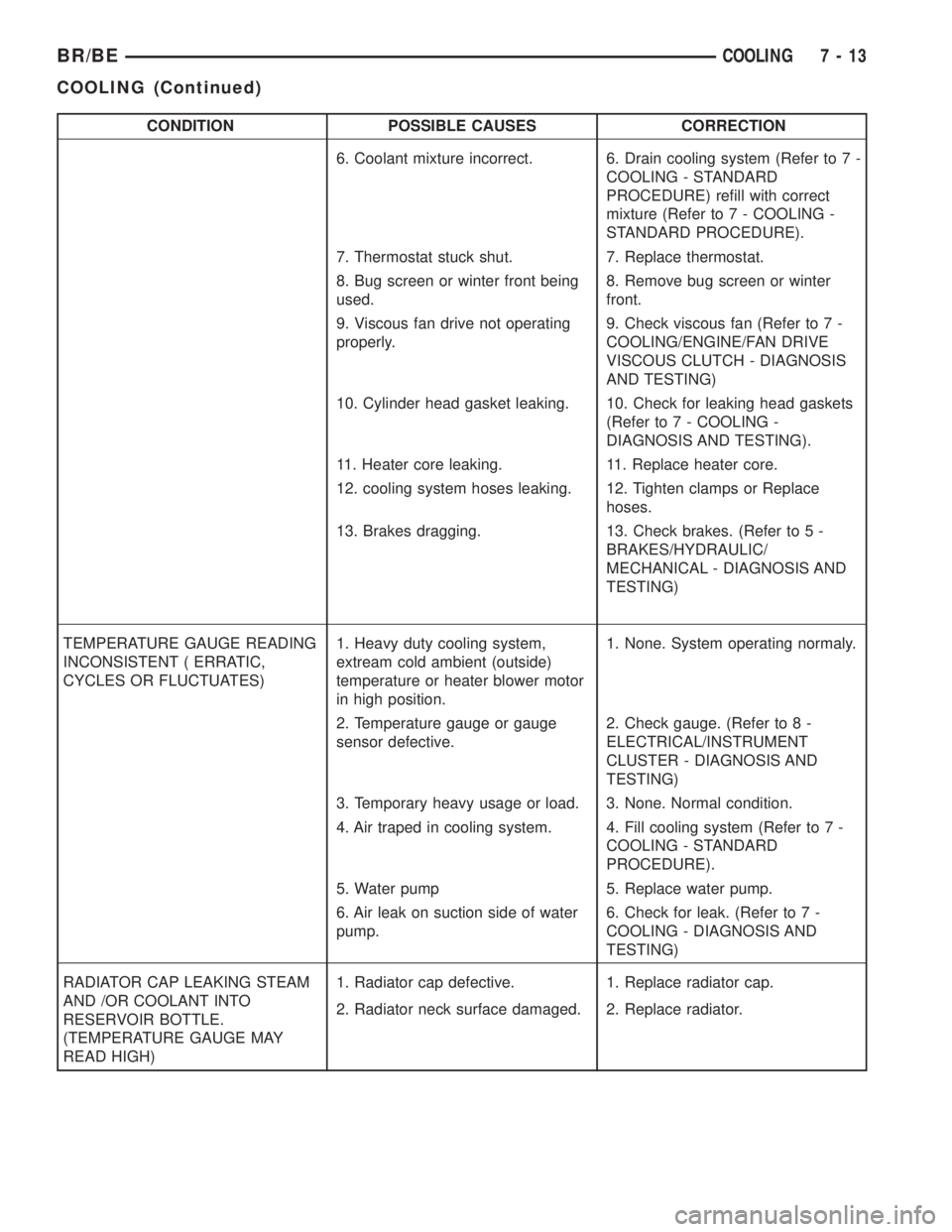
CONDITION POSSIBLE CAUSES CORRECTION
6. Coolant mixture incorrect. 6. Drain cooling system (Refer to 7 -
COOLING - STANDARD
PROCEDURE) refill with correct
mixture (Refer to 7 - COOLING -
STANDARD PROCEDURE).
7. Thermostat stuck shut. 7. Replace thermostat.
8. Bug screen or winter front being
used.8. Remove bug screen or winter
front.
9. Viscous fan drive not operating
properly.9. Check viscous fan (Refer to 7 -
COOLING/ENGINE/FAN DRIVE
VISCOUS CLUTCH - DIAGNOSIS
AND TESTING)
10. Cylinder head gasket leaking. 10. Check for leaking head gaskets
(Refer to 7 - COOLING -
DIAGNOSIS AND TESTING).
11. Heater core leaking. 11. Replace heater core.
12. cooling system hoses leaking. 12. Tighten clamps or Replace
hoses.
13. Brakes dragging. 13. Check brakes. (Refer to 5 -
BRAKES/HYDRAULIC/
MECHANICAL - DIAGNOSIS AND
TESTING)
TEMPERATURE GAUGE READING
INCONSISTENT ( ERRATIC,
CYCLES OR FLUCTUATES)1. Heavy duty cooling system,
extream cold ambient (outside)
temperature or heater blower motor
in high position.1. None. System operating normaly.
2. Temperature gauge or gauge
sensor defective.2. Check gauge. (Refer to 8 -
ELECTRICAL/INSTRUMENT
CLUSTER - DIAGNOSIS AND
TESTING)
3. Temporary heavy usage or load. 3. None. Normal condition.
4. Air traped in cooling system. 4. Fill cooling system (Refer to 7 -
COOLING - STANDARD
PROCEDURE).
5. Water pump 5. Replace water pump.
6. Air leak on suction side of water
pump.6. Check for leak. (Refer to 7 -
COOLING - DIAGNOSIS AND
TESTING)
RADIATOR CAP LEAKING STEAM
AND /OR COOLANT INTO
RESERVOIR BOTTLE.
(TEMPERATURE GAUGE MAY
READ HIGH)1. Radiator cap defective. 1. Replace radiator cap.
2. Radiator neck surface damaged. 2. Replace radiator.
BR/BECOOLING 7 - 13
COOLING (Continued)
Page 462 of 2889
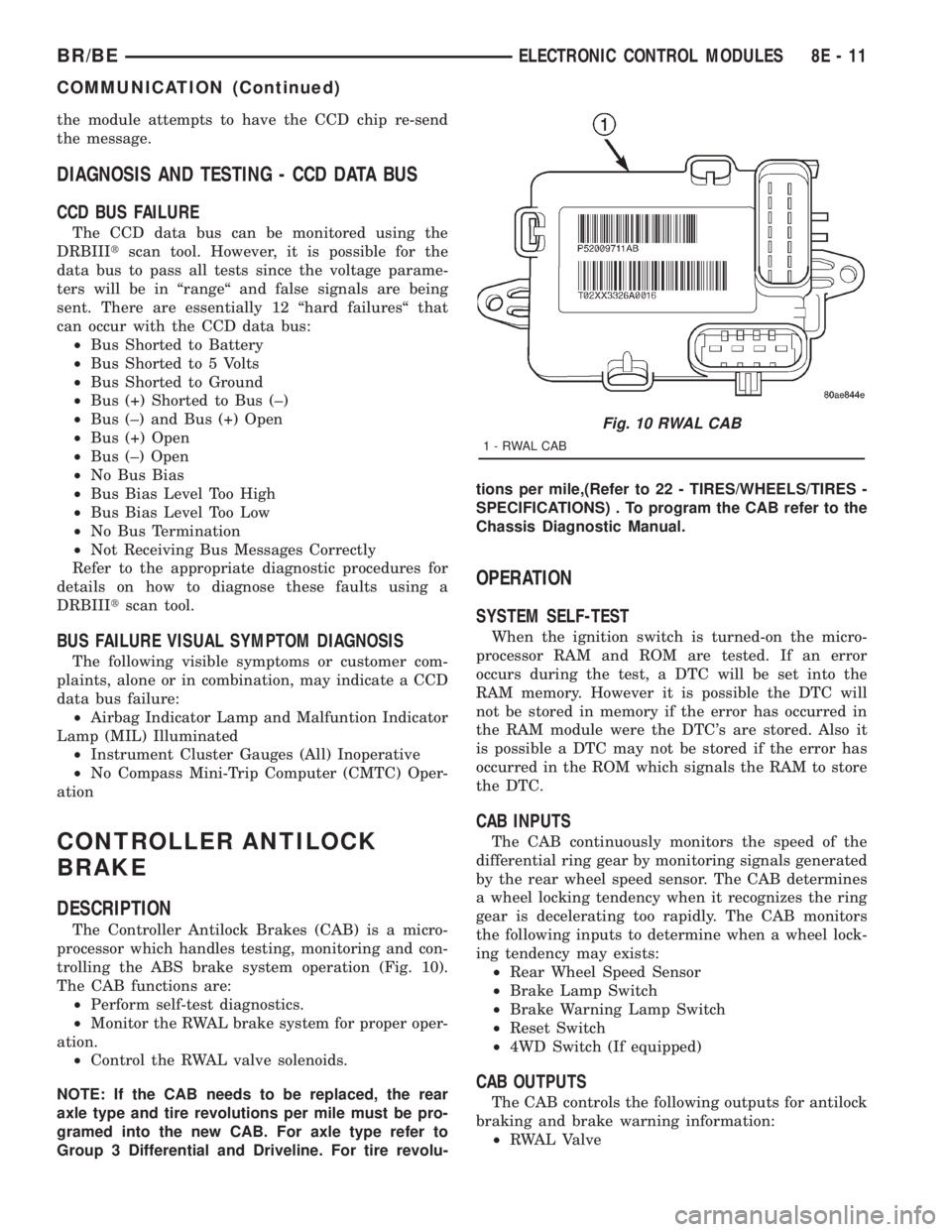
the module attempts to have the CCD chip re-send
the message.
DIAGNOSIS AND TESTING - CCD DATA BUS
CCD BUS FAILURE
The CCD data bus can be monitored using the
DRBIIItscan tool. However, it is possible for the
data bus to pass all tests since the voltage parame-
ters will be in ªrangeª and false signals are being
sent. There are essentially 12 ªhard failuresª that
can occur with the CCD data bus:
²Bus Shorted to Battery
²Bus Shorted to 5 Volts
²Bus Shorted to Ground
²Bus (+) Shorted to Bus (±)
²Bus (±) and Bus (+) Open
²Bus (+) Open
²Bus (±) Open
²No Bus Bias
²Bus Bias Level Too High
²Bus Bias Level Too Low
²No Bus Termination
²Not Receiving Bus Messages Correctly
Refer to the appropriate diagnostic procedures for
details on how to diagnose these faults using a
DRBIIItscan tool.
BUS FAILURE VISUAL SYMPTOM DIAGNOSIS
The following visible symptoms or customer com-
plaints, alone or in combination, may indicate a CCD
data bus failure:
²Airbag Indicator Lamp and Malfuntion Indicator
Lamp (MIL) Illuminated
²Instrument Cluster Gauges (All) Inoperative
²No Compass Mini-Trip Computer (CMTC) Oper-
ation
CONTROLLER ANTILOCK
BRAKE
DESCRIPTION
The Controller Antilock Brakes (CAB) is a micro-
processor which handles testing, monitoring and con-
trolling the ABS brake system operation (Fig. 10).
The CAB functions are:
²Perform self-test diagnostics.
²Monitor the RWAL brake system for proper oper-
ation.
²Control the RWAL valve solenoids.
NOTE: If the CAB needs to be replaced, the rear
axle type and tire revolutions per mile must be pro-
gramed into the new CAB. For axle type refer to
Group 3 Differential and Driveline. For tire revolu-tions per mile,(Refer to 22 - TIRES/WHEELS/TIRES -
SPECIFICATIONS) . To program the CAB refer to the
Chassis Diagnostic Manual.
OPERATION
SYSTEM SELF-TEST
When the ignition switch is turned-on the micro-
processor RAM and ROM are tested. If an error
occurs during the test, a DTC will be set into the
RAM memory. However it is possible the DTC will
not be stored in memory if the error has occurred in
the RAM module were the DTC's are stored. Also it
is possible a DTC may not be stored if the error has
occurred in the ROM which signals the RAM to store
the DTC.
CAB INPUTS
The CAB continuously monitors the speed of the
differential ring gear by monitoring signals generated
by the rear wheel speed sensor. The CAB determines
a wheel locking tendency when it recognizes the ring
gear is decelerating too rapidly. The CAB monitors
the following inputs to determine when a wheel lock-
ing tendency may exists:
²Rear Wheel Speed Sensor
²Brake Lamp Switch
²Brake Warning Lamp Switch
²Reset Switch
²4WD Switch (If equipped)
CAB OUTPUTS
The CAB controls the following outputs for antilock
braking and brake warning information:
²RWAL Valve
Fig. 10 RWAL CAB
1-RWALCAB
BR/BEELECTRONIC CONTROL MODULES 8E - 11
COMMUNICATION (Continued)