transmission DODGE RAM 2001 Service Owner's Guide
[x] Cancel search | Manufacturer: DODGE, Model Year: 2001, Model line: RAM, Model: DODGE RAM 2001Pages: 2889, PDF Size: 68.07 MB
Page 79 of 2889
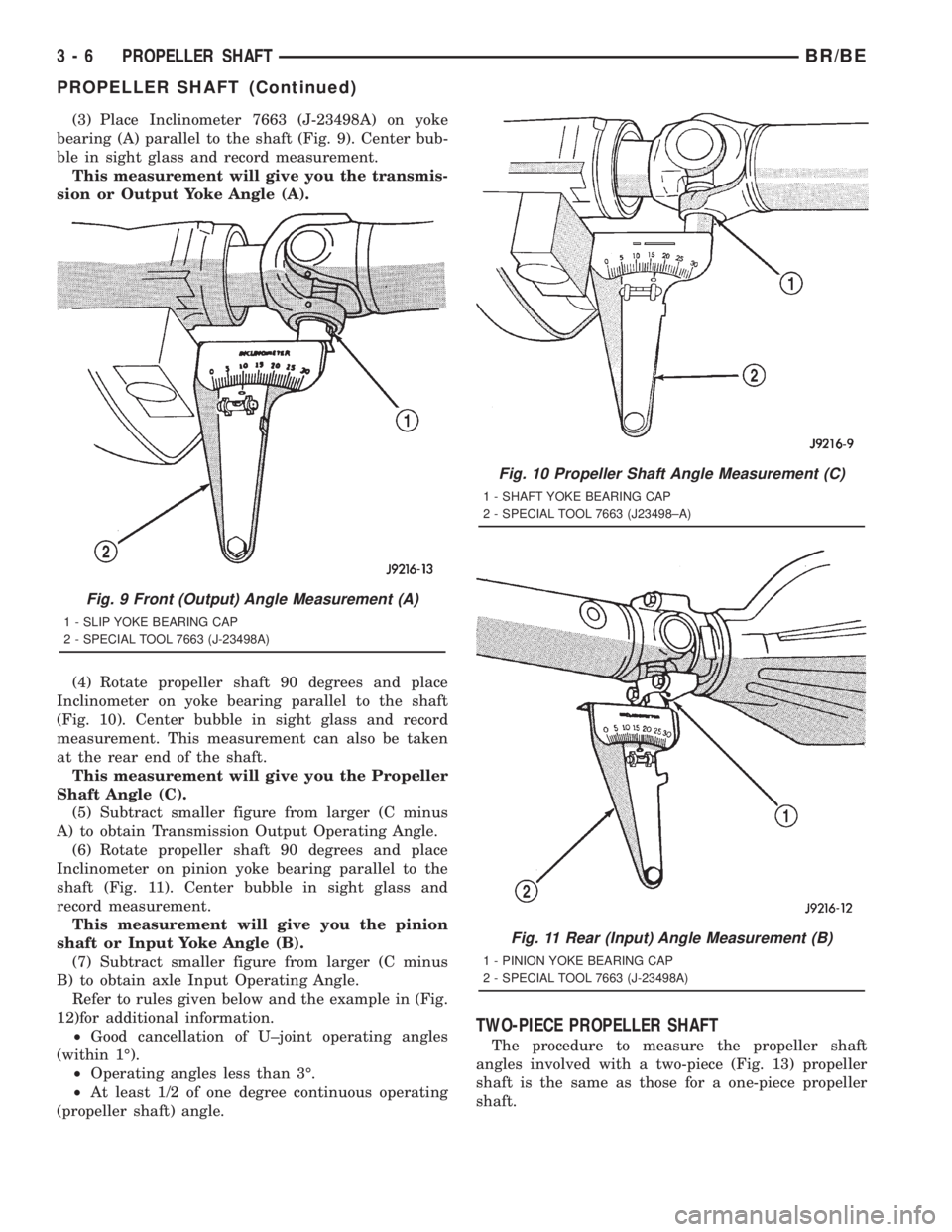
(3) Place Inclinometer 7663 (J-23498A) on yoke
bearing (A) parallel to the shaft (Fig. 9). Center bub-
ble in sight glass and record measurement.
This measurement will give you the transmis-
sion or Output Yoke Angle (A).
(4) Rotate propeller shaft 90 degrees and place
Inclinometer on yoke bearing parallel to the shaft
(Fig. 10). Center bubble in sight glass and record
measurement. This measurement can also be taken
at the rear end of the shaft.
This measurement will give you the Propeller
Shaft Angle (C).
(5) Subtract smaller figure from larger (C minus
A) to obtain Transmission Output Operating Angle.
(6) Rotate propeller shaft 90 degrees and place
Inclinometer on pinion yoke bearing parallel to the
shaft (Fig. 11). Center bubble in sight glass and
record measurement.
This measurement will give you the pinion
shaft or Input Yoke Angle (B).
(7) Subtract smaller figure from larger (C minus
B) to obtain axle Input Operating Angle.
Refer to rules given below and the example in (Fig.
12)for additional information.
²Good cancellation of U±joint operating angles
(within 1É).
²Operating angles less than 3É.
²At least 1/2 of one degree continuous operating
(propeller shaft) angle.
TWO-PIECE PROPELLER SHAFT
The procedure to measure the propeller shaft
angles involved with a two-piece (Fig. 13) propeller
shaft is the same as those for a one-piece propeller
shaft.
Fig. 9 Front (Output) Angle Measurement (A)
1 - SLIP YOKE BEARING CAP
2 - SPECIAL TOOL 7663 (J-23498A)
Fig. 10 Propeller Shaft Angle Measurement (C)
1 - SHAFT YOKE BEARING CAP
2 - SPECIAL TOOL 7663 (J23498±A)
Fig. 11 Rear (Input) Angle Measurement (B)
1 - PINION YOKE BEARING CAP
2 - SPECIAL TOOL 7663 (J-23498A)
3 - 6 PROPELLER SHAFTBR/BE
PROPELLER SHAFT (Continued)
Page 81 of 2889
SPECIFICATIONS
PROPELLER SHAFT
TORQUE SPECIFICATIONS
DESCRIPTION N´m Ft. Lbs. In. Lbs.
Center Bearing Bolts 68 50 -
Front Shaft Flange Yoke 88 65 -
Front Shaft Axle Yoke 19 14 -
Rear Shaft 9 1/4 Axle 108 80 -
Rear Shaft Dana Axle 29 22 -
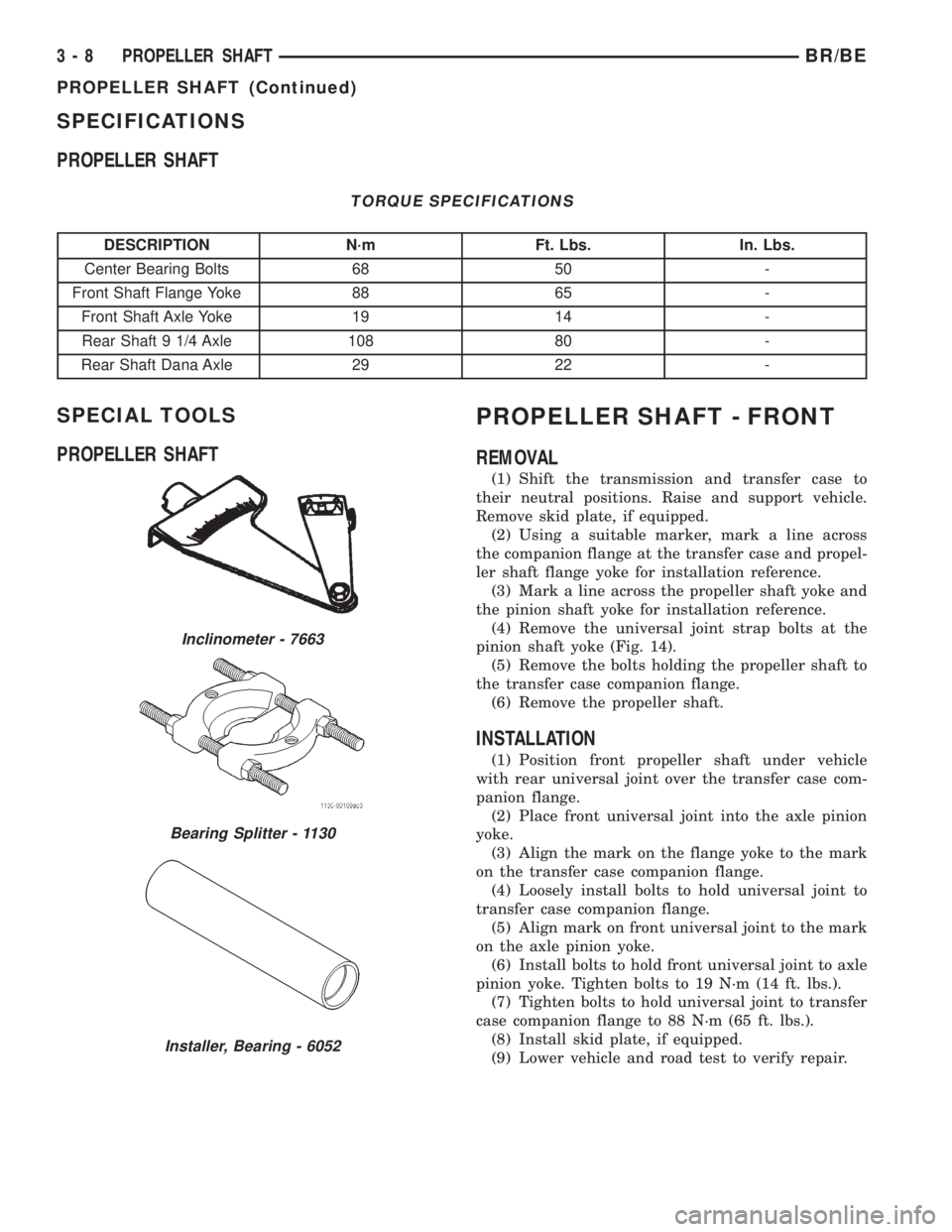
SPECIAL TOOLS
PROPELLER SHAFTPROPELLER SHAFT - FRONT
REMOVAL
(1) Shift the transmission and transfer case to
their neutral positions. Raise and support vehicle.
Remove skid plate, if equipped.
(2) Using a suitable marker, mark a line across
the companion flange at the transfer case and propel-
ler shaft flange yoke for installation reference.
(3) Mark a line across the propeller shaft yoke and
the pinion shaft yoke for installation reference.
(4) Remove the universal joint strap bolts at the
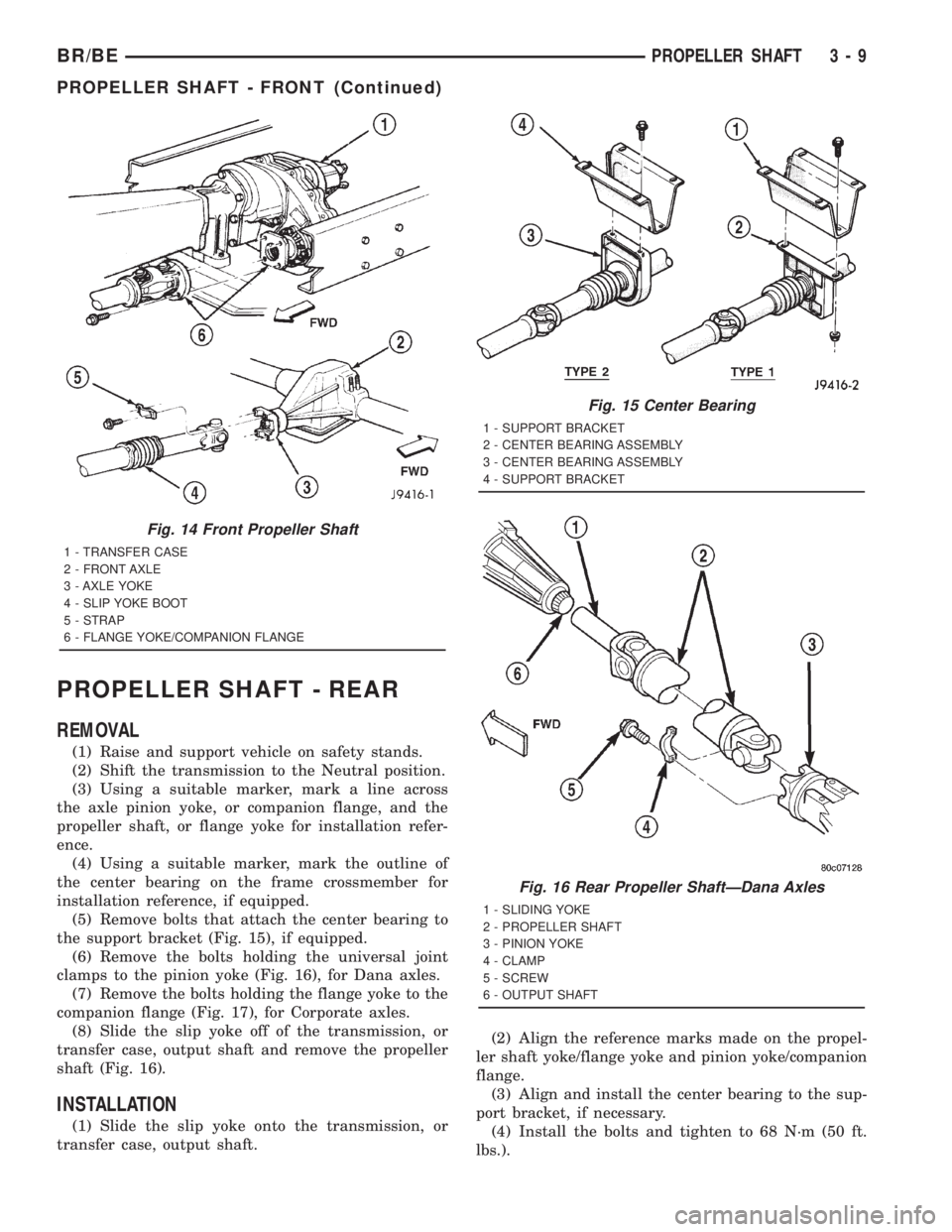
pinion shaft yoke (Fig. 14).
(5) Remove the bolts holding the propeller shaft to
the transfer case companion flange.
(6) Remove the propeller shaft.
INSTALLATION
(1) Position front propeller shaft under vehicle
with rear universal joint over the transfer case com-
panion flange.
(2) Place front universal joint into the axle pinion
yoke.
(3) Align the mark on the flange yoke to the mark
on the transfer case companion flange.
(4) Loosely install bolts to hold universal joint to
transfer case companion flange.
(5) Align mark on front universal joint to the mark
on the axle pinion yoke.
(6) Install bolts to hold front universal joint to axle
pinion yoke. Tighten bolts to 19 N´m (14 ft. lbs.).
(7) Tighten bolts to hold universal joint to transfer
case companion flange to 88 N´m (65 ft. lbs.).
(8) Install skid plate, if equipped.
(9) Lower vehicle and road test to verify repair.
Inclinometer - 7663
Bearing Splitter - 1130
Installer, Bearing - 6052
3 - 8 PROPELLER SHAFTBR/BE
PROPELLER SHAFT (Continued)
Page 82 of 2889
PROPELLER SHAFT - REAR
REMOVAL
(1) Raise and support vehicle on safety stands.
(2) Shift the transmission to the Neutral position.
(3) Using a suitable marker, mark a line across
the axle pinion yoke, or companion flange, and the
propeller shaft, or flange yoke for installation refer-
ence.
(4) Using a suitable marker, mark the outline of
the center bearing on the frame crossmember for
installation reference, if equipped.
(5) Remove bolts that attach the center bearing to
the support bracket (Fig. 15), if equipped.
(6) Remove the bolts holding the universal joint
clamps to the pinion yoke (Fig. 16), for Dana axles.
(7) Remove the bolts holding the flange yoke to the
companion flange (Fig. 17), for Corporate axles.
(8) Slide the slip yoke off of the transmission, or
transfer case, output shaft and remove the propeller
shaft (Fig. 16).
INSTALLATION
(1) Slide the slip yoke onto the transmission, or
transfer case, output shaft.(2) Align the reference marks made on the propel-
ler shaft yoke/flange yoke and pinion yoke/companion
flange.
(3) Align and install the center bearing to the sup-
port bracket, if necessary.
(4) Install the bolts and tighten to 68 N´m (50 ft.
lbs.).
Fig. 14 Front Propeller Shaft
1 - TRANSFER CASE
2 - FRONT AXLE
3 - AXLE YOKE
4 - SLIP YOKE BOOT
5 - STRAP
6 - FLANGE YOKE/COMPANION FLANGE
Fig. 15 Center Bearing
1 - SUPPORT BRACKET
2 - CENTER BEARING ASSEMBLY
3 - CENTER BEARING ASSEMBLY
4 - SUPPORT BRACKET
Fig. 16 Rear Propeller ShaftÐDana Axles
1 - SLIDING YOKE
2 - PROPELLER SHAFT
3 - PINION YOKE
4 - CLAMP
5 - SCREW
6 - OUTPUT SHAFT
BR/BEPROPELLER SHAFT 3 - 9
PROPELLER SHAFT - FRONT (Continued)
Page 87 of 2889
cle turns. A worn pinion mate shaft can also cause a
snapping or a knocking noise.
BEARING NOISE
The axle shaft, differential and pinion bearings can
all produce noise when worn or damaged. Bearing
noise can be either a whining, or a growling sound.
Pinion bearings have a constant-pitch noise. This
noise changes only with vehicle speed. Pinion bearing
noise will be higher pitched because it rotates at a
faster rate. Drive the vehicle and load the differen-
tial. If bearing noise occurs, the rear pinion bearing
is the source of the noise. If the bearing noise is
heard during a coast, the front pinion bearing is the
source.
Worn or damaged differential bearings usually pro-
duce a low pitch noise. Differential bearing noise is
similar to pinion bearing noise. The pitch of differen-
tial bearing noise is also constant and varies only
with vehicle speed.
Axle shaft bearings produce noise and vibration
when worn or damaged. The noise generally changes
when the bearings are loaded. Road test the vehicle.
Turn the vehicle sharply to the left and to the right.
This will load the bearings and change the noise
level. Where axle bearing damage is slight, the noise
is usually not noticeable at speeds above 30 mph.
LOW SPEED KNOCK
Low speed knock is generally caused by a worn
U-joint or by worn side-gear thrust washers. A worn
pinion shaft bore will also cause low speed knock.
VIBRATION
Vibration at the rear of the vehicle is usually
caused by:
²Damaged drive shaft.²Missing drive shaft balance weight(s).
²Worn or out of balance wheels.
²Loose wheel lug nuts.
²Worn U-joint(s).
²Loose/broken springs.
²Damaged axle shaft bearing(s).
²Loose pinion gear nut.
²Excessive pinion yoke run out.
²Bent axle shaft(s).
Check for loose or damaged front end components
or engine/transmission mounts. These components
can contribute to what appears to be a rear end
vibration. Do not overlook engine accessories, brack-
ets and drive belts.
All driveline components should be examined
before starting any repair.
(Refer to 22 - TIRES/WHEELS - DIAGNOSIS AND
TESTING)
DRIVELINE SNAP
A snap or clunk noise when the vehicle is shifted
into gear (or the clutch engaged) can be caused by:
²High engine idle speed.
²Transmission shift operation.
²Loose engine/transmission/transfer case mounts.
²Worn U-joints.
²Loose spring mounts.
²Loose pinion gear nut and yoke.
²Excessive ring gear backlash.
²Excessive side gear to case clearance.
The source of a snap or a clunk noise can be deter-
mined with the assistance of a helper. Raise the vehi-
cle on a hoist with the wheels free to rotate. Instruct
the helper to shift the transmission into gear. Listen
for the noise, a mechanics stethoscope is helpful in
isolating the source of a noise.
3 - 14 FRONT AXLE - 216FBIBR/BE
FRONT AXLE - 216FBI (Continued)
Page 120 of 2889
cle turns. A worn pinion mate shaft can also cause a
snapping or a knocking noise.
BEARING NOISE
The axle shaft, differential and pinion bearings can
all produce noise when worn or damaged. Bearing
noise can be either a whining, or a growling sound.
Pinion bearings have a constant-pitch noise. This
noise changes only with vehicle speed. Pinion bearing
noise will be higher pitched because it rotates at a
faster rate. Drive the vehicle and load the differen-
tial. If bearing noise occurs, the rear pinion bearing
is the source of the noise. If the bearing noise is
heard during a coast, the front pinion bearing is the
source.
Worn or damaged differential bearings usually pro-
duce a low pitch noise. Differential bearing noise is
similar to pinion bearing noise. The pitch of differen-
tial bearing noise is also constant and varies only
with vehicle speed.
Axle shaft bearings produce noise and vibration
when worn or damaged. The noise generally changes
when the bearings are loaded. Road test the vehicle.
Turn the vehicle sharply to the left and to the right.
This will load the bearings and change the noise
level. Where axle bearing damage is slight, the noise
is usually not noticeable at speeds above 30 mph.
LOW SPEED KNOCK
Low speed knock is generally caused by a worn
U-joint or by worn side-gear thrust washers. A worn
pinion shaft bore will also cause low speed knock.
VIBRATION
Vibration at the rear of the vehicle is usually
caused by:
²Damaged drive shaft.²Missing drive shaft balance weight(s).
²Worn or out of balance wheels.
²Loose wheel lug nuts.
²Worn U-joint(s).
²Loose/broken springs.
²Damaged axle shaft bearing(s).
²Loose pinion gear nut.
²Excessive pinion yoke run out.
²Bent axle shaft(s).
Check for loose or damaged front end components
or engine/transmission mounts. These components
can contribute to what appears to be a rear end
vibration. Do not overlook engine accessories, brack-
ets and drive belts.
All driveline components should be examined
before starting any repair.
(Refer to 22 - TIRES/WHEELS - DIAGNOSIS AND
TESTING)
DRIVELINE SNAP
A snap or clunk noise when the vehicle is shifted
into gear (or the clutch engaged) can be caused by:
²High engine idle speed.
²Transmission shift operation.
²Loose engine/transmission/transfer case mounts.
²Worn U-joints.
²Loose spring mounts.
²Loose pinion gear nut and yoke.
²Excessive ring gear backlash.
²Excessive side gear to case clearance.
The source of a snap or a clunk noise can be deter-
mined with the assistance of a helper. Raise the vehi-
cle on a hoist with the wheels free to rotate. Instruct
the helper to shift the transmission into gear. Listen
for the noise, a mechanics stethoscope is helpful in
isolating the source of a noise.
BR/BEFRONT AXLE - 248FBI 3 - 47
FRONT AXLE - 248FBI (Continued)
Page 150 of 2889
REAR AXLE-91/4
TABLE OF CONTENTS
page page
REAR AXLE-91/4
DESCRIPTION...........................77
OPERATION.............................77
DIAGNOSIS AND TESTING.................80
AXLE................................80
REMOVAL..............................83
INSTALLATION...........................84
ADJUSTMENTS..........................84
SPECIFICATIONS........................90
SPECIAL TOOLS.........................90
AXLE SHAFTS
REMOVAL..............................93
INSTALLATION...........................93
AXLE SHAFT SEALS
REMOVAL..............................94
INSTALLATION...........................94
AXLE BEARINGS
REMOVAL..............................94
INSTALLATION...........................95PINION SEAL
REMOVAL..............................95
INSTALLATION...........................95
DIFFERENTIAL
REMOVAL..............................96
DISASSEMBLY...........................97
ASSEMBLY.............................98
INSTALLATION...........................98
DIFFERENTIAL - TRAC-LOK
DIAGNOSIS AND TESTING.................98
TRAC-LOK............................98
DISASSEMBLY...........................99
ASSEMBLY............................101
DIFFERENTIAL CASE BEARINGS
REMOVAL.............................103
INSTALLATION..........................103
PINION GEAR/RING GEAR/TONE RING
REMOVAL.............................103
INSTALLATION..........................105
REAR AXLE-91/4
DESCRIPTION
The 9 1/4 Inch axle housings consist of a cast iron
center section with axle tubes extending from either
side. The tubes are pressed into and welded to the
differential housing to form a one-piece axle housing
(Fig. 1).
The axles have a vent hose to relieve internal pres-
sure caused by lubricant vaporization and internal
expansion.
The axles are equipped with semi-floating axle
shafts, meaning vehicle loads are supported by the
axle shaft and bearings. The axle shafts are retained
by C-locks in the differential side gears.
The removable, stamped steel cover provides a
means for inspection and service without removing
the complete axle from the vehicle.
The axle has a date tag and a gear ratio tag. The
tags are attached to the differential housing by a
cover bolt.
The rear wheel anti-lock (RWAL) brake speed sen-
sor is attached to the top, forward exterior of the dif-
ferential housing. A seal is located between the
sensor and the wire harness connector. The seal must
be in place when the wire connector is connected to
the sensor. The RWAL brake exciter ring is press-fit-ted onto the differential case against the ring gear
flange.
The differential case is a one-piece design. The dif-
ferential pinion shaft is retained with a screw. Differ-
ential bearing preload and ring gear backlash are set
and maintained by threaded adjusters at the outside
of the differential housing. Pinion bearing preload is
set and maintained by the use of a collapsible spacer.
Axles equipped with a Trac-Lokydifferential are
optional. A differential has a one-piece differential
case, and the same internal components as a stan-
dard differential, plus two clutch disc packs.
AXLE IDENTIFICATION
The axle differential cover can be used for identifi-
cation of the axle (Fig. 2). A ratio tag is attached to
the top of the differential cover.
OPERATION
The axle receives power from the transmission/
transfer case through the rear propeller shaft. The
rear propeller shaft is connected to the drive pinion
which rotates the differential through the gear mesh
with the ring gear bolted to the differential case. The
engine power is transmitted to the axle shafts
through the differential pinions and side gears. The
side gears are splined to the axle shafts.
BR/BEREAR AXLE - 9 1/4 3 - 77
Page 154 of 2889
When road testing, first warm-up the axle fluid by
driving the vehicle at least 5 miles and then acceler-
ate the vehicle to the speed range where the noise is
the greatest. Shift out-of-gear and coast through the
peak-noise range. If the noise stops or changes
greatly:
²Check for insufficient lubricant.
²Incorrect ring gear backlash.
²Gear damage.
Differential side gears and pinions can be checked
by turning the vehicle. They usually do not cause
noise during straight-ahead driving when the gears
are unloaded. The side gears are loaded during vehi-
cle turns. A worn pinion shaft can also cause a snap-
ping or a knocking noise.
BEARING NOISE
The axle shaft, differential and pinion bearings can
all produce noise when worn or damaged. Bearing
noise can be either a whining, or a growling sound.
Pinion bearings have a constant-pitch noise. This
noise changes only with vehicle speed. Pinion bearing
noise will be higher pitched because it rotates at a
faster rate. Drive the vehicle and load the differen-
tial. If bearing noise occurs, the rear pinion bearing
is the source of the noise. If the bearing noise is
heard during a coast, the front pinion bearing is the
source.
Worn or damaged differential bearings usually pro-
duce a low pitch noise. Differential bearing noise is
similar to pinion bearing noise. The pitch of differen-
tial bearing noise is also constant and varies only
with vehicle speed.
Axle shaft bearings produce noise and vibration
when worn or damaged. The noise generally changes
when the bearings are loaded. Road test the vehicle.
Turn the vehicle sharply to the left and to the right.
This will load the bearings and change the noise
level. Where axle bearing damage is slight, the noise
is usually not noticeable at speeds above 30 mph.
LOW SPEED KNOCK
Low speed knock is generally caused by a worn
U-joint or by worn side±gear thrust washers. A worn
pinion shaft bore will also cause low speed knock.
VIBRATION
Vibration at the rear of the vehicle is usually
caused by a:
²Damaged drive shaft.
²Missing drive shaft balance weight(s).
²Worn or out-of-balance wheels.
²Loose wheel lug nuts.
²Worn U-joint(s).
²Loose/broken springs.
²Damaged axle shaft bearing(s).
²Loose pinion gear nut.
²Excessive pinion yoke run out.
²Bent axle shaft(s).
Check for loose or damaged front-end components
or engine/transmission mounts. These components
can contribute to what appears to be a rearend vibra-
tion. Do not overlook engine accessories, brackets
and drive belts.
All driveline components should be examined
before starting any repair.
(Refer to 22 - TIRES/WHEELS - DIAGNOSIS AND
TESTING)
DRIVELINE SNAP
A snap or clunk noise when the vehicle is shifted
into gear (or the clutch engaged), can be caused by:
²High engine idle speed.
²Transmission shift operation.
²Loose engine/transmission/transfer case mounts.
²Worn U-joints.
²Loose spring mounts.
²Loose pinion gear nut and yoke.
²Excessive ring gear backlash.
²Excessive side gear to case clearance.
The source of a snap or a clunk noise can be deter-
mined with the assistance of a helper. Raise the vehi-
cle on a hoist with the wheels free to rotate. Instruct
the helper to shift the transmission into gear. Listen
for the noise, a mechanics stethoscope is helpful in
isolating the source of a noise.
BR/BEREAR AXLE - 9 1/4 3 - 81
REAR AXLE - 9 1/4 (Continued)
Page 166 of 2889
AXLE SHAFTS
REMOVAL
(1) Place the transmission in NEUTRAL and raise
and support vehicle.
(2) Remove wheel and tire assembly.
(3) Remove brake drum (Refer to 5 - BRAKES/HY-
DRAULIC/MECHANICAL/DRUM - REMOVAL) ..
(4) Clean all foreign material from housing cover
area.
(5) Remove the housing cover and drain lubricant.
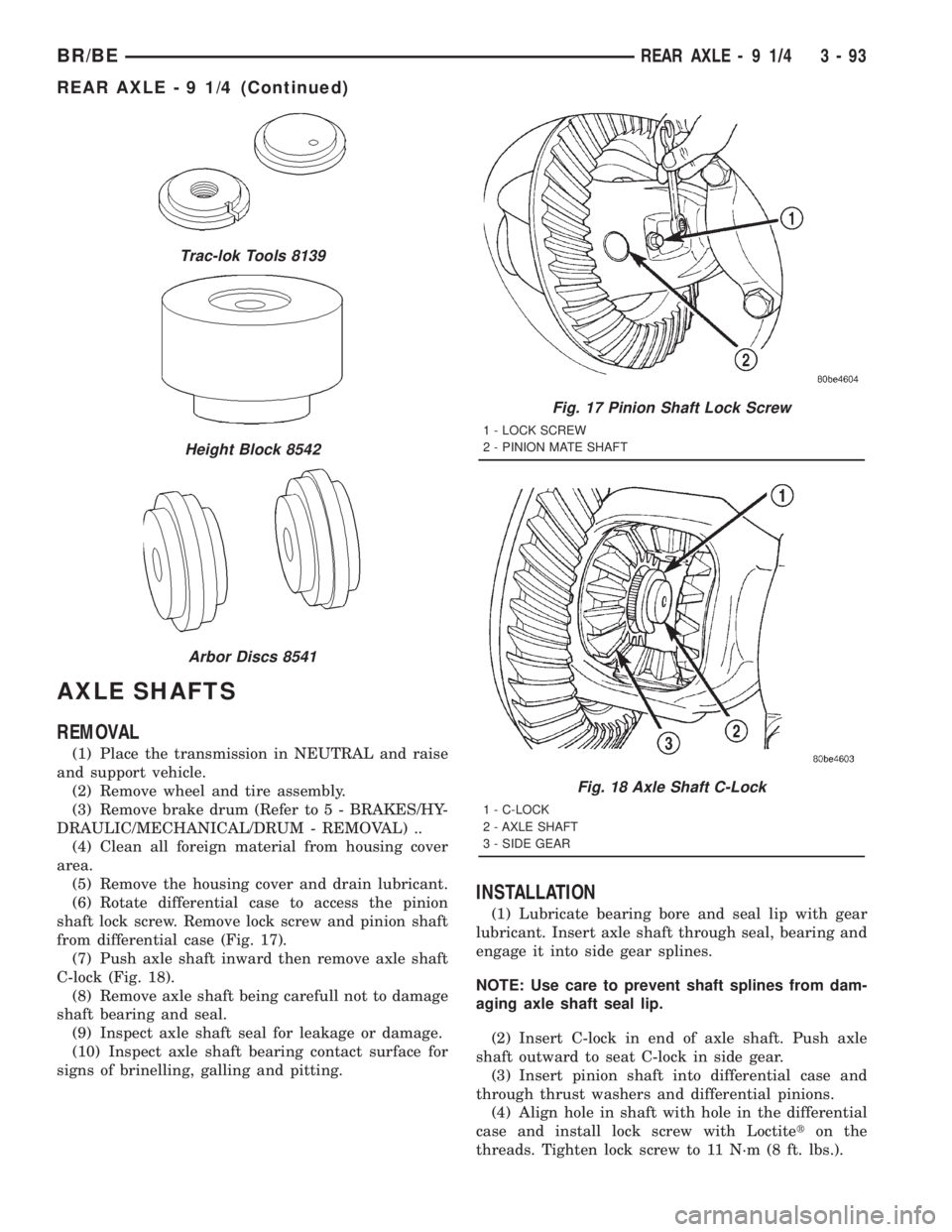
(6) Rotate differential case to access the pinion
shaft lock screw. Remove lock screw and pinion shaft
from differential case (Fig. 17).
(7) Push axle shaft inward then remove axle shaft
C-lock (Fig. 18).
(8) Remove axle shaft being carefull not to damage
shaft bearing and seal.
(9) Inspect axle shaft seal for leakage or damage.
(10) Inspect axle shaft bearing contact surface for
signs of brinelling, galling and pitting.
INSTALLATION
(1) Lubricate bearing bore and seal lip with gear
lubricant. Insert axle shaft through seal, bearing and
engage it into side gear splines.
NOTE: Use care to prevent shaft splines from dam-
aging axle shaft seal lip.
(2) Insert C-lock in end of axle shaft. Push axle
shaft outward to seat C-lock in side gear.
(3) Insert pinion shaft into differential case and
through thrust washers and differential pinions.
(4) Align hole in shaft with hole in the differential
case and install lock screw with Loctiteton the
threads. Tighten lock screw to 11 N´m (8 ft. lbs.).
Trac-lok Tools 8139
Height Block 8542
Arbor Discs 8541
Fig. 17 Pinion Shaft Lock Screw
1 - LOCK SCREW
2 - PINION MATE SHAFT
Fig. 18 Axle Shaft C-Lock
1 - C-LOCK
2 - AXLE SHAFT
3 - SIDE GEAR
BR/BEREAR AXLE - 9 1/4 3 - 93
REAR AXLE - 9 1/4 (Continued)
Page 172 of 2889
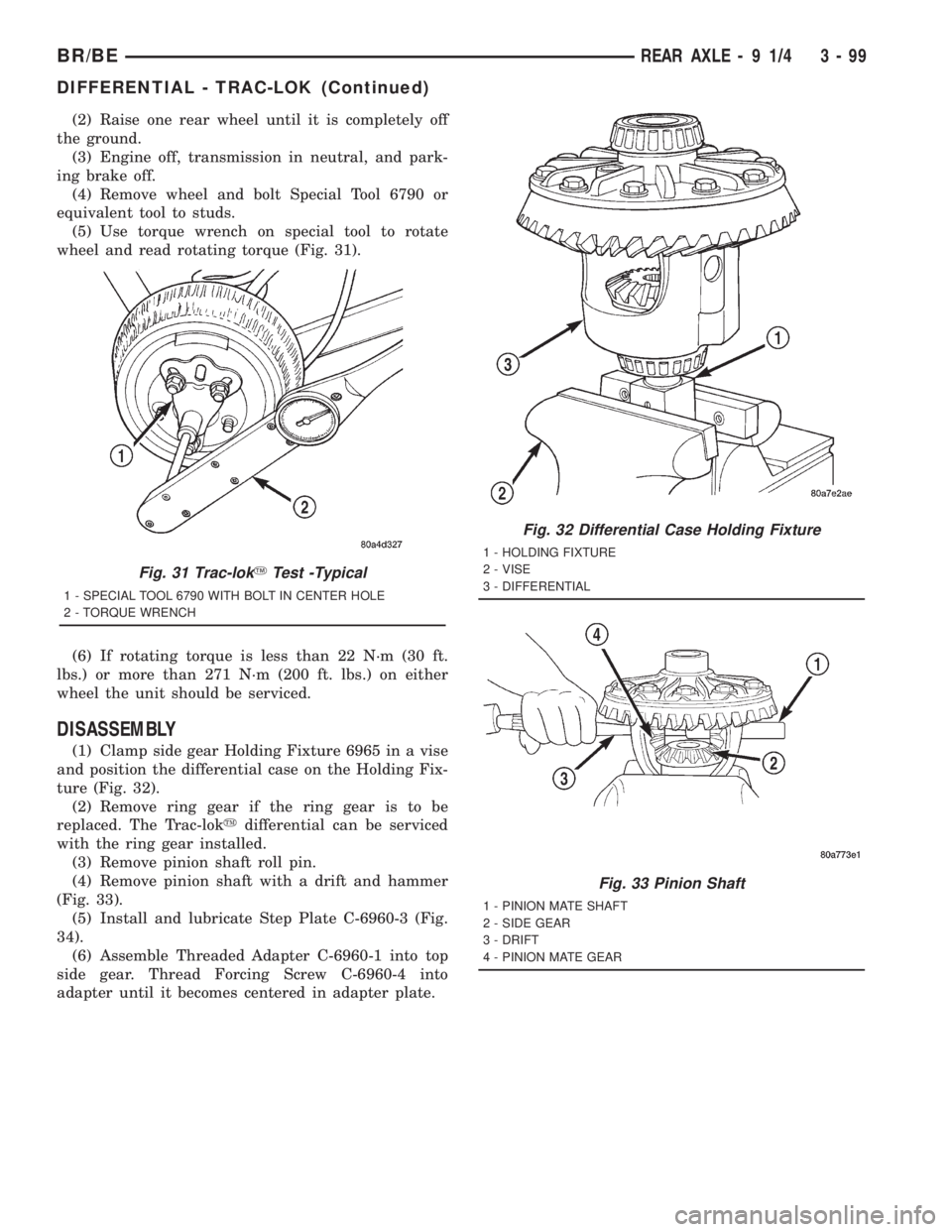
(2) Raise one rear wheel until it is completely off
the ground.
(3) Engine off, transmission in neutral, and park-
ing brake off.
(4) Remove wheel and bolt Special Tool 6790 or
equivalent tool to studs.
(5) Use torque wrench on special tool to rotate
wheel and read rotating torque (Fig. 31).
(6) If rotating torque is less than 22 N´m (30 ft.
lbs.) or more than 271 N´m (200 ft. lbs.) on either
wheel the unit should be serviced.
DISASSEMBLY
(1) Clamp side gear Holding Fixture 6965 in a vise
and position the differential case on the Holding Fix-
ture (Fig. 32).
(2) Remove ring gear if the ring gear is to be
replaced. The Trac-lokydifferential can be serviced
with the ring gear installed.
(3) Remove pinion shaft roll pin.
(4) Remove pinion shaft with a drift and hammer
(Fig. 33).
(5) Install and lubricate Step Plate C-6960-3 (Fig.
34).
(6) Assemble Threaded Adapter C-6960-1 into top
side gear. Thread Forcing Screw C-6960-4 into
adapter until it becomes centered in adapter plate.
Fig. 31 Trac-lokYTest -Typical
1 - SPECIAL TOOL 6790 WITH BOLT IN CENTER HOLE
2 - TORQUE WRENCH
Fig. 32 Differential Case Holding Fixture
1 - HOLDING FIXTURE
2 - VISE
3 - DIFFERENTIAL
Fig. 33 Pinion Shaft
1 - PINION MATE SHAFT
2 - SIDE GEAR
3 - DRIFT
4 - PINION MATE GEAR
BR/BEREAR AXLE - 9 1/4 3 - 99
DIFFERENTIAL - TRAC-LOK (Continued)
Page 182 of 2889
REAR AXLE - 248RBI
TABLE OF CONTENTS
page page
REAR AXLE - 248RBI
DESCRIPTION..........................109
OPERATION............................109
DIAGNOSIS AND TESTING.................111
AXLE...............................111
REMOVAL.............................113
INSTALLATION..........................114
ADJUSTMENTS.........................114
SPECIFICATIONS........................122
SPECIAL TOOLS........................122
AXLE SHAFTS
REMOVAL.............................125
INSTALLATION..........................125
AXLE BEARINGS
REMOVAL.............................125
INSTALLATION..........................125
PINION SEAL
REMOVAL.............................125INSTALLATION..........................125
DIFFERENTIAL
REMOVAL.............................127
DISASSEMBLY..........................128
ASSEMBLY............................128
INSTALLATION..........................129
DIFFERENTIAL - TRAC-LOK
DIAGNOSIS AND TESTING................130
TRAC-LOK...........................130
DISASSEMBLY..........................130
ASSEMBLY............................132
DIFFERENTIAL CASE BEARINGS
REMOVAL.............................134
INSTALLATION..........................134
PINION GEAR/RING GEAR/TONE RING
REMOVAL.............................135
INSTALLATION..........................137
REAR AXLE - 248RBI
DESCRIPTION
The Rear Beam-design Iron (RBI) axle housings
consist of an iron center casting (differential housing)
with axle shaft tubes extending from either side. The
tubes are pressed in to form a one-piece axle housing.
The integral type housing, hypoid gear design has
the centerline of the pinion set below the centerline
of the ring gear.
The axles are equipped with full-floating axle
shafts, meaning that loads are supported by the axle
housing tubes. The full-float axle shafts are retained
by bolts attached to the hub. The hub rides on two
bearings at the outboard end of the axle tube. The
axle shafts can be removed without disturbing or
removing the wheel bearings. The wheel bearings are
opposed tapered roller bearings and are contained in
the hub assembly.
The removable, stamped steel cover provides a
means for inspection and service without removing
the complete axle from the vehicle. A small, stamped
metal axle gear ratio identification tag is attached to
the housing cover via one of the cover bolts. This tag
also identifies the number of ring and pinion teeth.
The rear wheel anti-lock (RWAL) brake speed sen-
sor is attached to the top, forward exterior of the dif-
ferential housing. A seal is located between the
sensor and the wire harness connector. The seal mustbe in place when the wire connector is connected to
the sensor. The RWAL brake exciter ring is press-fit-
ted onto the differential case against the ring gear
flange.
The differential case for the standard differentials
and the Trac-lokydifferential are a one-piece design.
The differential pinion mate shaft is retained with a
roll pin. Differential bearing preload and ring gear
backlash are adjusted by the use of shims located
between the differential bearing cones and case. Pin-
ion bearing preload is set and maintained by the use
of a solid shims.
OPERATION
STANDARD DIFFERENTIAL
The axle receives power from the transmission/
transfer case through the rear propeller shaft. The
rear propeller shaft is connected to the pinion gear
which rotates the differential through the gear mesh
with the ring gear bolted to the differential case. The
engine power is transmitted to the axle shafts
through the pinion mate and side gears. The side
gears are splined to the axle shafts.
During straight-ahead driving, the differential pin-
ion gears do not rotate on the pinion mate shaft. This
occurs because input torque applied to the gears is
divided and distributed equally between the two side
BR/BEREAR AXLE - 248RBI 3 - 109