catalytic converter DODGE RAM 2002 Service User Guide
[x] Cancel search | Manufacturer: DODGE, Model Year: 2002, Model line: RAM, Model: DODGE RAM 2002Pages: 2255, PDF Size: 62.07 MB
Page 1274 of 2255
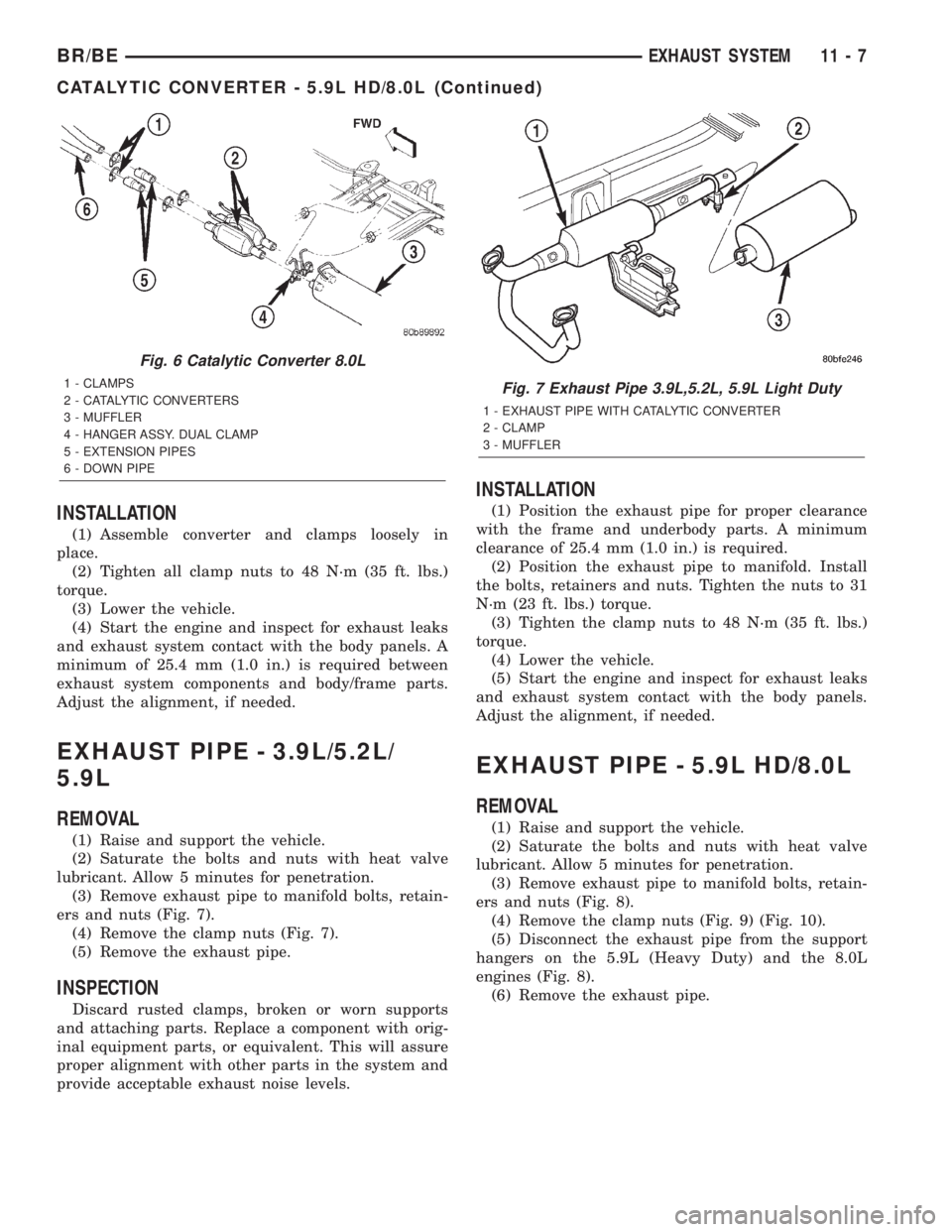
INSTALLATION
(1) Assemble converter and clamps loosely in
place.
(2) Tighten all clamp nuts to 48 N´m (35 ft. lbs.)
torque.
(3) Lower the vehicle.
(4) Start the engine and inspect for exhaust leaks
and exhaust system contact with the body panels. A
minimum of 25.4 mm (1.0 in.) is required between
exhaust system components and body/frame parts.
Adjust the alignment, if needed.
EXHAUST PIPE - 3.9L/5.2L/
5.9L
REMOVAL
(1) Raise and support the vehicle.
(2) Saturate the bolts and nuts with heat valve
lubricant. Allow 5 minutes for penetration.
(3) Remove exhaust pipe to manifold bolts, retain-
ers and nuts (Fig. 7).
(4) Remove the clamp nuts (Fig. 7).
(5) Remove the exhaust pipe.
INSPECTION
Discard rusted clamps, broken or worn supports
and attaching parts. Replace a component with orig-
inal equipment parts, or equivalent. This will assure
proper alignment with other parts in the system and
provide acceptable exhaust noise levels.
INSTALLATION
(1) Position the exhaust pipe for proper clearance
with the frame and underbody parts. A minimum
clearance of 25.4 mm (1.0 in.) is required.
(2) Position the exhaust pipe to manifold. Install
the bolts, retainers and nuts. Tighten the nuts to 31
N´m (23 ft. lbs.) torque.
(3) Tighten the clamp nuts to 48 N´m (35 ft. lbs.)
torque.
(4) Lower the vehicle.
(5) Start the engine and inspect for exhaust leaks
and exhaust system contact with the body panels.
Adjust the alignment, if needed.
EXHAUST PIPE - 5.9L HD/8.0L
REMOVAL
(1) Raise and support the vehicle.
(2) Saturate the bolts and nuts with heat valve
lubricant. Allow 5 minutes for penetration.
(3) Remove exhaust pipe to manifold bolts, retain-
ers and nuts (Fig. 8).
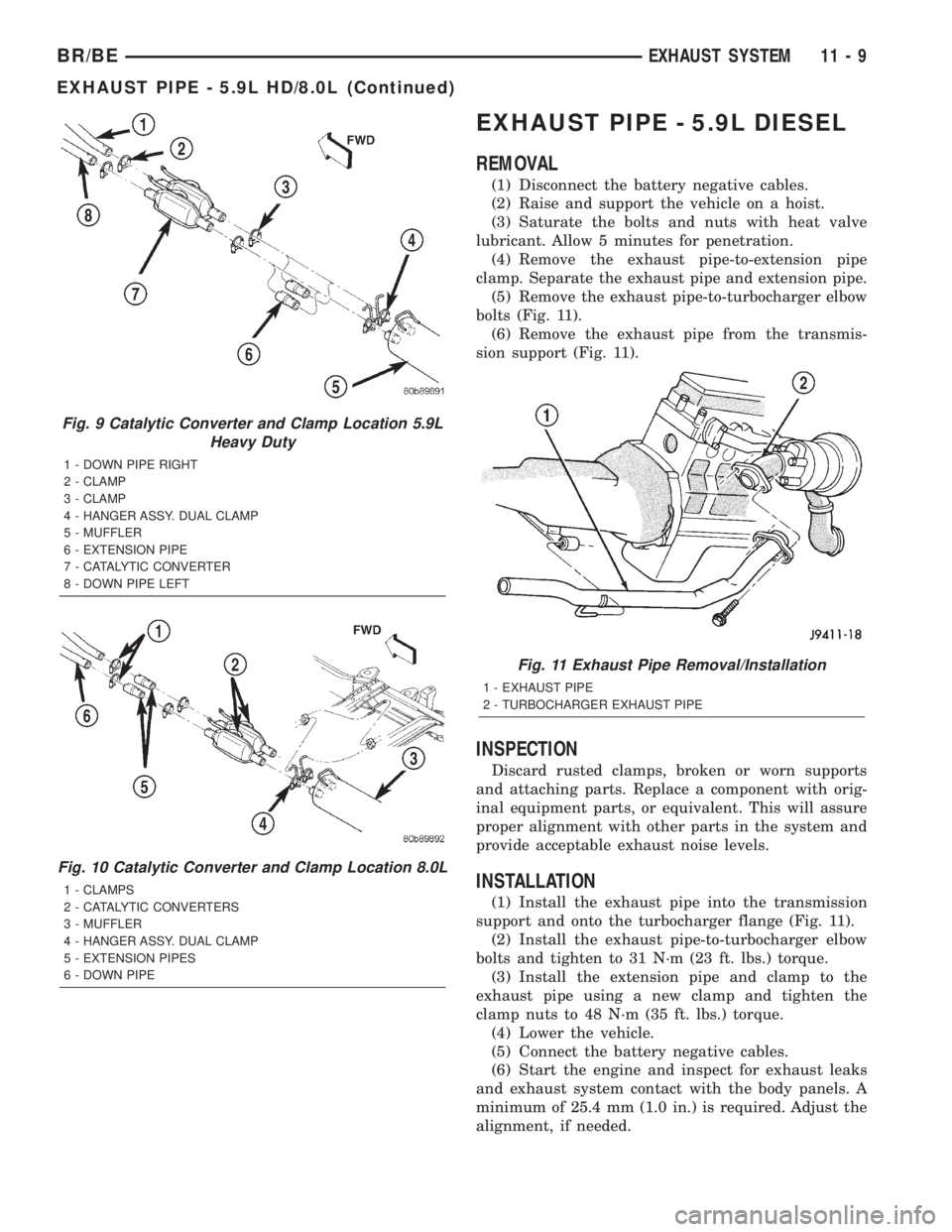
(4) Remove the clamp nuts (Fig. 9) (Fig. 10).
(5) Disconnect the exhaust pipe from the support
hangers on the 5.9L (Heavy Duty) and the 8.0L
engines (Fig. 8).
(6) Remove the exhaust pipe.
Fig. 6 Catalytic Converter 8.0L
1 - CLAMPS
2 - CATALYTIC CONVERTERS
3 - MUFFLER
4 - HANGER ASSY. DUAL CLAMP
5 - EXTENSION PIPES
6 - DOWN PIPEFig. 7 Exhaust Pipe 3.9L,5.2L, 5.9L Light Duty
1 - EXHAUST PIPE WITH CATALYTIC CONVERTER
2 - CLAMP
3 - MUFFLER
BR/BEEXHAUST SYSTEM 11 - 7
CATALYTIC CONVERTER - 5.9L HD/8.0L (Continued)
Page 1276 of 2255
EXHAUST PIPE - 5.9L DIESEL
REMOVAL
(1) Disconnect the battery negative cables.
(2) Raise and support the vehicle on a hoist.
(3) Saturate the bolts and nuts with heat valve
lubricant. Allow 5 minutes for penetration.
(4) Remove the exhaust pipe-to-extension pipe
clamp. Separate the exhaust pipe and extension pipe.
(5) Remove the exhaust pipe-to-turbocharger elbow
bolts (Fig. 11).
(6) Remove the exhaust pipe from the transmis-
sion support (Fig. 11).
INSPECTION
Discard rusted clamps, broken or worn supports
and attaching parts. Replace a component with orig-
inal equipment parts, or equivalent. This will assure
proper alignment with other parts in the system and
provide acceptable exhaust noise levels.
INSTALLATION
(1) Install the exhaust pipe into the transmission
support and onto the turbocharger flange (Fig. 11).
(2) Install the exhaust pipe-to-turbocharger elbow
bolts and tighten to 31 N´m (23 ft. lbs.) torque.
(3) Install the extension pipe and clamp to the
exhaust pipe using a new clamp and tighten the
clamp nuts to 48 N´m (35 ft. lbs.) torque.
(4) Lower the vehicle.
(5) Connect the battery negative cables.
(6) Start the engine and inspect for exhaust leaks
and exhaust system contact with the body panels. A
minimum of 25.4 mm (1.0 in.) is required. Adjust the
alignment, if needed.
Fig. 9 Catalytic Converter and Clamp Location 5.9L
Heavy Duty
1 - DOWN PIPE RIGHT
2 - CLAMP
3 - CLAMP
4 - HANGER ASSY. DUAL CLAMP
5 - MUFFLER
6 - EXTENSION PIPE
7 - CATALYTIC CONVERTER
8 - DOWN PIPE LEFT
Fig. 10 Catalytic Converter and Clamp Location 8.0L
1 - CLAMPS
2 - CATALYTIC CONVERTERS
3 - MUFFLER
4 - HANGER ASSY. DUAL CLAMP
5 - EXTENSION PIPES
6 - DOWN PIPE
Fig. 11 Exhaust Pipe Removal/Installation
1 - EXHAUST PIPE
2 - TURBOCHARGER EXHAUST PIPE
BR/BEEXHAUST SYSTEM 11 - 9
EXHAUST PIPE - 5.9L HD/8.0L (Continued)
Page 1345 of 2255
around 70ÉF, the resistance of the heating element is
approximately 4.5 ohms. As the sensor's temperature
increases, resistance in the heater element increases.
This allows the heater to maintain the optimum
operating temperature of approximately 930É-1100ÉF
(500É-600É C). Although the sensors operate the
same, there are physical differences, due to the envi-
ronment that they operate in, that keep them from
being interchangeable.
Maintaining correct sensor temperature at all
times allows the system to enter into closed loop
operation sooner. Also, it allows the system to remain
in closed loop operation during periods of extended
idle.
In Closed Loop operation, the PCM monitors cer-
tain O2 sensor input(s) along with other inputs, and
adjusts the injector pulse width accordingly. During
Open Loop operation, the PCM ignores the O2 sensor
input. The PCM adjusts injector pulse width based
on preprogrammed (fixed) values and inputs from
other sensors.
Upstream Sensors:Two upstream sensors are
used (1/1 and 2/1). The 1/1 sensor is the first sensor
to receive exhaust gases from the #1 cylinder. They
provide an input voltage to the PCM. The input tells
the PCM the oxygen content of the exhaust gas. The
PCM uses this information to fine tune fuel delivery
to maintain the correct oxygen content at the down-
stream oxygen sensors. The PCM will change the air/
fuel ratio until the upstream sensors input a voltage
that the PCM has determined will make the down-
stream sensors output (oxygen content) correct.
The upstream oxygen sensors also provide an input
to determine mini-catalyst efficiency. Main catalytic
convertor efficiency is not calculated with this pack-
age.
Downstream Sensors:Two downstream sensors
are used (1/2 and 2/2). The downstream sensors are
used to determine the correct air-fuel ratio. As the
oxygen content changes at the downstream sensor,
the PCM calculates how much air-fuel ratio change is
required. The PCM then looks at the upstream oxy-
gen sensor voltage, and changes fuel delivery until
the upstream sensor voltage changes enough to cor-
rect the downstream sensor voltage (oxygen content).
The downstream oxygen sensors also provide an
input to determine mini-catalyst efficiency. Main cat-
alytic convertor efficiency is not calculated with this
package.
Medium and Heavy Duty 8.0L V-10 Engine:
Four oxygen sensors are used (2 upstream, 1 pre-cat-
alyst and 1 post-catalyst). The upstream sensors (1/1
and 2/1) will fine-tune the air-fuel ratio through the
Powertrain Control Module (PCM). The pre-catalyst
(1/2) and post-catalyst (1/3) sensors will determine
catalytic convertor efficiency (efficiency of the maincatalytic convertor). This is also done through the
PCM.
Heavy Duty 5.9L Engine:Downstream sensors
are not used with this emissions package, meaning
catalytic convertor efficiency is not calculated with
this package. Two upstream sensors are used. The
left upstream sensor (1/1) will monitor cylinders 1, 3,
5 and 7. The right upstream sensor (2/1) will monitor
cylinders 2, 4, 6 and 8. The PCM monitors the oxy-
gen content of the sensors, and will fine-tune the air-
fuel ratio.
Engines equipped with either a downstream sen-
sor(s), or a post-catalytic sensor, will monitor cata-
lytic convertor efficiency. If efficiency is below
emission standards, the Malfunction Indicator Lamp
(MIL) will be illuminated and a Diagnostic Trouble
Code (DTC) will be set. Refer to Monitored Systems
in Emission Control Systems for additional informa-
tion.
REMOVAL
Never apply any type of grease to the oxygen
sensor electrical connector, or attempt any sol-
dering of the sensor wiring harness.
The O2S (oxygen sensors) are numbered 1/1, 1/2,
1/3, 2/1 and 2/2.
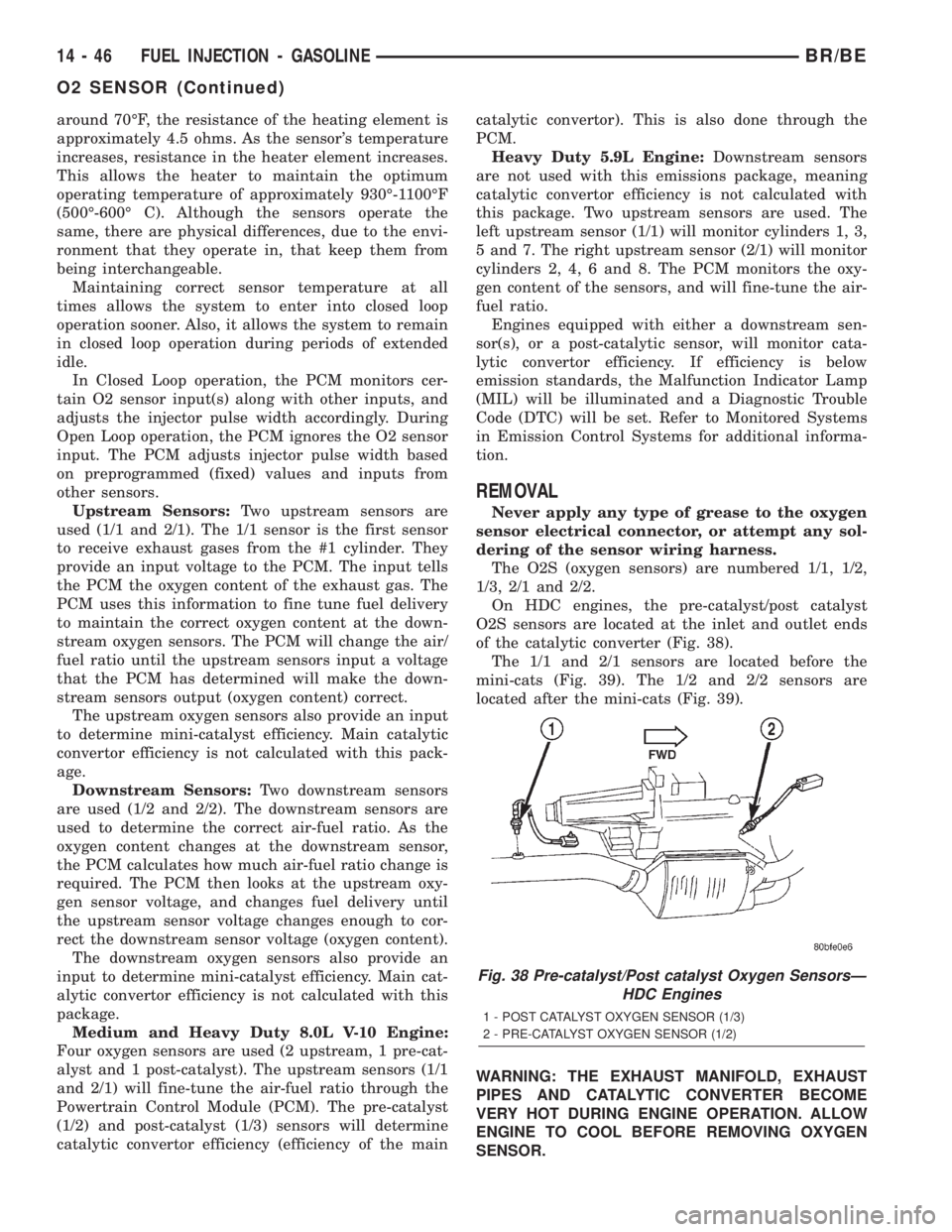
On HDC engines, the pre-catalyst/post catalyst
O2S sensors are located at the inlet and outlet ends
of the catalytic converter (Fig. 38).
The 1/1 and 2/1 sensors are located before the
mini-cats (Fig. 39). The 1/2 and 2/2 sensors are
located after the mini-cats (Fig. 39).
WARNING: THE EXHAUST MANIFOLD, EXHAUST
PIPES AND CATALYTIC CONVERTER BECOME
VERY HOT DURING ENGINE OPERATION. ALLOW
ENGINE TO COOL BEFORE REMOVING OXYGEN
SENSOR.
Fig. 38 Pre-catalyst/Post catalyst Oxygen SensorsÐ
HDC Engines
1 - POST CATALYST OXYGEN SENSOR (1/3)
2 - PRE-CATALYST OXYGEN SENSOR (1/2)
14 - 46 FUEL INJECTION - GASOLINEBR/BE
O2 SENSOR (Continued)
Page 2187 of 2255
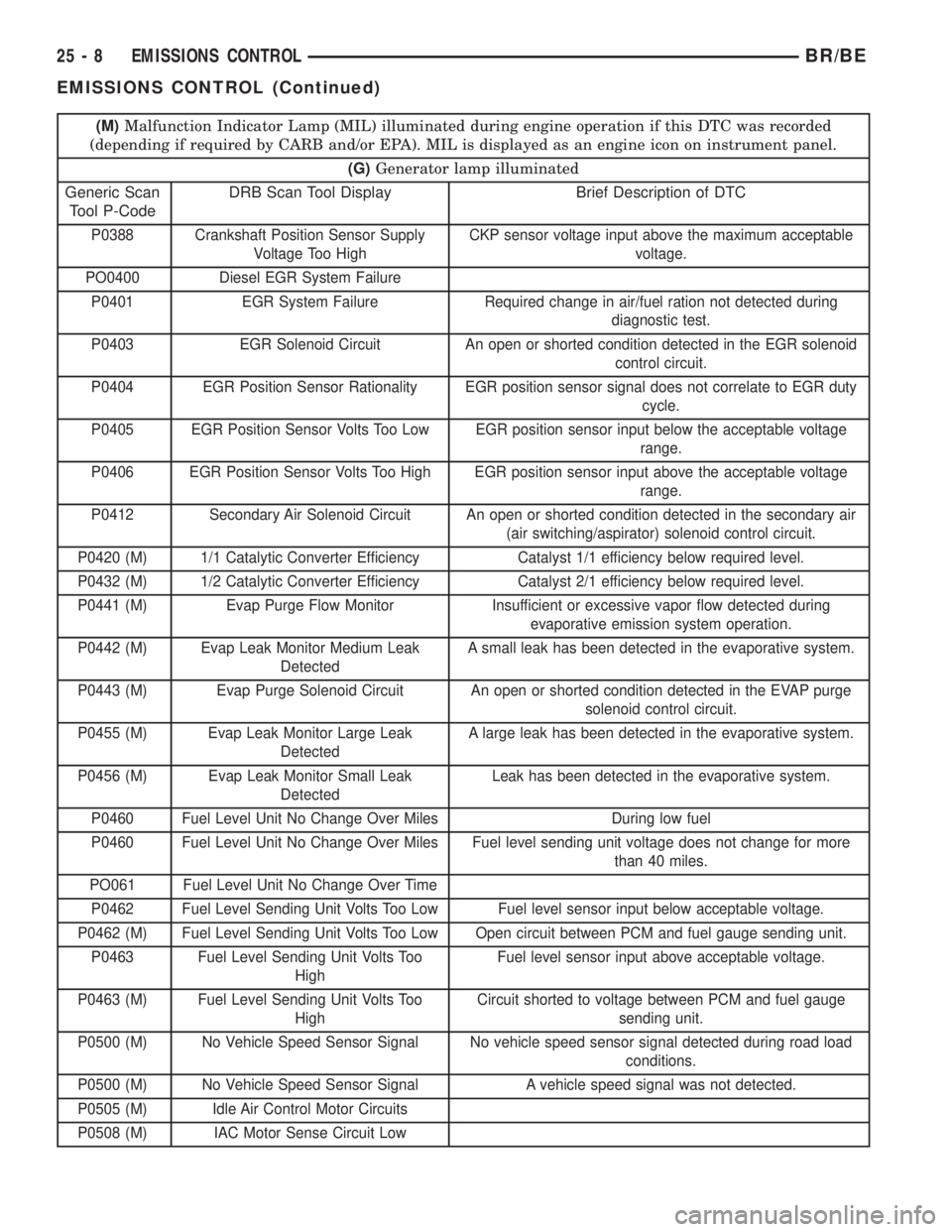
(M)Malfunction Indicator Lamp (MIL) illuminated during engine operation if this DTC was recorded
(depending if required by CARB and/or EPA). MIL is displayed as an engine icon on instrument panel.
(G)Generator lamp illuminated
Generic Scan
Tool P-CodeDRB Scan Tool Display Brief Description of DTC
P0388 Crankshaft Position Sensor Supply
Voltage Too HighCKP sensor voltage input above the maximum acceptable
voltage.
PO0400 Diesel EGR System Failure
P0401 EGR System Failure Required change in air/fuel ration not detected during
diagnostic test.
P0403 EGR Solenoid Circuit An open or shorted condition detected in the EGR solenoid
control circuit.
P0404 EGR Position Sensor Rationality EGR position sensor signal does not correlate to EGR duty
cycle.
P0405 EGR Position Sensor Volts Too Low EGR position sensor input below the acceptable voltage
range.
P0406 EGR Position Sensor Volts Too High EGR position sensor input above the acceptable voltage
range.
P0412 Secondary Air Solenoid Circuit An open or shorted condition detected in the secondary air
(air switching/aspirator) solenoid control circuit.
P0420 (M) 1/1 Catalytic Converter Efficiency Catalyst 1/1 efficiency below required level.
P0432 (M) 1/2 Catalytic Converter Efficiency Catalyst 2/1 efficiency below required level.
P0441 (M) Evap Purge Flow Monitor Insufficient or excessive vapor flow detected during
evaporative emission system operation.
P0442 (M) Evap Leak Monitor Medium Leak
DetectedA small leak has been detected in the evaporative system.
P0443 (M) Evap Purge Solenoid Circuit An open or shorted condition detected in the EVAP purge
solenoid control circuit.
P0455 (M) Evap Leak Monitor Large Leak
DetectedA large leak has been detected in the evaporative system.
P0456 (M) Evap Leak Monitor Small Leak
DetectedLeak has been detected in the evaporative system.
P0460 Fuel Level Unit No Change Over Miles During low fuel
P0460 Fuel Level Unit No Change Over Miles Fuel level sending unit voltage does not change for more
than 40 miles.
PO061 Fuel Level Unit No Change Over Time
P0462 Fuel Level Sending Unit Volts Too Low Fuel level sensor input below acceptable voltage.
P0462 (M) Fuel Level Sending Unit Volts Too Low Open circuit between PCM and fuel gauge sending unit.
P0463 Fuel Level Sending Unit Volts Too
HighFuel level sensor input above acceptable voltage.
P0463 (M) Fuel Level Sending Unit Volts Too
HighCircuit shorted to voltage between PCM and fuel gauge
sending unit.
P0500 (M) No Vehicle Speed Sensor Signal No vehicle speed sensor signal detected during road load
conditions.
P0500 (M) No Vehicle Speed Sensor Signal A vehicle speed signal was not detected.
P0505 (M) Idle Air Control Motor Circuits
P0508 (M) IAC Motor Sense Circuit Low
25 - 8 EMISSIONS CONTROLBR/BE
EMISSIONS CONTROL (Continued)
Page 2192 of 2255
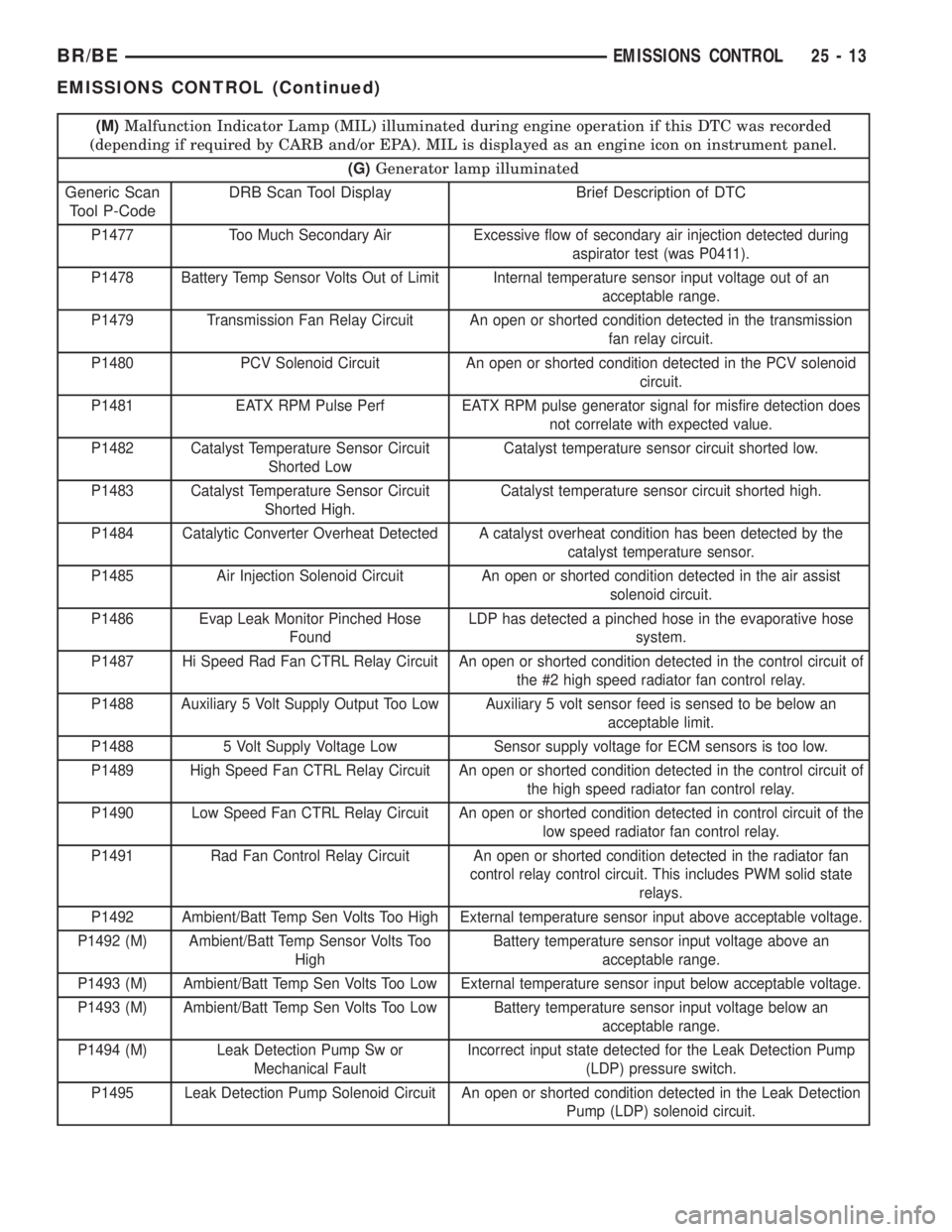
(M)Malfunction Indicator Lamp (MIL) illuminated during engine operation if this DTC was recorded
(depending if required by CARB and/or EPA). MIL is displayed as an engine icon on instrument panel.
(G)Generator lamp illuminated
Generic Scan
Tool P-CodeDRB Scan Tool Display Brief Description of DTC
P1477 Too Much Secondary Air Excessive flow of secondary air injection detected during
aspirator test (was P0411).
P1478 Battery Temp Sensor Volts Out of Limit Internal temperature sensor input voltage out of an
acceptable range.
P1479 Transmission Fan Relay Circuit An open or shorted condition detected in the transmission
fan relay circuit.
P1480 PCV Solenoid Circuit An open or shorted condition detected in the PCV solenoid
circuit.
P1481 EATX RPM Pulse Perf EATX RPM pulse generator signal for misfire detection does
not correlate with expected value.
P1482 Catalyst Temperature Sensor Circuit
Shorted LowCatalyst temperature sensor circuit shorted low.
P1483 Catalyst Temperature Sensor Circuit
Shorted High.Catalyst temperature sensor circuit shorted high.
P1484 Catalytic Converter Overheat Detected A catalyst overheat condition has been detected by the
catalyst temperature sensor.
P1485 Air Injection Solenoid Circuit An open or shorted condition detected in the air assist
solenoid circuit.
P1486 Evap Leak Monitor Pinched Hose
FoundLDP has detected a pinched hose in the evaporative hose
system.
P1487 Hi Speed Rad Fan CTRL Relay Circuit An open or shorted condition detected in the control circuit of
the #2 high speed radiator fan control relay.
P1488 Auxiliary 5 Volt Supply Output Too Low Auxiliary 5 volt sensor feed is sensed to be below an
acceptable limit.
P1488 5 Volt Supply Voltage Low Sensor supply voltage for ECM sensors is too low.
P1489 High Speed Fan CTRL Relay Circuit An open or shorted condition detected in the control circuit of
the high speed radiator fan control relay.
P1490 Low Speed Fan CTRL Relay Circuit An open or shorted condition detected in control circuit of the
low speed radiator fan control relay.
P1491 Rad Fan Control Relay Circuit An open or shorted condition detected in the radiator fan
control relay control circuit. This includes PWM solid state
relays.
P1492 Ambient/Batt Temp Sen Volts Too High External temperature sensor input above acceptable voltage.
P1492 (M) Ambient/Batt Temp Sensor Volts Too
HighBattery temperature sensor input voltage above an
acceptable range.
P1493 (M) Ambient/Batt Temp Sen Volts Too Low External temperature sensor input below acceptable voltage.
P1493 (M) Ambient/Batt Temp Sen Volts Too Low Battery temperature sensor input voltage below an
acceptable range.
P1494 (M) Leak Detection Pump Sw or
Mechanical FaultIncorrect input state detected for the Leak Detection Pump
(LDP) pressure switch.
P1495 Leak Detection Pump Solenoid Circuit An open or shorted condition detected in the Leak Detection
Pump (LDP) solenoid circuit.
BR/BEEMISSIONS CONTROL 25 - 13
EMISSIONS CONTROL (Continued)
Page 2197 of 2255
The primary components within the assembly are:
A three port solenoid that activates both of the func-
tions listed above; a pump which contains a switch,
two check valves and a spring/diaphragm, a canister
vent valve (CVV) seal which contains a spring loaded
vent seal valve.
Immediately after a cold start, between predeter-
mined temperature thresholds limits, the three port
solenoid is briefly energized. This initializes the
pump by drawing air into the pump cavity and also
closes the vent seal. During non test conditions the
vent seal is held open by the pump diaphragm
assembly which pushes it open at the full travel posi-
tion. The vent seal will remain closed while the
pump is cycling due to the reed switch triggering of
the three port solenoid that prevents the diaphragm
assembly from reaching full travel. After the brief
initialization period, the solenoid is de-energized
allowing atmospheric pressure to enter the pump
cavity, thus permitting the spring to drive the dia-
phragm which forces air out of the pump cavity and
into the vent system. When the solenoid is energized
and de energized, the cycle is repeated creating flow
in typical diaphragm pump fashion. The pump is con-
trolled in 2 modes:
Pump Mode: The pump is cycled at a fixed rate to
achieve a rapid pressure build in order to shorten the
overall test length.
Test Mode: The solenoid is energized with a fixed
duration pulse. Subsequent fixed pulses occur when
the diaphragm reaches the Switch closure point.
The spring in the pump is set so that the system
will achieve an equalized pressure of about 7.5º H20.
The cycle rate of pump strokes is quite rapid as the
system begins to pump up to this pressure. As the
pressure increases, the cycle rate starts to drop off. If
there is no leak in the system, the pump would even-
tually stop pumping at the equalized pressure. If
there is a leak, it will continue to pump at a rate rep-
resentative of the flow characteristic of the size of the
leak. From this information we can determine if the
leak is larger than the required detection limit (cur-
rently set at .040º orifice by CARB). If a leak is
revealed during the leak test portion of the test, the
test is terminated at the end of the test mode and no
further system checks will be performed.
After passing the leak detection phase of the test,
system pressure is maintained by turning on the
LDP's solenoid until the purge system is activated.
Purge activation in effect creates a leak. The cycle
rate is again interrogated and when it increases due
to the flow through the purge system, the leak check
portion of the diagnostic is complete.
The canister vent valve will unseal the system
after completion of the test sequence as the pump
diaphragm assembly moves to the full travel position.Evaporative system functionality will be verified by
using the stricter evap purge flow monitor. At an
appropriate warm idle the LDP will be energized to
seal the canister vent. The purge flow will be clocked
up from some small value in an attempt to see a
shift in the 02 control system. If fuel vapor, indicated
by a shift in the 02 control, is present the test is
passed. If not, it is assumed that the purge system is
not functioning in some respect. The LDP is again
turned off and the test is ended.
MISFIRE MONITOR
Excessive engine misfire results in increased cata-
lyst temperature and causes an increase in HC emis-
sions. Severe misfires could cause catalyst damage.
To prevent catalytic convertor damage, the PCM
monitors engine misfire.
The Powertrain Control Module (PCM) monitors
for misfire during most engine operating conditions
(positive torque) by looking at changes in the crank-
shaft speed. If a misfire occurs the speed of the
crankshaft will vary more than normal.
FUEL SYSTEM MONITOR
To comply with clean air regulations, vehicles are
equipped with catalytic converters. These converters
reduce the emission of hydrocarbons, oxides of nitro-
gen and carbon monoxide. The catalyst works best
when the Air Fuel (A/F) ratio is at or near the opti-
mum of 14.7 to 1.
The PCM is programmed to maintain the optimum
air/fuel ratio of 14.7 to 1. This is done by making
short term corrections in the fuel injector pulse width
based on the O2S sensor output. The programmed
memory acts as a self calibration tool that the engine
controller uses to compensate for variations in engine
specifications, sensor tolerances and engine fatigue
over the life span of the engine. By monitoring the
actual fuel-air ratio with the O2S sensor (short term)
and multiplying that with the program long-term
(adaptive) memory and comparing that to the limit,
it can be determined whether it will pass an emis-
sions test. If a malfunction occurs such that the PCM
cannot maintain the optimum A/F ratio, then the
MIL will be illuminated.
CATALYST MONITOR
To comply with clean air regulations, vehicles are
equipped with catalytic converters. These converters
reduce the emission of hydrocarbons, oxides of nitro-
gen and carbon monoxide.
Normal vehicle miles or engine misfire can cause a
catalyst to decay. This can increase vehicle emissions
and deteriorate engine performance, driveability and
fuel economy.
25 - 18 EMISSIONS CONTROLBR/BE
EMISSIONS CONTROL (Continued)
Page 2198 of 2255
The catalyst monitor uses dual oxygen sensors
(O2S's) to monitor the efficiency of the converter. The
dual O2S's sensor strategy is based on the fact that
as a catalyst deteriorates, its oxygen storage capacity
and its efficiency are both reduced. By monitoring
the oxygen storage capacity of a catalyst, its effi-
ciency can be indirectly calculated. The upstream
O2S is used to detect the amount of oxygen in the
exhaust gas before the gas enters the catalytic con-
verter. The PCM calculates the A/F mixture from the
output of the O2S. A low voltage indicates high oxy-
gen content (lean mixture). A high voltage indicates a
low content of oxygen (rich mixture).
When the upstream O2S detects a lean condition,
there is an abundance of oxygen in the exhaust gas.
A functioning converter would store this oxygen so it
can use it for the oxidation of HC and CO. As the
converter absorbs the oxygen, there will be a lack of
oxygen downstream of the converter. The output of
the downstream O2S will indicate limited activity in
this condition.
As the converter loses the ability to store oxygen,
the condition can be detected from the behavior of
the downstream O2S. When the efficiency drops, no
chemical reaction takes place. This means the con-
centration of oxygen will be the same downstream as
upstream. The output voltage of the downstream
O2S copies the voltage of the upstream sensor. The
only difference is a time lag (seen by the PCM)
between the switching of the O2S's.
To monitor the system, the number of lean-to-rich
switches of upstream and downstream O2S's is
counted. The ratio of downstream switches to
upstream switches is used to determine whether the
catalyst is operating properly. An effective catalyst
will have fewer downstream switches than it has
upstream switches i.e., a ratio closer to zero. For a
totally ineffective catalyst, this ratio will be one-to-
one, indicating that no oxidation occurs in the device.
The system must be monitored so that when cata-
lyst efficiency deteriorates and exhaust emissions
increase to over the legal limit, the MIL will be illu-
minated.
DESCRIPTION - TRIP DEFINITION
The term ªTripº has different meanings depending
on what the circumstances are. If the MIL (Malfunc-
tion Indicator Lamp) is OFF, a Trip is defined as
when the Oxygen Sensor Monitor and the Catalyst
Monitor have been completed in the same drive cycle.
When any Emission DTC is set, the MIL on the
dash is turned ON. When the MIL is ON, it takes 3
good trips to turn the MIL OFF. In this case, it
depends on what type of DTC is set to know what a
ªTripº is.For the Fuel Monitor or Mis-Fire Monitor (contin-
uous monitor), the vehicle must be operated in the
ªSimilar Condition Windowº for a specified amount of
time to be considered a Good Trip.
If a Non-Contiuous OBDII Monitor fails twice in a
row and turns ON the MIL, re-running that monitor
which previously failed, on the next start-up and
passing the monitor, is considered to be a Good Trip.
These will include the following:
²Oxygen Sensor
²Catalyst Monitor
²Purge Flow Monitor
²Leak Detection Pump Monitor (if equipped)
²EGR Monitor (if equipped)
²Oxygen Sensor Heater Monitor
If any other Emission DTC is set (not an OBDII
Monitor), a Good Trip is considered to be when the
Oxygen Sensor Monitor and Catalyst Monitor have
been completed; or 2 Minutes of engine run time if
the Oxygen Sensor Monitor or Catalyst Monitor have
been stopped from running.
It can take up to 2 Failures in a row to turn on the
MIL. After the MIL is ON, it takes 3 Good Trips to
turn the MIL OFF. After the MIL is OFF, the PCM
will self-erase the DTC after 40 Warm-up cycles. A
Warm-up cycle is counted when the ECT (Engine
Coolant Temperature Sensor) has crossed 160ÉF and
has risen by at least 40ÉF since the engine has been
started.
DESCRIPTION - COMPONENT MONITORS -
GAS ENGINES
There are several components that will affect vehi-
cle emissions if they malfunction. If one of these com-
ponents malfunctions the Malfunction Indicator
Lamp (MIL) will illuminate.
Some of the component monitors are checking for
proper operation of the part. Electrically operated
components now have input (rationality) and output
(functionality) checks. Previously, a component like
the Throttle Position sensor (TPS) was checked by
the PCM for an open or shorted circuit. If one of
these conditions occurred, a DTC was set. Now there
is a check to ensure that the component is working.
This is done by watching for a TPS indication of a
greater or lesser throttle opening than MAP and
engine rpm indicate. In the case of the TPS, if engine
vacuum is high and engine rpm is 1600 or greater,
and the TPS indicates a large throttle opening, a
DTC will be set. The same applies to low vacuum if
the TPS indicates a small throttle opening.
All open/short circuit checks, or any component
that has an associated limp-in, will set a fault after 1
trip with the malfunction present. Components with-
out an associated limp-in will take two trips to illu-
minate the MIL.
BR/BEEMISSIONS CONTROL 25 - 19
EMISSIONS CONTROL (Continued)
Page 2222 of 2255
CAB SIDE PANEL SPEAKER - REMOVAL,
REAR..............................8A-20
CABLE - ADJUSTMENTS,
TRANSMISSION THROTTLE
VALVE ......................21-210,21-382
CABLE - DESCRIPTION.................8P-4
CABLE - DESCRIPTION, ANTENNA BODY . . . 8A-4
CABLE - DESCRIPTION, BATTERY........8F-18
CABLE - DESCRIPTION, SPARK PLUG.....8I-20
CABLE - DESCRIPTION, THROTTLE
VALVE ......................21-209,21-381
CABLE - INSTALLATION, ANTENNA BODY . . 8A-6
CABLE - INSTALLATION, CHECK.........23-67
CABLE - INSTALLATION, FRONT
PARKING BRAKE......................5-30
CABLE - INSTALLATION, INSTRUMENT
PANEL ANTENNA......................8A-9
CABLE - INSTALLATION, LATCH RELEASE . 23-103
CABLE - INSTALLATION, REAR PARK
BRAKE..............................5-30
CABLE - INSTALLATION, RELEASE.......23-82
CABLE - INSTALLATION, SPARK PLUG....8I-21
CABLE - INSTALLATION, THROTTLE
CONTROL....................14-110,14-50
CABLE - OPERATION...................8P-4
CABLE - OPERATION, ANTENNA BODY.....8A-4
CABLE - OPERATION, BATTERY..........8F-18
CABLE - OPERATION, SPARK PLUG.......8I-20
CABLE - REMOVAL, ANTENNA BODY......8A-6
CABLE - REMOVAL, CHECK.............23-67
CABLE - REMOVAL, FRONT PARKING
BRAKE..............................5-29
CABLE - REMOVAL, INSTRUMENT PANEL
ANTENNA...........................8A-9
CABLE - REMOVAL, LATCH RELEASE....23-103
CABLE - REMOVAL, REAR PARK BRAKE . . . 5-29
CABLE - REMOVAL, RELEASE...........23-82
CABLE - REMOVAL, SPARK PLUG........8I-21
CABLE - REMOVAL, THROTTLE
CONTROL....................14-109,14-49
CABLE INSTALLATION, GASOLINE
ENGINE - NEGATIVE..................8F-22
CABLE INSTALLATION, GASOLINE
ENGINE - POSITIVE...................8F-22
CABLE ORDER, 8.0L V-10 ENGINE -
SPARK PLUG.........................8I-3
CABLE REMOVAL, GASOLINE ENGINE -
NEGATIVE..........................8F-22
CABLE REMOVAL, GASOLINE ENGINE -
POSITIVE...........................8F-21
CABLE RESISTANCE, SPECIFICATIONS -
SPARK PLUG.........................8I-3
CABLES - DIAGNOSIS AND TESTING,
BATTERY...........................8F-19
CABLES - DIAGNOSIS AND TESTING,
SPARK PLUG........................8I-20
CAB-TO-BED GROUND STRAP -
INSTALLATION.......................8A-14
CAB-TO-BED GROUND STRAP -
REMOVAL..........................8A-13
CALIBRATION - STANDARD PROCEDURE,
COMPASS...........................8M-4
CALIPERS - DESCRIPTION, DISC BRAKE . . . 5-10
CALIPERS - OPERATION, DISC BRAKE.....5-10
CAM - DESCRIPTION, TURN SIGNAL
CANCEL............................8L-31
CAM - OPERATION, TURN SIGNAL
CANCEL............................8L-31
CAM BORE REPAIR - STANDARD
PROCEDURE........................9-151
CAM/OVERDRIVE PISTON RETAINER -
ASSEMBLY, OVERRUNNING
CLUTCH.....................21-193,21-364
CAM/OVERDRIVE PISTON RETAINER -
CLEANING, OVERRUNNING
CLUTCH
.....................21-192,21-364
CAM/OVERDRIVE PISTON RETAINER -
DESCRIPTION, OVERRUNNING
CLUTCH
.....................21-192,21-363
CAM/OVERDRIVE PISTON RETAINER -
DISASSEMBLY, OVERRUNNING
CLUTCH
.....................21-192,21-364
CAM/OVERDRIVE PISTON RETAINER -
INSPECTION, OVERRUNNING
CLUTCH
.....................21-193,21-364
CAM/OVERDRIVE PISTON RETAINER -
OPERATION, OVERRUNNING
CLUTCH
.....................21-192,21-363CAMSHAFT - INSTALLATION....9-157,9-29,9-86
CAMSHAFT - REMOVAL.......9-152,9-28,9-85
CAMSHAFT BEARINGS - I
NSTALLATION...............9-157,9-28,9-86
CAMSHAFT BEARINGS -
REMOVAL..................9-152,9-27,9-85
CANCEL CAM - DESCRIPTION, TURN
SIGNAL............................8L-31
CANCEL CAM - OPERATION, TURN
SIGNAL............................8L-31
CANISTER - DESCRIPTION, VAPOR......25-37
CANISTER - INSTALLATION, CRANKCASE
BREATHER VAPOR...................9-126
CANISTER - INSTALLATION, VAPOR......25-38
CANISTER - OPERATION, VAPOR........25-37
CANISTER - REMOVAL, CRANKCASE
BREATHER VAPOR...................9-125
CANISTER - REMOVAL, VAPOR..........25-38
CAP - DESCRIPTION, FUEL FILLER.......25-34
CAP - DESCRIPTION, RADIATOR
PRESSURE..........................7-64
CAP - DIAGNOSIS AND TESTING,
DISTRIBUTOR.......................8I-14
CAP - DIAGNOSIS AND TESTING,
RADIATOR...........................7-65
CAP - OPERATION, FUEL FILLER........25-34
CAP - OPERATION, RADIATOR
PRESSURE..........................7-64
CAP - REMOVAL/INSTALLATION, FUEL
FILLER.............................25-34
CAPACITIES, SPECIFICATIONS - FLUID.......0-6
CAPACITY TEST - DIAGNOSIS AND
TESTING, FUEL PUMP..................14-9
CARDAN UNIVERSAL JOINTS -
ASSEMBLY, DOUBLE...................3-11
CARDAN UNIVERSAL JOINTS -
ASSEMBLY, SINGLE.....................3-9
CARDAN UNIVERSAL JOINTS -
DISASSEMBLY, DOUBLE................3-10
CARDAN UNIVERSAL JOINTS -
DISASSEMBLY, SINGLE..................3-8
CARDAN UNIVERSAL JOINTS -
INSTALLATION, SINGLE.................3-35
CARDAN UNIVERSAL JOINTS -
REMOVAL, SINGLE....................3-34
CARGO BOX - INSTALLATION...........23-97
CARGO BOX - REMOVAL...............23-97
CARGO DOOR - ADJUSTMENT..........23-78
CARPETS AND FLOOR MATS -
INSTALLATION......................23-123
CARPETS AND FLOOR MATS - REMOVAL . 23-123
CARTRIDGE FUSE - DESCRIPTION,
GENERATOR......................8W-97-4
CARTRIDGE FUSE - INSTALLATION,
GENERATOR......................8W-97-4
CARTRIDGE FUSE - OPERATION,
GENERATOR......................8W-97-4
CARTRIDGE FUSE - REMOVAL,
GENERATOR......................8W-97-4
CASE - DIAGNOSIS AND TESTING,
TRANSFER...................21-431,21-467
CASE - NV241 - DESCRIPTION,
TRANSFER
............................0-5
CASE - NV241HD - ASSEMBLY,
TRANSFER
.........................21-480
CASE - NV241HD - CLEANING,
TRANSFER
.........................21-476
CASE - NV241HD - DESCRIPTION,
TRANSFER
.........................21-465
CASE - NV241HD - DISASSEMBLY,
TRANSFER
.........................21-469
CASE - NV241HD - INSPECTION,
TRANSFER
.........................21-476
CASE - NV241HD - INSTALLATION,
TRANSFER
.........................21-494
CASE - NV241HD - OPERATION,
TRANSFER
.........................21-467
CASE - NV241HD - REMOVAL,
TRANSFER
.........................21-469
CASE - NV241LD - ASSEMBLY,
TRANSFER
.........................21-445
CASE - NV241LD - CLEANING,
TRANSFER
.........................21-441
CASE - NV241LD - DESCRIPTION,
TRANSFER
.........................21-430
CASE - NV241LD - DISASSEMBLY,
TRANSFER
.........................21-432CASE - NV241LD - INSPECTION,
TRANSFER.........................21-442
CASE - NV241LD - INSTALLATION,
TRANSFER.........................21-458
CASE - NV241LD - OPERATION,
TRANSFER.........................21-430
CASE - NV241LD - REMOVAL,
TRANSFER.........................21-432
CASE BEARINGS - INSTALLATION,
DIFFERENTIAL..........3-102,3-129,3-41,3-72
CASE BEARINGS - REMOVAL,
DIFFERENTIAL..........3-102,3-129,3-40,3-72
CASE, NV241HD - TRANSFER..........21-495
CASE, NV241LD - TRANSFER..........21-459
CASE SKID PLATE - INSTALLATION,
TRANSFER..........................13-11
CASE SKID PLATE - REMOVAL,
TRANSFER..........................13-11
CASE, SPECIFICATIONS -
TRANSFER...................21-458,21-495
CASTER CORRECTION MEASUREMENT -
STANDARD PROCEDURE.................2-3
CATALYTIC CONVERTER - 3.9L/5.2L/5.9L
- DESCRIPTION.......................11-5
CATALYTIC CONVERTER - 3.9L/5.2L/5.9L
- INSPECTION........................11-6
CATALYTIC CONVERTER - 3.9L/5.2L/5.9L
- INSTALLATION......................11-6
CATALYTIC CONVERTER - 3.9L/5.2L/5.9L
- OPERATION.........................11-5
CATALYTIC CONVERTER - 3.9L/5.2L/5.9L
- REMOVAL..........................11-5
CATALYTIC CONVERTER - 5.9L HD/8.0L -
DESCRIPTION........................11-6
CATALYTIC CONVERTER - 5.9L HD/8.0L -
INSPECTION.........................11-6
CATALYTIC CONVERTER - 5.9L HD/8.0L -
INSTALLATION........................11-7
CATALYTIC CONVERTER - 5.9L HD/8.0L -
OPERATION..........................11-6
CATALYTIC CONVERTER - 5.9L HD/8.0L -
REMOVAL...........................11-6
CAUSES OF BURNT FLUID - DIAGNOSIS
AND TESTING................21-157,21-327
CCD DATA BUS - DESCRIPTION..........8E-6
CCD DATA BUS - DIAGNOSIS AND
TESTING...........................8E-11
CCD DATA BUS - OPERATION............8E-7
CENTER - DESCRIPTION, POWER
DISTRIBUTION....................8W-97-8
CENTER - INSTALLATION, POWER
DISTRIBUTION...................8W-97-10
CENTER - OPERATION, POWER
DISTRIBUTION....................8W-97-8
CENTER - REMOVAL, POWER
DISTRIBUTION....................8W-97-8
CENTER BEARING - ADJUSTMENT.........3-8
CENTER BEARING - INSTALLATION........3-8
CENTER BEARING - REMOVAL............3-8
CENTER CONSOLE - INSTALLATION.....23-122
CENTER CONSOLE - REMOVAL.........23-122
CENTER CONSOLE LID - INSTALLATION . . 23-132
CENTER CONSOLE LID - REMOVAL.....23-131
CENTER HIGH MOUNTED STOP LAMP -
INSTALLATION........................8L-6
CENTER HIGH MOUNTED STOP LAMP -
REMOVAL...........................8L-6
CENTER HIGH MOUNTED STOP LAMP
UNIT - INSTALLATION..................8L-6
CENTER HIGH MOUNTED STOP LAMP
UNIT - REMOVAL.....................8L-6
CENTER SEAT ARMREST/CONSOLE -
INSTALLATION......................23-132
CENTER SEAT ARMREST/CONSOLE -
REMOVAL.........................23-132
CENTER SEAT ARMREST/LATCH COVER -
INSTALLATION......................23-132
CENTER SEAT ARMREST/LATCH COVER -
REMOVAL.........................23-132
CENTERING - STANDARD PROCEDURE,
CLOCKSPRING
......................8O-11
CENTRAL TIMER MODULE -
DESCRIPTION
........................8E-1
CENTRAL TIMER MODULE - DIAGNOSIS
AND TESTING
........................8E-4
CENTRAL TIMER MODULE -
INSTALLATION
........................8E-6
CENTRAL TIMER MODULE - OPERATION
. . . 8E-3
BR/BEINDEX 5
Description Group-Page Description Group-Page Description Group-Page
Page 2225 of 2255
CONTROLS - DIAGNOSIS AND TESTING,
OVERDRIVE ELECTRICAL.......21-191,21-344
CONVERTER - 3.9L/5.2L/5.9L -
DESCRIPTION, CATALYTIC...............11-5
CONVERTER - 3.9L/5.2L/5.9L -
INSPECTION, CATALYTIC................11-6
CONVERTER - 3.9L/5.2L/5.9L -
INSTALLATION, CATALYTIC..............11-6
CONVERTER - 3.9L/5.2L/5.9L -
OPERATION, CATALYTIC................11-5
CONVERTER - 3.9L/5.2L/5.9L -
REMOVAL, CATALYTIC..................11-5
CONVERTER - 5.9L HD/8.0L -
DESCRIPTION, CATALYTIC...............11-6
CONVERTER - 5.9L HD/8.0L -
INSPECTION, CATALYTIC................11-6
CONVERTER - 5.9L HD/8.0L -
INSTALLATION, CATALYTIC..............11-7
CONVERTER - 5.9L HD/8.0L -
OPERATION, CATALYTIC................11-6
CONVERTER - 5.9L HD/8.0L - REMOVAL,
CATALYTIC...........................11-6
CONVERTER - DESCRIPTION,
TORQUE.....................21-212,21-384
CONVERTER - INSTALLATION,
TORQUE.....................21-217,21-389
CONVERTER - OPERATION,
TORQUE.....................21-215,21-388
CONVERTER - REMOVAL,
TORQUE.....................21-216,21-389
CONVERTER DRAINBACK VALVE -
DESCRIPTION, TORQUE........21-217,21-390
CONVERTER DRAINBACK VALVE -
OPERATION, TORQUE............21-217,21-390
CONVERTER DRAINBACK VALVE -
STANDARD PROCEDURE,
TORQUE.....................21-217,21-390
CONVERTER HOUSING FLUID LEAK -
DIAGNOSIS AND TESTING......21-101,21-273
COOLANT - DESCRIPTION, ENGINE.......7-39
COOLANT - DESCRIPTION, ENGINE........0-3
COOLANT - OPERATION................7-40
COOLANT - STANDARD PROCEDURE,
ADDING ADDITIONAL..................7-16
COOLANT FLOW - DIAGNOSIS AND
TESTING, RADIATOR...........7-58,7-60,7-62
COOLANT LEVEL CHECK - STANDARD
PROCEDURE.........................7-16
COOLANT RECOVERY CONTAINER -
3.9L/5.2L/5.9L/5.9L DIESEL -
DESCRIPTION........................7-40
COOLANT RECOVERY CONTAINER -
3.9L/5.2L/5.9L/5.9L DIESEL -
INSTALLATION........................7-41
COOLANT RECOVERY CONTAINER -
3.9L/5.2L/5.9L/5.9L DIESEL -
OPERATION..........................7-40
COOLANT RECOVERY CONTAINER -
3.9L/5.2L/5.9L/5.9L DIESEL -
REMOVAL...........................7-40
COOLANT RECOVERY CONTAINER - 8.0L
- DESCRIPTION.......................7-41
COOLANT RECOVERY CONTAINER - 8.0L
- OPERATION.........................7-41
COOLANT SELECTION - ADDITIVES -
STANDARD PROCEDURE................7-17
COOLANT TEMP SENSOR - 5.9L -
DESCRIPTION, ENGINE.................7-47
COOLANT TEMP SENSOR - 5.9L -
INSTALLATION, ENGINE................7-47
COOLANT TEMP SENSOR - 5.9L -
OPERATION, ENGINE...................7-47
COOLANT TEMP SENSOR - 5.9L -
REMOVAL, ENGINE....................7-47
COOLANT THERMOSTAT - 5.9L -
DESCRIPTION, ENGINE.................7-48
COOLANT THERMOSTAT - 5.9L -
INSTALLATION, ENGINE................7-49
COOLANT THERMOSTAT - 5.9L -
OPERATION, ENGINE
...................7-48
COOLANT THERMOSTAT - 5.9L -
REMOVAL, ENGINE
....................7-48
COOLANT THERMOSTAT - 5.9L DIESEL -
DESCRIPTION, ENGINE
.................7-53
COOLANT THERMOSTAT - 5.9L DIESEL -
INSTALLATION, ENGINE
................7-54
COOLANT THERMOSTAT - 5.9L DIESEL -
OPERATION, ENGINE
...................7-53COOLANT THERMOSTAT - 5.9L DIESEL -
REMOVAL, ENGINE....................7-54
COOLANT THERMOSTAT - 8.0L -
DESCRIPTION, ENGINE.................7-51
COOLANT THERMOSTAT - 8.0L -
INSTALLATION, ENGINE................7-52
COOLANT THERMOSTAT - 8.0L -
OPERATION, ENGINE...................7-51
COOLANT THERMOSTAT - 8.0L -
REMOVAL, ENGINE....................7-51
COOLER - 5.9L - DESCRIPTION, TRANS....7-78
COOLER - 5.9L - OPERATION, TRANS.....7-78
COOLER - 5.9L DIESEL - DESCRIPTION,
TRANS..............................7-84
COOLER - 5.9L DIESEL - OPERATION,
TRANS..............................7-84
COOLER - 8.0L - DESCRIPTION, TRANS....7-81
COOLER - 8.0L - OPERATION, TRANS.....7-81
COOLER - INSTALLATION, AIR TO OIL.....7-87
COOLER & LINES - CLEANING AND
INSPECTION, OIL.....................9-179
COOLER - REMOVAL, AIR TO OIL.........7-86
COOLER - REMOVAL, WATER TO OIL......7-86
COOLER - STANDARD PROCEDURE,
FLUSHING COOLERS AND TUBES -
WITH RADIATOR IN-TANK
TRANSMISSION OIL...........7-78,7-82,7-84
COOLER - STANDARD PROCEDURE,
FLUSHING COOLERS AND TUBES -
WITHOUT RADIATOR IN-TANK
TRANSMISSION OIL...........7-79,7-82,7-85
COOLER AND PLUMBING - CLEANING,
CHARGE AIR..........................11-19
COOLER AND PLUMBING -
DESCRIPTION, CHARGE AIR............11-18
COOLER AND PLUMBING - INSPECTION,
CHARGE AIR........................11-19
COOLER AND PLUMBING -
INSTALLATION, CHARGE AIR...........11-20
COOLER AND PLUMBING - OPERATION,
CHARGE AIR........................11-18
COOLER AND PLUMBING - REMOVAL,
CHARGE AIR........................11-18
COOLER SYSTEM - LEAKS - DIAGNOSIS
AND TESTING, CHARGE AIR............11-18
COOLERS AND TUBES - WITH
RADIATOR IN-TANK TRANSMISSION
OIL COOLER - STANDARD
PROCEDURE, FLUSHING........7-78,7-82,7-84
COOLERS AND TUBES - WITHOUT
RADIATOR IN-TANK TRANSMISSION
OIL COOLER - STANDARD
PROCEDURE, FLUSHING........7-79,7-82,7-85
COOLING, SPECIAL TOOLS..............7-18
COOLING SYSTEM - OPERATION..........7-4
COOLING SYSTEM 5.9L DIESEL ENGINE
- STANDARD PROCEDURE, DRAINING.....7-15
COOLING SYSTEM 5.9L DIESEL ENGINE
- STANDARD PROCEDURE, REFILLING.....7-16
COOLING SYSTEM 5.9L/8.0L ENGINES -
STANDARD PROCEDURE, DRAINING......7-15
COOLING SYSTEM 5.9L/8.0L ENGINES -
STANDARD PROCEDURE, REFILLING......7-16
COOLING SYSTEM CLEANING/REVERSE
FLUSHING - STANDARD PROCEDURE.....7-17
COOLING SYSTEM DIESEL ENGINE -
DIAGNOSIS AND TESTING
..............7-13
COOLING SYSTEM FLOW - 5.9L DIESEL
- DESCRIPTION
........................7-2
COOLING SYSTEM FLOW - 5.9L ENGINE
- DESCRIPTION
........................7-1
COOLING SYSTEM GAS ENGINE -
DIAGNOSIS AND TESTING
...............7-7
COOLING SYSTEM LEAKS - DIAGNOSIS
AND TESTING
.........................7-5
COOLING SYSTEM REQUIREMENTS -
DESCRIPTION
........................24-1
CORE - DESCRIPTION, HEATER
.........24-56
CORE - INSTALLATION, HEATER
.........24-56
CORE - OPERATION, HEATER
...........24-56
CORE - REMOVAL, HEATER
............24-56
CORE GROUND STRAP - INSTALLATION,
HEATER
............................8A-14
CORE GROUND STRAP - REMOVAL,
HEATER
............................8A-14
CORNER SEAL - INSTALLATION, FRONT
DOOR UPPER
......................23-154CORNER SEAL - REMOVAL, FRONT
DOOR UPPER......................23-153
COUPLERS - DESCRIPTION, A/C LINE....24-40
COUPLERS - OPERATION, A/C LINE......24-41
COUPLERS - STANDARD PROCEDURE,
A/C LINE...........................24-44
COVER - INSTALLATION, CENTER SEAT
ARMREST/LATCH...................23-132
COVER - INSTALLATION, COWL TRIM . . . 23-120
COVER - INSTALLATION, GEAR HOUSING . 9-190
COVER - INSTALLATION, INSTRUMENT
PANEL TOP........................23-113
COVER - INSTALLATION, SEAT BACK....23-137
COVER - INSTALLATION, SEAT CUSHION . 23-139
COVER - INSTALLATION, STANCHION....23-143
COVER - INSTALLATION, STEERING
COLUMN OPENING..................23-114
COVER - NV4500 - INSTALLATION, SHIFT . 21-45
COVER - NV4500 - REMOVAL, SHIFT.....21-45
COVER - NV5600 - INSTALLATION, SHIFT . 21-86
COVER - NV5600 - REMOVAL, SHIFT.....21-86
COVER - REMOVAL, CENTER SEAT
ARMREST/LATCH...................23-132
COVER - REMOVAL, COWL TRIM.......23-119
COVER - REMOVAL, GEAR HOUSING.....9-189
COVER - REMOVAL, INSTRUMENT
PANEL TOP........................23-113
COVER - REMOVAL, SEAT BACK........23-137
COVER - REMOVAL, SEAT CUSHION......23-139
COVER - REMOVAL, STANCHION.......23-143
COVER - REMOVAL, STEERING COLUMN
OPENING..........................23-113
COVER - REMOVAL, WHEEL............22-12
COVER - SPLIT BENCH - INSTALLATION,
SEAT BACK........................23-137
COVER - SPLIT BENCH - INSTALLATION,
SEAT CUSHION.....................23-140
COVER - SPLIT BENCH - REMOVAL,
SEAT BACK........................23-137
COVER - SPLIT BENCH - REMOVAL,
SEAT CUSHION.....................23-139
COVER GASKET - DESCRIPTION,
CYLINDER HEAD......................9-20
COVER GASKET - OPERATION,
CYLINDER HEAD......................9-21
COVER INSTALLED - INSTALLATION,
FRONT OIL SEAL - FRONT..............9-89
COVER INSTALLED - REMOVAL, FRONT
OIL SEAL - FRONT....................9-89
COVER REMOVED - INSTALLATION,
FRONT OIL SEAL - FRONT..............9-90
COVER REMOVED - REMOVAL, FRONT
OIL SEAL - FRONT....................9-89
COVER(S) - CLEANING, CYLINDER HEAD . 9-137,
9-23,9-79
COVER(S) - DESCRIPTION, CYLINDER
HEAD...............................9-78
COVER(S) - INSPECTION, CYLINDER
HEAD......................9-138,9-23,9-79
COVER(S) - INSTALLATION, CYLINDER
HEAD......................9-138,9-23,9-79
COVER(S) - INSTALLATION, TIMING
BELT / CHAIN...................9-110,9-54
COVER(S) - REMOVAL, CYLINDER HEAD . 9-137,
9-23,9-78
COVER(S) - REMOVAL, TIMING BELT /
CHAIN.........................9-110,9-53
COWL GRILLE - INSTALLATION.........23-90
COWL GRILLE - REMOVAL.............23-90
COWL TRIM COVER - INSTALLATION....23-120
COWL TRIM COVER - REMOVAL.......23-119
COWL WEATHERSTRIP - INSTALLATION . 23-152
COWL WEATHERSTRIP - REMOVAL.....23-152
C-PILLAR TRIM - INSTALLATION.......23-128
C-PILLAR TRIM - REMOVAL...........23-128
CRANKCASE BREATHER VAPOR
CANISTER - INSTALLATION.............9-126
CRANKCASE BREATHER VAPOR
CANISTER - REMOVAL................9-125
CRANKSHAFT - DESCRIPTION......9-159,9-29
CRANKSHAFT - INSTALLATION
.......9-30,9-88
CRANKSHAFT - OPERATION
.............9-29
CRANKSHAFT - REMOVAL
..........9-30,9-87
CRANKSHAFT JOURNAL CLEARANCE -
STANDARD PROCEDURE, CONNECTING
ROD BEARING
.......................9-158
CRANKSHAFT MAIN BEARING FITTING -
STANDARD PROCEDURE
................9-31
8 INDEXBR/BE
Description Group-Page Description Group-Page Description Group-Page
Page 2232 of 2255
GRID - DIAGNOSIS AND TESTING,
HEATED MIRROR.....................8G-4
GRID - OPERATION, HEATED MIRROR.....8G-4
GRILLE - INSTALLATION...............23-91
GRILLE - INSTALLATION, COWL.........23-90
GRILLE - REMOVAL..................23-91
GRILLE - REMOVAL, COWL............23-90
GRILLE FRAME - INSTALLATION.........23-92
GRILLE FRAME - REMOVAL............23-91
GRILLES - INSTALLATION, DEMISTER....24-31
GRILLES - REMOVAL, DEMISTER........24-31
GROUND STRAP - INSTALLATION,
CAB-TO-BED........................8A-14
GROUND STRAP - INSTALLATION,
ENGINE-TO-BODY....................8A-13
GROUND STRAP - INSTALLATION,
HEATER CORE.......................8A-14
GROUND STRAP - REMOVAL,
CAB-TO-BED........................8A-13
GROUND STRAP - REMOVAL,
ENGINE-TO-BODY....................8A-12
GROUND STRAP - REMOVAL, HEATER
CORE..............................8A-14
GUIDES AND SPRINGS - STANDARD
PROCEDURE, VALVES..................9-23
HANDLE - INSTALLATION, A-PILLAR
GRAB.............................23-119
HANDLE - INSTALLATION, ASSIST......23-124
HANDLE - INSTALLATION, EXTERIOR.....23-71
HANDLE - INSTALLATION, LATCH.........23-66
HANDLE - INSTALLATION, RELEASE.......5-32
HANDLE - INSTALLATION, SHUTFACE.....23-83
HANDLE - REMOVAL, A-PILLAR GRAB . . . 23-119
HANDLE - REMOVAL, ASSIST..........23-124
HANDLE - REMOVAL, EXTERIOR........23-71
HANDLE - REMOVAL, LATCH...........23-66
HANDLE - REMOVAL, RELEASE..........5-31
HANDLE - REMOVAL, SHUTFACE........23-83
HANDLE ACTUATOR - INSTALLATION,
INSIDE........................23-72,23-80
HANDLE ACTUATOR - REMOVAL, INSIDE . 23-72,
23-80
HANDLE ESCUTCHEON - INSTALLATION . . 23-64
HANDLE ESCUTCHEON - REMOVAL......23-64
HANDLING NON-DEPLOYED AIRBAGS -
STANDARD PROCEDURE...............8O-4
HARNESS - DIAGNOSIS AND TESTING,
WIRING..........................8W-01-7
HAZARD WARNING SYSTEM -
DESCRIPTION, TURN SIGNAL............8L-2
HAZARD WARNING SYSTEM -
DIAGNOSIS AND TESTING, TURN
SIGNAL.............................8L-3
HAZARD WARNING SYSTEM -
OPERATION, TURN SIGNAL.............8L-2
HCU (HYDRAULIC CONTROL UNIT) -
DESCRIPTION........................5-40
HCU (HYDRAULIC CONTROL UNIT) -
INSTALLATION........................5-41
HCU (HYDRAULIC CONTROL UNIT) -
OPERATION..........................5-40
HCU (HYDRAULIC CONTROL UNIT) -
REMOVAL...........................5-41
HD/8.0L - DESCRIPTION, CATALYTIC
CONVERTER - 5.9L....................11-6
HD/8.0L - INSPECTION, CATALYTIC
CONVERTER - 5.9L....................11-6
HD/8.0L - INSPECTION, EXHAUST PIPE -
5.9L................................11-8
HD/8.0L - INSPECTION, TAILPIPE - 5.9L . . 11-12
HD/8.0L - INSTALLATION, CATALYTIC
CONVERTER - 5.9L....................11-7
HD/8.0L - INSTALLATION, EXHAUST PIPE
- 5.9L..............................11-8
HD/8.0L - INSTALLATION, TAILPIPE -
5.9L...............................11-12
HD/8.0L - OPERATION, CATALYTIC
CONVERTER - 5.9L....................11-6
HD/8.0L - REMOVAL, CATALYTIC
CONVERTER - 5.9L....................11-6
HD/8.0L - REMOVAL, EXHAUST PIPE -
5.9L................................11-7
HD/8.0L - REMOVAL, TAILPIPE - 5.9L
....11-12
HEAD - CLEANING, CYLINDER
......9-134,9-77
HEAD - DESCRIPTION, CYLINDER
. . . 9-130,9-20,
9-76
HEAD - INSPECTION, CYLINDER
.....9-134,9-77
HEAD - INSTALLATION, CYLINDER
........9-77HEAD - OPERATION, CYLINDER..........9-21
HEAD - REMOVAL, CYLINDER......9-130,9-76
HEAD COVER GASKET - DESCRIPTION,
CYLINDER...........................9-20
HEAD COVER GASKET - OPERATION,
CYLINDER...........................9-21
HEAD COVER(S) - CLEANING, CYLINDER . 9-137,
9-23,9-79
HEAD COVER(S) - DESCRIPTION,
CYLINDER...........................9-78
HEAD COVER(S) - INSPECTION,
CYLINDER..................9-138,9-23,9-79
HEAD COVER(S) - INSTALLATION,
CYLINDER..................9-138,9-23,9-79
HEAD COVER(S) - REMOVAL, CYLINDER . 9-137,
9-23,9-78
HEAD GASKET FAILURE - DIAGNOSIS
AND TESTING, CYLINDER...........9-21,9-76
HEADLAMP - DESCRIPTION............8L-13
HEADLAMP - DIAGNOSIS AND TESTING . . 8L-14
HEADLAMP - INSTALLATION............8L-16
HEADLAMP - OPERATION..............8L-13
HEADLAMP - REMOVAL...............8L-16
HEADLAMP ALIGNMENT, SPECIAL
TOOLS..............................8L-4
HEADLAMP RELAY - DESCRIPTION . . . 8W-97-13
HEADLAMP RELAY - DESCRIPTION......8L-17
HEADLAMP RELAY - DIAGNOSIS AND
TESTING...........................8L-17
HEADLAMP RELAY - INSTALLATION . . . 8W-97-13
HEADLAMP RELAY - INSTALLATION......8L-18
HEADLAMP RELAY - OPERATION........8L-17
HEADLAMP RELAY - REMOVAL......8W-97-13
HEADLAMP RELAY - REMOVAL.........8L-18
HEADLAMP SWITCH - DESCRIPTION.....8L-18
HEADLAMP SWITCH - DIAGNOSIS AND
TESTING...........................8L-19
HEADLAMP SWITCH - INSTALLATION....8L-20
HEADLAMP SWITCH - OPERATION.......8L-18
HEADLAMP SWITCH - REMOVAL........8L-19
HEADLAMP UNIT - ADJUSTMENTS......8L-21
HEADLAMP UNIT - INSTALLATION.......8L-21
HEADLAMP UNIT - REMOVAL...........8L-20
HEADLINER - INSTALLATION..........23-125
HEADLINER - REMOVAL..............23-125
HEAT SHIELDS - DESCRIPTION.........11-10
HEAT SHIELDS - INSTALLATION.........11-10
HEAT SHIELDS - REMOVAL.............11-10
HEAT/DEFROST DOOR - INSTALLATION . . . 24-38
HEAT/DEFROST DOOR - REMOVAL.......24-37
HEAT/DEFROST DOOR ACTUATOR -
INSTALLATION.......................24-27
HEAT/DEFROST DOOR ACTUATOR -
REMOVAL..........................24-26
HEATED MIRROR GRID - DESCRIPTION . . . 8G-4
HEATED MIRROR GRID - DIAGNOSIS
AND TESTING........................8G-4
HEATED MIRROR GRID - OPERATION.....8G-4
HEATED MIRROR SWITCH - DIAGNOSIS
AND TESTING........................8G-3
HEATED MIRROR SYSTEM -
DESCRIPTION........................8G-1
HEATED MIRROR SYSTEM - DIAGNOSIS
AND TESTING........................8G-2
HEATED MIRROR SYSTEM - OPERATION . . . 8G-2
HEATED SEAT ELEMENT - DESCRIPTION . . 8G-10
HEATED SEAT ELEMENT - INSTALLATION . 8G-13
HEATED SEAT ELEMENT - OPERATION....8G-11
HEATED SEAT ELEMENT - REMOVAL.....8G-13
HEATED SEAT ELEMENT AND SENSOR -
DIAGNOSIS AND TESTING.............8G-11
HEATED SEAT MODULE - DESCRIPTION . . . 8E-20
HEATED SEAT MODULE - DIAGNOSIS
AND TESTING.......................8E-21
HEATED SEAT MODULE - INSTALLATION . . 8E-23
HEATED SEAT MODULE - OPERATION....8E-20
HEATED SEAT MODULE - REMOVAL......8E-23
HEATED SEAT RELAY - DESCRIPTION....8G-14
HEATED SEAT RELAY - DIAGNOSIS AND
TESTING...........................8G-15
HEATED SEAT RELAY - INSTALLATION....8G-16
HEATED SEAT RELAY - OPERATION
......8G-15
HEATED SEAT RELAY - REMOVAL
.......8G-16
HEATED SEAT SWITCH - DIAGNOSIS
AND TESTING
...................8G-17,8G-8
HEATED SEAT SYSTEM - DESCRIPTION
....8G-5
HEATED SEAT SYSTEM - DIAGNOSIS
AND TESTING
........................8G-6HEATED SEAT SYSTEM - OPERATION.....8G-6
HEATER - 5.9L - DESCRIPTION, ENGINE
BLOCK..............................7-44
HEATER - 5.9L - INSTALLATION, ENGINE
BLOCK..............................7-44
HEATER - 5.9L - OPERATION, ENGINE
BLOCK..............................7-44
HEATER - 5.9L - REMOVAL, ENGINE
BLOCK..............................7-44
HEATER - 5.9L DIESEL - DESCRIPTION,
ENGINE BLOCK.......................7-46
HEATER - 5.9L DIESEL - INSTALLATION,
ENGINE BLOCK.......................7-46
HEATER - 5.9L DIESEL - OPERATION,
ENGINE BLOCK.......................7-46
HEATER - 5.9L DIESEL - REMOVAL,
ENGINE BLOCK.......................7-46
HEATER - 8.0L - DESCRIPTION, ENGINE
BLOCK..............................7-45
HEATER - 8.0L - INSTALLATION, ENGINE
BLOCK..............................7-45
HEATER - 8.0L - OPERATION, ENGINE
BLOCK..............................7-45
HEATER - 8.0L - REMOVAL, ENGINE
BLOCK..............................7-45
HEATER - DESCRIPTION, FUEL..........14-66
HEATER - DESCRIPTION, INTAKE AIR....14-104
HEATER - DIAGNOSIS AND TESTING,
FUEL..............................14-66
HEATER - INSTALLATION, INTAKE AIR . . . 14-105
HEATER - OPERATION, FUEL............14-66
HEATER - OPERATION, INTAKE AIR.......14-104
HEATER - REMOVAL, INTAKE AIR.......14-104
HEATER - REMOVAL/INSTALLATION,
FUEL..............................14-67
HEATER AND AIR CONDITIONER -
DESCRIPTION........................24-1
HEATER AND AIR CONDITIONER -
OPERATION..........................24-1
HEATER CONTROL - DIAGNOSIS AND
TESTING, A/C.......................24-18
HEATER CORE - DESCRIPTION..........24-56
HEATER CORE - INSTALLATION.........24-56
HEATER CORE - OPERATION............24-56
HEATER CORE - REMOVAL.............24-56
HEATER CORE GROUND STRAP -
INSTALLATION.......................8A-14
HEATER CORE GROUND STRAP -
REMOVAL..........................8A-14
HEATER PERFORMANCE - DIAGNOSIS
AND TESTING........................24-6
HEATER RELAY - DESCRIPTION, FUEL....14-67
HEATER RELAY - DESCRIPTION, INTAKE
AIR ..............................14-105
HEATER RELAY - DIAGNOSIS AND
TESTING, FUEL......................14-68
HEATER RELAY - INSTALLATION, FUEL . . . 14-69
HEATER RELAY - INSTALLATION, INTAKE
AIR ..............................14-106
HEATER RELAY - OPERATION, FUEL......14-67
HEATER RELAY - OPERATION, INTAKE
AIR ..............................14-105
HEATER RELAY - REMOVAL, FUEL.......14-69
HEATER RELAY - REMOVAL, INTAKE AIR . 14-106
HEATER SWITCH - DESCRIPTION,
DRIVER SEAT........................8G-7
HEATER SWITCH - DESCRIPTION,
PASSENGER SEAT....................8G-16
HEATER SWITCH - INSTALLATION,
DRIVER SEAT.......................8G-10
HEATER SWITCH - INSTALLATION,
PASSENGER SEAT....................8G-19
HEATER SWITCH - OPERATION, DRIVER
SEAT ...............................8G-8
HEATER SWITCH - OPERATION,
PASSENGER SEAT....................8G-17
HEATER SWITCH - REMOVAL, DRIVER
SEAT ...............................8G-9
HEATER SWITCH - REMOVAL,
PASSENGER SEAT....................8G-18
HGT ADJUSTER KNOB - INSTALLATION,
TURNING LOOP
.....................8O-30
HGT ADJUSTER KNOB - REMOVAL,
TURNING LOOP
.....................8O-30
HIGH BEAM INDICATOR - DESCRIPTION
. . 8J-21
HIGH BEAM INDICATOR - DIAGNOSIS
AND TESTING
.......................8J-21
HIGH BEAM INDICATOR - OPERATION
....8J-21
BR/BEINDEX 15
Description Group-Page Description Group-Page Description Group-Page