torque DODGE RAM 2003 Service Owner's Manual
[x] Cancel search | Manufacturer: DODGE, Model Year: 2003, Model line: RAM, Model: DODGE RAM 2003Pages: 2895, PDF Size: 83.15 MB
Page 99 of 2895
(6) Install the marked bearing caps in their correct
positions. Install and snug the bolts.
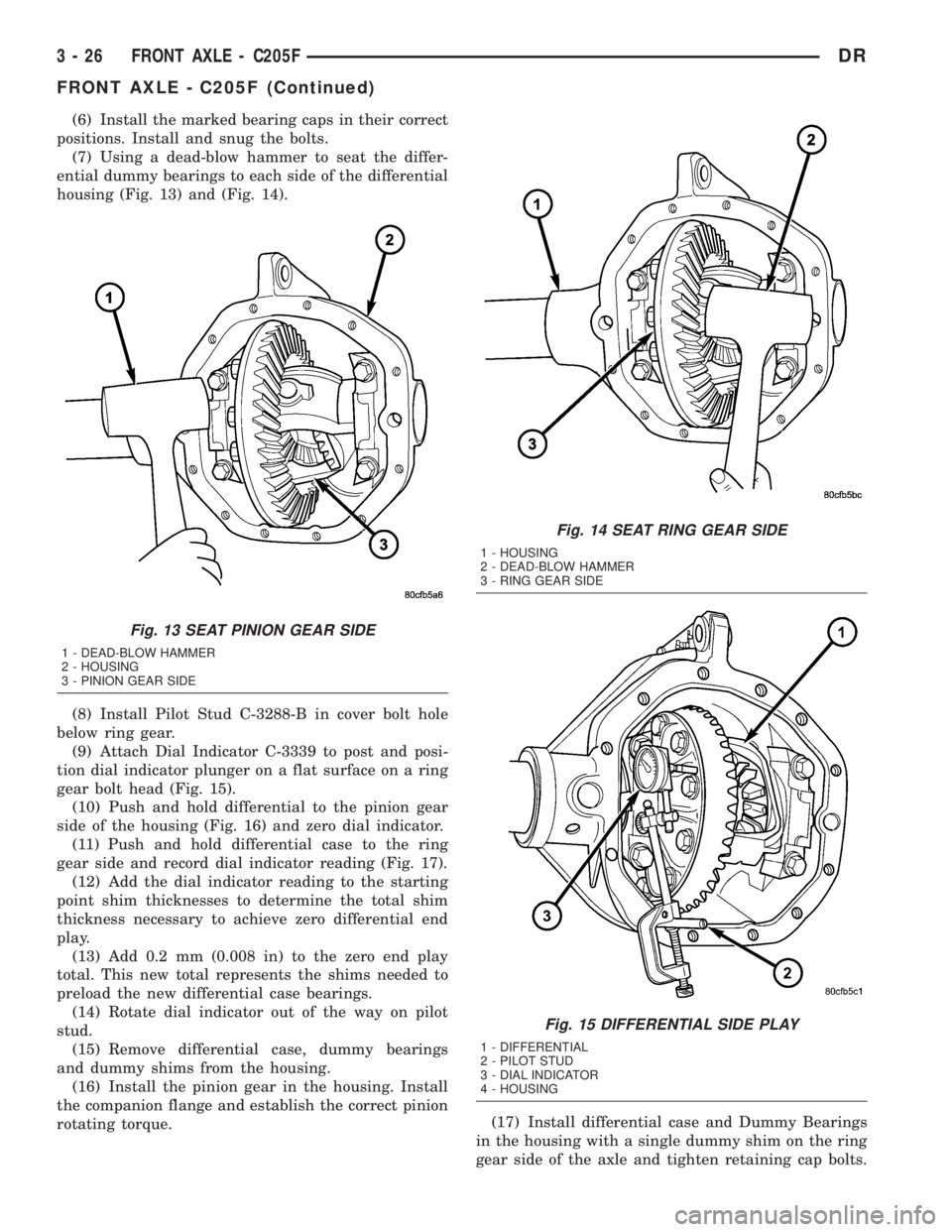
(7) Using a dead-blow hammer to seat the differ-
ential dummy bearings to each side of the differential
housing (Fig. 13) and (Fig. 14).
(8) Install Pilot Stud C-3288-B in cover bolt hole
below ring gear.
(9) Attach Dial Indicator C-3339 to post and posi-
tion dial indicator plunger on a flat surface on a ring
gear bolt head (Fig. 15).
(10) Push and hold differential to the pinion gear
side of the housing (Fig. 16) and zero dial indicator.
(11) Push and hold differential case to the ring
gear side and record dial indicator reading (Fig. 17).
(12) Add the dial indicator reading to the starting
point shim thicknesses to determine the total shim
thickness necessary to achieve zero differential end
play.
(13) Add 0.2 mm (0.008 in) to the zero end play
total. This new total represents the shims needed to
preload the new differential case bearings.
(14) Rotate dial indicator out of the way on pilot
stud.
(15) Remove differential case, dummy bearings
and dummy shims from the housing.
(16) Install the pinion gear in the housing. Install
the companion flange and establish the correct pinion
rotating torque.(17) Install differential case and Dummy Bearings
in the housing with a single dummy shim on the ring
gear side of the axle and tighten retaining cap bolts.
Fig. 13 SEAT PINION GEAR SIDE
1 - DEAD-BLOW HAMMER
2 - HOUSING
3 - PINION GEAR SIDE
Fig. 14 SEAT RING GEAR SIDE
1 - HOUSING
2 - DEAD-BLOW HAMMER
3 - RING GEAR SIDE
Fig. 15 DIFFERENTIAL SIDE PLAY
1 - DIFFERENTIAL
2 - PILOT STUD
3 - DIAL INDICATOR
4 - HOUSING
3 - 26 FRONT AXLE - C205FDR
FRONT AXLE - C205F (Continued)
Page 101 of 2895
(34) Zero dial indicator face to pointer.
(35) Push and hold ring gear downward while not
allowing the pinion gear to rotate. Dial indicator
reading should be between 0.12 mm (0.005 in.) and
0.20 mm (0.008 in.). If backlash is not within specifi-
cations transfer the necessary amount of shim thick-
ness from one side of the differential housing to the
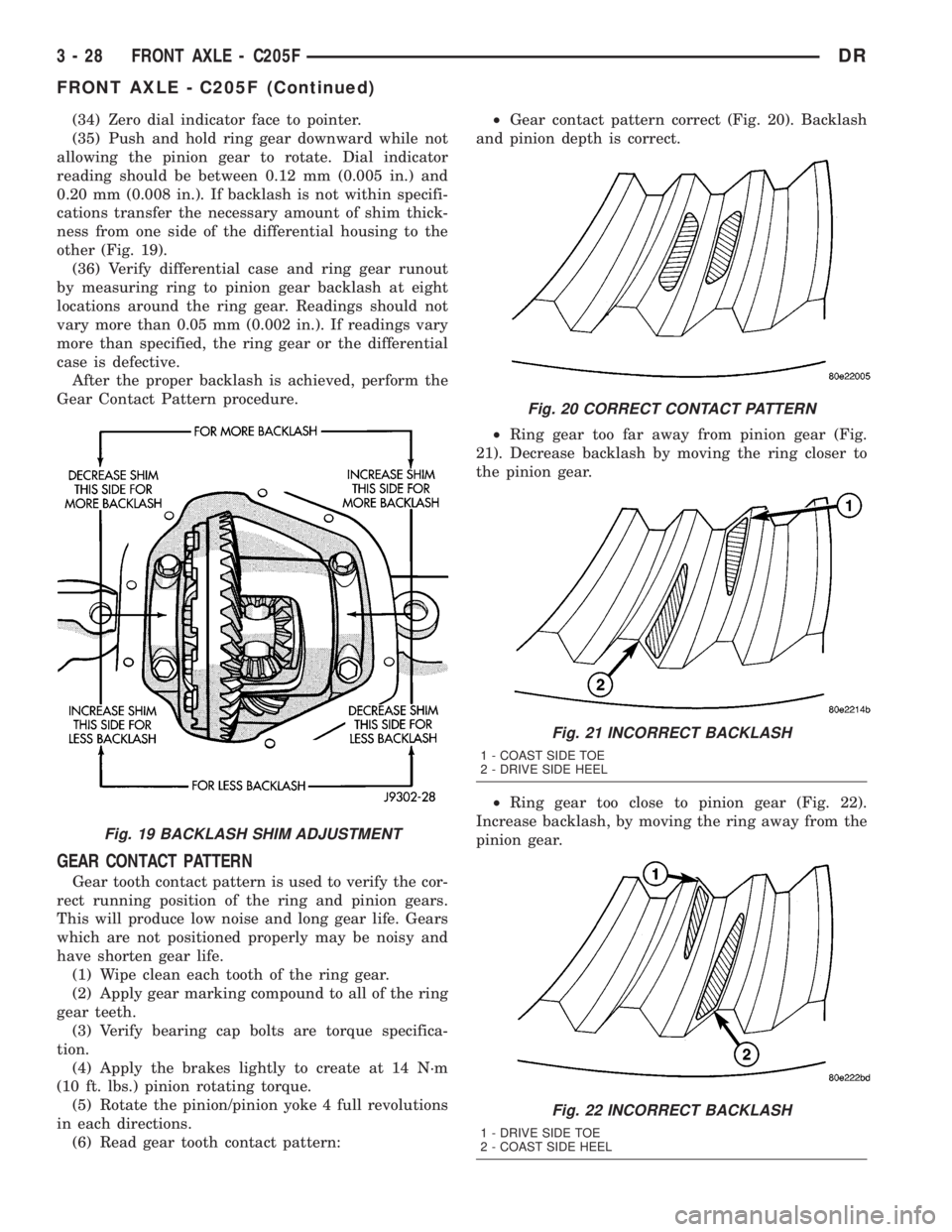
other (Fig. 19).
(36) Verify differential case and ring gear runout
by measuring ring to pinion gear backlash at eight
locations around the ring gear. Readings should not
vary more than 0.05 mm (0.002 in.). If readings vary
more than specified, the ring gear or the differential
case is defective.
After the proper backlash is achieved, perform the
Gear Contact Pattern procedure.
GEAR CONTACT PATTERN
Gear tooth contact pattern is used to verify the cor-
rect running position of the ring and pinion gears.
This will produce low noise and long gear life. Gears
which are not positioned properly may be noisy and
have shorten gear life.
(1) Wipe clean each tooth of the ring gear.
(2) Apply gear marking compound to all of the ring
gear teeth.
(3) Verify bearing cap bolts are torque specifica-
tion.
(4) Apply the brakes lightly to create at 14 N´m
(10 ft. lbs.) pinion rotating torque.
(5) Rotate the pinion/pinion yoke 4 full revolutions
in each directions.
(6) Read gear tooth contact pattern:²Gear contact pattern correct (Fig. 20). Backlash
and pinion depth is correct.
²Ring gear too far away from pinion gear (Fig.
21). Decrease backlash by moving the ring closer to
the pinion gear.
²Ring gear too close to pinion gear (Fig. 22).
Increase backlash, by moving the ring away from the
pinion gear.
Fig. 19 BACKLASH SHIM ADJUSTMENT
Fig. 20 CORRECT CONTACT PATTERN
Fig. 21 INCORRECT BACKLASH
1 - COAST SIDE TOE
2 - DRIVE SIDE HEEL
Fig. 22 INCORRECT BACKLASH
1 - DRIVE SIDE TOE
2 - COAST SIDE HEEL
3 - 28 FRONT AXLE - C205FDR
FRONT AXLE - C205F (Continued)
Page 103 of 2895
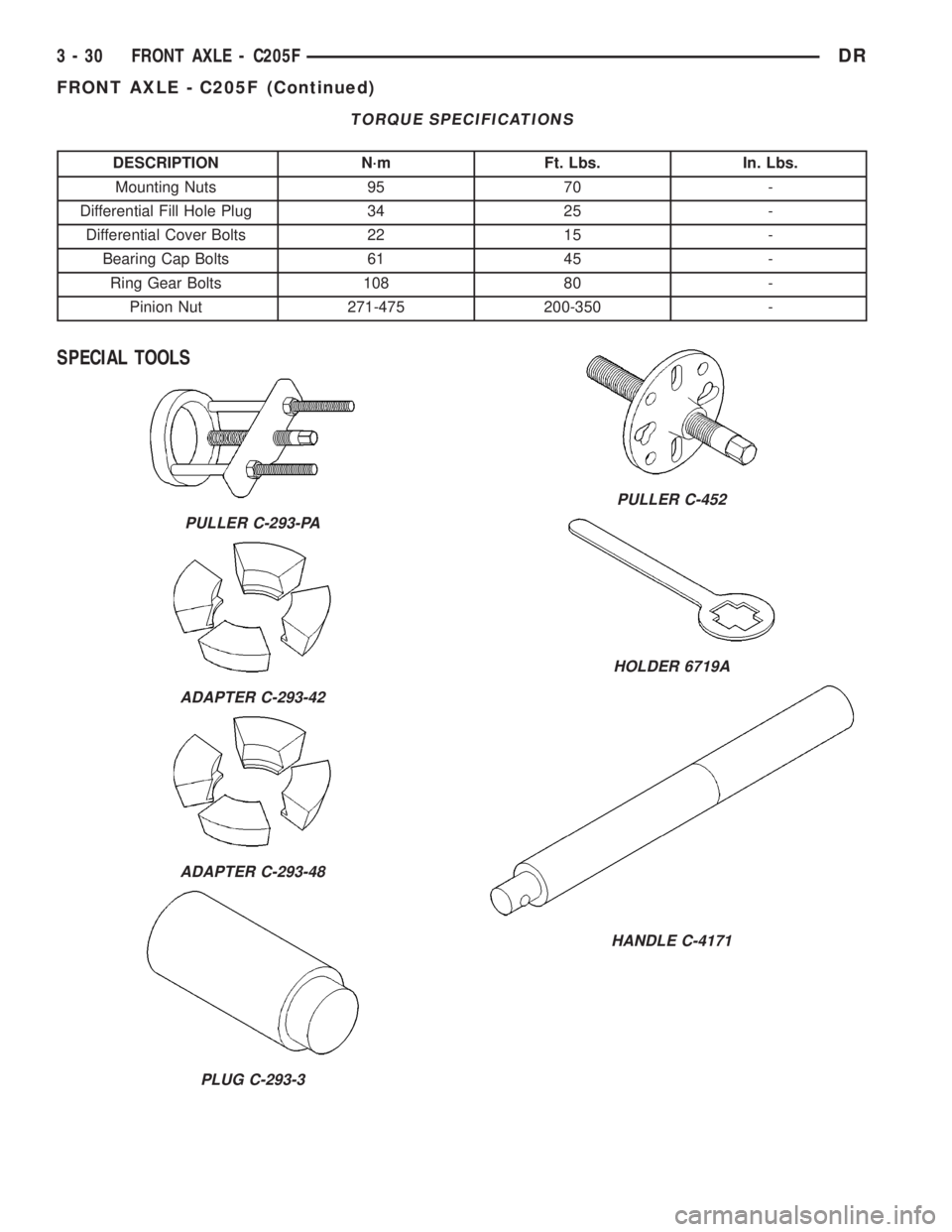
TORQUE SPECIFICATIONS
DESCRIPTION N´m Ft. Lbs. In. Lbs.
Mounting Nuts 95 70 -
Differential Fill Hole Plug 34 25 -
Differential Cover Bolts 22 15 -
Bearing Cap Bolts 61 45 -
Ring Gear Bolts 108 80 -
Pinion Nut 271-475 200-350 -
SPECIAL TOOLS
PULLER C-293-PA
ADAPTER C-293-42
ADAPTER C-293-48
PLUG C-293-3
PULLER C-452
HOLDER 6719A
HANDLE C-4171
3 - 30 FRONT AXLE - C205FDR
FRONT AXLE - C205F (Continued)
Page 107 of 2895
(9) Inspect the axle shaft tube bore for roughness
and burrs. Remove as necessary.
INSTALLATION
(1) Wipe the axle shaft tube bore clean.
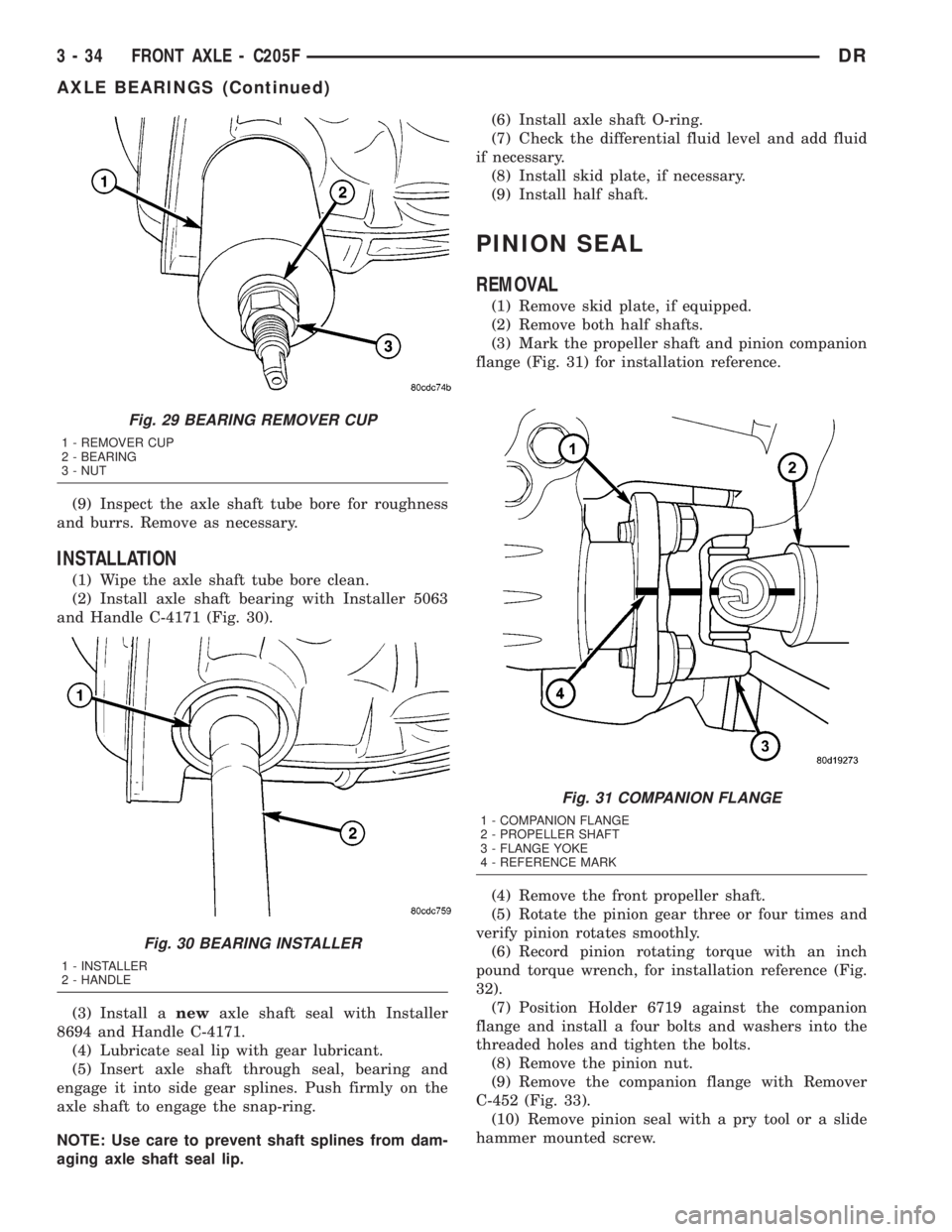
(2) Install axle shaft bearing with Installer 5063
and Handle C-4171 (Fig. 30).
(3) Install anewaxle shaft seal with Installer
8694 and Handle C-4171.
(4) Lubricate seal lip with gear lubricant.
(5) Insert axle shaft through seal, bearing and
engage it into side gear splines. Push firmly on the
axle shaft to engage the snap-ring.
NOTE: Use care to prevent shaft splines from dam-
aging axle shaft seal lip.(6) Install axle shaft O-ring.
(7) Check the differential fluid level and add fluid
if necessary.
(8) Install skid plate, if necessary.
(9) Install half shaft.
PINION SEAL
REMOVAL
(1) Remove skid plate, if equipped.
(2) Remove both half shafts.
(3) Mark the propeller shaft and pinion companion
flange (Fig. 31) for installation reference.
(4) Remove the front propeller shaft.
(5) Rotate the pinion gear three or four times and
verify pinion rotates smoothly.
(6) Record pinion rotating torque with an inch
pound torque wrench, for installation reference (Fig.
32).
(7) Position Holder 6719 against the companion
flange and install a four bolts and washers into the
threaded holes and tighten the bolts.
(8) Remove the pinion nut.
(9) Remove the companion flange with Remover
C-452 (Fig. 33).
(10) Remove pinion seal with a pry tool or a slide
hammer mounted screw.
Fig. 29 BEARING REMOVER CUP
1 - REMOVER CUP
2 - BEARING
3 - NUT
Fig. 30 BEARING INSTALLER
1 - INSTALLER
2 - HANDLE
Fig. 31 COMPANION FLANGE
1 - COMPANION FLANGE
2 - PROPELLER SHAFT
3 - FLANGE YOKE
4 - REFERENCE MARK
3 - 34 FRONT AXLE - C205FDR
AXLE BEARINGS (Continued)
Page 108 of 2895
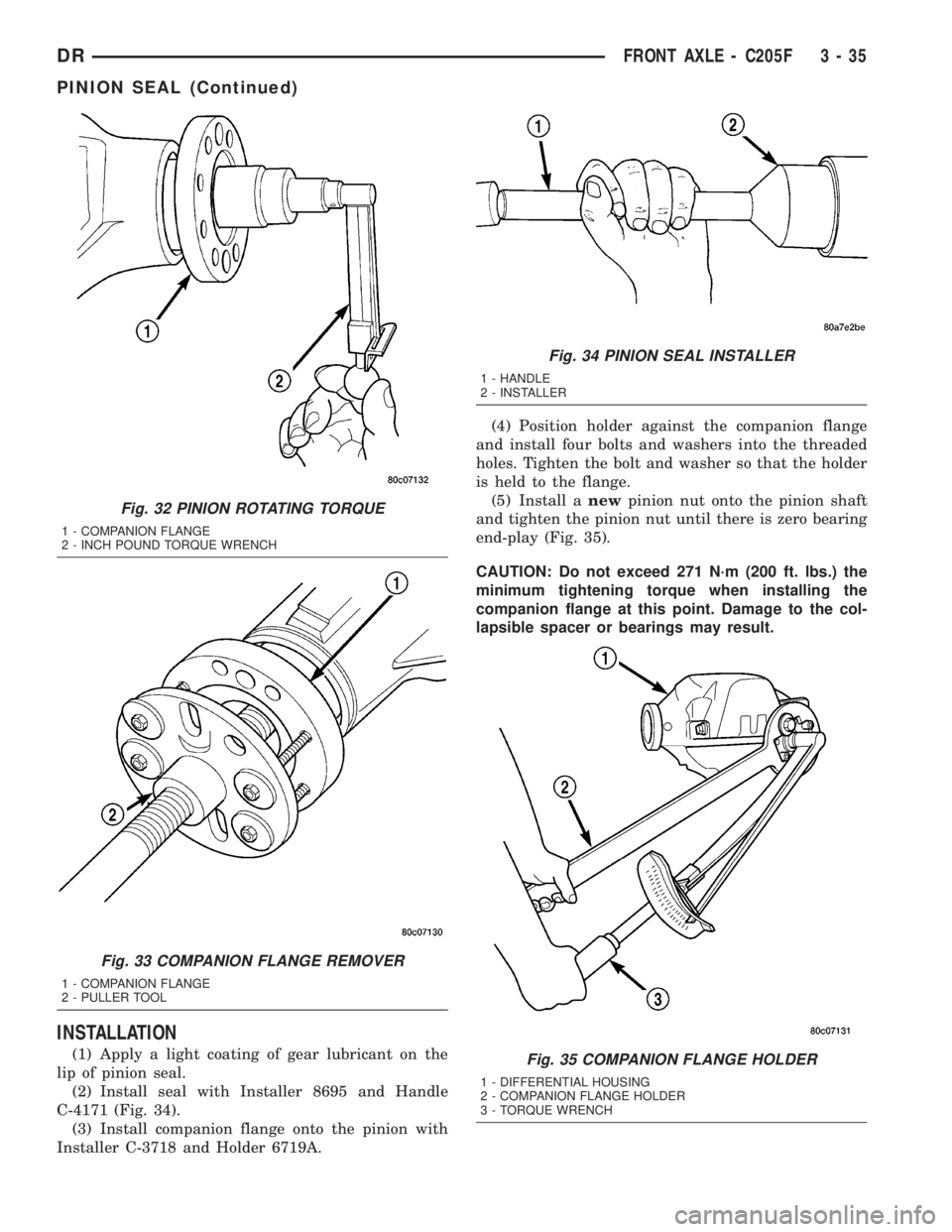
INSTALLATION
(1) Apply a light coating of gear lubricant on the
lip of pinion seal.
(2) Install seal with Installer 8695 and Handle
C-4171 (Fig. 34).
(3) Install companion flange onto the pinion with
Installer C-3718 and Holder 6719A.(4) Position holder against the companion flange
and install four bolts and washers into the threaded
holes. Tighten the bolt and washer so that the holder
is held to the flange.
(5) Install anewpinion nut onto the pinion shaft
and tighten the pinion nut until there is zero bearing
end-play (Fig. 35).
CAUTION: Do not exceed 271 N´m (200 ft. lbs.) the
minimum tightening torque when installing the
companion flange at this point. Damage to the col-
lapsible spacer or bearings may result.
Fig. 32 PINION ROTATING TORQUE
1 - COMPANION FLANGE
2 - INCH POUND TORQUE WRENCH
Fig. 33 COMPANION FLANGE REMOVER
1 - COMPANION FLANGE
2 - PULLER TOOL
Fig. 34 PINION SEAL INSTALLER
1 - HANDLE
2 - INSTALLER
Fig. 35 COMPANION FLANGE HOLDER
1 - DIFFERENTIAL HOUSING
2 - COMPANION FLANGE HOLDER
3 - TORQUE WRENCH
DRFRONT AXLE - C205F 3 - 35
PINION SEAL (Continued)
Page 109 of 2895
CAUTION: Never loosen pinion nut to decrease pin-
ion bearing rotating torque and never exceed spec-
ified preload torque. If preload torque or rotating
torque is exceeded a new collapsible spacer must
be installed.
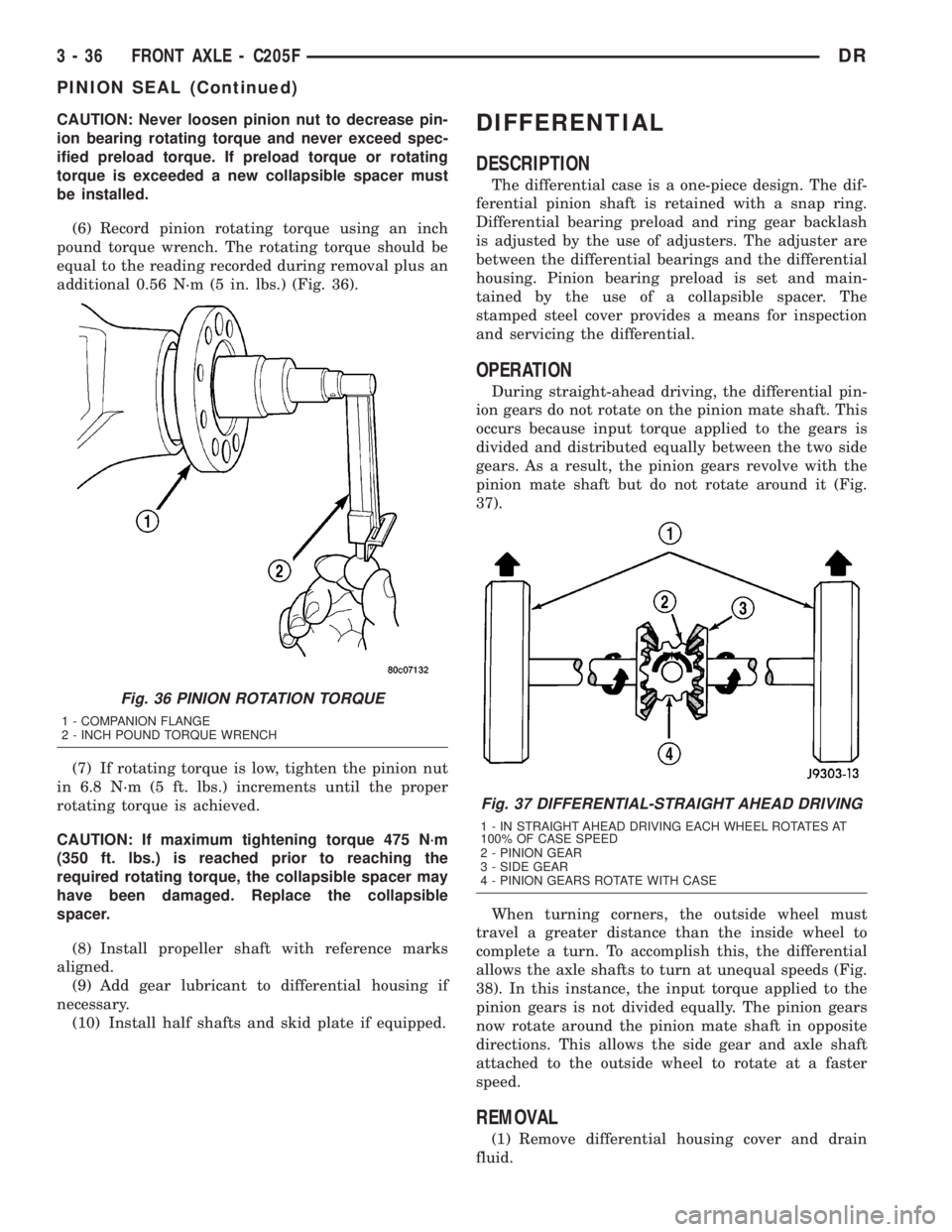
(6) Record pinion rotating torque using an inch
pound torque wrench. The rotating torque should be
equal to the reading recorded during removal plus an
additional 0.56 N´m (5 in. lbs.) (Fig. 36).
(7) If rotating torque is low, tighten the pinion nut
in 6.8 N´m (5 ft. lbs.) increments until the proper
rotating torque is achieved.
CAUTION: If maximum tightening torque 475 N´m
(350 ft. lbs.) is reached prior to reaching the
required rotating torque, the collapsible spacer may
have been damaged. Replace the collapsible
spacer.
(8) Install propeller shaft with reference marks
aligned.
(9) Add gear lubricant to differential housing if
necessary.
(10) Install half shafts and skid plate if equipped.DIFFERENTIAL
DESCRIPTION
The differential case is a one-piece design. The dif-
ferential pinion shaft is retained with a snap ring.
Differential bearing preload and ring gear backlash
is adjusted by the use of adjusters. The adjuster are
between the differential bearings and the differential
housing. Pinion bearing preload is set and main-
tained by the use of a collapsible spacer. The
stamped steel cover provides a means for inspection
and servicing the differential.
OPERATION
During straight-ahead driving, the differential pin-
ion gears do not rotate on the pinion mate shaft. This
occurs because input torque applied to the gears is
divided and distributed equally between the two side
gears. As a result, the pinion gears revolve with the
pinion mate shaft but do not rotate around it (Fig.
37).
When turning corners, the outside wheel must
travel a greater distance than the inside wheel to
complete a turn. To accomplish this, the differential
allows the axle shafts to turn at unequal speeds (Fig.
38). In this instance, the input torque applied to the
pinion gears is not divided equally. The pinion gears
now rotate around the pinion mate shaft in opposite
directions. This allows the side gear and axle shaft
attached to the outside wheel to rotate at a faster
speed.
REMOVAL
(1) Remove differential housing cover and drain
fluid.
Fig. 36 PINION ROTATION TORQUE
1 - COMPANION FLANGE
2 - INCH POUND TORQUE WRENCH
Fig. 37 DIFFERENTIAL-STRAIGHT AHEAD DRIVING
1 - IN STRAIGHT AHEAD DRIVING EACH WHEEL ROTATES AT
100% OF CASE SPEED
2 - PINION GEAR
3 - SIDE GEAR
4 - PINION GEARS ROTATE WITH CASE
3 - 36 FRONT AXLE - C205FDR
PINION SEAL (Continued)
Page 113 of 2895
PINION GEAR/RING GEAR
REMOVAL
NOTE: The ring gear and pinion are serviced in a
matched set. Never replace one without replacing
the other.
(1) Remove differential from housing.
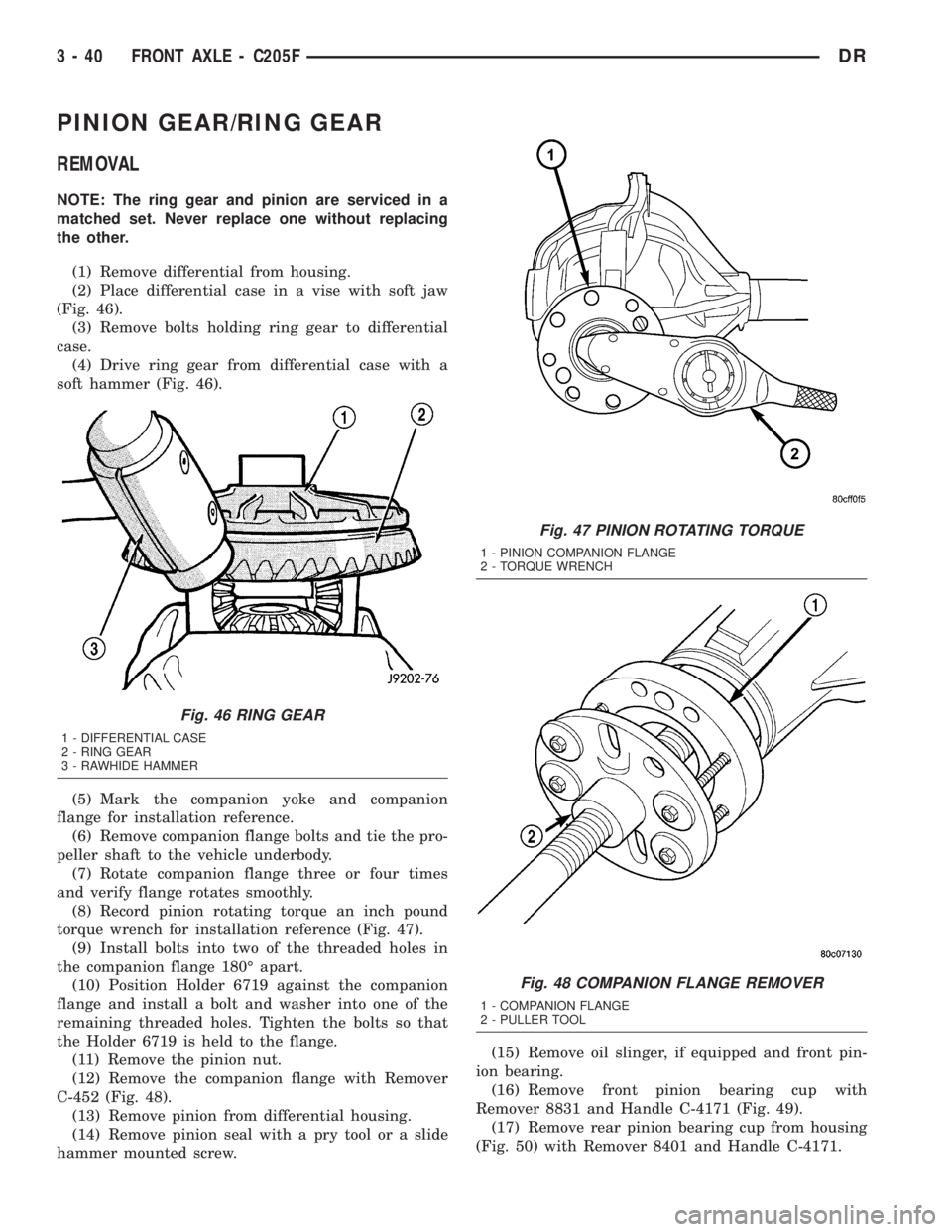
(2) Place differential case in a vise with soft jaw
(Fig. 46).
(3) Remove bolts holding ring gear to differential
case.
(4) Drive ring gear from differential case with a
soft hammer (Fig. 46).
(5) Mark the companion yoke and companion
flange for installation reference.
(6) Remove companion flange bolts and tie the pro-
peller shaft to the vehicle underbody.
(7) Rotate companion flange three or four times
and verify flange rotates smoothly.
(8) Record pinion rotating torque an inch pound
torque wrench for installation reference (Fig. 47).
(9) Install bolts into two of the threaded holes in
the companion flange 180É apart.
(10) Position Holder 6719 against the companion
flange and install a bolt and washer into one of the
remaining threaded holes. Tighten the bolts so that
the Holder 6719 is held to the flange.
(11) Remove the pinion nut.
(12) Remove the companion flange with Remover
C-452 (Fig. 48).
(13) Remove pinion from differential housing.
(14) Remove pinion seal with a pry tool or a slide
hammer mounted screw.(15) Remove oil slinger, if equipped and front pin-
ion bearing.
(16) Remove front pinion bearing cup with
Remover 8831 and Handle C-4171 (Fig. 49).
(17) Remove rear pinion bearing cup from housing
(Fig. 50) with Remover 8401 and Handle C-4171.
Fig. 46 RING GEAR
1 - DIFFERENTIAL CASE
2 - RING GEAR
3 - RAWHIDE HAMMER
Fig. 47 PINION ROTATING TORQUE
1 - PINION COMPANION FLANGE
2 - TORQUE WRENCH
Fig. 48 COMPANION FLANGE REMOVER
1 - COMPANION FLANGE
2 - PULLER TOOL
3 - 40 FRONT AXLE - C205FDR
Page 116 of 2895
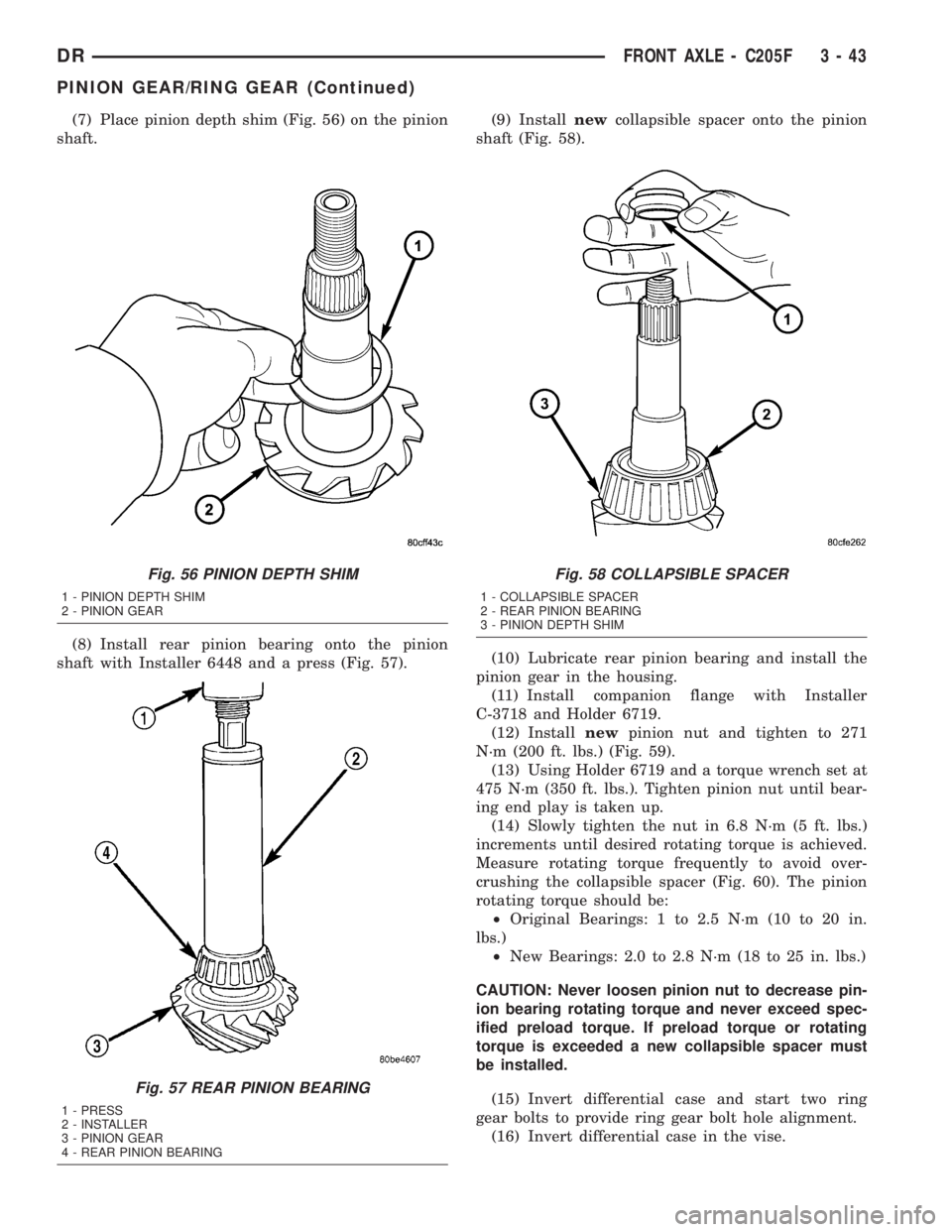
(7) Place pinion depth shim (Fig. 56) on the pinion
shaft.
(8) Install rear pinion bearing onto the pinion
shaft with Installer 6448 and a press (Fig. 57).(9) Installnewcollapsible spacer onto the pinion
shaft (Fig. 58).
(10) Lubricate rear pinion bearing and install the
pinion gear in the housing.
(11) Install companion flange with Installer
C-3718 and Holder 6719.
(12) Installnewpinion nut and tighten to 271
N´m (200 ft. lbs.) (Fig. 59).
(13) Using Holder 6719 and a torque wrench set at
475 N´m (350 ft. lbs.). Tighten pinion nut until bear-
ing end play is taken up.
(14) Slowly tighten the nut in 6.8 N´m (5 ft. lbs.)
increments until desired rotating torque is achieved.
Measure rotating torque frequently to avoid over-
crushing the collapsible spacer (Fig. 60). The pinion
rotating torque should be:
²Original Bearings: 1 to 2.5 N´m (10 to 20 in.
lbs.)
²New Bearings: 2.0 to 2.8 N´m (18 to 25 in. lbs.)
CAUTION: Never loosen pinion nut to decrease pin-
ion bearing rotating torque and never exceed spec-
ified preload torque. If preload torque or rotating
torque is exceeded a new collapsible spacer must
be installed.
(15) Invert differential case and start two ring
gear bolts to provide ring gear bolt hole alignment.
(16) Invert differential case in the vise.
Fig. 56 PINION DEPTH SHIM
1 - PINION DEPTH SHIM
2 - PINION GEAR
Fig. 57 REAR PINION BEARING
1 - PRESS
2 - INSTALLER
3 - PINION GEAR
4 - REAR PINION BEARING
Fig. 58 COLLAPSIBLE SPACER
1 - COLLAPSIBLE SPACER
2 - REAR PINION BEARING
3 - PINION DEPTH SHIM
DRFRONT AXLE - C205F 3 - 43
PINION GEAR/RING GEAR (Continued)
Page 117 of 2895
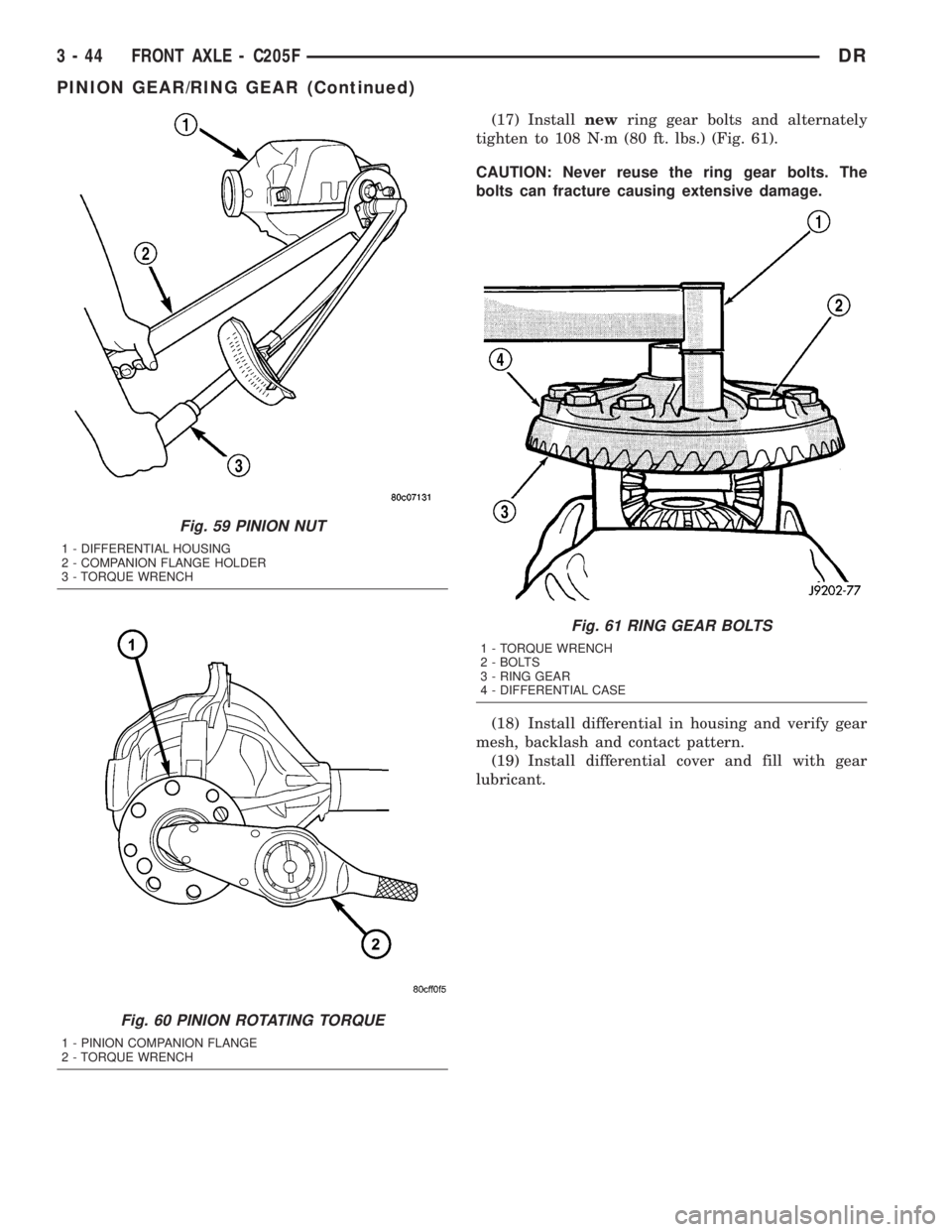
(17) Installnewring gear bolts and alternately
tighten to 108 N´m (80 ft. lbs.) (Fig. 61).
CAUTION: Never reuse the ring gear bolts. The
bolts can fracture causing extensive damage.
(18) Install differential in housing and verify gear
mesh, backlash and contact pattern.
(19) Install differential cover and fill with gear
lubricant.
Fig. 59 PINION NUT
1 - DIFFERENTIAL HOUSING
2 - COMPANION FLANGE HOLDER
3 - TORQUE WRENCH
Fig. 60 PINION ROTATING TORQUE
1 - PINION COMPANION FLANGE
2 - TORQUE WRENCH
Fig. 61 RING GEAR BOLTS
1 - TORQUE WRENCH
2 - BOLTS
3 - RING GEAR
4 - DIFFERENTIAL CASE
3 - 44 FRONT AXLE - C205FDR
PINION GEAR/RING GEAR (Continued)
Page 121 of 2895
Condition Possible Causes Correction
Gear Teeth Broke 1. Overloading. 1. Replace gears. Examine other
gears and bearings for possible
damage.
2. Erratic clutch operation. 2. Replace gears and examine the
remaining parts for damage. Avoid
erratic clutch operation.
3. Ice-spotted pavement. 3. Replace gears and examine
remaining parts for damage.
4. Improper adjustments. 4. Replace gears and examine
remaining parts for damage. Ensure
ring gear backlash is correct.
Axle Noise 1. Insufficient lubricant. 1. Fill differential with the correct
fluid type and quantity.
2. Improper ring gear and pinion
adjustment.2. Check ring gear and pinion
contact pattern.
3. Unmatched ring gear and pinion. 3. Replace gears with a matched
ring gear and pinion.
4. Worn teeth on ring gear and/or
pinion.4. Replace ring gear and pinion.
5. Loose pinion bearings. 5. Adjust pinion bearing pre-load.
6. Loose differential bearings. 6. Adjust differential bearing
pre-load.
7. Mis-aligned or sprung ring gear. 7. Measure ring gear run-out.
Replace components as necessary.
8. Loose differential bearing cap
bolts.8. Inspect differential components
and replace as necessary. Ensure
that the bearing caps are torqued
tot he proper specification.
9. Housing not machined properly. 9. Replace housing.
REMOVAL
(1) Remove wheels and tires.
(2) Remove brake calipers and rotors.
(3) Disconnect ABS wheel speed sensors.
(4) Disconnect axle vent hose.
(5) Remove front propeller shaft.
(6) Disconnect stabilizer bar links at the axle
brackets.
(7) Disconnect shock absorbers from axle brackets.
(8) Disconnect track bar from the axle bracket.
(9) Disconnect tie rod and drag link from the steer-
ing knuckles.
(10) Position suitable lifting device under the axle
assembly.
(11) Secure axle to lifting device.
(12) Mark suspension alignment cams for installa-
tion reference.
(13) Disconnect upper and lower suspension arms
from the axle bracket.(14) Lower the axle. The coil springs will drop
with the axle.
(15) Remove the coil springs from the axle bracket.
INSTALLATION
CAUTION: Suspension components with rubber
bushings should be tightened with the weight of the
vehicle on the suspension, at normal height. If
springs are not at their normal ride position, vehicle
ride comfort could be affected and premature bush-
ing wear may occur. Rubber bushings must never
be lubricated.
(1) Support the axle on a suitable lifting device.
(2) Secure axle to lifting device.
(3) Position the axle under the vehicle.
(4) Install springs, retainer clip and bolts.
(5) Raise axle and align it with the spring pads.
3 - 48 FRONT AXLE - 9 1/4 AADR
FRONT AXLE - 9 1/4 AA (Continued)