run flat DODGE RAM 2003 Service User Guide
[x] Cancel search | Manufacturer: DODGE, Model Year: 2003, Model line: RAM, Model: DODGE RAM 2003Pages: 2895, PDF Size: 83.15 MB
Page 2400 of 2895
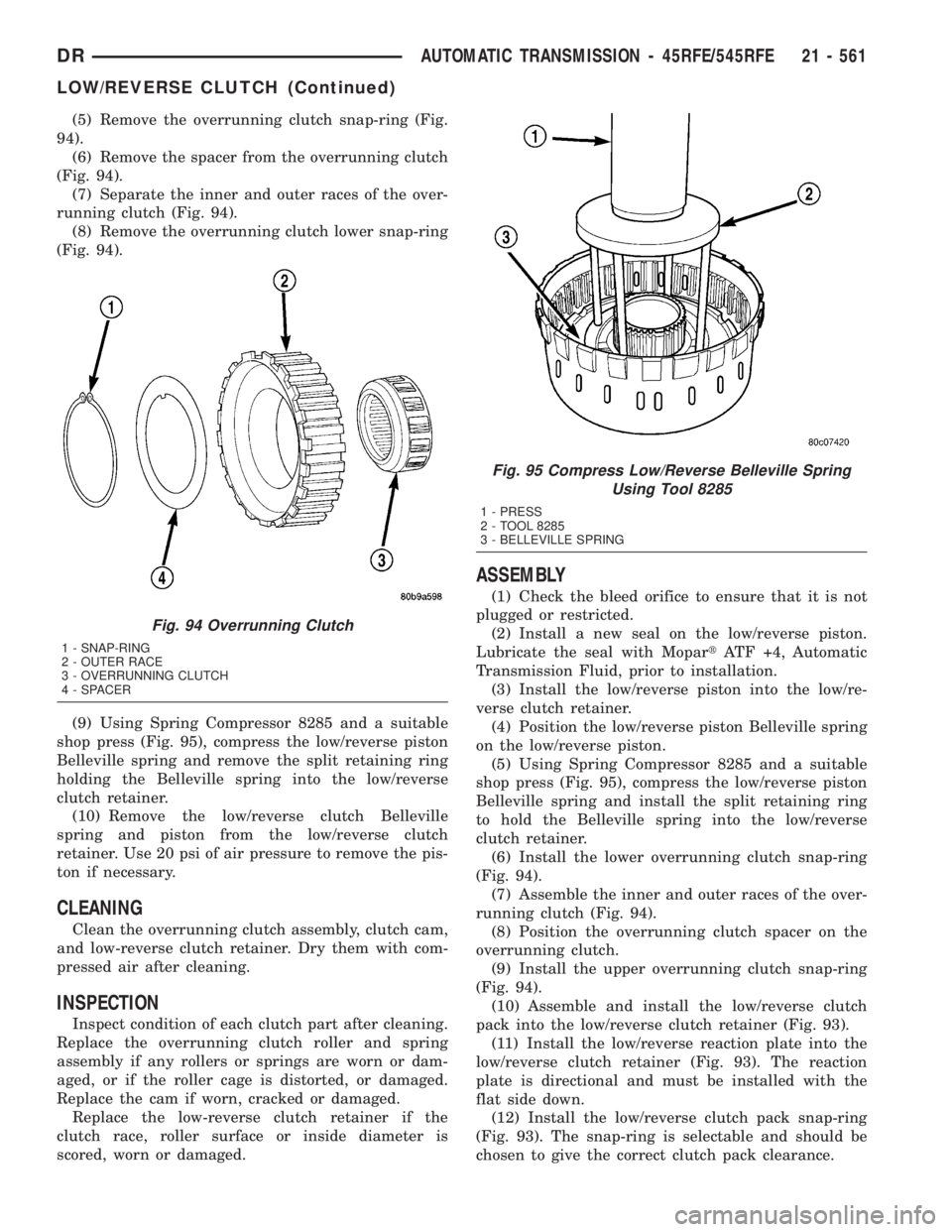
(5) Remove the overrunning clutch snap-ring (Fig.
94).
(6) Remove the spacer from the overrunning clutch
(Fig. 94).
(7) Separate the inner and outer races of the over-
running clutch (Fig. 94).
(8) Remove the overrunning clutch lower snap-ring
(Fig. 94).
(9) Using Spring Compressor 8285 and a suitable
shop press (Fig. 95), compress the low/reverse piston
Belleville spring and remove the split retaining ring
holding the Belleville spring into the low/reverse
clutch retainer.
(10) Remove the low/reverse clutch Belleville
spring and piston from the low/reverse clutch
retainer. Use 20 psi of air pressure to remove the pis-
ton if necessary.
CLEANING
Clean the overrunning clutch assembly, clutch cam,
and low-reverse clutch retainer. Dry them with com-
pressed air after cleaning.
INSPECTION
Inspect condition of each clutch part after cleaning.
Replace the overrunning clutch roller and spring
assembly if any rollers or springs are worn or dam-
aged, or if the roller cage is distorted, or damaged.
Replace the cam if worn, cracked or damaged.
Replace the low-reverse clutch retainer if the
clutch race, roller surface or inside diameter is
scored, worn or damaged.
ASSEMBLY
(1) Check the bleed orifice to ensure that it is not
plugged or restricted.
(2) Install a new seal on the low/reverse piston.
Lubricate the seal with MopartATF +4, Automatic
Transmission Fluid, prior to installation.
(3) Install the low/reverse piston into the low/re-
verse clutch retainer.
(4) Position the low/reverse piston Belleville spring
on the low/reverse piston.
(5) Using Spring Compressor 8285 and a suitable
shop press (Fig. 95), compress the low/reverse piston
Belleville spring and install the split retaining ring
to hold the Belleville spring into the low/reverse
clutch retainer.
(6) Install the lower overrunning clutch snap-ring
(Fig. 94).
(7) Assemble the inner and outer races of the over-
running clutch (Fig. 94).
(8) Position the overrunning clutch spacer on the
overrunning clutch.
(9) Install the upper overrunning clutch snap-ring
(Fig. 94).
(10) Assemble and install the low/reverse clutch
pack into the low/reverse clutch retainer (Fig. 93).
(11) Install the low/reverse reaction plate into the
low/reverse clutch retainer (Fig. 93). The reaction
plate is directional and must be installed with the
flat side down.
(12) Install the low/reverse clutch pack snap-ring
(Fig. 93). The snap-ring is selectable and should be
chosen to give the correct clutch pack clearance.
Fig. 94 Overrunning Clutch
1 - SNAP-RING
2 - OUTER RACE
3 - OVERRUNNING CLUTCH
4 - SPACER
Fig. 95 Compress Low/Reverse Belleville Spring
Using Tool 8285
1 - PRESS
2 - TOOL 8285
3 - BELLEVILLE SPRING
DRAUTOMATIC TRANSMISSION - 45RFE/545RFE 21 - 561
LOW/REVERSE CLUTCH (Continued)
Page 2560 of 2895
TIRES/WHEELS
TABLE OF CONTENTS
page page
TIRES/WHEELS
DIAGNOSIS AND TESTING - TIRE AND
WHEEL RUNOUT......................1
STANDARD PROCEDURE
STANDARD PROCEDURE - TIRE ROTATION . 2
STANDARD PROCEDURE - MATCH
MOUNTING...........................3
STANDARD PROCEDURE - TIRE AND
WHEEL BALANCE......................4
TIRES
DESCRIPTION
DESCRIPTION - SPARE TIRE /
TEMPORARY.........................5
DESCRIPTION - TIRES..................5
DESCRIPTION - RADIAL ± PLY TIRES......6
DESCRIPTION - TIRE PRESSURE FOR
HIGH SPEEDS.........................6
DESCRIPTION - REPLACEMENT TIRES.....6
DESCRIPTION - TIRE INFLATION
PRESSURES..........................6
DIAGNOSIS AND TESTING
DIAGNOSIS AND TESTING - PRESSURE
GAUGES.............................7
DIAGNOSIS AND TESTING - TIRE NOISE
OR VIBRATION........................7
DIAGNOSIS AND TESTING - TREAD WEAR
INDICATORS..........................7
DIAGNOSIS AND TESTING - TIRE WEAR
PATTERNS...........................8
DIAGNOSIS AND TESTING - TIRE/VEHICLE
LEAD................................8STANDARD PROCEDURE - REPAIRING
LEAKS..............................10
SPECIFICATIONS
TIRE REVOLUTIONS PER MILE..........10
WHEELS
DESCRIPTION.........................11
OPERATION...........................11
DIAGNOSIS AND TESTING
WHEEL INSPECTION..................11
STANDARD PROCEDURE
STANDARD PROCEDURE - WHEEL
REPLACEMENT.......................12
STANDARD PROCEDURE - DUAL REAR
WHEEL INSTALLATION.................12
SPECIFICATIONS
TORQUE CHART......................13
STUDS
REMOVAL.............................14
INSTALLATION.........................14
WHEEL COVER
REMOVAL.............................14
INSTALLATION
INSTALLATION - REAR.................14
INSTALLATION - FRONT................15
SPARE TIRE
DESCRIPTION
DESCRIPTION - SPARE / TEMPORARY
TIRE...............................15
DESCRIPTION - FULL SIZE, SPARE WHEEL
WITH MATCHING TIRE.................15
TIRES/WHEELS
DIAGNOSIS AND TESTING - TIRE AND WHEEL
RUNOUT
Radial runout is the difference between the high
and low points on the tire or wheel (Fig. 1).
Lateral runout is thewobbleof the tire or wheel.
Radial runout of more than 1.5 mm (.060 inch)
measured at the center line of the tread may cause
the vehicle to shake.
Lateral runout of more than 2.0 mm (.080 inch)
measured near the shoulder of the tire may cause the
vehicle to shake.
Sometimes radial runout can be reduced. Relocate
the wheel and tire assembly on the mounting studs
(See Method 1). If this does not reduce runout to anacceptable level, the tire can be rotated on the wheel.
(See Method 2).
METHOD 1 (RELOCATE WHEEL ON HUB)
(1) Drive vehicle a short distance to eliminate tire
flat spotting from a parked position.
(2) Check wheel bearings and adjust if adjustable
or replace if necessary.
(3) Check the wheel mounting surface.
(4) Relocate wheel on the mounting, two studs
over from the original position.
(5) Tighten wheel nuts until all are properly
torqued, to eliminate brake distortion.
(6) Check radial runout. If still excessive, mark
tire sidewall, wheel, and stud at point of maximum
runout and proceed to Method 2.
DRTIRES/WHEELS 22 - 1
Page 2561 of 2895
METHOD 2 (RELOCATE TIRE ON WHEEL)
NOTE: Rotating the tire on wheel is particularly
effective when there is runout in both tire and
wheel.
(1) Remove tire from wheel and mount wheel on
service dynamic balance machine.
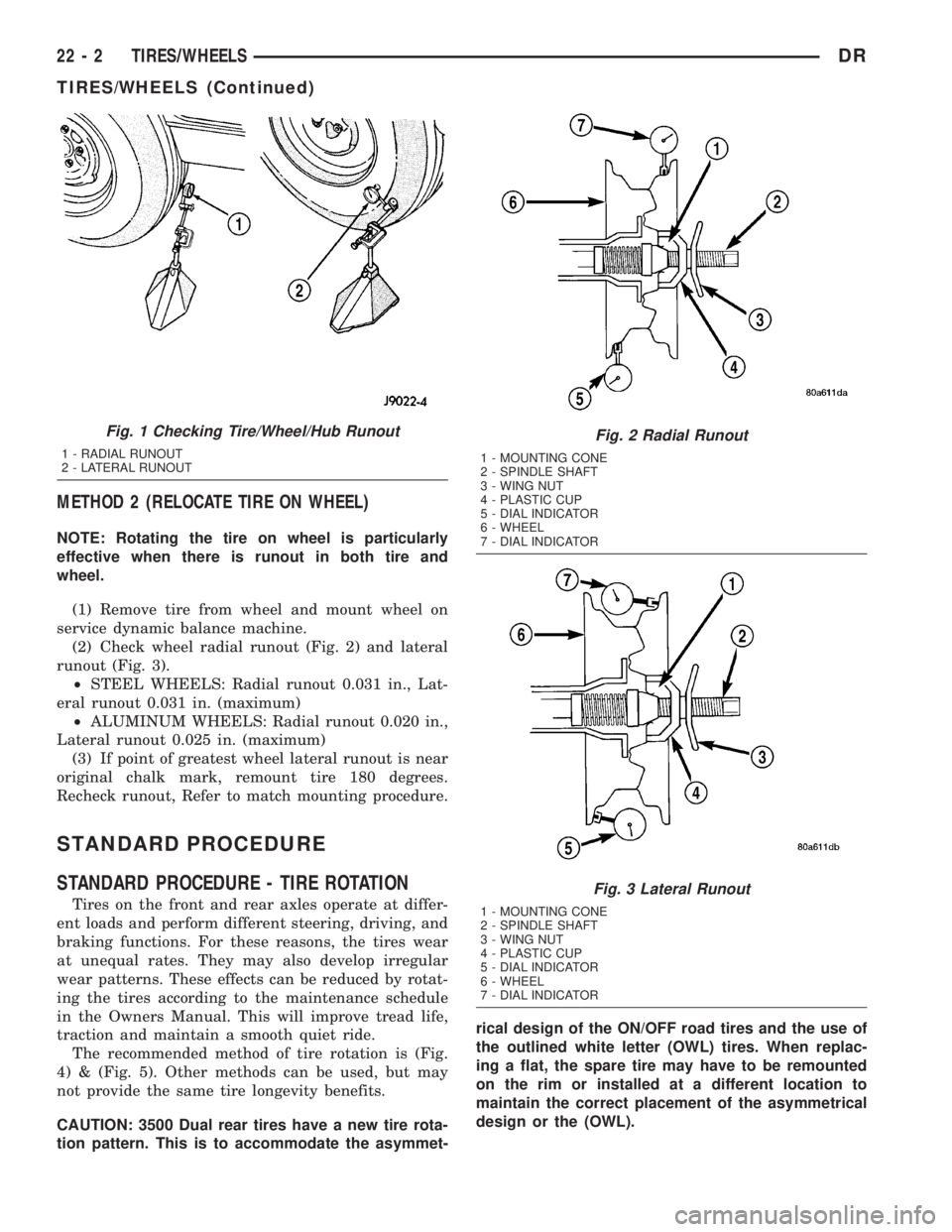
(2) Check wheel radial runout (Fig. 2) and lateral
runout (Fig. 3).
²STEEL WHEELS: Radial runout 0.031 in., Lat-
eral runout 0.031 in. (maximum)
²ALUMINUM WHEELS: Radial runout 0.020 in.,
Lateral runout 0.025 in. (maximum)
(3) If point of greatest wheel lateral runout is near
original chalk mark, remount tire 180 degrees.
Recheck runout, Refer to match mounting procedure.
STANDARD PROCEDURE
STANDARD PROCEDURE - TIRE ROTATION
Tires on the front and rear axles operate at differ-
ent loads and perform different steering, driving, and
braking functions. For these reasons, the tires wear
at unequal rates. They may also develop irregular
wear patterns. These effects can be reduced by rotat-
ing the tires according to the maintenance schedule
in the Owners Manual. This will improve tread life,
traction and maintain a smooth quiet ride.
The recommended method of tire rotation is (Fig.
4) & (Fig. 5). Other methods can be used, but may
not provide the same tire longevity benefits.
CAUTION: 3500 Dual rear tires have a new tire rota-
tion pattern. This is to accommodate the asymmet-rical design of the ON/OFF road tires and the use of
the outlined white letter (OWL) tires. When replac-
ing a flat, the spare tire may have to be remounted
on the rim or installed at a different location to
maintain the correct placement of the asymmetrical
design or the (OWL).
Fig. 1 Checking Tire/Wheel/Hub Runout
1 - RADIAL RUNOUT
2 - LATERAL RUNOUT
Fig. 2 Radial Runout
1 - MOUNTING CONE
2 - SPINDLE SHAFT
3 - WING NUT
4 - PLASTIC CUP
5 - DIAL INDICATOR
6 - WHEEL
7 - DIAL INDICATOR
Fig. 3 Lateral Runout
1 - MOUNTING CONE
2 - SPINDLE SHAFT
3 - WING NUT
4 - PLASTIC CUP
5 - DIAL INDICATOR
6 - WHEEL
7 - DIAL INDICATOR
22 - 2 TIRES/WHEELSDR
TIRES/WHEELS (Continued)
Page 2567 of 2895
DIAGNOSIS AND TESTING - TIRE WEAR
PATTERNS
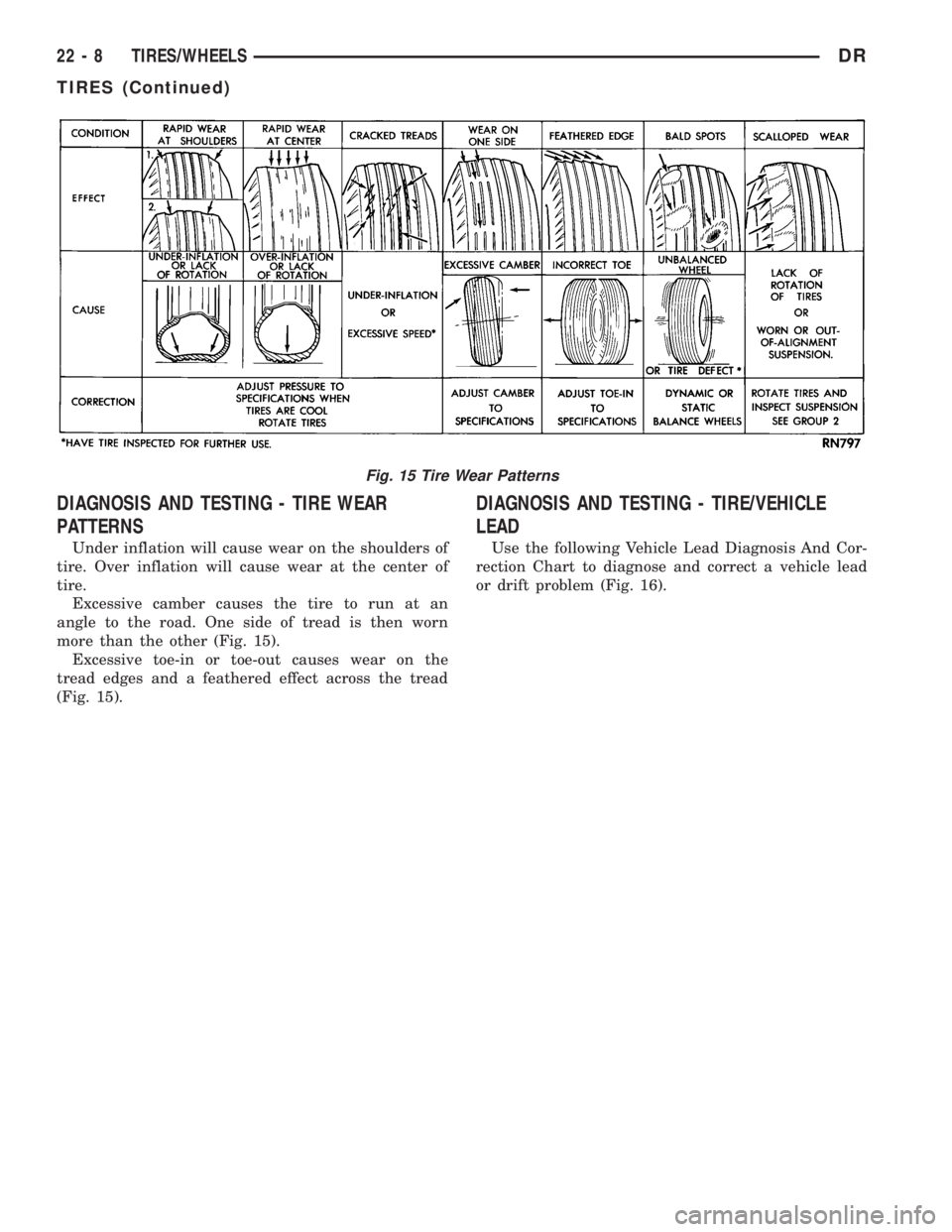
Under inflation will cause wear on the shoulders of
tire. Over inflation will cause wear at the center of
tire.
Excessive camber causes the tire to run at an
angle to the road. One side of tread is then worn
more than the other (Fig. 15).
Excessive toe-in or toe-out causes wear on the
tread edges and a feathered effect across the tread
(Fig. 15).
DIAGNOSIS AND TESTING - TIRE/VEHICLE
LEAD
Use the following Vehicle Lead Diagnosis And Cor-
rection Chart to diagnose and correct a vehicle lead
or drift problem (Fig. 16).
Fig. 15 Tire Wear Patterns
22 - 8 TIRES/WHEELSDR
TIRES (Continued)
Page 2570 of 2895
WHEELS
DESCRIPTION
Original equipment wheels are designed for the
specified Maximum Vehicle Capacity.
All models use steel or aluminum drop center
wheels.
Aluminum wheels require special balance weights
and alignment equipment.
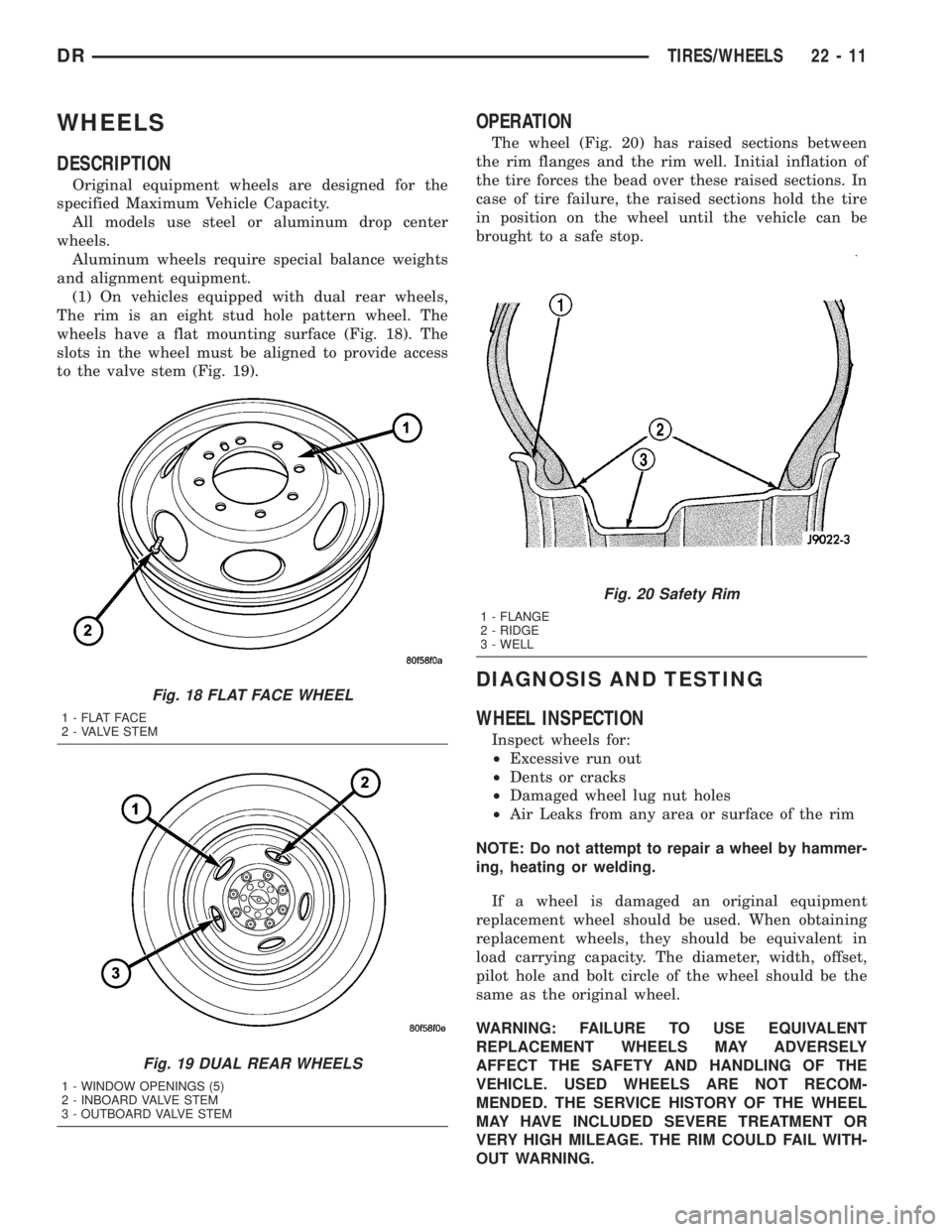
(1) On vehicles equipped with dual rear wheels,
The rim is an eight stud hole pattern wheel. The
wheels have a flat mounting surface (Fig. 18). The
slots in the wheel must be aligned to provide access
to the valve stem (Fig. 19).
OPERATION
The wheel (Fig. 20) has raised sections between
the rim flanges and the rim well. Initial inflation of
the tire forces the bead over these raised sections. In
case of tire failure, the raised sections hold the tire
in position on the wheel until the vehicle can be
brought to a safe stop.
DIAGNOSIS AND TESTING
WHEEL INSPECTION
Inspect wheels for:
²Excessive run out
²Dents or cracks
²Damaged wheel lug nut holes
²Air Leaks from any area or surface of the rim
NOTE: Do not attempt to repair a wheel by hammer-
ing, heating or welding.
If a wheel is damaged an original equipment
replacement wheel should be used. When obtaining
replacement wheels, they should be equivalent in
load carrying capacity. The diameter, width, offset,
pilot hole and bolt circle of the wheel should be the
same as the original wheel.
WARNING: FAILURE TO USE EQUIVALENT
REPLACEMENT WHEELS MAY ADVERSELY
AFFECT THE SAFETY AND HANDLING OF THE
VEHICLE. USED WHEELS ARE NOT RECOM-
MENDED. THE SERVICE HISTORY OF THE WHEEL
MAY HAVE INCLUDED SEVERE TREATMENT OR
VERY HIGH MILEAGE. THE RIM COULD FAIL WITH-
OUT WARNING.
Fig. 18 FLAT FACE WHEEL
1 - FLAT FACE
2 - VALVE STEM
Fig. 19 DUAL REAR WHEELS
1 - WINDOW OPENINGS (5)
2 - INBOARD VALVE STEM
3 - OUTBOARD VALVE STEM
Fig. 20 Safety Rim
1 - FLANGE
2 - RIDGE
3 - WELL
DRTIRES/WHEELS 22 - 11
Page 2889 of 2895
TACHOMETER - DESCRIPTION..........8J-37
TACHOMETER - OPERATION............8J-37
TAIL LAMP - INSTALLATION............8L-21
TAIL LAMP - REMOVAL................8L-21
TAIL LAMP UNIT - INSTALLATION.......8L-21
TAIL LAMP UNIT - REMOVAL...........8L-21
TAILGATE - INSTALLATION.............23-17
TAILGATE - REMOVAL.................23-17
TAILPIPE - 5.9L DIESEL - INSPECTION....11-9
TAILPIPE - 5.9L DIESEL - INSTALLATION . . . 11-9
TAILPIPE - 5.9L DIESEL - REMOVAL......11-9
TAILPIPE - INSPECTION...............11-10
TAILPIPE - INSTALLATION..............11-10
TAILPIPE - REMOVAL.................11-10
TANK - DESCRIPTION, FUEL............14-20
TANK - OPERATION, FUEL..............14-20
TANK MODULE - DESCRIPTION, FUEL....14-75
TANK MODULE - INSTALLATION, FUEL....14-75
TANK MODULE - OPERATION, FUEL......14-75
TANK MODULE - REMOVAL, FUEL.......14-75
TAPPETS - DIAGNOSIS AND TESTING,
HYDRAULIC....................9-258,9-386
TASK MANAGER - DESCRIPTION.........25-1
TASK MANAGER - OPERATION...........25-5
TCM QUICK LEARN - STANDARD
PROCEDURE........................8E-21
TEMP INDICATOR - DESCRIPTION,
TRANS.............................8J-38
TEMP INDICATOR - OPERATION, TRANS . . 8J-38
TEMP SENSOR - DESCRIPTION,
AMBIENT..........................8M-10
TEMP SENSOR - OPERATION, AMBIENT . . 8M-10
TEMPERATURE GAUGE - DESCRIPTION,
ENGINE............................8J-23
TEMPERATURE GAUGE - OPERATION,
ENGINE............................8J-23
TEMPERATURE SENSOR - DESCRIPTION,
BATTERY...........................8F-21
TEMPERATURE SENSOR - DESCRIPTION,
ENGINE COOLANT.....................7-44
TEMPERATURE SENSOR - DESCRIPTION,
INTAKE AIR .........................14-36
TEMPERATURE SENSOR - DESCRIPTION,
TRANSMISSION.........21-267,21-445,21-583
TEMPERATURE SENSOR - DIAGNOSIS
AND TESTING, AMBIENT..............8M-11
TEMPERATURE SENSOR -
INSTALLATION, BATTERY..............8F-21
TEMPERATURE SENSOR -
INSTALLATION, ENGINE COOLANT........7-47
TEMPERATURE SENSOR -
INSTALLATION, INTAKE AIR............14-38
TEMPERATURE SENSOR - OPERATION,
BATTERY...........................8F-21
TEMPERATURE SENSOR - OPERATION,
ENGINE COOLANT.....................7-44
TEMPERATURE SENSOR - OPERATION,
INTAKE AIR .........................14-36
TEMPERATURE SENSOR - OPERATION,
TRANSMISSION.........21-267,21-445,21-583
TEMPERATURE SENSOR - REMOVAL,
BATTERY...........................8F-21
TEMPERATURE SENSOR - REMOVAL,
ENGINE COOLANT.....................7-44
TEMPERATURE SENSOR - REMOVAL,
INTAKE AIR .........................14-36
TEMPERATURE SENSOR CIRCUIT -
DIAGNOSIS AND TESTING, AMBIENT....8M-11
TEMPERATURE SENSOR/MAP SENSOR -
DESCRIPTION, INTAKE AIR.............14-93
TEMPERATURE SENSOR/MAP SENSOR -
INSTALLATION, INTAKE AIR............14-94
TEMPERATURE SENSOR/MAP SENSOR -
OPERATION, INTAKE AIR...............14-93
TEMPERATURE SENSOR/MAP SENSOR -
REMOVAL, INTAKE AIR................14-93
TEMPERATURE SENSOR/PRESSURE
SENSOR - DESCRIPTION, INLET AIR.....14-90
TEMPERATURE SENSOR/PRESSURE
SENSOR - INSTALLATION, INLET AIR
.....14-90
TEMPERATURE SENSOR/PRESSURE
SENSOR - OPERATION, INLET AIR
.......14-90
TEMPERATURE SENSOR/PRESSURE
SENSOR - REMOVAL, INLET AIR
........14-90
TEMPORARY - DESCRIPTION, SPARE
TIRE
................................22-5
TEMPORARY TIRE - DESCRIPTION,
SPARE
.............................22-15TENSION REDUCER - DESCRIPTION,
SEAT BELT .........................8O-48
TENSION REDUCER - DIAGNOSIS AND
TESTING, SEAT BELT.................8O-49
TENSION REDUCER - OPERATION, SEAT
BELT ..............................8O-49
TENSIONER - DESCRIPTION, SEAT BELT . . 8O-47
TENSIONER - OPERATION, SEAT BELT....8O-48
TENSIONERS - 3.7L / 4.7L -
DESCRIPTION, BELT...................7-22
TENSIONERS - 3.7L / 4.7L -
INSTALLATION, BELT...................7-23
TENSIONERS - 3.7L / 4.7L - OPERATION,
BELT ...............................7-22
TENSIONERS - 3.7L / 4.7L - REMOVAL,
BELT ...............................7-22
TENSIONERS - 5.9L - DESCRIPTION,
BELT ...............................7-23
TENSIONERS - 5.9L - INSTALLATION,
BELT ...............................7-24
TENSIONERS - 5.9L - OPERATION, BELT . . . 7-23
TENSIONERS - 5.9L - REMOVAL, BELT.....7-23
TENSIONERS - 5.9L DIESEL -
DESCRIPTION, BELT...................7-24
TENSIONERS - 5.9L DIESEL -
INSTALLATION, BELT...................7-25
TENSIONERS - 5.9L DIESEL -
OPERATION, BELT.....................7-24
TENSIONERS - 5.9L DIESEL - REMOVAL,
BELT ...............................7-25
TERMINAL - INSTALLATION.........8W-01-14
TERMINAL - REMOVAL..............8W-01-14
TEST - DIAGNOSIS AND TESTING,
HYDRAULIC PRESSURE . . 21-140,21-321,21-493
TEST - DIAGNOSIS AND TESTING, ROAD . . . 8P-3
TEST - DIAGNOSIS AND TESTING,
VACUUM SUPPLY.....................8P-2
TEST - STANDARD PROCEDURE,
BUILT-IN INDICATOR..................8F-10
TEST - STANDARD PROCEDURE,
IGNITION-OFF DRAW..................8F-11
TEST - STANDARD PROCEDURE,
OPEN-CIRCUIT VOLTAGE...............8F-10
TEST - STANDARD PROCEDURE,
VERIFICATION........................8O-8
TEST MODE - DESCRIPTION, CIRCUIT
ACTUATION..........................25-1
TEST MODE - DESCRIPTION, STATE
DISPLAY............................25-1
TESTER - STANDARD PROCEDURE,
USING MICRO 420 BATTERY............8F-12
TESTS - DIAGNOSIS AND TESTING,
CYLINDER COMPRESSION/LEAKAGE.....9-288
THEFT SECURITY SYSTEM, DIAGNOSIS
AND TESTING - VEHICLE...............8Q-3
THERMOSTAT - 3.7L/4.7L -
DESCRIPTION, ENGINE COOLANT.........7-50
THERMOSTAT - 3.7L/4.7L -
INSTALLATION, ENGINE COOLANT........7-51
THERMOSTAT - 3.7L/4.7L - OPERATION,
ENGINE COOLANT.....................7-51
THERMOSTAT - 3.7L/4.7L - REMOVAL,
ENGINE COOLANT.....................7-51
THERMOSTAT - 5.9L DIESEL -
DESCRIPTION, ENGINE COOLANT.........7-52
THERMOSTAT - 5.9L DIESEL -
INSTALLATION, ENGINE COOLANT........7-53
THERMOSTAT - 5.9L DIESEL -
OPERATION, ENGINE COOLANT..........7-52
THERMOSTAT - 5.9L DIESEL -
REMOVAL, ENGINE COOLANT............7-53
THERMOSTAT - DIAGNOSIS AND
TESTING....................7-48,7-51,7-52
THERMOSTAT-5.7L/5.9L - DESCRIPTION,
ENGINE COOLANT.....................7-47
THERMOSTAT-5.7L/5.9L -
INSTALLATION, ENGINE COOLANT........7-49
THERMOSTAT-5.7L/5.9L - OPERATION,
ENGINE COOLANT
.....................7-48
THERMOSTAT-5.7L/5.9L - REMOVAL,
ENGINE COOLANT
.....................7-48
THREAD REPAIR - STANDARD
PROCEDURE, ALUMINUM
. 21-156,21-337,21-495
THREADED HOLE REPAIR -
DESCRIPTION
......................Intro.-9
THREADS - STANDARD PROCEDURE,
REPAIR DAMAGED OR WORN
.....9-186,9-232,
9-289,9-361,9-9,9-93THROTTLE BODY - DESCRIPTION........14-45
THROTTLE BODY - INSTALLATION.......14-47
THROTTLE BODY - OPERATION.........14-45
THROTTLE BODY - REMOVAL...........14-45
THROTTLE CONTROL CABLE -
INSTALLATION..................14-51,14-96
THROTTLE CONTROL CABLE - REMOVAL . 14-49,
14-94
THROTTLE POSITION SENSOR -
DESCRIPTION.......................14-52
THROTTLE POSITION SENSOR -
INSTALLATION.......................14-54
THROTTLE POSITION SENSOR -
OPERATION.........................14-52
THROTTLE POSITION SENSOR -
REMOVAL..........................14-53
THROTTLE VALVE CABLE -
ADJUSTMENTS...............21-255,21-432
THROTTLE VALVE CABLE -
DESCRIPTION................21-254,21-432
TIE DOWN - INSTALLATION, CARGO BOX . 23-37
TIE DOWN - REMOVAL, CARGO BOX.....23-37
TIE ROD END - DIAGNOSIS AND
TESTING, OUTER.....................19-31
TIE ROD END - INSTALLATION..........19-37
TIE ROD END - INSTALLATION, OUTER . . . 19-32
TIE ROD END - REMOVAL..............19-36
TIE ROD END - REMOVAL, OUTER.......19-31
TIMING - DESCRIPTION, VALVE..........9-75
TIMING - DIAGNOSIS AND TESTING,
FUEL INJECTION PUMP...............14-65
TIMING - OPERATION, VALVE............9-75
TIMING - VERIFICATION - STANDARD
PROCEDURE, ENGINE.................9-165
TIMING BELT / CHAIN COVER(S) -
INSTALLATION........9-169,9-278,9-404,9-81
TIMING BELT / CHAIN COVER(S) -
REMOVAL............9-168,9-278,9-404,9-80
TIMING BELT/CHAIN AND SPROCKETS -
INSPECTION....................9-171,9-83
TIMING BELT/CHAIN AND SPROCKETS -
INSTALLATION........9-172,9-279,9-406,9-84
TIMING BELT/CHAIN AND SPROCKETS -
REMOVAL............9-169,9-279,9-405,9-81
TIMING CHAIN STRETCH - INSPECTION,
MEASURING...................9-279,9-405
TIMING CHAIN WEAR - STANDARD
PROCEDURE, MEASURING.............9-165
TIMING CHAIN WEAR, STANDARD
PROCEDURE - MEASURING.............9-76
TIMING CHAIN/TENSIONER -
DESCRIPTION.......................9-222
TIMING CHAIN/TENSIONER - OPERATION . 9-222
TIMING DRIVE SYSTEM - DESCRIPTION . . 9-164
TIMING DRIVE SYSTEM - OPERATION....9-164
TIMING, SPECIFICATIONS - IGNITION......8I-6
TIMING VERIFICATION - SERVICE
PROCEDURE.........................9-76
TIMING VERIFICATION - STANDARD
PROCEDURE........................9-348
TIMING/CHAIN AND SPROCKETS -
INSTALLATION.......................9-222
TIMING/CHAIN AND SPROCKETS -
REMOVAL..........................9-221
TIMING/CHAIN COVER - INSTALLATION
. . . 9-221
TIMING/CHAIN COVER - REMOVAL
.......9-220
TIP INSERTS - INSTALLATION, SPRING
....2-42
TIP INSERTS - REMOVAL, SPRING
........2-41
TIP REPLACEMENT - STANDARD
PROCEDURE, LIGHT DUTY FRONT
FRAME RAIL
.........................13-4
TIRE - DESCRIPTION, FULL SIZE, SPARE
WHEEL WITH MATCHING
..............22-15
TIRE - DESCRIPTION, SPARE /
TEMPORARY
........................22-15
TIRE / TEMPORARY - DESCRIPTION,
SPARE
..............................22-5
TIRE AND WHEEL BALANCE -
STANDARD PROCEDURE
................22-4
TIRE AND WHEEL RUNOUT - DIAGNOSIS
AND TESTING
........................22-1
TIRE INFLATION PRESSURES -
DESCRIPTION
........................22-6
TIRE NOISE OR VIBRATION - DIAGNOSIS
AND TESTING
........................22-7
TIRE PRESSURE FOR HIGH SPEEDS -
DESCRIPTION
........................22-6
34 INDEXDR
Description Group-Page Description Group-Page Description Group-Page