app DODGE RAM 2003 Service Repair Manual
[x] Cancel search | Manufacturer: DODGE, Model Year: 2003, Model line: RAM, Model: DODGE RAM 2003Pages: 2895, PDF Size: 83.15 MB
Page 701 of 2895
DIAGNOSIS AND TESTING - WIPER ON/OFF
RELAY
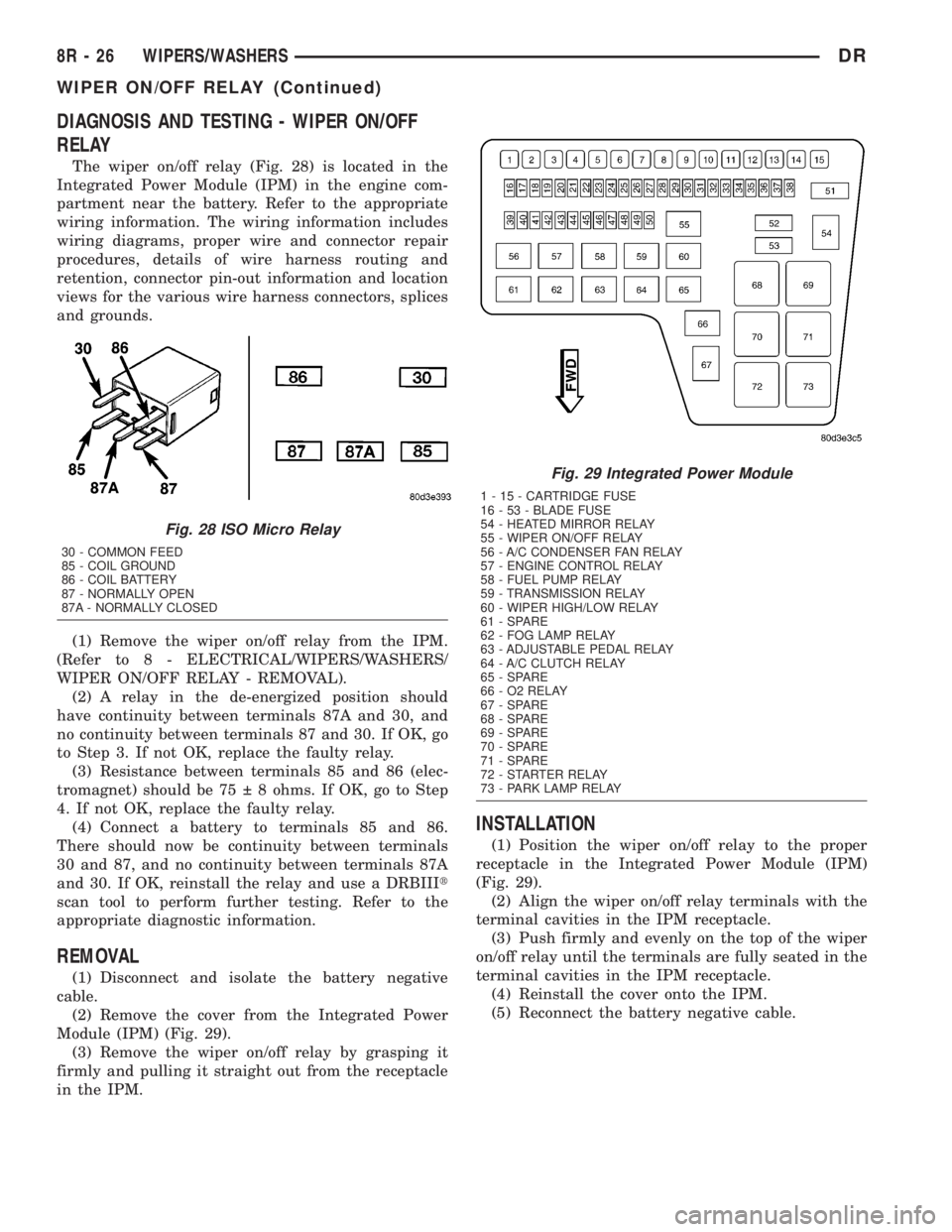
The wiper on/off relay (Fig. 28) is located in the
Integrated Power Module (IPM) in the engine com-
partment near the battery. Refer to the appropriate
wiring information. The wiring information includes
wiring diagrams, proper wire and connector repair
procedures, details of wire harness routing and
retention, connector pin-out information and location
views for the various wire harness connectors, splices
and grounds.
(1) Remove the wiper on/off relay from the IPM.
(Refer to 8 - ELECTRICAL/WIPERS/WASHERS/
WIPER ON/OFF RELAY - REMOVAL).
(2) A relay in the de-energized position should
have continuity between terminals 87A and 30, and
no continuity between terminals 87 and 30. If OK, go
to Step 3. If not OK, replace the faulty relay.
(3) Resistance between terminals 85 and 86 (elec-
tromagnet) should be 75 8 ohms. If OK, go to Step
4. If not OK, replace the faulty relay.
(4) Connect a battery to terminals 85 and 86.
There should now be continuity between terminals
30 and 87, and no continuity between terminals 87A
and 30. If OK, reinstall the relay and use a DRBIIIt
scan tool to perform further testing. Refer to the
appropriate diagnostic information.
REMOVAL
(1) Disconnect and isolate the battery negative
cable.
(2) Remove the cover from the Integrated Power
Module (IPM) (Fig. 29).
(3) Remove the wiper on/off relay by grasping it
firmly and pulling it straight out from the receptacle
in the IPM.
INSTALLATION
(1) Position the wiper on/off relay to the proper
receptacle in the Integrated Power Module (IPM)
(Fig. 29).
(2) Align the wiper on/off relay terminals with the
terminal cavities in the IPM receptacle.
(3) Push firmly and evenly on the top of the wiper
on/off relay until the terminals are fully seated in the
terminal cavities in the IPM receptacle.
(4) Reinstall the cover onto the IPM.
(5) Reconnect the battery negative cable.
Fig. 28 ISO Micro Relay
30 - COMMON FEED
85 - COIL GROUND
86 - COIL BATTERY
87 - NORMALLY OPEN
87A - NORMALLY CLOSED
Fig. 29 Integrated Power Module
1 - 15 - CARTRIDGE FUSE
16 - 53 - BLADE FUSE
54 - HEATED MIRROR RELAY
55 - WIPER ON/OFF RELAY
56 - A/C CONDENSER FAN RELAY
57 - ENGINE CONTROL RELAY
58 - FUEL PUMP RELAY
59 - TRANSMISSION RELAY
60 - WIPER HIGH/LOW RELAY
61 - SPARE
62 - FOG LAMP RELAY
63 - ADJUSTABLE PEDAL RELAY
64 - A/C CLUTCH RELAY
65 - SPARE
66 - O2 RELAY
67 - SPARE
68 - SPARE
69 - SPARE
70 - SPARE
71 - SPARE
72 - STARTER RELAY
73 - PARK LAMP RELAY
8R - 26 WIPERS/WASHERSDR
WIPER ON/OFF RELAY (Continued)
Page 704 of 2895
8W-01 WIRING DIAGRAM INFORMATION
TABLE OF CONTENTS
page page
WIRING DIAGRAM INFORMATION
DESCRIPTION
DESCRIPTION - HOW TO USE WIRING
DIAGRAMS...........................1
DESCRIPTION - CIRCUIT INFORMATION....5
DESCRIPTION - CIRCUIT FUNCTIONS......6
DESCRIPTION - SECTION IDENTIFICATION
AND INFORMATION....................6
DESCRIPTION - CONNECTOR, GROUND
AND SPLICE INFORMATION..............7
WARNING
WARNINGS - GENERAL.................7
DIAGNOSIS AND TESTING - WIRING
HARNESS............................7
STANDARD PROCEDURE
STANDARD PROCEDURE -
ELECTROSTATIC DISCHARGE (ESD)
SENSITIVE DEVICES...................8
STANDARD PROCEDURE - TESTING OF
VOLTAGE POTENTIAL...................9
STANDARD PROCEDURE - TESTING FOR
CONTINUITY..........................9STANDARD PROCEDURE - TESTING FOR A
SHORT TO GROUND...................9
STANDARD PROCEDURE - TESTING FOR A
SHORT TO GROUND ON FUSES
POWERING SEVERAL LOADS...........10
STANDARD PROCEDURE - TESTING FOR A
VOLTAGE DROP......................10
SPECIAL TOOLS
WIRING/TERMINAL....................10
CONNECTOR
REMOVAL.............................11
INSTALLATION.........................11
DIODE
REMOVAL.............................14
INSTALLATION.........................14
TERMINAL
REMOVAL.............................14
INSTALLATION.........................14
WIRE
STANDARD PROCEDURE - WIRE SPLICING . . 15
WIRING DIAGRAM
INFORMATION
DESCRIPTION
DESCRIPTION - HOW TO USE WIRING
DIAGRAMS
DaimlerChrysler Corporation wiring diagrams are
designed to provide information regarding the vehi-
cles wiring content. In order to effectively use the
wiring diagrams to diagnose and repair
DaimlerChrysler Corporation vehicles, it is important
to understand all of their features and characteris-
tics.
Diagrams are arranged such that the power (B+)
side of the circuit is placed near the top of the page,
and the ground (B-) side of the circuit is placed near
the bottom of the page (Fig. 1).
All switches, components, and modules are shown
in the at rest position with the doors closed and the
key removed from the ignition (Fig. 2).Components are shown two ways. A solid line
around a component indicates that the component is
complete. A dashed line around the component indi-
cates that the component is being shown is not com-
plete. Incomplete components have a reference
number to indicate the page where the component is
shown complete.
It is important to realize that no attempt is made
on the diagrams to represent components and wiring
as they appear on the vehicle. For example, a short
piece of wire is treated the same as a long one. In
addition, switches and other components are shown
as simply as possible, with regard to function only.
SYMBOLS
International symbols are used throughout the wir-
ing diagrams. These symbols are consistent with
those being used around the world (Fig. 3).
DR8W-01 WIRING DIAGRAM INFORMATION 8W - 01 - 1
Page 709 of 2895
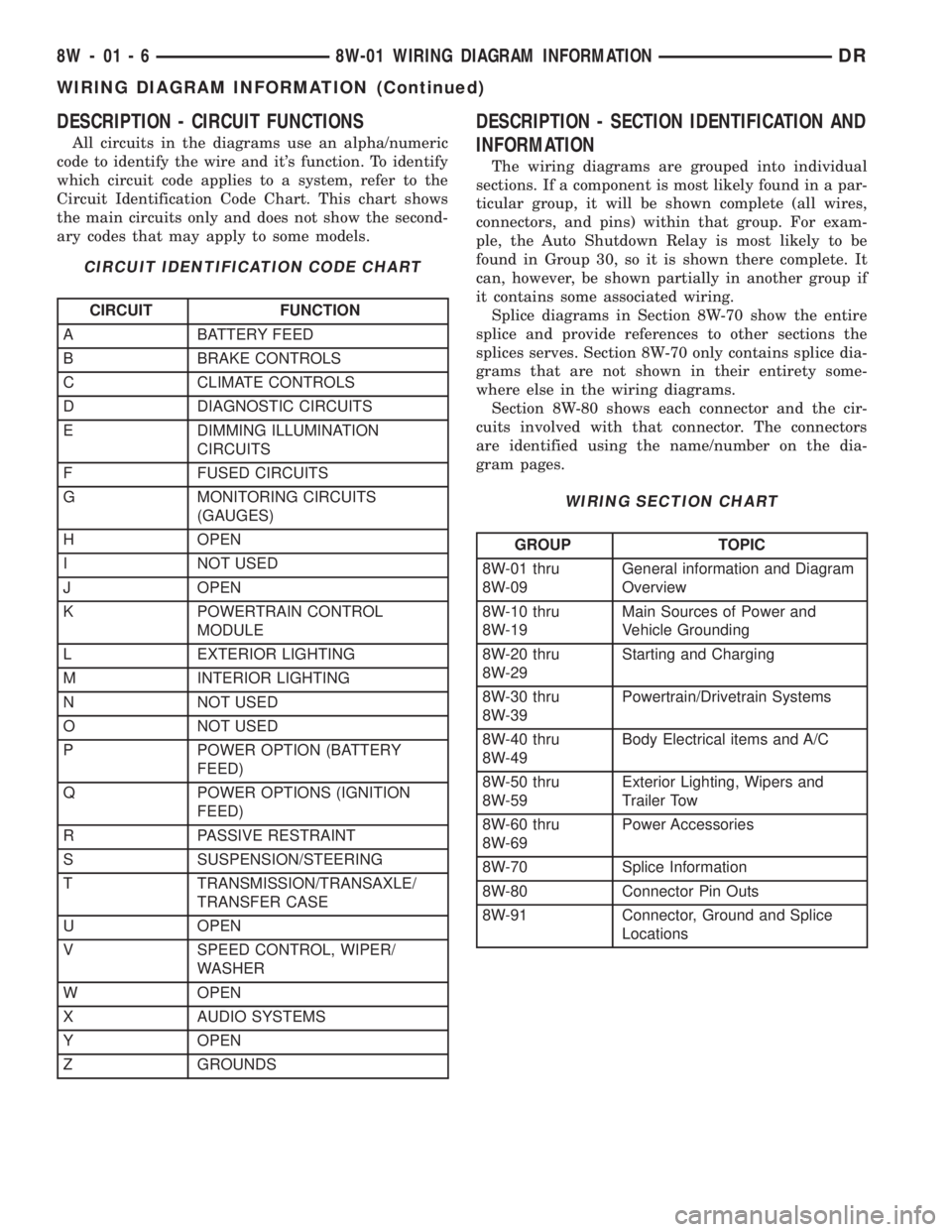
DESCRIPTION - CIRCUIT FUNCTIONS
All circuits in the diagrams use an alpha/numeric
code to identify the wire and it's function. To identify
which circuit code applies to a system, refer to the
Circuit Identification Code Chart. This chart shows
the main circuits only and does not show the second-
ary codes that may apply to some models.
CIRCUIT IDENTIFICATION CODE CHART
CIRCUIT FUNCTION
A BATTERY FEED
B BRAKE CONTROLS
C CLIMATE CONTROLS
D DIAGNOSTIC CIRCUITS
E DIMMING ILLUMINATION
CIRCUITS
F FUSED CIRCUITS
G MONITORING CIRCUITS
(GAUGES)
H OPEN
I NOT USED
J OPEN
K POWERTRAIN CONTROL
MODULE
L EXTERIOR LIGHTING
M INTERIOR LIGHTING
N NOT USED
O NOT USED
P POWER OPTION (BATTERY
FEED)
Q POWER OPTIONS (IGNITION
FEED)
R PASSIVE RESTRAINT
S SUSPENSION/STEERING
T TRANSMISSION/TRANSAXLE/
TRANSFER CASE
U OPEN
V SPEED CONTROL, WIPER/
WASHER
W OPEN
X AUDIO SYSTEMS
Y OPEN
Z GROUNDS
DESCRIPTION - SECTION IDENTIFICATION AND
INFORMATION
The wiring diagrams are grouped into individual
sections. If a component is most likely found in a par-
ticular group, it will be shown complete (all wires,
connectors, and pins) within that group. For exam-
ple, the Auto Shutdown Relay is most likely to be
found in Group 30, so it is shown there complete. It
can, however, be shown partially in another group if
it contains some associated wiring.
Splice diagrams in Section 8W-70 show the entire
splice and provide references to other sections the
splices serves. Section 8W-70 only contains splice dia-
grams that are not shown in their entirety some-
where else in the wiring diagrams.
Section 8W-80 shows each connector and the cir-
cuits involved with that connector. The connectors
are identified using the name/number on the dia-
gram pages.
WIRING SECTION CHART
GROUP TOPIC
8W-01 thru
8W-09General information and Diagram
Overview
8W-10 thru
8W-19Main Sources of Power and
Vehicle Grounding
8W-20 thru
8W-29Starting and Charging
8W-30 thru
8W-39Powertrain/Drivetrain Systems
8W-40 thru
8W-49Body Electrical items and A/C
8W-50 thru
8W-59Exterior Lighting, Wipers and
Trailer Tow
8W-60 thru
8W-69Power Accessories
8W-70 Splice Information
8W-80 Connector Pin Outs
8W-91 Connector, Ground and Splice
Locations
8W - 01 - 6 8W-01 WIRING DIAGRAM INFORMATIONDR
WIRING DIAGRAM INFORMATION (Continued)
Page 712 of 2895
STANDARD PROCEDURE - TESTING OF
VOLTAGE POTENTIAL
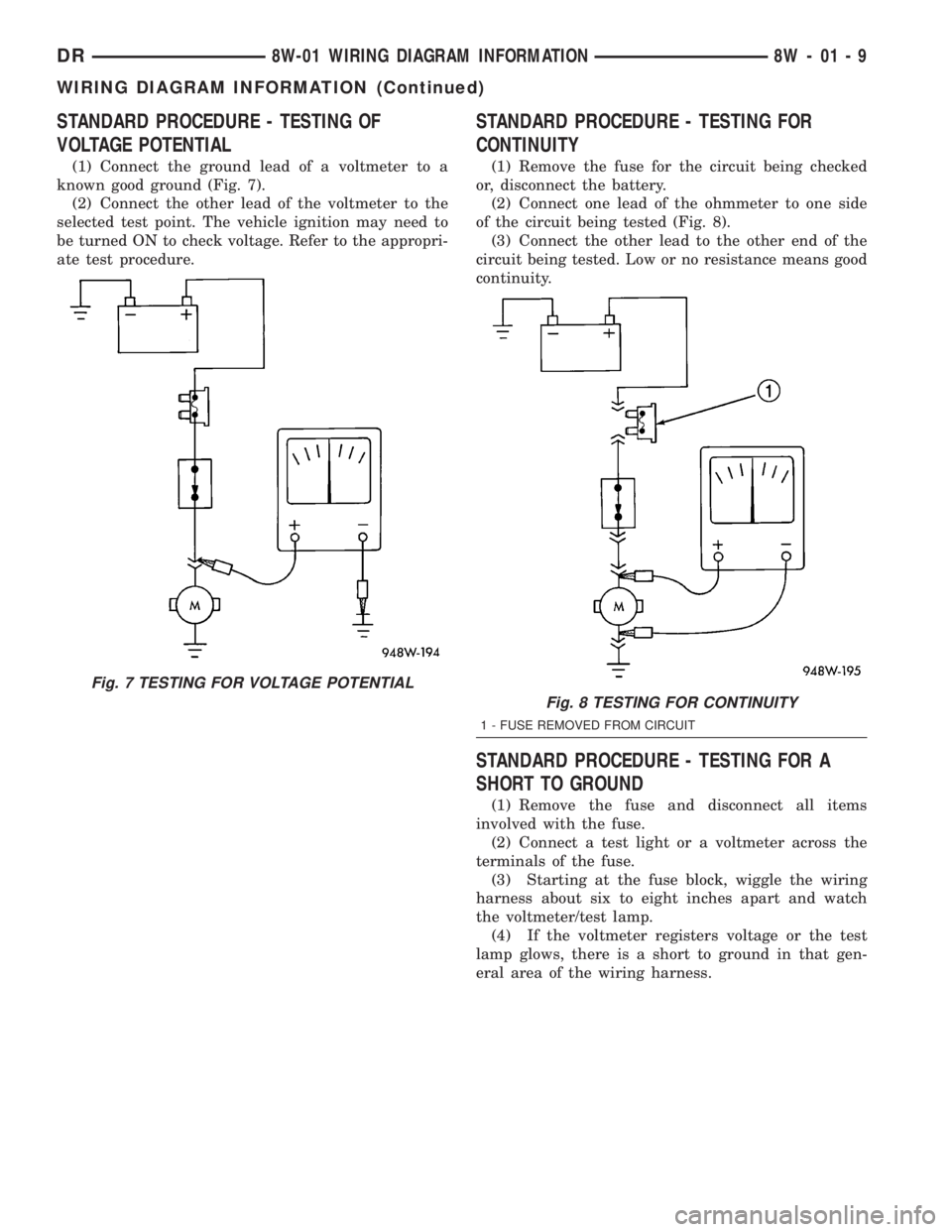
(1) Connect the ground lead of a voltmeter to a
known good ground (Fig. 7).
(2) Connect the other lead of the voltmeter to the
selected test point. The vehicle ignition may need to
be turned ON to check voltage. Refer to the appropri-
ate test procedure.
STANDARD PROCEDURE - TESTING FOR
CONTINUITY
(1) Remove the fuse for the circuit being checked
or, disconnect the battery.
(2) Connect one lead of the ohmmeter to one side
of the circuit being tested (Fig. 8).
(3) Connect the other lead to the other end of the
circuit being tested. Low or no resistance means good
continuity.
STANDARD PROCEDURE - TESTING FOR A
SHORT TO GROUND
(1) Remove the fuse and disconnect all items
involved with the fuse.
(2) Connect a test light or a voltmeter across the
terminals of the fuse.
(3) Starting at the fuse block, wiggle the wiring
harness about six to eight inches apart and watch
the voltmeter/test lamp.
(4) If the voltmeter registers voltage or the test
lamp glows, there is a short to ground in that gen-
eral area of the wiring harness.
Fig. 7 TESTING FOR VOLTAGE POTENTIAL
Fig. 8 TESTING FOR CONTINUITY
1 - FUSE REMOVED FROM CIRCUIT
DR8W-01 WIRING DIAGRAM INFORMATION 8W - 01 - 9
WIRING DIAGRAM INFORMATION (Continued)
Page 714 of 2895
CONNECTOR
REMOVAL
(1) Disconnect battery.
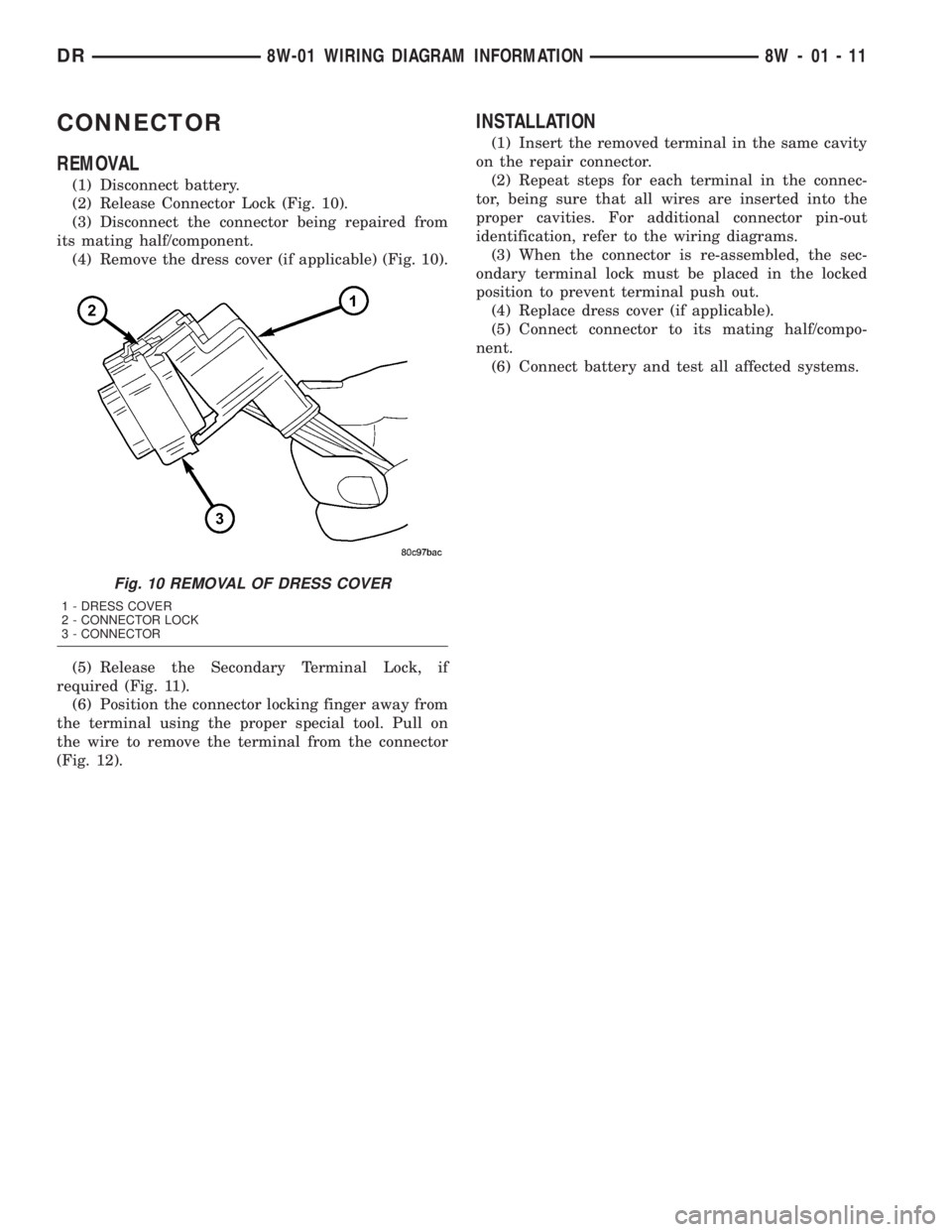
(2) Release Connector Lock (Fig. 10).
(3) Disconnect the connector being repaired from
its mating half/component.
(4) Remove the dress cover (if applicable) (Fig. 10).
(5) Release the Secondary Terminal Lock, if
required (Fig. 11).
(6) Position the connector locking finger away from
the terminal using the proper special tool. Pull on
the wire to remove the terminal from the connector
(Fig. 12).
INSTALLATION
(1) Insert the removed terminal in the same cavity
on the repair connector.
(2) Repeat steps for each terminal in the connec-
tor, being sure that all wires are inserted into the
proper cavities. For additional connector pin-out
identification, refer to the wiring diagrams.
(3) When the connector is re-assembled, the sec-
ondary terminal lock must be placed in the locked
position to prevent terminal push out.
(4) Replace dress cover (if applicable).
(5) Connect connector to its mating half/compo-
nent.
(6) Connect battery and test all affected systems.
Fig. 10 REMOVAL OF DRESS COVER
1 - DRESS COVER
2 - CONNECTOR LOCK
3 - CONNECTOR
DR8W-01 WIRING DIAGRAM INFORMATION 8W - 01 - 11
Page 717 of 2895
DIODE
REMOVAL
(1) Disconnect the battery.
(2) Locate the diode in the harness, and remove
the protective covering.
(3) Remove the diode from the harness, pay atten-
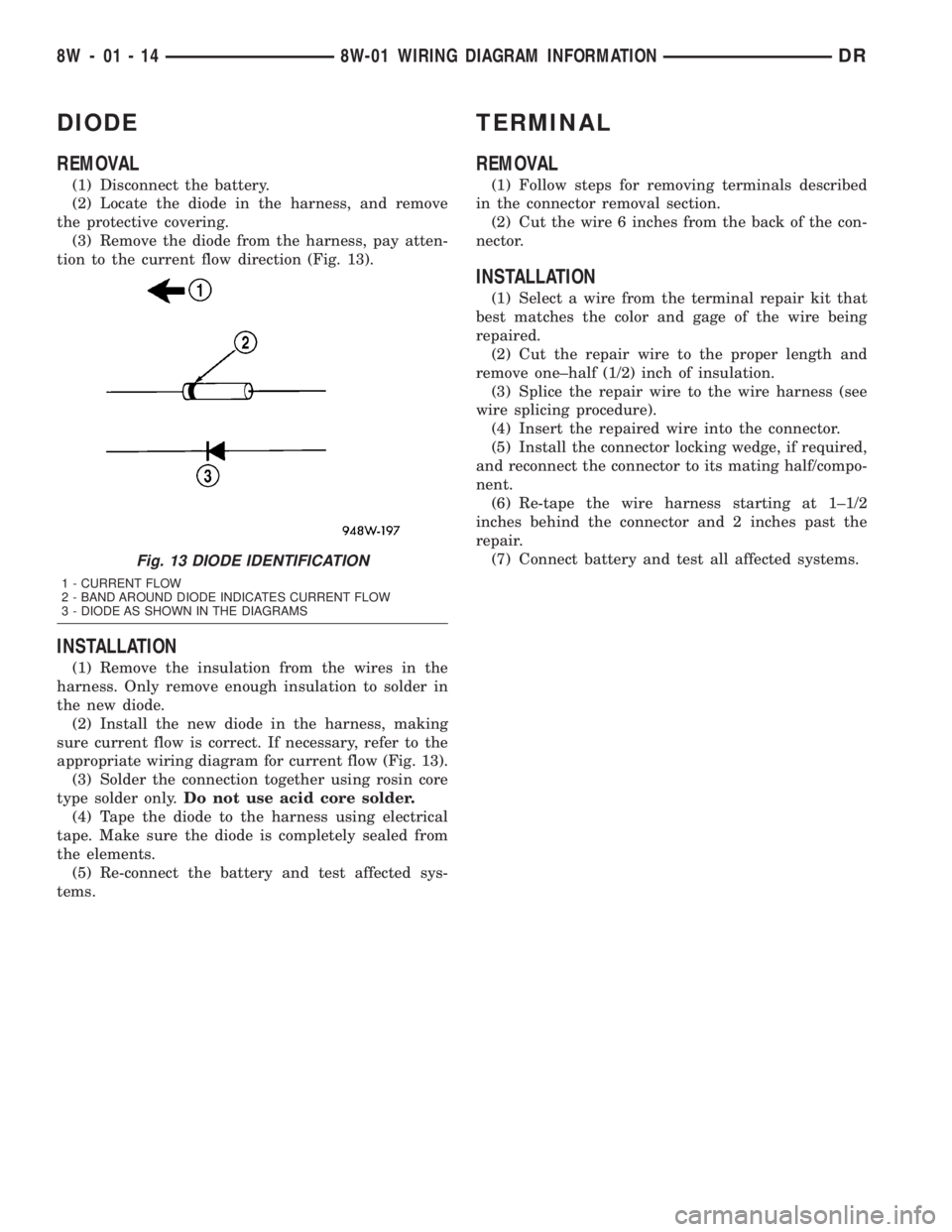
tion to the current flow direction (Fig. 13).
INSTALLATION
(1) Remove the insulation from the wires in the
harness. Only remove enough insulation to solder in
the new diode.
(2) Install the new diode in the harness, making
sure current flow is correct. If necessary, refer to the
appropriate wiring diagram for current flow (Fig. 13).
(3) Solder the connection together using rosin core
type solder only.Do not use acid core solder.
(4) Tape the diode to the harness using electrical
tape. Make sure the diode is completely sealed from
the elements.
(5) Re-connect the battery and test affected sys-
tems.
TERMINAL
REMOVAL
(1) Follow steps for removing terminals described
in the connector removal section.
(2) Cut the wire 6 inches from the back of the con-
nector.
INSTALLATION
(1) Select a wire from the terminal repair kit that
best matches the color and gage of the wire being
repaired.
(2) Cut the repair wire to the proper length and
remove one±half (1/2) inch of insulation.
(3) Splice the repair wire to the wire harness (see
wire splicing procedure).
(4) Insert the repaired wire into the connector.
(5) Install the connector locking wedge, if required,
and reconnect the connector to its mating half/compo-
nent.
(6) Re-tape the wire harness starting at 1±1/2
inches behind the connector and 2 inches past the
repair.
(7) Connect battery and test all affected systems.
Fig. 13 DIODE IDENTIFICATION
1 - CURRENT FLOW
2 - BAND AROUND DIODE INDICATES CURRENT FLOW
3 - DIODE AS SHOWN IN THE DIAGRAMS
8W - 01 - 14 8W-01 WIRING DIAGRAM INFORMATIONDR
Page 718 of 2895
WIRE
STANDARD PROCEDURE - WIRE SPLICING
When splicing a wire, it is important that the cor-
rect gage be used as shown in the wiring diagrams.
(1) Remove one-half (1/2) inch of insulation from
each wire that needs to be spliced.
(2) Place a piece of adhesive lined heat shrink tub-
ing on one side of the wire. Make sure the tubing will
be long enough to cover and seal the entire repair
area.
(3) Place the strands of wire overlapping each
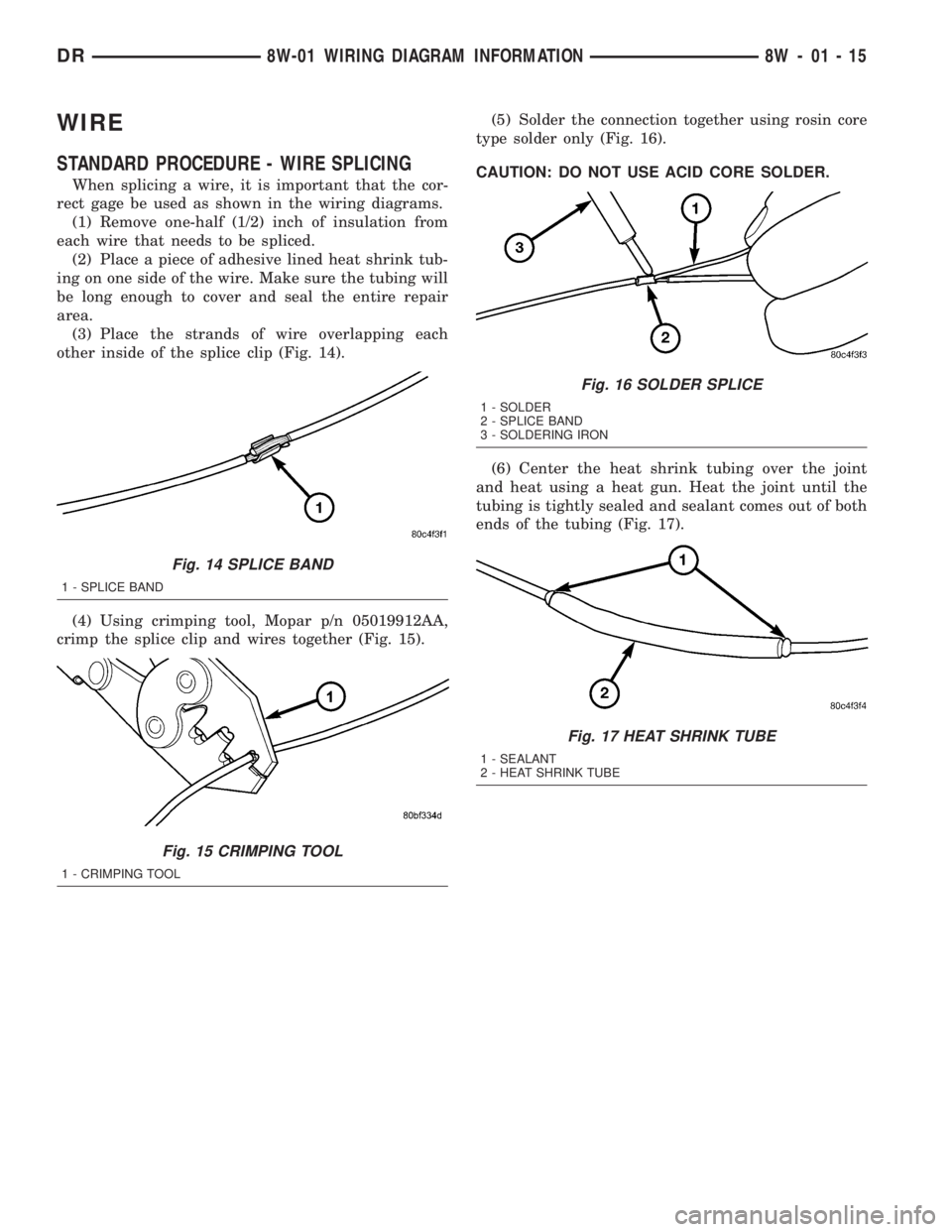
other inside of the splice clip (Fig. 14).
(4) Using crimping tool, Mopar p/n 05019912AA,
crimp the splice clip and wires together (Fig. 15).(5) Solder the connection together using rosin core
type solder only (Fig. 16).
CAUTION: DO NOT USE ACID CORE SOLDER.
(6) Center the heat shrink tubing over the joint
and heat using a heat gun. Heat the joint until the
tubing is tightly sealed and sealant comes out of both
ends of the tubing (Fig. 17).
Fig. 14 SPLICE BAND
1 - SPLICE BAND
Fig. 15 CRIMPING TOOL
1 - CRIMPING TOOL
Fig. 16 SOLDER SPLICE
1 - SOLDER
2 - SPLICE BAND
3 - SOLDERING IRON
Fig. 17 HEAT SHRINK TUBE
1 - SEALANT
2 - HEAT SHRINK TUBE
DR8W-01 WIRING DIAGRAM INFORMATION 8W - 01 - 15
Page 1073 of 2895
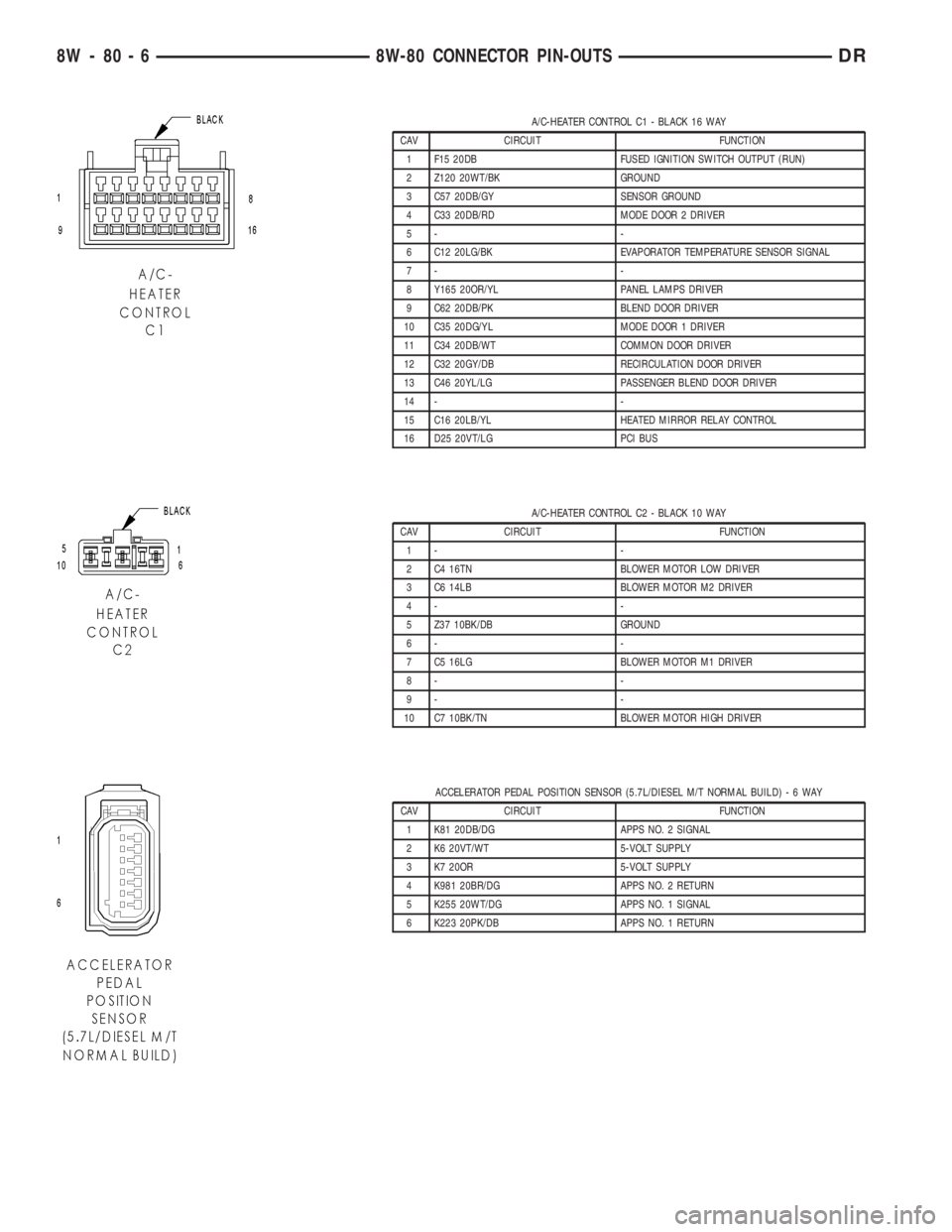
A/C-HEATER CONTROL C1 - BLACK 16 WAY
CAV CIRCUIT FUNCTION
1 F15 20DB FUSED IGNITION SWITCH OUTPUT (RUN)
2 Z120 20WT/BK GROUND
3 C57 20DB/GY SENSOR GROUND
4 C33 20DB/RD MODE DOOR 2 DRIVER
5- -
6 C12 20LG/BK EVAPORATOR TEMPERATURE SENSOR SIGNAL
7- -
8 Y165 20OR/YL PANEL LAMPS DRIVER
9 C62 20DB/PK BLEND DOOR DRIVER
10 C35 20DG/YL MODE DOOR 1 DRIVER
11 C34 20DB/WT COMMON DOOR DRIVER
12 C32 20GY/DB RECIRCULATION DOOR DRIVER
13 C46 20YL/LG PASSENGER BLEND DOOR DRIVER
14 - -
15 C16 20LB/YL HEATED MIRROR RELAY CONTROL
16 D25 20VT/LG PCI BUS
A/C-HEATER CONTROL C2 - BLACK 10 WAY
CAV CIRCUIT FUNCTION
1- -
2 C4 16TN BLOWER MOTOR LOW DRIVER
3 C6 14LB BLOWER MOTOR M2 DRIVER
4- -
5 Z37 10BK/DB GROUND
6- -
7 C5 16LG BLOWER MOTOR M1 DRIVER
8- -
9- -
10 C7 10BK/TN BLOWER MOTOR HIGH DRIVER
ACCELERATOR PEDAL POSITION SENSOR (5.7L/DIESEL M/T NORMAL BUILD)-6WAY
CAV CIRCUIT FUNCTION
1 K81 20DB/DG APPS NO. 2 SIGNAL
2 K6 20VT/WT 5-VOLT SUPPLY
3 K7 20OR 5-VOLT SUPPLY
4 K981 20BR/DG APPS NO. 2 RETURN
5 K255 20WT/DG APPS NO. 1 SIGNAL
6 K223 20PK/DB APPS NO. 1 RETURN
8W - 80 - 6 8W-80 CONNECTOR PIN-OUTSDR
Page 1121 of 2895
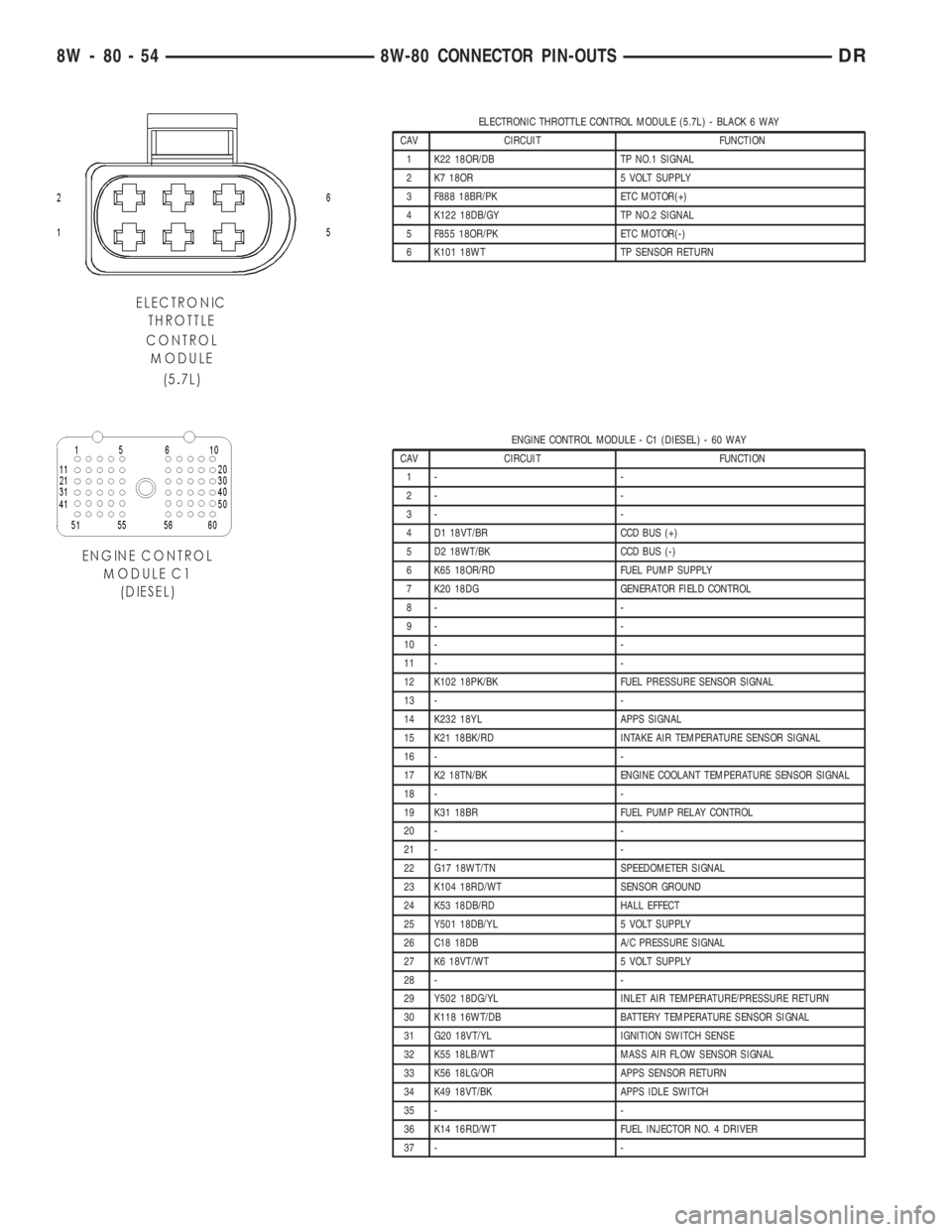
ELECTRONIC THROTTLE CONTROL MODULE (5.7L) - BLACK 6 WAY
CAV CIRCUIT FUNCTION
1 K22 18OR/DB TP NO.1 SIGNAL
2 K7 18OR 5 VOLT SUPPLY
3 F888 18BR/PK ETC MOTOR(+)
4 K122 18DB/GY TP NO.2 SIGNAL
5 F855 18OR/PK ETC MOTOR(-)
6 K101 18WT TP SENSOR RETURN
ENGINE CONTROL MODULE - C1 (DIESEL) - 60 WAY
CAV CIRCUIT FUNCTION
1- -
2- -
3- -
4 D1 18VT/BR CCD BUS (+)
5 D2 18WT/BK CCD BUS (-)
6 K65 18OR/RD FUEL PUMP SUPPLY
7 K20 18DG GENERATOR FIELD CONTROL
8- -
9- -
10 - -
11 - -
12 K102 18PK/BK FUEL PRESSURE SENSOR SIGNAL
13 - -
14 K232 18YL APPS SIGNAL
15 K21 18BK/RD INTAKE AIR TEMPERATURE SENSOR SIGNAL
16 - -
17 K2 18TN/BK ENGINE COOLANT TEMPERATURE SENSOR SIGNAL
18 - -
19 K31 18BR FUEL PUMP RELAY CONTROL
20 - -
21 - -
22 G17 18WT/TN SPEEDOMETER SIGNAL
23 K104 18RD/WT SENSOR GROUND
24 K53 18DB/RD HALL EFFECT
25 Y501 18DB/YL 5 VOLT SUPPLY
26 C18 18DB A/C PRESSURE SIGNAL
27 K6 18VT/WT 5 VOLT SUPPLY
28 - -
29 Y502 18DG/YL INLET AIR TEMPERATURE/PRESSURE RETURN
30 K118 16WT/DB BATTERY TEMPERATURE SENSOR SIGNAL
31 G20 18VT/YL IGNITION SWITCH SENSE
32 K55 18LB/WT MASS AIR FLOW SENSOR SIGNAL
33 K56 18LG/OR APPS SENSOR RETURN
34 K49 18VT/BK APPS IDLE SWITCH
35 - -
36 K14 16RD/WT FUEL INJECTOR NO. 4 DRIVER
37 - -
8W - 80 - 54 8W-80 CONNECTOR PIN-OUTSDR
Page 1122 of 2895
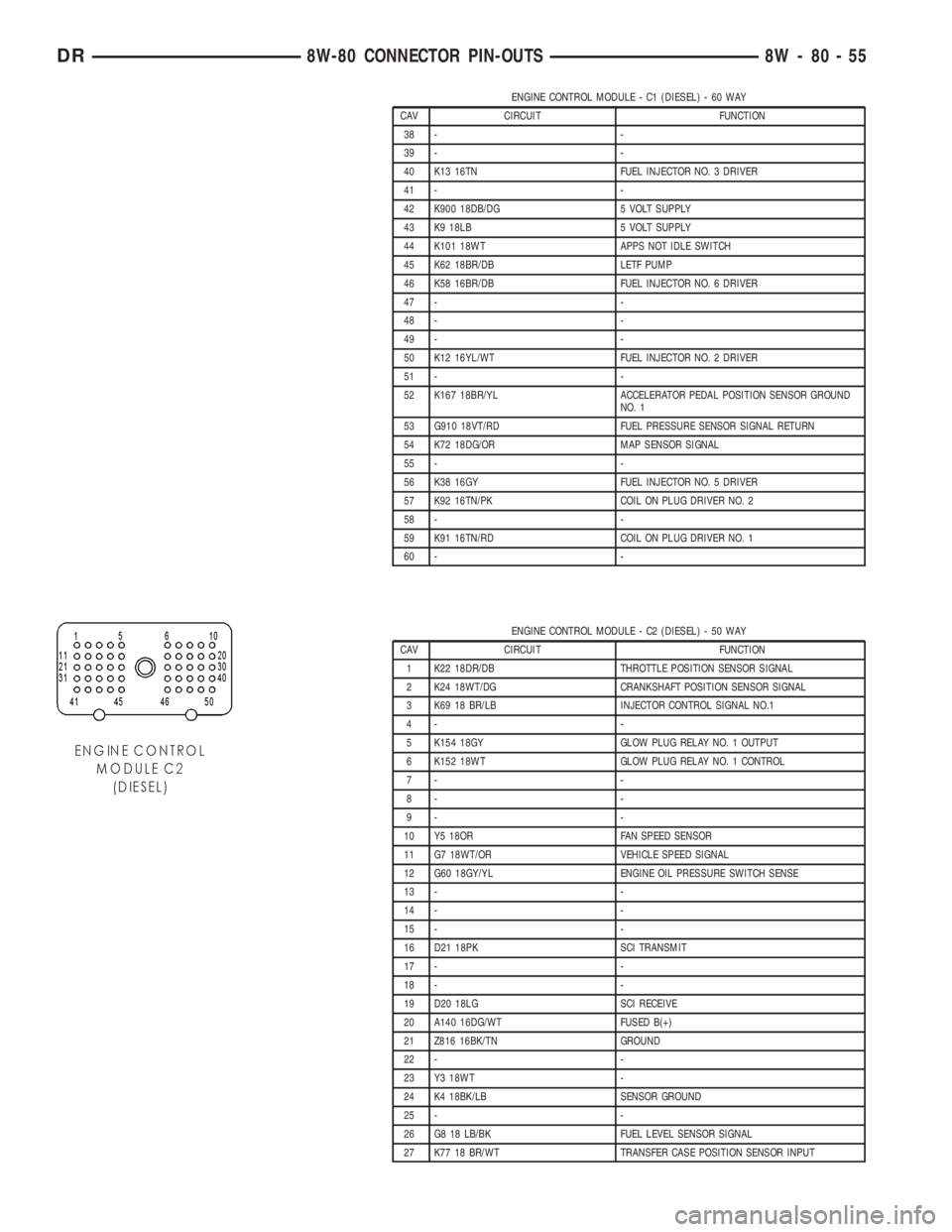
ENGINE CONTROL MODULE - C1 (DIESEL) - 60 WAY
CAV CIRCUIT FUNCTION
38 - -
39 - -
40 K13 16TN FUEL INJECTOR NO. 3 DRIVER
41 - -
42 K900 18DB/DG 5 VOLT SUPPLY
43 K9 18LB 5 VOLT SUPPLY
44 K101 18WT APPS NOT IDLE SWITCH
45 K62 18BR/DB LETF PUMP
46 K58 16BR/DB FUEL INJECTOR NO. 6 DRIVER
47 - -
48 - -
49 - -
50 K12 16YL/WT FUEL INJECTOR NO. 2 DRIVER
51 - -
52 K167 18BR/YL ACCELERATOR PEDAL POSITION SENSOR GROUND
NO. 1
53 G910 18VT/RD FUEL PRESSURE SENSOR SIGNAL RETURN
54 K72 18DG/OR MAP SENSOR SIGNAL
55 - -
56 K38 16GY FUEL INJECTOR NO. 5 DRIVER
57 K92 16TN/PK COIL ON PLUG DRIVER NO. 2
58 - -
59 K91 16TN/RD COIL ON PLUG DRIVER NO. 1
60 - -
ENGINE CONTROL MODULE - C2 (DIESEL) - 50 WAY
CAV CIRCUIT FUNCTION
1 K22 18DR/DB THROTTLE POSITION SENSOR SIGNAL
2 K24 18WT/DG CRANKSHAFT POSITION SENSOR SIGNAL
3 K69 18 BR/LB INJECTOR CONTROL SIGNAL NO.1
4- -
5 K154 18GY GLOW PLUG RELAY NO. 1 OUTPUT
6 K152 18WT GLOW PLUG RELAY NO. 1 CONTROL
7- -
8- -
9- -
10 Y5 18OR FAN SPEED SENSOR
11 G7 18WT/OR VEHICLE SPEED SIGNAL
12 G60 18GY/YL ENGINE OIL PRESSURE SWITCH SENSE
13 - -
14 - -
15 - -
16 D21 18PK SCI TRANSMIT
17 - -
18 - -
19 D20 18LG SCI RECEIVE
20 A140 16DG/WT FUSED B(+)
21 Z816 16BK/TN GROUND
22 - -
23 Y3 18WT -
24 K4 18BK/LB SENSOR GROUND
25 - -
26 G8 18 LB/BK FUEL LEVEL SENSOR SIGNAL
27 K77 18 BR/WT TRANSFER CASE POSITION SENSOR INPUT
DR8W-80 CONNECTOR PIN-OUTS 8W - 80 - 55