Oss DODGE RAM 2003 Service Repair Manual
[x] Cancel search | Manufacturer: DODGE, Model Year: 2003, Model line: RAM, Model: DODGE RAM 2003Pages: 2895, PDF Size: 83.15 MB
Page 2818 of 2895
NOTE: If the condenser is replaced, add 30 millili-
ters (1 fluid ounce) of refrigerant oil to the refriger-
ant system. Use only refrigerant oil of the type
recommended for the compressor in the vehicle(Re-
fer to 24 - HEATING & AIR CONDITIONING/PLUMB-
ING/REFRIGERANT OIL - DESCRIPTION).
(8) Charge the a/c system(Refer to 24 - HEATING
& AIR CONDITIONING/PLUMBING - STANDARD
PROCEDURE).
(9) Install the battery negative cable.
A/C CONDENSER FAN
REMOVAL - CONDENSER FAN (GAS ENGINE
ONLY - 3.7, 4.7 & 5.7L)
(1) Remove and isolate negative battery cable.
(2) Remove condenser assembly(Refer to 24 -
HEATING & AIR CONDITIONING/PLUMBING/A/C
CONDENSER - REMOVAL).
(3) Place condenser assembly on a flat work area
and remove screws holding fan assembly to con-
denser.
(4) Separate fan assembly from condenser noting
location of all seals for reinstallation.
INSTALLATION - CONDENSER FAN (GAS
ENGINE ONLY - 3.7, 4.7 & 5.7L)
(1) Position fan assembly on to the condenser.
(2) Check all fan shroud seals and replace as
required then install retainer screws to hold fan
assembly to condenser.
(3) Install condenser and fan assembly to vehi-
cle(Refer to 24 - HEATING & AIR CONDITIONING/
PLUMBING/A/C CONDENSER - INSTALLATION).
(4) Install battery negative cable.
A/C DISCHARGE LINE
REMOVAL
REMOVAL
WARNING: REVIEW THE WARNINGS AND CAU-
TIONS IN THE FRONT OF THIS SECTION BEFORE
PERFORMING THE FOLLOWING OPERATION.
(Refer to 24 - HEATING & AIR CONDITIONING/
PLUMBING - WARNING) (Refer to 24 - HEATING &
AIR CONDITIONING/PLUMBING - CAUTION)
(1) Disconnect and isolate the battery negative
cable.
(2) Recover the refrigerant from the refrigerant
system. (Refer to 24 - HEATING & AIR CONDI-TIONING/PLUMBING - STANDARD PROCEDURE -
REFRIGERANT RECOVERY)
(3) Unplug the wire harness connector from the
high pressure transducer.
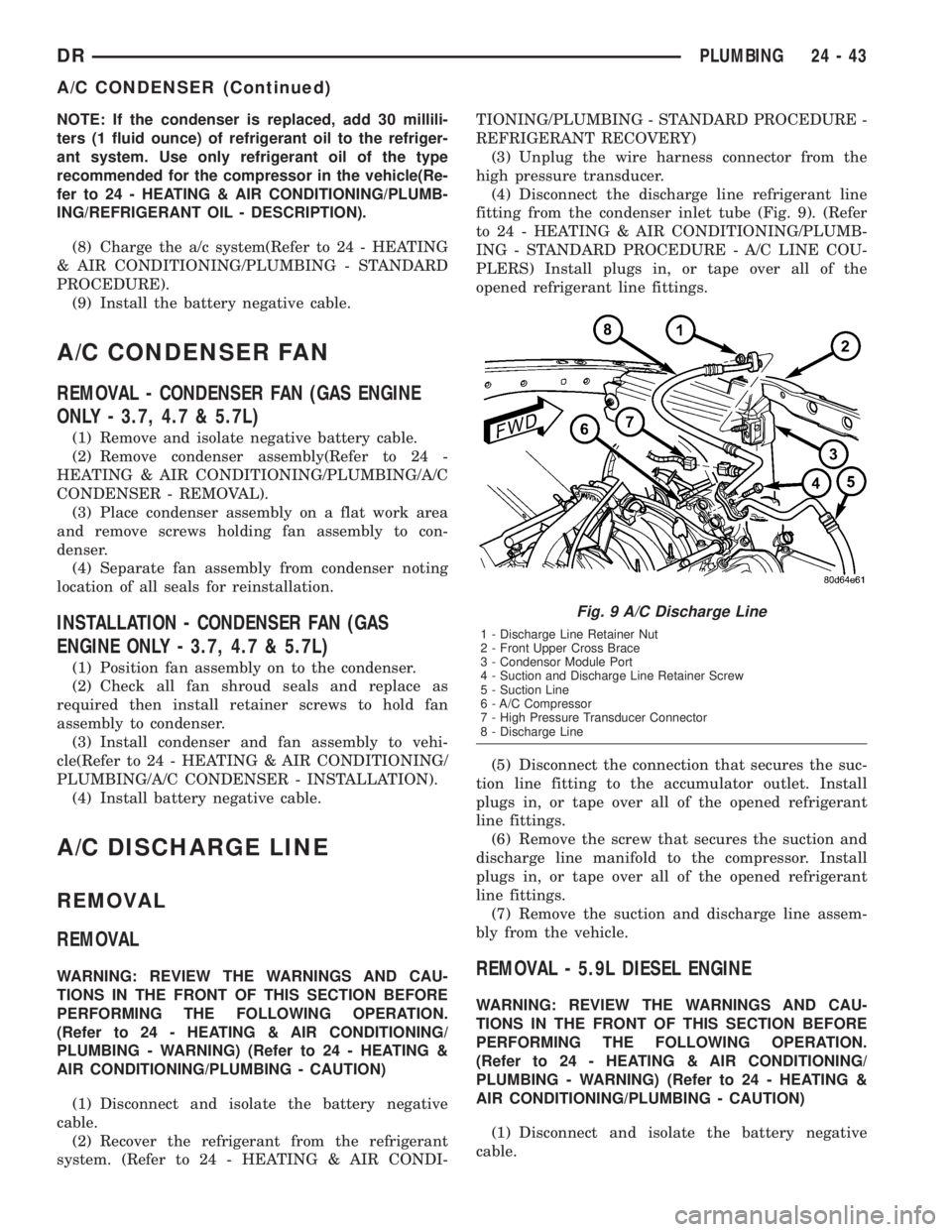
(4) Disconnect the discharge line refrigerant line
fitting from the condenser inlet tube (Fig. 9). (Refer
to 24 - HEATING & AIR CONDITIONING/PLUMB-
ING - STANDARD PROCEDURE - A/C LINE COU-
PLERS) Install plugs in, or tape over all of the
opened refrigerant line fittings.
(5) Disconnect the connection that secures the suc-
tion line fitting to the accumulator outlet. Install
plugs in, or tape over all of the opened refrigerant
line fittings.
(6) Remove the screw that secures the suction and
discharge line manifold to the compressor. Install
plugs in, or tape over all of the opened refrigerant
line fittings.
(7) Remove the suction and discharge line assem-
bly from the vehicle.REMOVAL - 5.9L DIESEL ENGINE
WARNING: REVIEW THE WARNINGS AND CAU-
TIONS IN THE FRONT OF THIS SECTION BEFORE
PERFORMING THE FOLLOWING OPERATION.
(Refer to 24 - HEATING & AIR CONDITIONING/
PLUMBING - WARNING) (Refer to 24 - HEATING &
AIR CONDITIONING/PLUMBING - CAUTION)
(1) Disconnect and isolate the battery negative
cable.
Fig. 9 A/C Discharge Line
1 - Discharge Line Retainer Nut
2 - Front Upper Cross Brace
3 - Condensor Module Port
4 - Suction and Discharge Line Retainer Screw
5 - Suction Line
6 - A/C Compressor
7 - High Pressure Transducer Connector
8 - Discharge Line
DRPLUMBING 24 - 43
A/C CONDENSER (Continued)
Page 2820 of 2895
STANDARD PROCEDURE - REFRIGERANT SYS-
TEM EVACUATE)
(7) Charge the refrigerant system. (Refer to 24 -
HEATING & AIR CONDITIONING/PLUMBING -
STANDARD PROCEDURE - REFRIGERANT SYS-
TEM CHARGE)
LIQUID LINE
REMOVAL
WARNING: REVIEW THE WARNINGS AND CAU-
TIONS IN THE FRONT OF THIS SECTION BEFORE
PERFORMING THE FOLLOWING OPERATION.
(Refer to 24 - HEATING & AIR CONDITIONING/
PLUMBING - WARNING) (Refer to 24 - HEATING &
AIR CONDITIONING/PLUMBING - CAUTION)
(1) Disconnect and isolate the battery negative
cable.
NOTE: Removal of the second battery and battery
tray is required on the diesel equipped vehicles.
(2) Remove rightside battery(Refer to 8 - ELEC-
TRICAL/BATTERY SYSTEM/BATTERY - REMOV-
AL).
(3) Remove rightside battery tray(Refer to 8 -
ELECTRICAL/BATTERY SYSTEM/TRAY - REMOV-
AL).
(4) Recover the refrigerant from the refrigerant
system. (Refer to 24 - HEATING & AIR CONDI-
TIONING/PLUMBING - STANDARD PROCEDURE -
REFRIGERANT RECOVERY)
(5) Disconnect the liquid line refrigerant line cou-
plers at the condenser outlet the mid point connec-
tion and the evaporator inlet. (Refer to 24 -
HEATING & AIR CONDITIONING/PLUMBING -
STANDARD PROCEDURE - A/C LINE COUPLERS)
Install plugs in, or tape over all of the opened refrig-
erant line fittings.
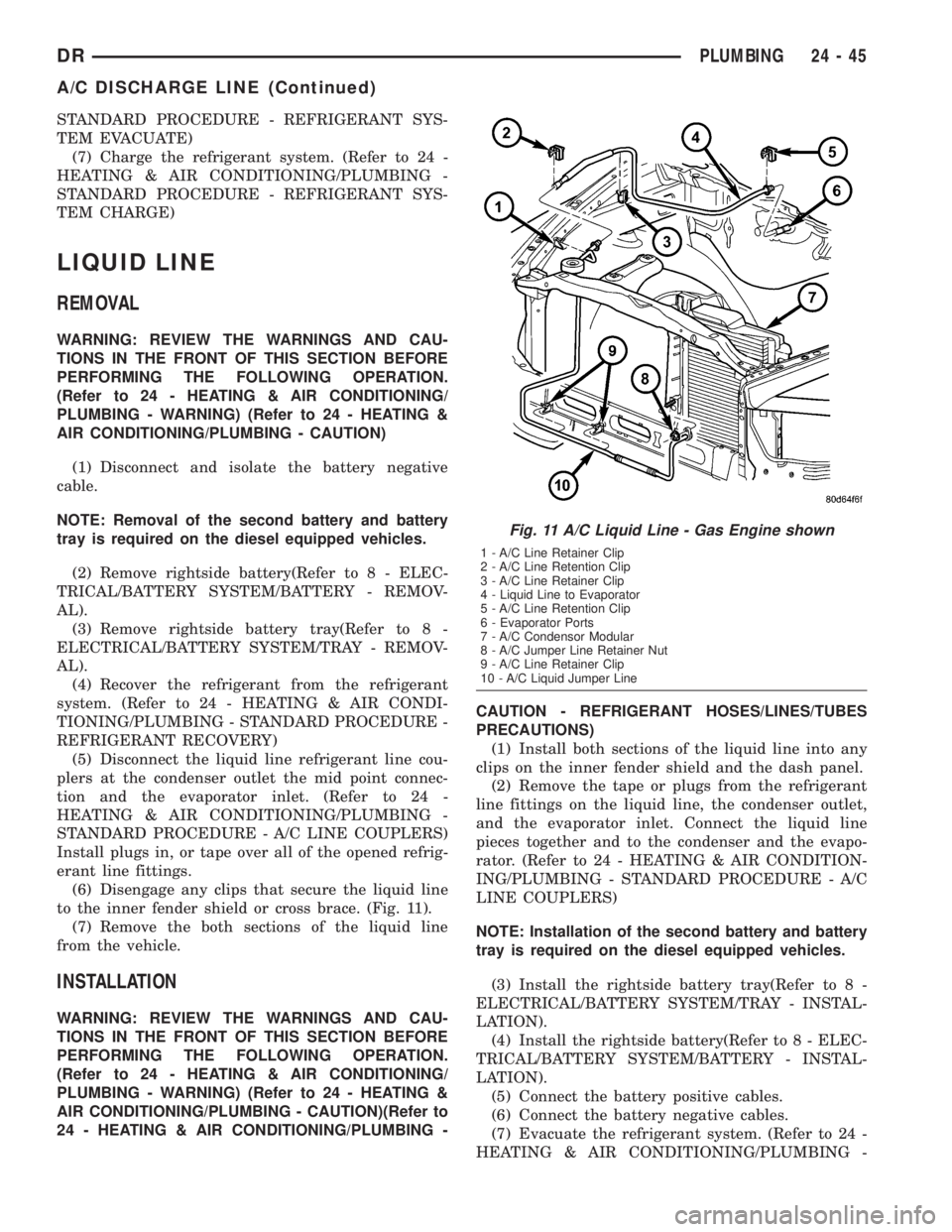
(6) Disengage any clips that secure the liquid line
to the inner fender shield or cross brace. (Fig. 11).
(7) Remove the both sections of the liquid line
from the vehicle.
INSTALLATION
WARNING: REVIEW THE WARNINGS AND CAU-
TIONS IN THE FRONT OF THIS SECTION BEFORE
PERFORMING THE FOLLOWING OPERATION.
(Refer to 24 - HEATING & AIR CONDITIONING/
PLUMBING - WARNING) (Refer to 24 - HEATING &
AIR CONDITIONING/PLUMBING - CAUTION)(Refer to
24 - HEATING & AIR CONDITIONING/PLUMBING -CAUTION - REFRIGERANT HOSES/LINES/TUBES
PRECAUTIONS)
(1) Install both sections of the liquid line into any
clips on the inner fender shield and the dash panel.
(2) Remove the tape or plugs from the refrigerant
line fittings on the liquid line, the condenser outlet,
and the evaporator inlet. Connect the liquid line
pieces together and to the condenser and the evapo-
rator. (Refer to 24 - HEATING & AIR CONDITION-
ING/PLUMBING - STANDARD PROCEDURE - A/C
LINE COUPLERS)
NOTE: Installation of the second battery and battery
tray is required on the diesel equipped vehicles.
(3) Install the rightside battery tray(Refer to 8 -
ELECTRICAL/BATTERY SYSTEM/TRAY - INSTAL-
LATION).
(4) Install the rightside battery(Refer to 8 - ELEC-
TRICAL/BATTERY SYSTEM/BATTERY - INSTAL-
LATION).
(5) Connect the battery positive cables.
(6) Connect the battery negative cables.
(7) Evacuate the refrigerant system. (Refer to 24 -
HEATING & AIR CONDITIONING/PLUMBING -
Fig. 11 A/C Liquid Line - Gas Engine shown
1 - A/C Line Retainer Clip
2 - A/C Line Retention Clip
3 - A/C Line Retainer Clip
4 - Liquid Line to Evaporator
5 - A/C Line Retention Clip
6 - Evaporator Ports
7 - A/C Condensor Modular
8 - A/C Jumper Line Retainer Nut
9 - A/C Line Retainer Clip
10 - A/C Liquid Jumper Line
DRPLUMBING 24 - 45
A/C DISCHARGE LINE (Continued)
Page 2826 of 2895
small amount of R-12 added to an R-134a refrigerant
system will cause compressor failure, refrigerant oil
sludge or poor air conditioning system performance.
In addition, the PolyAlkylene Glycol (PAG) synthetic
refrigerant oils used in an R-134a refrigerant system
are not compatible with the mineral-based refriger-
ant oils used in an R-12 refrigerant system.
R-134a refrigerant system service ports, service
tool couplers and refrigerant dispensing bottles have
all been designed with unique fittings to ensure that
an R-134a system is not accidentally contaminated
with the wrong refrigerant (R-12). There are also
labels posted in the engine compartment of the vehi-
cle and on the compressor identifying to service tech-
nicians that the air conditioning system is equipped
with R-134a.
DIAGNOSIS AND TESTING- REFRIGERANT
SYSTEM LEAKS
WARNING: (Refer to 24 - HEATING & AIR CONDI-
TIONING/PLUMBING - WARNING) and (Refer to 24 -
HEATING & AIR CONDITIONING/PLUMBING - CAU-
TION).
If the air conditioning system does not cool prop-
erly, the A/C system performance should be tested.
See A/C Performance in the Diagnosis and Testing
section of this group for the procedures. If the A/C
system refrigerant fill is found to be low or if the sys-
tem is empty; a leak at a refrigerant line, connector
fitting, component, or component seal is likely.
An electronic leak detector designed for R-134a
refrigerant, or a fluorescent R-134a leak detection
dye and a black light are recommended for locating
and confirming refrigerant system leaks. Refer to the
operating instructions supplied by the equipment
manufacturer for the proper care and use of this
equipment.
An oily residue on or near refrigerant system lines,
connector fittings, components, or component seals
can indicate the general location of a possible refrig-
erant leak. However, the exact leak location should
be confirmed with an electronic leak detector prior to
component repair or replacement.
To detect a leak in the refrigerant system with an
electronic leak detector, perform one of the following
procedures:
SYSTEM EMPTY
(1) Evacuate the refrigerant system (Refer to 24 -
HEATING & AIR CONDITIONING/PLUMBING/RE-
FRIGERANT - STANDARD PROCEDURE).
(2) Connect and dispense 0.283 kilograms (0.625
pounds or 10 ounces) of R-134a refrigerant into the
evacuated refrigerant system (Refer to 24 - HEAT-ING & AIR CONDITIONING/PLUMBING/REFRIG-
ERANT - STANDARD PROCEDURE).
(3) Position the vehicle in a wind-free work area.
This will aid in detecting small leaks.
(4) With the engine not running, use a electronic
R-134a leak detector and search for leaks. Because
R-134a refrigerant is heavier than air, the leak detec-
tor probe should be moved slowly along the bottom
side of all refrigerant lines, connector fittings and
components.
(5) To inspect the evaporator coil for leaks, insert
the electronic leak detector probe into the center
instrument panel outlet and the floor duct outlet. Set
the blower motor switch to the lowest speed position,
and the mode control switch in the recirculation
mode (Max-A/C).
SYSTEM LOW
(1) Position the vehicle in a wind-free work area.
This will aid in detecting small leaks.
(2) Bring the refrigerant system up to operating
temperature and pressure. This is done by allowing
the engine to run with the air conditioning system
turned on for five minutes.
(3) With the engine not running, use a electronic
R-134a leak detector and search for leaks. Because
R-134a refrigerant is heavier than air, the leak detec-
tor probe should be moved slowly along the bottom
side of all refrigerant lines, connector fittings and
components.
(4) To inspect the evaporator coil for leaks, insert
the electronic leak detector probe into the center
instrument panel outlet and the floor duct outlet. Set
the blower motor switch to the lowest speed position,
and the mode control switch in the recirculation
mode (Max-A/C).
STANDARD PROCEDURE
STANDARD PROCEDURE - REFRIGERANT
SYSTEM EVACUATE
WARNING: (Refer to 24 - HEATING & AIR CONDI-
TIONING/PLUMBING - WARNING) AND (Refer to 24 -
HEATING & AIR CONDITIONING/PLUMBING - CAU-
TION) BEFORE PERFORMING THE FOLLOWING
OPERATION.
If the refrigerant system has been open to the
atmosphere, it must be evacuated before the system
can be charged. If moisture and air enters the system
and becomes mixed with the refrigerant, the com-
pressor head pressure will rise above acceptable
operating levels. This will reduce the performance of
the air conditioner and could damage the compressor.
Evacuating the refrigerant system will remove the
DRPLUMBING 24 - 51
REFRIGERANT (Continued)
Page 2829 of 2895
(7) Ensure that the spring-lock coupler is fully
engaged by trying to separate the two coupler halves.
This is done by pulling the refrigerant lines on either
side of the coupler away from each other.
(8) Reinstall the secondary clip over the spring-
lock coupler cage.
REFRIGERANT OIL
DESCRIPTION
The refrigerant oil used in R-134a refrigerant sys-
tems is a synthetic-based, PolyAlkylene Glycol (PAG),
wax-free lubricant. Mineral-based R-12 refrigerant
oils are not compatible with PAG oils, and should
never be introduced to an R-134a refrigerant system.
There are different PAG oils available, and each
contains a different additive package. The SD±7 com-
pressor used in this vehicle is designed to use an
SP-15 PAG refrigerant oil. Use only refrigerant oil of
this same type to service the refrigerant system.
OPERATION
After performing any refrigerant recovery or recy-
cling operation, always replenish the refrigerant sys-
tem with the same amount of the recommended
refrigerant oil as was removed. Too little refrigerant
oil can cause compressor damage, and too much can
reduce air conditioning system performance.
PAG refrigerant oil is much more hygroscopic than
mineral oil, and will absorb any moisture it comes
into contact with, even moisture in the air. The PAG
oil container should always be kept tightly capped
until it is ready to be used. After use, recap the oil
container immediately to prevent moisture contami-
nation.
STANDARD PROCEDURE - REFRIGERANT OIL
LEVEL
When an air conditioning system is assembled at
the factory, all components except the compressor are
refrigerant oil free. After the refrigerant system hasbeen charged and operated, the refrigerant oil in the
compressor is dispersed throughout the refrigerant
system. The accumulator, evaporator, condenser, and
compressor will each retain a significant amount of
the needed refrigerant oil.
It is important to have the correct amount of oil in
the refrigerant system. This ensures proper lubrica-
tion of the compressor. Too little oil will result in
damage to the compressor. Too much oil will reduce
the cooling capacity of the air conditioning system.
It will not be necessary to check the oil level in the
compressor or to add oil, unless there has been an oil
loss. An oil loss may occur due to a rupture or leak
from a refrigerant line, a connector fitting, a compo-
nent, or a component seal. If a leak occurs, add 30
milliliters (1 fluid ounce) of refrigerant oil to the
refrigerant system after the repair has been made.
Refrigerant oil loss will be evident at the leak point
by the presence of a wet, shiny surface around the
leak.
Refrigerant oil must be added when a accumulator,
evaporator coil or condenser are replaced. See the
Refrigerant Oil Capacities chart. When a compressor
is replaced, the refrigerant oil must be drained from
the old compressor and measured. Drain all of the
refrigerant oil from the new compressor, then fill the
new compressor with the same amount of refrigerant
oil that was drained out of the old compressor.
Refrigerant Oil Capacities
Component ml fl oz
Complete A/C System 180 6
Accumulator 60 2
Condenser 30 1
Evaporator 60 2
Compressordrain and measure
the oil from the old
compressor - see
text.
24 - 54 PLUMBINGDR
REFRIGERANT LINE COUPLER (Continued)
Page 2831 of 2895
mance. These monitors use information from various
sensor circuits to indicate the overall operation of the
fuel, engine, ignition and emission systems and thus
the emissions performance of the vehicle.
The fuel, engine, ignition and emission systems
monitors do not indicate a specific component prob-
lem. They do indicate that there is an implied prob-
lem within one of the systems and that a specific
problem must be diagnosed.
If any of these monitors detect a problem affecting
vehicle emissions, the Malfunction Indicator Lamp
(MIL) will be illuminated. These monitors generate
Diagnostic Trouble Codes that can be displayed with
the MIL or a scan tool.
The following is a list of the system monitors:
²Misfire Monitor
²Fuel System Monitor
²Oxygen Sensor Monitor
²Oxygen Sensor Heater Monitor
²Catalyst Monitor
²Leak Detection Pump Monitor (if equipped)
All these system monitors require two consecutive
trips with the malfunction present to set a fault.
Refer to the appropriate Powertrain Diagnos-
tics Procedures manual for diagnostic proce-
dures.
The following is an operation and description of
each system monitor :
OXYGEN SENSOR (O2S) MONITOR
Effective control of exhaust emissions is achieved
by an oxygen feedback system. The most important
element of the feedback system is the O2S. The O2S
is located in the exhaust path. Once it reaches oper-
ating temperature 300É to 350ÉC (572É to 662ÉF), the
sensor generates a voltage that is inversely propor-
tional to the amount of oxygen in the exhaust. The
information obtained by the sensor is used to calcu-
late the fuel injector pulse width. This maintains a
14.7 to 1 Air Fuel (A/F) ratio. At this mixture ratio,
the catalyst works best to remove hydrocarbons (HC),
carbon monoxide (CO) and nitrogen oxide (NOx) from
the exhaust.
The O2S is also the main sensing element for the
Catalyst and Fuel Monitors.
The O2S can fail in any or all of the following
manners:
²slow response rate
²reduced output voltage
²dynamic shift
²shorted or open circuits
Response rate is the time required for the sensor to
switch from lean to rich once it is exposed to a richer
than optimum A/F mixture or vice versa. As the sen-
sor starts malfunctioning, it could take longer todetect the changes in the oxygen content of the
exhaust gas.
The output voltage of the O2S ranges from 0 to 1
volt. A good sensor can easily generate any output
voltage in this range as it is exposed to different con-
centrations of oxygen. To detect a shift in the A/F
mixture (lean or rich), the output voltage has to
change beyond a threshold value. A malfunctioning
sensor could have difficulty changing beyond the
threshold value.
OXYGEN SENSOR HEATER MONITOR
If there is an oxygen sensor (O2S) shorted to volt-
age DTC, as well as a O2S heater DTC, the O2S
fault MUST be repaired first. Before checking the
O2S fault, verify that the heater circuit is operating
correctly.
Effective control of exhaust emissions is achieved
by an oxygen feedback system. The most important
element of the feedback system is the O2S. The O2S
is located in the exhaust path. Once it reaches oper-
ating temperature 300É to 350ÉC (572 É to 662ÉF), the
sensor generates a voltage that is inversely propor-
tional to the amount of oxygen in the exhaust. The
information obtained by the sensor is used to calcu-
late the fuel injector pulse width. This maintains a
14.7 to 1 Air Fuel (A/F) ratio. At this mixture ratio,
the catalyst works best to remove hydrocarbons (HC),
carbon monoxide (CO) and nitrogen oxide (NOx) from
the exhaust.
The voltage readings taken from the O2S sensor
are very temperature sensitive. The readings are not
accurate below 300ÉC. Heating of the O2S sensor is
done to allow the engine controller to shift to closed
loop control as soon as possible. The heating element
used to heat the O2S sensor must be tested to ensure
that it is heating the sensor properly.
The O2S sensor circuit is monitored for a drop in
voltage. The sensor output is used to test the heater
by isolating the effect of the heater element on the
O2S sensor output voltage from the other effects.
LEAK DETECTION PUMP MONITOR (IF EQUIPPED)
The leak detection assembly incorporates two pri-
mary functions: it must detect a leak in the evapora-
tive system and seal the evaporative system so the
leak detection test can be run.
The primary components within the assembly are:
A three port solenoid that activates both of the func-
tions listed above; a pump which contains a switch,
two check valves and a spring/diaphragm, a canister
vent valve (CVV) seal which contains a spring loaded
vent seal valve.
Immediately after a cold start, between predeter-
mined temperature thresholds limits, the three port
solenoid is briefly energized. This initializes the
25 - 2 EMISSIONS CONTROLDR
EMISSIONS CONTROL (Continued)
Page 2833 of 2895
verter. The PCM calculates the A/F mixture from the
output of the O2S. A low voltage indicates high oxy-
gen content (lean mixture). A high voltage indicates a
low content of oxygen (rich mixture).
When the upstream O2S detects a lean condition,
there is an abundance of oxygen in the exhaust gas.
A functioning converter would store this oxygen so it
can use it for the oxidation of HC and CO. As the
converter absorbs the oxygen, there will be a lack of
oxygen downstream of the converter. The output of
the downstream O2S will indicate limited activity in
this condition.
As the converter loses the ability to store oxygen,
the condition can be detected from the behavior of
the downstream O2S. When the efficiency drops, no
chemical reaction takes place. This means the con-
centration of oxygen will be the same downstream as
upstream. The output voltage of the downstream
O2S copies the voltage of the upstream sensor. The
only difference is a time lag (seen by the PCM)
between the switching of the O2S's.
To monitor the system, the number of lean-to-rich
switches of upstream and downstream O2S's is
counted. The ratio of downstream switches to
upstream switches is used to determine whether the
catalyst is operating properly. An effective catalyst
will have fewer downstream switches than it has
upstream switches i.e., a ratio closer to zero. For a
totally ineffective catalyst, this ratio will be one-to-
one, indicating that no oxidation occurs in the device.
The system must be monitored so that when cata-
lyst efficiency deteriorates and exhaust emissions
increase to over the legal limit, the MIL will be illu-
minated.
DESCRIPTION - TRIP DEFINITION
The term ªTripº has different meanings depending
on what the circumstances are. If the MIL (Malfunc-
tion Indicator Lamp) is OFF, a Trip is defined as
when the Oxygen Sensor Monitor and the Catalyst
Monitor have been completed in the same drive cycle.
When any Emission DTC is set, the MIL on the
dash is turned ON. When the MIL is ON, it takes 3
good trips to turn the MIL OFF. In this case, it
depends on what type of DTC is set to know what a
ªTripº is.
For the Fuel Monitor or Mis-Fire Monitor (contin-
uous monitor), the vehicle must be operated in the
ªSimilar Condition Windowº for a specified amount of
time to be considered a Good Trip.
If a Non-Contiuous OBDII Monitor fails twice in a
row and turns ON the MIL, re-running that monitor
which previously failed, on the next start-up and
passing the monitor, is considered to be a Good Trip.
These will include the following:
²Oxygen Sensor²Catalyst Monitor
²Purge Flow Monitor
²Leak Detection Pump Monitor (if equipped)
²EGR Monitor (if equipped)
²Oxygen Sensor Heater Monitor
If any other Emission DTC is set (not an OBDII
Monitor), a Good Trip is considered to be when the
Oxygen Sensor Monitor and Catalyst Monitor have
been completed; or 2 Minutes of engine run time if
the Oxygen Sensor Monitor or Catalyst Monitor have
been stopped from running.
It can take up to 2 Failures in a row to turn on the
MIL. After the MIL is ON, it takes 3 Good Trips to
turn the MIL OFF. After the MIL is OFF, the PCM
will self-erase the DTC after 40 Warm-up cycles. A
Warm-up cycle is counted when the ECT (Engine
Coolant Temperature Sensor) has crossed 160ÉF and
has risen by at least 40ÉF since the engine has been
started.
DESCRIPTION - COMPONENT MONITORS
There are several components that will affect vehi-
cle emissions if they malfunction. If one of these com-
ponents malfunctions the Malfunction Indicator
Lamp (MIL) will illuminate.
Some of the component monitors are checking for
proper operation of the part. Electrically operated
components now have input (rationality) and output
(functionality) checks. Previously, a component like
the Throttle Position sensor (TPS) was checked by
the PCM for an open or shorted circuit. If one of
these conditions occurred, a DTC was set. Now there
is a check to ensure that the component is working.
This is done by watching for a TPS indication of a
greater or lesser throttle opening than MAP and
engine rpm indicate. In the case of the TPS, if engine
vacuum is high and engine rpm is 1600 or greater,
and the TPS indicates a large throttle opening, a
DTC will be set. The same applies to low vacuum if
the TPS indicates a small throttle opening.
All open/short circuit checks, or any component
that has an associated limp-in, will set a fault after 1
trip with the malfunction present. Components with-
out an associated limp-in will take two trips to illu-
minate the MIL.
OPERATION
OPERATION
The Powertrain Control Module (PCM) monitors
many different circuits in the fuel injection, ignition,
emission and engine systems. If the PCM senses a
problem with a monitored circuit often enough to
indicate an actual problem, it stores a Diagnostic
Trouble Code (DTC) in the PCM's memory. If the
25 - 4 EMISSIONS CONTROLDR
EMISSIONS CONTROL (Continued)
Page 2837 of 2895
²Upstream O2S VoltsÐ A live reading of the
Oxygen Sensor to indicate its performance. For
example, stuck lean, stuck rich, etc.
²SCW Time in Window (Similar Conditions
Window Time in Window)Ð A timer used by the
PCM that indicates that, after all Similar Conditions
have been met, if there has been enough good engine
running time in the SCW without failure detected.
This timer is used to increment a Good Trip.
²Fuel System Good Trip CounterÐATrip
Counter used to turn OFF the MIL for Fuel System
DTCs. To increment a Fuel System Good Trip, the
engine must be in the Similar Conditions Window,
Adaptive Memory Factor must be less than cali-
brated threshold and the Adaptive Memory Factor
must stay below that threshold for a calibrated
amount of time.
²Test Done This TripÐ Indicates that the
monitor has already been run and completed during
the current trip.
MISFIRE
²Same Misfire Warm-Up StateÐ Indicates if
the misfire occurred when the engine was warmed up
(above 160É F).
²In Similar Misfire WindowÐ An indicator
that 'Absolute MAP When Misfire Occurred' and
'RPM When Misfire Occurred' are all in the same
range when the failure occurred. Indicated by switch-
ing from 'NO' to 'YES'.
²Absolute MAP When Misfire OccurredÐ
The stored MAP reading at the time of failure.
Informs the user at what engine load the failure
occurred.
²Absolute MAPÐ A live reading of engine load
to aid the user in accessing the Similar Conditions
Window.
²RPM When Misfire OccurredÐ The stored
RPM reading at the time of failure. Informs the user
at what engine RPM the failure occurred.
²Engine RPMÐ A live reading of engine RPM
to aid the user in accessing the Similar Conditions
Window.
²Adaptive Memory FactorÐ The PCM utilizes
both Short Term Compensation and Long Term Adap-
tive to calculate the Adaptive Memory Factor for
total fuel correction.
²200 Rev CounterÐ Counts 0±100 720 degree
cycles.
²SCW Cat 200 Rev CounterÐ Counts when in
similar conditions.
²SCW FTP 1000 Rev CounterÐ Counts 0±4
when in similar conditions.
²Misfire Good Trip CounterÐ Counts up to
three to turn OFF the MIL.
²Misfire DataÐ Data collected during test.²Test Done This TripÐ Indicates YES when the
test is done.
OPERATION - NON-MONITORED CIRCUITS
The PCM does not monitor the following circuits,
systems and conditions that could have malfunctions
causing driveability problems. The PCM might not
store diagnostic trouble codes for these conditions.
However, problems with these systems may cause the
PCM to store diagnostic trouble codes for other sys-
tems or components.EXAMPLE:a fuel pressure
problem will not register a fault directly, but could
cause a rich/lean condition or misfire. This could
cause the PCM to store an oxygen sensor or misfire
diagnostic trouble code
FUEL PRESSURE
The fuel pressure regulator controls fuel system
pressure. The PCM cannot detect a clogged fuel
pump inlet filter, clogged in-line fuel filter, or a
pinched fuel supply or return line. However, these
could result in a rich or lean condition causing the
PCM to store an oxygen sensor or fuel system diag-
nostic trouble code.
SECONDARY IGNITION CIRCUIT
The PCM cannot detect an inoperative ignition coil,
fouled or worn spark plugs, ignition cross firing, or
open spark plug cables.
CYLINDER COMPRESSION
The PCM cannot detect uneven, low, or high engine
cylinder compression.
EXHAUST SYSTEM
The PCM cannot detect a plugged, restricted or
leaking exhaust system, although it may set a fuel
system fault.
FUEL INJECTOR MECHANICAL MALFUNCTIONS
The PCM cannot determine if a fuel injector is
clogged, the needle is sticking or if the wrong injector
is installed. However, these could result in a rich or
lean condition causing the PCM to store a diagnostic
trouble code for either misfire, an oxygen sensor, or
the fuel system.
EXCESSIVE OIL CONSUMPTION
Although the PCM monitors engine exhaust oxygen
content when the system is in closed loop, it cannot
determine excessive oil consumption.
THROTTLE BODY AIR FLOW
The PCM cannot detect a clogged or restricted air
cleaner inlet or filter element.
25 - 8 EMISSIONS CONTROLDR
EMISSIONS CONTROL (Continued)
Page 2842 of 2895
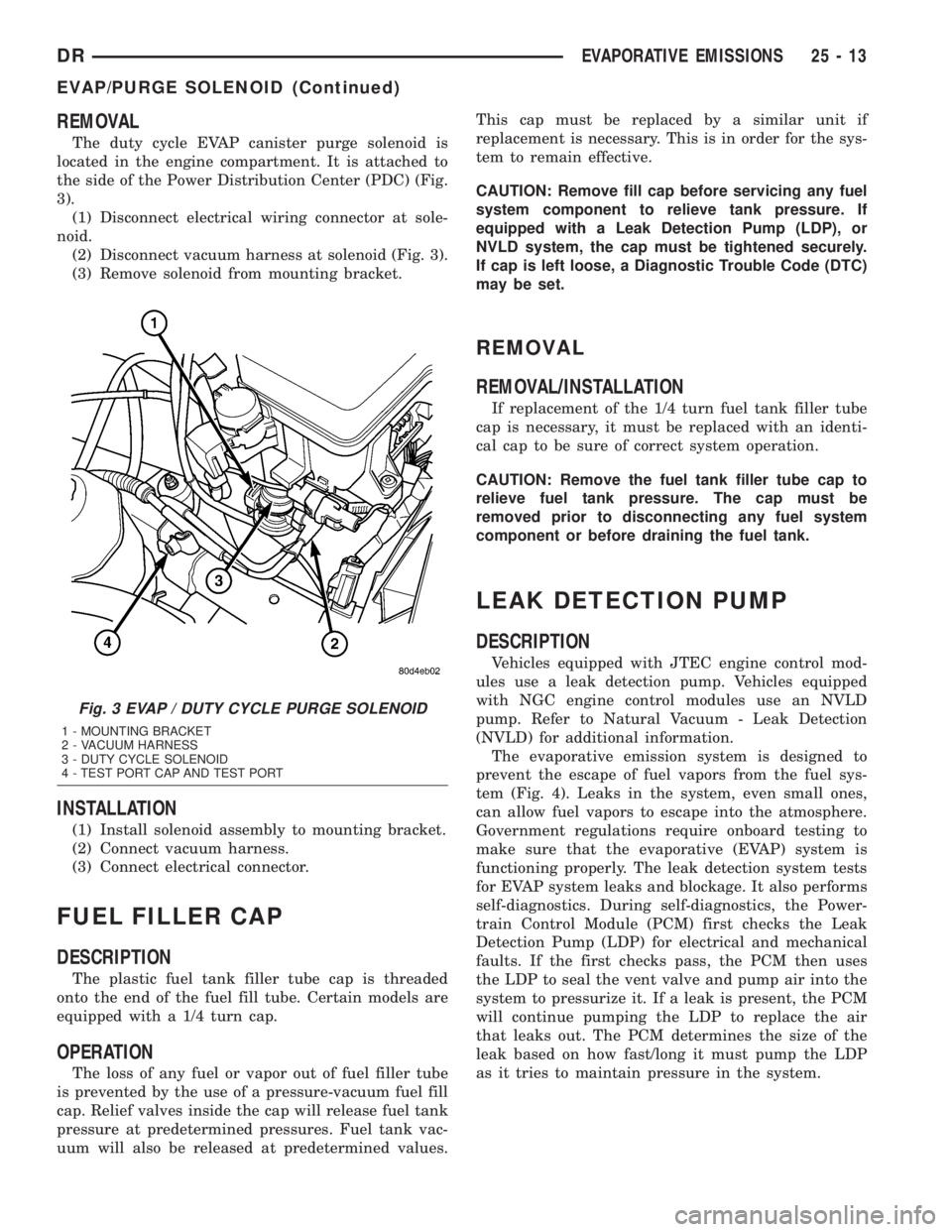
REMOVAL
The duty cycle EVAP canister purge solenoid is
located in the engine compartment. It is attached to
the side of the Power Distribution Center (PDC) (Fig.
3).
(1) Disconnect electrical wiring connector at sole-
noid.
(2) Disconnect vacuum harness at solenoid (Fig. 3).
(3) Remove solenoid from mounting bracket.
INSTALLATION
(1) Install solenoid assembly to mounting bracket.
(2) Connect vacuum harness.
(3) Connect electrical connector.
FUEL FILLER CAP
DESCRIPTION
The plastic fuel tank filler tube cap is threaded
onto the end of the fuel fill tube. Certain models are
equipped with a 1/4 turn cap.
OPERATION
The loss of any fuel or vapor out of fuel filler tube
is prevented by the use of a pressure-vacuum fuel fill
cap. Relief valves inside the cap will release fuel tank
pressure at predetermined pressures. Fuel tank vac-
uum will also be released at predetermined values.This cap must be replaced by a similar unit if
replacement is necessary. This is in order for the sys-
tem to remain effective.
CAUTION: Remove fill cap before servicing any fuel
system component to relieve tank pressure. If
equipped with a Leak Detection Pump (LDP), or
NVLD system, the cap must be tightened securely.
If cap is left loose, a Diagnostic Trouble Code (DTC)
may be set.
REMOVAL
REMOVAL/INSTALLATION
If replacement of the 1/4 turn fuel tank filler tube
cap is necessary, it must be replaced with an identi-
cal cap to be sure of correct system operation.
CAUTION: Remove the fuel tank filler tube cap to
relieve fuel tank pressure. The cap must be
removed prior to disconnecting any fuel system
component or before draining the fuel tank.
LEAK DETECTION PUMP
DESCRIPTION
Vehicles equipped with JTEC engine control mod-
ules use a leak detection pump. Vehicles equipped
with NGC engine control modules use an NVLD
pump. Refer to Natural Vacuum - Leak Detection
(NVLD) for additional information.
The evaporative emission system is designed to
prevent the escape of fuel vapors from the fuel sys-
tem (Fig. 4). Leaks in the system, even small ones,
can allow fuel vapors to escape into the atmosphere.
Government regulations require onboard testing to
make sure that the evaporative (EVAP) system is
functioning properly. The leak detection system tests
for EVAP system leaks and blockage. It also performs
self-diagnostics. During self-diagnostics, the Power-
train Control Module (PCM) first checks the Leak
Detection Pump (LDP) for electrical and mechanical
faults. If the first checks pass, the PCM then uses
the LDP to seal the vent valve and pump air into the
system to pressurize it. If a leak is present, the PCM
will continue pumping the LDP to replace the air
that leaks out. The PCM determines the size of the
leak based on how fast/long it must pump the LDP
as it tries to maintain pressure in the system.
Fig. 3 EVAP / DUTY CYCLE PURGE SOLENOID
1 - MOUNTING BRACKET
2 - VACUUM HARNESS
3 - DUTY CYCLE SOLENOID
4 - TEST PORT CAP AND TEST PORT
DREVAPORATIVE EMISSIONS 25 - 13
EVAP/PURGE SOLENOID (Continued)
Page 2843 of 2895
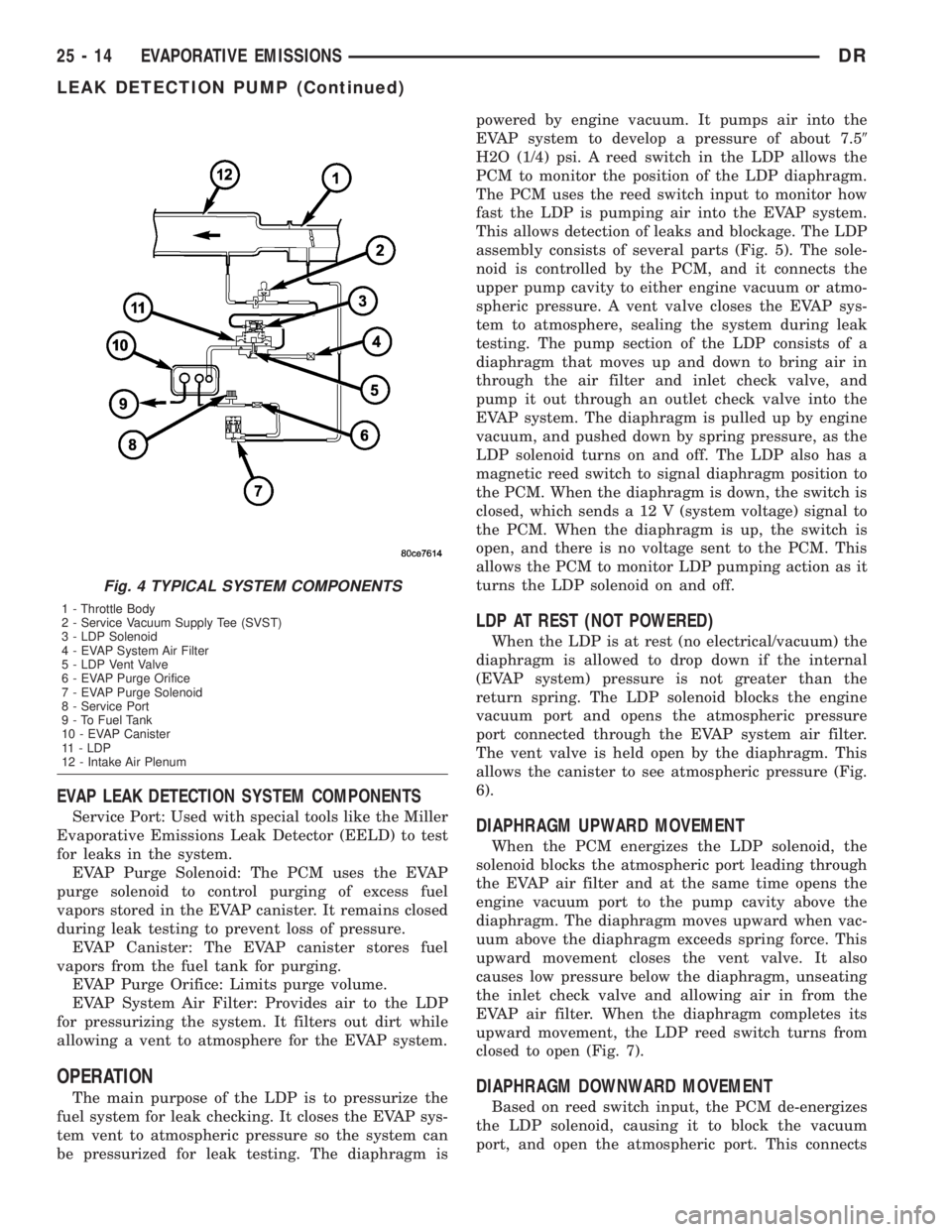
EVAP LEAK DETECTION SYSTEM COMPONENTS
Service Port: Used with special tools like the Miller
Evaporative Emissions Leak Detector (EELD) to test
for leaks in the system.
EVAP Purge Solenoid: The PCM uses the EVAP
purge solenoid to control purging of excess fuel
vapors stored in the EVAP canister. It remains closed
during leak testing to prevent loss of pressure.
EVAP Canister: The EVAP canister stores fuel
vapors from the fuel tank for purging.
EVAP Purge Orifice: Limits purge volume.
EVAP System Air Filter: Provides air to the LDP
for pressurizing the system. It filters out dirt while
allowing a vent to atmosphere for the EVAP system.
OPERATION
The main purpose of the LDP is to pressurize the
fuel system for leak checking. It closes the EVAP sys-
tem vent to atmospheric pressure so the system can
be pressurized for leak testing. The diaphragm ispowered by engine vacuum. It pumps air into the
EVAP system to develop a pressure of about 7.59
H2O (1/4) psi. A reed switch in the LDP allows the
PCM to monitor the position of the LDP diaphragm.
The PCM uses the reed switch input to monitor how
fast the LDP is pumping air into the EVAP system.
This allows detection of leaks and blockage. The LDP
assembly consists of several parts (Fig. 5). The sole-
noid is controlled by the PCM, and it connects the
upper pump cavity to either engine vacuum or atmo-
spheric pressure. A vent valve closes the EVAP sys-
tem to atmosphere, sealing the system during leak
testing. The pump section of the LDP consists of a
diaphragm that moves up and down to bring air in
through the air filter and inlet check valve, and
pump it out through an outlet check valve into the
EVAP system. The diaphragm is pulled up by engine
vacuum, and pushed down by spring pressure, as the
LDP solenoid turns on and off. The LDP also has a
magnetic reed switch to signal diaphragm position to
the PCM. When the diaphragm is down, the switch is
closed, which sends a 12 V (system voltage) signal to
the PCM. When the diaphragm is up, the switch is
open, and there is no voltage sent to the PCM. This
allows the PCM to monitor LDP pumping action as it
turns the LDP solenoid on and off.
LDP AT REST (NOT POWERED)
When the LDP is at rest (no electrical/vacuum) the
diaphragm is allowed to drop down if the internal
(EVAP system) pressure is not greater than the
return spring. The LDP solenoid blocks the engine
vacuum port and opens the atmospheric pressure
port connected through the EVAP system air filter.
The vent valve is held open by the diaphragm. This
allows the canister to see atmospheric pressure (Fig.
6).
DIAPHRAGM UPWARD MOVEMENT
When the PCM energizes the LDP solenoid, the
solenoid blocks the atmospheric port leading through
the EVAP air filter and at the same time opens the
engine vacuum port to the pump cavity above the
diaphragm. The diaphragm moves upward when vac-
uum above the diaphragm exceeds spring force. This
upward movement closes the vent valve. It also
causes low pressure below the diaphragm, unseating
the inlet check valve and allowing air in from the
EVAP air filter. When the diaphragm completes its
upward movement, the LDP reed switch turns from
closed to open (Fig. 7).
DIAPHRAGM DOWNWARD MOVEMENT
Based on reed switch input, the PCM de-energizes
the LDP solenoid, causing it to block the vacuum
port, and open the atmospheric port. This connects
Fig. 4 TYPICAL SYSTEM COMPONENTS
1 - Throttle Body
2 - Service Vacuum Supply Tee (SVST)
3 - LDP Solenoid
4 - EVAP System Air Filter
5 - LDP Vent Valve
6 - EVAP Purge Orifice
7 - EVAP Purge Solenoid
8 - Service Port
9 - To Fuel Tank
10 - EVAP Canister
11 - LDP
12 - Intake Air Plenum
25 - 14 EVAPORATIVE EMISSIONSDR
LEAK DETECTION PUMP (Continued)
Page 2858 of 2895
BACK LID - INSTALLATION, CENTER
SEAT ..............................23-80
BACK LID - REMOVAL, CENTER SEAT....23-80
BACK PANEL TRIM - INSTALLATION,
REAR CAB..........................23-70
BACK PANEL TRIM - REMOVAL, REAR
CAB ...............................23-70
BACK REAR - FOOTMANS LOOP
BRACKETS - INSTALLATION, SEAT.......23-85
BACK REAR - FOOTMANS LOOP
BRACKETS - REMOVAL, SEAT...........23-85
BACKLITE - INSTALLATION.............23-86
BACKLITE - REMOVAL.................23-86
BACKLITE VENT GLASS - INSTALLATION . . 23-87
BACKLITE VENT GLASS - REMOVAL......23-87
BACKUP LAMP - INSTALLATION..........8L-7
BACKUP LAMP - REMOVAL.............8L-7
BACKUP LAMP SWITCH - DESCRIPTION . . . 8L-7
BACKUP LAMP SWITCH - DIAGNOSIS
AND TESTING........................8L-8
BACKUP LAMP SWITCH - OPERATION.....8L-8
BALANCE - STANDARD PROCEDURE,
TIRE AND WHEEL.....................22-4
BALANCE SHAFT - INSTALLATION........9-79
BALANCE SHAFT - REMOVAL............9-79
BALL JOINT - DIAGNOSIS AND TESTING,
LOWER.............................2-18
BALL JOINT - DIAGNOSIS AND TESTING,
UPPER..............................2-26
BALL JOINT - INSTALLATION, LOWER . . 2-19,2-33
BALL JOINT - INSTALLATION, UPPER.....2-33
BALL JOINT - REMOVAL, LOWER.....2-18,2-32
BALL JOINT - REMOVAL, UPPER.........2-33
BAND OPERATION - DIAGNOSIS AND
TESTING, AIR TESTING
TRANSMISSION CLUTCH.......21-143,21-324
BANDS - ADJUSTMENT.........21-193,21-374
BANDS - DESCRIPTION.........21-193,21-373
BANDS - OPERATION..........21-193,21-374
BAR - DESCRIPTION, STABILIZER........2-24
BAR - DESCRIPTION, TORSION..........2-25
BAR - INSTALLATION, STABILIZER....2-24,2-37
BAR - INSTALLATION, TORSION..........2-26
BAR - INSTALLATION, TRACK...........19-37
BAR - OPERATION, STABILIZER..........2-24
BAR - OPERATION, TORSION............2-25
BAR - REMOVAL, STABILIZER.......2-24,2-37
BAR - REMOVAL, TORSION.............2-25
BAR - REMOVAL, TRACK..............19-37
BAR CROSS MEMBER BUSHING -
INSTALLATION, TORSION...............2-14
BAR CROSSMEMBER BUSHING -
REMOVAL, TORSION...................2-12
BASE BRAKE, SPECIFICATIONS............5-7
BASE BRAKE SYSTEM - DIAGNOSIS AND
TESTING.............................5-2
BASE BRAKES, SPECIAL TOOLS...........5-5
BASECOAT/CLEARCOAT FINISH -
DESCRIPTION.......................23-74
BATTERIES - STANDARD PROCEDURE,
RKE TRANSMITTER...................8N-9
BATTERY - DESCRIPTION...............8F-7
BATTERY - DIAGNOSIS AND TESTING.....8F-7
BATTERY CABLES - DESCRIPTION.......8F-14
BATTERY CABLES - DIAGNOSIS AND
TESTING...........................8F-15
BATTERY CABLES - INSTALLATION.......8F-17
BATTERY CABLES - OPERATION.........8F-14
BATTERY CABLES - REMOVAL..........8F-16
BATTERY CHARGING - STANDARD
PROCEDURE.........................8F-8
BATTERY HOLDDOWN - DESCRIPTION....8F-14
BATTERY HOLDDOWN - INSTALLATION . . . 8F-14
BATTERY HOLDDOWN - OPERATION.....8F-14
BATTERY HOLDDOWN - REMOVAL.......8F-14
BATTERY SYSTEM - CLEANING...........8F-4
BATTERY SYSTEM - DESCRIPTION........8F-1
BATTERY SYSTEM - DIAGNOSIS AND
TESTING............................8F-2
BATTERY SYSTEM - INSPECTION.........8F-6
BATTERY SYSTEM - OPERATION
.........8F-2
BATTERY SYSTEM - SPECIFICATIONS
......8F-6
BATTERY SYSTEM SPECIAL TOOLS,
SPECIAL TOOLS
......................8F-7
BATTERY TEMPERATURE SENSOR -
DESCRIPTION
.......................8F-21
BATTERY TEMPERATURE SENSOR -
INSTALLATION
.......................8F-21BATTERY TEMPERATURE SENSOR -
OPERATION.........................8F-21
BATTERY TEMPERATURE SENSOR -
REMOVAL..........................8F-21
BATTERY TESTER - STANDARD
PROCEDURE, USING MICRO 420........8F-12
BATTERY TRAY - DESCRIPTION.........8F-17
BATTERY TRAY - INSTALLATION.........8F-18
BATTERY TRAY - OPERATION...........8F-17
BATTERY TRAY - REMOVAL............8F-17
BEAM INDICATOR - DESCRIPTION, HIGH . . 8J-27
BEAM INDICATOR - OPERATION, HIGH....8J-28
BEARING - ADJUSTMENTS, CENTER.......3-8
BEARING - FITTING - STANDARD
PROCEDURE, CRANKSHAFT MAIN . . 9-133,9-202
BEARING - INSTALLATION, CENTER........3-8
BEARING - INSTALLATION, CLUTCH
RELEASE............................6-11
BEARING - INSTALLATION, HUB..........2-31
BEARING - INSTALLATION, OUTPUT
SHAFT FRONT................21-217,21-395
BEARING - INSTALLATION, OUTPUT
SHAFT REAR.................21-217,21-396
BEARING - INSTALLATION, PILOT........6-12
BEARING - REMOVAL, CENTER...........3-8
BEARING - REMOVAL, CLUTCH RELEASE . . . 6-11
BEARING - REMOVAL, HUB.............2-30
BEARING - REMOVAL, OUTPUT SHAFT
FRONT......................21-217,21-395
BEARING - REMOVAL, OUTPUT SHAFT
REAR.......................21-217,21-395
BEARING - REMOVAL, PILOT............6-12
BEARING AND CRANKSHAFT JOURNAL
CLEARANCE - STANDARD
PROCEDURE, CONNECTING ROD........9-321
BEARING CLEARANCE - STANDARD
PROCEDURE, MAIN...................9-322
BEARING FITTING - STANDARD
PROCEDURE, CONNECTING ROD . . . 9-128,9-251,
9-382
BEARING FITTING - STANDARD
PROCEDURE, CRANKSHAFT MAIN.......9-253
BEARING FITTING, STANDARD
PROCEDURE - CONNECTING ROD........9-48
BEARING FITTING, STANDARD
PROCEDURE - MAIN...................9-43
BEARINGS - DESCRIPTION,
CRANKSHAFT MAIN..................9-253
BEARINGS - INSPECTION, CRANKSHAFT
MAIN.........................9-133,9-203
BEARINGS - INSTALLATION, AXLE . . 3-112,3-139,
3-34,3-84
BEARINGS - INSTALLATION, CAMSHAFT . . 9-320,
9-381
BEARINGS - INSTALLATION,
CRANKSHAFT MAIN.............9-254,9-383
BEARINGS - INSTALLATION,
DIFFERENTIAL CASE . 3-121,3-148,3-39,3-65,3-94
BEARINGS - OPERATION, CRANKSHAFT
MAIN..............................9-253
BEARINGS - REMOVAL, AXLE . 3-112,3-138,3-33,
3-84
BEARINGS - REMOVAL, CAMSHAFT . 9-317,9-380
BEARINGS - REMOVAL, CRANKSHAFT
MAIN.........................9-254,9-383
BEARINGS - REMOVAL, DIFFERENTIAL
CASE.............3-121,3-148,3-39,3-64,3-93
BEARINGS - STANDARD PROCEDURE,
FITTING CRANKSHAFT MAIN...........9-383
BELT / CHAIN COVER(S) -
INSTALLATION, TIMING . 9-169,9-278,9-404,9-81
BELT / CHAIN COVER(S) - REMOVAL,
TIMING..............9-168,9-278,9-404,9-80
BELT - DIAGNOSIS AND TESTING,
ACCESSORY DRIVE............7-25,7-28,7-31
BELT - INSTALLATION, FRONT CENTER
SEAT ..............................8O-27
BELT - REMOVAL, FRONT CENTER SEAT . . 8O-26
BELT & RETRACTOR - INSTALLATION,
FRONT CENTER SEAT
.................8O-26
BELT & RETRACTOR - INSTALLATION,
REAR CENTER SEAT
..................8O-40
BELT & RETRACTOR - INSTALLATION,
REAR OUTBOARD SEAT
...............8O-42
BELT & RETRACTOR - REMOVAL, FRONT
CENTER SEAT
.......................8O-25
BELT & RETRACTOR - REMOVAL, REAR
CENTER SEAT
.......................8O-39BELT & RETRACTOR - REMOVAL, REAR
OUTBOARD SEAT....................8O-41
BELT BUCKLE - INSTALLATION, FRONT
OUTBOARD SEAT....................8O-34
BELT BUCKLE - REMOVAL, FRONT
OUTBOARD SEAT....................8O-33
BELT MOLDING - INSTALLATION, FRONT
DOOR INNER........................23-93
BELT MOLDING - INSTALLATION, FRONT
DOOR OUTER.......................23-93
BELT MOLDING - INSTALLATION, REAR
DOOR INNER........................23-94
BELT MOLDING - INSTALLATION, REAR
DOOR OUTER.......................23-94
BELT MOLDING - REMOVAL, FRONT
DOOR INNER........................23-93
BELT MOLDING - REMOVAL, FRONT
DOOR OUTER.......................23-93
BELT MOLDING - REMOVAL, REAR
DOOR INNER........................23-94
BELT MOLDING - REMOVAL, REAR
DOOR OUTER.......................23-94
BELT SWITCH - DESCRIPTION, SEAT.....8O-46
BELT SWITCH - DIAGNOSIS AND
TESTING, SEAT......................8O-47
BELT SWITCH - OPERATION, SEAT.......8O-46
BELT TENSION REDUCER -
DESCRIPTION, SEAT..................8O-48
BELT TENSION REDUCER - DIAGNOSIS
AND TESTING, SEAT..................8O-49
BELT TENSION REDUCER - OPERATION,
SEAT ..............................8O-49
BELT TENSIONER - DESCRIPTION, SEAT....8O-47
BELT TENSIONER - OPERATION, SEAT....8O-48
BELT TENSIONERS - 3.7L / 4.7L -
DESCRIPTION........................7-22
BELT TENSIONERS - 3.7L / 4.7L -
INSTALLATION........................7-23
BELT TENSIONERS - 3.7L / 4.7L -
OPERATION..........................7-22
BELT TENSIONERS - 3.7L / 4.7L -
REMOVAL...........................7-22
BELT TENSIONERS - 5.9L -
DESCRIPTION........................7-23
BELT TENSIONERS - 5.9L -
INSTALLATION........................7-24
BELT TENSIONERS - 5.9L - OPERATION....7-23
BELT TENSIONERS - 5.9L - REMOVAL.....7-23
BELT TENSIONERS - 5.9L DIESEL -
DESCRIPTION........................7-24
BELT TENSIONERS - 5.9L DIESEL -
INSTALLATION........................7-25
BELT TENSIONERS - 5.9L DIESEL -
OPERATION..........................7-24
BELT TENSIONERS - 5.9L DIESEL -
REMOVAL...........................7-25
BELT TURNING LOOP ADJUSTER -
INSTALLATION, SEAT.................8O-50
BELT TURNING LOOP ADJUSTER -
REMOVAL, SEAT.....................8O-50
BELT/CHAIN AND SPROCKETS -
INSPECTION, TIMING.............9-171,9-83
BELT/CHAIN AND SPROCKETS -
INSTALLATION, TIMING . 9-172,9-279,9-406,9-84
BELT/CHAIN AND SPROCKETS -
REMOVAL, TIMING.....9-169,9-279,9-405,9-81
BELTS - 3.7L / 4.7L - INSTALLATION,
DRIVE..............................7-27
BELTS - 3.7L / 4.7L - REMOVAL, DRIVE....7-27
BELTS - 5.9L - INSTALLATION, DRIVE.....7-31
BELTS - 5.9L - REMOVAL, DRIVE.........7-30
BELTS - 5.9L DIESEL - INSTALLATION,
DRIVE..............................7-34
BELTS - 5.9L DIESEL - REMOVAL, DRIVE . . 7-34
BEZEL - INSTALLATION, CLUSTER.......23-50
BEZEL - INSTALLATION, INSTRUMENT
PANEL CENTER......................23-58
BEZEL - INSTALLATION, INSTRUMENT
PANEL DRIVER SIDE..................23-59
BEZEL - INSTALLATION, INSTRUMENT
PANEL HEADLAMP SWITCH
............23-57
BEZEL - REMOVAL, CLUSTER
...........23-50
BEZEL - REMOVAL, INSTRUMENT PANEL
CENTER
............................23-58
BEZEL - REMOVAL, INSTRUMENT PANEL
DRIVER SIDE
........................23-58
BEZEL - REMOVAL, INSTRUMENT PANEL
HEADLAMP SWITCH
..................23-57
DRINDEX 3
Description Group-Page Description Group-Page Description Group-Page