maintenance DODGE RAM 2500 DIESEL 2008 3.G User Guide
[x] Cancel search | Manufacturer: DODGE, Model Year: 2008, Model line: RAM 2500 DIESEL, Model: DODGE RAM 2500 DIESEL 2008 3.GPages: 527, PDF Size: 8.88 MB
Page 268 of 527
mFuel Requirements......................348
NFuel Requirements (6.7L Diesel Engines).....348
mAdding Fuel (Diesel Engines)..............349
NFuel Filler Cap (Gas Cap)...............350
NBulk Fuel Storage.....................351
mVehicle Loading........................352
NCertification Label.....................352
mTrailer Towing.........................356
NCommon Towing Definitions.............356
NTrailer Hitch Classification...............360
NTrailer Towing Weights (Maximum Trailer
Weight Ratings)......................361NTrailer And Tongue Weight..............361
NTowing Requirements..................362
NTowing Tips.........................368
NTrailer Towing Mirrors Ð If Equipped......370
mSnowplow............................371
NBefore Plowing.......................372
NSnowplow Prep Package Model Availability . . 372
NOver The Road Operation With Snowplow
Attached...........................373
NMethods For Removing Snow............373
NOperating Tips.......................373
NGeneral Maintenance...................374
266 STARTING AND OPERATING
Page 272 of 527
CAUTION!
If WATER IN FUEL indicator light remains on DO
NOT START engine before you drain water from the
fuel filter to avoid engine damage. Refer to ªDrain-
ing Fuel/Water Separator Filter (6.7L Diesel Engine)º
under ªMaintenance Proceduresº in Section 7.
4. Turn the ignition key to START and crank the engine.
Do not press the accelerator during starting.
CAUTION!
Do not crank engine for more than 15 seconds at a
time as starter motor damage may result. Turn key to
OFF and wait at least two minutes before trying
again.5. When the engine starts, release the key.
6. Check to see that there is oil pressure.
7. Release the parking brake.
Starting Procedure ± Engine Manifold Air
Temperature Below 66ÉF (19ÉC)
NOTE:The temperature displayed on the overhead
console (if equipped) does not necessarily reflect the
engine manifold air temperature. When certain engine
temperatures fall below 66ÉF (19ÉC) the lights will remain
on indicating the intake manifold heater system is active.
270 STARTING AND OPERATING
Page 338 of 527
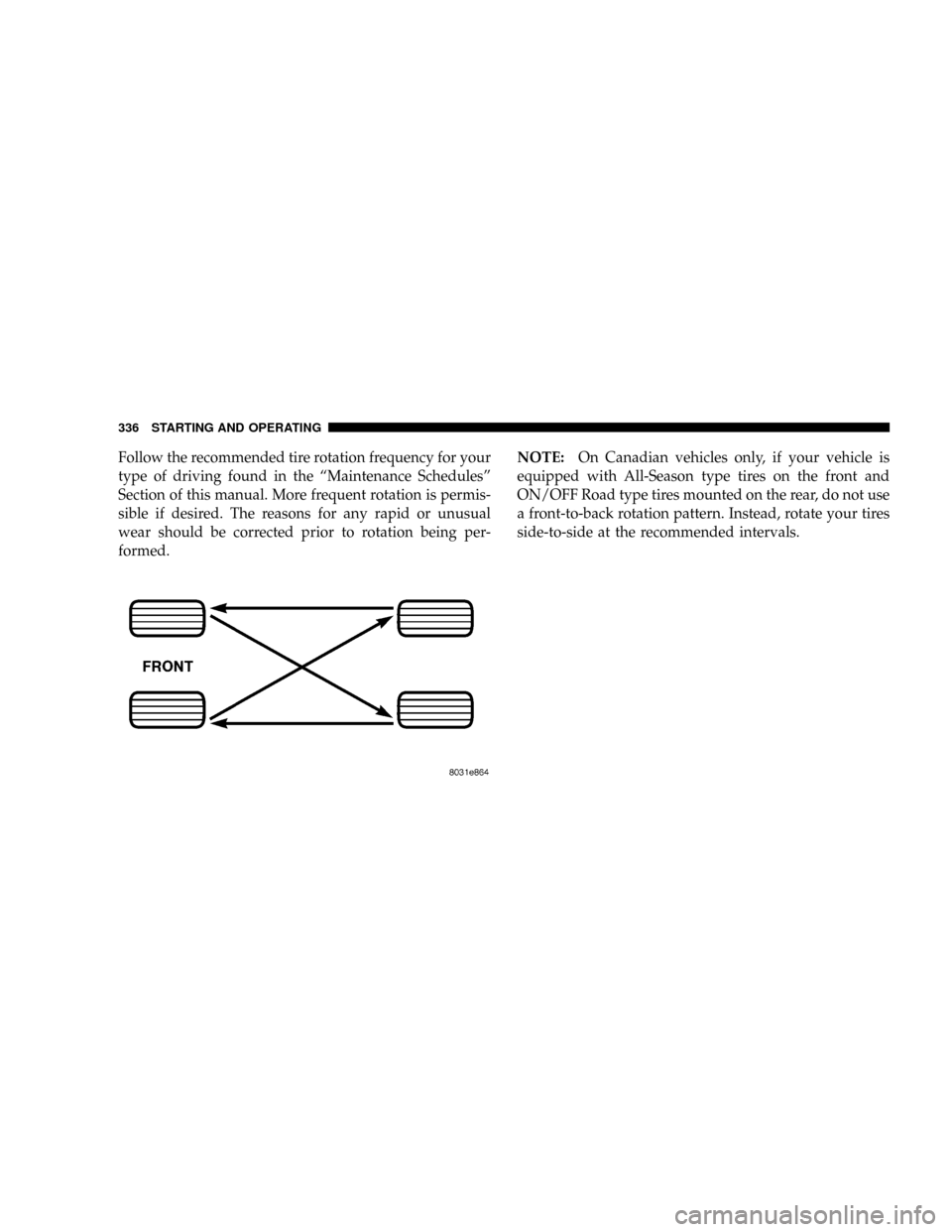
Follow the recommended tire rotation frequency for your
type of driving found in the ªMaintenance Schedulesº
Section of this manual. More frequent rotation is permis-
sible if desired. The reasons for any rapid or unusual
wear should be corrected prior to rotation being per-
formed.NOTE:On Canadian vehicles only, if your vehicle is
equipped with All-Season type tires on the front and
ON/OFF Road type tires mounted on the rear, do not use
a front-to-back rotation pattern. Instead, rotate your tires
side-to-side at the recommended intervals.
336 STARTING AND OPERATING
Page 342 of 527
CAUTION!
After inspecting or adjusting the tire pressure always
reinstall the valve stem cap. This will prevent mois-
ture and dirt from entering the valve stem, which
could damage the Tire Pressure Monitoring Sensor.
NOTE:
²The TPMS is not intended to replace normal tire care
and maintenance, nor to provide warning of a tire
failure or condition.
²The TPMS should not be used as a tire pressure gauge
while adjusting your tire pressure.
²Driving on a significantly under-inflated tire causes
the tire to overheat and can lead to tire failure.
Under-inflation also reduces fuel efficiency and tire
tread life, and may affect the vehicle's handling and
stopping ability.
²The TPMS is not a substitute for proper tire mainte-
nance, and it is the driver 's responsibility to maintain
correct tire pressure, even if under-inflation has not
reached the level to trigger illumination of the ªTire
Pressure Monitoring Telltale Light.º
²Seasonal temperature changes will affect tire pressure,
and the TPM system will monitor the actual tire
pressure in the tire.
340 STARTING AND OPERATING
Page 353 of 527
Avoid Using Contaminated Fuel
Fuel that is contaminated by water or dirt can cause
severe damage to the engine fuel system. Proper main-
tenance of the engine fuel filter and fuel tank is essential.
(See Section 7 for Maintenance Procedures).
NOTE:Climatized diesel fuel is a blend of Number 2
and Number 1 Diesel fuel which reduces the temperature
at which wax crystals form in the fuel.
Bulk Fuel Storage
If you store quantities of fuel, good maintenance of the
stored fuel is also essential. Fuel contaminated with
water will promote the growth of ªmicrobes.º These
microbes form ªslimeº that will clog fuel filters and lines.
Drain condensation from the supply tank and change the
line filter on a regular basis.
NOTE:When a diesel engine is allowed to run out of
fuel, air is pulled into the fuel system.You may try priming as described below. However, if the
engine will not start, refer to the fuel priming procedure
in the Service Manual or have the vehicle towed to an
authorized Dodge dealer.
WARNING!
Do not open the high pressure fuel system with the
engine running. Engine operation causes high fuel
pressure. High pressure fuel spray can cause serious
injury or death.
Priming if the engine has run out of fuel
1. Add a substantial quantity of fuel to the tank 5 to 10
gallons (19 to 38L).
STARTING AND OPERATING 351
5
Page 364 of 527
²The weight of any other type of cargo or equipment
put in or on your vehicle.
²The weight of the driver and all passengers.
NOTE:Remember that everything put into or on the
trailer adds to the load on your vehicle. Also, additional
factory-installed options, or dealer-installed options,
must be considered as part of the total load on your
vehicle. Refer to the Tire and Loading Information plac-
ard in the Tire Safety Information Section of this manual.
Towing Requirements
To promote proper break-in of your new vehicle driv-
etrain components the following guidelines are recom-
mended:
CAUTION!
²Avoid towing a trailer for the first 500 miles (805
km) of vehicle operation. Doing so may damage
your vehicle.
²During the first 500 miles (805 km) of trailer
towing, limit your speed to 50 mph (80 km/h).
WARNING!
Your vehicle may require special axle lubricant.
Please refer to the fluids section of this manual.
Perform the maintenance listed in Section 8 of this
manual. When towing a trailer, never exceed the GAWR,
or GCWR, ratings.
362 STARTING AND OPERATING
Page 371 of 527
The automatic transmission fluid and filter should be
changed if you REGULARLY tow a trailer for more than
45 minutes of continuous operation. See Maintenance
Schedule in section 8 of this manual for transmission
fluid change intervals.
NOTE:Check the automatic transmission fluid level
before towing.
Towing Tips Ð Tow/Haul (If Equipped)
To reduce potential for automatic transmission overheat-
ing, turn the ªTOW HAULº feature ON when driving in
hilly areas or downshift the transmission (using the
Auto-6 [ERS] switch).
Towing Tips Ð Electronic Speed Control (If
Equipped)
þ
Don't use in hilly terrain or with heavy loads.
þWhen using the speed control, if you experience speed
drops greater than 10 mph (16 km/h), disengage until
you can get back to cruising speed.
þUse speed control in flat terrain and with light loads to
maximize fuel efficiency.
Towing Tips Ð Cooling System
To reduce potential for engine and transmission over-
heating, take the following actions:
þCity Driving
When stopped for short periods of time, put transmission
in neutral and increase engine idle speed.
þHighway Driving
Reduce speed.
þAir Conditioning
Turn off temporarily.
STARTING AND OPERATING 369
5
Page 372 of 527
þrefer to Cooling System Operating information in the
Maintenance section of this manual for more informa-
tion.
Trailer Towing Mirrors Ð If Equipped
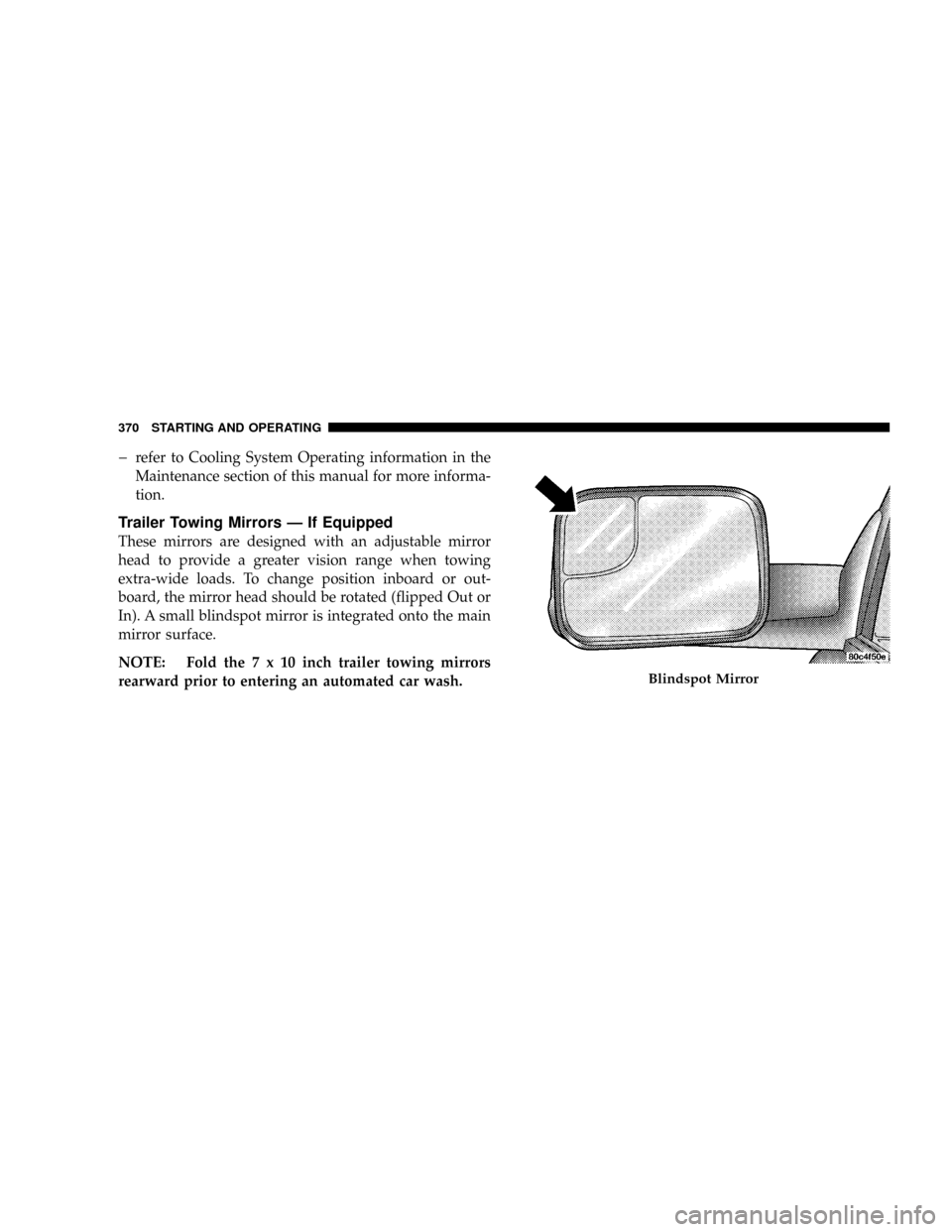
These mirrors are designed with an adjustable mirror
head to provide a greater vision range when towing
extra-wide loads. To change position inboard or out-
board, the mirror head should be rotated (flipped Out or
In). A small blindspot mirror is integrated onto the main
mirror surface.
NOTE: Fold the7x10inch trailer towing mirrors
rearward prior to entering an automated car wash.
Blindspot Mirror
370 STARTING AND OPERATING
Page 376 of 527
NOTE:During snowplow usage on vehicles equipped
with an overhead console module, the outside tempera-
ture display will show higher temperatures than the
outside ambient temperature. The higher displayed tem-
perature is due to blocked or reduced airflow to the
underhood ambient temperature sensor by the snow-
plow. This is common and outside temperature display
operation will return to normal when the snowplow is
removed.
General Maintenance
Snowplows should be maintained in accordance with the
plow manufacturer's instructions.
Keep all snowplow electrical connections and battery
terminals clean and free of corrosion.When plowing snow, to avoid transmission and driv-
etrain damage, the following precautions should be ob-
served.
²Operate with transfer case in 4L when plowing small
or congested areas where speeds are not likely to
exceed 15 mph (24 km/h). At higher speeds operate in
4H.
²Vehicles with 68RFE transmissions should use 4L
range when plowing deep or heavy snow for extended
periods of time to avoid transmission overheating.
²Do not shift the transmission unless the engine has
returned to idle and wheels have stopped. Make a
practice of stepping on the brake pedal before shifting
the transmission.
374 STARTING AND OPERATING
Page 407 of 527
MAINTAINING YOUR VEHICLE
CONTENTS
mEngine Compartment Ð 6.7L Diesel Engine....408
mOnboard Diagnostic System (OBD II).........409
mReplacement Parts......................409
mEngine Data Plate......................410
mAuthorized Dealer Service................410
mService Information.....................410
mMaintenance Procedures..................412
NEngine Oil..........................413
NDrive Belt...........................418NEngine Air Cleaner Filter (6.7L Diesel
Engines)............................419
NDraining Fuel/Water Separator Filter (6.7L
Diesel Engine).......................422
NIntervention Regeneration Strategy ± EVIC
Message Process Flow (Catalyst Full Message)
(6.7L Diesel Engines Only)...............425
NMaintenance Free Batteries...............428
NAir Conditioner Maintenance.............430
NPower Steering Ð Fluid Check............431
7