warning DODGE RAM 2500 DIESEL 2009 4.G Owners Manual
[x] Cancel search | Manufacturer: DODGE, Model Year: 2009, Model line: RAM 2500 DIESEL, Model: DODGE RAM 2500 DIESEL 2009 4.GPages: 532, PDF Size: 9.37 MB
Page 315 of 532
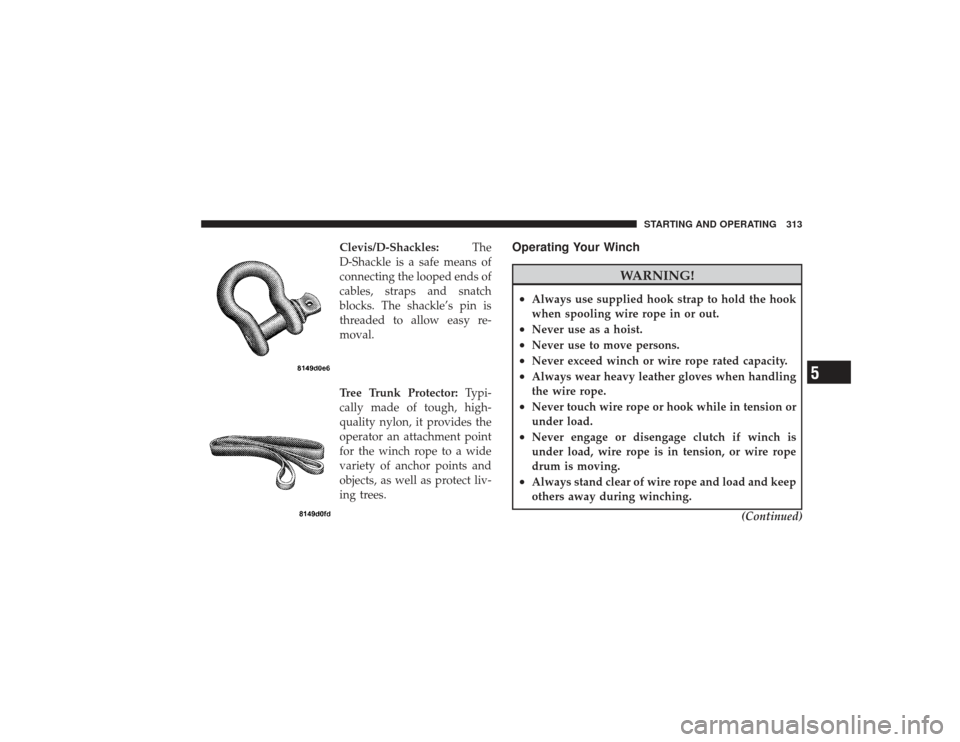
Clevis/D-Shackles:The
D-Shackle is a safe means of
connecting the looped ends of
cables, straps and snatch
blocks. The shackle’s pin is
threaded to allow easy re-
moval.
Tree Trunk Protector: Typi-
cally made of tough, high-
quality nylon, it provides the
operator an attachment point
for the winch rope to a wide
variety of anchor points and
objects, as well as protect liv-
ing trees.
Operating Your Winch
WARNING!
•
Always use supplied hook strap to hold the hook
when spooling wire rope in or out.
•
Never use as a hoist.
•
Never use to move persons.
•
Never exceed winch or wire rope rated capacity.
•
Always wear heavy leather gloves when handling
the wire rope.
•
Never touch wire rope or hook while in tension or
under load.
•
Never engage or disengage clutch if winch is
under load, wire rope is in tension, or wire rope
drum is moving.
•
Always stand clear of wire rope and load and keep
others away during winching.
(Continued)
STARTING AND OPERATING 313
5
Page 316 of 532
WARNING! (Continued)
•
Always keep hands and clothing clear of the wire
rope, hook and fairlead opening during operation
and when spooling.
•
Never wrap wire rope back onto itself. Always use
a choker chain, wire choker rope or tree trunk
protector on the anchor.
•
Never attach a recovery strap to the winch hook to
increase the length of a pull.
•
Never attempt to tow a vehicle with the recovery
strap attached directly to the winch hook.
•
Never use\bbungee\bstraps that develop tremen-
dous and potentially dangerous amounts of force
when stretched.
•
Always disconnect the remote control when not in
use.
(Continued)
WARNING! (Continued)
•
Never winch when there are less than five wraps
of wire rope around the winch drum.
•
Always pass remote control through a window to
avoid pinching lead in door, then using remote
inside a vehicle.
•
Never leave the remote control plugged into the
winch while free spooling, rigging or sitting idle.
Failure to observe any of these warnings regarding
proper winch usage may result in severe injury.
314 STARTING AND OPERATING
Page 326 of 532
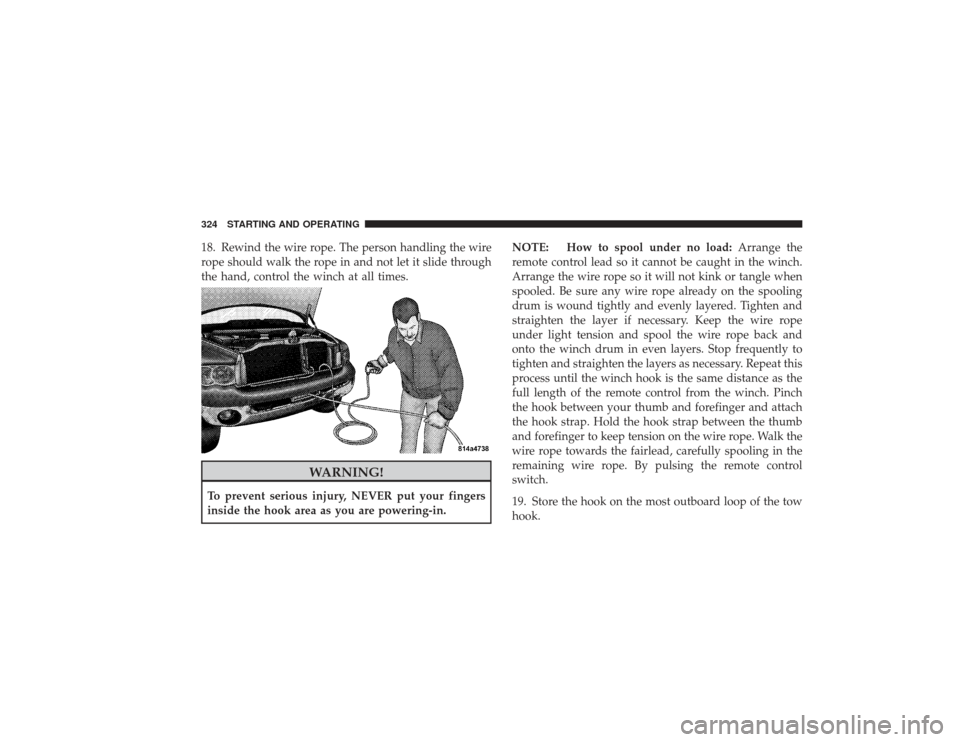
18. Rewind the wire rope. The person handling the wire
rope should walk the rope in and not let it slide through
the hand, control the winch at all times.
WARNING!
To prevent serious injury, NEVER put your fingers
inside the hook area as you are powering-in.NOTE: How to spool under no load:
Arrange the
remote control lead so it cannot be caught in the winch.
Arrange the wire rope so it will not kink or tangle when
spooled. Be sure any wire rope already on the spooling
drum is wound tightly and evenly layered. Tighten and
straighten the layer if necessary. Keep the wire rope
under light tension and spool the wire rope back and
onto the winch drum in even layers. Stop frequently to
tighten and straighten the layers as necessary. Repeat this
process until the winch hook is the same distance as the
full length of the remote control from the winch. Pinch
the hook between your thumb and forefinger and attach
the hook strap. Hold the hook strap between the thumb
and forefinger to keep tension on the wire rope. Walk the
wire rope towards the fairlead, carefully spooling in the
remaining wire rope. By pulsing the remote control
switch.
19. Store the hook on the most outboard loop of the tow
hook.324 STARTING AND OPERATING
Page 330 of 532
NOTE:Increased noise levels at the end of the steering
wheel travel are considered normal and do not indicate
that there is a problem with the power steering system.
Upon initial start-up in cold weather, the power steering
pump may make noise for a short amount of time. This is
due to the cold, thick fluid in the steering system. This
noise should be considered normal, and it does not in any
way damage the steering system.
WARNING!
Continued operation with reduced power steering
assist could pose a safety risk to yourself and others.
Service should be obtained as soon as possible.
CAUTION!
Prolonged operation of the steering system at the end
of the steering wheel travel will increase the steering
fluid temperature and it should be avoided when
possible. Damage to the power steering pump may
occur.Power Steering Fluid CheckChecking the power steering fluid level at a defined
service interval is not required. The fluid should only be
checked if a leak is suspected, abnormal noises are
apparent, and/or the system is not functioning as antici-
pated. Coordinate inspection efforts through an autho-
rized dealer.
No chemical flushes should be used in any power
steering system; only the approved lubricant may be
used.
328 STARTING AND OPERATING
Page 331 of 532
WARNING!
Fluid level should be checked on a level surface and
with the engine off to prevent injury from moving
parts and to ensure accurate fluid level reading. Do
not overfill. Use only manufacturer’s recommended
power steering fluid.
If necessary, add fluid to restore to the proper indicated
level. With a clean cloth, wipe any spilled fluid from all
surfaces. Refer to “Fluids, Lubricants, and Genuine
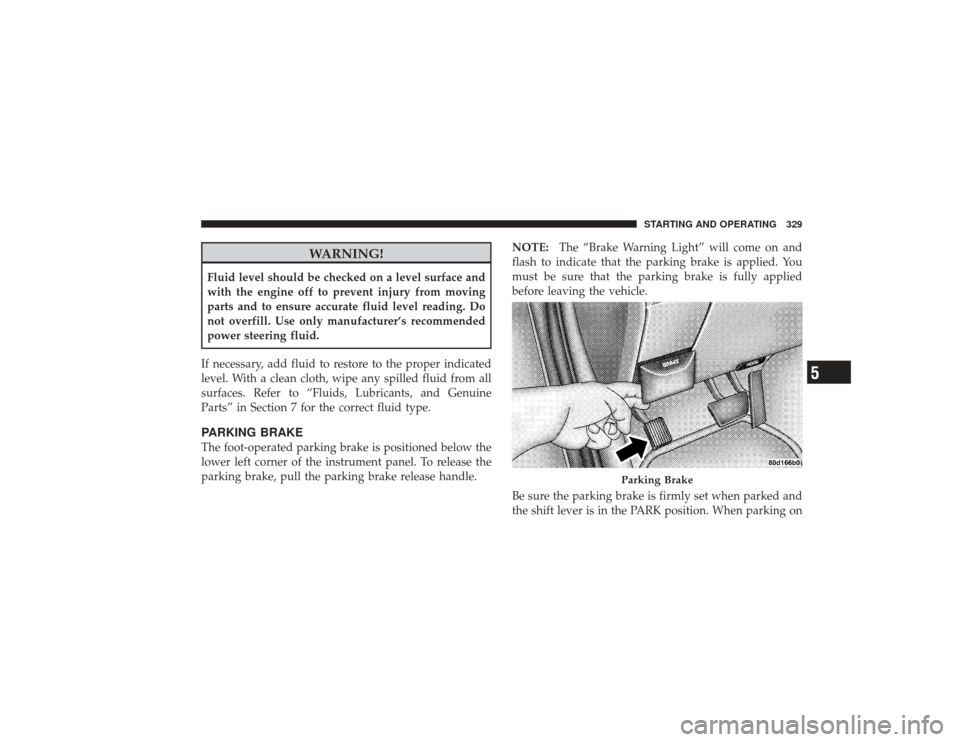
Parts” in Section 7 for the correct fluid type.PARKING BRAKEThe foot-operated parking brake is positioned below the
lower left corner of the instrument panel. To release the
parking brake, pull the parking brake release handle. NOTE:
The “Brake Warning Light” will come on and
flash to indicate that the parking brake is applied. You
must be sure that the parking brake is fully applied
before leaving the vehicle.
Be sure the parking brake is firmly set when parked and
the shift lever is in the PARK position. When parking on
Parking Brake
STARTING AND OPERATING 329
5
Page 332 of 532
a hill, you should apply the parking brake before placing
the shift lever in PARK, otherwise, the load on the
transmission locking mechanism may make it difficult to
move the shift lever out of PARK.
WARNING!
•
Always fully apply the parking brake when leav-
ing your vehicle, or it may roll and cause damage
or injury. Also be certain to leave the transmission
in PARK. Failure to do so may allow the vehicle to
roll and cause damage or injury.
•
Never leave children alone in a vehicle. Leaving
unattended children in a vehicle is dangerous for a
number of reasons. A child or others could be
seriously or fatally injured. Do not leave the key in
the ignition. A child could operate power win-
dows, other controls, or move the vehicle.(Continued)
WARNING! (Continued)
•
Be sure the parking brake is fully disengaged
before driving, failure to do so can lead to brake
problems due to excessive heating of the rear
brakes.
When parking on a hill, turn the front wheels toward the
curb on a downhill grade and away from the curb on an
uphill grade.
The parking brake should always be applied whenever
the driver is not in the vehicle.
BRAKE SYSTEMIf power assist is lost for any reason (for example,
repeated brake applications with the engine off), the
brakes will still function. However, you will experience a
substantial increase in braking effort to stop the vehicle.
330 STARTING AND OPERATING
Page 333 of 532
If either the front or rear hydraulic system loses normal
braking capability, the remaining system will still func-
tion with some loss of overall braking effectiveness. This
will be evident by increased pedal travel during applica-
tion, greater pedal force required to slow or stop, and
activation of the “Brake Warning Light” and the “ABS
Warning Light” (If Equipped) during brake use.3500 Dual Rear Wheel Models OnlyThe brake system power assist is provided by a hydro-
boost unit which shares fluid with the power steering
system. You may experience some clicking or hissing
noises from the hydro-boost system during hard braking
conditions.
NOTE:Under cold temperatures, pedal effort will be
higher than normal until the power steering fluid reaches
operating temperature.
Four-Wheel Anti-Lock Brake System
WARNING!
The Four-Wheel Anti-Lock Brake System contains
sophisticated electronic equipment. It may be sus-
ceptible to interference caused by improperly in-
stalled or high output radio transmitting equipment.
This interference can cause possible loss of anti-lock
braking capability. Installation of such equipment
should be performed by qualified professionals.
The Four-Wheel Anti-lock Brake System (ABS) is de-
signed to aid the driver in maintaining vehicle control
under adverse braking conditions. The system operates
with a separate computer to modulate hydraulic pressure
to prevent wheel lockup and help avoid skidding on
slippery surfaces.
STARTING AND OPERATING 331
5
Page 334 of 532
The system’s pump motor runs during an ABS stop to
provide regulated hydraulic pressure. The pump motor
makes a low humming noise during operation. This is
normal.
The ABS conducts a low-speed selftest at about 10 mph
(16 km/h). If you have your foot lightly on the brake
while this test is occurring, you may feel slight pedal
movement. The movement can be more apparent on ice
and snow. This is normal.
The ABS pump motor runs during the self-test at 10 mph
(16 km/h) and during an ABS stop. The pump motor
makes a low humming noise during operation. This is
normal.
When you are in a severe braking condition involving
use of the ABS, you will experience some pedal drop as
the vehicle comes to a complete stop. This is the result of
the system reverting to the base brake system and is
normal.Engagement of the ABS may be accompanied by a
pulsing sensation. You may also hear a clicking noise.
These occurrences are normal, and indicate that the
system is functioning.
ABS Warning LightThe ABS includes an amber warning light. When the light
is illuminated, the ABS is not functioning. The system
reverts to standard, non-anti-lock brakes.
WARNING!
•
Pumping of the anti-lock brakes will diminish
their effectiveness and may lead to an accident.
Pumping makes the stopping distance longer. Just
press firmly on your brake pedal when you need
to slow down or stop.
(Continued)
332 STARTING AND OPERATING
Page 335 of 532
WARNING! (Continued)
•
The Anti-Lock Brake System (ABS) cannot prevent
the natural laws of physics from acting on the
vehicle, nor can it increase braking or steering
efficiency beyond that afforded by the condition
of the vehicle brakes and tires or the traction
afforded.
•
The ABS cannot prevent accidents, including
those resulting from excessive speed in turns,
following another vehicle too closely, or hydro-
planing. Only a safe, attentive, and skillful driver
can prevent accidents.
•
The capabilities of an ABS-equipped vehicle must
never be exploited in a reckless or dangerous
manner which could jeopardize the user’s safety
or the safety of others.
ELECTRONIC BRAKE CONTROL SYSTEM — IF
EQUIPPEDYour vehicle is equipped with an advanced electronic
brake control system that includes Anti-Lock Brake Sys-
tem (ABS), Traction Control System (TCS), Brake Assist
System (BAS), HSA (Hill Start Assist), Electronic Roll
Mitigation (ERM), Electronic Stability Program (ESP) and
Trailer Sway Control (TSC). All six systems work to-
gether to enhance vehicle stability and control in various
driving conditions, and are commonly referred to as ESP.Anti-Lock Brake System (ABS)The ABS aids the driver in maintaining vehicle control
under adverse braking conditions. The system controls
hydraulic brake pressure to prevent wheel lockup and
help avoid skidding on slippery surfaces during braking.
For more information about ABS, refer to “Anti-Lock
Brake System” under “Brake System” in Section 5 of this
manual.
STARTING AND OPERATING 333
5
Page 336 of 532
NOTE:ABS improves steering control of the vehicle
during hard braking maneuvers.
WARNING!
•
ABS cannot prevent the natural laws of physics
from acting on the vehicle, nor can it increase
braking or steering efficiency beyond that af-
forded by the condition of the vehicle brakes and
tires or the traction afforded.
•
The ABS cannot prevent accidents, including
those resulting from excessive speed in turns,
following another vehicle too closely, or hydro-
planing. Only a safe, attentive, and skillful driver
can prevent accidents.
•
The capabilities of an ABS-equipped vehicle must
never be exploited in a reckless or dangerous
manner which could jeopardize the user’s safety
or the safety of others.
Traction Control System (TCS)The TCS monitors the amount of wheel spin of each of
the driven wheels. If wheel spin is detected, brake
pressure is applied to the slipping wheel(s), and engine
power is reduced to provide enhanced acceleration and
stability. A feature of the TCS functions similar to a
limited-slip differential and controls the wheel spin
across a driven axle. If one wheel on a driven axle is
spinning faster than the other, the system will apply the
brake of the spinning wheel. This will allow more engine
torque to be applied to the wheel that is not spinning.
This feature remains active even if TCS and ESP are in the
“Partial Off” mode. Refer to “Electronic Stability Pro-
gram (ESP)” in this section of this manual. This brake
pressure modulation transfers drive torque from slipping
to non-slipping wheels to provide optimal forward
traction.
334 STARTING AND OPERATING